- 01Open-source your core component as free top-of-funnel
- 02Borrow one credible third-party quote instead of writing case studies
- 03Bid on "competitor alternative" search terms instead of chasing their organic rankings
- 04Seed the tutorial-creator communities already teaching adjacent skills
01 Snapshot
The one-glance read on who they are and how they grow. Each point is verifiable from the receipts above.
Zep AI sells agent-memory and context infrastructure, built on its open-source Graphiti knowledge-graph library, to developers and enterprises building AI agents, launched via Y Combinator Winter 2024.
Open-source-led with a heavy enterprise paid overlay, not creator- or affiliate-driven.
~115,633 monthly visits (-16.1% over the last 3 months) as of 2026-08-01; Graphiti hit 20,000 GitHub stars by November 2025, within about a year of open-sourcing; 33 total active paid ads (9 of 10 Google, 23 of 23 LinkedIn) as of 2026-08-01.
LinkedIn is running 8 fresh ad variants as of 2026-08-01 that all recycle the same S&P Global "de facto partner" analyst quote in new layouts, still aimed at enterprise buyers rather than developers.
Zep's engine is two-sided: Graphiti's open-source virality earns developer trust for free, while the sustained paid layer above does the harder job of converting enterprise buyers using one borrowed S&P Global analyst quote as the core credibility artifact instead of in-house case studies.
02 How it unfolded
The order the channels came online. Sequence is strategy: what they did first, and what they layered on once demand existed.
03 Traffic & channel mix
Estimated demand, the channel split behind it, and the keywords and referrers doing the work. Directional modeling, not audited analytics.
Zep draws an estimated 115,633 monthly visits, down 16.1% over the last 3 months. The evidence doesn't break out a channel-by-channel percentage split, but the ranking keyword set stands in for one: the top four ranked terms, zep (#1), graphiti (#2), zep net (#3), and zep app (#4), are all the company's own name or its open-source library's name, not a generic category term like "agent memory." That branded-keyword dominance says discovery is happening off-site first, on GitHub and Hacker News, before someone types the name into a search bar. A fifth ranked term, langgraph logo (#32), is a stray image-search ranking with no real signal.
04 Organic content
The specific pages earning their organic search traffic, and the pattern behind why they rank. Adapt the format, not the topic.
The organic-search footprint concentrates almost entirely on the root homepage, with the product app subdomain, the Graphiti platform page, and the docs welcome page earning only trace independent pull despite being real, indexed pages. For a company with a short, distinctive brand name and a viral open-source library, that pattern reads as navigational search: people who already know "Zep" from GitHub, Hacker News, or a colleague search for it by name and land on the homepage, rather than discovering it through a comparison guide or how-to post. No content page in the data is doing category-level SEO work on its own.
Top pages by organic traffic
05 Channel map
Not traffic share. How much weight the growth system actually puts on each channel, with a one-line read on the role it plays.
What drove growth
06 Who they’re hiring
Open roles read like a roadmap: the functions they’re staffing show where the company is investing next and what stage it’s at.
2 open roles
07 The motions doing the work
For founder-led SaaS the breakdown shifts from ads to traction: where the first users came from, how the founder grows it in the open, and the compounding organic surface.
Zep's early traction came from years of repeated, modest Hacker News visibility rather than one breakout moment, with the real inflection landing when the team open-sourced Graphiti.
Zep launched publicly through Y Combinator's Winter 2024 batch positioned as "long-term memory for AI assistants," building on years of low-traction technical blog shares to Hacker News going back to June 2023 that rarely earned more than a couple of points.
The September 2024 "Show HN: Zep, Open-Source Graph Memory for AI Apps" post (6 points), where the team introduced themselves as "Daniel, Paul, Travis, and Preston from Zep," coincided with open-sourcing Graphiti, the moment the growth engine shifted from product launches to a library that now anchors the company's GitHub-driven distribution.
Dig deeper+2▾
The team returned to Hacker News with new angles at least ten times through 2026, including Daniel personally posting "Show HN: Cursor IDE now remembers your coding prefs using MCP" in March 2025 ("Hi, I'm Daniel from Zep"), none of which cracked the front page, persistence over any single breakout is the visible pattern here.
Graphiti also launched on Product Hunt in February 2025, though no upvote or comment data is available in this evidence set.
Zep's build-in-public motion runs almost entirely through founder Daniel Chalef, CEO and co-founder alongside Paul Paliychuk and Preston Rasmussen, rather than the brand account.
Daniel Chalef posts from a bio-verified personal X account (@danielchalef, 2,473 followers, 1,347 posts) that explicitly ties back to @zep_ai and getzep.com, a small but high-frequency audience rather than a large one.
Rather than routing every announcement through a company account, Daniel personally authored at least one Show HN post in the founder's own voice ("Hi, I'm Daniel from Zep"), pairing build-in-public credibility with a concrete integration demo (Cursor IDE memory via MCP).
Dig deeper+1▾
Chalef previously founded KnowledgeTree and was a later-stage operator at SparkPost (acquired by MessageBird), background that likely helps a small, technical audience trust his hands-on framing of Zep's architecture decisions. No founder Reddit or LinkedIn post activity appears in the evidence, so the build-in-public motion here is narrower and X-and-HN-centric rather than spread across a wider personal-audience map.
Organic search is a minor, homepage-only channel for Zep, real distribution compounds elsewhere.
The homepage-only organic split above means there is effectively no comparison-page or blog-driven SEO engine at work, a reader trying to copy a content-marketing motion would find little to adapt here.
Graphiti, not the marketing site, accumulates distribution over time, climbing from 14,000 to 20,000 GitHub stars within about a year of its 2024 open-source launch while picking up integrations (Cursor IDE, LiveKit, an MCP Server 1.0 release) that each seed new discovery.
Dig deeper+2▾
Zep runs four dedicated Google ad pages, "Mem0 Alternative," "Cognee Alternative," "Letta Alternative," and "Supermemory Alternative," bidding on competitor brand terms with paid placements rather than trying to out-rank those competitors organically; a fifth theme leans on benchmark claims like "94.7% on LoCoMo" and "sub-200ms retrieval." One caveat: those benchmark claims have drawn public pushback, a GitHub-filed correction and Hacker News discussion challenged how Zep calculated a headline LoCoMo score, a reminder that ad-stated benchmarks are marketing claims, not independently confirmed results.
No partner, affiliate, or referral program appears anywhere in the evidence, consistent with a usage-based enterprise sale rather than a consumer-style referral loop.
08 Paid ads
This founder-led SaaS also runs paid acquisition. Here are the live ads doing the work, each with the X-ray and a play you can adapt.
- Running
- 36 days (longevity = it's converting)
- Hook
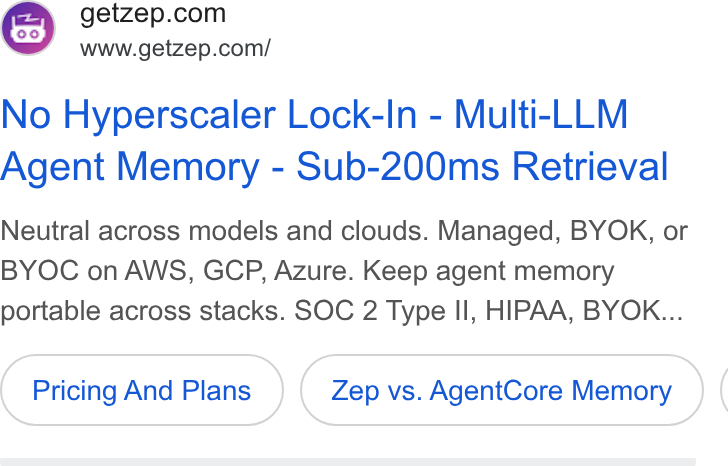
- getzep.com www.getzep.com/ No Hyperscaler Lock-In - Multi-LLM Agent Memory - Sub-200ms Retrieval. The visual shows a search result snippet with a purple icon, website URL, and a blue headline.
- CTA / offer
- Pricing And Plans
- Audience
- Developers, IT professionals, and businesses using or planning to use Large Language Models (LLMs) and cloud services, indicated by terms like 'Hyperscaler Lock-In', 'Multi-LLM', 'Agent Memory', 'AWS, GCP, Azure', 'SOC 2 Type II, HIPAA'.
Why it works. Front-loads three specific technical differentiators, lock-in, model flexibility, and latency, for engineers evaluating vendor risk.
Bold, benefit-driven headline: 'No Hyperscaler Lock-In - Multi-LLM Agent Memory - Sub-200ms Retrieval' List your top three technical differentiators as short dash-separated phrases in the headline instead of one broad claim.
- Running
- 275 days (longevity = it's converting)
- Hook
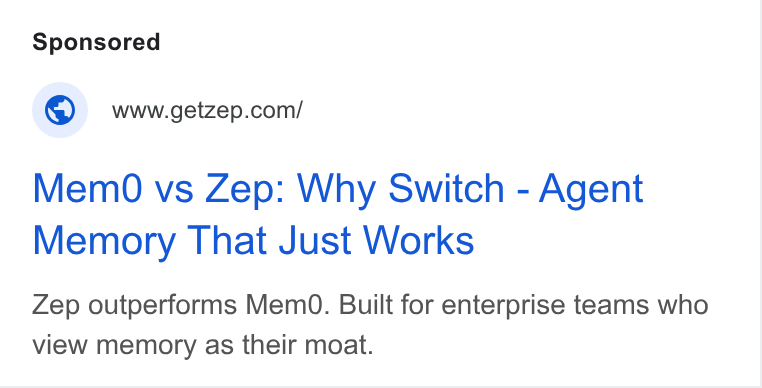
- Sponsored www.getzep.com/ Mem0 vs Zep: Why Switch - Agent Memory That Just Works
- Audience
- Enterprise teams who 'view memory as their moat' are targeted, indicating a focus on businesses with advanced data and AI needs.
Why it works. Speaks directly to current Mem0 users with a switching pitch, using 'just works' to imply the competitor's memory does not.
Direct competitor comparison in headline: "Mem0 vs Zep: Why Switch - Agent Memory That Just Works" If a competitor has a known reliability complaint, write your comparison headline around 'why switch' instead of a generic feature list.
- Running
- 183 days (longevity = it's converting)
- Hook
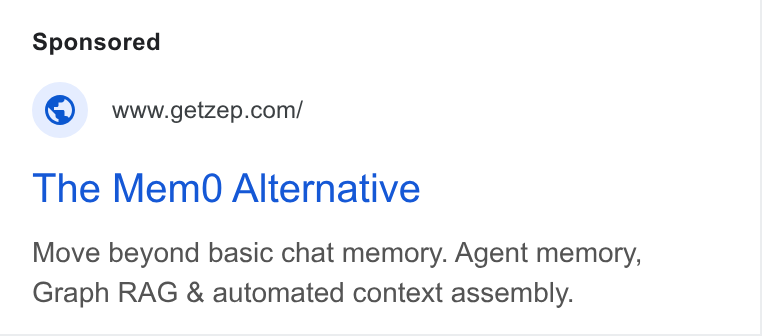
- Visual: The word "Sponsored" at the top, followed by a globe icon and the URL "www.getzep.com/". Text: "The Mem0 Alternative".
- Audience
- Individuals or businesses familiar with 'Mem0' or seeking advanced AI memory solutions, indicated by the specific product comparison and technical terms like 'Agent memory', 'Graph RAG', and 'automated context assembly'.
Why it works. Runs the same branded-search play as the Letta and Supermemory variants, capturing Mem0's own audience through paid search.
Direct competitor comparison in headline: "The Mem0 Alternative" Test 'The [Competitor] Alternative' against a plain '[Competitor] Alternative' headline, the definite article implies market consensus.
Show 1 more ad
- Running
- 36 days (longevity = it's converting)
- Hook
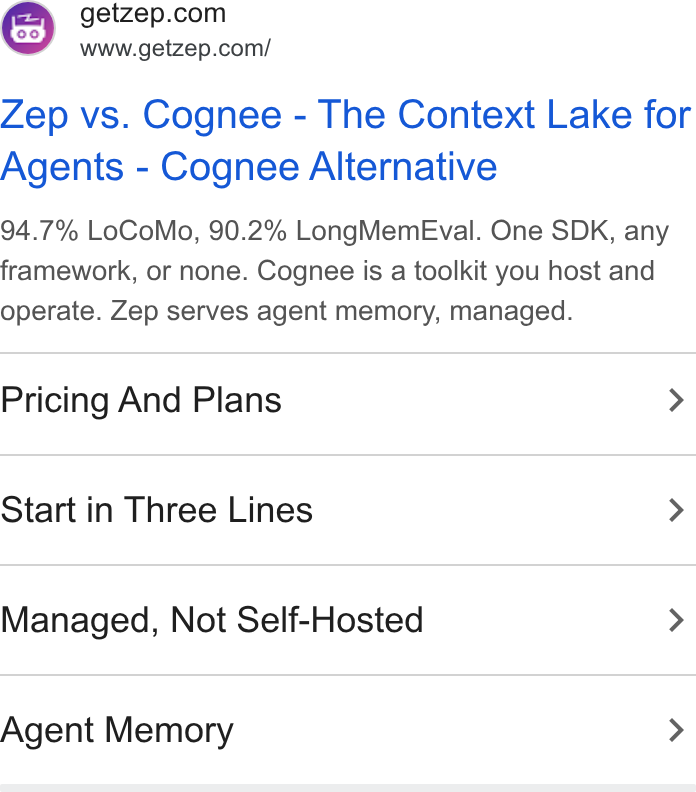
- Visual: A purple icon with two white circles and a white line, next to the text "getzep.com" and "www.getzep.com/". Below this, a blue headline reads "Zep vs. Cognee - The Context Lake for Agents - Cognee Alternative".
- Audience
- The text "Zep vs. Cognee", "Agents", "SDK", "framework", "toolkit", and "agent memory" targets developers, AI engineers, or product managers working with AI agents and looking for specific technical solutions.
Why it works. Directly targets people researching Cognee by name and reframes the category as a 'context lake,' a term this ad appears to be coining for positioning.
Direct competitive headline: The headline "Zep vs. Cognee - The Context Lake for Agents - Cognee Alternative" is prominently displayed. Structure a comparison headline as '[You] vs. [Competitor]' so it surfaces for anyone actively researching that competitor by name.
09 The playbook
The channels are not separate. They are one system where each stage feeds the next. Here is the read, then the plays to run tomorrow.
The inferred playbook
Zep's acquisition loop starts with free open-source attention and converts on two tracks, self-serve credits for small teams and analyst-validated paid ads for enterprise buyers.
Graphiti's GitHub growth is where cold attention starts for free, corroborated by unpaid TikTok creators describing discovering "this tool called ZEP" while building their own AI agents.
A free tier (10,000 credits/month, no rollover) leads into Flex ($1,250/year, $104/month billed annually) and Flex Plus ($3,750/year, $312/month billed annually), letting individual developers convert without talking to sales, while custom Enterprise plans (SOC 2 Type II, HIPAA BAA, bring-your-own-cloud) run as a separate negotiated track.
Dig deeper+3▾
The LinkedIn ad set built almost entirely around the S&P Global analyst quote is a lead-generation play for buyers who need third-party validation before adopting infrastructure, not a brand-awareness push. Zep's own blog also recounts a 30x usage spike in November 2025 when several large enterprise customers landed at once, the evidence doesn't detail which deals or what revenue resulted, an unexplained jump worth flagging.
There is no comparison or how-to content compounding organically (the competitor-alternative pages exist only as paid landing pages), no affiliate or community referral layer, and no visible Reddit amplification in the evidence, leaving a thin middle layer between the open-source top of funnel and the enterprise paid close.
the free-to-paid credit conversion rate, blended ARPU between self-serve Flex plans and negotiated Enterprise contracts, and the revenue impact of the November 2025 enterprise usage spike noted above. Given no public MRR or revenue figures were found, a rough estimate: with enterprise-priced custom contracts sitting alongside $104-312/month self-serve tiers, and a lean team, Zep's revenue is plausibly in the low-to-mid six-figure annual range, likely weighted toward enterprise deals over self-serve seats. This is an estimate, not a confirmed number.
Open-source your core component as free top-of-funnel
The proofGraphiti, Zep's internal knowledge-graph engine, became the company's biggest distribution surface once open-sourced, climbing from 14,000 to 20,000 GitHub stars within about a year, well ahead of anything the marketing site generates organically.
The adaptationPull out one genuinely useful internal module, a parser, a scoring function, a CLI wrapper, package it as a standalone open-source repo, and post it to Hacker News as a Show HN, then repost with new framing every few months the way Zep kept returning to HN with fresh angles rather than one big bet. Start by identifying the one piece of your stack developers already ask you about and shipping it as its own repo with a working example in the README.
Cost: $0 · Time to signal: weeks to months · Works pre-PMF: yes, provided the extracted component solves a real standalone problem developers already search for.
Borrow one credible third-party quote instead of writing case studies
The proofZep's entire LinkedIn ad set, 23 of 23 ads active as of 2026-08-01, reuses a single S&P Global Market Intelligence line ("a likely de facto partner in the enterprise agent stack") across a dozen-plus creative variants instead of commissioning new customer case studies each time.
The adaptationPitch the smallest credible analyst, trade newsletter, or niche publication covering your category for one line of coverage, then reuse that exact quote across 5-10 cheap ad layout variants rather than producing new creative for each test, the way Zep spread one quote across dozens of ad images. Start by listing the three smallest, most category-specific analysts or newsletters that cover your space and send one a short product briefing.
Cost: under $500 for ad testing, outreach itself is free · Time to signal: months for the coverage to land, days once you have the quote · Works pre-PMF: conditional, the product needs to be mature enough for a credible outside voice to write about it.
Bid on "competitor alternative" search terms instead of chasing their organic rankings
The proofZep runs dedicated Google ad pages for "Mem0 Alternative," "Cognee Alternative," "Letta Alternative," and "Supermemory Alternative" as paid placements, none of which show up in Zep's own organic top pages.
The adaptationWrite one honest comparison landing page for your top competitor and run a small daily budget bidding on "[competitor name] alternative" search queries, a narrower, cheaper, more buyer-intent query pattern than generic category keywords. Start by writing that single comparison page for your #1 competitor this way, then set a $10-20/day Google Search campaign against just that query.
Cost: under $500 · Time to signal: days to weeks · Works pre-PMF: yes, cheap and fast even with a handful of customers.
Seed the tutorial-creator communities already teaching adjacent skills
The proofUnpaid Spanish-language TikTok creators, notably i__juancho at 1,357 engagements, documented discovering and wiring Zep into their own AI agents mid-way through a public "Día X" build-log series, with zero brand spend behind it.
The adaptationFind the specific tutorial or course-creator community already teaching an adjacent skill in your category (a Discord, a YouTube series, a niche TikTok tag) and make it trivial for a few of them to feature your product mid-tutorial with free access and a short code snippet, mirroring how a n8n-automation creator worked Zep into an existing build-log format rather than a sponsored post. Start by messaging 3-5 creators already making "building X with Y" content in your space, offering free API access plus a two-line integration example.
Cost: $0 to under $500 · Time to signal: weeks · Works pre-PMF: yes.
Make technical framework videos, not feature tours
The proofZep's two best-performing YouTube videos explain the Graphiti framework and its Cursor IDE integration (13,773 and 12,217 views), each far ahead of standard product feature-tour videos in the 300-2,000 view range.
The adaptationPick the single most name-recognizable tool in your category's adjacent developer stack and record one focused video showing your underlying technical concept solving a real problem inside that tool, your version of "Cursor IDE gets memory," rather than a tour of your own UI. Start by identifying that one adjacent tool and scripting a 3-5 minute integration demo for YouTube.
Cost: $0 · Time to signal: weeks · Works pre-PMF: yes. Not transferable at an earlier stage: the analyst-quote paid layer needs a real third-party report to exist first, and Graphiti's star growth also rode an unusually hot "AI agent memory" category at the right moment, a tailwind a founder in a cooler category should expect to work harder for.
You just read how Zep AI does it. Tomorrow it is someone else.
Every morning we take one company that is actually growing and break down where its customers come from: the ads still running after a year, the channel doing the real work, and the play you can run this week.
Systemaic · directional intelligence. Traffic, spend, and reach figures are SimilarWeb-style estimates and qualitative reads of public data, not audited numbers. Built on real public receipts.
// teardowns with a similar GTM motion
sources & receipts (36)
Live ad libraries: linkedin ad library · google ad library
Launch archives: Hacker News: The private agent memory fallacy · Hacker News: Show HN: Exploring Russian Election Interference with Graphi · Hacker News: Show HN: Zep – Open-Source Graph Memory for AI Apps · Hacker News: Show HN: Cursor IDE now remembers your coding prefs using MC · Hacker News: Building Agents in Go: Without a Framework · Hacker News: Russian Influence Operations Explorer
Researched facts: Founding team: Zep AI was co-founded by Daniel Chalef along with Paul (Pavlo Paliychuk) an · Company tagline / positioning: "Agent Context Is Hard. We Fixed It." · Founder Daniel Chalef background: Engineer turned startup founder, previously founded Know · Pre-seed funding round: $500K Pre-Seed round closed on 05 March 2024, led by Y Combinator · Research paper introducing Zep's memory architecture: Zep published "Zep: A Temporal Knowl · Graphiti open-source project star milestone (mid-2025): Zep's open-source temporal knowled · Graphiti star milestone (late 2025): Graphiti crossed 20,000 GitHub stars within under 12 · Customer case study — Athena Intelligence: Athena Intelligence integrated Zep's memory lay · Pricing — Free tier: Free plan offers 10,000 credits per month for prototyping; credits do · Prior metered billing model (superseded): Zep previously (as of ~March 2025) billed $1.25 · Compliance/enterprise certifications: Zep Cloud is SOC 2 Type II certified and offers HIPA · Analyst coverage: S&P Global Market Intelligence (451 Research) initiated analyst coverage
Milestone sources: 2023-05-19: Zep launches as a long-term memory storage & enrichment platform for LLM apps · 2024-03: Zep launches publicly via Y Combinator (W24 batch) as 'long-term memory for AI as · 2024-09: Zep open-sources Graphiti, its temporal knowledge graph library that powers Zep's · 2025-01: Zep claims new state-of-the-art agent memory results (DMR, LongMemEval) and publi · 2025-02: Graphiti launches on Product Hunt · 2025-03: Zep ships Q1 product round-up: Graph Explorer, redesigned Playground, and a Cookb · 2025-04: Zep ends support for Zep Community Edition, pivots open-source focus fully to Gra · 2025-05: Zep publicly rebuts Mem0's SOTA benchmark claims, defending its LoCoMo accuracy l · 2025-11: Zep's largest enterprise customers land at once, causing a 30x usage spike that b · 2026-04: S&P Global Market Intelligence (451 Research) initiates analyst coverage of Zep,
Community threads: GitHub (getzep/zep-papers issue tracker): A Mem0 GitHub issue accused Zep of miscalculatin · Hacker News: Hacker News commenters piled on after Mem0's benchmark paper was shown to hav · Hacker News (Show HN): A Show HN poster justified building a competing zero-LLM memory too · Hacker News (Show HN): Another Show HN builder made the identical architectural complaint · Hacker News: An HN poster used Zep as the default hosted-memory comparison point when ques · Independent blog/essay (The Hidden Layer): An independent essay on agent-memory benchmarki
Traffic, spend, and revenue figures are estimates as noted in the report; the links above are the primary public artifacts.