- 01Pivot from a repeated complaint, not a hunch
- 02Guest your way onto the media your buyer already trusts
- 03Recruit the professionals who already touch your buyer's records
- 04Turn buyer interviews into an owned show
01 Snapshot
The one-glance read on who they are and how they grow. Each point is verifiable from the receipts above.
An AI-native project accounting platform that layers job costing, AP automation, billing, and WIP reporting on top of a construction company's existing accounting system, aimed at contractors and developers doing $5M-$1B in annual revenue.
Paid-led demand capture (Google + LinkedIn) stacked on an owned vertical-media engine, not a self-serve product-led or personal-founder-audience motion.
~75,200 estimated monthly visits (-4.8% over the last 3 months), a $19M Series A closed July 2024 (bringing total funding to $26.4M), and >280 construction companies managing >$1.4B in project volume as of that same round.
As of 2026-07-10, Google is running new image-format creative and fresh landing pages first shown mid-June 2026, while LinkedIn is testing a colder, task-focused hook ("Stop hiring people to move data between systems").
Adaptive doesn't chase a single viral launch moment, it wedges into the construction back office via keyword-intent landing pages and a purpose-built trade podcast, then lets the CPA firms who already touch these customers' books do the referring.
02 How it unfolded
The order the channels came online. Sequence is strategy: what they did first, and what they layered on once demand existed.
03 Traffic & channel mix
Estimated demand, the channel split behind it, and the keywords and referrers doing the work. Directional modeling, not audited analytics.
Traffic sources
Top search keywords
| Keyword | Volume | Weight | CPC |
|---|---|---|---|
| adaptive | 15k | $2.65 | |
| adaptive ai | 2.5k | $5.40 | |
| adptive | 260 | - | |
| pelles | 420 | - | |
| adaptibe | 280 | - |
Closest competitors by audience
Adaptive draws an estimated ~75,200 monthly visits, down 4.8% over the last 3 months. Direct traffic dominates at 85.5%, an unusually lopsided split that points to habitual, logged-in usage by existing customers typing the URL from memory rather than net-new discovery. Referrals sit second at 6.6% (consistent with the CPA-firm and construction-community partnerships described below), and Search Organic trails at 3.2%. The rest, email, social organic, generative-AI referrals, and paid search, together total under 5%.
Their top-ranking keyword is their own brand term, "adaptive" (~14,800 monthly searches across the web), where they rank #2 organically, alongside "adaptive ai" (~2,500/mo) and several misspellings ("adptive," "adaptibe"). These are demand for the company's name, not category-level search volume, which explains why they still run a Google ad on their own brand term. The listed closest competitors, loanpro.io, origence.com, and goldpointsystems.com, are all loan-origination and lending software rather than construction accounting tools; this looks like a traffic-tool mismatch driven by the generic word "adaptive," rather than a real competitive set worth benchmarking against.
04 Organic content
The specific pages earning their organic search traffic, and the pattern behind why they rank. Adapt the format, not the topic.
Their organic footprint is thin and homepage-heavy: the root domain alone pulls an estimated 85.3% of their organic search visits, with the rest split across a handful of educational posts. The pattern is definitional, not programmatic: a blog explainer ("construction accounting software: what contractors need to know"), a comparison post ("bookkeeping vs. accounting, what's the difference"), and a single podcast episode page, plus a separate finance.adaptive.build subdomain pulling its own small organic slice. This reads as content built to catch buyers who don't yet know the software category exists, in a low-competition vertical niche, rather than a scaled comparison or template-page machine.
Top pages by organic traffic
05 Channel map
Not traffic share. How much weight the growth system actually puts on each channel, with a one-line read on the role it plays.
/bookkeeping, /billing, /invoicing, /cost-plus); the Google advertiser account is registered as "Adaptive Real Estate," likely a holdover from the founders' pre-pivot real-estate concept.What drove growth
06 The motions doing the work
For founder-led SaaS the breakdown shifts from ads to traction: where the first users came from, how the founder grows it in the open, and the compounding organic surface.
Adaptive's traction story runs through funding rounds and a Series A customer count, not a single viral launch.
The founders started on an unrelated real-estate concept and pivoted into construction finance after repeatedly hearing the same back-office complaint from construction firms, closing a $750K pre-seed in August 2021 before shipping product.
A $6.5M seed led by Andreessen Horowitz closed in July 2022, with the product itself launching in February 2023.
Dig deeper+2▾
By the July 2024 $19M Series A (led by Emergence Capital), Adaptive had >280 construction companies on the platform managing over $1.4B in project volume, the clearest verified traction checkpoint in the public record.
There is no visible Product Hunt, Hacker News, or Reddit launch thread tied to Adaptive; the growth read instead comes from the funding cadence and the vertical-media presence covered above.
Adaptive's version of "build in public" isn't a personal founder feed, it's an owned trade-podcast that borrows authority from the construction industry itself.
There is no verified personal X or LinkedIn account for Calvano, Bradlow, or Enriquez in this dataset; the brand accounts (@AdaptiveBuilds on X, "adaptiverealestate" on LinkedIn) carry the public presence instead.
The "Builders Budgets and Beers" YouTube channel runs long-form (40-70 minute) conversations with controllers, CPAs, and builders on topics like WIP reporting and cost coding, with CEO Calvano co-hosting several episodes rather than posting solo threads.
Dig deeper+1▾
Rather than a founder audience, Adaptive leans on partnerships with accounting firms serving construction clients as its trust layer, a community-led substitute for a personal following.
Organic search is a minor channel (3.2% of total traffic) relative to Adaptive's paid footprint, so the content engine functions more as a trust-building surface than a primary acquisition channel.
The blog and podcast pages covered above are definitional content aimed at buyers unfamiliar with the category, rather than a scaled programmatic or comparison-page operation.
Nothing in the evidence shows a public referral or affiliate program; distribution instead runs through direct CPA-firm partnerships rather than an open, self-serve referral link.
Dig deeper+1▾
Paid is doing double duty, defensive brand-term capture on Google (bidding on "Adaptive" itself, where they rank #2 organically) and demand generation on LinkedIn via the "AI project accountant" positioning and customer-testimonial video ads.
07 Paid ads
This founder-led SaaS also runs paid acquisition. Here are the live ads doing the work, each with the X-ray and a play you can adapt.
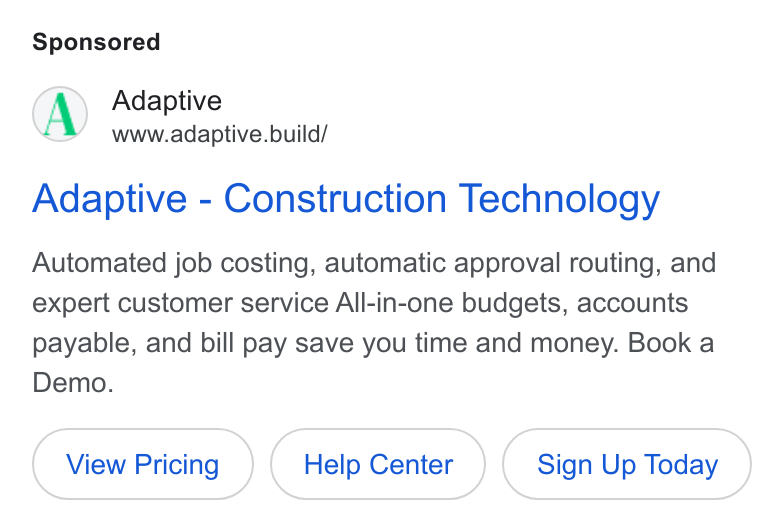
- Running
- 1156 days (longevity = it's converting)
- Hook
- Sponsored" text at the top, followed by a green 'A' logo, then "Adaptive" and "www.adaptive.build/". Below this, the blue headline "Adaptive - Construction Technology" is visible.
- CTA / offer
- Book a Demo.
- Audience
- The text "Automated job costing, automatic approval routing, and expert customer service All-in-one budgets, accounts payable, and bill pay" targets businesses or individuals involved in construction management and finance.
Why it works. A brand-and-category-only search ad used to capture generic construction technology searches rather than a specific pain point.
Headline clearly states the product and industry: "Adaptive - Construction Technology". Ensure your ad's main headline explicitly names your product/service and the specific industry or problem it addresses to quickly filter for relevant viewers.
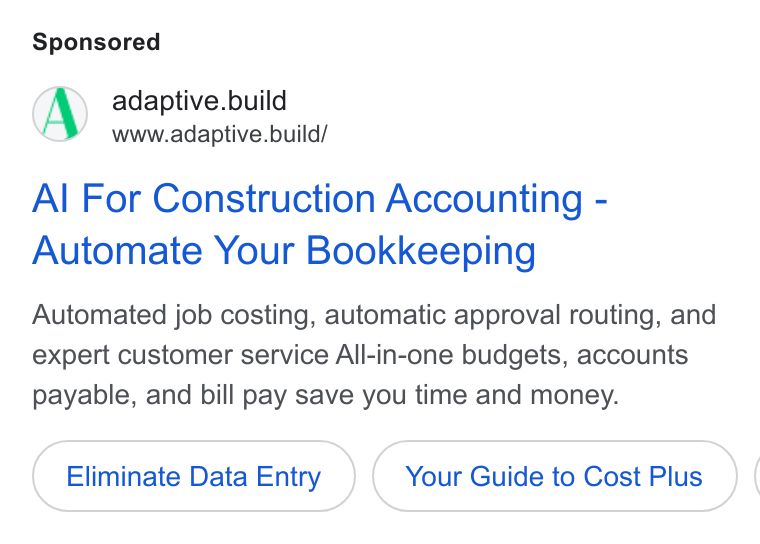
- Running
- 510 days (longevity = it's converting)
- Hook
- The image opens with the word "Sponsored" at the top left, followed by a green 'A' logo, the text "adaptive.build", and the URL "www.adaptive.build/". Below this is the blue headline "AI For Construction Accounting - Automate Your Bookkeeping".
- CTA / offer
- Buttons with text "Eliminate Data Entry" and "Your Guide to Cost Plus" suggest further engagement or information.
- Audience
- Construction companies or individuals involved in construction accounting, indicated by "AI For Construction Accounting" and "Automated job costing".
Why it works. Targets construction accountants by naming both the technology and the exact task, bookkeeping, it replaces.
Headline directly addresses a specific industry and a core problem: "AI For Construction Accounting - Automate Your Bookkeeping". Follow your AI or tech claim with the one specific task it automates, not a general efficiency claim.
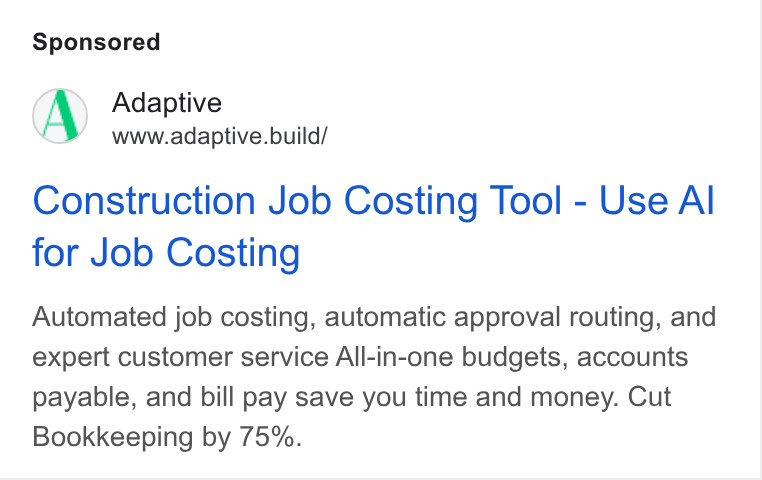
- Running
- 363 days (longevity = it's converting)
- Hook
- Visual: A green 'A' logo inside a circle, next to the text "Adaptive" and "www.adaptive.build/". Text: "Sponsored" above, and "Construction Job Costing Tool - Use Al for Job Costing" below.
- Audience
- Businesses or individuals involved in construction, accounting, or bookkeeping, indicated by terms like "Construction Job Costing," "budgets," "accounts payable," and "Bookkeeping."
Why it works. Mirrors the exact search term back to the searcher twice, a job-costing-specific pitch for construction estimators and PMs.
Headline directly names the problem and solution: "Construction Job Costing Tool - Use Al for Job Costing" Echo your target keyword phrase in both the product name and the benefit clause of the headline to lift ad relevance.
Show 3 more ads
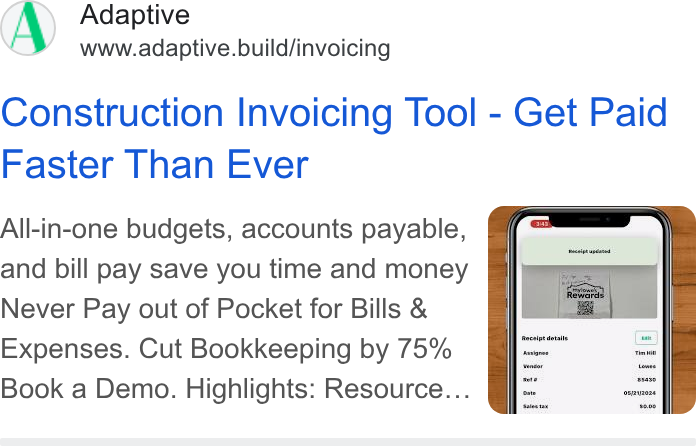
- Running
- 363 days (longevity = it's converting)
- Hook
- "Construction Invoicing Tool - Get Paid Faster Than Ever" with a small logo of a green 'A' in a circle and the text "Adaptive www.adaptive.build/invoicing" above it.
- CTA / offer
- Book a Demo.
- Audience
- Construction businesses or contractors dealing with invoicing, budgeting, accounts payable, and bookkeeping, indicated by "Construction Invoicing Tool" and the detailed financial services.
Why it works. Targets the cash-flow anxiety specific to subcontractors and GCs waiting on payment, offering speed as the differentiator.
Headline with a strong benefit: "Construction Invoicing Tool - Get Paid Faster Than Ever" Attach a specific speed-to-outcome promise directly onto your product name in the headline.
- Running
- 364 days (longevity = it's converting)
- Hook
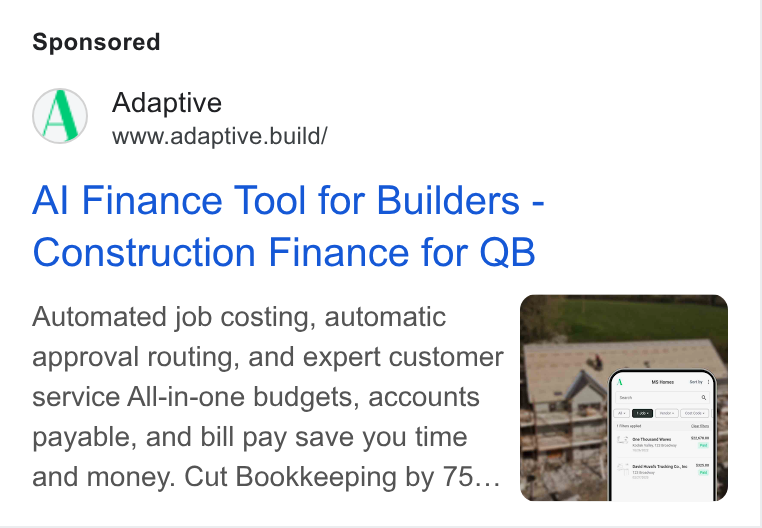
- Sponsored Adaptive www.adaptive.build/ AI Finance Tool for Builders - Construction Finance for QB
- Audience
- The headline 'AI Finance Tool for Builders - Construction Finance for QB' directly targets professionals in construction and those using QuickBooks.
Why it works. Defuses the switching-cost objection for the large base of contractors already running QuickBooks.
Headline with specific niche and benefit: 'AI Finance Tool for Builders - Construction Finance for QB' If you integrate with a category-leading incumbent tool, name it explicitly in the headline to remove a switching objection.
- Running
- 363 days (longevity = it's converting)
- Hook
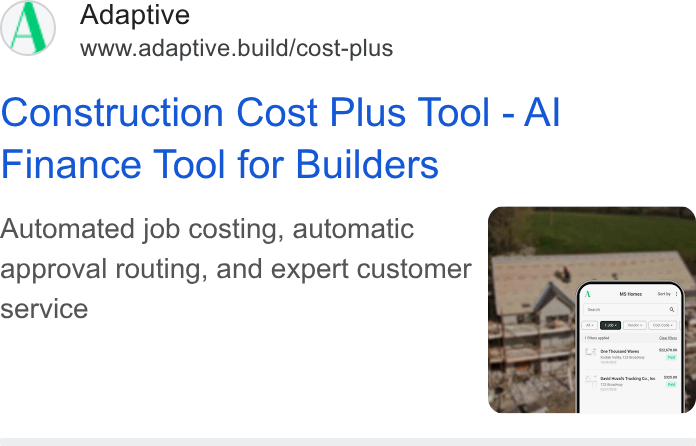
- A Adaptive www.adaptive.build/cost-plus Construction Cost Plus Tool - Al Finance Tool for Builders
- Audience
- The terms "Construction Cost Plus Tool," "Finance Tool for Builders," and "Automated job costing" clearly indicate the target audience is builders and construction professionals.
Why it works. Matches a niche, high-intent search query with a landing-page-specific headline, so cost-plus contractors self-select before clicking.
Headline clearly states the product's purpose: "Construction Cost Plus Tool - Al Finance Tool for Builders" Build a separate ad group and headline for each specific feature or landing page instead of one generic headline for all traffic.
08 The playbook
The channels are not separate. They are one system where each stage feeds the next. Here is the read, then the plays to run tomorrow.
The inferred playbook
Pricing is packaged in modules rather than a flat seat fee: third-party listings report tiers starting anywhere from $575/month (for companies under $5M in revenue, a wedge-down below the core $5M+ ICP) to a $1,000/month "Basic" plan with unlimited users, while Adaptive's own site withholds exact figures and routes prospects to a custom quote, consistent with a paid/trial model (no $0 tier, so not freemium). Applying that pricing range against the company's own reported customer count (undated company claims of roughly 1,000 customers, up from the >280 verified at the July 2024 Series A) puts an estimated MRR in the high six to low seven figures, a rough order-of-magnitude read, not a confirmed number.
The product enters via an existing accounting system rather than replacing it, which lowers the switching cost and lines up with the CPA-firm partnership motion.
At 85.5% of all visits, most traffic looks like existing customers logging back in, meaning the acquisition engine is running mostly through paid and partner channels rather than compounding organic discovery.
Dig deeper+2▾
With search organic at just 3.2% of the mix, the long-running Google ads and the large LinkedIn ad library are carrying acquisition load that content alone isn't yet supplying.
free-to-paid conversion, churn, CAC, exact current pricing, and current headcount.
Pivot from a repeated complaint, not a hunch
The proofAdaptive's founders started on an unrelated real-estate idea and only pivoted into construction finance after hearing the same back-office pain point repeatedly from industry contacts.
The adaptationBefore writing a line of code, run 20-30 structured conversations with people in your target niche and listen for the same specific complaint surfacing unprompted three or more times; that repetition, not a personal hunch, is your signal to build. First step: pick one narrow buyer type, book five calls this week, and write down the exact words they use for the pain.
Cost: $0 · Time to signal: days · Works pre-PMF: yes
Guest your way onto the media your buyer already trusts
The proofAdaptive's growth has leaned on appearances on construction-industry podcasts rather than general tech press, with CEO Calvano showing up as a guest across shows in the niche.
The adaptationList the 5-10 podcasts, newsletters, or YouTube channels your specific buyer already follows, then pitch yourself as a guest with one sharp data point or contrarian take, not a product demo. The mechanism: a niche host's existing trust transfers to you faster than any content you could build from zero. First step: identify one show this week and send a two-line pitch naming the exact topic you'd cover.
Cost: $0 · Time to signal: weeks · Works pre-PMF: yes
Recruit the professionals who already touch your buyer's records
The proofAdaptive distributes partly through direct partnerships with CPA and accounting firms that already manage its target customers' books, layering on top of their existing systems instead of asking them to switch.
The adaptationIdentify the adjacent service provider your buyer already pays (a bookkeeper, consultant, or agency) and pitch a referral arrangement positioning your product as additive to their work, not a threat to it. First step: list five such providers in your buyer's world and offer one a revenue share or co-branded resource in exchange for introductions.
Cost: under $500 · Time to signal: weeks · Works pre-PMF: conditional, works best once you have one or two paying reference customers to point to
Turn buyer interviews into an owned show
The proofAdaptive runs its own YouTube interview series with construction operators and accountants on a roughly monthly cadence, with the CEO co-hosting, compounding into the small organic-search pages covered above.
The adaptationRecord your own customer-discovery calls as a public interview series instead of a private call, publishing each to YouTube or a podcast feed. Each episode does double duty: it's a relationship-building conversation and a piece of search-indexable content that compounds. First step: book one recorded conversation with a prospective buyer or domain expert and publish it unedited.
Cost: $0 · Time to signal: months, this compounds slowly · Works pre-PMF: yes
Bid on task-specific search intent, not your brand name
The proofAdaptive's Google ads point to task-specific landing pages (`/bookkeeping`, `/billing`, `/invoicing`, `/cost-plus`) rather than one generic homepage ad, with 39 of 46 ads still active as of 2026-07-10.
The adaptationOnce you have a working product, build one landing page per high-intent task your buyer searches for (not your company name), and test a small daily budget against that exact phrase. First step: pick the single task keyword closest to a buying decision and put $5-10/day behind a page built only for it.
Cost: under $500 · Time to signal: weeks · Works pre-PMF: no, this needs a working product and enough margin to justify paid acquisition before it makes sense Not transferable at an earlier stage: the ~320-ad LinkedIn library and multi-year-running Google campaigns are funded by a $19M Series A; a pre-funding founder should adapt the landing-page structure in Play 5, not the ad spend behind it.
You just read how Adaptive does it. Tomorrow it is someone else.
Every morning we take one company that is actually growing and break down where its customers come from: the ads still running after a year, the channel doing the real work, and the play you can run this week.
Systemaic · directional intelligence. Traffic, spend, and reach figures are SimilarWeb-style estimates and qualitative reads of public data, not audited numbers. Built on real public receipts.
// teardowns with a similar GTM motion
sources & receipts (8)
Live ad libraries: linkedin ad library · google ad library
Launch archives: Hacker News: Parkinsons patient "feels cured" with new adaptive deep brai · Hacker News: Google Meet rolls out multi-device adaptive audio merging · Hacker News: Commander Keen's adaptive tile refresh · Hacker News: Show HN: AutoThink – Boosts local LLM performance with adapt · Hacker News: Anxiety, depression, and PTSD may be adaptive responses to a · Hacker News: Why do random forests work? They are self-regularizing adapt
Traffic, spend, and revenue figures are estimates as noted in the report; the links above are the primary public artifacts.