- 01Bid on the category leader's name
- 02Publish the glossary post before the sales page
- 03Turn a recurring update into a lead-gate
- 04Film the testimonial the day the deal closes
01 Snapshot
The one-glance read on who they are and how they grow. Each point is verifiable from the receipts above.
Freight orchestration and procurement software that unifies TMS, bid, and market-pricing data for enterprise shippers, fresh off a $25M Series B in August 2025.
Enterprise sales-led, backed by an active paid-search and LinkedIn ABM program rather than organic or creator growth.
~4,283 monthly visits (down 53% over the last 3 months) as of 2026-07-09, 13 active Google ads, and a $25M Series B raised August 2025 atop $40M+ total funding.
LinkedIn carries a problem-agitation creative, "Six moves for a tight freight market," among the 9 newest of the 24 ads sampled from its ~29-ad library as of 2026-07-09.
Growth now runs on paid conquesting of competitor brand terms like Project44, not the founders' freight-network pedigree, and organic traffic is shrinking under it.
02 How it unfolded
The order the channels came online. Sequence is strategy: what they did first, and what they layered on once demand existed.
03 Traffic & channel mix
Estimated demand, the channel split behind it, and the keywords and referrers doing the work. Directional modeling, not audited analytics.
Top search keywords
| Keyword | Volume | Weight | CPC |
|---|---|---|---|
| goodship | 530 | $4.99 | |
| top us freight broker companies list | 100 | - | |
| goodship logo | 250 | - | |
| project44 | 6.6k | $5.69 | |
| transporeon | 5.2k | $0.91 |
GoodShip's own site draws an estimated ~4,283 monthly visits, down 53% over the last 3 months as of 2026-07-09, a steep pullback for a company eleven months removed from a $25M raise. No full referrer or channel-percentage breakdown was captured in this pull, but the keyword data is telling on its own: the term "project44" pulls 6,600 monthly searches and "transporeon" pulls 5,170, both far ahead of GoodShip's own name at 530 searches a month. That gap means most of the demand GoodShip's search program can realistically capture already belongs to established category players, not to GoodShip's own brand awareness. A secondary branded query, "goodship logo" (250 searches/mo), likely reflects existing customers or prospects looking up brand assets rather than new discovery.
04 Organic content
The specific pages earning their organic search traffic, and the pattern behind why they rank. Adapt the format, not the topic.
GoodShip's organic footprint is small but shows a clear pattern: comparison and category-definition posts. Its strongest blog entries pit its category against an adjacent one ("freight broker software vs TMS, what's the difference") and define a specific artifact buyers research before purchasing ("what is a carrier scorecard"), both aimed at readers still forming the vocabulary for the problem rather than already searching for GoodShip by name. That shows up in the rankings too: alongside branded terms, GoodShip ranks for category queries like carrier scorecards and tms freight broker, meaning the content doubles as a glossary for a category the company is also trying to help define.
Top pages by organic traffic
05 Channel map
Not traffic share. How much weight the growth system actually puts on each channel, with a one-line read on the role it plays.
What drove growth
06 The motions doing the work
For founder-led SaaS the breakdown shifts from ads to traction: where the first users came from, how the founder grows it in the open, and the compounding organic surface.
GoodShip's traction story runs through funding rounds and enterprise logos rather than a single viral launch moment.
The $25M Series B, announced August 12, 2025 and led by Greenfield Partners with Bessemer, Ironspring, Chicago Ventures, and FUSE VC participating, generated third-party trade pickup, including a FreightWaves industry news roundup naming the raise alongside other freight-tech leadership and funding news, the closest thing to a launch spike visible in the evidence.
Instead of one big debut, GoodShip runs a steady drip of named-customer video testimonials, covering Cemex USA, KeHE Distributors, Reser's Fine Foods, KBX Logistics, Michael Foods, Hoplite Logistics, and Rise Baking, released through April to July 2026, each a proof point aimed at buyers already mid-sales-cycle rather than cold discovery.
Dig deeper+1▾
The company stayed fully remote until opening its first physical office in Bellevue, WA in August 2025, immediately after the Series B, marking a shift from scrappy-remote toward a visibly-scaling posture for enterprise buyers.
GoodShip's founder-visibility motion is podcast-guest thought leadership and customer-story amplification, not personal build-in-public posting.
Founder and CEO Ryan Soskin, who co-founded GoodShip alongside CTO David Tsai after the two worked together at freight-tech company Convoy (Soskin also came up through Coyote Logistics and Stord), appears on freight-industry podcasts; one clip on GoodShip's own YouTube channel shows him joining The Freight Pod to explain the company's positioning ("We're not a TMS, and that's intentional"), a message aimed at buyers who conflate freight software categories.
Soskin's LinkedIn profile carries 5,241 followers and a bio naming GoodShip, but no individual post-level activity showed up in the evidence, so the account functions as a resume-style credibility anchor for prospects and investors rather than a live content feed.
Dig deeper+1▾
No founder posts on Reddit or X appear in the evidence; the company's brand account (@goodship_io on X) exists but shows no captured posting activity, so whatever founder-adjacent attention exists comes through third-party press and podcasts rather than a self-authored feed.
GoodShip's organic motion is a small, deliberate category-education play layered under a much larger paid-conquesting program.
The blog invests in comparison ("freight broker software vs TMS") and glossary-style ("what is a carrier scorecard") posts rather than broad content volume, a strategy suited to a company still teaching buyers its own vocabulary.
Webinar and podcast content, including one titled "The Rise of Freight Orchestration," positions GoodShip as defining a category rather than competing purely on existing search terms, consistent with its own branded search volume staying tiny at 530 searches a month.
Dig deeper+2▾
GoodShip's Google library (13 active ads as of 2026-07-09) includes a "Project44 Alternative, AI Award Optimizer" creative pointed at a dedicated procurement landing page, running directly against a competitor whose name pulls 6,600 monthly searches, over 12x GoodShip's own branded volume. That pairing shows the paid program is built for demand generation off a rival's name recognition, not defensive brand-term protection.
The ~29-ad LinkedIn library leans almost entirely on repeated "Freight Market Update" webinar creative and named-guest sessions (with figures like Chris Pickett of Flock Freight and Marisa Dempsey of Schreiber Foods), all funneling to a gated recording rather than a self-serve signup.
07 Paid ads
This founder-led SaaS also runs paid acquisition. Here are the live ads doing the work, each with the X-ray and a play you can adapt.
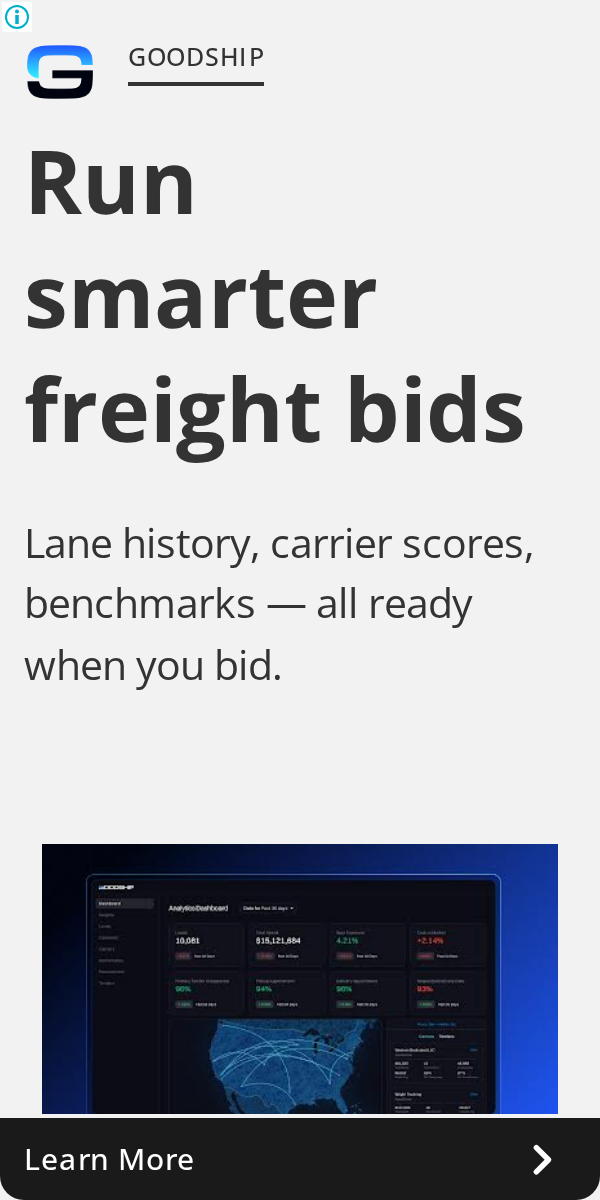
- Running
- 89 days (longevity = it's converting)
- Hook
- "Run smarter freight bids" is the prominent text. Below it, a smaller text reads: "Lane history, carrier scores, benchmarks — all ready when you bid." The visual shows a blue and black 'G' logo with the word "GOODSHIP" next to it, and a small blue information icon at the top left.
- CTA / offer
- Learn More
- Audience
- The terms "freight bids," "lane history," "carrier scores," and "benchmarks" indicate the target audience is professionals involved in logistics, shipping, or freight management.
Why it works. Names the specific inputs, lane history, carrier scores, benchmarks, that back the promise, so freight brokers see the mechanism instead of a vague upgrade.
The headline "Run smarter freight bids" is displayed in large, bold font. List the specific data points your tool assembles before a user needs them, not just the outcome, so the claim reads as mechanical, not aspirational.
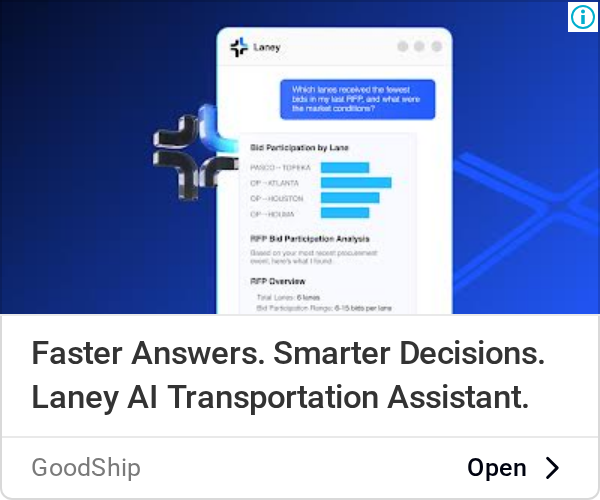
- Running
- 89 days (longevity = it's converting)
- Hook
- "Laney" (on-screen text) + a white window with a blue background and a stylized blue cross logo.
- CTA / offer
- Open
- Audience
- Professionals in logistics or transportation procurement, indicated by terms like 'RFP', 'bids', 'lanes', and 'procurement event'.
Why it works. Shows the product's AI assistant, Laney, in a clean interface shot so freight professionals see the interaction surface before any explanation.
Directly addressing a common industry question with a visual answer: "Which lanes received the lowest bids in my last RFP, and what were the market conditions?" followed by a bar chart titled "Bid Participation by Lane." Show your product's UI on screen within the first three seconds, before any spoken pitch, to answer what-is-this visually.
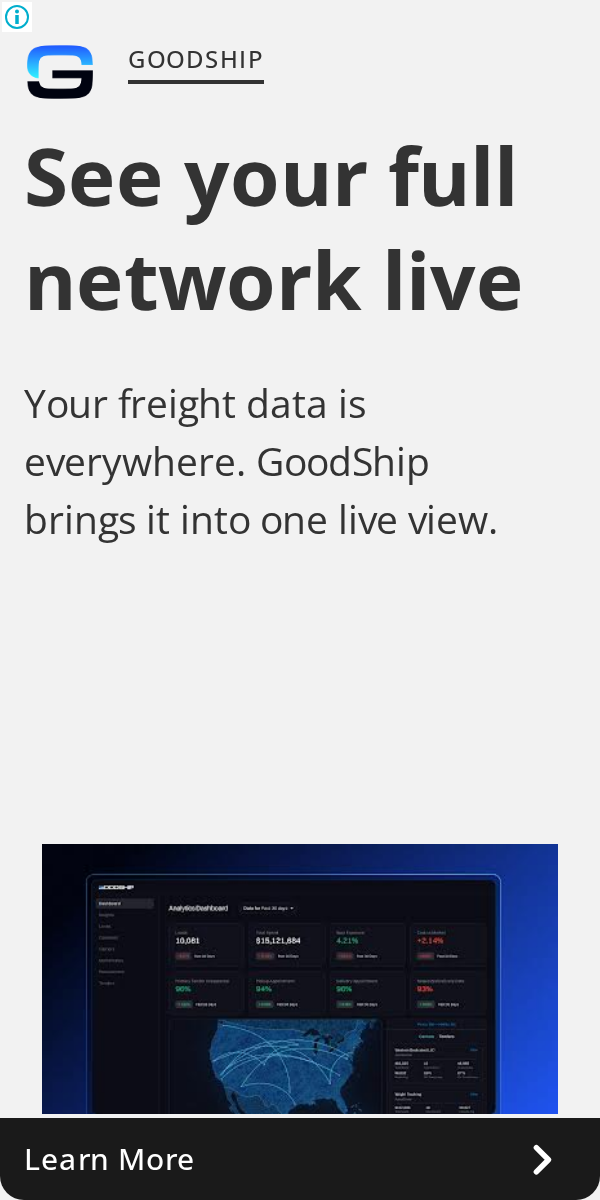
- Running
- 89 days (longevity = it's converting)
- Hook
- Visual: A blue and black 'G' logo with the word "GOODSHIP" next to it, followed by large text "See your full network live". Audio: not applicable
- CTA / offer
- Learn More
- Audience
- Businesses or individuals involved in freight logistics, indicated by terms like "freight data" and "network live view".
Why it works. Promises a live, unified view of scattered freight data, targeting shippers who currently patch together visibility from multiple systems.
Headline and sub-headline benefit statement: "See your full network live" and "Your freight data is everywhere. GoodShip brings it into one live view." Add a time-sensitive word like live or real-time to a data-visibility claim to separate it from static reporting tools.
Show 3 more ads
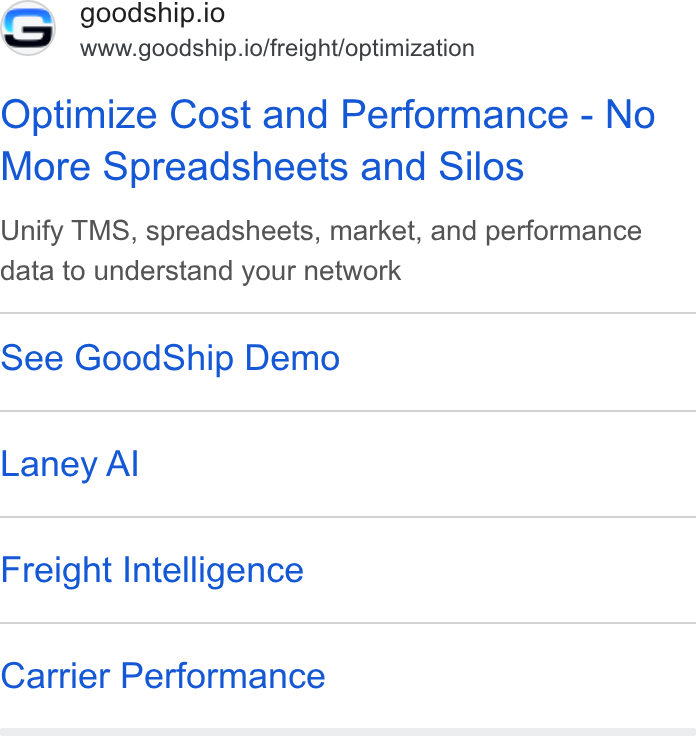
- Running
- 86 days (longevity = it's converting)
- Hook
- goodship.io www.goodship.io/freight/optimization Optimize Cost and Performance - No More Spreadsheets and Silos
- CTA / offer
- See GoodShip Demo
- Audience
- Businesses involved in freight and logistics operations, specifically those using Transportation Management Systems (TMS) and dealing with market and performance data, indicated by terms like 'freight/optimization', 'TMS', 'market', 'network', 'Freight Intelligence', and 'Carrier Performance'.
Why it works. Names the exact incumbent tools, spreadsheets, silos, that the buyer currently fights, making the pain concrete instead of abstract.
Headline directly addresses a pain point: "Optimize Cost and Performance - No More Spreadsheets and Silos" Name the specific tool or workaround your buyer uses today, a spreadsheet, a shared inbox, instead of describing the pain in the abstract.
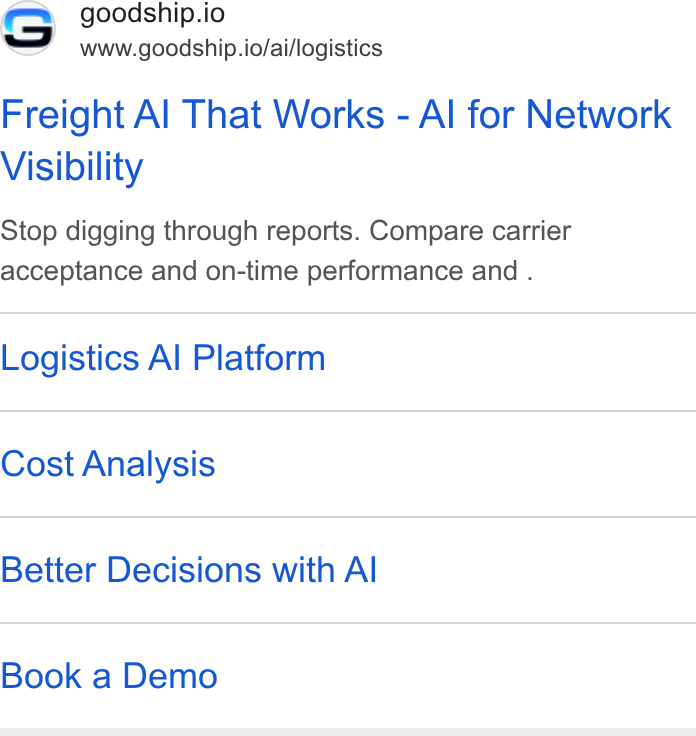
- Running
- 70 days (longevity = it's converting)
- Hook
- goodship.io www.goodship.io/ai/logistics Freight Al That Works - Al for Network Visibility
- CTA / offer
- Book a Demo
- Audience
- Logistics professionals or businesses involved in freight and supply chain management, indicated by terms like 'Freight AI', 'Network Visibility', 'carrier acceptance', 'on-time performance', 'Logistics AI Platform', and 'Cost Analysis'.
Why it works. Google search ad pairs the domain with a benefit headline so freight ops teams searching for AI visibility tools see a direct match to their query.
Headline stating a clear benefit: "Freight Al That Works - Al for Network Visibility" Pair your URL slug with a benefit headline that names the exact buyer search term, so search ads read as a direct answer to it.
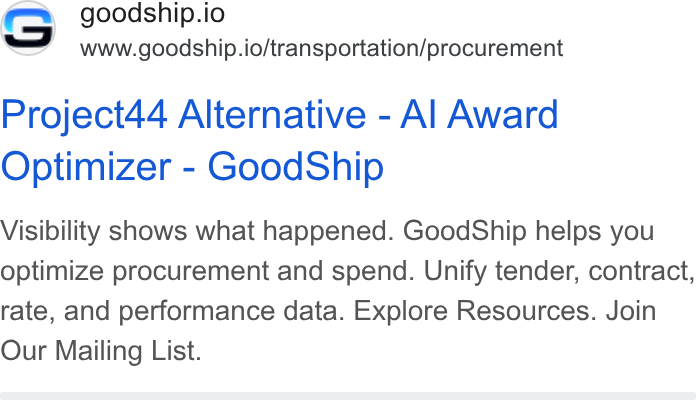
- Running
- 33 days (longevity = it's converting)
- Hook
- goodship.io www.goodship.io/transportation/procurement Project44 Alternative - Al Award Optimizer - GoodShip
- CTA / offer
- Join Our Mailing List.
- Audience
- Procurement and transportation professionals, indicated by the URL path '/transportation/procurement' and keywords like 'optimize procurement and spend', 'tender, contract, rate, and performance data'.
Why it works. Anchors positioning against a category-known competitor by name, letting procurement buyers place the product without explaining the category from scratch.
Headline positioning as a direct competitor: 'Project44 Alternative - Al Award Optimizer - GoodShip' If a well-known competitor already occupies your buyer's mental map, name them directly and lead with what you do differently.
08 The playbook
The channels are not separate. They are one system where each stage feeds the next. Here is the read, then the plays to run tomorrow.
The inferred playbook
The loop runs from paid competitor-conquesting search and gated LinkedIn webinars into a demo-led sales cycle, with case-study video reinforcing deals already in motion.
Paid search on rival brand terms (Project44, Transporeon) and gated LinkedIn webinars pull in-market freight and procurement buyers, while organic search plays a minor supporting role given the small, shrinking ~4,283 monthly visits.
No self-serve pricing was found in the evidence, so every ad and webinar funnels into a human sales conversation, consistent with an enterprise-shipper customer base that includes Cemex USA, KeHE Distributors, and KBX Logistics.
Dig deeper+3▾
Case-study videos and podcast guest appearances build a reusable trust library that should shorten later sales cycles, but none of it is built to compound organic discovery independent of continued ad spend.
Traffic falling 53% over 3 months while the ad library stays fully active suggests paid isn't offsetting an organic base that is both small and shrinking, and there is no visible community, affiliate, or self-serve motion to pick up the slack. Given roughly 40 to 60 employees and $40M+ raised through a Series B, GoodShip likely operates in the single-digit-million-dollar ARR range as of 2026, though no public revenue figure is confirmed and this is an estimate, not a verified number.
deal close rate, CAC, churn, and exact pricing or ARPU (no public pricing page detected).
Bid on the category leader's name
The proofGoodShip runs a Google ad headlined "Project44 Alternative, AI Award Optimizer" pointed at a dedicated landing page, sitting inside its 13-ad active Google library as of 2026-07-09, while "project44" alone pulls 6,600 monthly searches versus 530 for GoodShip's own name.
The adaptationIdentify the one competitor whose name your best prospects already search for, write a single "[Competitor] alternative" landing page naming the specific gap you close, then run a small daily budget against that exact brand term instead of broad category keywords. Start by drafting the page and pointing $10-20 a day of search spend at the competitor's name plus "alternative," since that traffic is already qualified and cheaper to convert than generic terms.
Cost: under $500 · Time to signal: days · Works pre-PMF: conditional, only if you can honestly name a specific gap the competitor leaves open.
Publish the glossary post before the sales page
The proofGoodShip's top-performing blog content is category-definition writing like "what is a carrier scorecard," ranking for the buyer's research-stage vocabulary rather than for GoodShip's own name.
The adaptationList the five terms your prospects google before they know your product exists, the "what is X" and "X vs Y" questions, and write one clear, undersold definition post per term with your product mentioned once near the bottom. Start by drafting the single most-searched definitional post in your category and publishing it with no product pitch in the headline.
Cost: $0 · Time to signal: months · Works pre-PMF: yes, this is one of the few channels that compounds before you have paying customers.
Turn a recurring update into a lead-gate
The proofGoodShip's most repeated LinkedIn creative is a recurring "Freight Market Update" webinar series, the single most reused hook across its ~29-ad library.
The adaptationPick a data point your industry checks obsessively, commit to a short recurring recap of it, and gate the full recording behind an email address. Start by recording a 5-minute update on the metric your prospects already track, posting the clip organically, and offering the full version for a signup, no ad spend needed to test it.
Cost: $0 · Time to signal: weeks · Works pre-PMF: yes, provided you can speak credibly about the metric even before shipping product.
Film the testimonial the day the deal closes
The proofGoodShip built a library of short customer videos, Cemex USA, KeHE Distributors, Reser's Fine Foods, KBX Logistics among them, released as a steady drip through 2026 rather than one launch splash.
The adaptationAsk every new customer for a 2-minute video the week they go live, scripted around one specific number they'd say out loud. Start with your first paying customer: ask for 10 minutes on a call, ask what's different now, and clip the best 90 seconds for your site and outbound.
Cost: $0 · Time to signal: weeks · Works pre-PMF: conditional, only once you have a customer with a real, specific result to point to.
Pitch your own milestone to trade press
The proofGoodShip's Series B got picked up in a third-party trade news roundup alongside other funding and leadership stories in its category, extending the raise's reach beyond GoodShip's own channels.
The adaptationWhen you close a round, land a notable customer, or hit a real milestone, identify the two or three trade newsletters or podcasts your buyers actually read and pitch the editor directly with the one specific number that makes it news. Start by listing which trade newsletters your last five customers mentioned, then send a two-sentence pitch built around your single best number.
Cost: $0 · Time to signal: days · Works pre-PMF: conditional, this only fires when you have a genuine milestone, it isn't a repeatable weekly channel. Not transferable at an earlier stage: the Series B trade pickup and the enterprise-logo testimonial reel both depend on funding and paying customers GoodShip already has; a founder without either can adapt the mechanics (the glossary posts, the gated recap, the day-one testimonial ask) but not the underlying credibility they're built on.
You just read how GoodShip does it. Tomorrow it is someone else.
Every morning we take one company that is actually growing and break down where its customers come from: the ads still running after a year, the channel doing the real work, and the play you can run this week.
Systemaic · directional intelligence. Traffic, spend, and reach figures are SimilarWeb-style estimates and qualitative reads of public data, not audited numbers. Built on real public receipts.
// teardowns with a similar GTM motion
sources & receipts (2)
Live ad libraries: linkedin ad library · google ad library
Traffic, spend, and revenue figures are estimates as noted in the report; the links above are the primary public artifacts.