- 01Bid on your rivals' brand names
- 02Write the glossary page your buyers Google before they know your name
- 03Monitor the threads where strangers vouch for you
- 04Run the paid test before you announce anything
01 Snapshot
The one-glance read on who they are and how they grow. Each point is verifiable from the receipts above.
An AI GTM "System of Actions" running three named agents, Katie (outbound AI SDR), Alex (AI calling/inbound qualifier) and Luna (growth intelligence), sold to B2B revenue teams, reporting a $15M new-revenue run rate as of July 2026.
Paid-led, running roughly 330 combined Google and LinkedIn ads as of 2026-07-16 on top of an SEO glossary page and a branded education hub.
≈144,000 estimated monthly visits (+69.6% over the last 3 months) as of 2026-07-16; $32M raised across a 2025 seed and a $25M Series A announced July 8, 2026; 300+ customers including Snowflake, Deel and Atlassian as of July 2026.
CEO and co-founder Stav Levi-Neumark framed the company's ambition as "we are doing for marketing and sales what AWS did for cloud infrastructure," as reported in Israeli tech press covering the round.
As of 2026-07-16, Alta's newest LinkedIn creatives pivot from feature claims to a contrarian "AI SDRs failed miserably" framing that attacks the very AI-SDR category it sells into.
The paid engine predates the funding story. Google search ads bidding on rival tool names like Artisan and Amplemarket started in October 2024, months before any public seed or Series A announcement, making conquest-keyword ads, not a launch moment, the real first-customer channel.
02 How it unfolded
The order the channels came online. Sequence is strategy: what they did first, and what they layered on once demand existed.
03 Traffic & channel mix
Estimated demand, the channel split behind it, and the keywords and referrers doing the work. Directional modeling, not audited analytics.
Traffic sources
Top search keywords
| Keyword | Volume | Weight | CPC |
|---|---|---|---|
| alta | 64k | $1.33 | |
| nooks | 73k | $2.17 | |
| altahq | 1.7k | $28.96 | |
| alta ai | 1.7k | $8.17 | |
| alta hq | 750 | - |
Closest competitors by audience
Alta pulls an estimated ≈144,000 monthly visits, up 69.6% over the last 3 months. Direct traffic leads the mix at 34.5%, with Search Paid close behind at 22.7% and Social Paid at 13.1%, meaning paid search and paid social combined (35.8%) nearly match direct traffic outright. Social Organic (9.6%) and Search Organic (8.5%) trail as smaller organic contributors, Display Ads add 6.2% and Referrals 3.2%; the rest, email and affiliate, totals under 3%.
The highest-volume keyword in the data, "alta" at ≈64,000 searches/month, is likely diluted by unrelated brands sharing the name rather than reflecting category-specific demand. The two cleanly branded terms, "alta ai" and "altahq," each pull roughly 1,700 searches/month, a better read on genuine category awareness. On competitors, the closest-matched domains, rogo.ai, nixtla.io and pecan.ai, skew toward general AI/data-analytics platforms rather than direct AI-SDR rivals; the company's own ad copy, which bids against named tools like Artisan and Amplemarket, is the more reliable signal of who it actually competes with.
04 Organic content
The specific pages earning their organic search traffic, and the pattern behind why they rank. Adapt the format, not the topic.
Alta's organic footprint is thin but purposeful: a definitional glossary page on "AI voice call" is its single largest organic earner, followed by the homepage, then two educational blog posts (a cohorts explainer and a sales-pipeline how-to). The pattern is definitional, category-education content rather than commercial comparison pages, and it ranks well, taking the #1-2 spots for "ai call" and "ai voice call." That likely works because those terms sit in a newer, lower-competition search category than the crowded "AI SDR" or "sales automation" space, letting a small page set punch above a young site's typical weight.
Top pages by organic traffic
05 Channel map
Not traffic share. How much weight the growth system actually puts on each channel, with a one-line read on the role it plays.
What drove growth
06 The motions doing the work
For founder-led SaaS the breakdown shifts from ads to traction: where the first users came from, how the founder grows it in the open, and the compounding organic surface.
Alta's growth didn't start with a single launch spike; paid search ads targeting rival AI-SDR tools were already running months before either funding round went public.
Google search ads for altahq.com began running on 2024-10-14, roughly five months before the company's reported March 2025 seed round, meaning paid conquest-keyword capture, not a coordinated launch, built the earliest funnel.
The visible public milestones are funding announcements rather than product launches: a $7M seed in March 2025, then a $25M Series A on 2026-07-08 led by IN Venture, each paired with self-reported growth claims (800% revenue growth, a $15M run rate) instead of a coordinated multi-surface release.
Dig deeper+1▾
The closest thing to organic discovery in the evidence is two Reddit threads (2025-06-15 and 2025-10-30) where prospects ask peers to compare Alta against rivals like Salestools.io, suggesting the tool spreads through category-evaluation threads rather than a viral moment.
Alta's public presence runs through brand-owned channels and paid media rather than a personal founder following; no verified founder social activity appears in this pull.
The Altaversity "GTM 101" series (five YouTube lessons on positioning, ICP and outbound) and a company podcast substitute for founder build-in-public content, positioning Alta as a category teacher rather than routing attention through an individual's profile.
One LinkedIn ad promotes a July 29 industry panel featuring CEO and co-founder Stav Levi-Neumark (alongside co-founders Tom Hoffen and Mor Shabtai) next to speakers from Salesforce and Meta, using the founder as a credibility signal in paid media rather than as an organic personal-brand channel.
Dig deeper+1▾
The two Reddit threads discussing Alta originate from prospects, not the company, meaning whatever community traction exists is peer-driven rather than founder-seeded.
Search spend and search rank are doing different jobs here: paid captures competitor and generic-intent traffic while a thin set of organic pages carries lightweight category education.
Search Organic sits at 8.5% of total traffic against Search Paid's 22.7%, meaning Alta pays for roughly 2.7 times the search volume it earns for free, a buy-now posture typical of a team fresh off a large raise.
The ai-voice-call glossary page, their top organic earner, is the one surface actually built for search rather than conversion, a format cheap to replicate since it competes on definitional intent rather than crowded "vs" terms.
Dig deeper+2▾
Google ad copy directly bids on rival tool names ("Amplemarket Alternative," "Best Alternative To Artisan") while LinkedIn ad copy runs longer-form positioning pieces contrasting Alta against two prior AI-sales waves, lead-scoring tools and conversation-intelligence tools, to carve out a "system of actions" category rather than a single feature.
Nothing in the homepage or pricing evidence points to a partner or affiliate lever; distribution runs through paid media and content, not a recruited seller network.
07 Paid ads
This founder-led SaaS also runs paid acquisition. Here are the live ads doing the work, each with the X-ray and a play you can adapt.
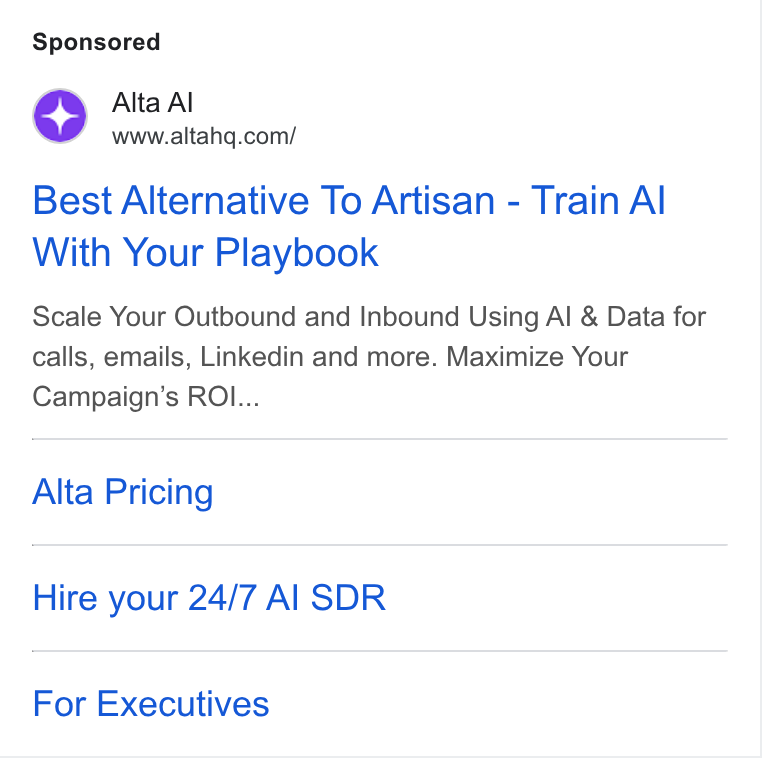
- Running
- 517 days (longevity = it's converting)
- Hook
- Sponsored Alta AI www.altahq.com/ Best Alternative To Artisan - Train AI With Your Playbook
- Audience
- Businesses and executives looking to scale their outbound and inbound sales, indicated by phrases like 'Scale Your Outbound and Inbound', 'Maximize Your Campaign's ROI', and 'For Executives'.
Why it works. Intercepts switch-consideration searches for a named rival, Artisan, and immediately offers a distinct feature instead of a generic swap pitch.
Direct competitor comparison in headline: 'Best Alternative To Artisan - Train AI With Your Playbook' If you have a clear competitive advantage, name your competitor directly in your ad headline and state your superior benefit or alternative approach.
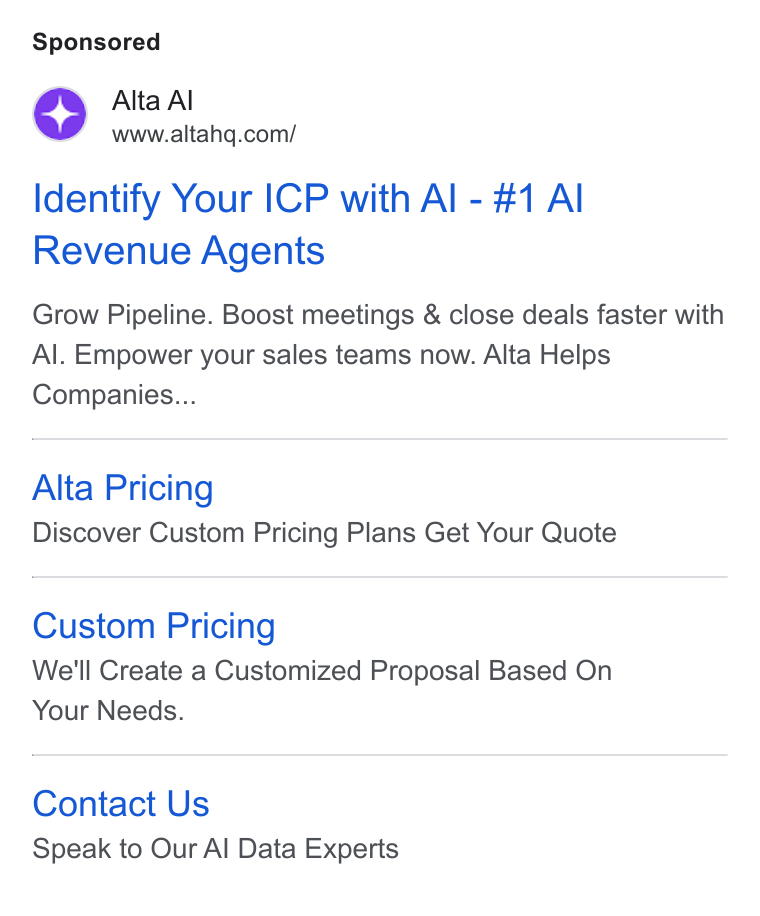
- Running
- 499 days (longevity = it's converting)
- Hook
- Sponsored Alta AI www.altahq.com/ Identify Your ICP with AI - #1 AI Revenue Agents
- CTA / offer
- Discover Custom Pricing Plans Get Your Quote
- Audience
- Businesses and sales teams looking to improve their pipeline, meetings, and deal closing with AI, indicated by phrases like "Grow Pipeline," "Boost meetings & close deals faster," and "Empower your sales teams."
Why it works. Combines a specific job-to-be-done with a category-leadership claim, catching both narrow-task searchers and broad category shoppers.
Headline with a bold claim and problem-solution framing: "Identify Your ICP with AI - #1 AI Revenue Agents" Start your ad with a headline that directly names a key problem your target audience faces and positions your product as the leading solution, using a verifiable claim.
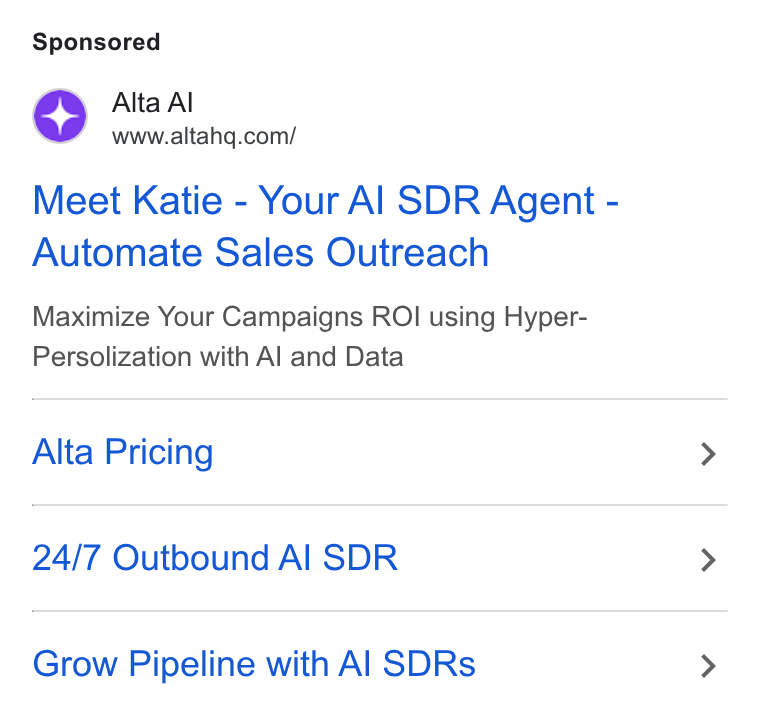
- Running
- 349 days (longevity = it's converting)
- Hook
- Sponsored Alta AI www.altahq.com/ Meet Katie - Your AI SDR Agent - Automate Sales Outreach
- Audience
- Businesses or sales professionals looking to improve sales efficiency and ROI, indicated by terms like "AI SDR Agent," "Automate Sales Outreach," "Campaigns ROI," and "Grow Pipeline."
Why it works. Runs the Katie persona against the plainest benefit claim in the set, likely the control variant other Katie headlines are tested against.
Headline clearly states the product and its primary benefit: "Meet Katie - Your AI SDR Agent - Automate Sales Outreach." Lead with a headline that explicitly names your product/service and its single most compelling benefit for the target audience.
Show 3 more ads
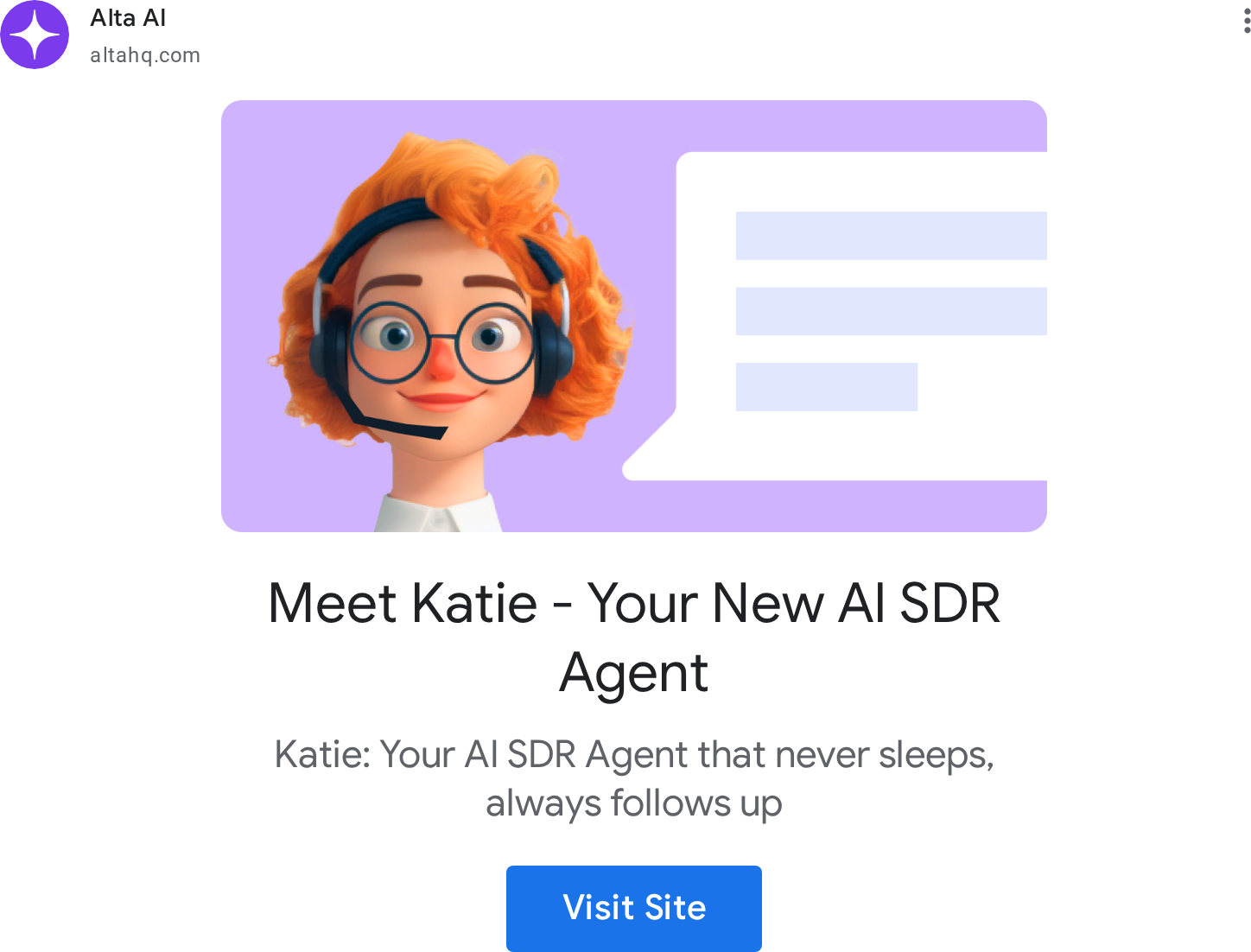
- Running
- 305 days (longevity = it's converting)
- Hook
- Visual: A purple square with a white star-like icon, next to the text "Alta AI" and "altahq.com".
- CTA / offer
- Visit Site
- Audience
- The text "AI SDR Agent" and the promise of an agent that "never sleeps, always follows up" targets businesses or sales teams looking for automated, persistent sales development representatives.
Why it works. Runs a plain branded search unit, the purple starburst mark and Alta AI name, to build repeat recognition among buyers already comparing AI SDR tools.
Introduces a named AI agent: "Meet Katie - Your New AI SDR Agent". If your product is an AI or automation tool, give it a human-like name and persona in your ad copy to make it more relatable.
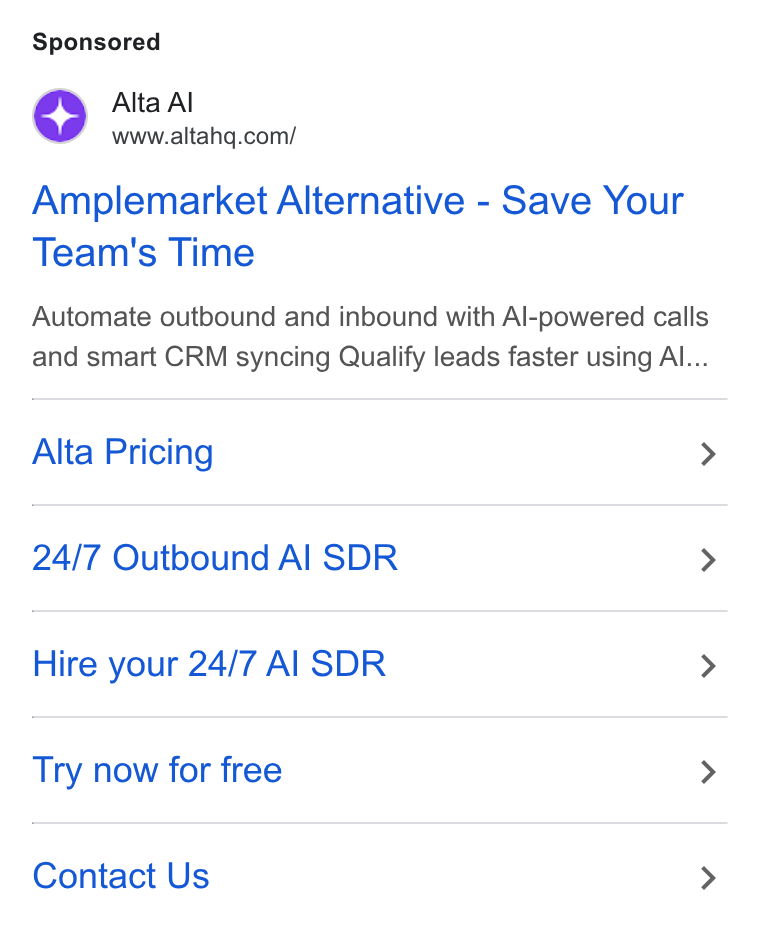
- Running
- 301 days (longevity = it's converting)
- Hook
- Sponsored Alta AI www.altahq.com/ Amplemarket Alternative - Save Your Team's Time
- CTA / offer
- Try now for free
- Audience
- Businesses looking to optimize sales and lead qualification processes, indicated by terms like 'Amplemarket Alternative', 'Automate outbound and inbound', 'AI-powered calls', 'smart CRM syncing', and 'Qualify leads faster'.
Why it works. Intercepts buyers already typing a named competitor into search and offers a one-line reason to switch instead of demoing the product first.
Headline comparison: "Amplemarket Alternative - Save Your Team's Time" If you have a clear competitive advantage, explicitly name a well-known competitor in your headline and immediately follow it with your key benefit.

- Running
- 633 days (longevity = it's converting)
- Hook
- Visual: A purple circular icon with a white four-pointed star in the center, next to the text "Alta AI" and "www.altahq.com/". Text: "Meet Katie - Your AI SDR Agent - AI Finds Your Best ICP"
- Audience
- The terms "SDR Agent," "ICP" (Ideal Customer Profile), and "Personalize Your Campaigns at Scale" signal that this ad targets sales development representatives, sales managers, and marketing professionals in B2B companies.
Why it works. Names the AI SDR 'Katie' to make an abstract automation product feel like hiring staff, aimed at teams comparing faceless competitor tools.
Headline directly addresses a common pain point with a clear solution: "Meet Katie - Your AI SDR Agent - AI Finds Your Best ICP" Create a headline that names your AI solution and directly states its primary benefit in solving a key customer problem, using industry-specific terminology.
08 The playbook
The channels are not separate. They are one system where each stage feeds the next. Here is the read, then the plays to run tomorrow.
The inferred playbook
The loop starts with paid capture of intent and depends on named enterprise logos to keep the pipeline credible while organic and community channels stay secondary.
Conquest and category-term ads on Google, plus contrarian LinkedIn thought-leadership pieces, put Alta in front of buyers already shopping AI-SDR tools or scrolling RevOps content.
The homepage and the AI-voice-call glossary page both funnel into the same product-demo path, with named enterprise customers like Snowflake, Deel and Atlassian doing trust-transfer work paid media alone can't.
Dig deeper+3▾
The Altaversity course and blog posts build a slow-growing organic layer, ≈2,400 organic visits/month across four ranked pages, that should get cheaper per visit as it ages, unlike ad spend that has to be repaid every day.
There is no visible peer-referral, partner or affiliate mechanism and no founder personal-audience channel, so a rise in ad costs leaves SEO as Alta's only fallback lever.
Exact tier pricing (packaging is custom, quote-based, per the company), the paid-versus-organic split behind the reported $15M new-revenue run rate, and net-dollar retention across its 300+ accounts.
Bid on your rivals' brand names
The proofAlta's Google search ads directly target competitor brand terms, "Amplemarket Alternative" and "Best Alternative To Artisan," a conquest-keyword tactic that's been one of its longest-active ad angles.
The adaptationPull the two or three tools your own prospects compare you against, check your last ten lost-deal notes or a comparison thread in your category, then write one Google Search ad per rival using the exact "[Competitor] Alternative" headline pattern, pointing to a page that names the switch cost directly. Start with the single rival your sales team hears about most often.
Cost: under $500 · Time to signal: weeks · Works pre-PMF: conditional, only once you know which specific competitor prospects actually weigh you against.
Write the glossary page your buyers Google before they know your name
The proofA single definitional page, "what is an AI voice call," is Alta's top organic earner and ranks in the top two results for that exact term on a site with under 150,000 monthly visits.
The adaptationWrite one page answering the plain-English "what is X" question your ICP types into Google before they've heard of any vendor (the definitional version, not "best X tool"), keep it under 500 words with your product mentioned once near the end, and publish it on your own domain. A solo founder can ship one of these in an afternoon, and it keeps earning traffic long after any single ad campaign ends.
Cost: $0 · Time to signal: weeks · Works pre-PMF: yes.
Monitor the threads where strangers vouch for you
The proofTwo unprompted Reddit threads, in r/salesdevelopment and r/AiAutomations, show prospects asking peers to compare Alta against rival tools with zero brand posting from Alta itself.
The adaptationSet up a free keyword alert for your product name plus "vs," "alternative," and "review" across Reddit and Google. When a thread surfaces, reply from a personal account with a direct, non-promotional answer to the specific question asked. The goal is to be the most useful voice in a thread you didn't start, not to seed one.
Cost: $0 · Time to signal: days · Works pre-PMF: yes.
Run the paid test before you announce anything
The proofAlta's Google ads started running in October 2024, months before its first public seed announcement, meaning the paid funnel was already proving demand before there was any launch story to tell.
The adaptationBefore any public launch or press push, put a few hundred dollars behind a narrow set of Google Search ads on the exact terms a buyer types when they already have the problem, not your brand name, and use click-through and reply rate as your go/no-go signal for the bigger launch. This only needs a landing page and a card, not a finished product.
Cost: under $500 · Time to signal: weeks · Works pre-PMF: yes.
Turn your onboarding curriculum into a public course
The proofAlta packaged its own category education into "Altaversity," a five-lesson GTM course on YouTube covering ICPs, signals and outbound, separate from its product tutorials.
The adaptationTake the exact framework you already use to onboard new customers or new hires on how your category works, split it into four or five short lessons, and publish it as a named mini-course on YouTube or a linked page series. It compounds as a shareable asset because it teaches the category, not just the product.
Cost: under $500 · Time to signal: months · Works pre-PMF: conditional, needs an already-clear point of view on how the category should work, not just something to sell. Not transferable at an earlier stage: Alta's paid-media volume, roughly 330 combined Google and LinkedIn ads and a 640-day-old always-on Google campaign, runs on Series A capital a pre-funding reader won't have. Run the adaptations above one ad at a time until revenue funds the rest.
You just read how Alta does it. Tomorrow it is someone else.
Every morning we take one company that is actually growing and break down where its customers come from: the ads still running after a year, the channel doing the real work, and the play you can run this week.
Systemaic · directional intelligence. Traffic, spend, and reach figures are SimilarWeb-style estimates and qualitative reads of public data, not audited numbers. Built on real public receipts.
// teardowns with a similar GTM motion
sources & receipts (11)
Live ad libraries: linkedin ad library · google ad library
Launch archives: Hacker News: Altair 8800 – Loading 4K BASIC with a Teletype [video] · Hacker News: Altavista: The rise and fall of the biggest pre-Google searc · Hacker News: Yahoo SEC Filing: Name change to Altaba Inc and director res · Hacker News: How AltaVista, the first good search engine, fell into the d · Hacker News: What Microsoft is this the Altair Basic of? · Hacker News: Using Altair for most of my visualization in Python
Researched facts: Alta was founded in 2023 in Tel Aviv, Israel by Stav Levi-Neumark (CEO), Tom Hoffen, and M · CEO's stated company vision: "We are doing for marketing and sales what AWS did for cloud · Security certification: Alta states it has achieved SOC 2 Type II certification and is GDP
Traffic, spend, and revenue figures are estimates as noted in the report; the links above are the primary public artifacts.