- 01Mine subreddit patterns before you post
- 02Launch a narrow wedge, not the whole platform
- 03Write the comparison page your buyers are already searching
- 04Advertise the exact wall your product removes
01 Snapshot
The one-glance read on who they are and how they grow. Each point is verifiable from the receipts above.
Composio sells usage-based infrastructure connecting AI agents to 800+ third-party tools, priced free to $229/mo, after raising roughly $29M including a $24-25M Series A in March 2025.
Organic-led: direct and organic search make up nearly 78% of traffic, with a founder-run podcast and a heavy programmatic paid-search layer riding on top.
About 1.51 million monthly visits (+84.1% over the last 3 months) as of 2026-07-08, plus 100,000+ developers and 200+ enterprise customers reported at the March 2025 Series A announcement.
Google ads show live tests of per-app "MCP (Model Context Protocol) Server" pages for Salesforce, Slack, GitHub, Jira, Notion, Linear, Confluence and Gong, chasing per-integration search intent, as of 2026-07-08.
Composio turns AI-model comparison content, like its #1-ranking Claude Code vs. Codex page, into a funnel, then backs it with programmatic per-app "MCP Server" ad pages, turning tool research into product discovery.
02 How it unfolded
The order the channels came online. Sequence is strategy: what they did first, and what they layered on once demand existed.
03 Traffic & channel mix
Estimated demand, the channel split behind it, and the keywords and referrers doing the work. Directional modeling, not audited analytics.
Traffic sources
Top search keywords
| Keyword | Volume | Weight | CPC |
|---|---|---|---|
| composio | 169k | $2.35 | |
| meta ads mcp | 101k | $6.65 | |
| composio mcp | 4.7k | $10.22 | |
| composio ai | 4.7k | $1.26 | |
| codex vs claude code | 153k | $3.90 |
Top referring sites
Closest competitors by audience
Composio pulls an estimated 1.51 million monthly visits as of 2026-07-08, up 84.1% over the last 3 months. Direct traffic leads at 44.2%, organic search follows at 33.6%, and referrals add another 11.2%, a mix that reads as a developer audience that already knows the brand and finds it again through search rather than being pulled in by ads. The rest, including organic social, paid search, AI-assistant referrals, email and paid social, totals under 11%.
The keyword list shows the content strategy at work: "composio" pulls roughly 169,000 searches/mo in brand-level demand, while "codex vs claude code" carries about 153,000 searches/mo, a term with no brand name in it that Composio's own comparison content ranks for. A third term, "meta ads mcp" at roughly 100,000 searches/mo, is demand Composio is bidding into rather than a term describing its own product.
Its top referrer, rube.app, is not a third party at all: it is Composio's own consumer MCP spinout, meaning a chunk of that 11.2% referral share is cross-traffic between its two products rather than earned links. toolify.ai, an AI-tool directory, is a genuine outside referral pointing to directory-driven discovery. Among the sites clustered as competitors, pipedream.com is a direct rival in agent-integration tooling, portkey.ai is an adjacent LLM-gateway and observability player rather than a head-to-head competitor, and warp.dev (an AI-native terminal) shows the clustering is picking up broader "AI dev tools" audience overlap as much as direct competition.
04 Organic content
The specific pages earning their organic search traffic, and the pattern behind why they rank. Adapt the format, not the topic.
Composio's top-ranking pages split between AI-model comparison content and integration-specific docs: its Claude Code vs. Codex page and a Grok 4 vs. Claude 4 Opus vs. Gemini 2.5 Pro comparison sit alongside a Polygon.io toolkit doc page, and four of its pages rank #1 for their target terms (composio, codex vs claude code, grok 4 coding, claude code vs codex). The pattern is a developer-research funnel: content written to help engineers pick an AI coding model captures high-intent search traffic that has nothing to do with "integrations," then sits on Composio's own domain to introduce the product once the reader is there. The toolkit-doc page for a single data API (Polygon.io) suggests a second, quieter engine: templated per-integration docs pages built once per toolkit that can rank for long-tail, low-competition developer queries at near-zero marginal content cost.
Top pages by organic traffic
05 Channel map
Not traffic share. How much weight the growth system actually puts on each channel, with a one-line read on the role it plays.
What drove growth
06 The motions doing the work
For founder-led SaaS the breakdown shifts from ads to traction: where the first users came from, how the founder grows it in the open, and the compounding organic surface.
Composio's early traction reads as founder-driven product launches stacked on top of a fast-growing developer base, not a single viral moment.
In November 2024, co-founder and CEO Soham Ganatra posted his first-ever Product Hunt submission, a narrower "SWE-Kit" coding-agent toolkit rather than the full platform, asking his X following to support it. Public upvote or comment counts for that listing are not available in this dataset, only the founder's own account of launching it.
By late December 2024, Ganatra was citing 15,000+ developers on the platform in a single tweet, a base that scaled to the six-figure developer count already noted in the Snapshot above by the time Series A closed in March 2025.
Dig deeper+2▾
To land its first 100 customers, Ganatra built and publicized an AI agent that scans the top ten posts in a target subreddit, extracts the pattern behind what goes viral there, and drafts matching content, a homemade growth tool he shared openly as the tactic itself.
The raise closed publicly with a July 2025 "series_a_aftermovie.mp4" post from Ganatra, turning the funding milestone into its own share-worthy content moment rather than a plain announcement.
Composio's build-in-public motion runs almost entirely through Ganatra's personal X account, with co-founder Karan Vaidya's LinkedIn as a second, more enterprise-facing channel.
Ganatra's X account (@GanatraSoham, 4,036 followers, 1,513 posts) is distinct from the brand's @composio account and is where product milestones, growth experiments, and funding news actually get posted, including the MCP-hub launch covered above.
In October 2024, Ganatra detailed a five-email onboarding feedback sequence he built, then reported the result plainly: "The results? Bad. We got 0 replies," a rare admission of a failed tactic rather than a highlight reel.
Dig deeper+2▾
Karan Vaidya runs a larger channel on LinkedIn (31,195 followers), where his bio ties directly to building Composio for AI agents, giving the company a second audience distinct from Ganatra's developer-heavy X following.
Composio has no personal founder presence on Reddit; instead Reddit shows up as a tactic (the subreddit-pattern-mining agent covered above) and as unmanaged organic chatter, including the stealth-marketing callout noted in the channel map.
Organic search covers roughly a third of Composio's total traffic mix, and the SEO motion doubles as a targeting map for paid search sitting directly on top of it.
The comparison-content engine and the templated toolkit-docs pages (both covered above) work at different paces: model comparisons capture spiky, high-volume search moments while docs pages accumulate steady long-tail traffic, together keeping organic search at its current channel share.
Comparison content lives on the root domain while toolkit references live on a separate docs subdomain, a structural split that lets marketing-driven content and reference documentation rank independently without competing for the same page real estate.
Dig deeper+2▾
Google ads bid on the per-app "MCP Server" landing pages covered above and on competitor-conquest terms like "Skip oauth hell with Composio," a problem-agitation hook aimed at developers who already know the pain of building OAuth themselves.
The most-repeated LinkedIn creative, appearing across at least five separate ad images, stages a fake "Tool limit reached" error dialog with a red warning triangle, dramatizing the exact wall a growing agent hits without Composio, expanded as Play 4 below.
07 Paid ads
This founder-led SaaS also runs paid acquisition. Here are the live ads doing the work, each with the X-ray and a play you can adapt.
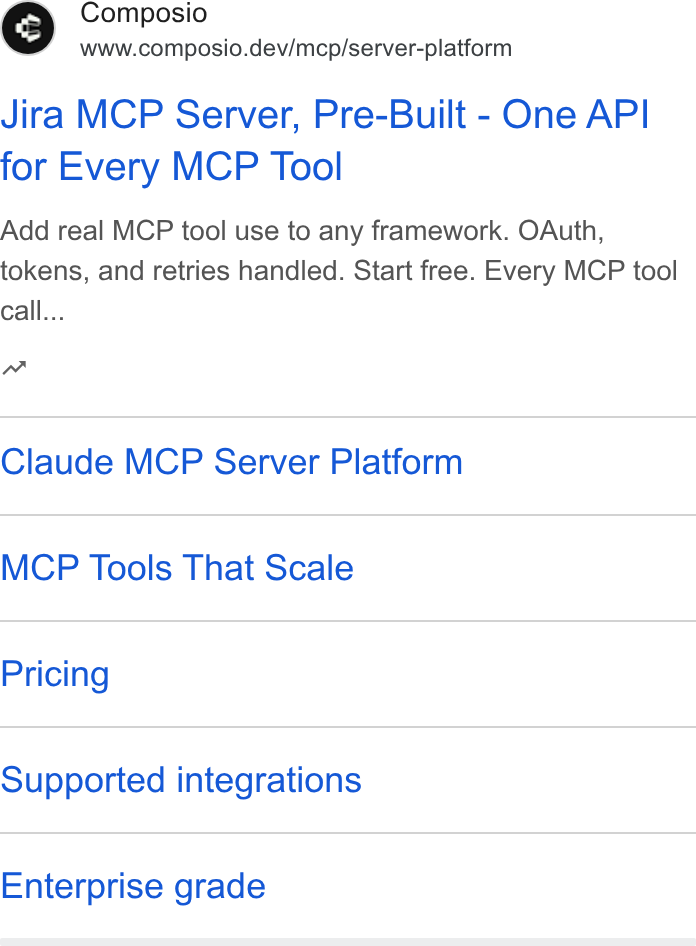
- Running
- 82 days (longevity = it's converting)
- Hook
- "Composio" with a black and white logo of a stylized 'C' or gear, followed by "www.composio.dev/mcp/server-platform". Below this, the headline "Jira MCP Server, Pre-Built - One API for Every MCP Tool" is displayed.
- CTA / offer
- Start free.
- Audience
- Developers, IT professionals, or businesses using Jira and other MCP (Multi-Cloud Platform or similar) tools, indicated by the specific product names and technical language like 'API', 'OAuth', 'tokens', and 'framework'.
Why it works. Captures narrow, high-intent searches for a specific tool integration (Jira) then expands the pitch to the full platform in the same line.
Headline with a bold, simplifying claim: "Jira MCP Server, Pre-Built - One API for Every MCP Tool" Build individual ad variants keyed to each specific integration your users search for, then bridge to your platform-wide value in the same headline.
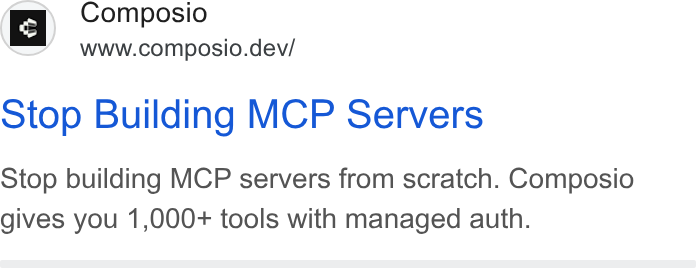
- Running
- 82 days (longevity = it's converting)
- Hook
- Composio www.composio.dev/ Stop Building MCP Servers
- Audience
- Individuals or businesses involved in building 'MCP servers' and seeking tools for managed authentication, indicated by the specific terminology used.
Why it works. Speaks to developers who are mid-way through the painful task of manually building MCP servers, meeting them at their exact frustration.
Direct problem statement as headline: 'Stop Building MCP Servers' Use an imperative 'Stop doing X' headline that names the exact manual task your product eliminates.
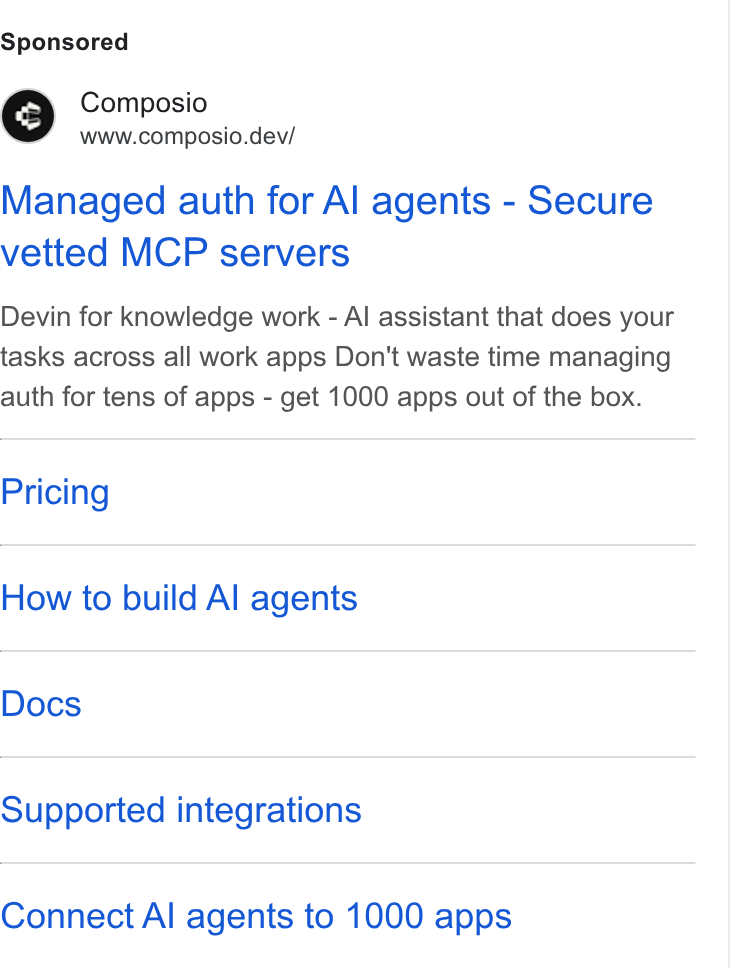
- Running
- 205 days (longevity = it's converting)
- Hook
- Sponsored Composio www.composio.dev/ Managed auth for Al agents - Secure vetted MCP servers
- Audience
- Developers, AI practitioners, and businesses using AI agents, indicated by terms like 'AI agents', 'MCP servers', 'knowledge work', and 'managing auth'.
Why it works. Targets developers building AI agents who need OAuth/auth infrastructure, naming the exact keyword (MCP servers) they're searching for.
Headline directly addresses a technical pain point and offers a solution: 'Managed auth for Al agents - Secure vetted MCP servers'. Pair your core headline with a specific proof qualifier (e.g. 'vetted', 'secure') instead of a vague benefit claim.
Show 3 more ads
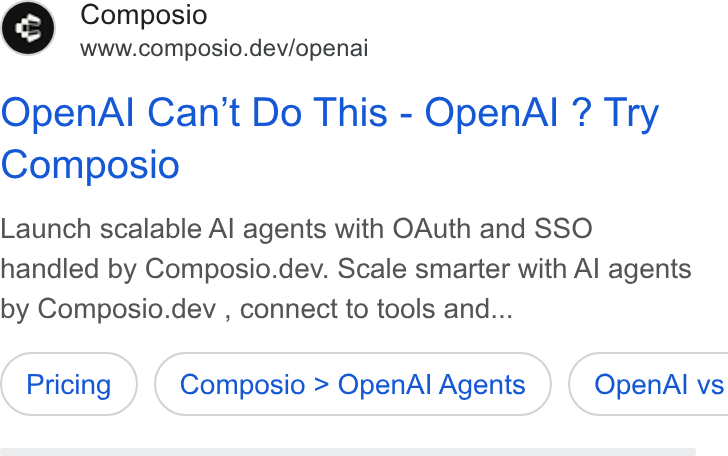
- Running
- 106 days (longevity = it's converting)
- Hook
- Composio www.composio.dev/openai OpenAI Can't Do This - OpenAI ? Try Composio
- Audience
- The mention of 'AI agents', 'OAuth and SSO', and 'tools' signals a target audience of developers, tech-savvy individuals, or businesses looking for advanced AI integration and management solutions.
Why it works. Targets OpenAI users searching for extra agent functionality by naming the exact tool they already use and implying it falls short.
Direct comparative headline: The headline states, "OpenAI Can't Do This - OpenAI ? Try Composio". Name your biggest competitor by name in the headline and claim one specific gap, rather than a vague comparison.
- Running
- 106 days (longevity = it's converting)
- Hook
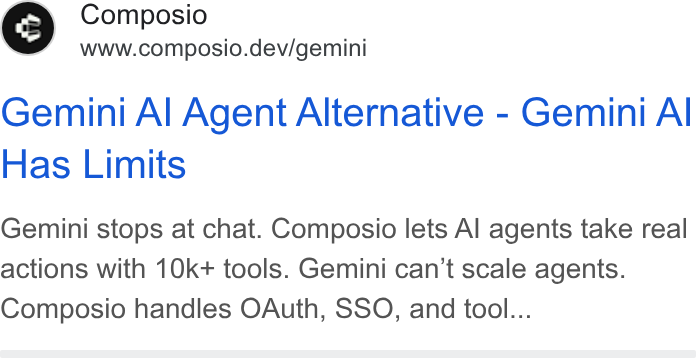
- Composio www.composio.dev/gemini Gemini AI Agent Alternative - Gemini AI Has Limits
- Audience
- AI developers/users experiencing limitations with Gemini AI, indicated by the direct comparison and technical terms like 'AI agents', '10k+ tools', 'OAuth', 'SSO'.
Why it works. Captures Gemini users at the exact moment they hit a capability ceiling, by naming the competitor in the search term itself.
Direct comparison and bold claim in headline: "Gemini AI Agent Alternative - Gemini AI Has Limits" Run a competitor-alternative landing page keyed to the exact competitor name plus 'alternative' as your ad headline.
- Running
- 98 days (longevity = it's converting)
- Hook
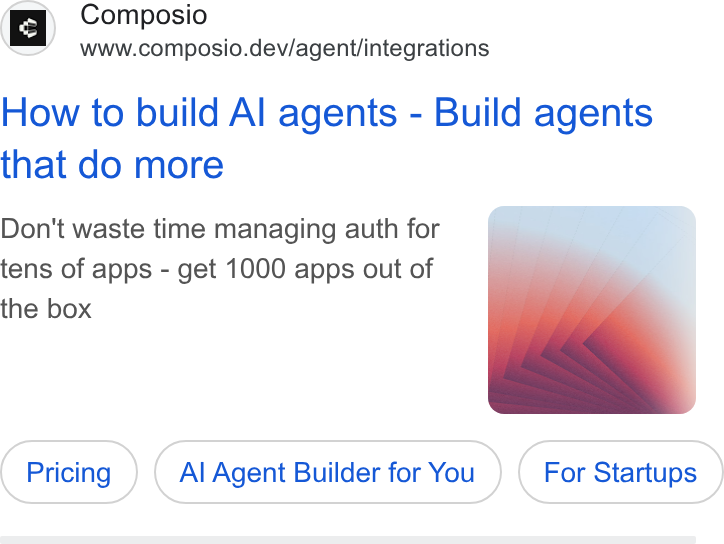
- Composio www.composio.dev/agent/integrations How to build Al agents - Build agents that do more
- Audience
- Developers, startups, and businesses interested in AI automation and integration, evidenced by the terms 'AI agents', 'apps', 'AI Agent Builder for You', and 'For Startups'.
Why it works. Captures top-of-funnel searchers still learning how to build AI agents, then upsells with 'do more' to differentiate from tutorial content.
Problem statement and solution on-screen text: "Don't waste time managing auth for tens of apps - get 1000 apps out of the box" Target early-stage 'how to' search queries with a benefit line that promises more than a plain tutorial.
08 The playbook
The channels are not separate. They are one system where each stage feeds the next. Here is the read, then the plays to run tomorrow.
The inferred playbook
Composio's loop starts with search intent across three surfaces at once, routes into a free usage-based tier, and compounds through toolkit breadth rather than a paid growth-hacking motion.
Attention begins in three places simultaneously: branded and comparison search (organic), per-app "MCP Server" search ads (paid), and Ganatra's own X posts, with no single dominant acquisition surface visible in the data.
The $0 Free tier (20,000 tool calls/mo) is the conversion point behind the pricing in the Snapshot, letting a developer wire up an agent and hit real usage limits before ever talking to sales, the exact moment the "Tool limit reached" ad message is designed to trigger.
Dig deeper+3▾
Toolkit count compounds the loop directly: each new integration adds a docs page, a potential MCP-Server ad landing page, and a line in the "800+ toolkits" ad copy, so the paid and organic engines both strengthen as the product surface grows.
There is no visible affiliate, partner, or community-referral program, and no repeatable launch surge beyond the single early SWE-Kit listing, so new-user acquisition still depends on Composio's own search and ad spend rather than an outside amplification layer.
free-to-paid conversion rate, churn, CAC, and blended ARPU.
Mine subreddit patterns before you post
The proofComposio's founder built a growth hack for its first 100 customers, an agent that scans a subreddit's top ten posts to extract the format behind what goes viral there, covered in Launch & Traction above.
The adaptationBefore posting in any community your customers already use, pull up the top ten posts of the past month in that specific subreddit or forum and note what they share: the framing, whether it's a question or a result, the length, whether there's a screenshot. Draft your own post in that same shape rather than a generic announcement, post it in one community at a time, and track which format gets traction before repeating it elsewhere. The mechanism: platforms reward pattern-matching to what already works in that specific room, not a polished outside pitch.
Cost: $0 · Time to signal: days · Works pre-PMF: yes
Launch a narrow wedge, not the whole platform
The proofcovered in Launch & Traction, Ganatra's first Product Hunt listing was SWE-Kit, a narrow coding-agent toolkit split out from the full platform.
The adaptationIf your main product is broad or hard to explain in one line, carve out the single sharpest feature or use case and launch that piece on its own, under its own name, with one landing page and one clear promise. It gets a cleaner story and a lower-risk test of messaging before you commit the core brand to a launch. First step: pick the one workflow inside your product a stranger could understand in ten seconds, and ship a one-page version of just that.
Cost: $0 · Time to signal: days · Works pre-PMF: yes
Write the comparison page your buyers are already searching
The proofthe comparison-content engine covered above (Claude Code vs. Codex and similar pages) drives Composio's single largest organic page.
The adaptationIdentify the two tools or approaches your prospective customers are actively weighing, even if neither is you, and publish an honest head-to-head that answers the comparison first, then introduces your product as the practical follow-up. Publish it on your own domain so the traffic lands where you can convert it. First step: pull the actual "X vs Y" search terms your audience uses and write the page for the highest-volume one first.
Cost: under $500 · Time to signal: weeks · Works pre-PMF: conditional, it needs a real, high-volume rivalry in your category; a manufactured comparison nobody searches for will not rank
Advertise the exact wall your product removes
The proofComposio's most-repeated LinkedIn creative stages a fake "Tool limit reached" error dialog, the problem-agitation hook covered in Content & SEO Engine above.
The adaptationFind the specific error message, limit, or failure screen your own free or lower tier shows users right before they need to upgrade, and turn that exact UI moment into the ad creative itself instead of a generic value proposition. It shows the prospect their own near-future problem rather than describing an abstract benefit. First step: screenshot the real limit screen from your product, mock up a clean static version, and run it only to the segment most likely to hit that wall.
Cost: under $500 · Time to signal: weeks · Works pre-PMF: no, it needs live trial or paying users close to a real upgrade wall plus a small ad budget to test against them
Publish your failed experiments, not just the wins
The proofGanatra's October 2024 post detailing a five-email feedback sequence that got zero replies, covered in Build in Public above, is candid rather than promotional.
The adaptationTake the last growth or product tactic that didn't work, the actual numbers included, and post it on your own founder account instead of quietly dropping it. Name what you tried, what you expected, and the real result, then ask what to try next. Founders follow other founders for the failures as much as the wins, and a specific flopped number earns more trust than another polished launch post. First step: pick one experiment from the last quarter that underperformed and write it up in under 150 words.
Cost: $0 · Time to signal: days · Works pre-PMF: yes Not transferable at an earlier stage: the paid-search and LinkedIn ad motion depends on already having usage-limit walls that real users hit, plus the credibility of a $24-25M Series A behind the brand, neither of which a pre-revenue founder can manufacture. Adapt the messaging mechanics from those ads, not the spend level, until you have paying users to target.
You just read how Composio does it. Tomorrow it is someone else.
Every morning we take one company that is actually growing and break down where its customers come from: the ads still running after a year, the channel doing the real work, and the play you can run this week.
Systemaic · directional intelligence. Traffic, spend, and reach figures are SimilarWeb-style estimates and qualitative reads of public data, not audited numbers. Built on real public receipts.
// teardowns with a similar GTM motion
sources & receipts (8)
Live ad libraries: linkedin ad library · google ad library
Launch archives: Hacker News: Gemini 2.5 Pro vs. Claude 3.7 Sonnet: Coding Comparison · Hacker News: OpenClaw is a security nightmare dressed up as a daydream · Hacker News: Notes on the New Deepseek v3 · Hacker News: Notes on Anthropic's Computer Use Ability · Hacker News: Improving GPT 4 Function Calling Accuracy · Hacker News: MCP Vulnerabilities Every Developer Should Know
Traffic, spend, and revenue figures are estimates as noted in the report; the links above are the primary public artifacts.