- 01Lead with a scarcity fact, not a feature list
- 02Gate a useful reference resource instead of running a demo ad
- 03Write for the buyer's question, not your brand name
- 04Post your own milestones from your personal account
01 Snapshot
The one-glance read on who they are and how they grow. Each point is verifiable from the receipts above.
A headless, GraphQL-based ERP that lets retail, ecommerce, and supply-chain operators build custom backend workflows without a monolithic system like SAP or NetSuite, riding fresh Series A momentum.
Paid-led B2B demand generation on top of an organic-search backbone, kicked off by a founder-driven YC launch story rather than product virality.
~29,978 monthly visits (+81.6% over the last 3 months), 26 active ads across Google and LinkedIn, and a Series A that grew to $37M by its November 2025 final close after a 2022 seed.
Co-founder and CEO Yo Shibata framed the Series A around urgency: "modern businesses deserve systems that match their speed and complexity... legacy ERP just doesn't cut it" amid tariff volatility.
As of 2026-07-07, three LinkedIn variants swap the proven conference-directory graphic for lifestyle notebook-and-laptop photography promoting a "Retail Software Evaluation Guide."
Tailor spins a scarcity fact, first Japan-based YC company since 2007, into recurring press, then feeds a long enterprise sales cycle with gated research PDFs instead of self-serve trials.
02 How it unfolded
The order the channels came online. Sequence is strategy: what they did first, and what they layered on once demand existed.
03 Traffic & channel mix
Estimated demand, the channel split behind it, and the keywords and referrers doing the work. Directional modeling, not audited analytics.
Traffic sources
Top search keywords
| Keyword | Volume | Weight | CPC |
|---|---|---|---|
| テイラー株式会社 | 970 | - | |
| tailor | 51k | $1.63 | |
| tailor japan | 460 | - | |
| tailor 高橋三徳 | 0 | - | |
| テイラー | 2.3k | - |
Closest competitors by audience
Tailor pulls an estimated ~29,978 monthly visits across all channels, up +81.6% over the last 3 months off a small base. Search organic is the largest single channel at 50.5% of the mix, direct traffic follows close behind at 33.9%, and referrals add another 9.4%; social organic is a minor 6.2% sliver. The heavy direct share is notable for a quote-based enterprise seller: it likely reflects existing prospects and customers typing the URL directly after a sales conversation or a piece of gated content, not pure brand recall from a consumer audience.
Search demand is muddied by naming: their top tracked keyword is the generic word "tailor" itself (51,450 searches/mo), a term shared with actual tailoring shops, while the Japanese queries "テイラー" (2,310/mo) and "テイラー株式会社" (970/mo) show a smaller, cleaner pocket of demand tied specifically to the company. Among the closest competitors, netsuite.co.uk represents the incumbent monolithic ERP Tailor positions against directly, while airbase.com (spend management) and propelsoftware.com (product lifecycle management) sit as category-adjacent tools rather than head-to-head rivals.
04 Organic content
The specific pages earning their organic search traffic, and the pattern behind why they rank. Adapt the format, not the topic.
Tailor's organic strength comes from evergreen how-to and definition content rather than brand-name searches: the top page is a mobile ERP applications guide, followed by an HR ERP systems guide, a "days sales of inventory" explainer, and a sales-order-process walkthrough. The pattern is category education for buyers who don't yet know Tailor exists, glossary-style pages answering "what is X" and "how does X work" questions researched long before anyone evaluates vendors. That works because these pages rank on the underlying ERP/retail-ops term (Tailor holds the #1 spot for "mobile erp," "omnichannel erp," and "erp mobile") rather than competing on the crowded generic word "tailor," so the ranking doesn't erode as branded search stays thin.
Top pages by organic traffic
05 Channel map
Not traffic share. How much weight the growth system actually puts on each channel, with a one-line read on the role it plays.
What drove growth
06 Who they’re hiring
Open roles read like a roadmap: the functions they’re staffing show where the company is investing next and what stage it’s at.
3 open roles
07 The motions doing the work
For founder-led SaaS the breakdown shifts from ads to traction: where the first users came from, how the founder grows it in the open, and the compounding organic surface.
Tailor's breakout moment was becoming the first Japan-based company accepted into Y Combinator since 2007, a scarcity narrative the founder rode through Japanese press before ever building a paid-ads program.
Shibata announced the S22 acceptance on X in June 2022, explicitly framing Tailor as "the first Japan based YC company since 2007," a rarity angle that fed coverage in Japanese business press.
The $4.3M seed round from Y Combinator and Global Brain landed in September 2022 and doubled as a press pickup, announced from the same personal account within the same week.
Dig deeper+2▾
In May 2025, Shibata announced an initial Series A close he put at $14M, led by ANRI with Spiral Capital participating; subsequent reporting shows the round growing to a $37M final close by November 2025.
There is no visible Product Hunt, Hacker News, or Reddit launch thread for Tailor in the public record, so the entire traction story runs through founder-posted funding news and press, not a developer-forum launch moment.
Shibata's personal X account, not large at 5,904 followers, functions as Tailor's real-time newsfeed rather than a brand channel.
Every material company event, the YC acceptance, the seed close, a press placement, a ChatGPT plugin launch in September 2023, and the Series A first close, gets posted from Shibata's own handle at low but consistent volume across more than three years.
Several posts run in Japanese aimed at the Japan founder/press ecosystem, while funding and product posts run in English for the international YC audience, matching Tailor's dual Tokyo/San Francisco footprint.
Dig deeper+1▾
Co-founder and CTO Misato Takahashi (previously R&D leadership at Mercari/Merpay) has no evidenced public posting activity, so the build-in-public motion runs through one founder, not a shared team voice.
Organic search is Tailor's largest single channel at 50.5% of total traffic, built on the evergreen category-education pages covered above rather than the brand name.
The guide-and-explainer content compounds because it targets category terms a buyer searches regardless of which vendor they end up choosing, so it keeps ranking even as branded search volume stays thin.
Their highest-volume tracked keyword is the generic word "tailor" (51,450 searches/mo), a term the company can never fully own against unrelated tailoring businesses, which is likely why the paid program exists to protect category terms an SEO-only strategy can't capture.
Dig deeper+2▾
26 ads run active across Google and LinkedIn as of 2026-07-07 (8 of 8 tracked Google ads, 18 of 18 tracked LinkedIn ads). The Google side bids directly on migration intent ("Seamless ERP Integrations - No More Legacy ERP," "Odoo Integration Shopify"), while the LinkedIn side runs almost entirely on one proven hook, a text-heavy "80+ Retail Conferences Worth Your Time in 2026" directory ad, with a newer lead magnet, a gated "Retail Software Evaluation Guide" promoted through lifestyle notebook-and-laptop photography, now running alongside it (see Snapshot).
There is no partner, affiliate, or referral program visible on the owned site, consistent with a sales-assisted enterprise motion rather than a distributed reseller network.
08 Paid ads
This founder-led SaaS also runs paid acquisition. Here are the live ads doing the work, each with the X-ray and a play you can adapt.
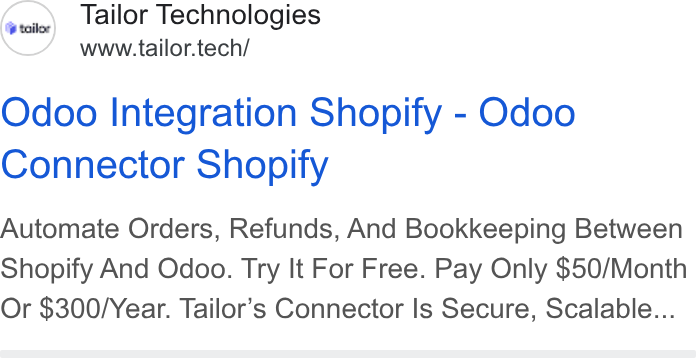
- Running
- 216 days (longevity = it's converting)
- Hook
- Odoo Integration Shopify - Odoo Connector Shopify
- CTA / offer
- Try It For Free. Pay Only $50/Month Or $300/Year.
- Audience
- Businesses using both Shopify and Odoo, looking for automation and integration solutions, indicated by the specific product names and problem statement.
Why it works. Bids on a competitor's name paired with Shopify to intercept searchers mid-comparison or mid-troubleshooting for that exact integration.
Specific problem-solution headline: "Odoo Integration Shopify - Odoo Connector Shopify" If your product connects to or replaces a named competitor, put both names together in a search headline to catch comparison-stage searches.

- Running
- 125 days (longevity = it's converting)
- Hook
- Tailor Technologies www.tailor.tech/ AI Inventory Management ERP
- CTA / offer
- Get Real-Time ERP Sync Today.
- Audience
- Businesses or individuals dealing with inventory management, purchase orders, faxes, and PDFs, indicated by the specific problem addressed.
Why it works. Layers an AI claim onto a well-understood category, inventory ERP, to differentiate from legacy competitors on the same search results page.
Headline stating a specific solution: 'AI Inventory Management ERP' Pair your newest capability with the established category name your buyer already searches, so you differentiate without re-educating them.
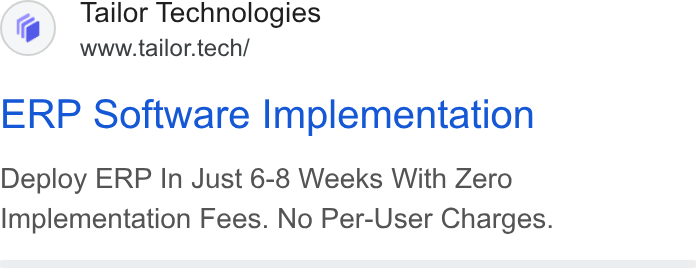
- Running
- 123 days (longevity = it's converting)
- Hook
- Visual: A logo with three stacked purple rectangles in a circle, followed by the text "Tailor Technologies" and "www.tailor.tech/". Below this, in large blue font, is "ERP Software Implementation".
- CTA / offer
- Deploy ERP In Just 6-8 Weeks With Zero Implementation Fees. No Per-User Charges.
- Audience
- Businesses or individuals looking for ERP solutions, indicated by the prominent text "ERP Software Implementation" and the offer details.
Why it works. Bids on the implementation-stage search term itself, catching buyers who are past evaluation and actively planning a rollout.
Headline stating the core service: "ERP Software Implementation" Write a search ad headline that mirrors the literal phrase your buyer types when they're ready to act, not just your product category.
Show 3 more ads
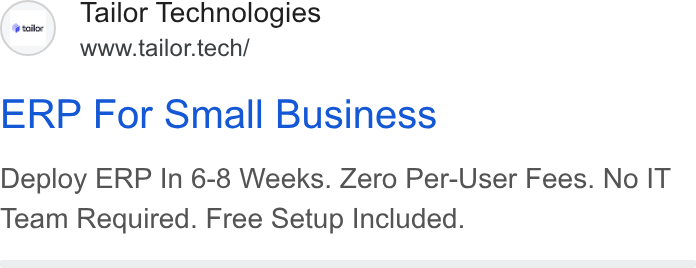
- Running
- 117 days (longevity = it's converting)
- Hook
- Tailor Technologies www.tailor.tech/ ERP For Small Business
- CTA / offer
- Free Setup Included.
- Audience
- Small business owners or managers looking for ERP solutions, indicated by 'ERP For Small Business' and the benefits like 'Zero Per-User Fees' and 'No IT Team Required'.
Why it works. Calls out small-business buyers by name in a category where most ERP marketing targets enterprise, filtering in the exact underserved searcher.
Headline directly states the solution and target: 'ERP For Small Business'. If your product serves a segment competitors ignore in their marketing, name that segment directly in your headline to pre-qualify the click.
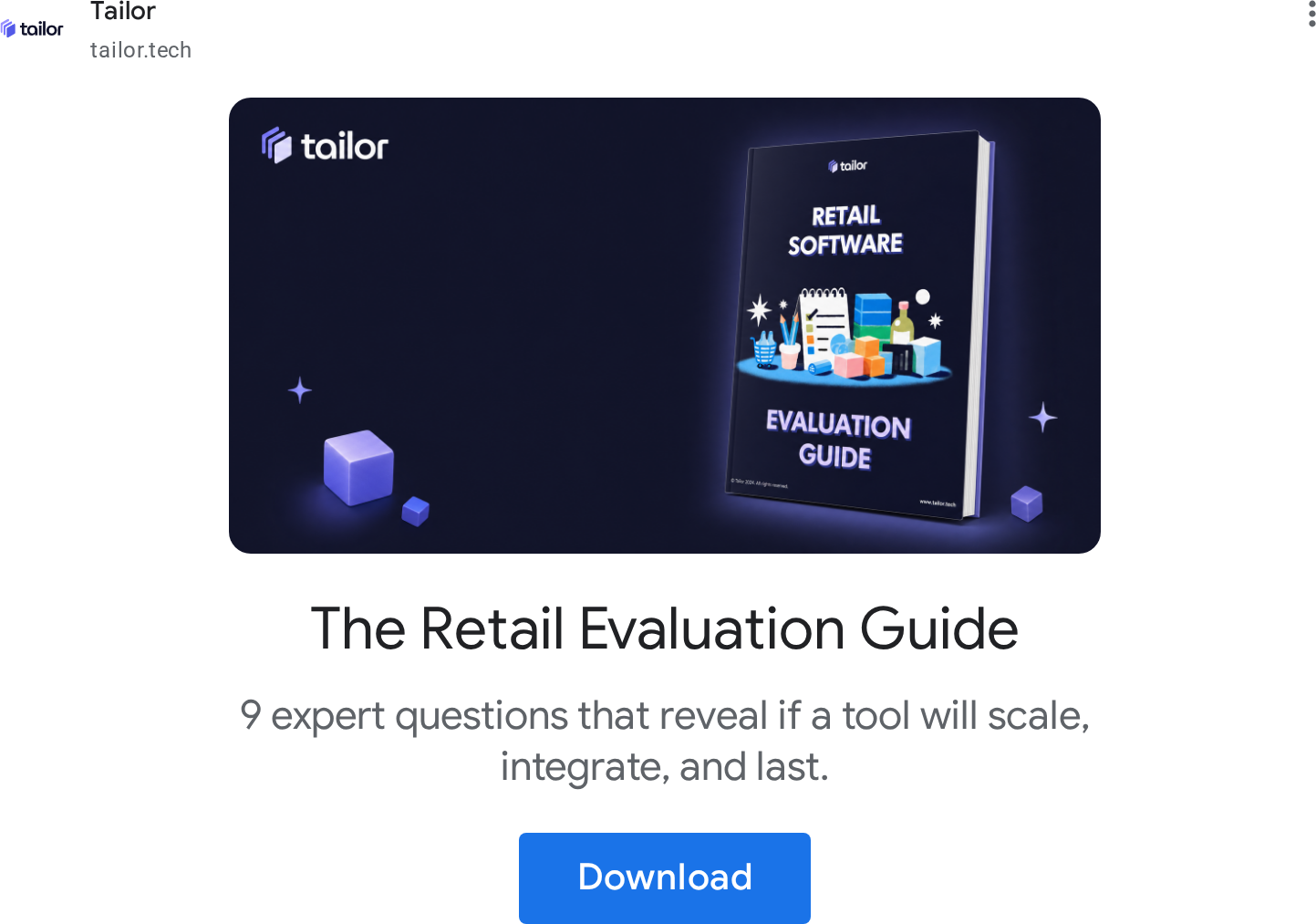
- Running
- 40 days (longevity = it's converting)
- Hook
- The image shows a dark blue book with the words "RETAIL SOFTWARE" and "EVALUATION GUIDE" on its cover, surrounded by small purple cubes and stars. Above the book, the text "tailor" is visible. Below the book, the headline "The Retail Evaluation Guide" is displayed.
- CTA / offer
- Download
- Audience
- Individuals or businesses involved in retail operations and software selection, indicated by "RETAIL SOFTWARE" and "The Retail Evaluation Guide".
Why it works. Uses a designed book-cover mockup for the same evaluation guide as the LinkedIn version, making a free PDF feel like a premium resource.
Prominent display of a free resource: The image features a book titled "RETAIL SOFTWARE EVALUATION GUIDE" as the central visual element. Design your lead magnet's cover like a real book or report, not a plain PDF icon, so the ad implies more value than a form-fill download.

- Running
- 235 days (longevity = it's converting)
- Hook
- Tailor Technologies www.tailor.tech/ Tailor ERP Platform
- Audience
- Businesses looking for an ERP solution, indicated by the text "Tailor ERP Platform" and integration mentions like "Shopify, QuickBooks, Netsuite & More."
Why it works. Uses a plain company-and-product-name search ad to capture branded-search traffic from people already looking for Tailor by name.
Clear company and product naming at the top: "Tailor Technologies" and "Tailor ERP Platform". Ensure your ad's headline or primary text clearly states your company name and the core product/service you offer within the first few words.
09 The playbook
The channels are not separate. They are one system where each stage feeds the next. Here is the read, then the plays to run tomorrow.
The inferred playbook
Tailor's loop starts with category-education content and a scarcity-driven origin story, converts through gated paid lead magnets into a sales-assisted quote process, and compounds through evergreen search rather than user-generated buzz.
Category-education guides and the "first Japan-based YC company since 2007" story pull in ERP researchers and press attention without requiring paid spend to seed initial visibility.
Google and LinkedIn ads intercept high-intent searchers and retarget them into gated PDFs rather than a self-serve trial, consistent with a custom-quote enterprise sale and two named product tiers (the full Tailor Platform and a lighter Tailor Omakase tier for fast-growing retail brands) that carry no public pricing.
Dig deeper+3▾
Open roles span a forward-deployed product role, a bilingual engineering hire, and a frontend engineer in Australia, spread across three time zones, a stage signal of a company standing up hands-on enterprise implementation capacity rather than a self-serve product-led layer.
There is no visible self-serve signup path, community, or creator layer; growth depends on sales and implementation capacity keeping pace with lead volume, not product-led virality. Self-reported figures put revenue at $3.8M in June 2024 growing to $14.6M by December 2024, neither independently verified, and no current figure is public.
free-to-paid conversion, churn, CAC, per-seat ARPU (pricing is quote-based and undisclosed).
Lead with a scarcity fact, not a feature list
The proofTailor's entire launch narrative rests on one framing, first Japan-based YC company since 2007, repeated across the founder's own funding and press posts rather than a product pitch.
The adaptationFind the genuinely rare fact about your own company (first in your city's accelerator in years, first tool built by a former operator at a specific well-known company, smallest team to reach a specific milestone) and make that single sentence the headline of your next launch post, cold outreach line, and directory listing, rather than leading with what the product does.
Cost: $0 · Time to signal: days · Works pre-PMF: yes
Gate a useful reference resource instead of running a demo ad
The proofTailor's dominant paid creative is not a demo request; it is a free "80+ Retail Conferences" directory, and it has stayed the majority of their active LinkedIn ad set.
The adaptationBuild one genuinely useful reference asset for your buyer (an annotated list, a benchmark table, a checklist) and gate it behind a single email field instead of a "book a demo" ad. Start by compiling 20-30 real entries in a spreadsheet and publishing it as a page; the mechanism is that people trade an email for a tool they'd bookmark anyway far more readily than they book a sales call from a cold ad.
Cost: under $500 · Time to signal: weeks · Works pre-PMF: yes
Write for the buyer's question, not your brand name
The proofTailor's top-ranking organic page holds the #1 spot for a purely generic category term, not their own company name, covered above.
The adaptationList the ten "what is X" or "how does X work" questions your buyers search before they've heard of any vendor, and write the single best page on the internet answering the top three. Publish under your own domain, not a gated PDF, so search engines can index it.
Cost: $0 (own time) or under $500 for a freelance writer · Time to signal: months · Works pre-PMF: yes, conditional on the pages being genuinely useful rather than thin SEO filler, which is what makes them worth linking to and ranking over time.
Post your own milestones from your personal account
The proofEvery major Tailor milestone, from the YC acceptance to the Series A close, was posted from Shibata's personal X handle to a modest 5,904 followers, not a brand page.
The adaptationThe next time you hit a real number (first paying customer, a specific revenue figure, a hard lesson from a failed experiment), post it as a personal reflection with that one concrete number from your own account rather than a company page. A fresh brand account has no earned trust or algorithmic reach; a named person's account does.
Cost: $0 · Time to signal: days · Works pre-PMF: yes
Bid on your buyer's incumbent, not your own name
The proofTailor's Google ads target switching-intent phrases like "Odoo Integration Shopify" and "Seamless ERP Integrations - No More Legacy ERP," intercepting people mid-migration from a competitor.
The adaptationIdentify the one legacy tool your buyers complain about most and write ad copy that speaks directly to that specific complaint, then bid on "[competitor] alternative" and "[competitor] migration" terms rather than your own brand name.
Cost: under $500 to test · Time to signal: weeks · Works pre-PMF: conditional, this only converts once you have a real, specific answer for why someone should switch, not just a lower price. Not transferable at an earlier stage: the quote-based enterprise sales motion, the forward-deployed implementation hiring, and the dual-market Tokyo/San-Francisco press machine all assume a funded team and an existing enterprise pipeline; a pre-revenue founder should adapt the scarcity-hook, gated-resource, and personal-milestone mechanics, not the full paid-ads-plus-sales-team apparatus.
You just read how Tailor does it. Tomorrow it is someone else.
Every morning we take one company that is actually growing and break down where its customers come from: the ads still running after a year, the channel doing the real work, and the play you can run this week.
Systemaic · directional intelligence. Traffic, spend, and reach figures are SimilarWeb-style estimates and qualitative reads of public data, not audited numbers. Built on real public receipts.
// teardowns with a similar GTM motion
sources & receipts (8)
Live ad libraries: linkedin ad library · google ad library
Launch archives: Hacker News: Google will use Chrome browsing data for ad tailoring · Hacker News: Fine-Tuning Llama-2: A Comprehensive Case Study for Tailorin · Hacker News: Cancer Vaccine, tailor-made for each patient, advances to St · Hacker News: Show HN: HN Resume to Jobs – AI Powered Job Matching Tailore · Hacker News: A good livestreaming setup is a well-tailored suit · Hacker News: King County rolls out Miranda rights tailored for young peop
Traffic, spend, and revenue figures are estimates as noted in the report; the links above are the primary public artifacts.