- 01Seed the Room That Decides
- 02Design Your Product's Absence
- 03Post the Product Decision You Refused to Make
- 04Screenshot the Right Testimonial into a Static Ad
01 Snapshot
The one-glance read on who they are and how they grow. Each point is verifiable from the receipts above.
An AI meeting notepad that captures audio on-device without deploying a visible bot into calls, targeting founders and operators at tech companies, priced from free to $35/user/month, at a $1.5B valuation as of the March 2026 Series C ($20M Series A, $43M Series B, $125M Series C, $192M raised in total).
Word-of-mouth-led within the VC and founder community, with paid search and paid social added as the user base expands beyond that initial cohort.
~1.88M estimated monthly visits (+23.3% trend); 1M+ users reached in the latter half of 2025; 10% weekly user growth sustained from the May 2024 public launch through late 2025; 250% revenue growth in the quarter before the Series C; 100 active Google ads plus a newer Meta presence as of 2026-07-04.
Co-founder and CEO Chris Pedregal, defending the product's no-auto-email decision: "AI meeting bots have a bad rap because they have historically prioritized growth hacks over keeping you in control. Our meetings and relationships are too complex for cookie cutter product decisions like this."
As of 2026-07-04, Granola is testing Meta creative angles built around specific workflow outputs: "Every sprint ends with tickets. Granola WRITES them" and "You ran the interview. Granola ran the email, the brief, the ATS," a shift from platform-level positioning toward task-level proof for non-founder personas.
The decision to keep AI invisible, no bot, no recording announcement, notes that look like the user wrote them, was simultaneously a product philosophy and a distribution mechanism that made Granola safe to use in any room and shareable without social friction in the communities where its first users lived.
02 How it unfolded
The order the channels came online. Sequence is strategy: what they did first, and what they layered on once demand existed.
03 Traffic & channel mix
Estimated demand, the channel split behind it, and the keywords and referrers doing the work. Directional modeling, not audited analytics.
Traffic sources
Top search keywords
| Keyword | Volume | Weight | CPC |
|---|---|---|---|
| granola | 343k | $1.98 | |
| granola ai | 168k | $1.97 | |
| granola app | 16k | $2.61 | |
| granola mcp | 5.9k | $3.34 | |
| gronola | 6.1k | $6.54 |
Top referring sites
Closest competitors by audience
~1.88M estimated monthly visits, trending up +23.3%. The channel mix tells a layered growth story: direct traffic at 26.4% reflects the word-of-mouth and press coverage that sent users who already knew the brand name; organic search at 23.5% is nearly all branded demand rather than informational content discovery, driven by ranking #1 for "granola ai" (167,860 total monthly searches across the web) and #2 for the generic term "granola" (342,640 total monthly searches). Paid search at 16.4% and paid social at 11.2% are channels Granola added relatively recently, Google ads date to September 2025, Meta to April 2026, indicating a deliberate shift toward capturing demand the word-of-mouth engine built and pushing reach beyond the founder community into broader knowledge-worker segments.
Referrals at 8.3% include a telling trio: lennysproductpass.com (Lenny Rachitsky's newsletter, widely read by product managers and operators) signals the product earned a feature or recommendation reaching exactly Granola's buyer profile; GitHub points to developer community traction and ecosystem integrations; creatoreconomy.so reflects coverage in creator-adjacent media. The remaining channels, email at 5.2%, display at 3.2%, social organic at 2.7%, Gen AI at 2.6%, affiliate at 0.6%, account for under 15% of visits combined.
Top keywords they rank and bid for: "granola ai" (167,860 monthly searches, ranked #1), "granola" (342,640 monthly searches, ranked #2), "granola app" (16,100 monthly searches), "granola mcp" (5,880 monthly searches). Closest in-category competitors: Fathom, Fireflies, tl;dv, Otter, Fellow, Circleback, Jamie, and Laxis.
04 Organic content
The specific pages earning their organic search traffic, and the pattern behind why they rank. Adapt the format, not the topic.
About 90% of the ~27,684 monthly visits to its top-ranked organic pages land on the homepage, which ranks #1 for "granola ai" and #2 for "granola." The remaining organic pages are transactional utility pages: pricing, download, security, and an explore page. The pattern here is almost entirely brand-search capture rather than informational content built for discovery, Granola earns organic visits from people who already heard the name from a colleague or investor and then searched to find the product. A blog exists on the site but does not appear in the top organic pages, and no evidence of content built around category-level or comparison keywords appears in the data. The strategic read: at this stage, organic search functions as a lagging indicator of the word-of-mouth engine, not an independent acquisition channel.
Top pages by organic traffic
05 Channel map
Not traffic share. How much weight the growth system actually puts on each channel, with a one-line read on the role it plays.
What drove growth
06 Who they’re hiring
Open roles read like a roadmap: the functions they’re staffing show where the company is investing next and what stage it’s at.
16 open roles
07 The motions doing the work
For founder-led SaaS the breakdown shifts from ads to traction: where the first users came from, how the founder grows it in the open, and the compounding organic surface.
Granola's first users came from a deliberately chosen community, and the company's fastest fundraise happened while the total user base was still small enough to fit in a conference room.
Sam Stephenson posted on May 22, 2024 announcing Granola was live on Product Hunt "after a year of prototypes and iteration." The HN submission that same day received 3 points, no front-page moment. The Product Hunt launch was the formal public signal, but the real distribution had already been seeded during the beta period into the VC and founder network.
The Series A ($20M, led by Spark Capital, October 2024) closed in approximately one week with only ~5,000 weekly active users. Sam Stephenson noted publicly that every investor who offered a term sheet was already a Granola user, which meant the investor diligence process was users evaluating their own daily workflow tool, not evaluators assessing an unfamiliar product.
Dig deeper+2▾
Chris Pedregal posted in September 2024 that Granola had "weirdly high PMF with founders of unicorn companies," naming Intercom co-founder Des Traynor as the eleventh they knew about. That post (122 likes, 28K views) gave the word-of-mouth engine a precise frame: the product was spreading through the exact social graph that VCs and operators use daily.
Sam Stephenson's June 2025 Windows announcement framed the expansion as opening Granola to "many millions more computer users", a public acknowledgment that the Mac-only constraint had bounded the user base within the Apple-heavy founder community, and that the next growth phase required crossing that hardware divide.
Chris Pedregal's X account is the primary build-in-public surface, with each post landing at a strategic moment rather than maintaining a steady posting cadence.
The April 2023 founding engineer hire post (82 likes, 30K views) introduced the company publicly before the product launched. The September 2024 "unicorn PMF" post named a specific kind of user and gave the word-of-mouth engine a social proof anchor that others could repeat. The September 2024 product philosophy thread, pushing back on investor pressure to auto-email notes to participants, earned 122 likes and 28K views by arguing product ethics in public, not announcing a feature. The March 2026 Series C announcement reached 1,222 likes and 506K views, the largest single post in the scraped evidence.
The September 2024 thread is the clearest example of build-in-public used as competitive positioning: "Our meetings and relationships are too complex for cookie cutter product decisions." The post differentiated Granola from bot-first competitors without naming them, and signaled to potential users that the company's values matched theirs on meeting privacy.
Dig deeper+1▾
At 3,497 followers, Sam Stephenson posts less frequently, concentrating on launch moments (the May 2024 public launch, the June 2025 Windows expansion). Lower volume, focused on milestone announcements rather than ongoing narrative.
Organic discovery is almost entirely brand-search-driven, with paid search functioning as the demand-capture layer and Meta as the broader awareness push.
The top organic pages are the homepage, pricing, and download, transactional pages capturing people who already know the name. With no informational content or comparison pages appearing in the top organic results, Granola is not competing for category-level keywords like "best AI meeting notes app" or "Fathom alternative" in organic search. Competitors including Fathom, Fireflies, and Otter.ai almost certainly own that informational content surface.
100 active ads as of 2026-07-04, with the longest-running at ~298 days. The proven Google winners anchor on problem-agitation ("No Meeting Bots - AI Note-Taking. Simple"), category positioning ("The Future of Work," "AI for Transcription"), and bottom-funnel intent ("Pricing plans | Granola"). A newer test, "Don't bring a bot to your Board meeting", expands the target context from routine stand-ups to high-stakes executive meetings.
Dig deeper+3▾
The longest-running Meta winners cluster around two angles. First: the "no bot" message in direct copy ("Great notes from your meetings, without bringing along a bot") across dynamic creative formats. Second: social-proof screenshots, Des Traynor's tweet ("I don't think I've ever gotten more thanks from people recommending an app than I have for @meetgranola") and Nat Friedman's testimonial running as static image ads. A UGC talking-head format ("These guys just raised $43M so you never have to take notes again") rounds out the proven set. Testing now: task-specific output hooks ("Every sprint ends with tickets. Granola WRITES them," "You ran the interview. Granola ran the email, the brief, the ATS") and a platform-reach message ("Granola works everywhere you do") featuring the Mac and Windows app icons side by side.
The partner program at partners.dub.co/granola is active. The mpaige13 affiliate's "Granola + Claude Skills" Meta series, positioning Granola as part of an AI workflow stack alongside Claude, with a DM-funnel mechanic for leads, shows affiliates independently generating creative and paid traffic. This channel accounts for 0.6% of estimated traffic, a small but real signal that the program is functioning.
The Lenny Rachitsky newsletter referral (lennysproductpass.com) is earned media reaching product managers and operators, Granola's natural expansion audience beyond founders.
08 Paid ads
This founder-led SaaS also runs paid acquisition. Here are the live ads doing the work, each with the X-ray and a play you can adapt.
- Running
- 74 days (longevity = it's converting)
- Hook
- "Granola works everywhere you do" text above a green square logo with a black spiral on a white card.
- CTA / offer
- "Try for free"
- Audience
- Knowledge workers and remote teams who use Slack, Google Meet, Microsoft Teams, or Zoom for daily meetings.
Why it works. Pairs a portability claim with matching app-icon visuals on a bright abstract backdrop to reassure remote workers switching devices.
Rapid cycling of platform logos (0:01-0:08) Run your top compatibility claim on a bright background paired with two matching icons to test if visual boldness lifts clicks.
- Running
- 52 days (longevity = it's converting)
- Hook
- "These guys just raised $43 million so you never have to take notes again" + a woman in glasses in a floating bubble over two men sitting in a loft-style office.
- CTA / offer
- Comment GRANOLA and I'll send you the link so you can check it out for free.
- Audience
- People with 'back-to-back meetings' and 'multitasking' calendars who use 'Apple Notes' or 'Mac'.
Why it works. Opens on a funding number as proof of momentum, then translates it directly into the exact daily annoyance it solves.
Anchoring with VC funding at 0:01: 'These guys just raised $43 million'. If you've raised funding, put the dollar figure in the same sentence as the specific task it lets users stop doing.
- Running
- 52 days (longevity = it's converting)
- Hook
- "Ready for ca" typing on a light grey background, transitioning to "more productive meetings?"
- Audience
- Knowledge workers and managers who take meeting notes, indicated by the "My notes" interface and business-specific content like "Q4 release priorities".
Why it works. Uses a mid-word text fade to buy a few extra seconds of attention before revealing what the question actually asks.
0:03-0:05 showing messy shorthand ("180", "100, growi"). Animate your headline so it visibly cuts off mid-word, then resolves, to buy an extra second of watch time.
Show 3 more ads
- Running
- 52 days (longevity = it's converting)
- Hook
- Abstract black ink strokes on a textured off-white background with upside-down text "ORK" and "THE" (0:00-0:03).
- Audience
- Professionals who attend meetings (shown via 'Better Engineering' and 'Design Crit' calendar items) and listen to high-level coaching (Matt Mochary CEO Coach).
Why it works. Opens on fragmented handwritten text that reads as a mid-thought note, priming viewers for a note-taking product before any logo appears.
Rapid-fire abstract visual hook (0:00-0:03) with upside-down text 'ORK'. Try opening your video on an abstract, product-relevant texture, like handwriting, before your logo shows, to earn a beat of attention first.
- Running
- 11 days (new — still being tested)
- Hook
- "all these crazy complex notes without a notetaker on the call. How is that?" spoken by a man in a cream sweater in a split-screen podcast setup.
- Audience
- Professionals who attend meetings (visual evidence: app screen showing "GTM Cross-Functional Priorities" and "Media Literacy vs Media Involvement").
Why it works. Opens mid conversation with one person questioning how the other takes such detailed notes, giving the ad a peer testimonial feel before any product mention.
Peer-to-peer dialogue (0:00-0:23) Film two people mid conversation where one questions how the other produces such detailed notes, and reveal the tool only after the hook lands.
- Running
- 298 days (longevity = it's converting)
- Hook
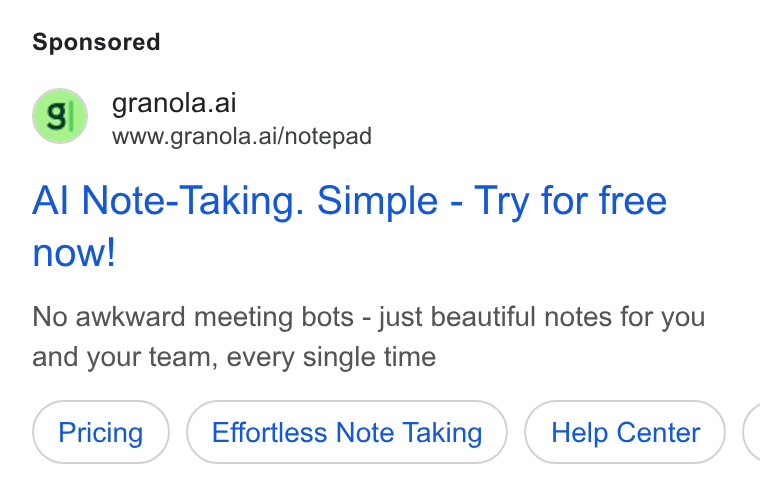
- Sponsored granola.ai www.granola.ai/notepad AI Note-Taking. Simple - Try for free now!
- CTA / offer
- Try for free now!
- Audience
- Individuals and teams who take notes in meetings and want to avoid 'awkward meeting bots'.
Why it works. Strips the pitch down to ease plus a free trial, aimed at people already comparing note-taking tools who just need a reason to click now.
Headline with benefit and immediate offer: "AI Note-Taking. Simple - Try for free now!" Follow your core benefit word with an immediate no-cost CTA in the same line so cost and complexity objections disappear together.
09 The playbook
The channels are not separate. They are one system where each stage feeds the next. Here is the read, then the plays to run tomorrow.
The inferred playbook
Granola's 16 open roles split between a large engineering bloc (Product Engineer x5, AI Engineer, Security Engineer, Design Engineer, Product Designer Mobile) and a forming commercial layer (Head of Enterprise Sales, Account Executive, SDR, Revenue Operations Lead, GTM Engineer), the textbook PLG-to-enterprise hiring pattern, with self-serve distribution already working and an outbound motion being layered on top to convert large-org demand.
The product's on-device audio capture removed the social cost of using AI in sensitive rooms, making Granola safe to share in VC and founder networks where bot anxiety runs highest. This was both a product decision and a deliberate persona choice, seeding where word-of-mouth velocity would be fastest.
Design Engineering Nights and Granola Firesides bring the relevant audience physically to Granola's London office, generate recorded content for YouTube, and position the company as a gathering point for the design-engineer and founder communities rather than just a meeting tool. The 1.9M-view "Recipes" product launch video shows that the community surface occasionally breaks out of the niche audience.
Dig deeper+3▾
Google ads since September 2025 and Meta since April 2026 capture branded demand the word-of-mouth engine built, and are now being tested on broader category hooks and workflow-specific audiences (sprint teams, recruiters) that extend beyond the original founder persona.
No programmatic SEO motion, no "alternatives to Granola" or comparison-page strategy, and no informational content visible in the top organic pages. With Fathom, Fireflies, and Otter.ai likely ranking on category-level informational terms, the top-of-funnel organic surface is almost entirely ceded to paid search and referrals. Whether this is deliberate given the strength of word-of-mouth or an unmade investment is not clear from public signals.
Free-to-paid conversion rate, monthly churn, CAC by channel, blended ARPU.
Seed the Room That Decides
The proofGranola's earliest users came from seeding the VC and founder community during beta, before the May 2024 public launch. Sam Stephenson noted publicly that every investor who offered a term sheet was already a daily user. The Series A closed in approximately one week with ~5,000 WAU because the investors weren't evaluating an unfamiliar product, they were users deciding whether to back something they already relied on.
The adaptationBefore your first fundraise or growth push, identify the 20 to 50 people in your category whose daily habits are visible to your buyers: analysts, investors, newsletter writers, community organizers in your specific vertical. Get the product into their hands personally and without asking for anything in return. Start by listing who your ideal customers follow on X or whose newsletters they read, then send a personal note offering early access. The mechanism: your buyers evaluate social proof by source quality, not volume, so one recognizable person who uses your tool daily outperforms 500 cold signups as a credibility signal to the next wave of users.
Cost: $0 · Time to signal: months · Works pre-PMF: yes, provided the product reveals its value through daily use without a demo or pitch
Design Your Product's Absence
The proofThe no-bot architecture, audio captured on-device, no visible attendee in the call, no automated email to participants, was Granola's core product differentiator and also its primary word-of-mouth mechanism. Chris Pedregal defended this publicly in September 2024, pushing back on investor suggestions to add auto-email features. The ad library confirms the positioning held: "Great notes from your meetings, without bringing along a bot" became the proven Meta copy anchor running for over 52 days.
The adaptationFor any B2B tool, audit the list of things your competitors do that make buyers reluctant to use the product in front of clients, in board meetings, or with external parties: logging everything to a shared cloud, adding a visible participant, sending automated communications to people outside the buyer's company. Removing one of those friction points for your specific buyer persona can turn a private user into a vocal recommender. First step: interview five current users and ask what they would not feel comfortable doing with your product in front of a client or a senior executive. That answer is your next product priority and your most honest marketing frame.
Cost: $0 · Time to signal: months (product change plus adoption cycle) · Works pre-PMF: yes
Post the Product Decision You Refused to Make
The proofChris Pedregal's September 2024 X thread, pushing back on investor pressure to auto-email meeting notes to participants, earned 122 likes and 28,000 views from an account with 10,033 followers. The post argued product ethics in public rather than announcing a feature. The engagement came from founders and operators who recognized the tension and shared it within their networks.
The adaptationWhen you make a product decision that goes against conventional advice or that investors or advisors push you to reverse, write it up publicly: what the pressure was, why you disagreed, and what principle guided the choice. Post it on X or LinkedIn. The intended audience is people in your category who have the same frustration with how competitors handle the same tradeoff and want to see that someone building in the space thinks like they do. Start by listing the three things you refused to build because you believed they would harm the user experience, and write the post about the one you feel most strongly about. The more specific the product decision, the more signal it carries; generic "we put users first" posts carry none.
Cost: $0 · Time to signal: days · Works pre-PMF: yes
Screenshot the Right Testimonial into a Static Ad
The proofGranola's proven Meta winners include a static image of Intercom co-founder Des Traynor's tweet: "I don't think I've ever gotten more thanks from people recommending an app than I have for @meetgranola. Everyone thinks they have a good meeting notes app, but it's only once they use Granola they realise what they've been missing." The creative works because Traynor's name is recognizable to Granola's buyer, his handle and account context are visible in the screenshot, and the specific claim, being thanked for a recommendation, signals second-order virality rather than plain satisfaction.
The adaptationCollect three to five testimonials from people your buyers already recognize: a founder in your niche with an active X presence, an operator whose opinions your buyers follow, a newsletter writer with a named audience in your space. Screenshot the actual public post with the handle visible, get permission to run it, and test it as a static image ad on Meta targeting your core buyer persona. Start by searching X for posts mentioning your product from accounts with more than 2,000 followers in your vertical. The mechanism: one recognizable source outperforms fifty anonymous five-star reviews because buyers are already calibrated to that person's judgment on other topics.
Cost: under $500 (ad spend to test; creative costs nothing) · Time to signal: weeks · Works pre-PMF: conditional, requires at least one genuinely enthusiastic testimonial from a recognizable name in your category; running a weak testimonial as a paid ad amplifies the weakness
Host the Meetup Your Buyers Already Wanted
The proofGranola's Design Engineering Nights at their London office bring speakers from Linear, Figma, PostHog, DuckDuckGo, Lovable, and GitHub, exactly the design-engineer persona that uses Granola and talks about it within their networks. The talks are recorded and uploaded to YouTube, creating a durable content archive. The same channel produced "Say hello to Recipes," a product launch video that reached 1.9M views, showing the community surface can compound beyond the room.
The adaptationIdentify a job-function or interest cluster that overlaps heavily with your buyer, framed as a topic community rather than a user group: not "Granola users meetup" but "design engineers who care about interaction feel." Pick a recurring narrow theme, book a room at your office or a co-working space, recruit two to three speakers from recognizable companies in your niche, record the talks, and post them to YouTube. Speakers promote their own appearance to their own audiences, which brings the right people into contact with your brand through association rather than advertising. First step: choose the one job-function topic your best users care about beyond your product itself, then identify three potential speakers by browsing who has posted publicly about that topic in the last six months.
Cost: under $500 per event · Time to signal: months · Works pre-PMF: conditional, requires a clear enough product focus to attract a coherent audience; a company still searching for its ICP will attract a diffuse crowd that produces no compounding community signal Not transferable at an earlier stage: the $192M in funding, the enterprise sales team Granola is assembling (Head of Enterprise Sales, Account Executive, SDR), and the Windows expansion at scale are all late-stage moves that require budget and organizational capacity unavailable before PMF. The paid search library of 100 active ads and the Meta spend require both meaningful budget and a brand that already has search demand to capture. The five plays above draw from Granola's early motion, plays one through three cost nothing and can run the week you read this.
You just read how Granola does it. Tomorrow it is someone else.
Every morning we take one company that is actually growing and break down where its customers come from: the ads still running after a year, the channel doing the real work, and the play you can run this week.
Systemaic · directional intelligence. Traffic, spend, and reach figures are SimilarWeb-style estimates and qualitative reads of public data, not audited numbers. Built on real public receipts.
// teardowns with a similar GTM motion
sources & receipts (8)
Live ad libraries: meta ad library · google ad library
Launch archives: Hacker News: Don't animate height · Hacker News: Glyphosate found in granola, crackers and oatmeal · Hacker News: Open-source granola (meetings summary) · Hacker News: Show HN: Muesli – If Granola and Wisprflow had an open sourc · Hacker News: Twix Is OK but Granola Isn't as States Deploy New Food Stamp · Hacker News: Dangerously-skip-permissions is the only safe mode
Traffic, spend, and revenue figures are estimates as noted in the report; the links above are the primary public artifacts.