- 01Post growth milestones from your own account, not the brand's
- 02Publish how you build, not just what you shipped
- 03Run an invite-only beta before you open the doors
- 04Bid on your competitor's "alternative" search intent
01 Snapshot
The one-glance read on who they are and how they grow. Each point is verifiable from the receipts above.
A fast, opinionated issue tracker and project-management tool for software teams, with press estimates putting ARR near $100M around April 2026.
Founder-led and organic-led, with disciplined always-on Google search ads layered on top of an organic-first foundation.
~8.57M monthly visits (+15.7% over the last 3 months), 14 of 21 Google ads active, and 20 open roles, all as of 2026-07-08.
As of 2026-07-08, Linear's newest Google search ads pitch "AI Coding Agents" and "AI Code Review," testing an agent-workflow angle beside its core issue-tracker pitch.
With 77.9% of traffic arriving direct, growth here is compounding brand recall inside engineering teams rather than a funnel any single channel drives.
02 How it unfolded
The order the channels came online. Sequence is strategy: what they did first, and what they layered on once demand existed.
03 Traffic & channel mix
Estimated demand, the channel split behind it, and the keywords and referrers doing the work. Directional modeling, not audited analytics.
Traffic sources
Top search keywords
| Keyword | Volume | Weight | CPC |
|---|---|---|---|
| linear | 470k | $2.56 | |
| linear app | 28k | $4.03 | |
| linear mcp | 11k | $5.17 | |
| linear pricing | 8.6k | $5.56 | |
| linear careers | 4.8k | $4.14 |
Top referring sites
Closest competitors by audience
Linear pulls an estimated ~8,572,820 monthly visits, up 15.7% over the last 3 months. Direct traffic dominates the mix at 77.9%, consistent with a daily-use SaaS product where existing teams are re-opening the app rather than discovering it fresh each visit. Search Organic (7%) and Social Organic (5.2%) are the next two channels of note: organic search captures people actively evaluating a Jira alternative, while the social share tracks with the founders' own X audiences amplifying threads that click through. The rest, referrals, email, Gen AI search, and paid search/social/display combined, totals under 10%.
The keywords they show up for skew almost entirely branded: "linear" pulls 469,790 searches/month across the web, "linear mcp" pulls 10,640/month (MCP, the Model Context Protocol standard for connecting AI agents to external tools, signals rising demand from teams wiring Linear into agent workflows), and "linear pricing" pulls 8,560/month, a high-intent, late-funnel query. Referrers point to an integration-driven tail: composio.dev (a developer platform connecting AI agents to tools like Linear via API/MCP integrations), and usepylon.com (a customer-support platform with a native Linear integration), and trengo.com, reachable to Linear only through third-party tools like Zapier, not its own integrations page. Named competitors for the same team-tooling budget include jira.com, the incumbent Linear's own ad copy positions directly against, alongside clickup.com and notion.so.
04 Organic content
The specific pages earning their organic search traffic, and the pattern behind why they rank. Adapt the format, not the topic.
Linear's organic footprint is concentrated, not broad: the homepage alone accounts for the majority of organic clicks, with the rest split across a handful of high-intent product pages rather than a wide blog catalog. The supporting pages are a changelog entry documenting their MCP rollout, the pricing page, and a dedicated AI feature page, each ranking #1 for its respective term ("linear," "linear ai," "linear mcp," "linear app"). This is a brand-capture pattern, not a top-of-funnel content play: the pages exist to close the loop on people already searching for Linear by name or evaluating a specific capability (AI, pricing, agent integrations), and they rank because Linear's brand search volume is already dominant and Google rewards the changelog's topical freshness on emerging terms like "linear mcp."
Top pages by organic traffic
05 Channel map
Not traffic share. How much weight the growth system actually puts on each channel, with a one-line read on the role it plays.
What drove growth
06 Who they’re hiring
Open roles read like a roadmap: the functions they’re staffing show where the company is investing next and what stage it’s at.
20 open roles
07 The motions doing the work
For founder-led SaaS the breakdown shifts from ads to traction: where the first users came from, how the founder grows it in the open, and the compounding organic surface.
Linear's traction curve runs through a founder-announced public launch after a long private beta and repeated organic returns to Hacker News's front page, not a coordinated multi-platform launch day.
Co-founder and CPO Jori Lallo announced the public launch on June 30, 2020, writing "After a year in private beta we're launching @linear_app to everyone today," turning roughly twelve months of restricted access into the opening beat of the public story.
Linear's Show HN debut, covered above, kept recurring years later through engineering and design essays rather than product-launch posts, keeping the company in front of the same technical audience on its own terms.
Dig deeper+2▾
Co-founder and CEO Karri Saarinen announced a $13M Series A in December 2020, six months after public launch, then a $35M Series B in September 2023 and an $82M Series C at a $1.25B valuation in June 2025, each posted from his personal account rather than a press release.
Lallo told his audience in October 2022, "No AB tests, no growth tactics, no hashtags, no marketing department, no cartoon characters on ladders," framing the entire traction story as a product-and-taste bet rather than a channel bet.
Nearly every public growth beat, launches, funding, and philosophy, comes from Saarinen and Lallo posting as themselves, not from a branded marketing account, with the company's third co-founder, CTO Tuomas Artman, keeping a lower public profile.
Saarinen posts to 89,605 followers across 12,872 posts on X and to 60,814 followers on LinkedIn, making his personal feed the largest single distribution surface the company has, larger than the brand's own X presence referenced above.
Lallo runs a smaller but more active personal account, 13,840 followers across 37,216 posts on X, and it's where the original 2020 launch announcement and the "no growth tactics" position, both covered above, actually ran.
Dig deeper+2▾
The posts that land hardest split into two types: funding milestones (the Series B announcement pulled 346,665 views, the Series C announcement pulled 178,262 views) and design-philosophy threads, like Saarinen's December 2022 post contrasting Linear's dark, screenshot-forward site against 2019-era "Corporate Memphis" SaaS pages (the era's trend of generic flat-illustration marketing sites), which drew 1,243 likes.
Saarinen also builds in public about strategy itself, arguing in a November 2025 post that "viral marketing is often a mistake" for early-stage startups because it attracts curious visitors instead of true early adopters, turning his own GTM thinking into another post format.
Organic search is a minority channel here, so the real system is a small number of pages built to close out brand and capability searches, backed by narrow, defensive paid spend rather than broad demand generation.
Search organic holds 7% of traffic (covered above), and the site carries a blog for ongoing content output, but the pages that actually rank are product surfaces, not a wide blog catalog, so the system leans on the product itself being the content.
The MCP changelog page, covered above, sits on a keyword surface that should keep gaining search volume as more teams adopt agent workflows, without a new page needed to capture it.
Dig deeper+2▾
Of the ads still active as of 2026-07-08 (count covered above), the proven winners bid on generic issue-tracker terms and a dedicated "jira/alternative" landing page, a direct conquesting move against the incumbent it competes with (expanded as Play 4 below), while the newest tests pitch "AI Coding Agents" and "AI Code Review" (flagged above), pushing into agent-workflow demand instead of pure issue-tracking.
There's no partner, referral, or affiliate program visible in the site evidence, consistent with a motion that runs on product-led word of mouth and paid brand defense rather than a recruited distribution force.
08 Paid ads
This founder-led SaaS also runs paid acquisition. Here are the live ads doing the work, each with the X-ray and a play you can adapt.

- Running
- 461 days (longevity = it's converting)
- Hook
- Sponsored Linear www.linear.app/issue-tracking Fast, Modern Task Management - Blazingly Fast
- Audience
- The ad targets professionals or teams involved in software development or project management, indicated by the mention of "issue-tracking" in the URL and "Git integrations" in the description.
Why it works. Stacks the same speed claim three times in one headline so the single takeaway, speed, survives even a half second glance.
Headline with bold claims: "Fast, Modern Task Management - Blazingly Fast" Pick one differentiator and restate it two or three times in different words within the same headline instead of listing multiple features.
- Running
- 653 days (longevity = it's converting)
- Hook
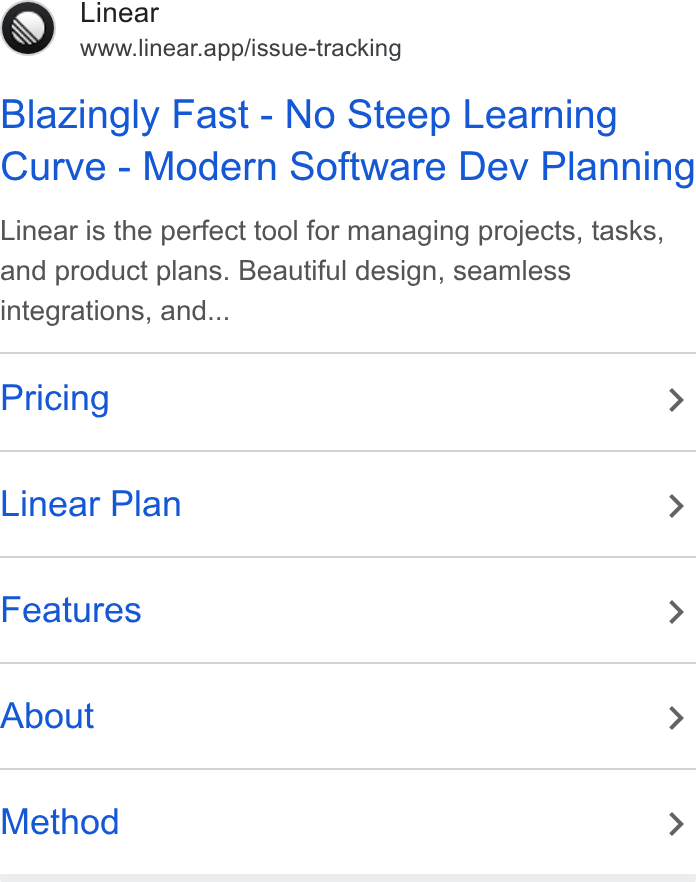
- Visual: A circular logo with a white design on a black background, next to the text "Linear" and "www.linear.app/issue-tracking". Below this, a large blue headline reads "Blazingly Fast - No Steep Learning Curve - Modern Software Dev Planning".
- Audience
- The text "Modern Software Dev Planning" and the mention of "managing projects, tasks, and product plans" targets individuals or teams involved in software development and project management.
Why it works. Directly answers the switching-cost objection, learning curve, alongside a speed claim, aimed at dev teams evaluating a tool switch.
The headline states "Blazingly Fast - No Steep Learning Curve - Modern Software Dev Planning". If switching cost is a real objection for your buyer, name it explicitly in the headline instead of only implying it.
- Running
- 476 days (longevity = it's converting)
- Hook
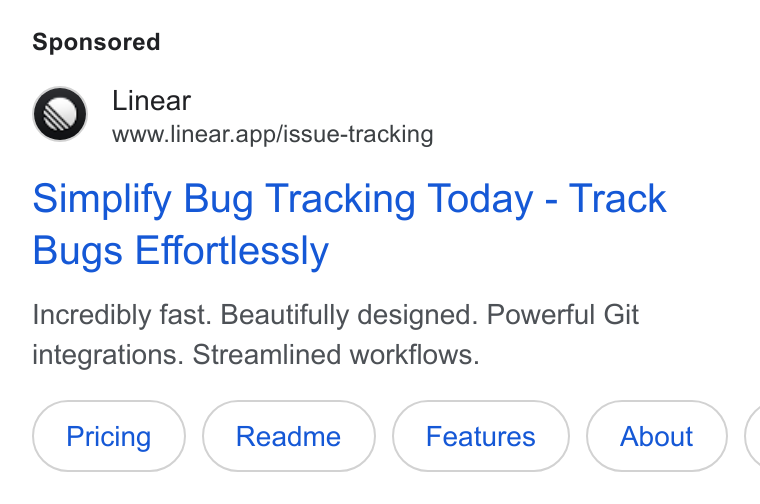
- Sponsored Linear www.linear.app/issue-tracking Simplify Bug Tracking Today - Track Bugs Effortlessly
- Audience
- Software developers or project managers are targeted, evidenced by the terms 'Bug Tracking', 'Git integrations', and 'Streamlined workflows'.
Why it works. Reinforces exact-match keyword relevance for the bug-tracking search query by repeating the target term across both headline lines.
Headline directly addresses a pain point and offers a solution: "Simplify Bug Tracking Today - Track Bugs Effortlessly" Repeat your core keyword across both headline lines of a search ad to reinforce relevance and quality score.
Show 3 more ads
- Running
- 476 days (longevity = it's converting)
- Hook
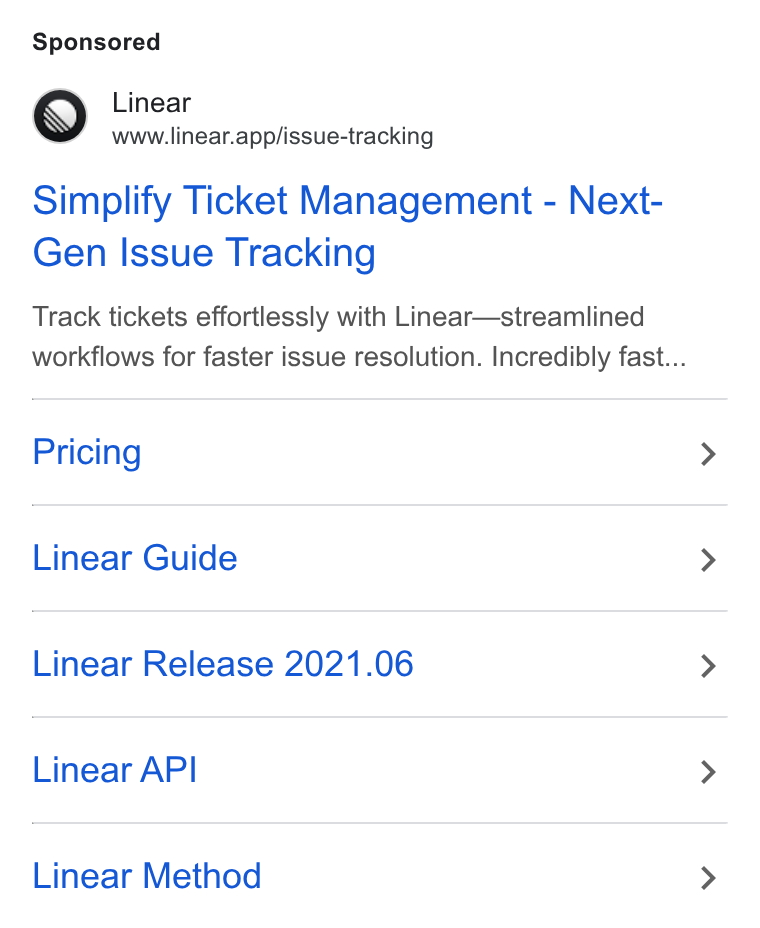
- Sponsored Linear www.linear.app/issue-tracking Simplify Ticket Management - Next-Gen Issue Tracking
- Audience
- The ad targets businesses or teams dealing with 'issue tracking' and 'ticket management', indicated by the product description and related links.
Why it works. Targets ticket-management searchers switching from legacy tools by framing Linear as the modern replacement category.
Headline directly addresses a pain point and offers a solution: "Simplify Ticket Management - Next-Gen Issue Tracking". If you compete with a legacy incumbent, pair your category term with next-gen or modern to signal an upgrade.
- Running
- 41 days (longevity = it's converting)
- Hook
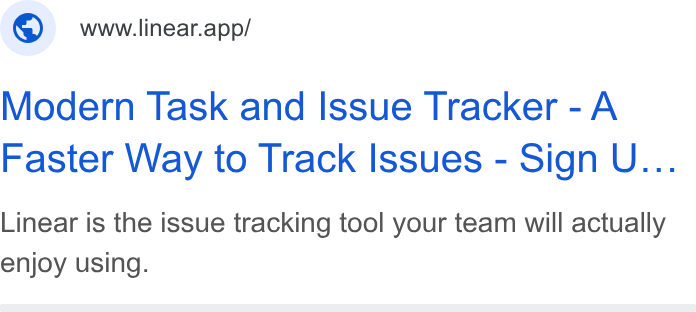
- www.linear.app/ Modern Task and Issue Tracker - A Faster Way to Track Issues - Sign U...
- CTA / offer
- Sign U...
- Audience
- Teams and professionals who use issue tracking tools, indicated by 'your team' and the focus on 'Task and Issue Tracker'.
Why it works. Combines a category label with a comparative speed claim and a truncated sign-up CTA that Google visibly renders, prompting the click.
Headline with a strong benefit and call to action: 'Modern Task and Issue Tracker - A Faster Way to Track Issues - Sign U...' End your headline with a truncated CTA like 'Sign U' so Google's ellipsis visually signals more is behind the click.
- Running
- 41 days (longevity = it's converting)
- Hook
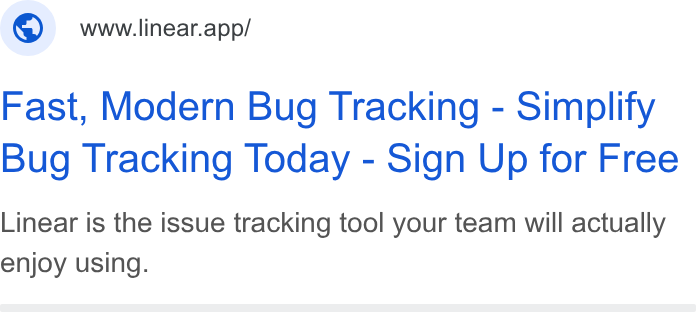
- www.linear.app/ Fast, Modern Bug Tracking - Simplify Bug Tracking Today - Sign Up for Free
- CTA / offer
- Sign Up for Free
- Audience
- Teams and individuals involved in software development or project management who are looking for an improved bug/issue tracking tool. This is signaled by phrases like "Bug Tracking", "issue tracking tool", and "your team".
Why it works. Removes the cost objection for bug-tracking searchers by pairing the speed claim with a free sign-up in the same headline.
Headline with a strong benefit and call to action: "Fast, Modern Bug Tracking - Simplify Bug Tracking Today - Sign Up for Free" Stack your core benefit claim directly against a free offer in the same headline to remove the cost objection at the click stage.
09 The playbook
The channels are not separate. They are one system where each stage feeds the next. Here is the read, then the plays to run tomorrow.
The inferred playbook
The loop starts with earned attention the founders generate personally, converts through a free tier generous enough to run a real team on, and compounds through daily product use rather than repeat marketing touches. The 20 open roles skew toward customer-facing revenue functions, Account Executive, Customer Success Manager, Implementation Manager, Solutions Engineer, alongside compliance and accounting hires, reading as an enterprise-sales and trust layer being built on top of an already-proven self-serve base.
Founder threads and engineering essays, both covered above, do the top-of-funnel work that ads would otherwise do, feeding people who are already primed to try the product.
The entry-level Basic plan (unlimited issues, 5 teams) at $10/user/month lets a whole small team run real work before anyone hits a paywall, and the paid step-up from there is a flat per-seat price, Business at $16/user/month for AI-assisted triage and analytics, so the upgrade decision is about team size and features rather than access.
Dig deeper+3▾
Direct traffic at 77.9% of all visits (covered above) means the loop mostly closes itself once a team adopts Linear: people are opening a tool they already use rather than being re-marketed to.
There's no visible creator, affiliate, or multi-surface launch-day motion here, so a business without the founders' existing personal following would have to manufacture its own equivalent earned-attention engine from scratch.
free-to-paid conversion rate, churn, and CAC.
Post growth milestones from your own account, not the brand's
The proofLinear's biggest funding moments ran through Saarinen's and Lallo's personal accounts, with the Series B post alone reaching 346,665 views, far outpacing anything the brand account generated.
The adaptationStart by moving your next real milestone, a revenue number, a launch, a hard lesson, off the company account and onto your own profile, written in first person with the actual number attached. People follow specific humans building something, not logos, so a founder's account earns reach a brand handle never will at small scale.
Cost: $0 · Time to signal: days · Works pre-PMF: yes
Publish how you build, not just what you shipped
The proofLinear's recurring front-page technical and design essays, not launch posts, kept it returning to the same community's attention for years (covered above).
The adaptationPick one real engineering or design decision from the last month, why you chose a schema, why you rejected a feature, and write it as a standalone essay for the community where your users already gather, then submit it yourself. Specific, opinionated process writing earns attention that a generic launch post does not.
Cost: $0 · Time to signal: weeks · Works pre-PMF: yes, provided you have a real technical or design decision worth explaining; an essay with no substance behind it won't get traction.
Run an invite-only beta before you open the doors
The proofLinear stayed invite-only for roughly a year before its public launch tweet (covered above), turning restricted access into anticipation instead of an empty room on day one.
The adaptationBefore opening broadly, cap your beta at a waitlist and hand-pick the first cohort from people who match your ideal user, then let them pull friends in rather than opening signups to everyone. Scarcity plus a curated first cohort produces word of mouth that a wide-open free-for-all launch does not.
Cost: $0 · Time to signal: months · Works pre-PMF: yes, but this is a one-time move tied to a single launch moment, not a repeatable channel.
Bid on your competitor's "alternative" search intent
The proofLinear's longest-running Google ads (covered above) point to a dedicated "jira/alternative" landing page bidding on issue-tracker terms.
The adaptationBuild a single comparison landing page naming your category's incumbent directly, then bid narrowly on "[competitor] alternative" and "[competitor] vs" search terms rather than broad category keywords. This targets people already frustrated with a specific tool and mid-switch, a much higher-intent audience than generic category terms.
Cost: under $500 · Time to signal: weeks · Works pre-PMF: conditional, only works once you have a specific, credible answer to "why switch," not just a lower price.
Make the free tier a real workspace, not a demo
The proofLinear's entry-level Basic plan (covered above) caps out at 5 teams instead of capping seats, with unlimited issues so a whole team can actually use the product without hitting a usage ceiling.
The adaptationSet your free tier's limit on volume or history rather than on seats or core features, so a whole team can genuinely adopt the product and feel the cost of outgrowing it. Teams that already depend on the tool convert themselves when they hit the ceiling, instead of being sold to by a rep.
Cost: under $5k · Time to signal: months · Works pre-PMF: conditional, this only works once the core product is good enough that unrestricted use converts on its own. Not transferable at an earlier stage: the founders' own large personal followings, built over years before most of this evidence was captured, are the quiet precondition under several of these plays, and the invite-only beta itself only works once, as a single launch moment rather than a repeatable channel.
You just read how Linear does it. Tomorrow it is someone else.
Every morning we take one company that is actually growing and break down where its customers come from: the ads still running after a year, the channel doing the real work, and the play you can run this week.
Systemaic · directional intelligence. Traffic, spend, and reach figures are SimilarWeb-style estimates and qualitative reads of public data, not audited numbers. Built on real public receipts.
// teardowns with a similar GTM motion
sources & receipts (7)
Live ad libraries: google ad library
Launch archives: Hacker News: Immersive Linear Algebra (2016) · Hacker News: Interactive Linear Algebra · Hacker News: Introduction to Applied Linear Algebra: Vectors, Matrices, a · Hacker News: A 2020 Vision of Linear Algebra · Hacker News: An Intuitive Guide to Linear Algebra (2012) · Hacker News: Linear Algebra Done Right – 4th Edition
Traffic, spend, and revenue figures are estimates as noted in the report; the links above are the primary public artifacts.