- 01Turn a personal money story into a feature launch
- 02Run a public first-customers swap
- 03Bid on your own name before someone else does
- 04Package a niche survey into your paid-ad hook
01 Snapshot
The one-glance read on who they are and how they grow. Each point is verifiable from the receipts above.
Business banking and financial-workflow software (accounts, cards, invoicing, expense management) for startups and small businesses, past 300,000 customers as of its February 2026 annual letter.
Founder-led, reinforced by an always-on paid-search program rather than a single viral channel.
$650M annualized revenue as of Q3/Q4 2025 (up from $500M at the end of 2024), a $200M Series D at a $5.2B valuation announced May 2026, and ~3.5M estimated monthly visits (-5% over the last 3 months).
As of 2026-07-07, live experiments include a LinkedIn push for Command, Mercury's new agentic-banking AI feature that lets customers kick off AI agents to handle financial work, early ecommerce holiday-report creative already seeded on LinkedIn, and several new Google search variants launched between April and June 2026.
Growth compounds across three tracks at once: CEO Immad Akhund narrating milestones to a 527K-follower X audience, a Google search campaign with ads still running after more than three years, and a single 2023 banking-crisis moment that reset the company's customer base within months.
02 How it unfolded
The order the channels came online. Sequence is strategy: what they did first, and what they layered on once demand existed.
03 Traffic & channel mix
Estimated demand, the channel split behind it, and the keywords and referrers doing the work. Directional modeling, not audited analytics.
Traffic sources
Top search keywords
| Keyword | Volume | Weight | CPC |
|---|---|---|---|
| mercury | 525k | $2.54 | |
| mercury bank | 115k | $16.46 | |
| mercury login | 14k | $0.89 | |
| mercury careers | 8.9k | $1.66 | |
| mercury bank login | 7.6k | $1.44 |
Top referring sites
Closest competitors by audience
Mercury draws an estimated ~3.5M monthly visits, down 5% over the last 3 months. Direct traffic dominates the mix at 76.1%, an unusually high share that fits a banking product customers log into repeatedly rather than discover fresh (the #2 organic page is the app login screen itself, not marketing content). Organic search sits at 10.8% and paid search at 2.5%, the remainder, email, referrals, display, social, generative-AI referrals, and affiliate, together total under 12% and none individually clears 3.5%. The keywords they show up for are almost entirely brand-name searches: "mercury" draws roughly 525,000 monthly searches, "mercury bank" about 115,000, and "mercury login" around 14,000, demand for the company itself rather than category terms like "startup banking." Its top referring domains are salesloft.com and force.com (Salesforce's platform), both B2B sales-tooling properties rather than press or editorial links, suggesting the referral traffic is coming from sales-stack integrations and outbound tooling, not media coverage. Among named competitors, Brex and Ramp are the direct card/spend-management rivals, while Stripe is listed as a competitor domain despite functioning more as an adjacent payments platform than a head-to-head banking substitute.
04 Organic content
The specific pages earning their organic search traffic, and the pattern behind why they rank. Adapt the format, not the topic.
The pages actually earning Mercury's organic traffic are overwhelmingly brand and product surfaces: the homepage alone pulls roughly half of it, followed by the app login page, the personal-banking landing page, and the "about" page. The one exception is a blog post, a "best invoicing software for startups" roundup, the classic comparison/listicle format built to intercept commercial-intent long-tail searches. That mix shows an organic footprint still riding almost entirely on branded-search equity (people typing "mercury" or "mercury login") rather than a built-out content engine, with only a single piece of published content proving the format can work if replicated at scale.
Top pages by organic traffic
05 Channel map
Not traffic share. How much weight the growth system actually puts on each channel, with a one-line read on the role it plays.
What drove growth
06 Who they’re hiring
Open roles read like a roadmap: the functions they’re staffing show where the company is investing next and what stage it’s at.
23 open roles
07 The motions doing the work
For founder-led SaaS the breakdown shifts from ads to traction: where the first users came from, how the founder grows it in the open, and the compounding organic surface.
Mercury's traction shows two distinct engines: an organic 2019 developer-community launch that built early credibility, and a single 2023 banking crisis that multiplied its customer base within months.
Co-founder and CTO Max Tagher announced the company's launch directly on X in April 2019 ("Today my co-founders and I are launching Mercury, a new bank for any US business"), the same week the company's Hacker News thread (covered above) reached the front page organically among startup founders.
The real traction jump came from the March 2023 Silicon Valley Bank collapse. CEO Immad Akhund reported Mercury added 26,000 new customers in the following months while growing twice as fast as before, quadrupled its net revenue by May 2023 versus the year prior, and retained 95% of ex-SVB customers past 90 days.
Dig deeper+2▾
Behind that spike, Mercury scaled its account-opening team to 60 people over a single weekend and temporarily lifted deposit coverage to $5M through its Vault product. Two small Hacker News threads on the $1M FDIC increase and the Vault product itself, each drawing just 2-7 points, capture that same week in real time.
Unlike companies that repeatedly relaunch until a moment sticks, the evidence shows one clean beta launch followed by one external shock. Growth here came from a market event landing on already-built trust, not from iterating the launch pitch itself.
Mercury's public-building voice runs almost entirely through CEO Immad Akhund's personal X account, since every piece of X evidence here is tagged to a founder, not a brand handle.
In August 2023 Akhund tweeted the story of his own first venture round ("$500k raise at a $2m valuation... It cost $35k in legal fees!") to introduce free SAFE-issuance inside Mercury accounts, a post that drew 1,685 likes and 353,067 views by tying a specific personal number to a new feature rather than announcing the feature alone.
Akhund also uses the account to broker help directly. A July 2023 post asking followers to reply with their website, customer, and price point so he could critique their sales pitch drew 356 likes and 246 replies, the most reply-dense post in the evidence, well ahead of any pure announcement.
Dig deeper+2▾
The same account extends into produced content, with Akhund hosting Vercel CEO Guillermo Rauch at a Mercury-run "Founders in Arms" conversation from its San Francisco headquarters (2,286 likes), pairing live founder interviews with the "Series Tea" YouTube catalogue covered above as a recurring property rather than one-off clips.
Co-founder and CTO Max Tagher's own X account (1,674 followers) is smaller and carries mainly the original 2019 launch post covered above rather than ongoing narration, while third co-founder and COO Jason Zhang has no visible distribution presence in the evidence, leaving Akhund as the sole sustained voice.
Organic search is a secondary engine here, real but modest at the 10.8% traffic share covered above, so Mercury leans on an always-on paid-search program to defend its own name rather than a wide content moat.
The 32 active Google ads covered above run copy that is almost entirely brand-plus-value-prop text, like "Banking for ambitious startups, no monthly fees" and "Free account opening," a defensive capture of the roughly 525,000 and 115,000 monthly searches for "mercury" and "mercury bank" so competitors or copycat sites cannot outbid Mercury on its own name.
Outside the invoicing-roundup blog post covered above, the evidence shows no docs hub, "alternative to X" pages, or integrations directory, so a founder trying to adapt this motion should expect to build the content moat Mercury has largely skipped rather than assume one exists to copy.
Dig deeper+2▾
Where Google ads defend the brand, the LinkedIn program covered above does demand generation instead: its "2025 Ecommerce Holiday Report" creative and its AI "Command" feature ads pull a specific buyer segment, ecommerce operators and AI-curious finance teams, into gated content rather than catching generic search intent.
Affiliate referrals account for just 0.5% of total traffic, and no affiliate or partner program page appears in the site evidence, so unlike DTC brands, partner-recruited distribution plays no real role in this playbook.
08 Paid ads
This founder-led SaaS also runs paid acquisition. Here are the live ads doing the work, each with the X-ray and a play you can adapt.
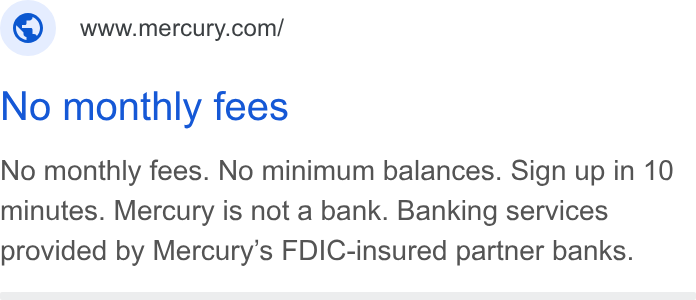
- Running
- 1153 days (longevity = it's converting)
- Hook
- "No monthly fees" with the text "No monthly fees. No minimum balances. Sign up in 10 minutes. Mercury is not a bank. Banking services provided by Mercury's FDIC-insured partner banks." below it.
- CTA / offer
- Sign up in 10 minutes
- Audience
- Individuals or businesses looking for banking services without common fees or minimums, indicated by the direct address of these pain points.
Why it works. Leads Google results with the fee objection startups research before switching banks, matching high-intent business-banking-fee searches.
Headline stating a key benefit: "No monthly fees" Turn your top pricing objection into a three-word negation and run it as your Google headline.
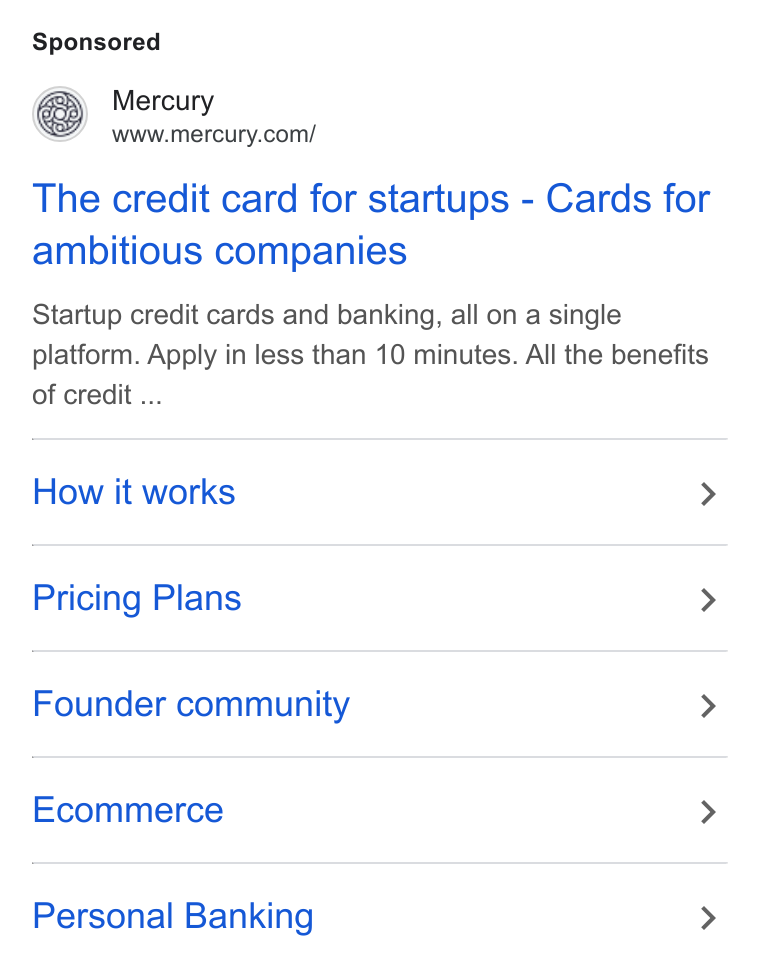
- Running
- 915 days (longevity = it's converting)
- Hook
- Sponsored Mercury www.mercury.com/ The credit card for startups - Cards for ambitious companies
- CTA / offer
- Apply in less than 10 minutes.
- Audience
- Startups and ambitious companies, indicated by the headline 'The credit card for startups - Cards for ambitious companies' and the mention of 'Startup credit cards and banking'.
Why it works. Uses category-defining language ('the credit card for startups') to position Mercury as the default choice rather than one option among many.
Headline directly addresses target audience and their aspiration: 'The credit card for startups - Cards for ambitious companies'. Claim category-defining language for your product, 'the X for Y', instead of a feature list, so searchers read you as the default pick.
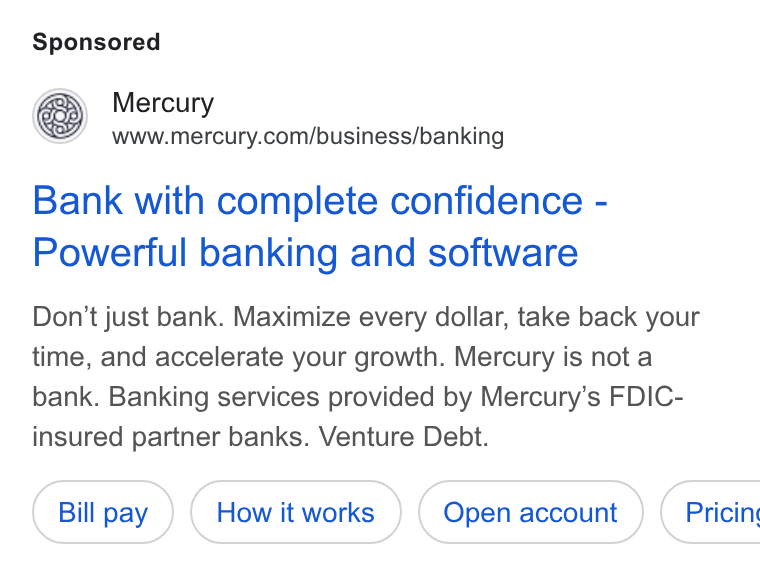
- Running
- 811 days (longevity = it's converting)
- Hook
- Sponsored Mercury www.mercury.com/business/banking Bank with complete confidence - Powerful banking and software
- CTA / offer
- Open account
- Audience
- Businesses or individuals seeking banking services, indicated by "business/banking" in the URL and the focus on "growth" and "Venture Debt".
Why it works. Addresses trust anxiety around startup banking while also signaling Mercury bundles software, not just an account.
Headline with a strong benefit: "Bank with complete confidence - Powerful banking and software" If your category has a recent trust scare, lead with a reassurance statement before your feature list.
Show 3 more ads
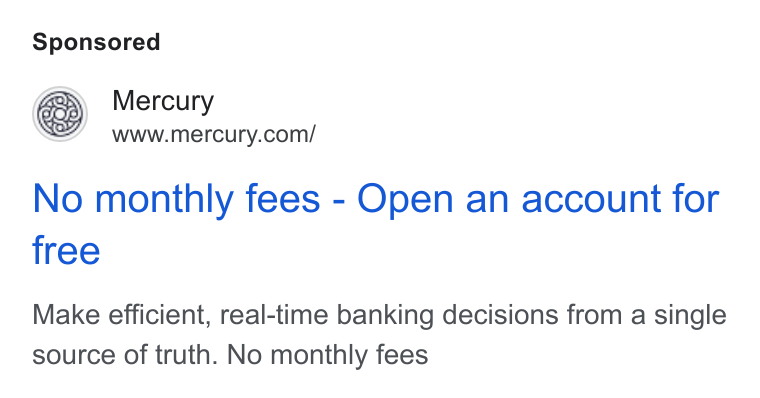
- Running
- 636 days (longevity = it's converting)
- Hook
- Sponsored Mercury www.mercury.com/ No monthly fees - Open an account for free
- CTA / offer
- Open an account for free
- Audience
- Businesses or individuals seeking banking services without monthly fees, indicated by the focus on 'banking decisions' and 'no monthly fees'.
Why it works. Doubles down on the fee objection with a free signup CTA, cutting perceived friction for cost-sensitive founders comparing banks.
Headline directly states a key benefit: "No monthly fees - Open an account for free" Stack your strongest price objection-killer with a free, low-friction next step in the same headline.
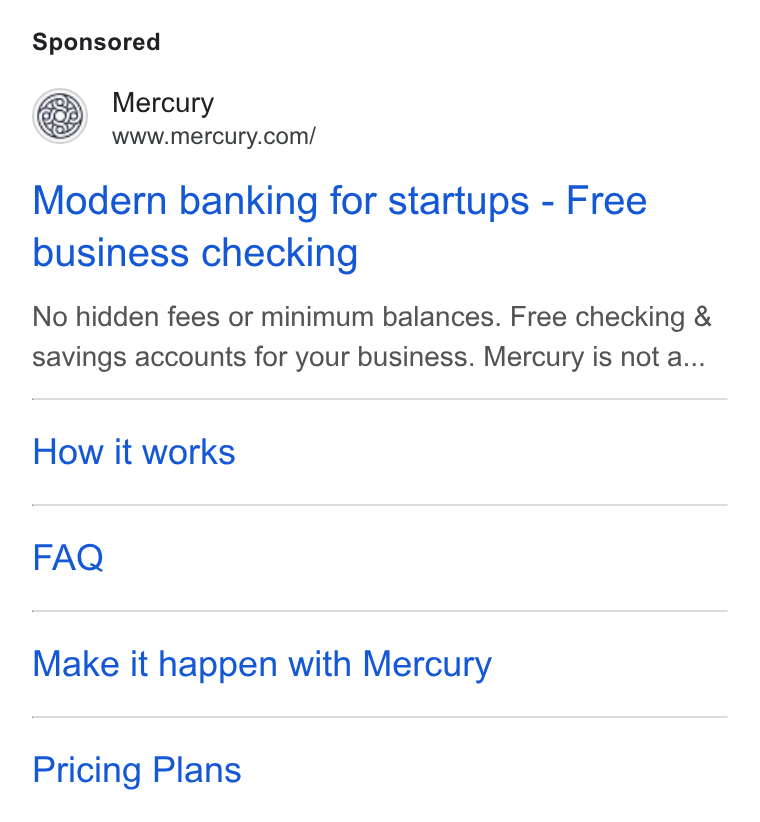
- Running
- 369 days (longevity = it's converting)
- Hook
- Sponsored Mercury www.mercury.com/ Modern banking for startups - Free business checking
- CTA / offer
- Free business checking
- Audience
- The phrase 'Modern banking for startups' explicitly targets new businesses and entrepreneurs.
Why it works. Positions against legacy banks with a modernity contrast, then closes with a concrete free product instead of an abstract benefit.
Headline stating a clear benefit: 'Modern banking for startups - Free business checking' Pair a modernity contrast against incumbents with one specific free product name, not just 'free banking'.
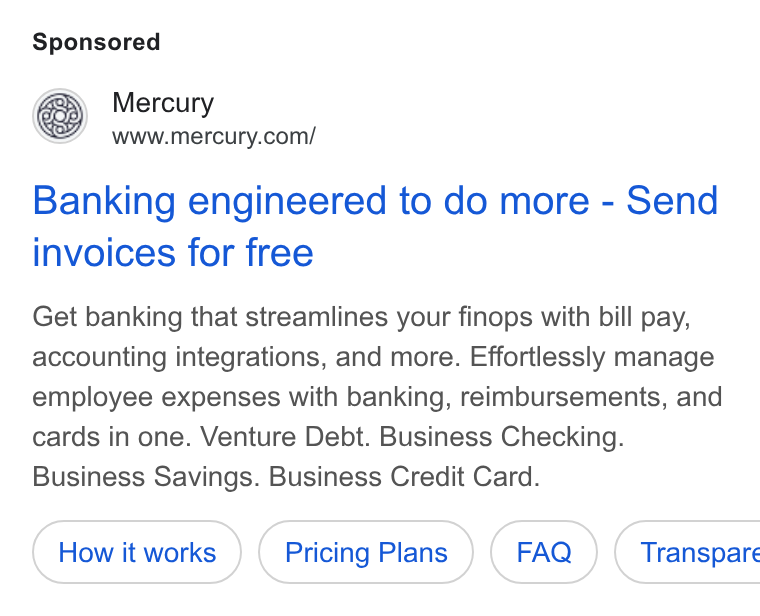
- Running
- 369 days (longevity = it's converting)
- Hook
- Sponsored Mercury www.mercury.com/ Banking engineered to do more - Send invoices for free
- CTA / offer
- Send invoices for free
- Audience
- The mention of 'finops', 'bill pay', 'accounting integrations', 'employee expenses', 'Venture Debt', 'Business Checking', 'Business Savings', and 'Business Credit Card' targets business owners and financial operations managers.
Why it works. Pairs a broad positioning line with one specific free feature so skeptical searchers get proof, not just a tagline.
Headline with a strong, free offer: 'Banking engineered to do more - Send invoices for free' After any broad positioning line in your ad, add one named free feature as immediate proof.
09 The playbook
The channels are not separate. They are one system where each stage feeds the next. Here is the read, then the plays to run tomorrow.
The inferred playbook
Mercury's loop runs on founder-driven attention converting through a frictionless free tier, then getting locked in by brand-level search dominance most early-stage teams can't yet afford to defend.
The company's 23 open roles as of 2026-07-07 skew toward audit, risk, and compliance functions alongside brand-design and partnerships hires, a mix that reads as Mercury building the regulatory backbone for its pursuit of a national bank charter (the OCC, the Office of the Comptroller of the Currency, approval covered above) while still funding brand-level growth work, not a company scaling a sales org.
Top-of-funnel awareness comes from Akhund's X account and the occasional external shock (the SVB moment covered above). There's no evidence of a wide influencer, creator, or affiliate layer feeding the funnel the way a consumer brand would use one.
Dig deeper+3▾
A genuinely free tier removes the signup objection, and the app's own login page ranks as Mercury's #2 organic page (covered above), showing people who hear about Mercury go straight to opening an account. That initial demand then gets locked in by branded-search equity plus a Google ad program still active after 1,153+ days (both covered above), so founder-driven or crisis-driven spikes convert into durable direct traffic rather than fading.
Outside of one blog post and brand-term ads, there's no visible docs hub, comparison-page network, or affiliate layer, so a challenger willing to build out category-level content (like "startup banking" guides) faces less entrenched organic competition from Mercury than its traffic numbers suggest.
free-to-paid conversion rate across the three pricing tiers, churn, CAC, and blended ARPU.
Turn a personal money story into a feature launch
The proofAkhund's 2023 tweet about his own first venture round (covered above) doubled as the launch vehicle for Mercury's free SAFE-issuance feature, pulling 353,067 views.
The adaptationPick one specific, numbers-backed story from your own founder history, a bad vendor bill, a slow first sale, a fundraising fee, and post it from your personal account, not the brand account, the same day you ship a related feature, letting the anecdote carry the announcement instead of a feature-bullet list. The specificity of the number is what makes people stop scrolling; a vague "fundraising is hard" post will not get the same read.
Cost: $0 · Time to signal: days · Works pre-PMF: yes
Run a public first-customers swap
The proofAkhund's July 2023 open call for followers to reply with their website, customer, and price point (covered above) generated 246 replies, the most reply-dense post in the evidence.
The adaptationPost an open offer to your own following, however small, asking people to reply with their product, ideal customer, and price, and commit to giving direct, specific feedback or a referral on a handful of them publicly. The public commitment is what gets replies instead of silence in your DMs, turning your own audience into a visible pool of prospects and warm intros in one thread.
Cost: $0 · Time to signal: days · Works pre-PMF: yes, conditional on having even a small engaged following to seed the first replies.
Bid on your own name before someone else does
The proofMercury's longest-running Google ad, a defensive brand-term buy covered above, has stayed active for more than three years.
The adaptationOnce your product name starts pulling meaningful search volume, once people are typing your brand into Google instead of finding you cold, claim a cheap always-on text ad against your own name and its close misspellings so a reseller, scraper site, or lookalike competitor cannot sit above your real listing. Start with one ad group and a $5-10/day cap tied only to brand-name queries, and expand only once click-through clears what a generic category ad gets you.
Cost: under $500 · Time to signal: days · Works pre-PMF: conditional, only once your own name generates real search volume; before that there is nothing to defend.
Package a niche survey into your paid-ad hook
The proofMercury's proven-winner LinkedIn creative promoting its Ecommerce Holiday Report (covered above) is a data-driven curiosity hook, not a feature pitch.
The adaptationSurvey 50-100 people in your own buyer persona, a simple form plus a small incentive works, pull out three or four surprising stats, package them into a one-page report, and run that report, not product screenshots, as the hook creative on paid social. A "here's what your peers actually think" hook earns clicks a feature-bullet ad does not.
Cost: under $500 · Time to signal: weeks · Works pre-PMF: conditional, you need enough of an audience or customer base to survey credibly; a 10-person sample will not hold up.
Pre-build a trust lever for your category's next scare
The proofWhen the Silicon Valley Bank collapse hit, Mercury didn't design a response from scratch; it activated an existing lever, the Vault product's expanded coverage covered above, and simply scaled its account-opening team to meet demand.
The adaptationIf your category carries a shared trust risk, data loss, downtime, refund disputes, build one concrete reassurance mechanic now, an uptime guarantee, an export tool, an escrow option, even if nobody is asking for it yet, so you can publicize it the moment a competitor or the market has a visible failure. Treat this as insurance you activate on demand, not a campaign you schedule.
Cost: dedicated budget or hire · Time to signal: days once triggered, but timing itself is unpredictable · Works pre-PMF: no, it depends on an existing customer base large enough for the reassurance to matter. Not transferable at an earlier stage: the three-year defensive paid-search budget, the compliance-driven hiring build-out, and the SVB-style trust lever all assume an existing customer base, real search volume, and regulatory scale a pre-PMF founder does not yet have. The personal-story launch and the first-customers swap above are the two plays that transfer immediately regardless of stage.
You just read how Mercury does it. Tomorrow it is someone else.
Every morning we take one company that is actually growing and break down where its customers come from: the ads still running after a year, the channel doing the real work, and the play you can run this week.
Systemaic · directional intelligence. Traffic, spend, and reach figures are SimilarWeb-style estimates and qualitative reads of public data, not audited numbers. Built on real public receipts.
// teardowns with a similar GTM motion
sources & receipts (9)
Live ad libraries: meta ad library · linkedin ad library · google ad library
Launch archives: Hacker News: Mercury Colonization · Hacker News: Mercury Spill · Hacker News: Mercury: Ultra-fast language models based on diffusion · Hacker News: A couple million lines of Haskell: Production engineering at · Hacker News: Mercury: Commercial-scale diffusion language model · Hacker News: Mercury 2: Fast reasoning LLM powered by diffusion
Traffic, spend, and revenue figures are estimates as noted in the report; the links above are the primary public artifacts.