- 01Pay strangers for an honest reaction
- 02Anchor your pitch to a nostalgic reference point
- 03Run a blind comparison against the incumbent
- 04Recruit a visible creator-partner cohort with a branded tag
01 Snapshot
The one-glance read on who they are and how they grow. Each point is verifiable from the receipts above.
High-protein, potato-chip-style chips and crackers made from chicken breast, egg whites, and bone broth, sold direct-to-consumer and through major retail grocers, backed by roughly $24.4M in total funding including a $20M round in April 2024.
Paid-led, with a creator-affiliate layer riding alongside a heavy Meta UGC-style ad rotation.
~38,200 estimated monthly site visits (+28.9% over the trailing 3 months), 72,786 Instagram followers, and 55 active Meta ads as of 2026-07-13.
Alongside its core man-on-the-street ad hooks, Wilde's newest Meta creatives try a blindfolded "Wilde vs. classic crackers" comparison and a "popcorn chicken" bowl demo, as of 2026-07-13.
Growth here is not a content-marketing SEO story, it's retail-seeded brand search (82.8% of traffic is organic search, almost entirely on their own branded terms) converted by a freshly relaunched paid UGC wave rather than a slow-tested winner set.
02 How it unfolded
The order the channels came online. Sequence is strategy: what they did first, and what they layered on once demand existed.
03 Traffic & channel mix
Estimated demand, the channel split behind it, and the keywords and referrers doing the work. Directional modeling, not audited analytics.
Traffic sources
Top search keywords
| Keyword | Volume | Weight | CPC |
|---|---|---|---|
| wilde chips | 5.6k | $0.69 | |
| wilde protein chips | 4.4k | $0.69 | |
| wilde | 12k | $0.56 | |
| wilde protein crackers | 830 | - | |
| wild chips | 1.4k | $0.71 |
Closest competitors by audience
Wilde pulls an estimated ~38,200 monthly visits, up 28.9% over the trailing 3 months. Search Organic dominates at 82.8% of the mix, with Direct a distant second at 12.1%, a combination that fits a retail-first CPG brand: shoppers who see Wilde on shelf either type the URL directly or search the brand name. The rest, social organic, AI-assistant referrals, display ads, and other referrals, together total under 6% of traffic.
The keywords they show up for are almost entirely branded: "wilde" (~11,800 searches/mo), "wilde chips" (~5,600 searches/mo), and "wilde protein chips" (~4,400 searches/mo) dwarf the category term "wilde protein crackers" (~830/mo), confirming the organic share is name recognition, not category discovery. SimilarWeb's model surfaces questnutrition.com and simplyprotein.ca as the closest matches, both direct protein-snack category rivals competing for the same high-protein-snacking search intent, while lilys.com (a better-for-you confectionery brand) shows up too, more a "healthier treat" audience overlap than a true chip competitor.
04 Organic content
The specific pages earning their organic search traffic, and the pattern behind why they rank. Adapt the format, not the topic.
Wilde's organic search traffic concentrates on its own commerce pages rather than any blog or comparison content: the shop-all collection page and homepage together account for roughly 87.5% of the top five organic pages' traffic (66.2% and 21.3% respectively), with the variety-pack and buffalo-flavor product pages picking up the rest. This matches the branded-search pattern above: people search "wilde chips" or "wilde protein chips" and land directly on a shelf page, not a landing page built to capture new discovery. The brand ranks #1 for "wilde protein chips," "wilde chips," and "wilde chicken chips," but only #12 for the generic category term "protein chips," a real gap between owning the brand name and owning the category.
Top pages by organic traffic
05 Channel map
Not traffic share. How much weight the growth system actually puts on each channel, with a one-line read on the role it plays.
What drove growth
06 The creative doing the work
Each exhibit shows the actual asset, an X-ray of why it works, a status, and a play you can adapt. This is the heart of the teardown.
The visible Meta library totals 55 active ads as of 2026-07-13. Meta's own tagging labels most of them "proven winners," but every one of them launched from the same wave, first shown 2026-06-05, putting the whole library at just 38 days of runtime, short of the 60-day bar that would prove a real longevity edge. This reads as a coordinated creative relaunch, a current push, not a track record yet.
-
Hook: "I will GIVE YOU $20 each," overlaid on a host approaching three women in a park holding two bags of chips. Why it works: Paying real bystanders to react on camera removes the "paid actor" skepticism that stages viewers, and their unscripted surprise sells the core hook (chicken that tastes like chips) more convincingly than a script could. Run this play: Expanded as Play 1 below.
-
Hook: "What's your favorite childhood snack?" asked to a stranger in a park before pivoting to product. Why it works: The question format gets the viewer answering in their head before the reveal, and nostalgia pre-loads goodwill that lowers resistance to the "healthier alternative" pitch that follows. Run this play: Expanded as Play 2 below.
-
Hook: "We're going to try," two men with a yellow bag of Wilde crackers, one handing the other a piece to taste. Why it works: The peer-to-peer framing, one guy sharing with another rather than a brand pitching at the camera, reads as an authentic recommendation instead of an ad. Run this play: Film two real customers, not staged actors, trying your product together for the first time on camera and let the unscripted reaction carry the sell rather than a script.
The "Real chicken. Real crunch." ad, part of the core Meta wave, lands on Wilde's Crackers collection page on wildebrands.com, a standard commerce/collection page rather than a dedicated lander built around that specific hook. The page leads with free shipping on all orders $40+, a threshold that effectively requires bundling several bags since single flavors list from $9.99 on the brand's own site, and layers in a 10% off first order offer to capture email and SMS signups. Subscriptions run through the Recharge app, so the funnel is built to convert a first $40+ cart into a recurring subscriber rather than just a one-off sample sale.
- Running
- 38 days (longevity = it's converting)
- Hook
- "What's your favourite childhood snack?" spoken by a man in a white hat holding a microphone and a bag of Wilde chips, standing in a park.
- CTA / offer
- wildebrands.com
- Audience
- Young adults in an urban park setting who reference legacy snack brands like Doritos and Cheez-Its.
Why it works. Opening on a nostalgia question anchors viewers to a specific childhood snack before pitting it against Wilde's higher-protein version.
Nostalgia Anchoring (0:00 - "What's your favourite childhood snack?") Open your interview with a nostalgia question about the category leader before introducing your product as the upgrade.
- Running
- 38 days (longevity = it's converting)
- Hook
- "We're going to try both these chips tell me the first word that comes in mind" Visual: A man in a tan hat and beige t-shirt holds a microphone and a bag of Wilde Protein Crackers while talking to a man in a black zip-up jacket.
- CTA / offer
- wildebrands.com
- Audience
- Health-conscious snackers looking for high-protein alternatives to traditional crackers.
Why it works. Pitting two chip options side by side and demanding a one-word verdict turns the interaction into a live head-to-head taste ruling.
Surprise ingredient reveal at 0:15 ('it's all chicken'). Have your interviewer hand over two competing options at once and ask for a single-word verdict on the spot.
- Running
- 38 days (longevity = it's converting)
- Hook
- "I want you to try these and tell me the first word that comes in mind." A man in a tan hat and white t-shirt holds a microphone and a bag of Wilde Protein Crackers, approaching a woman in a blue hat in a crowded convention hall.
- CTA / offer
- go to wildebrands.com and check them out
- Audience
- Snackers looking for high-protein alternatives (signaled by the comparison to 'Cheez-Its' and the '12g of protein' claim).
Why it works. Trapping the interviewee into a one-word reaction at a trade show makes the response feel unfiltered rather than coached.
Direct Competitor Anchoring (0:15): "Better than Cheez-Its" Ask your interview subject for one instant word instead of a full review to capture an unfiltered reaction on camera.
Show 6 more exhibits
- Running
- 27 days (longevity = it's converting)
- Hook
- "I will GIVE YOU $20 each" spoken by a man in a white shirt and a "WILDE" hat sitting on a park bench with three women, holding two Ziploc bags of snacks.
- CTA / offer
- I will give you guys $20 each if you can tell me which one is a Cheez-It
- Audience
- Snackers looking for healthier alternatives (implied by the comparison of a junk food brand to 'chicken breast').
Why it works. Wilde bets $20 that strangers can't tell its chips from Cheez-Its, letting real on-camera reactions do the convincing for skeptical snackers.
Direct Comparison to Category Leader (0:01 - 'which one is a Cheez-It') Film a street taste test where you pay real strangers cash to compare your product blind against the category leader.
- Running
- 2 days (new — still being tested)
- Hook
- "That's chicken?" + a man wearing a blue sleep mask is fed a cracker by a hand with long fingernails.
- CTA / offer
- "If you see these, you have to pick them up."
- Audience
- Health-conscious snackers and protein seekers who enjoy classic cheese crackers (evidenced by the comparison to Cheez-It style crackers and the mention of 12g of protein).
Why it works. A blindfolded taster's shocked reaction to learning the cracker is made from chicken breast turns the ingredient list into the plot twist.
Blind Taste Test Pattern Interrupt (0:00): "That's chicken?" Blindfold a taster, feed them your product, then reveal the one surprising ingredient on camera as the payoff.
- Running
- 5 days (new — still being tested)
- Hook
- "popcorn chicken but make it snackable 🍿🧀✨" shown over an empty orange bowl on a wooden table.
- Audience
- Health-conscious snackers looking for high-protein options ("12g PROTEIN" and "BUILT FROM CHICKEN BREAST" visible on packaging).
Why it works. A punny recipe-hack framing turns a protein cracker into popcorn-chicken territory, giving health-conscious snackers permission to crave comfort food.
Pun-based hook "popcorn chicken but make it snackable" at 0:00. Rename your product's use case as a punny hack on a beloved comfort food to reframe it as indulgent rather than healthy.
Wilde Protein Chip Review✨ Nashville Hot is definitely my fav, then Chicken & Waffles, Seasalt & Vinegar, and then Pink Himalayan Salt! @wildechips #wilde #protein #highprotein #lowcal #chips #snack #weightloss #pcos #pcosweightloss #journey #mealprep #togo #caloriedeficit #review #eat #yummy #nashville #hot #chicken #waffles
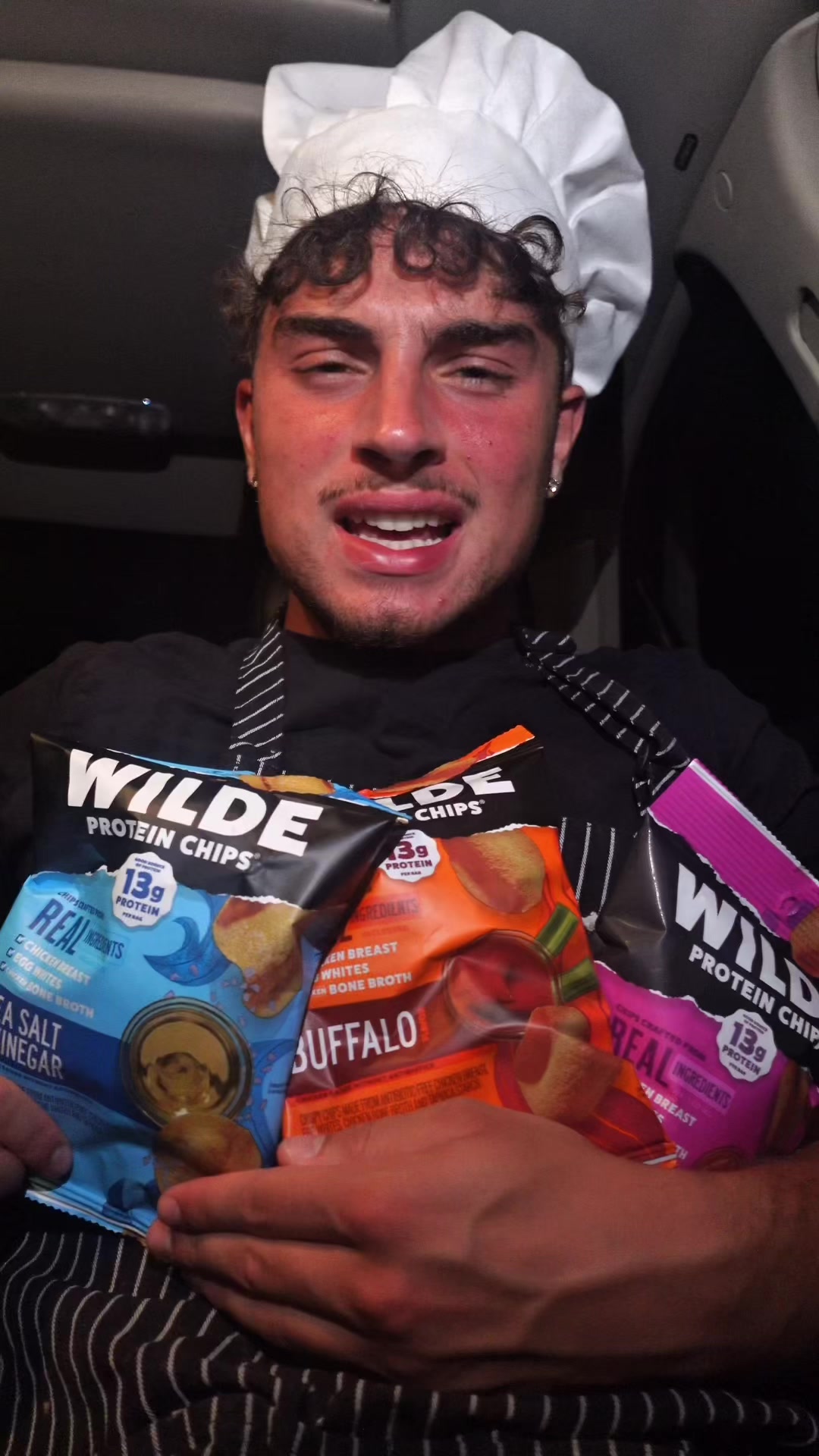
We’re WILDE about this girl dinner! @wildechips #WILDEpartner #WILDE #fyp
Who amplifies them
The clearest amplification comes from named creators posting under the brand's own tag rather than paid placements: @smaller_sam.pcos's flavor-ranking reel (8,759 engagement) is the strongest single piece, followed by @deltas.kitchen's reaction video ("Trying Wilde protein chips," 482 engagement) and @taraandargenis's "We're WILDE about this girl dinner" post (400 engagement, tagged #WILDEpartner). A co-branded post from @monica pairs Wilde with a Costco find (tagged @WildeChips and @Costco Wholesale, #wildepartner #costcotiktok), tying the retail distribution story directly to creator content. Beyond these, a longer tail of smaller creators (@milkychanceofficial, @naiaracostadasilva1, @Helmsly_, @spjute_strong.fit, and others) post under #wilde, #wildechips, and #tiktokshop in the single-to-low-double-digit engagement range. The brand's own @wildechips account is distinct from all of this: it posts its own lifestyle content but doesn't drive the biggest numbers, those come from third-party creators.
07 Organic & video
The organic content engine: the videos, creator posts, and community presence earning attention without paid spend.
On owned Instagram, cadence leans lifestyle and humor over hard-sell: posts like "When the craving hits, WILDE's always the answer, no matter the time of day" (54 engagement) and "Snack Time… aka Happy Hour" (256 engagement) frame the product around daily moments rather than nutrition facts. The standout piece of organic content, though, comes from a creator: an 8,759-engagement Instagram reel ranking four flavors (Nashville Hot topping the list, then Chicken & Waffles, Sea Salt & Vinegar, Pink Himalayan Salt), far outperforming anything on the brand's own account.
Read the full breakdown+1▾
The format that wins across both owned and creator content is the same UGC talking-head reaction or review, someone opening a bag on camera and giving an honest first take, whether it's a bearded creator eating straight from a green bag, or a couple in a car declaring "we're obsessed with these Wilde chips."
08 Affiliate & partners
How the brand turns creators and partners into a tracked, variable-cost acquisition channel, and how the program is structured.
Wilde runs a referral program through ReferralCandy at wildebrands.referralcandy.com, linked from the homepage. That formal program sits alongside a visible informal layer: several creators tag posts #tiktokshop (indicating TikTok Shop affiliate-seller activity) and others use a consistent #WILDEpartner hashtag, suggesting a recruited creator-partner cohort beyond organic mentions.
09 The playbook
The channels are not separate. They are one system where each stage feeds the next. Here is the read, then the plays to run tomorrow.
The inferred playbook
Wilde's growth loop runs on retail-seeded brand search converted by a freshly relaunched paid UGC wave, with a modest creator-affiliate layer stitched on top.
The dominant 82.8% organic search share is almost entirely branded terms ranking #1, consistent with shoppers who encounter Wilde on shelf later searching the name and landing straight on the shop-all page rather than discovering it through content.
The entire visible Meta library, 55 ads as of 2026-07-13, launched in the same roughly 38-day window, pushing UGC-style curiosity hooks toward a single collection page rather than a slow-tested set of proven winners.
Dig deeper+3▾
A ReferralCandy program and a #WILDEpartner-tagged creator cohort supply organic reach and TikTok Shop-seller activity, though the biggest hits (like the 8,759-engagement flavor-ranking reel) look more like earned reviews than a tightly managed program at scale.
Every ad in the current wave funnels to one generic collection page rather than a dedicated lander per concept, and beyond the on-page Recharge subscription toggle there's no visible loyalty or repeat-purchase mechanic.
blended CAC, DTC subscription retention, and the online-vs-retail revenue split.
Pay strangers for an honest reaction
The proofWilde's "I will GIVE YOU $20 each" ad puts real park-goers on camera reacting to the product, part of its 55-ad Meta wave covered above.
The adaptationTake your product to a public place, offer a small cash incentive (even $10-20 per person) to strangers to try it on camera, and post the raw, unscripted reaction with minimal editing. The mechanism: paying real people rather than hiring actors removes viewer skepticism, because a surprised or delighted face from someone with nothing to gain reads as proof, not pitch.
Cost: under $500 · Time to signal: days · Works pre-PMF: yes.
Anchor your pitch to a nostalgic reference point
The proofWilde's "What's your favorite childhood snack?" ad opens with a question before pivoting to its better-ingredients pitch.
The adaptationFind the nostalgic touchpoint your product improves on (a childhood snack, a college staple, a lunch-box item) and open your content by asking people about that memory before introducing your product as the upgraded version. Weave in the mechanism as you write it: the question gets viewers mentally engaged and emotionally warmed up before they see any sales pitch, so resistance is lower by the time the product appears.
Cost: $0 · Time to signal: days · Works pre-PMF: yes.
Run a blind comparison against the incumbent
The proofWilde's testing-now creative "Comparing WILDE Protein Crackers to classic crackers" blindfolds a taster and feeds them both products on camera.
The adaptationSet up a blind taste, feel, or use test between your product and the category leader, film a real person's unscripted verdict, and post it without heavy editing. This only works if your product actually wins the blind comparison, if the reaction is lukewarm on camera it will undercut you publicly, so test privately first.
Cost: $0 · Time to signal: days · Works pre-PMF: yes, provided the blind-test result is genuinely favorable; a mediocre or ambiguous result will backfire in public.
Recruit a visible creator-partner cohort with a branded tag
The proofWilde's #WILDEpartner-tagged creator posts and Costco co-branded content ride alongside its ReferralCandy program, covered above.
The adaptationSet up a lightweight referral or affiliate tool (ReferralCandy and similar platforms serve small merchants), give it a branded hashtag, and recruit a handful of niche micro-creators with free product or a commission code in exchange for an honest post. Track which creators actually post and double down on repeat senders rather than one-off mentions.
Cost: under $500 · Time to signal: weeks · Works pre-PMF: conditional, only once you have physical product ready to ship to creators.
Make your commerce pages the SEO target, not just your blog
The proofWilde's shop-all page and homepage capture the large majority of its organic search traffic on branded terms it ranks #1 for, covered in Organic Content above.
The adaptationOnce you have any outside driver of brand-name search (press, retail placement, word of mouth), make sure your core product and collection pages, not just blog posts, are optimized to catch that branded demand: clear product-name titles, on-page copy matching how customers actually search for you. The mechanism: branded searchers already intend to buy, so the highest-leverage SEO work is making sure your own transactional pages, not a third party, are what they land on.
Cost: $0 · Time to signal: months · Works pre-PMF: conditional, only once some outside driver (retail shelf presence, PR, or ad spend) is already generating brand-name search volume for these pages to capture. Not transferable at an earlier stage: the retail-to-search loop assumes Wilde's retail shelf presence and roughly $24.4M in funding are already driving brand-name search and bankrolling a 55-ad paid wave. A reader without retail distribution or that budget won't see the same branded-search payoff until they've built comparable offline or paid-awareness reach first, so plays 1 through 4 are the ones to start with.
You just read how Wilde does it. Tomorrow it is someone else.
Every morning we take one company that is actually growing and break down where its customers come from: the ads still running after a year, the channel doing the real work, and the play you can run this week.
Systemaic · directional intelligence. Traffic, spend, and reach figures are SimilarWeb-style estimates and qualitative reads of public data, not audited numbers. Built on real public receipts.
// teardowns with a similar GTM motion
sources & receipts (1)
Live ad libraries: meta ad library
Traffic, spend, and revenue figures are estimates as noted in the report; the links above are the primary public artifacts.