- 01Turn seeded creator content into paid media pointed at the actual point of sale THE PROOF
- 02Ride a real distribution milestone with early creator access THE PROOF
- 03Run a scarce, co-branded bundle with an aesthetically adjacent partner THE PROOF
- 04Formalize the free promotion you didn't ask for THE PROOF
01 Snapshot
The one-glance read on who they are and how they grow. Each point is verifiable from the receipts above.
Sulfate/paraben-free shampoo, conditioner, styling and body-wash products sold mainly through Target, Ulta, CVS and Walmart, with direct-to-consumer as a minority slice of sales per public reporting.
Creator-led, UGC seeding and paid amplification layered on top of a mass-retail distribution base built from a Target-exclusive launch.
~65,000 monthly site visits as of 2026-07-08, 48,707 Instagram followers, and 11 of 11 sampled Meta ads still active as of 2026-07-08.
As of 2026-07-08, the Google ads actively sending clicks to odelebeauty.com come from unrelated third-party advertisers, not Odele's own dormant search campaign.
Odele's reported retail sales keep growing, meaning conversion increasingly happens on Target's and Ulta's pages, not odelebeauty.com.
02 How it unfolded
The order the channels came online. Sequence is strategy: what they did first, and what they layered on once demand existed.
03 Traffic & channel mix
Estimated demand, the channel split behind it, and the keywords and referrers doing the work. Directional modeling, not audited analytics.
Traffic sources
Top search keywords
| Keyword | Volume | Weight | CPC |
|---|---|---|---|
| odele | 4.6k | $0.42 | |
| odele shampoo | 1.8k | $0.57 | |
| odele beauty | 690 | $0.50 | |
| odele air dry styler | 1.6k | $0.59 | |
| odele shampoo moisturizing | 230 | - |
Closest competitors by audience
Odele draws an estimated 65,000 monthly visits, down 24.9% over the last 3 months. Search organic dominates the mix at 69.2%, with direct at 15.7% and referrals a distant third at 4.9%. The rest, Gen AI referrals, affiliate, paid search, display and social organic, totals under 11% combined and none of those individual channels clears 4%. The brand's own name drives most of the demand it captures: its homepage and shampoo/conditioner collection page are its two largest organic pages by far, both fed by branded searches it ranks #1 for, so most of the traffic landing on the site is people who already know the name rather than new-category discovery, even though it also holds a #1 organic spot on the broad non-branded term "clarifying shampoo." Its closest competitors by traffic profile are livingproof.com (a comparable mass/prestige clean-hair player), colorwowhair.com (a styling-tool-adjacent challenger) and curlsmith.com (a curl-specific rival), each indicating Odele sits in a crowded affordable clean-haircare set rather than a category of its own.
04 Organic content
The specific pages earning their organic search traffic, and the pattern behind why they rank. Adapt the format, not the topic.
Odele's top organic pages split evenly between commercial and educational intent: the homepage and a shampoo/conditioner collection page anchor the branded searches, a single clarifying-shampoo product page captures product-specific demand, and two blog guides, a curl-pattern identification chart and a "how to get fluffy hair" post, pull in non-branded, top-of-funnel readers. The pattern is a classic hybrid: branded and category pages harvest people who already know the name (largely seeded by retail shelf exposure), while the two how-to guides target adjacent informational questions that rank on their own, evidenced by "fluffy hair" landing at position 4 versus the near-universal #1 rankings on branded terms. That combination lets a small content team win competitive branded real estate for free while still opening a side door to shoppers who haven't searched the brand yet.
Top pages by organic traffic
05 Channel map
Not traffic share. How much weight the growth system actually puts on each channel, with a one-line read on the role it plays.
What drove growth
06 The creative doing the work
Each exhibit shows the actual asset, an X-ray of why it works, a status, and a play you can adapt. This is the heart of the teardown.
On Meta, 11 of 11 ads in the library are active as of 2026-07-08, but the oldest is only about 29 days old, so this is a current push rather than a proven-winner rotation, the longevity signal simply doesn't exist yet. On Google, the picture is different: a roughly 200-ad library (116 sampled) has only 14 ads active as of 2026-07-08, and the oldest of those has run about 244 days.
Hook: A woman with wet, messy hair looks at camera, then cuts instantly to styled, voluminous hair, voiced over "Before and after using Odele's Clarifying Shampoo and Hair Oil." Why it works: The cut happens with zero setup, no explanation, no waiting, which reads as unstaged proof rather than a claim. It kills the "does this actually work" objection in under three seconds. Run this play: Expanded as Play 1 below.
Hook: On-screen text "My hair care basics! Here's how I go from this" over a woman in loungewear in a bathroom, transitioning to the same woman styled and dressed in a classroom. Why it works: The transformation is aspirational but attainable, home-messy to public-polished, and the same creative runs simultaneously against both the Ulta and Target landing pages rather than needing a separate ad per retailer. Run this play: Same creator content can serve every retail listing a product sells through; there is no need to shoot separate ads per store, just swap the destination link.
Hook: A shower curtain and two product bottles on a windowsill, on-screen text "postpartum," voiceover: "Going through postpartum a second time..." Why it works: It targets a specific, under-served life stage by name instead of a generic hair complaint, which makes a niche audience feel individually spoken to. Run this play: Write ad narration around a named life stage or situation (new parent, first winter in a new climate, post-illness) instead of a generic product benefit.
Every deconstructed Meta winner clicks through to a retail product or category page, not odelebeauty.com. The "hair reset day" and "my hair care basics" ads land on individual Target and Ulta product pages (Clarifying Shampoo, Volumizing Shampoo, Shine Enhancing Hair Oil), while the "summer hair essentials" ad lands on Ulta's full 38-product Odele storefront. None of these pages are Odele's own checkout, there's no visible email or SMS capture, discount code, or bundle mechanic to analyze, because the funnel intentionally hands the sale off to the retailer. That matches the profile's reported ~90/10 wholesale-to-DTC split: paid social's job here is to drive the in-store or retailer-site sale, not to fill a branded cart.
- Running
- 28 days (longevity = it's converting)
- Hook
- "These hair care essentials make everything else in my routine work better." + Woman with wavy brown hair and bangs, wearing a denim jacket, smiling and touching her hair.
- CTA / offer
- "pick up both for less than $25"
- Audience
- Women with "fine textured waves" who value a "capsule wardrobe" aesthetic (denim jacket, cargo pants, loafers).
Why it works. Positions the product as foundational to the whole beauty routine, then anchors that value against price at the close.
Fashion Analogy (0:03): "Similar to how high-quality basics can elevate your outfits..." Describe your product as what makes the rest of the customer's routine work better, then close with a direct price-to-value comparison.
- Running
- 14 days (longevity = it's converting)
- Hook
- "My hair care basics!" + visual cut from bathroom ponytail to classroom sleek hair.
- CTA / offer
- "Go check them out!"
- Audience
- Women with long hair, specifically professionals like teachers, given the classroom setting.
Why it works. Cuts from a lived-in bathroom ponytail to a done-up classroom look, telling students the routine survives a real morning, not just a studio shoot.
Immediate visual contrast (0:00-0:02) jumping from a bathroom 'before' to a classroom 'after'. Shoot your before shot in a messy real-life setting (bathroom, bedroom) and your after shot in a different everyday setting (class, office) to prove the routine holds up.
- Running
- 29 days (longevity = it's converting)
- Hook
- "Before and after using Odele's Clarifying Shampoo and Hair Oil." Visual: A woman with wet, dark hair transitions immediately to a shot of her with voluminous, shiny, styled curls.
- Audience
- People with long, dark hair concerned with product buildup and frizz.
Why it works. Uses a wet-hair-to-styled-curls cut to prove the two-step routine's payoff before explaining a single step of it, for curly/wavy shoppers hunting a reset.
Immediate Before/After reveal (0:00-0:02) Caption your before/after video with the exact product names used, so the transformation reads as reproducible, not just lucky footage.
Show 7 more exhibits
- Running
- 8 days (new — still being tested)
- Hook
- "postpartum" text overlay on a window with two Odele bottles as shower water begins to spray, 0:00-0:03.
- Audience
- Postpartum mothers (explicitly stated in text and voiceover).
Why it works. Names a narrow life stage where a two-minute shower routine is a real constraint, targeting new mothers scanning for anything that saves time.
Identity-based text overlay at 0:00: "postpartum". Open with one word naming your buyer's current life stage or moment (finals week, new job, moving day) instead of a product shot.
- Running
- 2 days (new — still being tested)
- Hook
- "My hair has been looking like this..." + close-up of frizzy, textured hair transitioning to smooth, shiny waves.
- Audience
- Women with long, textured, or frizzy hair looking for a simplified maintenance routine.
Why it works. Uses a low-production, close-up shot of frizz to read as a real complaint rather than a staged ad, for viewers tired of complex routines.
Immediate visual before/after (0:00-0:03) Let a sentence about your problem trail off with an ellipsis over close-up footage of the problem itself, before naming any product.
- Running
- 2 days (new — still being tested)
- Hook
- "from this" + woman with messy, frizzy hair making a face while running hands through it.
- Audience
- Women with long hair seeking salon-quality volume and shine at home.
Why it works. Leads with the messy, frustrated moment so viewers with the same frizz problem recognize themselves before the product ever appears.
Rapid Before/After Contrast (0:00-0:02) "from this" to "to this" Caption your worst hair-day footage with just two words ('from this') and save the product reveal for the second half of the video.
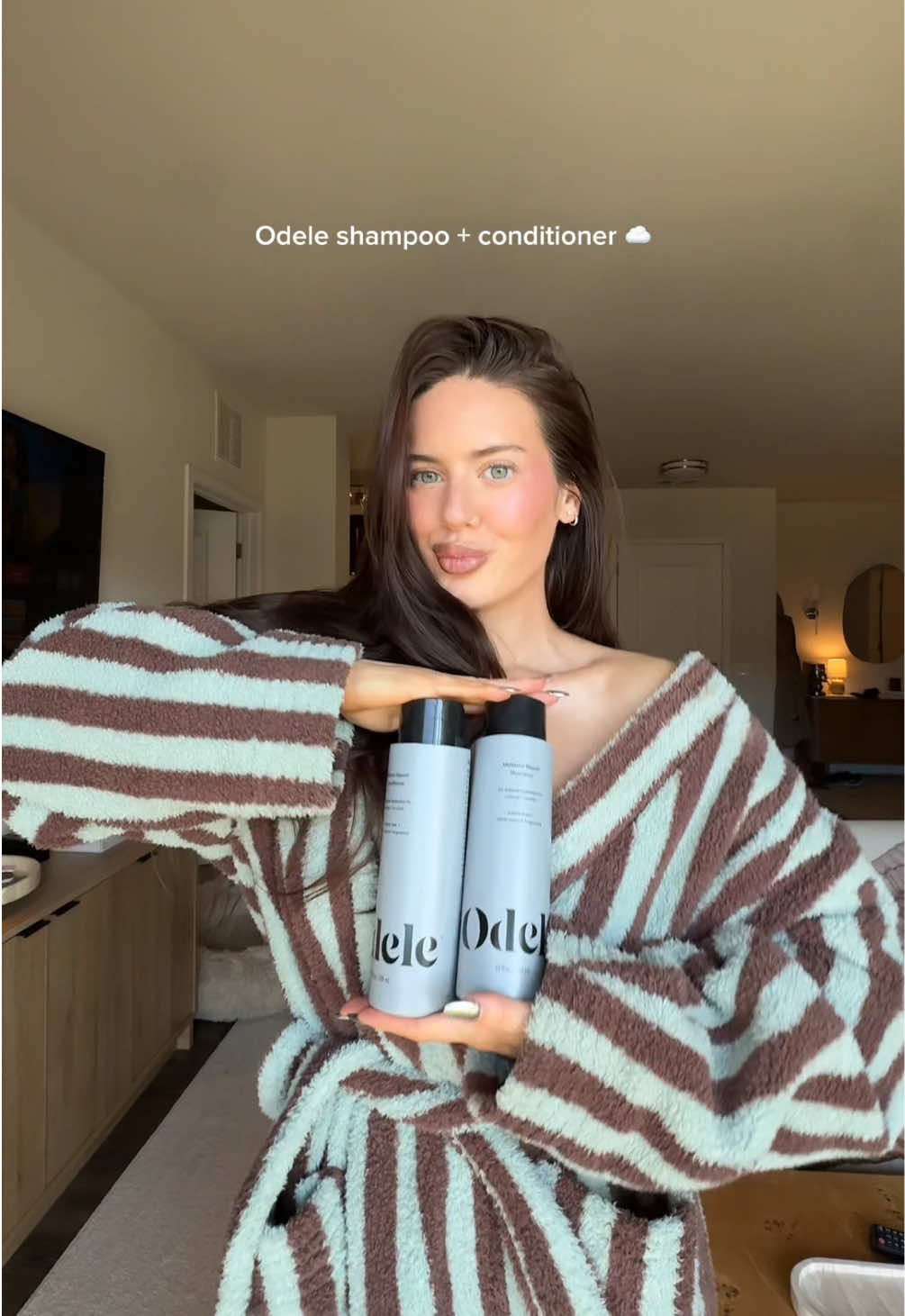
- Hook
- 0:00-0:03, a woman with long, dark brown hair in a striped robe turns her back to the camera and shakes her hair, which is long and wavy. On-screen text reads: "Odele shamp".
- Audience
- Women with long, dark hair who shop at Walmart and are looking for affordable, high-quality hair care products, especially those with dry and static-prone hair. Signaled by the creator's appearance, product choice, and mention of Walmart.
Why it works. Opens on a satisfying hair-shake visual before the product name even loads, using the reveal to hold attention into a Walmart pitch.
Visual demonstration of product benefits (0:00-0:03, 0:18-0:21): The creator starts by showing off her long, healthy hair, then later demonstrates the smooth, hydrated results after using the product. Open your video on the finished result, the shake, the shine, the outcome, before naming the product so viewers watch to find out what it is.
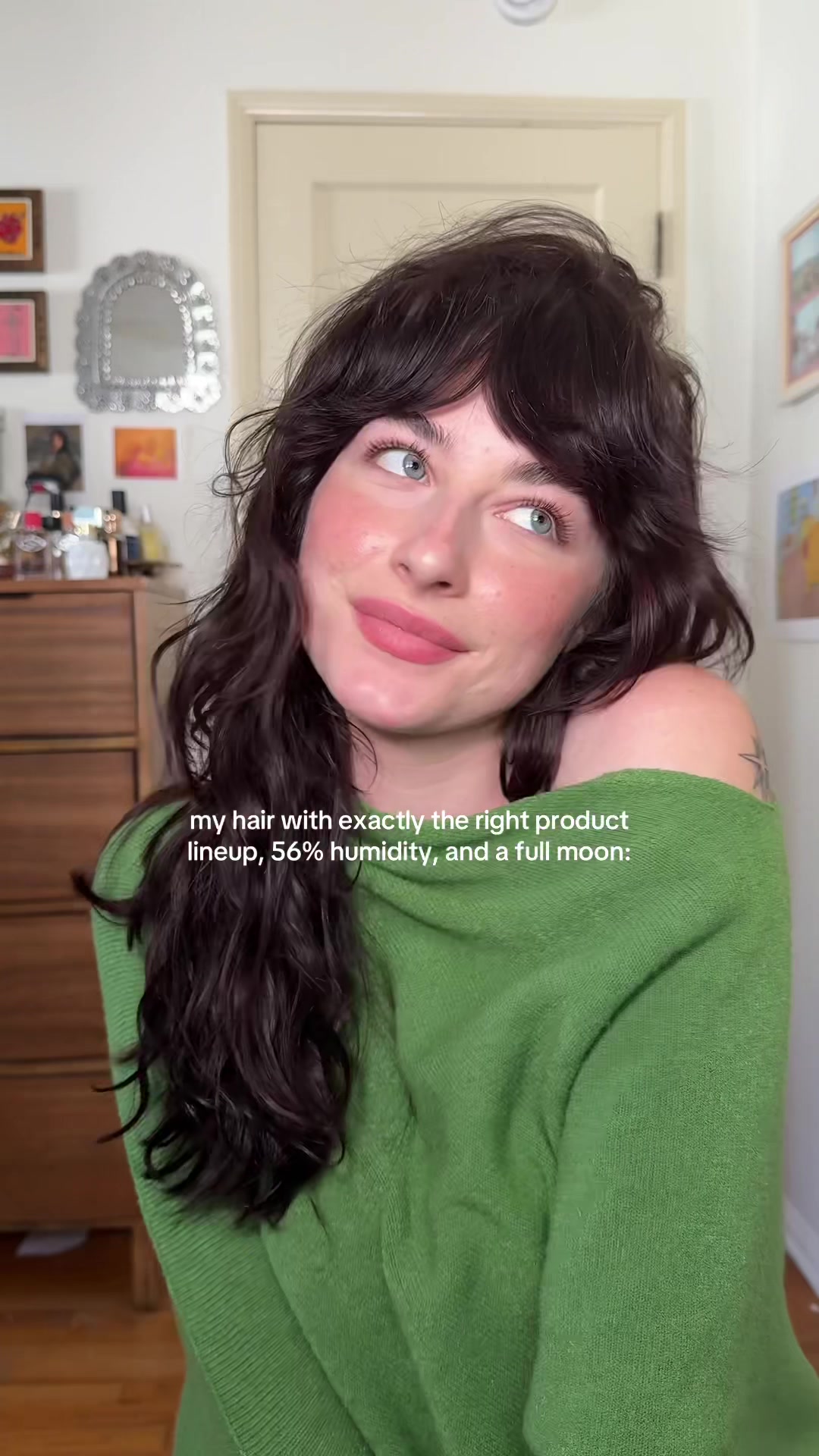
- Hook
- my hair with exactly the right product lineup, 56% humidity, and a full moon: (visual: a woman with dark, wet, wavy hair, wearing a green sweater, drying her hair with a light-colored towel)
- Audience
- Individuals with wavy or curly hair seeking product recommendations for defined, frizz-free results, as evidenced by the hair type shown and the product application.
Why it works. Borrows an existing meme structure so the ad reads as a relatable joke first and a product plug second, lowering ad resistance.
The video starts with a specific, slightly humorous setup for achieving 'perfect' hair, as seen in the on-screen text at 0:00: "my hair with exactly the right product lineup, 56% humidity, and a full moon:". Take a meme format currently trending in your niche and slot your product into the punchline instead of writing an original hook.
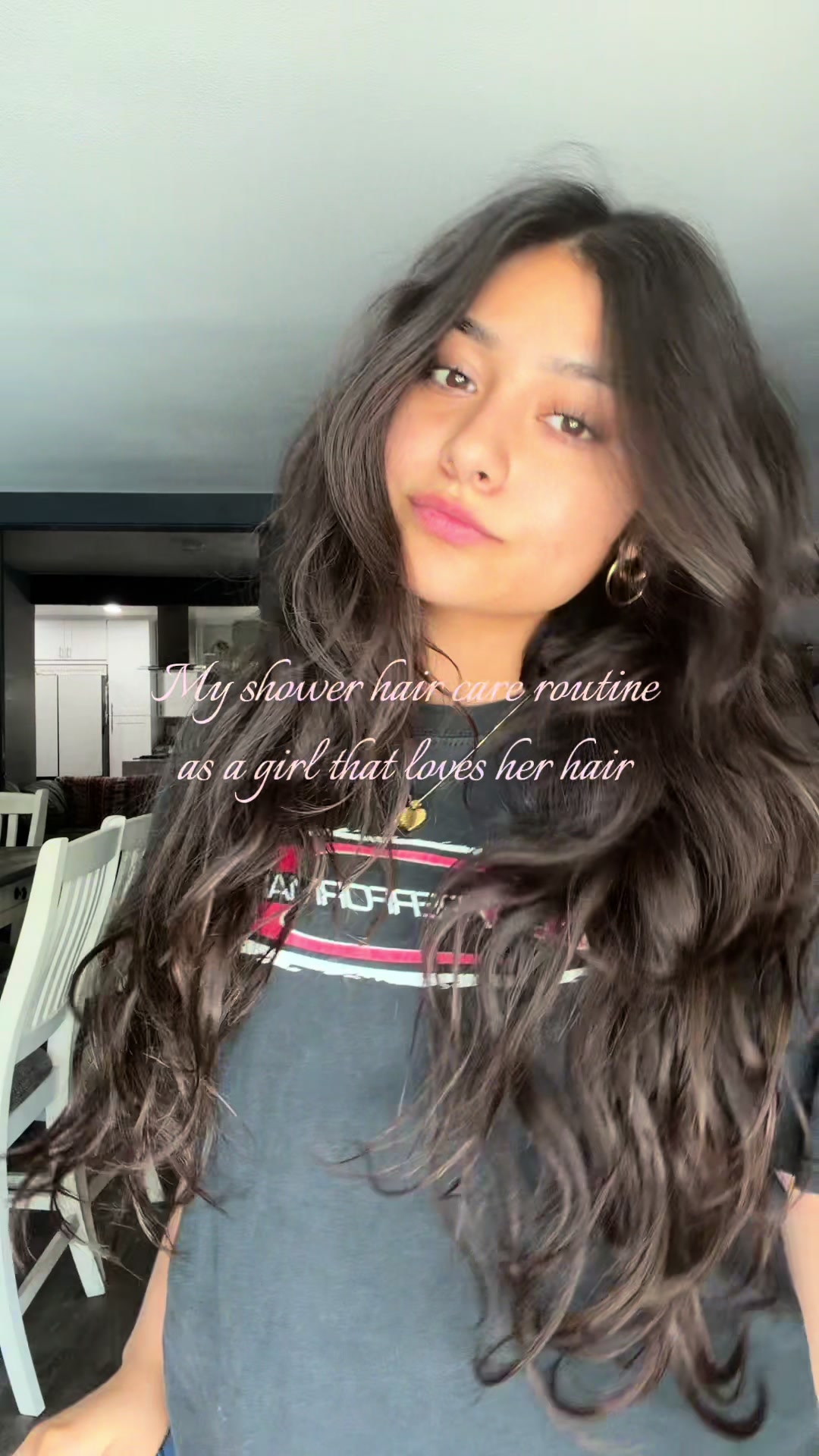
- Hook
- "My shower hair care" - A young woman with long, dark, wavy hair looks directly at the camera, then runs her hands through her hair.
- Audience
- Individuals interested in hair care routines, particularly those with long, wavy hair, indicated by the creator's hair type and the products shown (clarifying, volumizing, moisture repair).
Why it works. Opens with direct eye contact and a hair touch, using the presenter's own visible result as proof before explaining the routine.
Visual demonstration of desired outcome at the start (0:00-0:15) Open on a few seconds of direct eye contact showing your product's end result before cutting to the how-to steps.
- Reach
- 231 upvotes · 58 comments · r/SkincareAddiction
A community is already discussing this in r/SkincareAddiction. Show up there authentically and answer the thread before a competitor does.
Who amplifies them
The amplifier base is almost entirely everyday creators rather than macro-influencers. oliviadeano_, Ella Colby and grimes post routine and before/after content tagging @Odele Beauty, several marked #gifted or #notsponsored, indicating a seeding rather than paid-commission relationship. A distinct thread is subscription-box seeding: creators Maya Jacobs⭐️ and julia! both received Odele product through @Curls Monthly, a curly-hair subscription box, putting the brand in front of a pre-qualified audience without running a single ad. The one named brand collaboration is with @susan_alexandra, a limited "Touch-Ups To Go" bundle pairing Odele's dry shampoo with a custom beaded charm, capped at 100 units. On Meta, the paid-amplified creators (The Lisa Mae, Anna Los, Myclassroomcloset, AnnaKlypka, Kelly, sarahscreativeclaws) are distinct from these organic seeders, they're the same UGC style boosted into paid rotation.
07 Organic & video
The organic content engine: the videos, creator posts, and community presence earning attention without paid spend.
Creator posting is dense and consistent in format: a talking-head or hands-in-hair demo, often shot in a bathroom, paired with a routine or before/after narrative. The standout is ABIGAIL GRACE's post ("moisture repair is NEEDED this time of year + @Odele Beauty is coming to @Walmart"), which pulled roughly 2.2 million engagements by riding a real distribution announcement rather than a manufactured hook. Other strong performers cluster in the low thousands, amanda's curl-cream first-try post at 11,952 engagements and phantogram's shower-routine clip at 8,236, plus a long tail of posts in the 150-5,000 range. The format that consistently wins is the routine demo: hands running through hair, a product callout, and a plain-language reaction, not polished production.
08 Affiliate & partners
How the brand turns creators and partners into a tracked, variable-cost acquisition channel, and how the program is structured.
Odele runs one formal affiliate channel, a listing on UNiDAYS, a student-discount affiliate platform, linked from its homepage to recruit student shoppers via referral. Beyond that, the widespread #odelepartner tagging across dozens of creators points to a structured gifting/ambassador program rather than a commission affiliate scheme, since posts are repeatedly marked "gifted" and "not sponsored." Combined with the Curls Monthly subscription-box seeding, the partner motion leans on product-for-content exchanges, not paid-per-sale affiliate links.
09 The playbook
The channels are not separate. They are one system where each stage feeds the next. Here is the read, then the plays to run tomorrow.
The inferred playbook
Odele's growth engine runs mostly outside its own website: real retail distribution wins and creator seeding generate organic buzz, paid social recycles that same creator content into ads that click straight through to Target and Ulta checkout pages, and the brand's own domain functions more as a content and SEO hub than a sales funnel. ---
Every deconstructed paid winner sends clicks to a Target or Ulta product page, consistent with the profile's reported ~90% wholesale mix, so odelebeauty.com's modest 65,000 monthly visits understate how the brand is actually being bought.
Gifted-product seeding through everyday creators and a subscription-box tie-in with Curls Monthly produce organic reach without ad spend, occasionally spiking hard when tied to real news, as the Walmart-expansion clip covered above shows.
Dig deeper+3▾
Odele's own multi-hundred-day Google search campaign has gone dark, and the traffic now landing on its domain from Google ads comes from advertisers the company doesn't control, an unpaid gap rather than a defended channel.
The brand's reported retail sales have grown year over year; the likely explanation, given how the funnel is built, is that more of the buying journey now happens on retailer sites the brand doesn't own, not that overall demand is shrinking, though the exact cause isn't shown in the data. ---
DTC conversion rate, blended customer acquisition cost, wholesale margin, and sell-through by retailer.
Turn seeded creator content into paid media pointed at the actual point of sale THE PROOF
The proofOdele's Meta rotation takes organic-style creator UGC, the wet-to-styled before/after covered above among them, and runs it as paid ads landing on Target and Ulta product pages rather than its own site.
The adaptationSeed 5-10 relatable creators in your category (1,000-50,000 followers, not celebrities) with free product for an honest routine or before/after post, then ask permission to boost whichever post performs best as a paid ad pointed at wherever your product is actually purchased, a marketplace listing, a retailer page, or your own cart if that's where the sale happens. The mechanism: creator content reads as testimony, not ad copy, so it survives the skepticism a polished brand ad triggers.
Cost: under $500 · Time to signal: weeks · Works pre-PMF: yes, provided you already have sellable inventory to send out.
Ride a real distribution milestone with early creator access THE PROOF
The proofThe Walmart-expansion TikTok referenced above turned a genuine retail milestone into an outsized organic spike, not a manufactured hook.
The adaptationWhen you land a real distribution win, a new stockist, a marketplace approval, a new city, give two or three trusted creators early product and a heads-up so they can post the reaction the moment it goes live, rather than announcing it yourself first. Start by listing your next confirmed distribution milestone and lining up creators to receive stock before the public announcement.
Cost: $0 · Time to signal: days · Works pre-PMF: conditional, this only works when there is a genuine milestone to hook to, it isn't repeatable on demand.
Run a scarce, co-branded bundle with an aesthetically adjacent partner THE PROOF
The proofThe capped 100-unit Susan Alexandra bundle pairs Odele's dry shampoo with a custom charm, sold through the partner's own audience.
The adaptationFind one small creator or micro-brand whose audience overlaps with yours but isn't identical, propose a co-branded bundle of your hero product plus their signature add-on, and cap it at a deliberately small run. First step: pick the partner and propose a 50-100 unit limited drop sold through their bio link, not yours, so their following discovers you through them.
Cost: under $500 to under $5k depending on product costs · Time to signal: weeks · Works pre-PMF: conditional, needs an existing hero product people already want more of.
Formalize the free promotion you didn't ask for THE PROOF
The proofActive Google ads sending clicks to odelebeauty.com as of 2026-07-08 come from advertisers other than Odele itself, unpaid traffic the brand isn't capturing as a relationship.
The adaptationPeriodically search your own brand name in Google's or Meta's ad transparency tools. If you find someone other than you already spending money to send clicks to your product, reach out and propose a tracked, commission-based arrangement instead of leaving it as an accident, the same logic behind Odele's own UNiDAYS referral listing covered above. First step: run the search this cycle and note who shows up.
Cost: $0 · Time to signal: days · Works pre-PMF: conditional, only pays off if someone is already sending you traffic to find.
Publish evergreen how-to content next to your product pages THE PROOF
The proofTwo of Odele's five top organic pages are informational guides, not product pages, and one ranks at position 4 on a non-branded term like "fluffy hair."
The adaptationPull the two or three actual questions customers ask in reviews or support tickets before or after buying, and write one genuinely useful guide answering the highest-volume question, linking naturally to the relevant product. First step: mine your last 50 customer reviews for a recurring question and draft one guide around it.
Cost: $0 · Time to signal: months · Works pre-PMF: yes. Not transferable at an earlier stage: Odele's mass-retail distribution to thousands of doors and its early Target exclusivity came from a founder's insider merchandising relationships, not a repeatable growth tactic; a reader without that kind of retail access should focus on the creator seeding, bundle, and content mechanics above rather than trying to replicate the shelf-space itself.
You just read how Odele does it. Tomorrow it is someone else.
Every morning we take one company that is actually growing and break down where its customers come from: the ads still running after a year, the channel doing the real work, and the play you can run this week.
Systemaic · directional intelligence. Traffic, spend, and reach figures are SimilarWeb-style estimates and qualitative reads of public data, not audited numbers. Built on real public receipts.
// teardowns with a similar GTM motion
sources & receipts (2)
Live ad libraries: meta ad library · google ad library
Traffic, spend, and revenue figures are estimates as noted in the report; the links above are the primary public artifacts.