- 01Seed micro-creators with product, not fees
- 02Give each seeded creator a named code
- 03Build one curiosity-cutoff hook and let it run
- 04Package a low-commitment starter bundle
01 Snapshot
The one-glance read on who they are and how they grow. Each point is verifiable from the receipts above.
Premium, illustrated-tin seafood (salmon, sardines, trout, tuna, caviar) sold D2C and through 3,200+ retail doors including Whole Foods, riding the tinned-fish trend it helped popularize.
Creator-led, now reinforced with paid social and search.
Reported revenue climbed from $750K (2021) to $7.6M (2024, the latest publicly reported figure), against ~209,618 monthly site visits and 293,421 Instagram followers as of 2026-07-15.
Meta is running a fresh tuna-DCO variant active 14 days and Google is trialing ten new search ads active 16 days, both as of 2026-07-15.
Individual creators like Toni Bravo circulate their own named discount codes, turning one-off TikTok virality into a trackable, repeatable purchase channel rather than a single big-platform bet.
02 How it unfolded
The order the channels came online. Sequence is strategy: what they did first, and what they layered on once demand existed.
03 Traffic & channel mix
Estimated demand, the channel split behind it, and the keywords and referrers doing the work. Directional modeling, not audited analytics.
Traffic sources
Top search keywords
| Keyword | Volume | Weight | CPC |
|---|---|---|---|
| fishwife | 35k | $0.45 | |
| fish wife | 6.9k | $0.43 | |
| tinned fish | 13k | $0.89 | |
| fishwife sardines | 3.0k | $0.61 | |
| fishwife tuna | 1.5k | $0.59 |
Closest competitors by audience
Fishwife draws an estimated 209,618 monthly visits, down 21.4% over the last 3 months. The mix is dominated by three channels: search organic at 46%, search paid at 16.9%, and direct at 14.5%. Email sits unusually high at 10.7%, plausibly compounding from the early SMS list-building push (a 2021 brand post offered 10% off for texting in), while direct traffic likely reflects grocery shoppers who spot the illustrated tins at Whole Foods or Target and type the URL directly. The rest, display ads, referrals, affiliate links, organic and paid social, and AI-chat referrals, totals 12%. The brand ranks #1 for its own name (34,710 searches/month) and for the category term "tinned fish" (13,450 searches/month), with "fishwife sardines" pulling 3,010 searches/month, meaning most of its visible demand is branded rather than generic-category capture. Named competitors include tinnedfishclub.com, a subscription-box rival born from the same tinned-fish wave, thetinnedfishmarket.com, a multi-brand marketplace aggregating the category Fishwife helped popularize, and naturalcatchtuna.com, a multi-species DTC tinned-fish brand selling tuna, salmon, sardines, and mackerel.
04 Organic content
The specific pages earning their organic search traffic, and the pattern behind why they rank. Adapt the format, not the topic.
The five pages earning Fishwife's organic search traffic are almost entirely transactional, not editorial: the homepage (40.3%), the tinned-fish collection page (24.6%), the all-products collection (8.9%), and two individual product pages for smoked salmon and smoked trout. There is no blog, recipe hub, or comparison content in the top pages, only category and product pages ranking #1 for "fishwife," "tinned fish," and "fishwife smoked salmon." That pattern suggests the organic search demand is a downstream consequence of the brand's social virality rather than a standalone content-marketing engine: people search the brand or category by name after seeing it elsewhere, and the storefront itself is built to catch that demand.
Top pages by organic traffic
05 Channel map
Not traffic share. How much weight the growth system actually puts on each channel, with a one-line read on the role it plays.
What drove growth
06 The creative doing the work
Each exhibit shows the actual asset, an X-ray of why it works, a status, and a play you can adapt. This is the heart of the teardown.
Google's ad library runs roughly 300 ads with 132 still active in the sampled set as of 2026-07-15 (filed under the legal entity name Shrimp Girls, Inc.), and its longest-running active ad has been live for about 978 days. Meta's sample surfaced 78 ads from a roughly 139-ad library, across image, video, DCO, and dynamic product-ad formats.
Hook: A curiosity cutoff, "Why is our tr-", over a close-up of caramelized trout. Why it works: Chopping the sentence mid-word forces a rewatch or a scroll-back, creating a pattern interrupt that stops the scroll. Run this play: Expanded as Play 3 below.
Hook: "Tinned fish so good, you can eat it right out of the tin." Why it works: It preempts the newcomer's actual objection, that tinned fish requires effort or a recipe, by explicitly naming the laziest possible use case, then layers in "glow up" language that mirrors the TikTok vocabulary its own creator base already uses. Run this play: Name your product's easiest, laziest legitimate use case directly in the headline instead of assuming customers already know how to use it.
Hook: "FISHWIFE CAVIAR IS BACK." Why it works: "Back" framing signals scarcity on a premium SKU that had been off-shelf, giving repeat buyers a reason to return around a higher-margin, gifting-occasion item rather than the everyday 3-pack. Run this play: Reintroduce a limited or seasonal SKU with explicit "it's back" urgency copy to reactivate lapsed buyers around your highest-margin item.
The winning DPA creative ("eat it right out of the tin") lands on individual product pages like Smoked Atlantic Salmon and Sardines with Preserved Lemon, each offering a 20% off discount, free shipping, and a subscribe-and-save toggle through the Stay.ai subscription platform, turning a single-tin browse into a recurring order at checkout. The caviar "IS BACK" campaign points into the same collection architecture but at the top of the price ladder, with bundle and gift-set pages running $40 to $150 alongside a $30 Fishwife Cookbook cross-sell, letting a scarcity-driven premium ad convert into either a one-off purchase or an upsell into a larger gift bundle. None of the pulled landing pages surfaced an on-page email or SMS capture beyond the subscription toggle itself.
- Running
- 404 days (longevity = it's converting)
- Hook
- "Why is our tr-" on-screen text over a close-up of cooked fish.
- CTA / offer
- SHOP NOW
- Audience
- Food enthusiasts, people looking for convenient gourmet options, those interested in high-quality ingredients.
Why it works. Mid-word cutoff over a tight product close-up withholds the punchline to hold attention through a feature-benefit explainer.
Problem/Curiosity Hook: The video opens with an incomplete question, "Why is our tr-" (0:00-0:01), which then completes to "Why is our trout so darn good?" (0:01-0:02). Cut your opening question off mid-word right as it starts, resolving it only after a beat of product visual.
- Running
- 278 days (longevity = it's converting)
- Hook
- “We’re Fishwife” + A hand opens a round tin of fish, revealing dark brown fish fillets in a rich, reddish-brown sauce.
- Audience
- People who appreciate gourmet food, care about sustainability and ethical sourcing, and are willing to pay more for quality. Evidenced by phrases like “gourmet fish”, “anything but ordinary”, “premium seafood”, “sustainably sourced”, “heritage canneries”, and the mention of “home cooks to chefs” and “Shark Tank”/“Forbes 30 Under 30” recognition.
Why it works. Opens with a plain brand intro then reveals fillets in a rich sauce, resetting expectations set by ordinary tinned fish.
Highlighting unique brand identity and origin story with historical context (0:21-0:27, “The name is a nod to the bold brash women who ran the fish markets In the 16th century. Loud, proud and unapologetically themselves.”). Open your video with a two second brand name card, then cut straight to unboxing the product's best visual detail.
- Running
- 69 days (longevity = it's converting)
- Hook
- On-screen text: "Opening Fishwife's Starter Pack". A person's hands are shown opening a yellow rectangular tin with colorful illustrations.
- CTA / offer
- The Starter Pack, with a 'Shop Now' call to action.
- Audience
- Individuals interested in gourmet food, unique culinary experiences, and aesthetically pleasing packaging, indicated by the detailed unboxing and variety of exotic flavors.
Why it works. Names the exact bundle before the reveal, turning a generic unboxing clip into a specific starter pack tour.
Visual reveal of product variety and packaging at 0:03-0:07, with on-screen text: "Includes 7 of our top-selling and most unique tinned fish you've ever had." Title your unboxing video with the exact product bundle name instead of a generic Opening My Order headline.
Show 7 more exhibits
- Running
- 103 days (longevity = it's converting)
- Hook
- Visual: A white tiled shower with a white corner shelf. On the shelf is an open can of tuna with a blue-handled fork stuck in it. Water is visibly falling from a shower head above the shelf. On-screen text: "Literally can't go 5 minutes without my Fishwife tuna". Audio: Sound of running water and a dramatic, orchestral music track.
- Audience
- Individuals who appreciate quirky humor, enjoy gourmet or specialty food items, and are active on social media platforms where such content is shared.
Why it works. Absurd shower-tuna visual paired with an exaggerated craving line turns a mundane product into a shareable joke for meme-literate shoppers.
Unusual product placement and activity (0:00-0:07): An open can of tuna with a fork is shown on a shower shelf while water runs. Pair an exaggerated devotion claim with a visually absurd, unrelated setting for your product to make it feel like a joke worth sharing.
- Running
- 96 days (longevity = it's converting)
- Hook
- A woman in a brown hoodie takes a bite of a piece of bread with butter on it. She makes a satisfied sound. "Mmm. Mmm-hmm."
- Audience
- Individuals who appreciate gourmet food, luxury experiences, and are willing to spend on high-quality, unique products. This is signaled by the focus on the premium packaging, the 'mother of pearl spoon', and the repeated phrase 'treating yourself'.
Why it works. Opens on an unscripted sounding taste reaction before showing the product, letting the sound sell the caviar before any claim does.
Start with a satisfied reaction to the product, then reveal the product. At 0:00-0:03, the woman takes a bite of bread with butter and makes satisfied sounds, then at 0:03-0:06, she says, "I highly recommend treating yourself to this." before showing the caviar. Film a genuine first bite reaction on camera before you show the product name, and let the sound carry the pitch for a few seconds.
- Running
- 13 days (new — still being tested)
- Hook
- "Let me introduce you to Fishwife's newest starter pack." A hand holds a rectangular yellow tin with a colorful, stained-glass-like design on the lid, featuring fish, grapes, and other elements. The tin has text that reads "WORLD'S TASTIEST TINNED FISH".
- CTA / offer
- The Starter Pack, with a "Shop Now" call to action.
- Audience
- Individuals interested in trying new gourmet food items, specifically tinned fish, and those looking for convenient, high-protein meal options. The emphasis on 'starter pack' and 'kick off your tinned fish era' targets newcomers to the product category.
Why it works. Frames the bundle reveal as a personal introduction rather than an announcement, borrowing the trust of a friend's recommendation.
Visually appealing unboxing and product reveal (0:00-0:08). Script your product reveal as a personal introduction, Let me introduce you to, instead of an announcement style opening line.
- Reach
- 519 upvotes · 160 comments · r/CannedSardines
A community is already discussing this in r/CannedSardines. Show up there authentically and answer the thread before a competitor does.
Who amplifies them
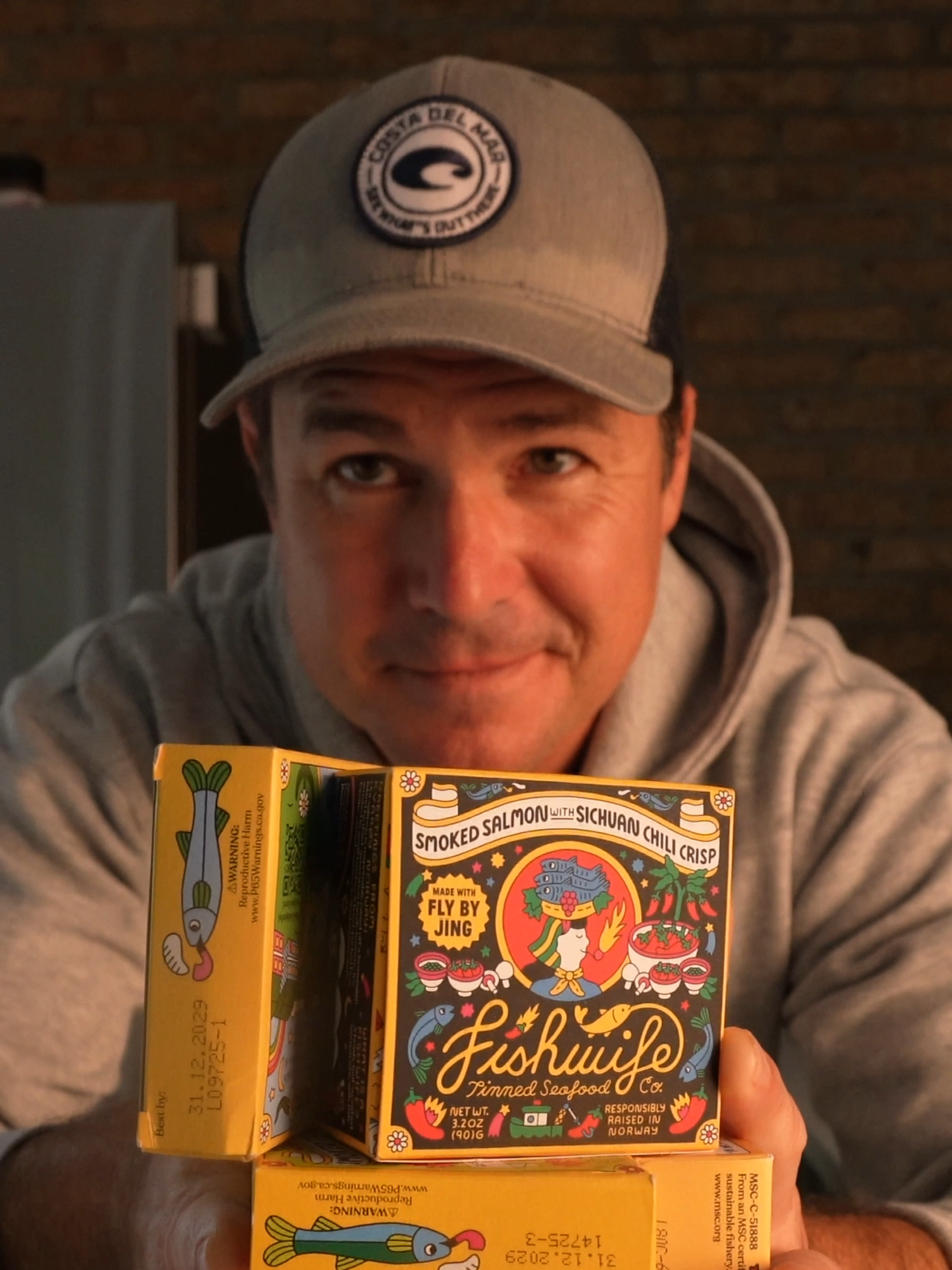
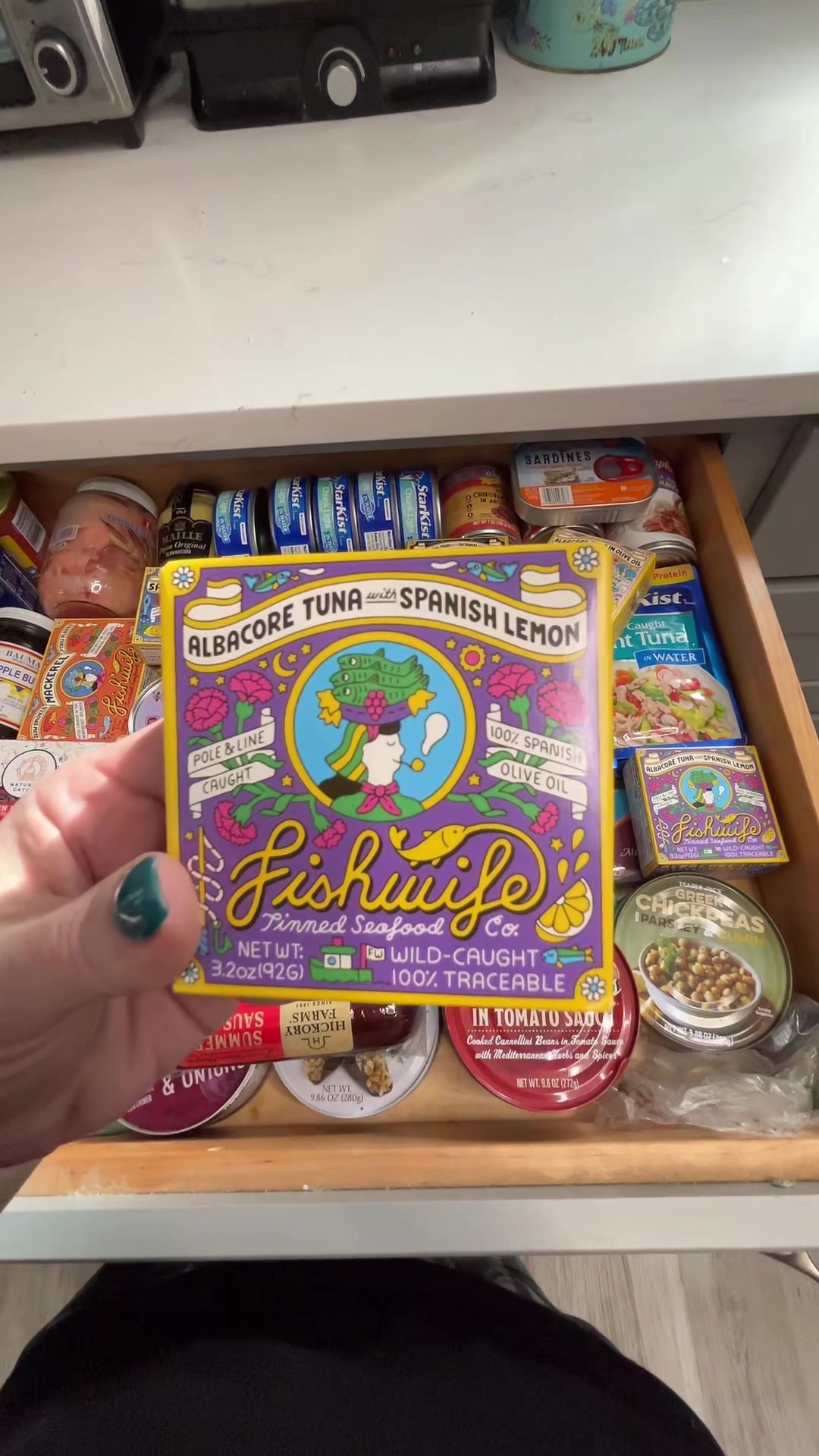
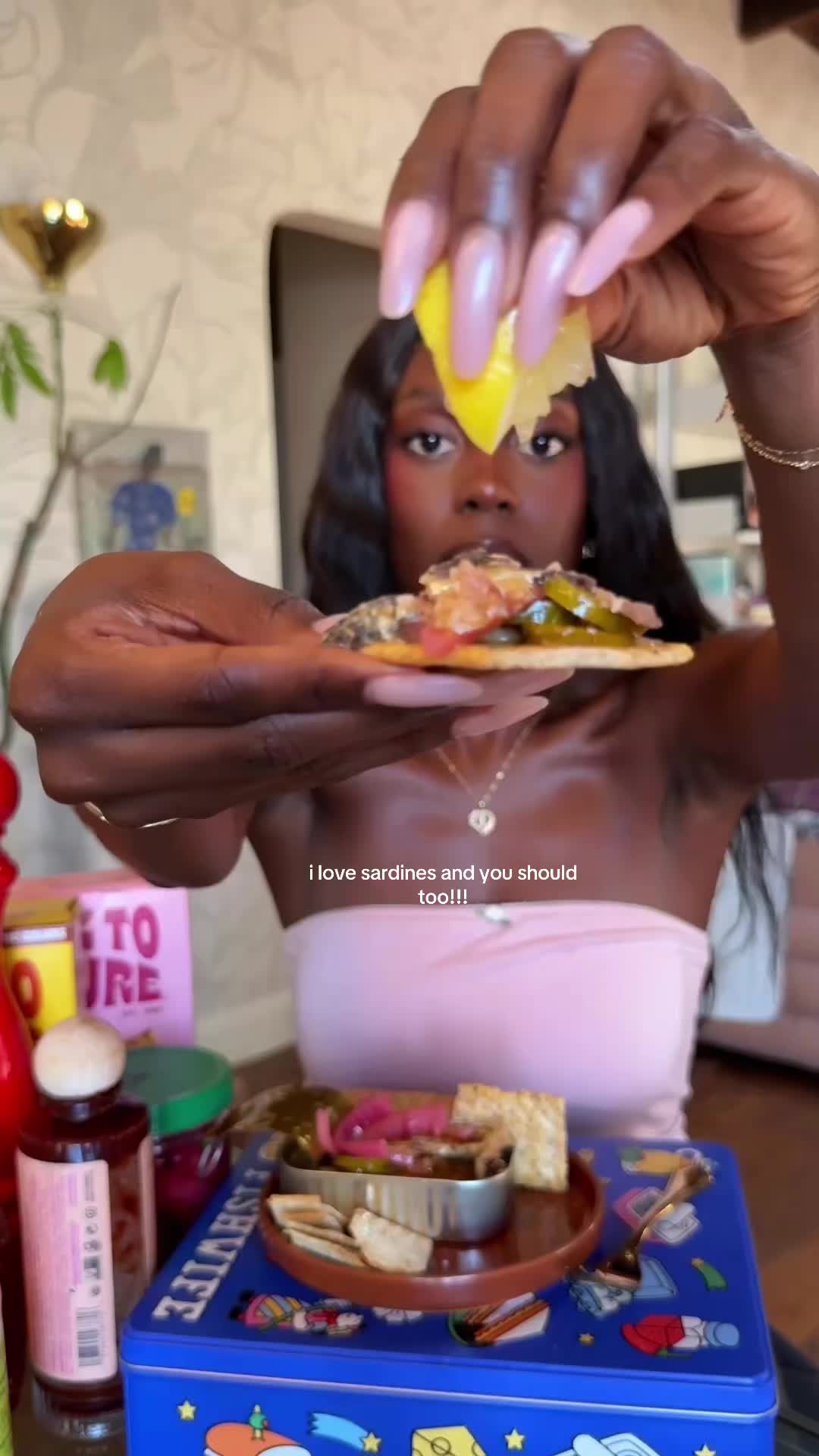
The clearest recurring amplifier is Toni Bravo, a creator who posts her own rotating discount codes directly in captions ("my fishwife code is TONIBRAVO," later refreshed to "BONITRAVO"), functioning as an informal affiliate seller rather than a one-off reviewer. Other creators publish recipe and snack-plate content featuring the brand, including cheezytalkwithmadelyn (who circulates a "MADELYN10" code), Cooking.With.Suzi, and tinned_fish_reviews on Instagram. Reddit's r/CannedSardines and r/Tinnedfish host genuine, brand-independent debate about the product rather than seeded promotion. The brand account (Fishwife/eatfishwife) and founder Becca Millstein's personal on-camera appearances are the two distinct owned voices; everyone else is third-party creator amplification.
07 Organic & video
The organic content engine: the videos, creator posts, and community presence earning attention without paid spend.
Creator content clusters around two formats: snack-plate assembly clips (a tin poured onto a board with eggs, crackers, or bread) and shorter review/ranking videos. The top posts include "By the Water"'s tinned-fish ranking video at 526,621 engagements, "Cooking.With.Suzi"'s snack-plate build at 233,901 engagements, and Toni Bravo's code-drop posts at 168,134 and 146,594 engagements. The brand's own TikTok account mixes product pushes with founder-to-camera content, including Becca Millstein, Fishwife's co-founder and CEO, promoting a limited NYC pop-up shop and snack bar in person rather than only through paid creative.
08 Affiliate & partners
How the brand turns creators and partners into a tracked, variable-cost acquisition channel, and how the program is structured.
The site links to a formal referral/partner program at eatfishwife.com/pages/refer, and the creator evidence shows that program extends informally through personalized creator discount codes (TONIBRAVO, BONITRAVO, MADELYN10) that function as trackable affiliate links even without a named platform badge in the evidence.
09 The playbook
The channels are not separate. They are one system where each stage feeds the next. Here is the read, then the plays to run tomorrow.
The inferred playbook
Fishwife's loop starts with free product in the hands of food-focused micro-creators, compounds through named, trackable discount codes, and only added paid media to scale the same creative language that already worked organically.
Individual creators like Toni Bravo issue their own refreshed discount codes in captions, turning a single seeded tin into a repeatable, attributable sales channel distinct from a formal affiliate dashboard.
The brand's longest-running Meta ad (404 days) and its DPA "eat it right out of the tin" messaging reuse the same recipe-occasion and objection-killing language that carried the organic wave, rather than introducing new ad concepts from scratch.
Dig deeper+2▾
Nearly all measured organic search traffic lands on the homepage and category pages rather than content pages, meaning search demand functions as a downstream capture mechanism for virality rather than an independent SEO engine.
the DTC-versus-retail revenue split behind the reported $7.6M figure, blended return on the Meta and Google ad spend, and the subscribe-and-save repeat-purchase rate behind the Stay.ai subscription toggle.
Seed micro-creators with product, not fees
The proofFishwife's first two years ran on $0 paid media, seeding tins to food-focused micro-creators whose posts now reach into the hundreds of thousands of engagements.
The adaptationShip free product to 10-20 creators already reviewing adjacent products in your category, ask for nothing but an honest post if they like it, and prioritize creators making the exact format that already works for you, snack-plate-style assembly or ranking-style comparison content, over follower count.
Cost: under $500 · Time to signal: weeks · Works pre-PMF: yes.
Give each seeded creator a named code
The proofToni Bravo circulates her own personalized, periodically refreshed discount codes directly in captions rather than a generic brand link.
The adaptationOnce a creator from Play 1 posts, issue them a code built from their own handle and refresh it every few months to re-trigger a new post, then track redemptions by code to see which creator relationship is actually driving purchases, not just views.
Cost: $0 (paid only on redemption) · Time to signal: weeks · Works pre-PMF: yes.
Build one curiosity-cutoff hook and let it run
The proofFishwife's single longest-running ad is a trout creative built on a mid-word curiosity cutoff, "Why is our tr-", kept alive for 404 days through creative refreshes rather than replaced.
The adaptationPick one specific use-occasion for your product, write one hook that cuts off mid-sentence at the exact moment of highest curiosity, and run it as a standing ad you refresh with new visuals rather than retiring it for a new concept every few weeks.
Cost: under $500 · Time to signal: months · Works pre-PMF: conditional, needs enough paid budget to sustain a multi-week test before you can tell if it's a real winner.
Package a low-commitment starter bundle
The proofFishwife's onboarding ad, "New to tinned fish? Start here," points to a Starter Pack bundling several bestsellers, paired with a subscribe-and-save discount at checkout.
The adaptationAssemble your existing bestsellers into one discounted "starter" bundle aimed specifically at category newcomers rather than existing fans, and put a subscription discount option directly on that bundle's checkout so first-time buyers can convert straight into a repeat customer.
Cost: $0 (repackaging existing inventory) · Time to signal: weeks · Works pre-PMF: yes.
Delay paid spend until organic proof exists
The proofFishwife held off on any paid advertising for roughly its first two years, using that runway to build organic momentum before turning on paid social.
The adaptationSet an organic threshold for yourself, a specific number of unpaid creator posts or a minimum engagement level, before spending on ads, and when you do turn ads on, reuse the exact hooks and language that already worked organically instead of writing new ad copy from a blank page.
Cost: $0 to start, dedicated budget once paid begins · Time to signal: months · Works pre-PMF: yes. Not transferable at an earlier stage: the multi-format Google and Meta ad libraries running hundreds of concurrent variants, the national Whole Foods and Target retail distribution, and the Shark Tank-style celebrity investment moment all depend on scale and relationships Fishwife built up over several years, not tactics a reader can run from a cold start.
You just read how Fishwife does it. Tomorrow it is someone else.
Every morning we take one company that is actually growing and break down where its customers come from: the ads still running after a year, the channel doing the real work, and the play you can run this week.
Systemaic · directional intelligence. Traffic, spend, and reach figures are SimilarWeb-style estimates and qualitative reads of public data, not audited numbers. Built on real public receipts.
// teardowns with a similar GTM motion
sources & receipts (2)
Live ad libraries: meta ad library · google ad library
Traffic, spend, and revenue figures are estimates as noted in the report; the links above are the primary public artifacts.