- 01Turn your top objection into the ad
- 02Seed named discount codes before building affiliate infrastructure
- 03Let retail placement generate its own creator content
- 04Gate your best landing page behind a free account, not an instant checkout
01 Snapshot
The one-glance read on who they are and how they grow. Each point is verifiable from the receipts above.
Organic bag-in-box and canned cold brew, now protein cold brew lattes, sold DTC, in retail (Whole Foods, Target, Costco), and to offices, with revenue estimated at ~$22.9 million as of 2026 (RocketReach estimate, unverified).
Paid-led and creator-led hybrid: long-running Meta and Google ad libraries paired with a sustained TikTok and Instagram creator-UGC engine.
~92,700 estimated monthly site visits (+69.8% recent trend, as of 2026-07-31); 111,825 Instagram followers across 1,738 posts; a roughly 200-ad Google library (162 sampled, 12 still active) plus at least 56 analyzed Meta ads; the longest-running active ad has run ~852 days on Meta (801 on Google) as of 2026-07-31.
As of 2026-07-31, Meta creative tests lean on seasonal-flavor UGC testimonials and a canned-latte-versus-cafe comparison angle, while Google is running several sub-two-month text and image tests.
A single "cancel your boring coffee routine" trial-pack offer has anchored their paid engine for over two years, and they appear to be extending that same evergreen infrastructure and creator base toward the new protein latte line rather than building a separate funnel for it.
02 How it unfolded
The order the channels came online. Sequence is strategy: what they did first, and what they layered on once demand existed.
03 Traffic & channel mix
Estimated demand, the channel split behind it, and the keywords and referrers doing the work. Directional modeling, not audited analytics.
The site draws an estimated ~92,700 monthly visits, up 69.8% as of 2026-07-31. No channel-by-channel split (direct, search, paid, social) was available for this domain, but the ranking-keyword data shows the visible organic pull is almost entirely branded search: the brand ranks #1 for "wandering bear coffee," "wandering bear cold brew," "wandering bear," and "wandering bear decaf cold brew." The one non-branded keyword in the data, "does cold brew have more caffeine," ranks #7, a modest toehold in category-level informational search rather than a real acquisition lever.
04 Organic content
The specific pages earning their organic search traffic, and the pattern behind why they rank. Adapt the format, not the topic.
Their top organic pages are dominated by the homepage (44.5% of tracked organic traffic) and two direct product pages for the flagship Extra Strong Straight Black line, one in the 96oz box format (19.8%) and one in the 32oz carton format (6.1%), plus a collections page (4.6%) and a single blog post, a "caffeine cold brew primer" (3.5%). The pattern is product-page and brand-term direct match, not a comparison-listicle or programmatic content engine: four of the five top pages are the homepage, a collection, or SKU pages that convert on-page, and only one is an evergreen educational asset. That primer is also the only page capturing a non-branded query ("does cold brew have more caffeine," ranking #7), suggesting it is quietly pulling in informational searchers that the rest of the site's organic footprint, built on owned brand terms, cannot reach on its own.
Top pages by organic traffic
05 Channel map
Not traffic share. How much weight the growth system actually puts on each channel, with a one-line read on the role it plays.
What drove growth
06 The creative doing the work
Each exhibit shows the actual asset, an X-ray of why it works, a status, and a play you can adapt. This is the heart of the teardown.
Across the two platforms, this is a genuinely proven paid operation: the Google library runs roughly 200 ads (162 sampled, 12 still active as of 2026-07-31), and the Meta side has at least 56 analyzed ads. The label "proven winner" is earned here, not inflated, since the single longest-running active ad (Google, image format) has been live for 801 days, and Meta's top active creative has run 852 days.
Hook: "CANCEL your old boring coffee routine & try our 3-for-1 Cold Brew Variety Pack!" Why it works: It reframes a coffee purchase as breaking a bad habit rather than trying a new product, then removes risk with a money-back guarantee and a "3 flavors for the price of one" trial mechanic; a companion Instagram Q&A-format creative kills the top stated objection directly ("I get stomach aches from coffee" answered with "never once has my stomach gotten upset from Wandering Bear"), and a scarcity badge ("SELLING OUT") on the same trial pack pushes urgency on a genuinely low-commitment offer. Run this play: expanded as Play 1 below.
Hook: "You asked, we delivered! Back for limited time - Dirty Vanilla Chai." Why it works: It frames a returning seasonal SKU as a fan-requested comeback rather than a routine restock, borrowing social proof from the "you asked" framing without needing a real quoted request; the paired creatives run a UGC talking-head angle alongside a product demo, the recurring format across this brand's social ads. Run this play: Pair a "bring-it-back" hook with a UGC talking-head plus a close-up pour shot whenever reviving a discontinued or seasonal item, since the returning-favorite frame reads as lower risk than a brand-new launch.
Hook: "The only cold brew that makes your grandma's banana bread recipe jealous. Double-strength coffee that's totally legal in all 50 states." Why it works: The joke ("totally legal in all 50 states") sets up an unexpected reveal that it's just strong coffee, which earns attention before the real pitch (zero sugar, double-shot strength) lands; the copy leads with a sensory, nostalgic banana-bread image before the real pitch (zero sugar, double-shot strength) lands. Run this play: Lead a new-flavor ad with a sensory nostalgia image unrelated to the product category, then cut to the reveal, since it holds attention longer than opening on packaging.
Beyond these three, one Google search ad claims "Sold out 19x," an advertised outcome from the company's own copy rather than an independently confirmed count. The contrast with what's being tested now is stark: while the Variety Pack, Dirty Vanilla Chai, and Banana Bread creatives have proven themselves over months, the newest Meta tests are shorter-lived seasonal-flavor testimonials ("addicted to these summer flavors... saving $5/cup") and a canned-latte-versus-cafe comparison hook ("canned lattes are just as good as expensive lattes you get from a café"), both aimed at extending the same trial-pack and new-latte playbook into fresh angles rather than replacing it.
The winning ads route to two different funnel shapes depending on destination domain. Ads pointing to get.wanderingbearcoffee.com, including the 852-day Variety Pack ad and the Dirty Vanilla Chai video, appear to route to pages like "Extra Strong Black Organic Cold Brew Cartons (32oz)" and "Why Cold Brew 32oz," both of which are gated behind a "membership or subscription required" wall tied to their subscription app (Stay.ai) and a program called "The Pack": visitors must sign up or log in before seeing full pricing ($34.99-$44.99 visible on the gated variant). A third page, "Why Cold Brew Sells Out," is gated the same way and is the shared landing destination for two different creatives, the Banana Bread video and a Toasted Coconut image ad, meaning distinct flavor launches funnel into one educational, scarcity-themed page rather than flavor-specific landers. By contrast, the plain product page "Wandering Bear Cold Brew - Smooth, Strong, Ready to Pour," which the Banana Bread ad also links to in some placements, is open with no gating. The net effect is a funnel that uses membership/subscription gating as a soft email-and-account capture step before a purchaser sees full pricing, rather than a conventional open landing page.
- Running
- 462 days (longevity = it's converting)
- Hook
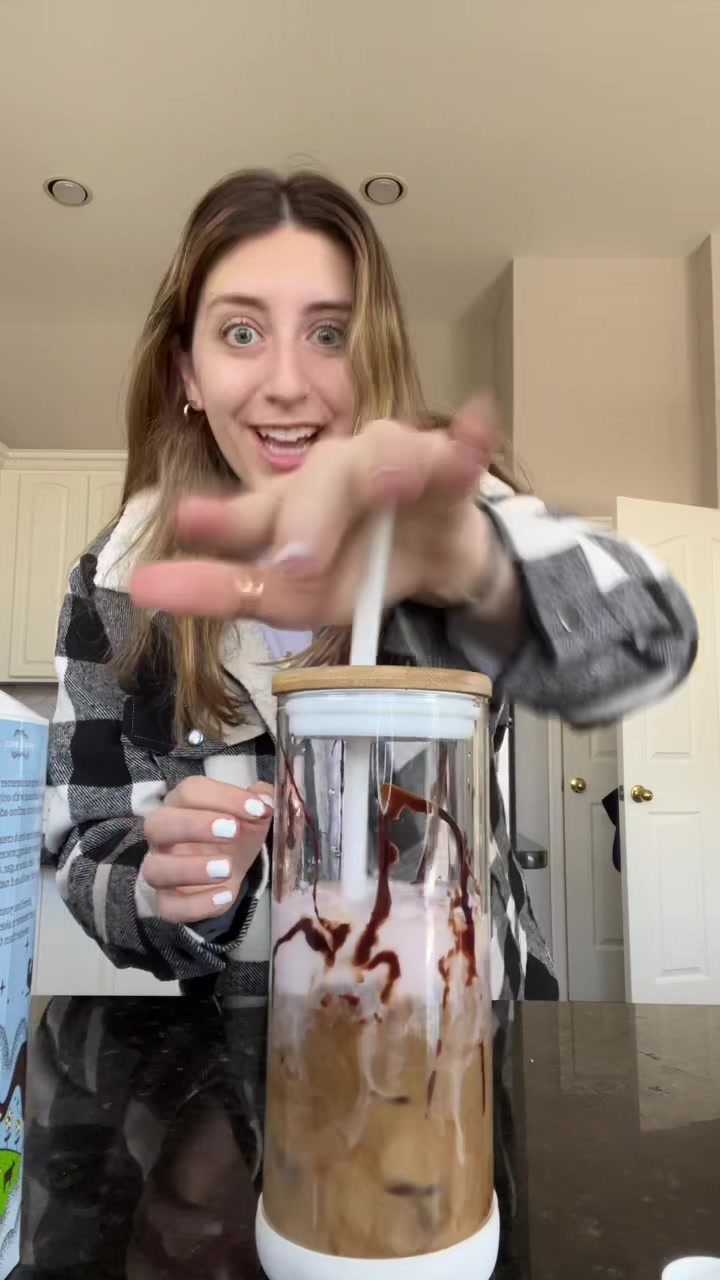
- "Dirty vanilla chai. Cold brew on tap." A woman with long brown hair is speaking directly to the camera, pointing her finger, with two cardboard boxes of "WANDERING BEAR" cold brew visible behind her.
- Audience
- The mention of "Dirty Vanilla Chai" and "2 espresso shots" targets coffee drinkers who enjoy flavored, strong cold brew and convenience, likely those who appreciate a cafe-style drink at home.
Why it works. A direct-to-camera flavor call-out styled like a drink order makes shelf-stable cold brew feel like a fresh pour, not a boxed product.
Direct address and enthusiastic endorsement at 0:00-0:03, "Dirty vanilla chai. Cold brew on tap. I have a really good feeling about this." Have your presenter name the flavor like they're ordering it at a counter, then reveal the packaging behind them.
- Running
- 462 days (longevity = it's converting)
- Hook
- On-screen text reads "Dirty." A hand pours a dark liquid from a box into a glass with ice. The box is labeled "WANDERING BEAR EXTRA STRONG COLD BREW -Dirty Vanilla Chai-".
- Audience
- People who enjoy cold brew coffee and chai, specifically those looking for a convenient, high-quality, and strong coffee option at home. The 'Dirty Vanilla Chai' flavor targets those who like flavored coffee drinks.
Why it works. Opens on one ambiguous word timed to the pour, so viewers stay through the reveal to find out what 'dirty' describes.
Sensory appeal through pouring and mixing (0:00-0:01, 0:10-0:11). Cut your video to show the product action first and drop one provocative word on screen before naming the product.
- Running
- 170 days (longevity = it's converting)
- Hook
- A person's hands are shown pouring a dark liquid from a box labeled "WANDERING BEAR EXTRA STRONG COLD BREW - Dirty Vanilla Chai" into a glass filled with ice. On-screen text reads: "Dirty." and then "Vanilla."
- Audience
- The video targets individuals who enjoy cold brew coffee and chai, specifically those looking for a convenient, high-quality 'dirty chai' experience at home, as evidenced by the product name 'Dirty Vanilla Chai' and the woman's enthusiastic testimonial about its taste.
Why it works. Builds the flavor name word by word over the pour shot, adding a beat of suspense to what would otherwise be a plain demo.
Product unboxing and placement in a home setting (0:02-0:10). The woman unboxes the product and places it in her refrigerator, showing its size and how it fits into a typical home. Reveal your product's flavor name across two or three on-screen text beats instead of all at once.
Show 7 more exhibits
- Running
- 74 days (longevity = it's converting)
- Hook
- A person's hands are shown pouring a dark liquid from a box labeled "WANDERING BEAR EXTRA STRONG COLD BREW" into a glass with ice. On-screen text reads: "WARNING: FULLY BAKED FLAVOR".
- Audience
- Coffee drinkers who enjoy flavored cold brew and convenience, indicated by the product being a large format cold brew box and the woman's positive reaction to the flavor.
Why it works. Borrows hazard-label phrasing for a dessert flavor claim, so the mismatch between warning and treat carries both the joke and the claim.
Intriguing flavor reveal with on-screen text at 0:00-0:03: "WARNING: FULLY BAKED FLAVOR". Frame your richest or most indulgent flavor as a mock warning label instead of a plain description.
- Running
- 74 days (longevity = it's converting)
- Hook
- Visual: A hand pours a white liquid into a glass of dark liquid. On-screen text: "This is dessert for breakfast but the best part is there's no sugar so it's completely guilt-free you're welcome". Audio: Soft, instrumental music.
- Audience
- Individuals who enjoy sweet treats but are health-conscious or sugar-averse, indicated by the 'no sugar' and 'guilt-free' claims.
Why it works. Stacks an indulgent claim against a health claim in one sentence so the guilt-free payoff arrives before a viewer can object.
Benefit-led text overlay at 0:00-0:15: "This is dessert for breakfast but the best part is there's no sugar so it's completely guilt-free you're welcome". Combine your product's indulgent appeal and its health credential in one uninterrupted sentence, not two separate claims.
- Running
- 4 days (new — still being tested)
- Hook
- Visual: A box of "WANDERING BEAR Blueberry Muffin COLD BREW" in a refrigerator, with smaller floating images of the product and a text box that reads "WHEN A BLUEBERRY MUFFIN AND COLD BREW GO ON ONE DATE AND MOVE INTO YOUR FRIDGE". On-screen text: "ATTN: COLD BREW LOVERS". Audio: Upbeat, rhythmic music begins.
- CTA / offer
- Get yours now at wanderingbearcoffee.com
- Audience
- Cold brew lovers (explicitly stated at 0:00), people seeking unique coffee flavors, those who value convenience (0:16-0:20), and individuals who appreciate organic ingredients (0:10-0:14).
Why it works. Meme style caption makes an unusual flavor pairing memorable for cold brew fans scrolling past standard product ads.
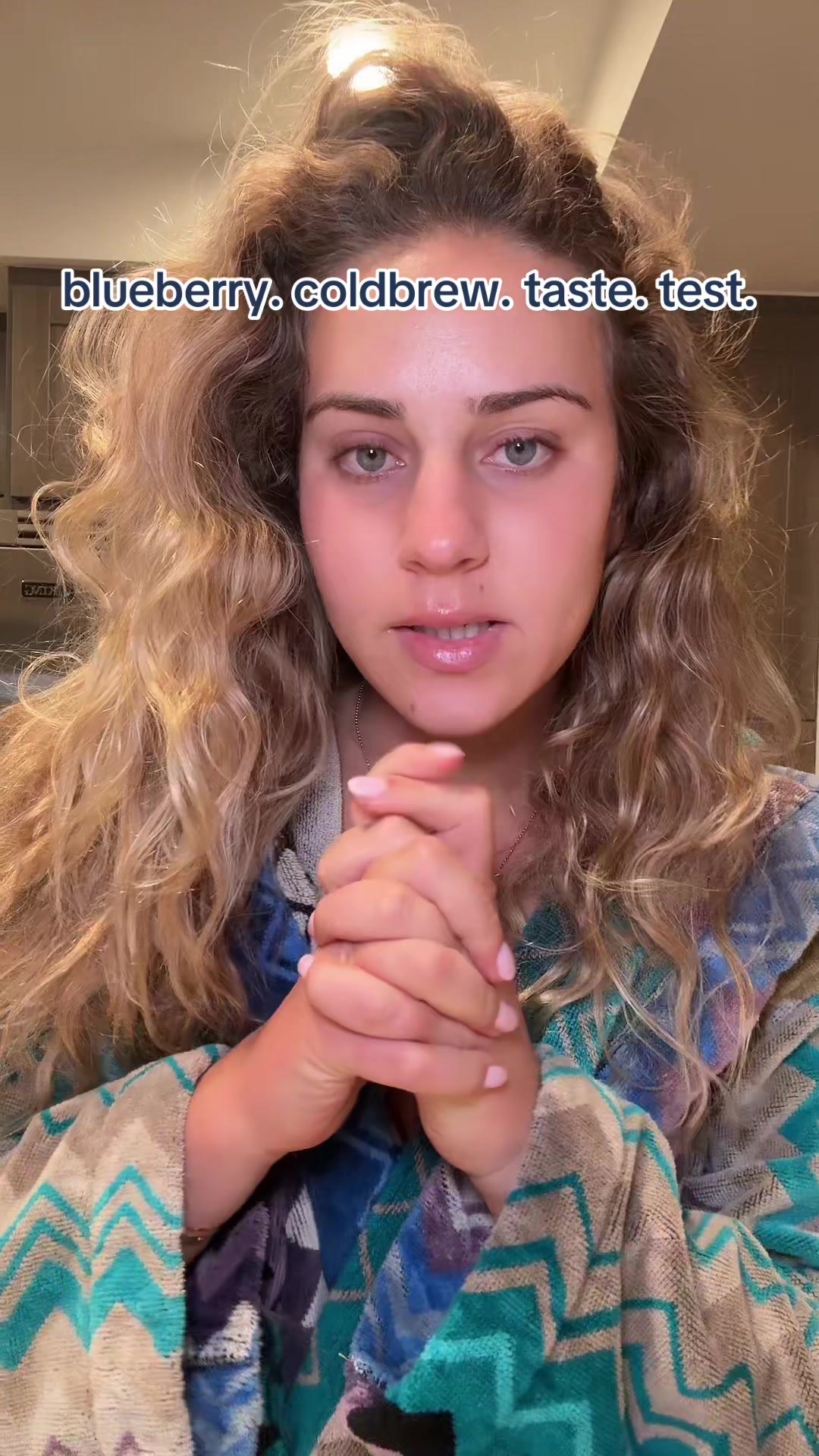
Problem-agitation hook with a unique flavor reveal (0:02-0:06): "Still drinking the same boring cold brew?" followed by "Meet your new obsession: Blueberry Muffin Cold Brew 🫐🫐". Turn your product's flavor combination into a playful relationship style caption instead of a plain description.
product demo
- Hook
- "I can never predict what day this is going to happen, but it always happens in early summer, my body is like, 'oh, we're switching from hot coffee to cold brew.'" A hand pours a thick, purple liquid from a clear measuring cup into a glass filled with ice and a dark liquid. The purple liquid mixes with the dark liquid. In the background, a blue carton labeled "COLD BREW" is visible.
- Audience
- Individuals who enjoy cold coffee, appreciate convenience, and are interested in customizing their drinks with unique flavors. The mention of switching from hot to cold coffee targets those experiencing seasonal changes in beverage preference.
Why it works. Opens with a relatable seasonal ritual instead of a pitch, then demonstrates a DIY cold brew recipe to show the product's versatility.
Relatable problem introduction and solution presentation at 0:00-0:07, "I can never predict what day this is going to happen, but it always happens in early summer, my body is like, 'oh, we're switching from hot coffee to cold brew.' And it has to be Wandering Bear Cold Brew." Open UGC scripts with a specific, recurring personal ritual your customer already recognizes in themselves before introducing the product.
- Reach
- 17 upvotes · 12 comments · r/AwesomeFreebies
A community is already discussing this in r/AwesomeFreebies. Show up there authentically and answer the thread before a competitor does.
Who amplifies them
Amplification here is almost entirely third-party rather than founder-driven. Retailer-specific creators recreate the haul-and-review format for whichever chain stocks the product: @costcofindsnortheast calls the original black cold brew "the best cold brew ever" in a Costco three-pack post, while @wholefoodshype breaks down the Cold Brew Latte's three flavors and protein content as a "strong fridge grab" at Whole Foods. Sourcing also surfaces in the posts themselves: the creator posting as K A T I E notes she "gets mine from @Thrive Market," pointing to a retail channel beyond the brand's own site and its named retailers, and reviewer @jake6young posts a plain "Better 4 You Drink Review" verdict. None of this is founder-led: the evidence contains no verified personal X, LinkedIn, or TikTok account for co-founders Matt Bachmann or Ben Gordon, so visibility runs through the brand account and unpaid or lightly-incentivized creators rather than build-in-public.
07 Organic & video
The organic content engine: the videos, creator posts, and community presence earning attention without paid spend.
Creator video content spans 2022 through 2026 across TikTok and Instagram, and recipe or demo integrations consistently outperform plain unboxing clips. The single highest-engagement TikTok post in the dataset actually came early: in January 2022, @jaeda:) posted a coffee-tips clip that folded in a personal discount code ("USE CODE: JAEDACOHEN"), pulling 2,216 engagements, more than any later creator post here. On Instagram, the pattern that repeats among food creators is a build-your-own-drink demo rather than a straight review: @chefreillymeehan's "3 drinks using @wanderingbearco" reel, which walks through a step-by-step Vanilla Cold Brew Protein Shake recipe, drew 605 engagements, and @simplyhealthyrd's maple sea salt cold foam recreation pulled 310. The sponsored cold-foam pairing reel and the July blueberry cold brew clip referenced above sit at the top of this pattern by volume. Against that, the brand's own owned-channel posting cadence, covered above, runs at a far lower engagement rate, which means the real organic video engine is creators recreating drinks at home rather than anything the brand publishes itself.
08 Affiliate & partners
How the brand turns creators and partners into a tracked, variable-cost acquisition channel, and how the program is structured.
The clearest partner-shaped mechanic in the evidence is informal rather than platformed: individual creators post personalized discount codes tied to their own name, including JAEDACOHEN, Kaela10, and APRILESCO, which functions as a trackable, ambassador-style referral loop even without a named affiliate platform running it. No formal affiliate or referral system, a TikTok Shop storefront, Rewardful, or PartnerStack integration appears anywhere in the evidence, and the site's own subscription program ("The Pack," running on Stay.ai) is a loyalty and retention mechanic, not a partner-recruitment one. At a company with a multi-year (700+ day) evergreen ad library and national retail distribution, running codes ad hoc through individual creator relationships rather than a formalized affiliate platform suggests partner marketing has stayed opportunistic rather than becoming a scaled acquisition channel in its own right.
09 The playbook
The channels are not separate. They are one system where each stage feeds the next. Here is the read, then the plays to run tomorrow.
The inferred playbook
Wandering Bear's growth loop runs on two engines at once: a multi-year evergreen paid-ad library that keeps feeding new visitors into a gated subscription funnel, and a long tail of unpaid creator content that builds trust and pushes buyers toward whichever retailer already stocks the product.
The 700+ day active Meta and Google creatives referenced above function as an always-on top of funnel, and the brand's total dominance of its own name in search suggests most of its organic traffic is people who already know the brand from ads or retail shelves, not new discovery through search.
The Whole Foods-exclusive Cold Brew Latte launch, the Costco- and Whole Foods-specific creator hauls, and shopper call-outs to Thrive Market all point to off-site retail availability, not the DTC site, as where real volume converts, with the site and its ad spend acting as a discovery and loyalty layer on top.
Dig deeper+3▾
The ambassador-style discount codes function as a real distribution layer but scale only as far as the team's own outreach reaches, since no platform sits behind them the way a formal affiliate program would.
Subscription and membership gating on key landing pages, established in the offer and funnel breakdown above, trades some top-of-funnel conversion for email capture, a bet that repeat and subscription revenue outweighs the added friction.
The Pack's active subscriber count, the sell-through or reorder split across Whole Foods versus Costco versus Target, and the blended customer acquisition cost across the combined Meta and Google spend.
Turn your top objection into the ad
The proofWandering Bear's Instagram Q&A-style creative answers the objection "I get stomach aches from coffee" directly with a guarantee and a trial-pack pitch, one of the pieces underpinning the 852-day-running Variety Pack campaign.
The adaptationPull the single most common hesitation from your own support DMs or reviews (a taste worry, a price worry, a "does this actually work" worry), and build a short post or ad styled exactly like a real customer question with your direct answer underneath it, paired with a low-commitment way to try the product (a sample size, a short trial, a money-back line). The mechanism is that a named, specific objection answered in public reads as more credible than a generic benefits list, because it proves you've heard the pushback before.
Cost: under $500 · Time to signal: days · Works pre-PMF: yes
Seed named discount codes before building affiliate infrastructure
The proofCreators like @jaeda:), Kaela, and Aprils_items have run personal codes (JAEDACOHEN, Kaela10, APRILESCO) starting in 2022 with no formal affiliate platform behind any of them.
The adaptationMessage five to ten small creators in your category (roughly 1,000 to 20,000 followers, the range that actually replies to DMs) and offer each one a code with their own name in it and a flat percentage off, tracked manually in a spreadsheet rather than through a platform. Naming the code after the creator, not a generic promo string, is what makes their audience treat it as a personal recommendation instead of an ad. Add a real affiliate platform later, once you can see which codes actually move volume.
Cost: $0 · Time to signal: weeks · Works pre-PMF: yes
Let retail placement generate its own creator content
The proofCostco- and Whole Foods-specific creators (@costcofindsnortheast, @wholefoodshype) post haul and find content the moment the product lands on those shelves, with no brand involvement visible in the posts themselves.
The adaptationOnce your product sits on any real shelf or marketplace listing, whether that's a regional grocer, a Target endcap, or even a single Amazon or Faire listing, tell your existing customers exactly where to find it and that you'd welcome a "look what I found" post, since shoppers already film these discovery moments unprompted once the placement exists. Prime the loop with one or two direct asks to happy customers rather than waiting for it to happen organically.
Cost: $0 · Time to signal: weeks · Works pre-PMF: conditional, only once at least one retail or marketplace listing exists to be "found"
Gate your best landing page behind a free account, not an instant checkout
The proofWandering Bear's top ad destinations route to pages requiring a free membership or subscription sign-up before full pricing shows, a soft email-capture layer sitting in front of its evergreen paid traffic (detailed in the offer and funnel breakdown above).
The adaptationTake your single best-performing ad or post and, instead of sending clicks straight to checkout, send them to a page that requires a free account or email sign-up to see your full pricing or a bundle deal. Frame the sign-up as unlocking a member price rather than a paywall, so it reads as a perk. This trades a slice of immediate purchases for an owned contact you can re-market to, which matters most once you have repeat-purchase or subscription economics worth protecting.
Cost: $0 · Time to signal: weeks · Works pre-PMF: conditional, only once you have an email or SMS flow ready to actually use the captured contacts
Build one evergreen page around the real question customers ask, not just your brand name
The proofAmong Wandering Bear's top organic pages, the one blog post in the mix, a caffeine primer, is also the only page capturing a non-branded search term, "does cold brew have more caffeine," a modest ranking outside the otherwise all-branded-search organic pattern covered above.
The adaptationIdentify the one factual, non-branded question your prospective customers actually type into search before they know your brand exists (a comparison, a how-it-works question, a safety or dosage question), and write a single dedicated page that answers it plainly, linking back to your product page once. One well-targeted informational page can pull in searchers your brand-term pages structurally cannot reach, since those visitors have never heard of you yet.
Cost: $0 · Time to signal: months · Works pre-PMF: yes Not transferable at an earlier stage: the 700-plus-day evergreen ad budgets, the Whole Foods national exclusive launch, and the years of compounding branded search dominance all depend on capital, retail relationships, and time that a reader below this stage will not yet have; the discount-code seeding, the objection-kill creative, and the single evergreen informational page are the parts worth adapting now.
You just read how Wandering Bear Coffee does it. Tomorrow it is someone else.
Every morning we take one company that is actually growing and break down where its customers come from: the ads still running after a year, the channel doing the real work, and the play you can run this week.
Systemaic · directional intelligence. Traffic, spend, and reach figures are SimilarWeb-style estimates and qualitative reads of public data, not audited numbers. Built on real public receipts.
// teardowns with a similar GTM motion
sources & receipts (21)
Live ad libraries: meta ad library · google ad library
Researched facts: Founding story and founders: Founded in 2014 by Matt Bachmann (CEO) and Ben Gordon (Presid · Started with minimal capital: Bachmann has described starting the company with only about · Pre-pandemic office-channel revenue concentration: Office coffee sales (kegs, bag-in-box) · 2022 funding round: Wandering Bear, Inc. closed a $5 million growth round from existing in · 2018 Series A funding: Wandering Bear raised an $8 million Series A in February 2018 from · 2017 seed round: In April 2017, Wandering Bear closed a $2.4 million equity round led by f · 2018 Target national retail rollout: In October 2018, Wandering Bear's 11-oz on-the-go col · 2019 peak pre-pandemic retail footprint: Retail footprint grew from about 750 stores at th · 2023 post-pandemic retail re-entry: In September 2023, Wandering Bear expanded its 32 oz. · Protein Cold Brew Latte launch: Launched September 16, 2025 exclusively at Whole Foods Mar · Direct-to-consumer packaging and pricing (as of July 2026): On wanderingbearcoffee.com, 32
Milestone sources: 2017-09-11: Launches an 11oz single-serve Tetra Pak cold brew line, its first on-the-go fo · 2018-02: Raises an $8M Series A round (AccelFoods, M3 Ventures) to scale team and distribu · 2020-08-19: Launches an expanded at-home product portfolio (32oz cartons, coffee beans, Ke
Community threads: Slickdeals (deal forum): Slickdeals commenters debate whether Wandering Bear's boxed cold · Slickdeals (deal forum): On a Whole Foods rebate deal thread for the new Wandering Bear pr · Walmart customer reviews: A Walmart shopper review captures the brand's core value trade-o · The Quality Edit (review blog): The Quality Edit's founder-reviewer gives a personal, high · AOL Lifestyle (roundup review): An AOL cold brew roundup names Wandering Bear's Extra Stro
Traffic, spend, and revenue figures are estimates as noted in the report; the links above are the primary public artifacts.