- 01Price-anchor against the competitor's sale
- 02Lead with a curiosity question, answer with your structural origin story
- 03Target a profession with an occupation-specific discount
- 04Seed a near-zero-margin entry product to make the quality claim testable
01 Snapshot
The one-glance read on who they are and how they grow. Each point is verifiable from the receipts above.
Factory-direct premium apparel and home goods at 50-70% below comparable retail, targeting millennials and Gen Z who want luxury-grade materials at accessible prices; the brand hit an annualized $2.0B revenue run rate as of February 2026 (Sacra estimate), up from $221M in 2023.
Creator-seeded, paid-amplified, influencer haul content ignites product discovery, and a massive Google and Meta paid stack converts that awareness into orders.
~54.5M estimated monthly visits as of July 2026, 1.6M Instagram followers, a ~5,000-ad Google library with the longest-running active ad at ~953 days, and a $10.1B valuation set at a $500M Series E in March 2026.
As of July 2026, Quince is running a summer home goods creative push across Meta and Google anchored on "This quilt sells out every spring and summer" and "The it-girl linen pants, for half the price."
The $50 Mongolian cashmere sweater (estimated at roughly $39 in COGS) is a deliberate near-zero-margin acquisition wedge: Quince eats the unit profit on order one to make the quality-at-this-price claim impossible to dismiss, then cross-sells into higher-margin home, jewelry, and beauty categories.
02 How it unfolded
The order the channels came online. Sequence is strategy: what they did first, and what they layered on once demand existed.
03 Traffic & channel mix
Estimated demand, the channel split behind it, and the keywords and referrers doing the work. Directional modeling, not audited analytics.
Traffic sources
Top search keywords
| Keyword | Volume | Weight | CPC |
|---|---|---|---|
| quince | 795k | $0.49 | |
| quince clothing | 19k | $0.56 | |
| madewell | 282k | $1.53 | |
| quince returns | 19k | $2.78 | |
| quince canada | 11k | $0.16 |
Top referring sites
Closest competitors by audience
Quince draws an estimated ~54.5M monthly visits as of July 2026, with a +1.7% trend over the approximately 3-month measurement window. At that volume, even smaller channels move millions of sessions.
The channel split tells a paid-first story at scale. Direct (25.6%) and Paid Search (24.2%) account for exactly half of all traffic. Direct at this share signals habitual brand recall, shoppers returning to quince.com without prompting, which implies a meaningful base of repeat buyers. Paid Search at 24.2% represents roughly 13.2M monthly visits bought through Google, consistent with a library of ~5,000 active ads running continuously for years. Organic Search (13.8%) is the third-largest channel but trails paid search by a wide margin. Display Ads (10.5%) and Email (9.2%) fill out the mid-funnel. Social Paid (7%) and Affiliate (4.3%) are real but secondary. Referrals, Social Organic, and Generative AI combine for just over 5%.
Keywords: Quince holds the #1 position for its own brand name across roughly 795,000 total monthly web searches for "quince" and roughly 19,000 for "quince clothing," capturing branded demand organically. The more revealing bet: Quince actively bids on "madewell" (roughly 282,000 total monthly searches across the web), conquest targeting against the category's mid-market anchor brand.
Referrers and competitors: amazon.com appears as a top referral source, most likely reflecting editorial links or informal product mentions. onequince.com (the brand's alternate domain, matching its social handles) routes traffic to the main site. The competitive set the tools surface, everlane.com, jcrew.com, madewell.com, aritzia.com, confirms Quince plays directly in the "quality basics at honest prices" positioning lane.
04 Organic content
The specific pages earning their organic search traffic, and the pattern behind why they rank. Adapt the format, not the topic.
The organic footprint is almost entirely branded and transactional: the homepage alone captures roughly 50% of the estimated ~594,000 monthly organic visits tracked across the top pages, meaning most organic search traffic arrives from people already looking for Quince by name. The /quince-offers and /discounts/service-education pages are the next largest earners, the latter drawing teachers, nurses, and military personnel who searched specifically for an occupational discount. Category pages for dresses and bedding contribute smaller but intent-driven slices.
The pattern inverts what most DTC brands try to build with SEO. Quince earns its top organic rankings for its own brand terms and its own discount pages, not through comparison content, material-education guides, or "best cashmere sweater" roundups. Organic traffic here is downstream of awareness built through influencer seeding, paid ads, and podcast placements, people who already know the brand and are searching for a deal or a specific category they heard about elsewhere.
Top pages by organic traffic
05 Channel map
Not traffic share. How much weight the growth system actually puts on each channel, with a one-line read on the role it plays.
What drove growth
06 The creative doing the work
Each exhibit shows the actual asset, an X-ray of why it works, a status, and a play you can adapt. This is the heart of the teardown.
Google: A library of roughly 5,000 active ads as of July 2026 (all 240 sampled ads were active; total library size is directional given the collection cap). The longest-running active ad has been live approximately 953 days, a text ad first shown in November 2023. Quince's Google text creative follows a consistent formula: material claim plus product name plus price credibility anchor ("100% Grade A Mongolian cashmere - Radically low prices"; "Quality Maternity Swimwear - Sustainable Maternity Swimwear"; "Hailey Wall Mirror"). Google functions here as a direct-response catalog, not a brand-building channel.
Meta: The Meta library is DPA-dominant, catalog retargeting that surfaces the exact product a visitor viewed, running across Facebook, Instagram, Audience Network, Messenger, and Threads simultaneously. Proven winners (running 192 to 304 days as of July 2026) cluster into three copy frameworks:
- Running
- 56 days (longevity = it's converting)
- Hook
- "This quilt sells out every spring and summer" + a woman in a white t-shirt and olive pants shakes out a white textured quilt over a bed.
- CTA / offer
- 40% LESS than traditional retail
- Audience
- Homeowners or renters looking for premium bedding, signaled by the high-end interior design (dark accent wall, gold sconce, wooden bench).
Why it works. The seasonal sellout claim gives a bedding item built-in social proof, aimed at shoppers who dread missing a popular restock again.
Scarcity-led hook at 0:00: "This quilt sells out every spring and summer." Open your video with a specific, repeatable scarcity claim like '[product] sells out every [season]' instead of a generic 'selling fast' line.
- Running
- 54 days (longevity = it's converting)
- Hook
- "The it-girl linen pants, for half the price" shown as on-screen text while a woman holds up a pair of navy blue linen trousers, then a white pair.
- CTA / offer
- Linen pants for "ONLY $52"
- Audience
- Women looking for trendy, high-quality linen clothing ("100% European linen") that is both stylish ("it-girl") and comfortable ("elastic waistband").
Why it works. Extends the it-girl nickname with a direct price contrast and a hand-held two-color reveal, giving price-sensitive shoppers a reason beyond the trend name alone.
Price Anchoring at 0:00 and 0:30 Once a nickname or trend hook is working, layer a specific price-comparison claim on top of it rather than replacing the hook.
- Running
- 52 days (longevity = it's converting)
- Hook
- "The perfect summer pant for half the price." spoken over a close-up of a blue and white striped waistband being adjusted.
- CTA / offer
- "FREE SHIPPING" and "365-DAY RETURNS"
- Audience
- Women looking for summer fashion staples that are versatile enough for travel, brunch, and the beach.
Why it works. Renames a commodity item, linen pants, with an aspirational label, letting the product ride existing trend-driven search and social interest.
Price Anchoring (0:01 - "half the price") Give a plain, commodity-style product a short, trend-coded nickname that borrows language from an existing cultural moment.
Show 7 more exhibits
- Running
- 36 days (longevity = it's converting)
- Hook
- "This quilt sells out every summer 🌊🐚" shown over a person's hands smoothing a blue textured quilt over a white bedsheet.
- CTA / offer
- "SHOP NOW"
- Audience
- People who "run hot in their sleep" and shoppers looking for "100% organic cotton" bedding.
Why it works. Frames scarcity as a repeating yearly pattern rather than a single flash sale, making the urgency feel earned by past demand instead of manufactured.
Opening with scarcity claim at 0:00: "This quilt sells out every summer 🌊🐚" If your product has genuinely sold out before, open with that history, like 'sells out every summer,' instead of a generic limited-time line.
- Running
- 688 days (longevity = it's converting)
- Hook
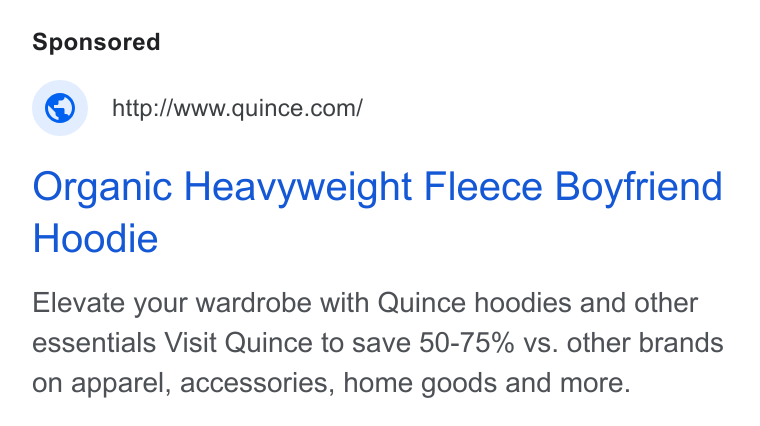
- Sponsored http://www.quince.com/ Organic Heavyweight Fleece Boyfriend Hoodie
- CTA / offer
- Visit Quince to save 50-75% vs. other brands on apparel, accessories, home goods and more.
- Audience
- Individuals looking for organic, comfortable, and stylish clothing ('Organic Heavyweight Fleece Boyfriend Hoodie') who are also value-conscious ('save 50-75% vs. other brands').
Why it works. Matches the literal long-tail search phrase for this hoodie, so the shopper sees their own words reflected back before they click.
Headline product specificity: 'Organic Heavyweight Fleece Boyfriend Hoodie' Write your Shopping ad titles as the exact phrase a buyer would type: material, weight, then garment style.
- Running
- 688 days (longevity = it's converting)
- Hook
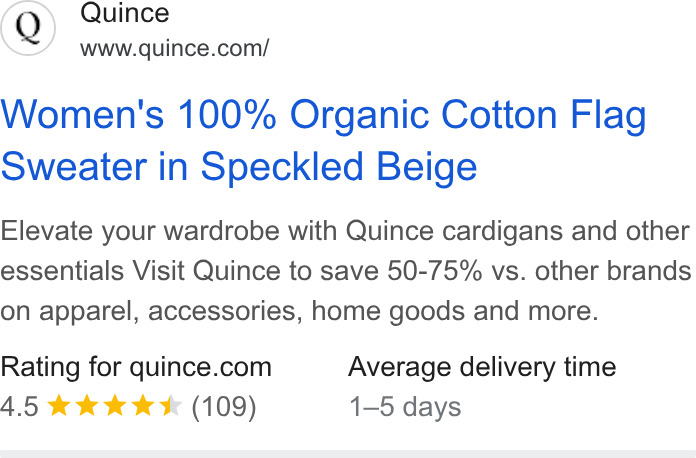
- Q Quince www.quince.com/ Women's 100% Organic Cotton Flag Sweater in Speckled Beige
- CTA / offer
- save 50-75% vs. other brands
- Audience
- Women interested in organic, high-quality clothing at a significant discount, as evidenced by 'Women's 100% Organic Cotton Flag Sweater' and 'save 50-75% vs. other brands'.
Why it works. Full product spec in the headline (fiber, garment, colorway) lets a value-conscious shopper self-qualify before clicking.
Leading with a specific product description and key material claim: "Women's 100% Organic Cotton Flag Sweater in Speckled Beige". Put the exact fabric percentage, garment name and colorway together in your search ad headline, not split across lines.
founder-to-camera
- Hook
- "Hi, I'm Kate Young, I'm a celebrity stylist." A woman with blonde hair, wearing a navy blue long-sleeved top and dark blue pants, stands next to a woman with dark skin and braided hair, wearing a light brown short-sleesleeved top and a light beige satin skirt, holding a light beige tote bag. They are standing in front of a green wall.
- Audience
- Individuals interested in elevated, versatile fashion, particularly those who value celebrity endorsement and quality materials like cashmere and satin. The mention of 'packing for summer' and 'double duty' pieces also targets travelers or those seeking versatile wardrobe items.
Why it works. A celebrity stylist's self-introduction hands Quince's styling credibility to a third party, aimed at shoppers who trust expert opinion over brand copy.
Celebrity Endorsement (0:00-0:03): The video opens with "Hi, I'm Kate Young, I'm a celebrity stylist." and later displays "Quince styled by KATE YOUNG". Open your UGC ad with your expert saying their name and exact credential before mentioning the product, so trust builds before the pitch.
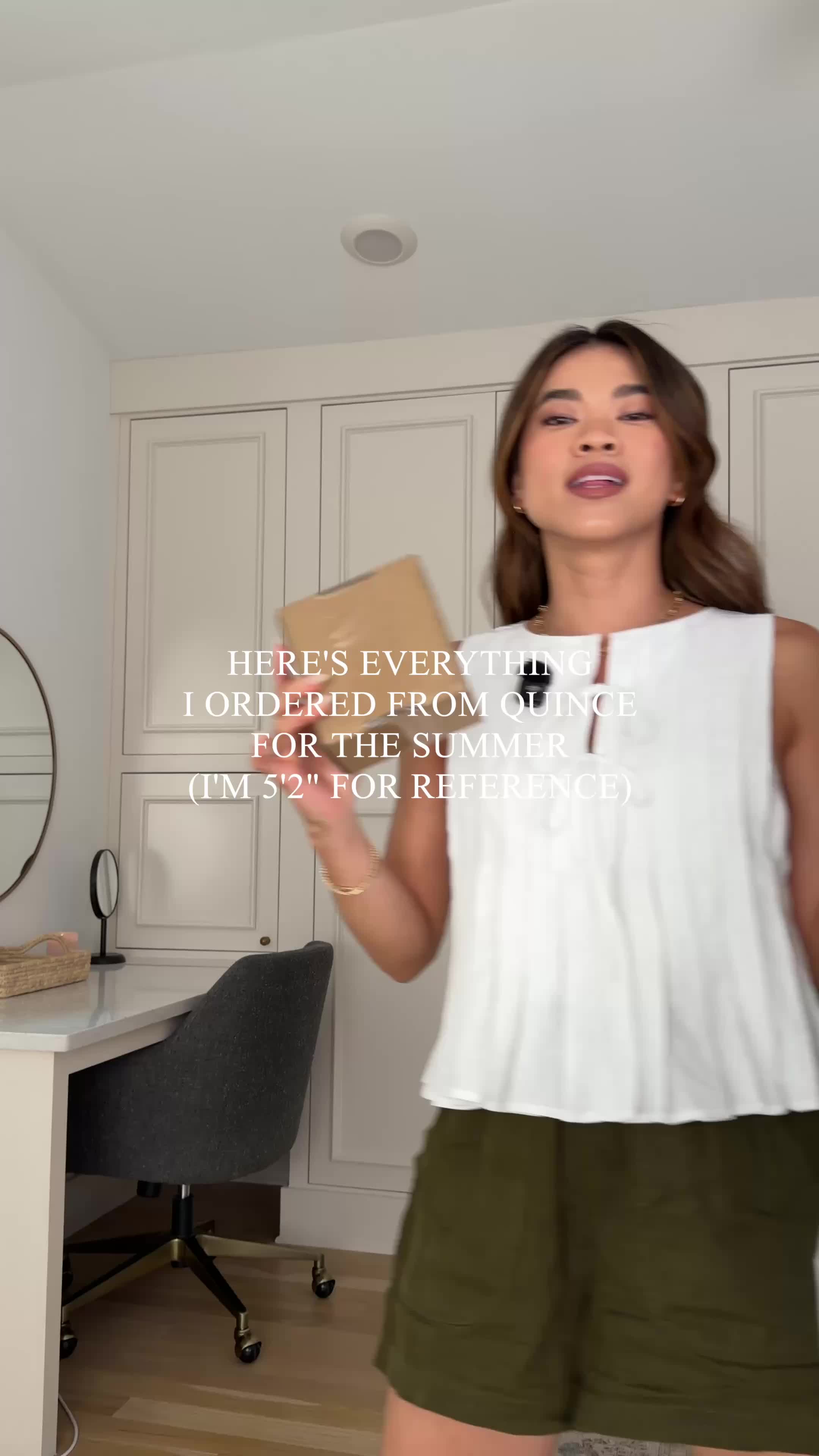
you all said Quince was worth it, so let’s try it out. Here are my first impressions on a couple of things I ordered last week 🤗
- Reach
- 1,166 upvotes · 242 comments · r/womensfashion
A community is already discussing this in r/womensfashion. Show up there authentically and answer the thread before a competitor does.
Who amplifies them
Celebrity stylists: Kate Young and Jamie Mizrahi anchor the credentialed-fashion tier, lending their names to Quince content in formats (capsule collections, styling challenges) that extend far beyond a typical sponsored post.
Lifestyle creators with referral codes: @apartment_bartender posts linen content with a formal referral code (INFG-26APARTMENTBARTENDER10, offering 10% off a first purchase), confirming a structured ambassador relationship. The code format, an "INFG" prefix plus the creator handle plus a discount percentage, suggests a systematized program generating unique codes per partner.
Fashion micro-creators: @katiesteckly (504 Instagram engagements on a try-on review), @bychloewen (563 TikTok engagements on a summer haul), and @fabricateurialist (Instagram pants review) represent the volume tier producing the base of organic-feeling content.
Third-party editorial: @annemarieconte referenced a Wirecutter textiles expert (@heyjackiereeve) testing Quince items alongside other experts, third-party editorial placement that carries outsized trust, though the post implies results were mixed (items tested and being "ready to donate").
Reddit communities: r/quince, r/womensfashion, r/handbags, and r/malefashionadvice host active Quince discussions. This amplification is largely uncontrolled and skews skeptical, the brand has no visible response or engagement presence in any of these communities.
Podcast networks: Multiple Reddit threads from 2025 and 2026 describe encountering Quince ads across a wide range of podcasts. Specific shows are not identified in the available evidence, but the frequency of references across independent Reddit users confirms a sustained, broad audio buy.
07 Organic & video
The organic content engine: the videos, creator posts, and community presence earning attention without paid spend.
Quince's @onequince Instagram reaches 1.6M followers but averages approximately 1,294 engagements per post, a low engagement rate indicating the account functions as a product broadcast channel rather than a community hub. The brand's two original content series carry the most strategic weight.
Read the full breakdown+4▾
The "Styled by Quince" collaboration with celebrity stylist Kate Young (803 engagements on the launch reel, promoting a curated summer capsule) positions Quince as a credentialed fashion destination, lending authority that offsets the "is this too good to be true?" skepticism the brand faces at scale. The "Styled by Quince Styling Challenge" with host Jamie Mizrahi extends that credentialing into a repeatable episodic format.
Third-party creator standouts (all Instagram, listed by engagement):
- @katiesteckly, "you all said Quince was worth it, so let's try it out": 504 engagements, the authentic first-impression format that functions as a credibility bridge for skeptical shoppers.
- @apartment_bartender, Father's Day linen content with referral code INFG-26APARTMENTBARTENDER10: 207 engagements, UGC-format content with embedded commerce attribution baked in.
- Additional creator posts (including @fabricateurialist and @munoslifedecor) contributed in the single-digit-to-low-double-digit engagement range.
On TikTok, @bychloewen's "Trying on my Quince summer haul" (563 engagements, July 2026) is the most recent creator signal and shows the format Quince consistently seeds: a petite-fashion try-on haul with a liketk.it affiliate link spoken aloud.
The format that performs across platforms is the first-impression try-on haul with a specific demographic hook (petite fashion, linen season, Father's Day gifting). The narrative structure that drives engagement is "I was skeptical, I tried it, here's my real reaction", which directly counters the growing Reddit skepticism in the brand's organic conversation.
08 Affiliate & partners
How the brand turns creators and partners into a tracked, variable-cost acquisition channel, and how the program is structured.
Quince runs a formal referral program (terms at quince.com/referral-program-terms-and-conditions). The creator code structure (INFG-26APARTMENTBARTENDER10, offering 10% off a first purchase) confirms a code-per-creator ambassador model with the creator handle embedded for attribution. The "INFG" prefix suggests a partner management layer generating unique codes systematically rather than manually.
Read the full breakdown+2▾
Quince also participates in LTK (LikeToKnowIt), the affiliate shopping platform used heavily by fashion creators: @bychloewen's TikTok haul links via liketk.it, making Quince discoverable through LTK's creator marketplace beyond individual direct partnerships.
No TikTok Shop merchant storefront is visible in the evidence. Creator UGC shows affiliate-linked posts rather than a dedicated TikTok Shop seller network.
09 The playbook
The channels are not separate. They are one system where each stage feeds the next. Here is the read, then the plays to run tomorrow.
The inferred playbook
Quince runs a four-stage loop where creator seeding builds aspiration, paid search and Meta retargeting convert it into first orders, a near-zero-margin cashmere wedge removes the purchase-risk barrier, and email plus direct traffic drive the repeat cycle that closes the unit economics.
The $50 cashmere sweater was designed to make the price-quality story impossible to dismiss in a creator review, at a price any viewer could test, describing a material (Grade A Mongolian cashmere) any creator could explain in one sentence. Influencer earned media value reached $19.3M in 2024, up from $4.1M in 2023. LTK participation and formal referral codes make creator-driven traffic measurably attributable rather than lost to dark social.
With roughly 24.2% of ~54.5M monthly visits arriving through paid search, Quince captures everyone who heard about the brand from a podcast or creator and then typed a search. The conquest bid on "madewell" (roughly 282,000 total monthly web searches) intercepts comparison shoppers at the point of decision.
Dig deeper+3▾
The proven winner copy frames Quince's everyday price against a competitor's sale price, neutralizing the "is this a real deal?" objection at the retargeting stage. DPA format means the specific product the visitor viewed appears in the ad, reducing the consideration gap between visit and purchase.
Brand credibility is under sustained pressure. Three high-engagement Reddit threads from 2025 and 2026 question Quince's quality and business model: a 1,166-upvote post in r/womensfashion titled "Quince is starting to feel… scammy," a 454-upvote post in r/quince titled "Genuinely I think quince is a scam," and a post in r/handbags flagging that Quince bags use split leather. These threads surface in search results for anyone conducting pre-purchase research, and Quince has no visible response or community presence in any of them. A Wirecutter textiles expert's social post implying mixed results on tested items compounds the third-party credibility risk. At $2.0B annualized revenue the drag is real but unmeasured, and the creator strategy of seeding "I was skeptical, I tried it" hauls is the only visible counter-move.
Repeat purchase rate, basket-level ARPU across categories, CAC.
Price-anchor against the competitor's sale
The proofQuince's longest-running Meta proven winners do not claim to be cheap. They say "Our full price < their sale price" and "Competitors marked it down. We never marked it up.", DPA copy running for approximately 192 days as of July 2026 across multiple variants.
The adaptationIdentify the biggest promotional event in your category, a competitor's seasonal sale, end-of-year markdown, or flash discount. Pull the competitor's actual sale price on a product comparable to yours. Write one line in the form "their [sale name] price is still [X] more than ours" and run it as a Meta retargeting ad to recent site visitors during or immediately after the sale. The mechanism: shoppers in promo season are primed to compare prices; this ad intercepts that comparison with the conclusion already drawn, before the shopper finishes comparing. No professional design needed, the copy is the creative.
Cost: under $500 to test · Time to signal: weeks · Works pre-PMF: conditional, requires a genuinely defensible price gap and a competitor with enough recognition that your audience already knows their prices.
Lead with a curiosity question, answer with your structural origin story
The proofQuince's second longest-running Meta proven winner (approximately 304 days as of July 2026) opens with "😍 Ever wonder why luxury products are so expensive?", a question that frames the copy as the answer the viewer sought. The factory-direct explanation follows immediately.
The adaptationIdentify the structural reason your product is priced or made differently from incumbents, a process you skip, a relationship you have, a material you source directly. Frame it as the question your customer already quietly wonders. "Ever wonder why [category] products cost so much? At [brand], they don't have to be." Write this as either a text-overlay DCO creative or a short video script where the question runs the first three seconds and the rest answers it. The mechanism: a question creates a scroll-stop and signals "I know what you're confused about" before asking for a click, which builds trust rather than triggering ad-skipping reflexes.
Cost: $0 to write, under $500 to test · Time to signal: weeks · Works pre-PMF: yes, provided the structural difference is real and the question resonates with your specific audience.
Target a profession with an occupation-specific discount
The proofQuince runs proven-winner "We salute nurses" and "We salute teachers" creatives, occupation-specific images paired with a discount accessible via the /discounts/service-education page, targeted by profession through Meta's ad platform.
The adaptationPick one profession whose members are likely to buy your product and talk to each other in dense professional networks (nurses in hospital Slack channels, teachers in faculty workrooms, architects at firm all-hands). Run a small Meta test targeting that occupation with a 15-20% occupational discount, creative that acknowledges the profession by name, and a dedicated landing page. The mechanism: an ad that addresses your job title feels personally made for you, lifting click-through rate; within tight professional communities, a useful deal gets shared with colleagues, compounding organic reach beyond the paid impression. First step: confirm Meta supports occupation targeting in your market before building the creative.
Cost: under $500 · Time to signal: weeks · Works pre-PMF: yes, provided your product has genuine fit with the chosen profession.
Seed a near-zero-margin entry product to make the quality claim testable
The proofQuince's $50 cashmere sweater carries an estimated ~$39 in COGS, a near-zero-margin product that functions as the viral review magnet and primary first-purchase driver before customers expand into higher-margin home, bedding, and jewelry. That cashmere wedge was the engine behind the brand's $19.3M in influencer earned media value in 2024.
The adaptationIdentify one product in your line where you can absorb near-zero unit margin in exchange for a price point that makes your quality story undeniable. Seed that product to ten creators in formats where the price is spoken aloud, first-impression reviews, haul videos, unboxings. The mechanism: a product that makes a creator say "I genuinely cannot believe this costs $X" becomes self-distributing content; the price is the hook and the quality is the proof. The economics work only if your product line includes at least one higher-margin category the first-time buyer can naturally expand into, without a second category, you are funding acquisition with no margin recovery.
Cost: cost of seeded units (variable) · Time to signal: months · Works pre-PMF: conditional, the product must survive a genuine, unscripted first-impression review, and you need a second category with real margin available before you commit to the wedge.
Use free public signals to pick your next product category before competitors see the demand
The proofQuince built proprietary scrapers to monitor search trends, review velocity on competing products, and influencer chatter, a process management calls the "M2C operating system", to identify categories with structural markups before committing inventory. This process preceded entries into cashmere, home goods, lab-grown diamonds, and other categories.
The adaptationBefore adding a product category, run a one-day research sprint with free tools: Google Trends for the category term (12-month view, look for sustained upward movement); Amazon Best Sellers review velocity for the top product in that category (a high-selling item with low review scores signals quality dissatisfaction that a better product could own); TikTok search for the category keyword filtered to the past 90 days (rising creator content with high engagement signals demand retailers haven't caught up with yet). If all three signals point the same direction, that is a structural markup opportunity worth a small test order before committing to full inventory. The mechanism: category selection is a GTM leverage point most founders treat as instinct; turning it into a repeatable, signal-reading process reduces the rate of inventory bets that miss.
Cost: $0 (all free tools) · Time to signal: months (the decision happens before product launch) · Works pre-PMF: yes, this is most valuable before you have committed capital to a second category. Not transferable at an earlier stage: The paid search machine Quince runs, roughly 5,000 active Google ads and approximately 13M monthly paid-search visits, requires capital available only after significant fundraising. The OOH billboard campaigns across major cities, the celebrity stylist capsule collaborations, and the factory-direct supply chain (1,800 employees, global manufacturing relationships, and proprietary data infrastructure) are all multi-year or multi-million builds. The five plays above, price-anchor copy, curiosity-hook origin story, occupation targeting, near-zero-margin product seeding, and signal-based category selection, are all executable before Quince's scale and before meaningful outside funding.
You just read how Quince does it. Tomorrow it is someone else.
Every morning we take one company that is actually growing and break down where its customers come from: the ads still running after a year, the channel doing the real work, and the play you can run this week.
Systemaic · directional intelligence. Traffic, spend, and reach figures are SimilarWeb-style estimates and qualitative reads of public data, not audited numbers. Built on real public receipts.
// teardowns with a similar GTM motion
sources & receipts (8)
Live ad libraries: meta ad library · google ad library
Launch archives: Hacker News: Bot Automatiza el recobro de tus Facturas Fallidas en Stripe · Hacker News: Kakitype et kydoniaty: Photography with Persimmon Tannin or · Hacker News: Second Life: Thomas De Quincey peels back the layers of the · Hacker News: The Animalcule: A Life of Thomas de Quincey · Hacker News: De Quincey: So Original, So Truly Weird (2016) · Hacker News: Supping on Horrors: Thomas De Quincey’s Bad Habits
Traffic, spend, and revenue figures are estimates as noted in the report; the links above are the primary public artifacts.