- 01Template one hook across many faces
- 02Anchor your price against a trusted luxury substitute
- 03Sell inside a marketplace your buyer already trusts
- 04Give partners a tag, not just a link
01 Snapshot
The one-glance read on who they are and how they grow. Each point is verifiable from the receipts above.
Slim-fit men's basics (tees, bundles, backpacks, activewear) sold direct at Target-priced points, still growing traffic +21.9% over the last 3 months.
Paid-led performance-video engine on Meta, layered with a TikTok Shop and Instagram creator-affiliate network.
~2,582,423 monthly visits, 793,179 Instagram followers, 56 active Meta ads and an $850M implied valuation from its first institutional round (1686 Partners, May 2025), all as of 2026-07-05 unless dated otherwise.
As of 2026-07-05, the newest Meta creative wave mixes an emotional "Dads who never quit" tribute video with re-shoots of the brand's celebrity-comparison script on new faces.
The ad library isn't a handful of one-off winners, it's a template factory: the same "guys who look good in a plain tee" script is re-shot with different creators and run through dynamic (DCO/DPA) ad formats, letting Meta auto-optimize which face and product pairing wins rather than betting on a single creative.
02 How it unfolded
The order the channels came online. Sequence is strategy: what they did first, and what they layered on once demand existed.
03 Traffic & channel mix
Estimated demand, the channel split behind it, and the keywords and referrers doing the work. Directional modeling, not audited analytics.
Traffic sources
Top search keywords
| Keyword | Volume | Weight | CPC |
|---|---|---|---|
| true classic | 105k | $1.24 | |
| true classic tees | 23k | $1.28 | |
| trueclassic | 21k | $1.27 | |
| true classic t shirts | 5.1k | $1.37 | |
| fresh clean threads | 23k | $0.94 |
Top referring sites
Closest competitors by audience
True Classic pulls an estimated 2,582,423 monthly visits, up 21.9% over the last 3 months. Search organic leads the mix at 26.4%, direct traffic at 21.4%, and email at 18.5%, a combination that points to a large base of repeat, already-aware visitors rather than first-time discovery. Paid search adds another 12.9%, reinforcing how much of the funnel is bought rather than earned; the rest, paid social, display, affiliate, organic social, referrals and AI-assisted search, together total near a fifth of visits and don't individually move the needle.
On keywords, "true classic" pulls 104,850 monthly searches and "true classic tees" pulls 23,410, both branded terms confirming the direct/email dominance above. Notably, "fresh clean threads" (a direct competitor's name) pulls 23,090 monthly searches and shows up in True Classic's own keyword set, consistent with the two brands appearing in each other's competitor list below, a sign of active comparison-shopping between them. Referring sites are thin and mostly non-strategic: getredo.com likely reflects a returns/exchange integration rather than a marketing channel, while chiefofstaffjob.com and feishu.cn read as incidental traffic noise. Closest named competitors include byltbasics.com (a direct fitted-tee rival), freshcleantees.com (the same brand surfacing in the keyword data above), and bonobos.com (a legacy, broader-catalog men's DTC brand competing more on category share than price).
04 Organic content
The specific pages earning their organic search traffic, and the pattern behind why they rank. Adapt the format, not the topic.
Organic search earns True Classic almost nothing beyond its own name: the homepage accounts for 93.4% of organic-page traffic and a single secondary page ("/WOI") takes the remaining 6.6%. The keywords driving even that are branded and navigational, "trueclassic.com," plus typo variants like "true vlassic" and "true ckassic," meaning people mistyping the URL, not a content or SEO strategy pulling in new searchers. There's no comparison-page, how-to, or programmatic content engine here; readers looking to adapt an SEO play should look elsewhere in this report, because for True Classic the entire growth story runs through paid and owned channels, not search content.
Top pages by organic traffic
05 Channel map
Not traffic share. How much weight the growth system actually puts on each channel, with a one-line read on the role it plays.
What drove growth
06 The creative doing the work
Each exhibit shows the actual asset, an X-ray of why it works, a status, and a play you can adapt. This is the heart of the teardown.
True Classic runs 56 active Meta ads as of 2026-07-05. Its longest-running creative has been active 166 straight days, a genuine proven winner rather than a fresh test, and several more sit past the 100-day mark.
Hook: "We rebuilt a $700 luxury leather backpack and made it accessible for $69!" paired with a customer testimonial ("this is by far the best backpack that I own"). Why it works: it borrows a luxury price anchor from a category the buyer already trusts, then lets a specific, first-person testimonial close the "is this actually good" gap instead of brand copy making the claim itself. Run this play: expanded as Play 2 below.
Hook: "Anytime you see a guy looking good in a plain blank t-shirt," delivered by a talking-head creator with a celebrity split-screen (Daniel Craig, Chris Hemsworth, Bruce Wayne/Batman) layered behind him. Why it works: it reframes the product claim as an "insider observation" rather than a pitch, borrowing authority from names the audience already associates with looking good in a tee, and the near-identical script recurs across at least four separate creators in the proven-winner bucket, meaning the brand is testing the messenger, not the message. Run this play: expanded as Play 1 below.
Hook: "STOP THE SEARCH! You found the perfect fit," run as a dynamic product ad against a product shot of folded tees. Why it works: the checklist copy (timeless style, ultra-comfort, insane value) removes the need for a paragraph pitch, and because it runs as a dynamic ad it can show the exact product a given visitor already browsed. Run this play: layer a checklist-copy retargeting ad under a top-funnel video, showing browsers the specific product they viewed alongside three short benefit lines instead of a long pitch.
- Running
- 129 days (longevity = it's converting)
- Hook
- "We're going to see if the True Classic shirts make me look like I'm in shape." + Man shirtless in a backyard holding a black shipping bag.
- CTA / offer
- "I'll drop the link for them right down there."
- Audience
- Men who want to look more muscular or 'fit' through clothing choices; evidenced by the man's opening line and physique.
Why it works. A shirtless does-this-actually-work test taps male body insecurity while keeping the product, not the body, as what's on trial.
The 'Insecurity Test' Hook (0:00-0:03: "see if... [they] make me look like I'm in shape") Frame your product as the variable being tested against a common insecurity, so viewers judge the product's result, not the presenter.
- Running
- 128 days (longevity = it's converting)
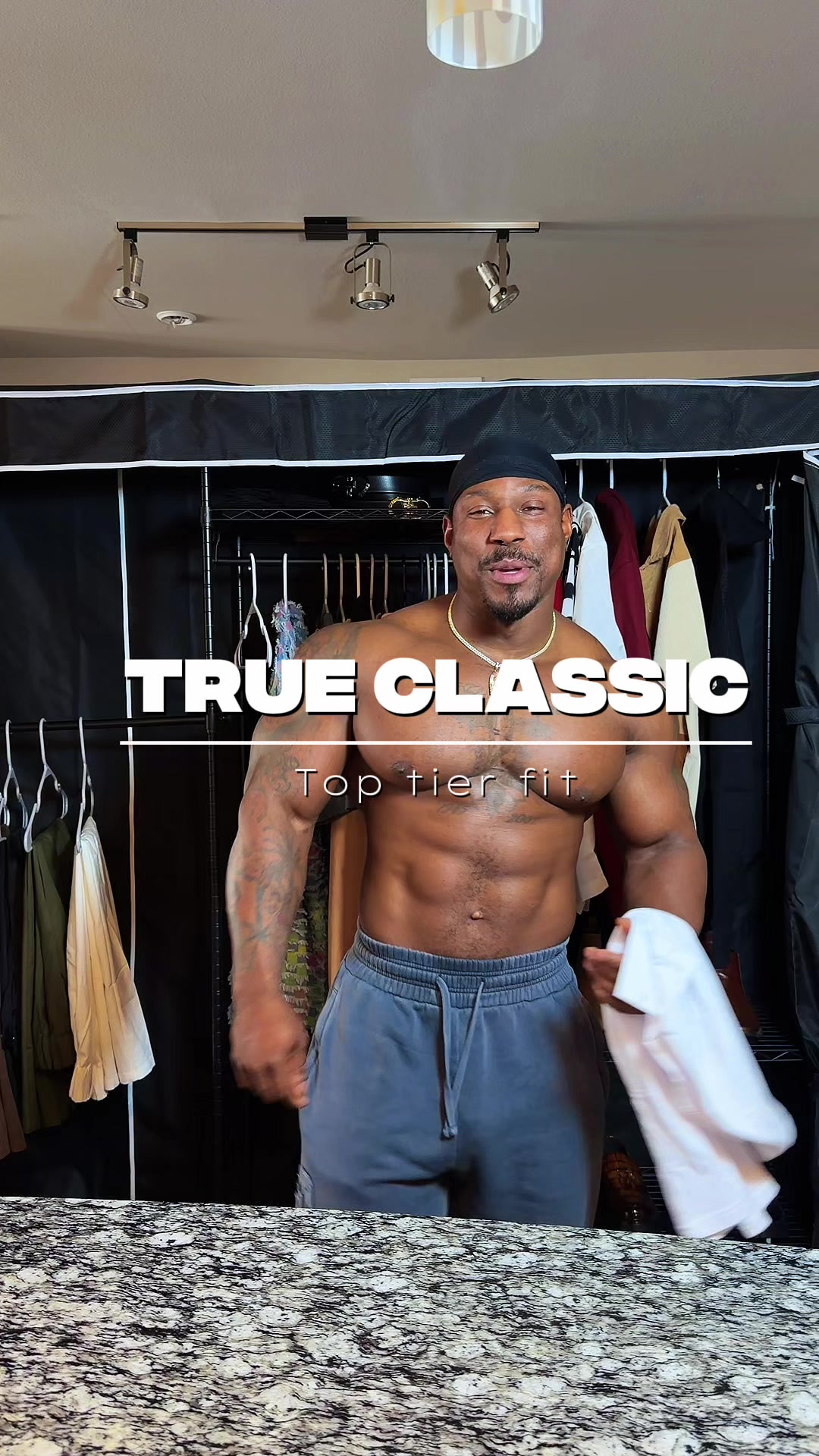
- Hook
- "EVERY GUY NEEDS" spoken as a muscular man in a grey t-shirt and white sweatpants stands in a kitchen.
- CTA / offer
- "I'll link them below for you guys."
- Audience
- Men who work out or want to accentuate a fit physique, signaled by the creator's muscular build and the focus on 'tight on the arms'.
Why it works. A muscular fit-check paired with a blanket imperative claim makes one specific cut read as a baseline requirement rather than a preference.
Specific Fit Callouts (0:05, 0:18): 'Tight on the arms... loose on the waist.' Pair a two-to-three word imperative claim with a visual fit-check on an in-shape body to imply your product is a standard, not a preference.
- Running
- 109 days (longevity = it's converting)
- Hook
- "Ever wonder why celebrities look so good in a plain blank t-shirt?" spoken by a man in a white t-shirt with images of Daniel Craig and Chris Hemsworth overlaid.
- Audience
- Men who are self-conscious about their physique (specifically mentioning "gyno" and "gut") and want to look more muscular.
Why it works. Overlays Daniel Craig and Chris Hemsworth as proof of the look, then pivots into the specific fit complaints viewers already have with basic tees.
Celebrity Anchoring (0:00) Open with a side-by-side of a celebrity and an average guy in the same product category to highlight the visual gap your product closes.
Show 7 more exhibits
- Running
- 128 days (longevity = it's converting)
- Hook
- "Any time you see guys looking good in plain blank t-shirts..." + Man talking with images of Christian Bale and Chris Hemsworth overlaid.
- CTA / offer
- "if you see your size and color still in stock, I'd hurry and get 'em."
- Audience
- Men who want to look better in basic clothing ("guys looking good in plain blank t-shirts").
Why it works. Anchors two A-list physiques against the viewer's own fit concerns, then closes on scarcity to push a decision before they overthink it.
Celebrity anchoring (0:00 - Christian Bale/Chris Hemsworth images) Overlay 2-3 recognizable celebrity photos wearing a generic version of your product to set a high-status visual benchmark before the reveal.
- Running
- 128 days (longevity = it's converting)
- Hook
- "Ever wonder why these guys look so good in a plain blank t-shirt?" + Man in a white t-shirt with two photos of celebrities (Daniel Craig and Chris Hemsworth) overlaid.
- Audience
- Men who want to look more muscular and hide a "gut" or "gyno" in basic apparel.
Why it works. Overlaying two famous physiques in plain tees makes a commodity item feel like the missing piece of their look, aimed at men chasing a leaner silhouette.
Celebrity Anchoring (0:00 - "Ever wonder why these guys look so good") Overlay two recognizable, admired faces wearing the plainest version of your product category to reframe it as the reason for their look.
- Running
- 109 days (longevity = it's converting)
- Hook
- "This. Good. This. Good. This. Good." + Man in a dark grey t-shirt pointing at his bicep, then switching to a light green t-shirt, then back to dark grey.
- CTA / offer
- "I'd recommend picking them up before they are sold out."
- Audience
- Men who want to look more muscular and hide their midsection, as evidenced by the specific callouts to arm size and belly coverage.
Why it works. A hypnotic good-bad-good cadence timed to fast cuts of the same body in different cuts turns a fit comparison into a rhythm viewers can't skip.
Rhythmic 'This. Good.' repetition (0:00-0:03) Cut your before-after shots on a half-second beat synced to one repeated word instead of narrating the comparison in full sentences.
product demo
- Hook
- "You will never marry my daughter, Greg!" A man with gray hair and a gray sweater points at the camera, looking angry.
- Audience
- Men who want to improve their style and appearance, particularly those who might be perceived as underdressed or unfashionable, as evidenced by the 'marriage material' and 'look better' lines.
Why it works. An absurd family-conflict scene disguises a fit-transformation demo, using narrative tension to hold attention past the usual scroll point.
Dramatic, humorous opening with a direct address at 0:00-0:03, "You will never marry my daughter, Greg!" Write a one-line confrontation unrelated to your product category, then cut to the product as the twist that resolves it.
UGC talking-head
- Hook
- "AHA!" + A man in a black t-shirt, seen from the chest up, is pointing to his left, out of frame. The background is dark and out of focus.
- CTA / offer
- Shop Our All-New Pima Tee
- Audience
- Men who are hesitant to upgrade their wardrobe but desire to look good and feel comfortable, signaled by the man's initial resistance to a new shirt and his concern about looking "soft" or having "style".
Why it works. A humorous couple before-and-after scene turns a fit complaint into a running joke, keeping skeptical men watching a basics ad.
Relatable problem setup with a time jump (0:06-0:08, "1 WEEK AGO" and "I don't need a new shirt."). Open with an exaggerated, relatable objection about your product category, then cut straight to a before-after reveal.
- Reach
- 69 upvotes · 74 comments · r/frugalmalefashion
A community is already discussing this in r/frugalmalefashion. Show up there authentically and answer the thread before a competitor does.
Who amplifies them
The brand account (@trueclassictees on X, @trueclassic on Instagram and TikTok) is distinct from co-founder Ryan Bartlett, who posts personally from @RyanBartlett on X and @ryanbartlett on Instagram, including an "origin story" reel about the company. Named TikTok Shop sellers move product directly, including Rightessentials (fit reviews tagged for holiday hauls) and Bo and ciaraaa (selling specific SKUs, including a women's loungewear set, showing the brand's product line extends beyond menswear into affiliate-driven categories). On Instagram, tagged partners treybryantstyle and theblumers post under #trueclassicpartner, distinct from one-off disclosed ads like mitchelleason's #ad post offering a 25%-off code. Community amplification is real but mixed: a r/frugalmalefashion thread surfaced a Costco 4-pack deal organically, while a r/mensfashion thread accused the brand of inflating "original" prices before discounting, a skepticism signal worth weighing alongside the creator praise.
07 Organic & video
The organic content engine: the videos, creator posts, and community presence earning attention without paid spend.
True Classic's own YouTube channel has shifted from short comedic sketches toward cinematic, pre-roll-style ad films: "New Office Uniform" (35M+ views), "A Brief Western" (10.7M views), and "Teemergency" (7.3M views) are the standouts, alongside a behind-the-scenes docu-series ("Behind the Seams") that runs longer-form brand storytelling. On Instagram, the brand's own reels lean into relationship-humor captions, one reading "A True Classic Tee: the clingy, low-maintenance relationship you've always dreamed of" pulled real engagement, while the top organic creator clip, SPOON's "TRUE CLASSIC IS A CLASSIC," pulled 687,309 in engagement outside any brand account. The format that consistently performs across both owned and creator video is the same one driving the Meta ad library: a talking-head or comedic sketch built around a single tight hook, not a straight product demo.
08 Affiliate & partners
How the brand turns creators and partners into a tracked, variable-cost acquisition channel, and how the program is structured.
True Classic runs a named partner-recruitment page at trueclassic.com/pages/partners, backed by a tagged Instagram partner cohort (#trueclassicpartner) and a TikTok Shop seller network, together making up the affiliate slice within the roughly one-fifth of remaining traffic described above. This is a real but secondary lever: the partner tag creates an identifiable, repeatable relationship with a small set of creators rather than one-off sponsored posts, while TikTok Shop functions as a commission-only storefront layer riding on top of the paid engine.
09 The playbook
The channels are not separate. They are one system where each stage feeds the next. Here is the read, then the plays to run tomorrow.
The inferred playbook
True Classic's growth runs on a Meta ad factory that tests one winning script across many faces, backed by big-reach owned video and a thin affiliate layer, with almost no organic content engine underneath it.
The library's dynamic (DCO/DPA) formats and the four near-identical celebrity-comparison scripts show a team optimizing which creator delivers a fixed winning message rather than writing new copy per test, consistent with the brand's leadership pedigree: CEO Ben Yahalom joined full-time from Meta.
Multi-million-view YouTube ad-films sit above the Meta feed ads as brand-building assets, likely feeding the strong direct and email share covered above rather than driving new discovery on their own.
Dig deeper+3▾
TikTok Shop sellers and tagged Instagram partners add a lower-cost seeding motion, but the affiliate channel remains a small slice of total traffic next to the paid and direct/email base.
organic search's 26.4% share is almost entirely branded and typo traffic rather than a built content engine, meaning new-customer discovery outside paid and owned channels is effectively undeveloped. On revenue: the brand reported $250M in annual revenue in 2023 and $500M in cumulative lifetime sales around 2024, before taking its first institutional round from 1686 Partners in May 2025 at an $850M implied valuation. No current annual revenue figure is publicly disclosed; given a headcount in the low hundreds and monthly visits still growing 21.9%, current annual revenue is plausibly well above the 2023 figure, likely in the several-hundred-million range, an estimate, not a confirmed number. Bundle pricing (~$25 for a single tee, down to ~$13/shirt in 6-packs) is the mechanic behind that scale: low per-unit price paired with bundle volume, not a subscription or freemium model.
blended customer acquisition cost, repeat-purchase rate, and the DTC-versus-wholesale (Target, Kohl's, Sam's Club) revenue split.
Template one hook across many faces
The proofthe celebrity-comparison UGC script recurs almost verbatim across four separate creators, all sitting among the longest-running ads in the library.
The adaptationtake the reader's single best-performing piece of organic content and lock its exact wording, then re-shoot it with three to five different unpaid people saying it verbatim on a phone camera, posting each version separately to see which delivery lifts response. The mechanism: this isolates the actual persuasion driver, the words and proof point, from any one creator's charisma, so the next round of spend expands a known winner instead of guessing at new copy.
Cost: $0 · Time to signal: days · Works pre-PMF: yes
Anchor your price against a trusted luxury substitute
The proofTrue Classic's longest-running ad reframes a "$700 luxury leather backpack" against a $69 price point, backed by a first-person testimonial.
The adaptationfind one direct luxury or name-brand equivalent to the reader's own product, state both prices in the same sentence or headline ("we rebuilt the $X into a $Y"), and pair it with one genuine customer line. A borrowed price anchor from a category the buyer already trusts collapses "is this good enough" into "this is obviously worth more than I'm paying," skipping the features pitch entirely.
Cost: $0 · Time to signal: days · Works pre-PMF: yes, provided there's a real, defensible price gap against the named comparison; an invented anchor breaks trust fast.
Sell inside a marketplace your buyer already trusts
The proofTikTok Shop sellers Rightessentials, Bo, and ciaraaa move True Classic product directly, alongside the brand's own affiliate-recruitment page.
The adaptationlist the reader's product inside whichever native marketplace their buyer already shops (TikTok Shop, an Etsy storefront, a marketplace plugin), then message 10-20 micro-creators in the category offering a commission-only link with no upfront fee. The marketplace supplies trust and checkout, the creator supplies discovery, and the founder pays only on a completed sale.
Cost: under $500 · Time to signal: weeks · Works pre-PMF: yes
Give partners a tag, not just a link
The proofInstagram partners treybryantstyle and theblumers post under a dedicated #trueclassicpartner tag, distinct from one-off disclosed #ad posts.
The adaptationcreate one hashtag exclusive to a small, named partner cohort of 5-10 people rather than a generic affiliate code, seed it with free product plus a flat fee or revenue share, and ask partners to use only that tag going forward. A repeated named tag reads as an ongoing relationship rather than a paid drop, which survives audience skepticism about sponsored content better than a single disclosed ad.
Cost: under $500 · Time to signal: weeks · Works pre-PMF: conditional, yes once the reader has real product to seed, no before that.
Let deal-hunters surface your best price for you
The proofa r/frugalmalefashion thread flagged a Costco 4-pack at $49.99 as "pretty good deal" and drew 74 comments with zero brand involvement, in contrast to a separate skeptical thread accusing the brand of inflated discount framing.
The adaptationidentify the one SKU or bundle with the strongest real per-unit price, make sure it's genuinely priced lower somewhere (a retail partner, a bundle) rather than marked up and then "discounted," and let it surface naturally in deal-focused communities instead of posting it as the brand.
Cost: $0 · Time to signal: weeks · Works pre-PMF: conditional, yes only if there's a genuine price advantage to surface; fabricated discount framing risks the same public callout visible in True Classic's own skepticism thread. Not transferable at an earlier stage: the 56-ad Meta testing library, the multi-million-view cinematic YouTube ad-films, and wholesale distribution through Target, Kohl's, and Sam's Club all depend on a production and media budget a pre-PMF founder won't have; adapt the underlying script-templating and price-anchoring mechanics, not the production scale behind them.
You just read how True Classic does it. Tomorrow it is someone else.
Every morning we take one company that is actually growing and break down where its customers come from: the ads still running after a year, the channel doing the real work, and the play you can run this week.
Systemaic · directional intelligence. Traffic, spend, and reach figures are SimilarWeb-style estimates and qualitative reads of public data, not audited numbers. Built on real public receipts.
// teardowns with a similar GTM motion
sources & receipts (1)
Live ad libraries: meta ad library
Traffic, spend, and revenue figures are estimates as noted in the report; the links above are the primary public artifacts.