- 01Pay referrers on lifetime value, not first sale
- 02Whitelist your best organic creator into paid media
- 03Name the objection in the first three seconds
- 04Offer a zero-risk trial on a premium, habit-breaking product
01 Snapshot
The one-glance read on who they are and how they grow. Each point is verifiable from the receipts above.
New Wash, a detergent-free liquid cleanser sold direct-to-consumer, through 4,300+ enrolled hairdressers (as of 2023), and now in 370 Ulta Beauty stores plus Ulta.com as of April 2026, with 1M+ cumulative customers reported by Forbes in May 2026.
Affiliate and creator-led, reinforced by a heavy always-on paid social and search program.
~147,000 estimated monthly visits, 203,211 Instagram followers across 7,170 posts, and ~94 Meta ads plus 36 Google ads on file as of 2026-07-07.
Google's newest experiments are three video ads launched 2026-07-02, active only 4 days as of the observation date, alongside a text-ad test batch running since 2026-05-19.
Hairstory pays hairdressers a running commission on every future purchase from a client they refer, regardless of channel, which is the mechanism that let it expand into Ulta without triggering a channel war, and is now the exact tension stylists are debating on Reddit.
02 How it unfolded
The order the channels came online. Sequence is strategy: what they did first, and what they layered on once demand existed.
03 Traffic & channel mix
Estimated demand, the channel split behind it, and the keywords and referrers doing the work. Directional modeling, not audited analytics.
Traffic sources
Top search keywords
| Keyword | Volume | Weight | CPC |
|---|---|---|---|
| hairstory | 4.7k | $1.91 | |
| hair story | 1.9k | $2.72 | |
| new wash | 260 | $1.79 | |
| paul mitchell tea tree shampoo and conditioner | 580 | $1.27 | |
| no wash shampoo | 320 | - |
Closest competitors by audience
SimilarWeb estimates ~147,000 monthly visits, down 23% over the trailing 3 months. Search Organic leads the mix at 31.9%, followed by Direct at 25.9% and Display Ads at 11.5%, with Search Paid (10.5%) and Email (8.9%) close behind; the rest, affiliate, social paid, social organic, and referrals, totals under 12% combined. The organic-plus-direct dominance (58% of traffic) points to a brand with real earned recognition rather than one bought purely through media, while the 11.5% display share reflects the heavy Google video and image testing visible in the ad data below.
Their top-ranked terms are branded: "hairstory" pulls 4,680 monthly searches and "hair story" another 1,900, both terms they already own at position #1, while "new wash" adds 260 more, showing most of their organic demand is people searching for the brand itself rather than the category. Among stated competitors, bumbleandbumble.com stands out because co-founder Michael Gordon previously ran that company before starting Hairstory, making it as much an origin story as a rival. prose.com competes directly as a subscription-model DTC haircare brand chasing the same "ditch your shampoo" positioning, and livingproof.com sits in the same premium salon-adjacent tier Hairstory is trying to displace.
04 Organic content
The specific pages earning their organic search traffic, and the pattern behind why they rank. Adapt the format, not the topic.
Their top organic pages split cleanly into two jobs: the homepage and the New Wash product page together pull 45% of tracked organic traffic, capturing people already searching the brand or product by name, while the styling gel pouch page adds another 9%, showing the pattern extends to individual SKUs, not just the flagship cleanser. Below that sit two educational blog posts, "how often can you dye your hair safely" and "high vs low porosity hair," classic informational/how-to content that ranks on generic hair-science questions and feeds people into the product pages rather than converting directly. The strategy reads as branded-demand capture at the top plus a thin layer of educational content built to intercept category research, not a broad programmatic SEO play.
Top pages by organic traffic
05 Channel map
Not traffic share. How much weight the growth system actually puts on each channel, with a one-line read on the role it plays.
What drove growth
06 The creative doing the work
Each exhibit shows the actual asset, an X-ray of why it works, a status, and a play you can adapt. This is the heart of the teardown.
Hairstory runs ~94 Meta ads and 36 Google ads on file as of 2026-07-07, with 13 of the 36 Google ads still active. Google's longest-running active ad has been live for ~182 days, a genuine proven winner. Meta's longest-running active creative tops out at 57 days, newer than Google's proven set, so that library reads as a strong current push rather than a fully proven set.
Hook: "Hairstory Official - New Wash - Shampoo Destroys Hair & Scalp" (Google search ad). Why it works: the headline names the category default, shampoo, as the villain before the searcher even clicks, so it intercepts people already comparison-shopping and reframes their existing product as the problem rather than the solution. Run this play: pair a category-reversal headline with your highest-intent search terms so the ad itself does the reframing before the click.
Hook: "New Wash is priced the way it is because it is a complete replacement for all your products in the shower, biodegradable, recyclable." (Meta DCO ad fronted by the page Randa Rivera Hair, ~57 days active). Why it works: it preempts the price objection on a $55 product by reframing the cost as a bundle replacement, and it runs through a real hairstylist's own page rather than the brand handle, borrowing her credibility. Run this play: expanded as Play 2 below.
Hook: "Worried It Won't Work For Your Hair? Try It For $0" (Meta image ad, destination hairstory.com/try-before-you-buy). Why it works: it removes the entire purchase-risk objection on a premium, habit-breaking product by naming the exact fear ("won't work for your hair") and answering it with a specific, linked trial offer. Run this play: expanded as Play 4 below.
- Running
- 57 days (longevity = it's converting)
- Hook
- "Sticker shock is a thing. But let me tell you, New Wash is worth it." Visual: A woman with red hair, glasses, a green hat, and neck tattoos speaking directly to the camera.
- CTA / offer
- "SHOP NOW"
- Audience
- Consumers who currently buy high-end salon products ($40+ per bottle) but are looking for sustainable or more cost-effective alternatives.
Why it works. An on-camera expert states the price objection out loud first, reframing cost as expected rather than a dealbreaker for a premium product.
Direct Objection Handling (0:00 - 'Sticker shock is a thing') State the price objection your prospect is silently thinking, then counter it in the very next clause of the same sentence.
- Running
- 37 days (longevity = it's converting)
- Hook
- "My hair is fine." spoken by a woman with short, voluminous curly brown hair sitting in a car.
- CTA / offer
- The 'Air Dry Kit' featuring Pre-Wash, New Wash, and Hair Balm.
- Audience
- People with "fine, maybe slightly wavy or not wavy hair" who want volume and a quick routine.
Why it works. Uses wordplay to hook fine-haired viewers, then visually disproves the fine-hair-means-limp stereotype with her own volume.
Time-Saving Routine Claim (0:07-0:12): "I had 15 minutes this morning... air drying my hair." Open with a word that has two meanings inside your product category, then resolve the ambiguity visually within seconds.
- Running
- 33 days (longevity = it's converting)
- Hook
- "MY HAIR HAS" on-screen text with a woman with voluminous dark curls speaking to the camera.
- CTA / offer
- Fragrance-free option for New Wash Original, CTA: "SHOP NOW"
- Audience
- People with curly hair, sensitive scalps, or fragrance allergies (explicitly mentioned at 0:20 and 0:50).
Why it works. Pairs a visual of healthy, voluminous curls with progressive on-screen text crediting the product alone, aimed at viewers with the same hair type.
Villain Framing (0:31): "Detergents are actually the biggest reason why you experience so many hair issues" Build your on-screen text claim across the clip, timed to land as the visual proof gets stronger, instead of stating it all at once.
Show 7 more exhibits
- Running
- 37 days (longevity = it's converting)
- Hook
- "I have not washed my hair in 10 days." + Close-up of a woman with curly blonde hair, glasses, and red lipstick.
- Audience
- People with curly or fine hair who want to reduce wash frequency, evidenced by her saying "My hair is extremely fine" and showing her curls.
Why it works. A salon owner's counterintuitive confession borrows professional authority while her clean look despite no wash validates the low-frequency routine.
Counter-intuitive hygiene hook at 0:00 ("I have not washed my hair in 10 days.") Open with a specific countable claim, a number of days, dollars, or uses, that contradicts what your category assumes.
- Running
- 5 days (new — still being tested)
- Hook
- "Your gray hair does not have to be coarse" + woman with long gray hair talking to camera in front of a bookshelf.
- CTA / offer
- "SHOP NOW"
- Audience
- Women with gray hair (visual evidence: the speaker's hair; text: "YOUR GRAY HAIR").
Why it works. Targets an underserved gray-hair demographic with a claim that rejects a specific assumption about texture, making the pitch feel personally addressed.
Niche Problem Callout at 0:00: "YOUR GRAY HAIR DOES NOT HAVE TO BE COARSE" Name a physical trait your ideal customer assumes is permanent, then state in your opening line that it does not have to be.
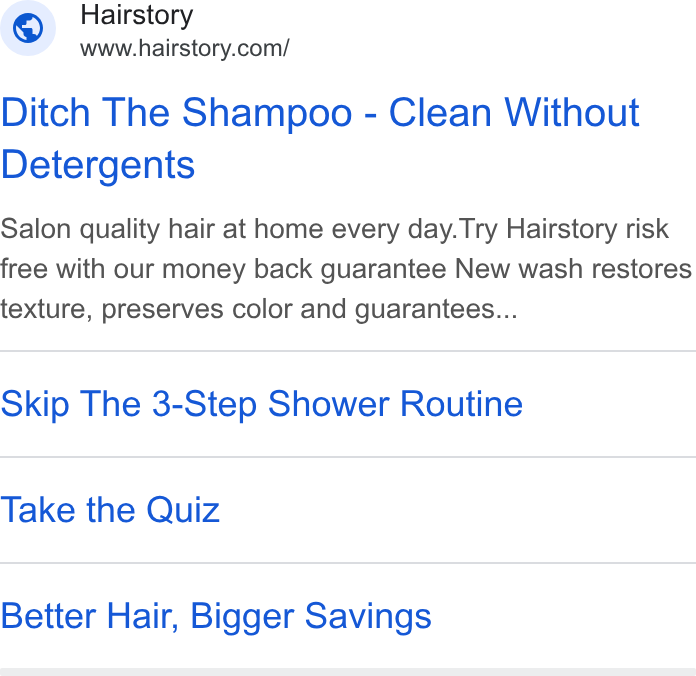
- Running
- 182 days (longevity = it's converting)
- Hook
- "Hairstory" with a blue globe icon and "www.hairstory.com/" below it. The main headline is "Ditch The Shampoo - Clean Without Detergents".
- CTA / offer
- money back guarantee
- Audience
- Individuals seeking improved hair health, simplified routines, and value for money, indicated by phrases like 'Salon quality hair at home', 'Skip The 3-Step Shower Routine', and 'Better Hair, Bigger Savings'.
Why it works. A direct imperative against shampoo paired with a concrete mechanism gives skeptical shoppers a reason beyond a marketing slogan.
Bold problem statement as headline: "Ditch The Shampoo - Clean Without Detergents" Pair a command that breaks a habit with the one concrete mechanism that justifies why your product can replace it.
Introducing Hairstory’s NEW WASH!!! As a barber, I see it all the time! Clients fighting dry ends, oily roots, or scalp irritation and thinking they need more product. But 9 times out of 10, it’s the shampoo that’s the problem. Most shampoos over-strip your hair, and switching to a detergent-free cleanser (like New Wash) can literally fix your scalp balance alone. Perfect if you wash daily (for all the fellow runners out there), have curly or thick hair, or just can’t figure out why your hair won’t behave. #LowEar #LowEarStudio #BarberTips #MensHair #BarberAdvice #Shampoo #DetergentFree #HairCare #HairStory
POWDER refre$h!! People always ask how I keep my hair looking fresh for days, my secret? @hairstorystudio POWDER! It works just like dry shampoo without the aerosols, alcohols, or added perfumes. Drop an emoji in the comments if you want the deets! I’ll slide into your DMs💨✨ . . . #mcnamaradesigns mcnamaradesigns #curls #curlyhair #curlyhaircut #curlytransformation #beforeandafter #houstonhairstylist #hairstylist #htxhair #haircut #curlspecialist #curlygirl #bigchophair #myhairstory #houstonhair #curlyshag #shortcurlyhair #curlybangs #curlyhairstylist #mullet #edgyhair #bigchopjourney #hanzo #htx #hairstory #hairstorypowder #canvascut #refresh #curlyrefresh
Bestie, it’s time to try Hairstory ✨USE THE LINK IN MY BIO FOR DISCOUNT 💕 #hairtips #hairstyling #newwash #hairstory
- Reach
- 20 upvotes · 13 comments · r/Ulta
A community is already discussing this in r/Ulta. Show up there authentically and answer the thread before a competitor does.
Who amplifies them
The stylist and creator layer is the real amplification engine. @mari.demonte, a barber, delivered the single biggest organic moment in the data. @randa.rivera posts organic content with her own bio discount link and, as "Randa Rivera Hair," also fronts one of Hairstory's longest-running paid Meta creatives, direct evidence the brand takes its best organic voices and puts media spend behind them. @jordanaveryz and @mcnamara_designs run similar stylist-discount posts, and a wider bench of stylist pages, including dinarosenbloom, dergdoeshair_, JPalm Hairdressing, and Andiwiththepinkhair, front additional paid Meta creative alongside ads posted directly from the Hairstory Studio brand account. On Reddit, the amplification is community-driven rather than creator-driven: r/hairstylist and r/Ulta carry organic discussion of the brand, and Eli Halliwell engaged that audience directly with a founder AMA in r/NoPoo, distinct from any brand-account activity.
07 Organic & video
The organic content engine: the videos, creator posts, and community presence earning attention without paid spend.
Instagram is the volume channel, 7,170 posts averaging ~154 engagements, but the standout organic clip comes from a barber, not the brand: @mari.demonte's reel introducing New Wash pulled 4,249 engagements by explaining scalp science directly to camera ("9 times out of 10, it's the shampoo that's the problem"). Two more stylist posts follow at a much smaller scale: @mcnamara_designs highlighting the Powder dry-shampoo alternative (219 engagements) and @randa.rivera pushing her own discount link (206 engagements), with the rest of the creator field clustered in the 20-80 engagement range on TikTok and Instagram. The pattern that performs is a practitioner explaining the mechanism, why shampoo strips hair, rather than a pure aesthetic reveal, which lines up with the ad copy's own problem-agitation hooks.
08 Affiliate & partners
How the brand turns creators and partners into a tracked, variable-cost acquisition channel, and how the program is structured.
Hairstory runs a dedicated affiliate dashboard (hairstory.com/pages/affiliate-dashboard) built around its direct-through-stylist model: hairdressers who introduce a client to New Wash earn an ongoing commission on that client's future purchases regardless of purchase channel, a perpetual referral structure rather than a one-time payout. The affiliate channel converts that structure into measurable traffic, accounting for an estimated 3.5% of site visits. The program has also run through ShopMy, a creator-commerce affiliate platform, extending the same commission logic to non-stylist creators. Hairstory has previously run a brand-ambassador program that grew past 1,000 members within nine months (1,150 within a full year), generating about 1,900 social posts, 8.3 million impressions, and over $250,000 in earned media value over its first year, evidence the affiliate motion has scaled beyond stylists alone.
09 The playbook
The channels are not separate. They are one system where each stage feeds the next. Here is the read, then the plays to run tomorrow.
The inferred playbook
Hairstory's growth engine is a stylist-recruitment flywheel now colliding with a new retail channel that threatens the commission structure that built it.
The direct-through-stylist model, 4,300+ enrolled stylists by 2023 up from 1,800 at the end of 2020, gives Hairstory a distribution force paid on lifetime value rather than a single referral, which is why the r/hairstylist threads read as genuine practitioner concern rather than noise.
The brand takes creators who already work, Randa Rivera Hair among them, and runs their content as paid Meta ads, buying reach behind material that already earned engagement rather than commissioning fresh paid-only creative.
Dig deeper+3▾
Expansion to 370 Ulta stores directly raises the question stylists are asking on Reddit, whether commissions survive once clients can buy off the shelf, a structural tension between the two channels that both trace back to the same growth story.
New Wash retails around $55 for 8 oz, with a "Subscribe & Save" model discounting 5-30% (one cited price: $41.80 every 6 weeks) plus free shipping, and a historically offered ~$20 trial kit; no current MRR is publicly verified, but between the 2021 pace of ~$30M in revenue (when Summit Partners closed its growth-equity investment), the Inc. 5000's citation of 190% revenue growth from 2019-2022, and the 2026 expansion into Ulta and 1M+ cumulative customers, a reasonable directional estimate places current annualized revenue in the $40M-$60M range; this is an estimate, not a confirmed figure.
current MRR/ARR, free-trial-to-paid conversion rate, churn, and CAC.
Pay referrers on lifetime value, not first sale
The proofHairstory's 4,300+ enrolled stylists earn ongoing commission on every future purchase from a client they referred, covered above.
The adaptationFind the practitioners in your category who already interact with buyers face to face, trainers, installers, consultants, whoever your customer trusts before they trust you, and offer them a percentage of that customer's lifetime spend instead of a one-time bounty. Start by drafting a one-page commission agreement for five practitioners you already have a relationship with, tracked in a simple spreadsheet before you build any tooling. The lifetime cut is what makes them recommend you repeatedly instead of once, because their income compounds with the customer's, not just the first sale.
Cost: $0 / under $500 · Time to signal: weeks · Works pre-PMF: yes, provided you already have a few practitioners in your category who interact directly with buyers.
Whitelist your best organic creator into paid media
The proofthe Meta page "Randa Rivera Hair" runs as both an organic creator post and a ~57-day paid Meta ad, the same creator amplified with spend.
The adaptationOnce an unpaid creator post outperforms your average engagement, ask that creator for whitelisting or partnership-ad permission and put a small budget behind the exact post that already worked, rather than briefing a new paid creative from scratch. First step: pull your last quarter of tagged creator posts, rank by engagement, and reach out to your top performer about running their post as a paid ad on their behalf.
Cost: under $500 · Time to signal: weeks · Works pre-PMF: conditional, only once you have at least one organic post that has already proven itself before you pay to amplify it.
Name the objection in the first three seconds
The proofHairstory's "STICKER SHOCK" UGC video opens by stating the exact price objection before the viewer can think it.
The adaptationScript your own UGC-style video so the on-screen text and the first spoken line both state the single biggest objection a prospect has, price, skepticism, "does this actually work", then spend the rest of the clip resolving that exact objection. Film it yourself or with one willing customer on a phone camera; no production budget required. Naming the objection first defuses it because the viewer stops forming their own counter-argument and starts listening for your answer instead.
Cost: $0 · Time to signal: days · Works pre-PMF: yes.
Offer a zero-risk trial on a premium, habit-breaking product
The proofHairstory's "Worried It Won't Work For Your Hair? Try It For $0" ad links to a dedicated try-before-you-buy landing page, covered above.
The adaptationIf your product asks people to abandon a habit or pay a premium price, build a specific, named trial offer, a refund window, a sample size, a money-back guarantee, and give it its own landing page rather than burying it in general terms. Start by writing the single sentence that names the risk your prospects actually fear and answers it directly in your headline. This works best when the product genuinely performs once tried, since the offer only converts skepticism you can actually resolve on contact.
Cost: $0 / under $500 (refund or sample exposure) · Time to signal: weeks · Works pre-PMF: yes, especially for a premium product where skepticism, not awareness, is the main blocker.
Take the founder into the community that already believes your claim
The proofco-founder and executive chairman Eli Halliwell hosted a Reddit AMA in r/NoPoo, a community built around the same detergent-free philosophy Hairstory sells.
The adaptationIdentify the online community, subreddit, forum, or Discord, whose existing beliefs already align with your product's core claim, and have the founder personally host an AMA or open thread there rather than routing it through a brand account. Prepare for real skepticism and answer it directly instead of with marketing language. This only works once per community before it feels repetitive, and it requires a founder who can credibly engage in that community's own terms, not a polished spokesperson.
Cost: $0 · Time to signal: days · Works pre-PMF: yes, conditional on finding a community whose existing worldview already supports your product's core claim. Not transferable at an earlier stage: the retail negotiating leverage behind a 370-store Ulta placement and the large paid media library (roughly 94 Meta plus 36 Google ads) both require capital and relationships a pre-PMF founder won't have; adapt the underlying mechanics, lifetime-value referrals, objection-first creative, founder-led community trust, rather than the scale at which Hairstory now runs them.
You just read how Hairstory does it. Tomorrow it is someone else.
Every morning we take one company that is actually growing and break down where its customers come from: the ads still running after a year, the channel doing the real work, and the play you can run this week.
Systemaic · directional intelligence. Traffic, spend, and reach figures are SimilarWeb-style estimates and qualitative reads of public data, not audited numbers. Built on real public receipts.
// teardowns with a similar GTM motion
sources & receipts (2)
Live ad libraries: meta ad library · google ad library
Traffic, spend, and revenue figures are estimates as noted in the report; the links above are the primary public artifacts.