- 01Document your ritual before you build
- 02Boost top creator affiliate posts as paid ads
- 03Split paid social between DTC and retail destinations
- 04Build a bundle configurator with tiered savings
01 Snapshot
The one-glance read on who they are and how they grow. Each point is verifiable from the receipts above.
Prestige clean hair care tools and formulas priced $15-$98 across roughly 20 SKUs, built around a slow daily ritual ethos, with Forbes and BeautyMatter reporting approximately $20M in 2024 revenue and a ~$30M projection for 2025 across both DTC and roughly 450 Sephora doors.
Founder-led social driving a creator-affiliate network, with Sephora retail acting as the mass-market trust layer that closes conversion.
An estimated 129,666 monthly site visits (up 19% over the prior three-month measurement window); 156,477 Instagram followers across 2,844 posts; roughly 200 Google ads in the library with 70 active as of 2026-06-30; and affiliate traffic at 11.9% of total site visits, confirming the creator partner program moves real checkout volume.
Organic search delivers 40.4% of all site traffic, yet every top-ranking keyword is a brand-name variant, meaning Crown Affair builds awareness through social and retail and collects pre-sold demand via search rather than earning discovery from category-level content.
02 How it unfolded
The order the channels came online. Sequence is strategy: what they did first, and what they layered on once demand existed.
03 Traffic & channel mix
Estimated demand, the channel split behind it, and the keywords and referrers doing the work. Directional modeling, not audited analytics.
Traffic sources
Top search keywords
| Keyword | Volume | Weight | CPC |
|---|---|---|---|
| crown affair | 13k | $0.90 | |
| the crown affair | 840 | $1.33 | |
| crownaffair | 1.0k | $0.93 | |
| the hair refresh ritual set – crown affair | 870 | - | |
| crown affair hair towel | 880 | $0.91 |
Top referring sites
Closest competitors by audience
Crown Affair draws an estimated 129,666 monthly visits, up 19% over the prior three-month measurement window. Organic search leads at 40.4% of traffic (roughly 52,400 visits per month), but the top-ranking keywords are all branded: "crown affair" (12,960 total web searches per month), "crown affair hair towel" (880/month), "the hair refresh ritual set - crown affair" (870/month), and "crown affair dry shampoo" (ranking number one). This is brand-capture SEO, not editorial top-of-funnel discovery. Direct traffic at 16.8% reinforces the same signal: a large share of visitors already know the brand before they arrive.
Paid search at 14.2% and affiliate at 11.9% are the next two material channels. The affiliate share is structurally notable: creator codes visible in the evidence (EMILYD15, mecahw15, CASSIDY15) and the CrownAffairPartner tagging convention confirm the program is driving real checkout volume, not just awareness. Social paid at 4.9% and social organic at just 2.9% confirm that Meta and TikTok paid spend handles conversion while organic social generates awareness rather than direct click-through at scale. The Gen AI channel at 1.5% is an emerging referral source, consistent with clean beauty brands appearing in AI-generated product recommendation responses.
Top referring domains are aurapro-0addfa0cda10.herokuapp.com and rosestreetcapital.com, neither of which signals a meaningful editorial or press referral pipeline. Closest traffic competitors by audience overlap include bumbleandbumble.com, masonpearson.com, harklinikken.com, renefurterer.com, and dermstore.com, placing Crown Affair in the prestige hair tools and clean beauty segment for search purposes. The replication read: organic brand-search capture pairs naturally with retail distribution (Sephora carries the trust that converts brand queries into purchases), and a performance-coded affiliate program is the lever that turns creator attention into trackable revenue without upfront influencer fees.
04 Organic content
The specific pages earning their organic search traffic, and the pattern behind why they rank. Adapt the format, not the topic.
Crown Affair's top five organic pages are the homepage (approximately 4,079 organic visits per month, 21% of organic traffic), The Towel product page (~3,453/month, 17.8%), The Dry Shampoo page (~2,967/month, 15.3%), The Leave-In Conditioner (~2,008/month, 10.3%), and the Texturizing Air Dry Mousse (~715/month, 3.7%), each ranking number one for its exact brand-plus-product-name query. The pattern is pure brand capture: there are no how-to guides, category comparison articles, or editorial roundups among the top organic pages, only the homepage and direct product URLs. Crown Affair earns new-customer awareness through social content and retail shelf visibility, then collects that pre-warmed demand through search. The strategic exposure: this works while social and retail momentum holds, but it provides no compounding organic buffer if creator activity or paid social volume drops, because there is no content layer attracting shoppers who do not already know the brand name.
Top pages by organic traffic
05 Channel map
Not traffic share. How much weight the growth system actually puts on each channel, with a one-line read on the role it plays.
What drove growth
06 The creative doing the work
Each exhibit shows the actual asset, an X-ray of why it works, a status, and a play you can adapt. This is the heart of the teardown.
Google's library holds approximately 200 total ads, with 70 active as of 2026-06-30 and the longest-running active ad at roughly 950 days. On Meta, a concentrated cluster of dynamic creative optimization and image ads launched in late June 2026 runs to both crownaffair.com and sephora.com simultaneously, alongside boosted creator-affiliate video content run through ShopMy. The top proven-winner creative formats:
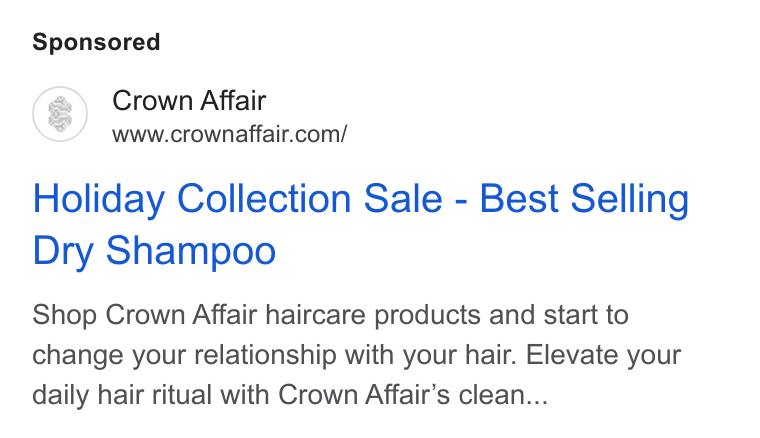
- Running
- 950 days (longevity = it's converting)
- Hook
- Sponsored text at the top, followed by a small circular logo with a stylized 'S' inside, and the text "Crown Affair" and "www.crownaffair.com/". Below this is the blue headline "Holiday Collection Sale - Best Selling Dry Shampoo".
- CTA / offer
- Holiday Collection Sale
- Audience
- Individuals interested in haircare products, particularly dry shampoo, and those looking for holiday sales or clean beauty options.
Why it works. Holiday sale ad naming the exact best-selling product category so interested dry shampoo shoppers self-select.
Headline stating a sale and product benefit: "Holiday Collection Sale - Best Selling Dry Shampoo" Name your single best-selling SKU by category in a sale headline instead of promoting the sale generically.
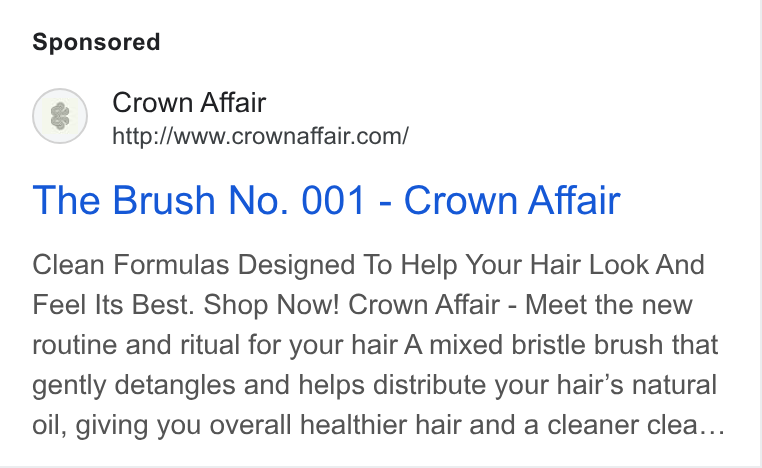
- Running
- 385 days (longevity = it's converting)
- Hook
- "Sponsored" text at the top, followed by a small circular icon with a light green, intricate design, and the text "Crown Affair" and "http://www.crownaffair.com/". Below this, in blue, is "The Brush No. 001 - Crown Affair".
- CTA / offer
- Shop Now!
- Audience
- Individuals interested in hair care and beauty products, specifically those looking for 'clean formulas' and 'healthier hair'.
Why it works. Product search ad where a numbered name turns a hairbrush into part of a considered system, not a commodity.
Headline with specific product name: "The Brush No. 001 - Crown Affair" Give your flagship product a numbered name like No. 001 so it reads as part of a designed line.
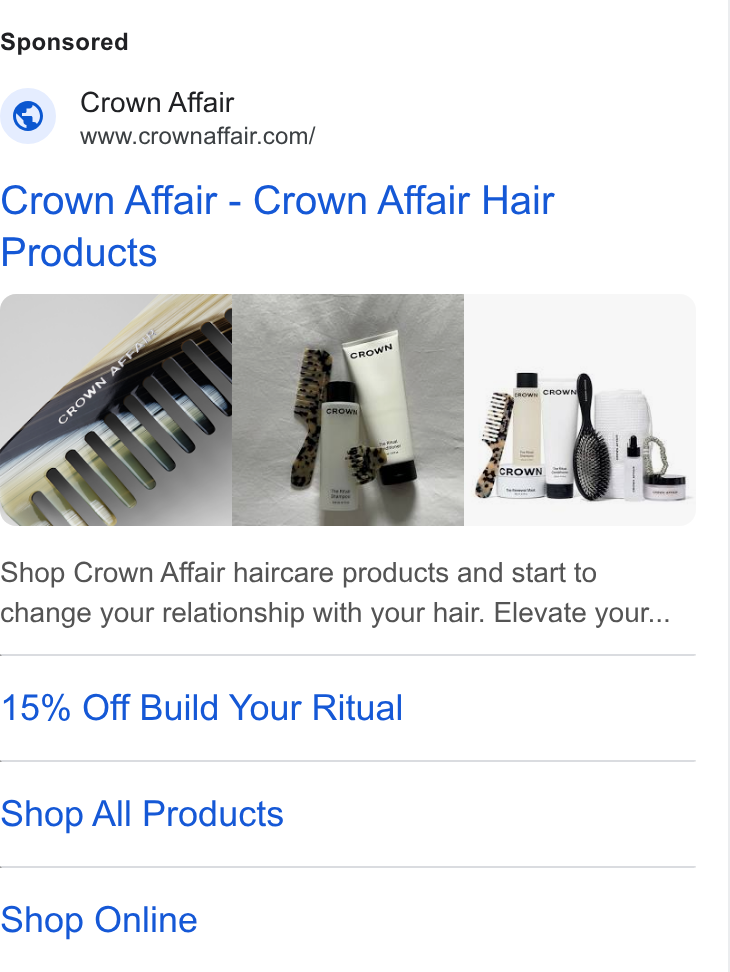
- Running
- 385 days (longevity = it's converting)
- Hook
- Sponsored Crown Affair www.crownaffair.com/ Crown Affair - Crown Affair Hair Products. Visual: A close-up image of a hair comb with 'CROWN AFFAIR' written on it, next to two white bottles and a tube of hair products, and a third image showing a collection of hair products including brushes, bottles, and a hair tie.
- CTA / offer
- 15% Off Build Your Ritual
- Audience
- Individuals interested in premium hair care products, indicated by the aesthetic product photography and the brand's focus on 'elevate your hair' and 'ritual' language.
Why it works. Catalog-style search ad using three distinct product photos, comb, bottles, brush set, to show product range in the ad itself.
Displaying multiple product images prominently at the top of the ad, including a close-up of a comb, a set of bottles, and a full collection of products. Use three different product photos in one ad slot to show breadth instead of one hero shot.
Show 6 more exhibits
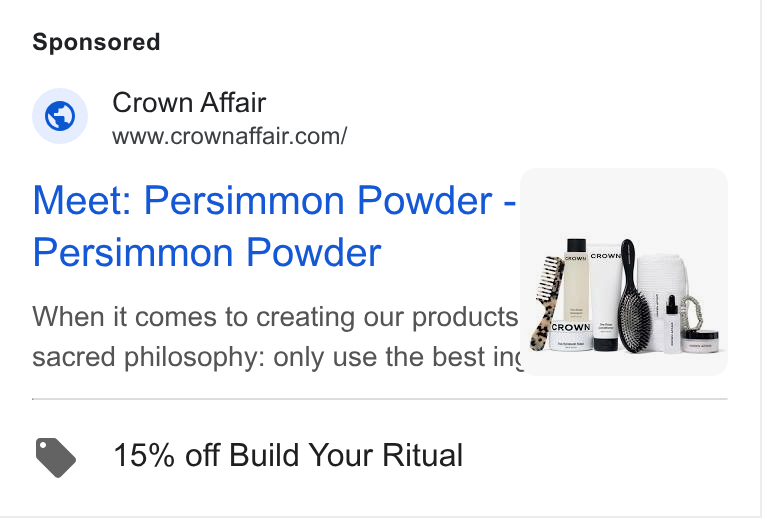
- Running
- 385 days (longevity = it's converting)
- Hook
- Sponsored text at the top, followed by the Crown Affair logo and website, then the headline "Meet: Persimmon Powder - Persimmon Powder" with a partial image of hair care products.
- CTA / offer
- 15% off Build Your Ritual
- Audience
- Individuals interested in hair care products, natural ingredients, and potential discounts, indicated by the product image, brand name, and discount offer.
Why it works. New-SKU search ad introducing an unfamiliar ingredient as a personality reveal rather than a plain launch announcement.
Headline repetition and partial product reveal: "Meet: Persimmon Powder - Persimmon Powder" with a cropped image of hair care items. Introduce a new product with 'Meet: [Name]' phrasing so it reads as an introduction rather than a launch notice.
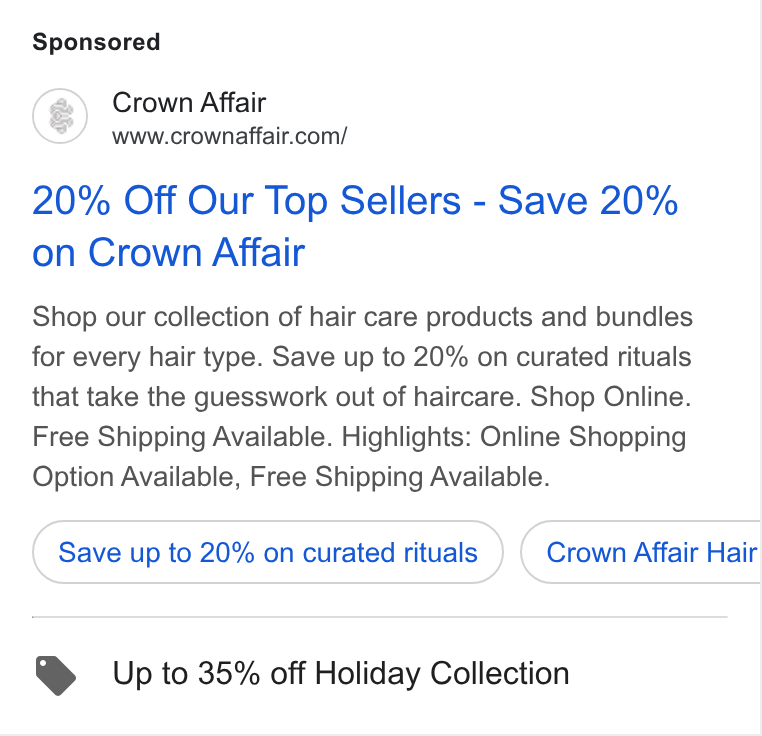
- Running
- 381 days (longevity = it's converting)
- Hook
- Sponsored Crown Affair www.crownaffair.com/ 20% Off Our Top Sellers - Save 20% on Crown Affair
- CTA / offer
- 20% Off Our Top Sellers - Save 20% on Crown Affair
- Audience
- Individuals interested in hair care products, indicated by the text "Shop our collection of hair care products and bundles for every hair type" and the brand name "Crown Affair Hair".
Why it works. Discount search ad aimed at new customers that repeats one number twice so the offer can't be missed.
Prominent discount headline: "20% Off Our Top Sellers - Save 20% on Crown Affair" Repeat your exact discount percentage twice within a single headline instead of stating it once.
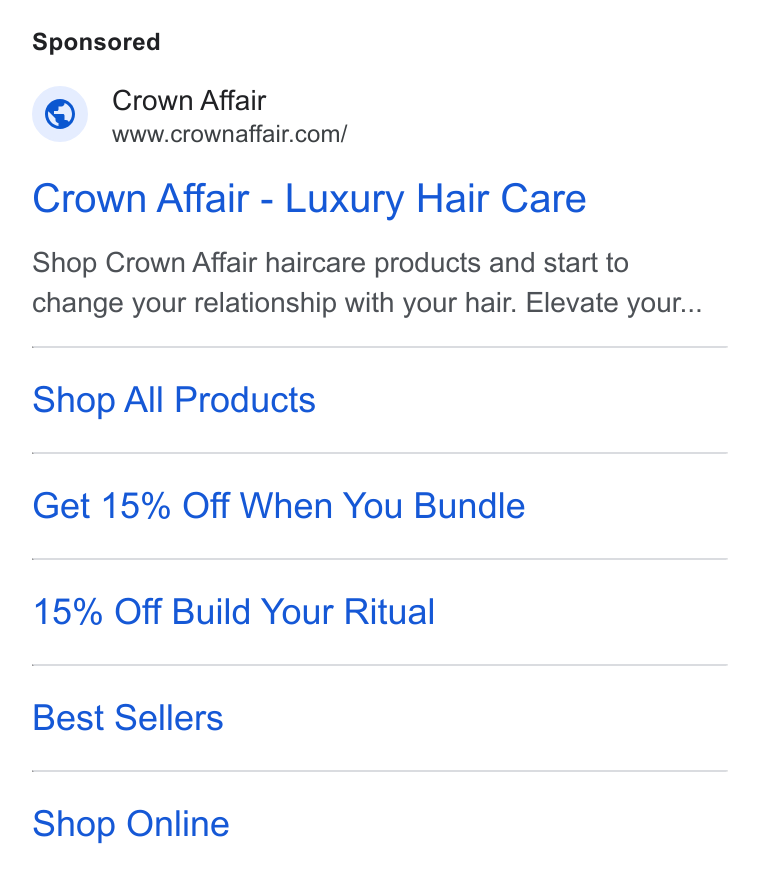
- Running
- 364 days (longevity = it's converting)
- Hook
- Sponsored Crown Affair www.crownaffair.com/ Crown Affair - Luxury Hair Care Shop Crown Affair haircare products and start to change your relationship with your hair. Elevate your...
- CTA / offer
- Get 15% Off When You Bundle
- Audience
- Individuals seeking premium hair care products and interested in improving their hair health and appearance, as indicated by 'Luxury Hair Care' and 'Elevate your...'.
Why it works. Positioning-led search ad that sells changing your relationship with your hair, not just fixing it, for ritual-minded shoppers.
Clear brand identification and value proposition in the headline: 'Crown Affair - Luxury Hair Care'. Describe your product as changing the customer's relationship with the problem, not just solving it.
Who amplifies them
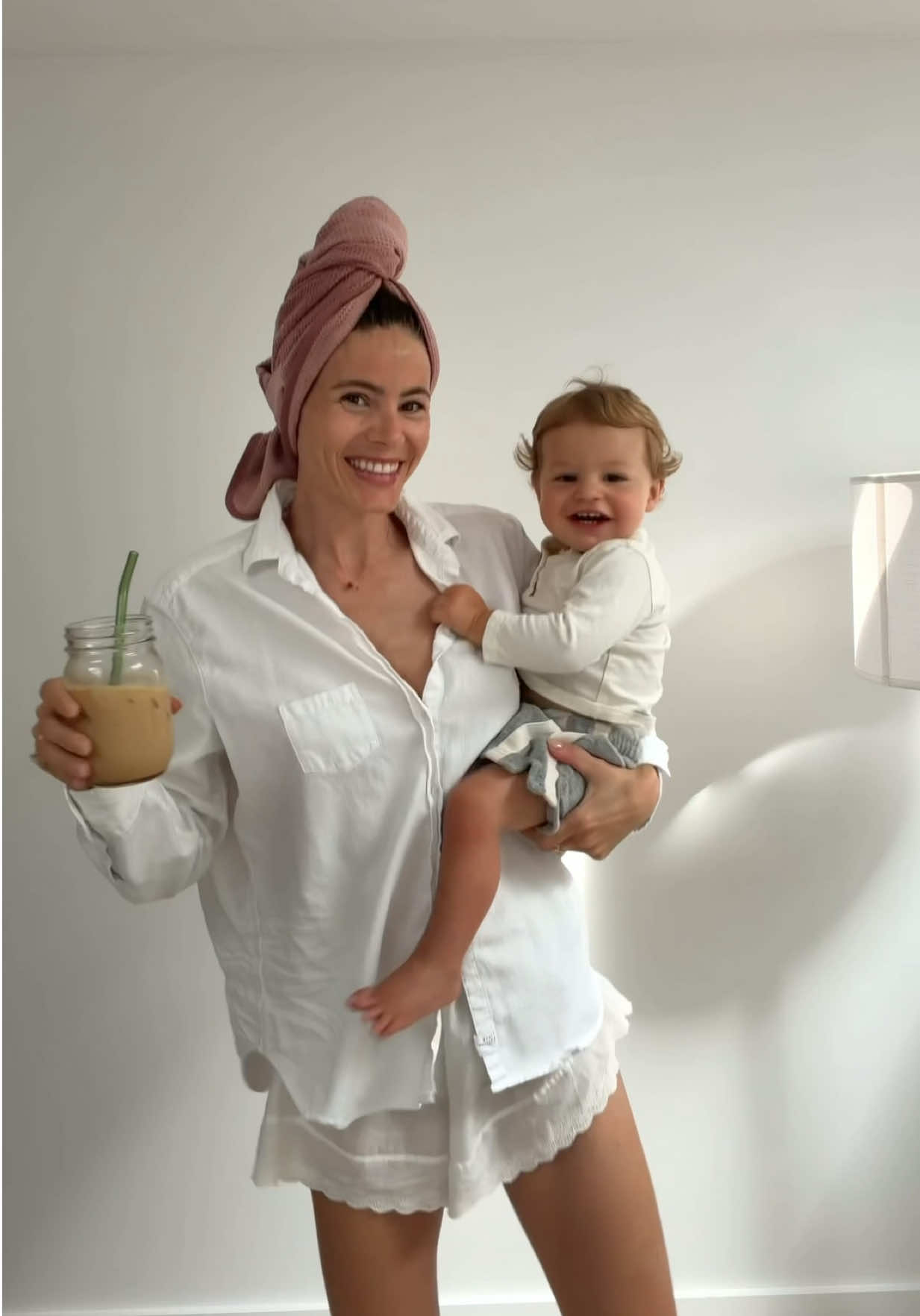
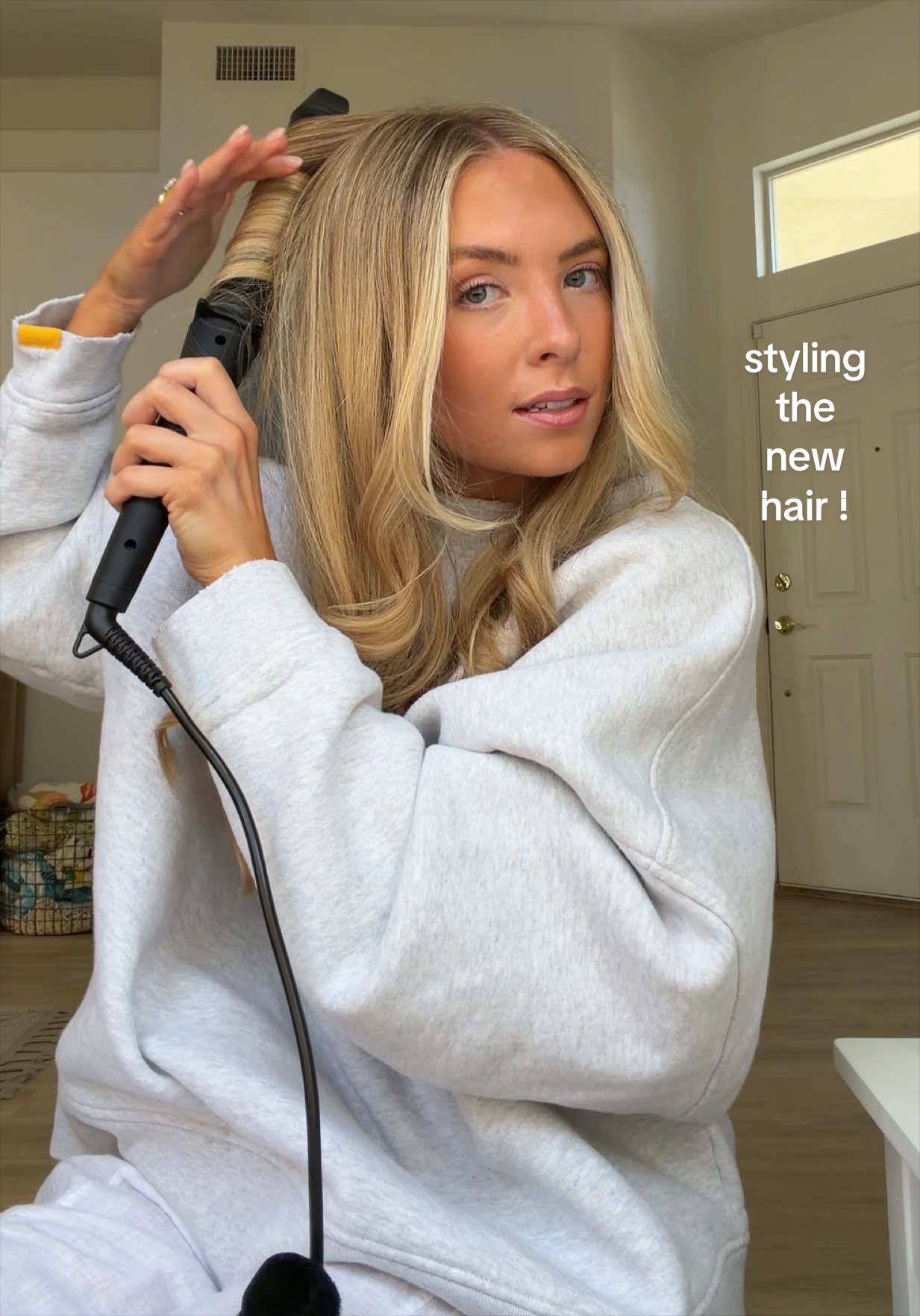
Named Instagram creator partners identified in the evidence: @emilydidonato (15% off via code EMILYD15; 1,080-engagement dry shampoo routine reel: "Fresh hair in seconds... no grit, no heaviness"), @mecahwirht (code mecahw15; 895-engagement two-step routine), @tishmal (1,717-engagement overnight hair routine), @lorenasad (8,159-engagement leave-in routine; Sephora Squad and CrownAffairPartner dual-tagged), @lindsaysilb (Dry Shampoo powder review), @juliaamory (summer hair products roundup), and @glossangelespod (Dry Shampoo feature including founder Dianna Cohen). All use the CrownAffairPartner tag, indicating a structured affiliate relationship with a discount-code component.
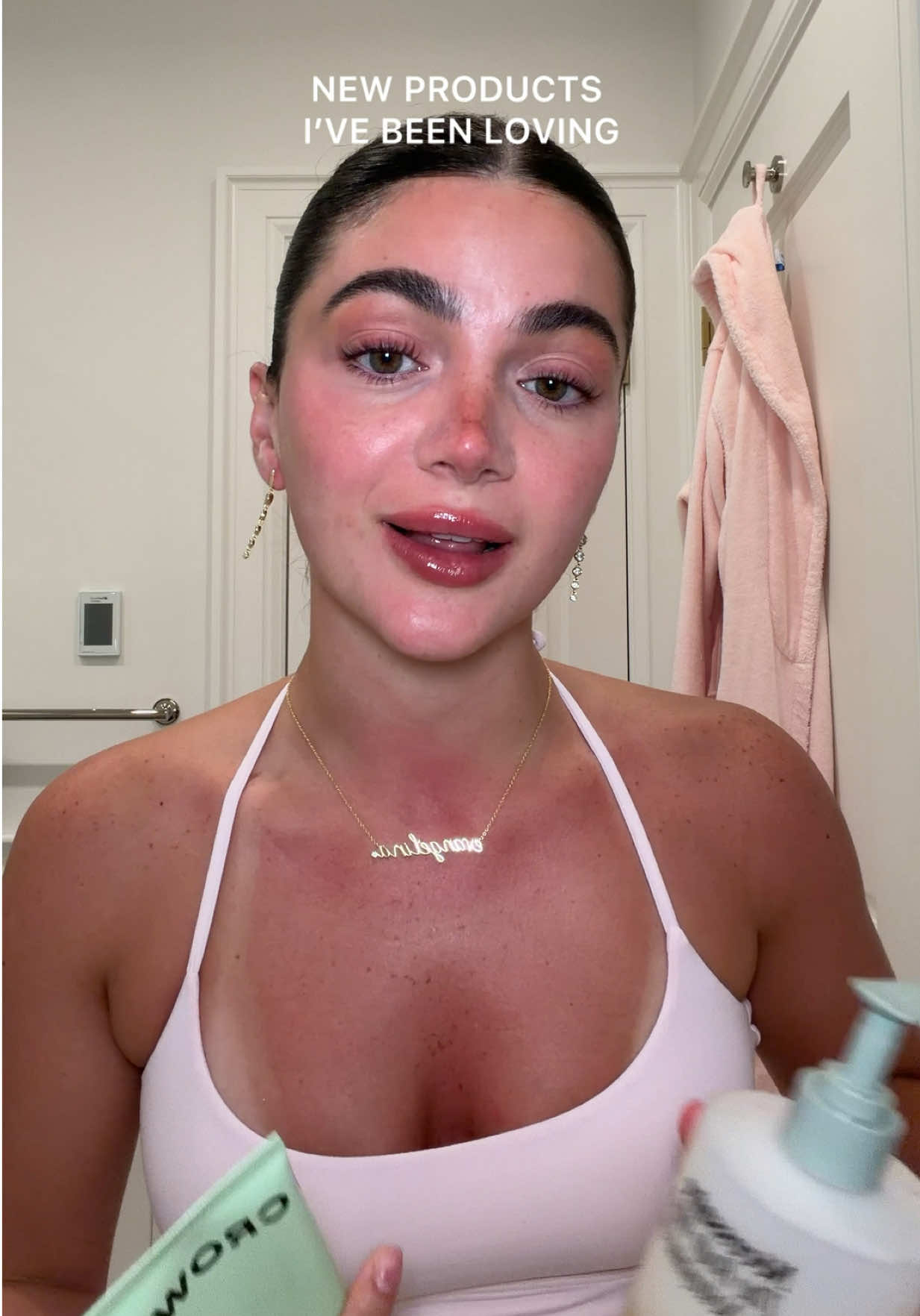
Top TikTok amplifiers include @mackenzie (37,511 engagements, limited-edition pink towel), @evange (35,373, favorites roundup), @samanthahorton (33,469, styling video), and @dakotapaige (8,860, partner-tagged curly hair tutorial). These are third-party creators distinct from the brand account @crownaffair and from founder Dianna Cohen's personal @diannacohen account.
ShopMy runs paid Meta ads on behalf of the brand: a video ad from a ShopMy Page account features code CASSIDY15 and tags @sarah.creal and @mphbeauty, confirming ShopMy functions here as both affiliate link infrastructure and a paid media amplification layer for creator content. The Crown Affair x ILIA Beauty (a clean beauty makeup brand) partnership extended amplification to ILIA's creator network, with @jillibean on TikTok (539 engagements) and the brand's own collab launch post (4,148 engagements) generating cross-brand reach.
07 Organic & video
The organic content engine: the videos, creator posts, and community presence earning attention without paid spend.
TikTok generates Crown Affair's largest single reach events. @mackenzie drove 37,511 engagements on a pink towel dance video ("A little dance party, a little self-care, and a very cute pink towel"), @evange pulled 35,373 in a favorites roundup naming Crown Affair alongside Redken, Oribe, and Rhode Skin, and @samanthahorton reached 33,469 in a "90s Jennifer Aniston hair this summer" styling video featuring the brand alongside T3 Micro and Bio Ionic. The format that outperforms is product embedded in routine or favorites roundup: the brand appears as one piece of a creator's personal stack rather than the subject of a dedicated review, which is why the content reads as peer recommendation even when the post is a tagged partner collaboration.
Read the full breakdown+2▾
On Instagram, @lorenasad reached 8,159 engagements on a leave-in conditioner post-shower routine tagged as a Sephora Squad and CrownAffairPartner collaboration, and @tishmal reached 1,717 engagements on an overnight hair routine post. The Dry Shampoo and The Towel are the two most-featured products across creator content on both platforms. Founder Dianna Cohen posts from her personal account @diannacohen with brand-origin content tied to product development ("When I launched Crown Affair in 2020, The Oil was one of just four products... six years of customer feedback, learnings, and team innovation led us to The Radiance Hair Oil"), keeping the brand's identity tethered to a human voice distinct from the corporate @crownaffair account.
Organic, unsponsored creator posts surface in the same feeds as partner content and carry a distinct trust signal. @maileminardi wrote of the brand's Scalp Mask "idk what yall put in this but its like miracle grow" (2,136 engagements), and @cheyenne noted her partner "was against hair products COMPLETELY until trying crown affair" (1,619 engagements). These uncompensated posts convert differently from partner content because their authenticity is unambiguous.
08 Affiliate & partners
How the brand turns creators and partners into a tracked, variable-cost acquisition channel, and how the program is structured.
Crown Affair runs a structured creator affiliate program anchored in personalized discount codes distributed through Instagram and TikTok creator partners, with the CrownAffairPartner tag as the public identifier for partner content. The affiliate channel drives 11.9% of total site traffic (roughly 15,430 visits per month), ranking as the fourth-largest acquisition source ahead of social paid (4.9%) and email (3.7%), which confirms the program is a material performance channel rather than a vanity initiative.
Read the full breakdown+1▾
ShopMy is the visible affiliate infrastructure, and the platform runs paid Meta ads boosting creator content with embedded codes, turning the affiliate program into a hybrid earned-plus-paid media engine. TikTok Shop is active as a native selling channel with at least The Brush No. 002 listed. The brand's product pricing ($15-$98, with bundle discounts up to 20% off through a "Build Your Ritual" configurator) provides sufficient margin to run affiliate commissions alongside a meaningful contribution, though exact commission rates are not visible in public data. No standalone affiliate SaaS platform (Rewardful, PartnerStack, or similar) is visible in the evidence; the stack appears to be ShopMy for creator-side management and TikTok Shop for in-platform commerce. Blended CAC and affiliate commission structure are not visible in public data.
09 The playbook
The channels are not separate. They are one system where each stage feeds the next. Here is the read, then the plays to run tomorrow.
The inferred playbook
Crown Affair builds brand desire through founder social identity and earned creator content, captures that demand via search, routes it to checkout through both DTC and Sephora, and scales reach through a creator affiliate program thatearns performance-based amplification without upfront influencer fees.
Founder Dianna Cohen built the brand's original audience through personal social content (air-dry tutorials, product origin stories tied to her own discovery of ingredients), so the brand's credibility reads as earned rather than bought, and uncompensated creator posts appear in the same feeds as partner content with essentially the same tone.
The approximately 450 Sephora doors generate wholesale revenue and function as a legitimization signal that closes cold paid-social traffic; this is exactly why Meta ad sets run sephora.com as a parallel destination alongside crownaffair.com, and why the brand reportedly splits revenue roughly evenly between DTC and retail. A shopper who is not ready to buy DTC from an unfamiliar brand will convert on a Sephora product page where reviews, loyalty points, and a known return policy absorb the trust friction.
Dig deeper+2▾
The creator partner program (ShopMy-managed, code-based) drives 11.9% of site traffic at performance economics, and the brand boosts top-performing creator posts as paid ads through ShopMy's infrastructure, turning earned media moments into a paid flywheel with measurable conversion.
All five top organic pages are brand or product name pages, with no editorial or category-intent content layer visible; new-customer acquisition depends entirely on social visibility, retail presence, and paid media, with no compounding organic buffer if social momentum slows.
Document your ritual before you build
The proofCrown Affair originated as a Google Doc, a personal hair ritual guide that founder Dianna Cohen shared with friends before any product existed. The demand signal from that document shaped the brand's first four SKUs, its positioning language, and the authentic founder social voice that anchored years of growth.
The adaptationBefore launching or extending into a new product category, write out your honest personal routine or philosophy for that category in an unpolished format: a detailed Twitter/X thread, a Notion doc shared in a community, or a newsletter post. Share it with a small audience before mentioning any product. The words people use in replies and shares are both a demand signal and the copy language for your eventual product page, because those are the words buyers use when searching. Start by writing one honest, detailed post about how you personally use the category and share it in one relevant online community or with your existing audience. The mechanism: early content that reads as personal and unsolicited surfaces language your target buyer already uses, which later becomes your headline copy and your top-of-funnel SEO terms. Caveat: This play is most powerful when the founder already has some audience. A founder with zero followers will need to seed distribution (a relevant community, targeted outreach to potential early customers) to generate enough signal from that first share. ---
Boost top creator affiliate posts as paid ads
The proofCrown Affair runs paid Meta ads through a ShopMy Page account featuring creator-made video content with embedded discount codes (code CASSIDY15, tagging @sarah.creal and @mphbeauty). The creative is creator-produced content that the brand amplifies as paid media, combining performance-based affiliate economics with paid reach in the same asset.
The adaptationSign up for ShopMy or a comparable creator commerce platform with ad-boosting capability. Identify your top-performing creator posts by engagement over the past 90 days. Boost those specific posts as paid Meta or TikTok ads through the platform's infrastructure, keeping the creator's discount code visible in the caption. Start by testing one creator's best-performing post as a paid ad with a small daily budget and compare its cost-per-click and conversion rate against your brand-produced creative for cold audiences. The mechanism: creator-produced content reads as peer recommendation for cold audiences because it is structurally indistinguishable from organic content in the feed, and boosting it extends that trust signal to audiences who would never have seen the post organically. ---
Split paid social between DTC and retail destinations
The proofCrown Affair runs concurrent Meta DCO ad sets for the same products, with some ad sets pointing to crownaffair.com and others to sephora.com. The brand uses Sephora's checkout trust to convert shoppers who are not yet ready to buy DTC from an unfamiliar brand, while retaining DTC traffic for warmer audiences already in its ecosystem.
The adaptationIf your product is available in a major retail partner's online store, run parallel paid social campaigns with different landing page destinations: one set to your own site, one to the retailer's product listing. Test which destination converts better for cold audiences versus retargeting audiences. Cold audiences frequently convert better on a major retailer's page because the retailer absorbs the trust friction (reviews, loyalty programs, known return policy). Start by duplicating your best-performing ad set and swapping only the destination URL to the retailer's product listing; run both for two to three weeks and compare cost-per-purchase. The mechanism: the retailer's brand equity functions as free trust infrastructure for a first-time purchase, and you pay the same media cost either way. ---
Build a bundle configurator with tiered savings
The proofCrown Affair runs a product-shot ad creative showing "PERSONALIZE YOUR BUNDLE UP TO 20% OFF" with a gift-tag visual layered over multiple products, and Google ad copy includes "Build Your Ritual 15% Off." The bundle offer appears as a distinct creative format from the brand's product-hero and lifestyle ads, and its presence in the Google library suggests the bundle configurator is a tested AOV lever alongside single-product purchase flows.
The adaptationBuild a bundle configurator on your product site that presents a progressive discount as the customer selects more items (for example, 10% off at two SKUs, 20% off at four). Frame the page as "build your routine" or "build your kit" rather than "bundle and save" to align with your brand voice. The configurator serves as a product discovery surface (customers browse your full range to assemble a kit) and an AOV elevator (the next savings tier is always one more item away). Start by identifying your four to six best-selling SKUs and building a simple landing page that allows any combination with progressive savings, then run a paid search or paid social ad pointing directly to that page and test conversion against your homepage. The mechanism: a self-selected kit at tiered savings earns higher average order value than a flat discount on a pre-built set, because the customer already intends to use the specific items they chose, which also reduces post-purchase regret. ---
Attach a free trial of a new line to every purchase above a threshold
The proofCrown Affair runs dedicated Meta DCO ad sets with the offers "Try one of our bestselling Air Dry essentials free with any purchase" and "For a limited time only, get a free Air Dry product with every purchase," appearing alongside Air Dry Mousse and Leave-In Conditioner creative. The mechanic is used specifically for the Air Dry line, indicating the brand uses free-with-purchase to drive first-touch trial for a category extension rather than discounting existing hero SKUs.
The adaptationWhen launching a new product line or category extension, attach a free trial or minimum-size full item from that new line to any purchase at or above your current average order value. This drives trial of peak buyer intent (during an active purchase), avoids training customers to expect blanket discounts on your existing catalog, and generates initial review volume for the new SKU faster than a standalone launch campaign. Start by identifying your lowest-cost-to-produce new SKU and testing it as a free gift with orders above your average order value for two to four weeks; measure the new SKU's repeat purchase rate among customers who received it free versus those who did not. The mechanism: the free item is positioned as a reward for a purchase already made rather than a discount on the new product itself, which preserves perceived value while removing all friction from a first trial.
You just read how Crown Affair does it. Tomorrow it is someone else.
Every morning we take one company that is actually growing and break down where its customers come from: the ads still running after a year, the channel doing the real work, and the play you can run this week.
Systemaic · directional intelligence. Traffic, spend, and reach figures are SimilarWeb-style estimates and qualitative reads of public data, not audited numbers. Built on real public receipts.
// teardowns with a similar GTM motion
sources & receipts (3)
Live ad libraries: meta ad library · google ad library
Launch archives: Hacker News: Dune Buggy Driven by Steve Mcqueen in the Thomas Crown Affai
Traffic, spend, and revenue figures are estimates as noted in the report; the links above are the primary public artifacts.