- 01Turn a hiring post into a growth mechanic
- 02Cap your beta below demand on purpose
- 03Launch inside an adjacent community's migration conversation
- 04Bid on "alternative to [competitor]" search terms
01 Snapshot
The one-glance read on who they are and how they grow. Each point is verifiable from the receipts above.
An AI-native workspace pairing an outliner/knowledge-graph note editor with a newer team-facing AI meeting-agent product, sold freemium from $0 to $80/user/month (early-bird Max tier, as of 2026-07-12).
Organic-led and community-sustained, backstopped by an always-on Google search program rather than paid social or creator content.
$25M total raised (Seed $11M in Nov 2022, Series A $14M closed May 2024) at a reported ~$100M valuation, a 160,000-person waitlist by the Feb 2025 funding announcement, roughly 50 employees, and 27 of 60 total collected Google ads still active as of 2026-07-12.
As of 2026-07-12, the newest Google ad tests (8-22 days active) push an "Otter AI Alternative" angle, an AI image-generation feature, and a spaced-repetition/Anki niche hook.
Tana's growth engine was a scarcity-driven waitlist, 160,000 signups against a beta that only ever served 30,000 people, but its mid-2026 pivot from personal outliner to team AI-agent workspace is now testing that same community's loyalty, with longtime users publicly asking what the "new Tana" even is.
02 How it unfolded
The order the channels came online. Sequence is strategy: what they did first, and what they layered on once demand existed.
03 Traffic & channel mix
Estimated demand, the channel split behind it, and the keywords and referrers doing the work. Directional modeling, not audited analytics.
SimilarWeb does not publish a traffic estimate for this domain yet, which is normal for a newer or smaller site below its tracking threshold. The growth read here leans on the other public signals in this teardown rather than modeled traffic.
SimilarWeb does not publish a traffic estimate for this domain yet, which is normal for a site this size, so the growth read here leans on the other public signals below.
04 Organic content
The specific pages earning their organic search traffic, and the pattern behind why they rank. Adapt the format, not the topic.
Tana's organic footprint concentrates on its own homepage and the outliner subdomain rather than a spread of blog or comparison content, and the pattern reads as brand-term capture: the top-ranking keywords are the product's own name and category terms ("tana," "tana app," "outliner," all #1), plus one long-tail hit surfaced by a public feature-request board ("strikethrough shortcut," #7). That mix suggests these pages recapture people who already know the product rather than generate new-to-category demand, with the ideas.tana.inc feedback board acting as the only page format generating incidental long-tail search visibility. For a company at this funding stage, it's a thin content surface: no blog, no "alternative to" or comparison pages, and no glossary or template library doing the acquisition work a broader content strategy usually would.
Top pages by organic traffic
05 Channel map
Not traffic share. How much weight the growth system actually puts on each channel, with a one-line read on the role it plays.
What drove growth
06 Who they’re hiring
Open roles read like a roadmap: the functions they’re staffing show where the company is investing next and what stage it’s at.
1 open role
07 The motions doing the work
For founder-led SaaS the breakdown shifts from ads to traction: where the first users came from, how the founder grows it in the open, and the compounding organic surface.
Tana's early traction ran entirely on manufactured scarcity rather than a single launch moment, and its most recent "launch" is actually a mid-flight repositioning that its own community is still processing.
The company ran a closed "Early Access" beta from 2022, testing with roughly 30,000 users over a nine-month window, while a public waitlist swelled to about 160,000 people by the time the $25M raise surfaced in Feb 2025, a demand-to-capacity gap that built pressure before any public launch.
Early uptake was pulled by the existing personal-knowledge-management (PKM) crowd, users publicly migrating from Notion, Roam, and Obsidian, seeding comparison-driven interest that Reddit later sustained.
Dig deeper+2▾
The Series A drew personal investment from Google Wave co-founder Lars Rasmussen specifically because co-founder Grim Iversen had pitched similar knowledge-graph ideas for Google Wave, a founder-network signal rather than a metrics-driven raise.
On 2026-07-01 Tana published "Beyond AI Meeting Notes: Meet the New Tana," repositioning around AI meeting agents, but r/TanaInc had already flagged confusion two weeks earlier ("What is this new Tana?," 17 points, 19 comments) and a churn post ("Goodbye Tana...Hello Capacities," a rival note-taking app, 22 points, 29 comments) shows some existing users leaving mid-pivot rather than converting.
The founder's personal following is real but small, so Tana's build-in-public signal runs more through product-drop content and its own subreddit than through a large personal audience.
Tarjei Vassbotn's X bio explicitly names him founder and CEO of Tana, but at 844 followers and modest engagement (max 16 likes on Tana-specific posts), it functions as a footnote channel rather than a growth lever.
His 2021 post recruiting alongside the founding team offered "successful referral = lifetime free subscription" and asked for retweets as a "karma-boost," turning hiring outreach into an early user-acquisition mechanic before any public launch.
Dig deeper+2▾
Rather than a founder audience, build-in-public energy shows up in r/TanaInc (covered above), where users debate data access and workflow setup in an open, unmanaged feedback loop.
The near-weekly TanaInc channel, not personal founder posts, carries the changelog and tutorial function that build-in-public usually serves at founder-led companies.
Organic search functions as brand-term defense rather than demand generation, so paid search is doing the "alternative to a competitor" positioning that the thin organic footprint (the brand-term concentration above) doesn't cover.
Proven-winner Google ads position Tana as the "Anytype Alternative," while newer tests push an "Otter AI Alternative" angle, meaning the category-comparison messaging that would normally live on owned comparison pages instead runs as paid copy, expanded as a Play below.
No affiliate, referral, or partner program was found on the site, so distribution runs on the waitlist and community mechanics covered above rather than a recruited seller network.
Dig deeper+1▾
The ideas.tana.inc board (referenced in Organic Content) is the closest thing to a compounding content asset, converting user feature requests into indexed, ranking pages without a dedicated content team.
08 Paid ads
This founder-led SaaS also runs paid acquisition. Here are the live ads doing the work, each with the X-ray and a play you can adapt.
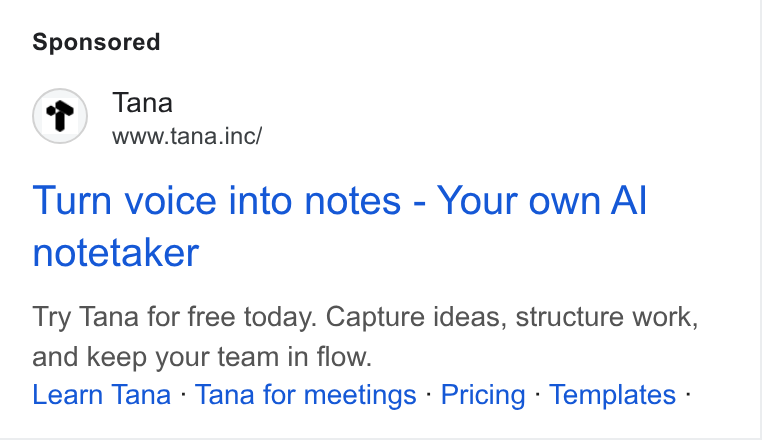
- Running
- 268 days (longevity = it's converting)
- Hook
- Sponsored Tana www.tana.inc/ Turn voice into notes - Your own AI notetaker
- CTA / offer
- Try Tana for free today.
- Audience
- Individuals and teams looking to streamline note-taking and workflow, evidenced by phrases like "Your own AI notetaker" and "keep your team in flow."
Why it works. Speaks to people who think out loud in meetings or on the go by naming the exact conversion, voice to notes, they need.
Headline states a direct benefit: "Turn voice into notes - Your own AI notetaker." Describe your AI feature as an input-to-output transformation (X into Y) instead of a generic 'AI-powered' label.
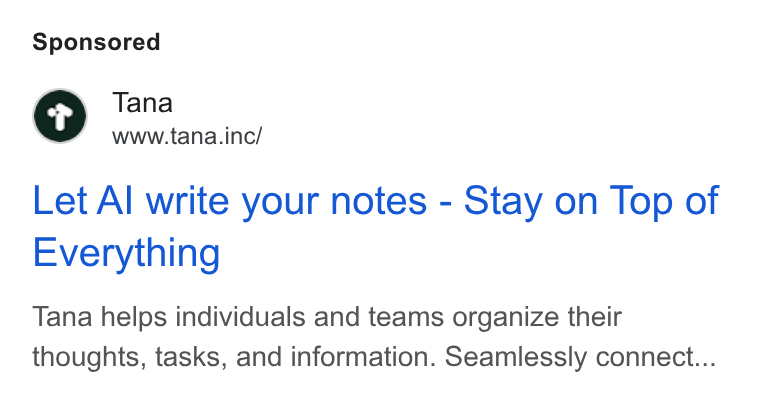
- Running
- 259 days (longevity = it's converting)
- Hook
- Sponsored Tana www.tana.inc/ Let AI write your notes - Stay on Top of Everything
- Audience
- Individuals and teams who struggle with organization and information management, indicated by the text "Tana helps individuals and teams organize their thoughts, tasks, and information."
Why it works. Removes the labor of writing notes entirely, appealing to people who want the outcome of good notes without doing the writing.
Headline with a bold, benefit-driven claim: "Let AI write your notes - Stay on Top of Everything" State plainly which tedious task your AI removes entirely for the user, not just that AI is involved.
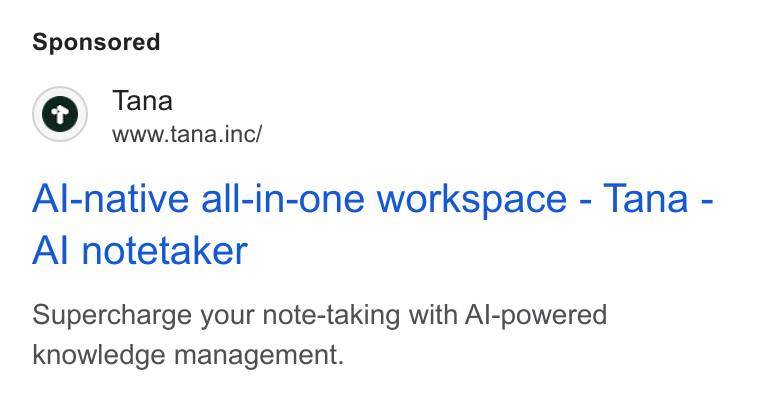
- Running
- 175 days (longevity = it's converting)
- Hook
- Sponsored - Tana - www.tana.inc/ - AI-native all-in-one workspace - Tana - AI notetaker
- Audience
- Individuals or teams seeking advanced productivity tools, specifically those interested in AI-powered solutions for note-taking and knowledge management, indicated by the phrases 'AI-native', 'all-in-one workspace', and 'AI notetaker'.
Why it works. Catches both broad 'AI workspace' searchers and narrow 'AI notetaker' searchers with a single ad by covering two intents at once.
Lead with a clear, benefit-driven headline: 'AI-native all-in-one workspace - Tana - AI notetaker' If you serve two different search intents, combine both positioning phrases in one headline instead of running only one.
Show 3 more ads
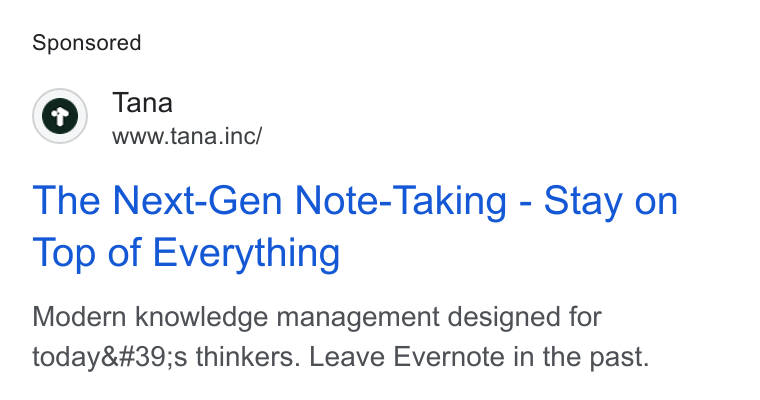
- Running
- 117 days (longevity = it's converting)
- Hook
- Sponsored. A circular icon with a white upward-pointing arrow inside a green circle. Text reads "Tana" and "www.tana.inc/". Below this, the headline "The Next-Gen Note-Taking - Stay on Top of Everything" is visible.
- Audience
- The phrase "today's thinkers" and the mention of "Evernote" target individuals who are already engaged in knowledge management and are looking for advanced or alternative solutions.
Why it works. Targets people frustrated with old note apps by promising both novelty and control over their workload in one line.
Directly challenging an incumbent: The ad states, "Leave Evernote in the past." Combine a 'next generation' framing with a single concrete outcome your product delivers, not a feature dump, in your top headline.
- Running
- 116 days (longevity = it's converting)
- Hook
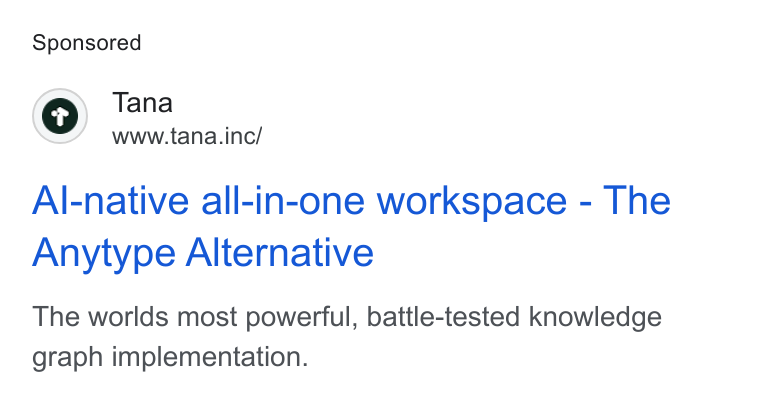
- Sponsored Tana www.tana.inc/ AI-native all-in-one workspace - The Anytype Alternative
- Audience
- Individuals or teams seeking advanced productivity tools, specifically those familiar with or looking for alternatives to 'Anytype', indicated by the direct comparison in the headline.
Why it works. Intercepts Anytype's own users and searchers by explicitly branding Tana as the upgrade path from that specific tool.
Direct competitor call-out in headline: 'AI-native all-in-one workspace - The Anytype Alternative' Run separate ad variants naming each individual competitor your prospects already use, not just one generic 'alternative' ad.
- Running
- 113 days (longevity = it's converting)
- Hook
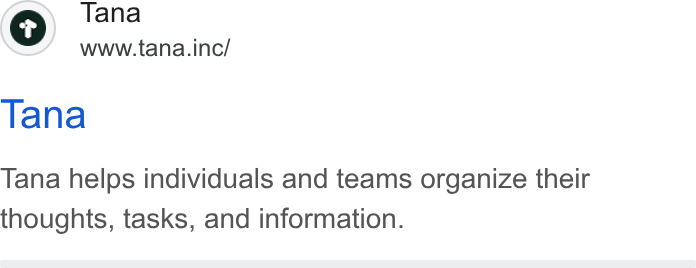
- Tana www.tana.inc/ Tana Tana helps individuals and teams organize their thoughts, tasks, and information.
- Audience
- Individuals and teams who struggle with organizing thoughts, tasks, and information, as stated in the text: "Tana helps individuals and teams organize their thoughts, tasks, and information."
Why it works. Works for both solo users and team buyers at once by naming both audiences explicitly in the description line.
Clearly state the product's name and website at the top, followed by a bolded repetition of the name and a concise value proposition. On-screen text: "Tana www.tana.inc/ Tana Tana helps individuals and teams organize their thoughts, tasks, and information." Write your one-line description to explicitly name every buyer segment you serve, not just the primary one.
09 The playbook
The channels are not separate. They are one system where each stage feeds the next. Here is the read, then the plays to run tomorrow.
The inferred playbook
Tana's loop starts with brand-anchored search and its own community, converts through a generous free tier, but has no visible engine building new top-of-funnel demand to match its paid-search spend.
Most inbound demand arrives via searches for "tana" itself or competitor "alternative to" terms, recaptured by the always-on Google program (27 active ads as of 2026-07-12) covered above.
The $0 tier plus AI-credit-gated Pro ($20) and Max ($80) seats let individual PKM users adopt free and expand into paid seats once teams form.
Dig deeper+3▾
r/TanaInc and the weekly YouTube cadence keep existing users engaged and surface objections (data portability, export, pivot confusion) that a lean team, one open engineering role as of 2026-07-12, will need to answer directly.
With no comparison-page network, no affiliate program, and a founder X account under 1,000 followers, there's no organic-content or personal-audience flywheel sized to match the paid-search spend, leaving existing-community word-of-mouth to carry most new discovery.
free-to-paid conversion rate, churn, CAC, blended ARPU across the three paid tiers.
Turn a hiring post into a growth mechanic
The proofTana's 2021 recruiting post on X offered "lifetime free subscription" for a successful referral and asked for retweets as a "karma-boost," before the product had any public users.
The adaptationStart by writing your own hiring or "we're building X" post and add a referral clause tied to your product itself, a free month, a lifetime discount, or early access, instead of a cash bounty. Post it in the communities where your ideal early user already hangs out, not just your own feed. The mechanism: hiring posts get shared for reasons unrelated to the product, which piggybacks your offer onto reach you didn't pay for.
Cost: $0 · Time to signal: days · Works pre-PMF: yes
Cap your beta below demand on purpose
The proofTana ran a closed beta that served roughly 30,000 users while its public waitlist grew to about 160,000, a gap that manufactured urgency ahead of any public launch.
The adaptationIf you're pre-launch, cap your beta at a number visibly smaller than your waitlist and say so explicitly ("we can only onboard 200 people this month"). First step: pick a real capacity constraint (support bandwidth, server cost, manual onboarding time) and publish it as the reason for the cap, not as manufactured scarcity, so it holds up under scrutiny.
Cost: $0 · Time to signal: weeks · Works pre-PMF: yes, provided the cap is tied to a real constraint rather than an obviously fake one
Launch inside an adjacent community's migration conversation
The proofTana's early adoption was pulled by the existing PKM (personal-knowledge-management) community, users publicly documenting their moves from Notion, Roam, and Obsidian.
The adaptationFind the community already comparing tools in your category (a subreddit, a Discord, a niche newsletter) and show up with a genuine migration story or comparison post, not an ad. First step: search for "moving from [incumbent tool]" threads in your category's forums and reply with a specific, honest account of what your tool does differently.
Cost: $0 · Time to signal: weeks · Works pre-PMF: yes
Bid on "alternative to [competitor]" search terms
The proofTana runs proven-winner Google ads positioned as the "Anytype Alternative" alongside newer tests as the "Otter AI Alternative," part of an always-on program with 27 of 60 collected ads still active as of 2026-07-12.
The adaptationIdentify the two or three competitors your prospects search for most and run a small text-ad campaign bidding on "[competitor] alternative" and "[competitor] vs [you]" terms, pointing to a page that names the specific difference. Start with a $10-20/day cap and watch which comparison term converts before scaling spend.
Cost: under $500 · Time to signal: weeks · Works pre-PMF: conditional, only once you can name a specific, credible difference from the competitor, a vague "better" claim will waste the spend
Turn your users' subreddit into an unmanaged support and beta channel
The proofr/TanaInc runs as a genuine, company-unmanaged community where users debate data access, workflow setup, and product changes, generating real engagement (a 44-point thread on data portability).
The adaptationOnce you have even a small user base, don't create a branded community forum, let a subreddit or Discord form organically around your product name and monitor it instead of controlling it. First step: search for whether one already exists, and if not, seed one conversation yourself in a related community rather than founding your own from scratch.
Cost: $0 · Time to signal: months · Works pre-PMF: no, this requires an existing user base large enough to sustain conversation without the founder carrying it Not transferable at an earlier stage: the founder-network fundraising angle (an investor backing Tana specifically because a co-founder's prior pitch impressed them at Google) depends on a pre-existing personal network most early founders won't have, and the always-on paid-search program assumes a funded team's budget, not a pre-revenue one.
You just read how Tana does it. Tomorrow it is someone else.
Every morning we take one company that is actually growing and break down where its customers come from: the ads still running after a year, the channel doing the real work, and the play you can run this week.
Systemaic · directional intelligence. Traffic, spend, and reach figures are SimilarWeb-style estimates and qualitative reads of public data, not audited numbers. Built on real public receipts.
// teardowns with a similar GTM motion
sources & receipts (8)
Live ad libraries: linkedin ad library · google ad library
Launch archives: Hacker News: Tanaka Hisashige, builder of the Myriad Year Clock (2016) · Hacker News: Tanagram: Tools for complex codebases, inspired by 5 years o · Hacker News: Matt Tanase (a founder of Slicehost) on Rackspace’s decision · Hacker News: Tana – The Everything OS for You · Hacker News: After 40 years, Nintendo's Kensuke Tanabe is retiring · Hacker News: Tana: Put your notes to work with voice and AI
Traffic, spend, and revenue figures are estimates as noted in the report; the links above are the primary public artifacts.