- 01Localize into one underserved language before expanding further
- 02Turn a referral program into a paid-traffic reseller network
- 03Bid a direct comparison ad against your biggest competitor's term
- 04Post the surprising output as a short standalone hook, not a tutorial
01 Snapshot
The one-glance read on who they are and how they grow. Each point is verifiable from the receipts above.
An AI platform that scripts, voices, and assembles marketing and social videos for creators and small businesses, sold on a freemium credits model, backed by a Y Combinator Summer 2024 placement.
Paid search-led, run partly through an affiliate reseller network, layered on top of a Vietnamese-language organic wedge.
An estimated 285,900 monthly visits and a roughly 500-ad Google search library with 31 ads active, both as of 2026-07-14.
As of 2026-07-14, VideoGen and several affiliate-run accounts are live-testing a fresh wave of plain "AI Video Generator" search ads only 4-16 days old, including one new test from VideoGen's own advertiser account.
A large share of its Google ad library is run by advertiser Anton Koenig, the same name the corpus ties to VideoGen's founder, turning what looks like an independent referral program into a founder-run paid-traffic operation.
02 How it unfolded
The order the channels came online. Sequence is strategy: what they did first, and what they layered on once demand existed.
03 Traffic & channel mix
Estimated demand, the channel split behind it, and the keywords and referrers doing the work. Directional modeling, not audited analytics.
Traffic sources
Top search keywords
| Keyword | Volume | Weight | CPC |
|---|---|---|---|
| videogen | 9.2k | $0.78 | |
| video gen | 1.5k | $2.99 | |
| invideo ai | 374k | $0.44 | |
| videogen ai | 1.0k | $0.18 | |
| tạo video ai | 7.4k | $0.06 |
Top referring sites
Closest competitors by audience
VideoGen draws an estimated 285,900 monthly visits, down 35.8% over the last 3 months as of 2026-07-14. Direct traffic dominates the mix at 64.6%, typical of a tool people bookmark or open straight from a saved link rather than discover fresh each session, with Search Organic a distant but real second at 21.5%. Gen AI referrals sit at 3.7%, a notable line item for an AI video tool since it points to discovery through AI chat interfaces and tool aggregators rather than classic search. The rest, email, referrals, organic social, paid search, and display, together total under 11% and don't move the needle individually.
On keywords, VideoGen ranks for its own name (videogen, ≈9,200 searches/month) but is also bidding into invideo ai (≈374,000 searches/month), a competitor's branded term with roughly 40x VideoGen's own search volume, and into tạo video ai (≈7,400 searches/month), the Vietnamese-language query tied to its localized page. Among referrers, getrewardful.com is a referral-tracking platform, its presence as a top referrer confirms VideoGen's affiliate program is sending real traffic, not just sitting unused on the homepage. toolify.ai is an AI-tool directory, a passive listing rather than an active channel, and stripe.com is simply the checkout redirect, not a growth source. Its closest named competitors include heygen.com, invideo.io (the one it directly names in its own ad copy), and runwayml.com, all larger, better-funded AI video players it's positioning against rather than partnering with.
04 Organic content
The specific pages earning their organic search traffic, and the pattern behind why they rank. Adapt the format, not the topic.
VideoGen's organic-search traffic is overwhelmingly carried by a single asset: its Vietnamese-language homepage at /vi, which its top-content data credits with 88.4% of organic-search traffic, dwarfing the English homepage's 4.8% share. The other top pages (/vi/tao-mot-video, /vi/generator-video-ai, /vi/about-vi) are all Vietnamese variants too, and the pattern is a localized micro-site rather than a broad blog or comparison-page library. It ranks #1 for its own branded terms (videogen, video gen, videogen ai) and a more modest #7-#9 for generic Vietnamese queries like "tạo video ai miễn phí" and "tạo video ai," suggesting the localized wedge is still climbing on non-branded demand. The likely reason it works: English-language "AI video generator" search is saturated by well-funded competitors, while a literal Vietnamese translation of the same category term faces far less competition for real volume.
Top pages by organic traffic
05 Channel map
Not traffic share. How much weight the growth system actually puts on each channel, with a one-line read on the role it plays.
What drove growth
06 The motions doing the work
For founder-led SaaS the breakdown shifts from ads to traction: where the first users came from, how the founder grows it in the open, and the compounding organic surface.
VideoGen's traction reads as bootstrapped demo virality plus a slow-building localization wedge, not a single coordinated launch moment.
Several early hook videos, including "How to Instantly Generate Videos Using AI" (1.31M views), "This Video Was Generated By AI" (1.1M views), and "VideoGen | The Most Powerful AI Video Generator Ever" (679K views), carry an identical July 14, 2024 upload date in the data and represent the largest traction spike visible in the evidence, dwarfing every video posted since.
That mid-2024 video cluster lines up with VideoGen's Y Combinator Summer 2024 batch placement, its clearest external momentum marker.
Dig deeper+2▾
Advertiser Anton Koenig, the same name the corpus ties to VideoGen's founder, began running Google ads pointing to videogen.io as early as August 2024, a founder-run mechanic that still populates a large share of the current ad library.
Rather than a second spike, the Vietnamese /vi page described above appears to have built organic traction gradually well after the 2024 video moment, making it the compounding half of an otherwise launch-video-driven start.
VideoGen's public presence runs through the brand's own product-demo channel, not a personal founder following, since the founder's individual social footprint barely registers next to it.
The YouTube channel, not a personal account, carries the audience: 30 videos spanning 2023 through 2026, shifting from high-reach demo hooks to a near-monthly cadence of feature tutorials.
Anton Koenig, co-founder and CEO (alongside co-founder and CTO David Grossman), posts from his personal X account to just 80 followers, with a single product-update tweet drawing 3 likes and 73 views, a real but negligible lever next to YouTube's reach.
Dig deeper+1▾
The evidence contains no founder Reddit posts, revenue-milestone updates, or interview commentary describing a personal audience-building motion, so the "founder-led" story here is told through the product's own demo videos rather than a founder's personal brand.
Organic search is VideoGen's second-largest channel at 21.5% of total traffic, and the system behind it is a language wedge plus an affiliate layer, not a broad content library.
The Vietnamese-language wedge covered above reflects a broader strategy of chasing underserved-language search terms instead of competing directly on saturated English terms like invideo ai, where entrenched competitors already own the results page.
getrewardful.com's presence as a top referrer confirms VideoGen's affiliate program actively recruits partners who send real traffic, turning a homepage link into a functioning referral channel rather than a dormant page.
Dig deeper+1▾
Google is the only paid channel with evidence (no Meta ads appear in the data), and several long-running ads, active between 410 and 584 days, were switched off between December 2025 and April 2026, while the 600-plus and 700-plus day ads remained active, just as a fresh wave of tests began in late June 2026, even though SimilarWeb's own channel mix credits paid search with only 1.7% of total visits, suggesting the ad fleet targets narrow, low-volume terms rather than broad category keywords.
07 Paid ads
This founder-led SaaS also runs paid acquisition. Here are the live ads doing the work, each with the X-ray and a play you can adapt.
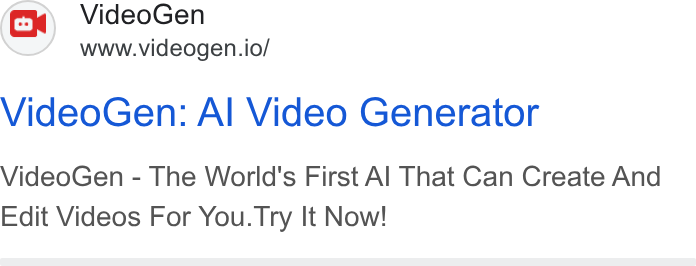
- Running
- 612 days (longevity = it's converting)
- Hook
- VideoGen: AI Video Generator - VideoGen - The World's First AI That Can Create And Edit Videos For You.Try It Now!
- CTA / offer
- Try It Now!
- Audience
- Individuals or businesses interested in video creation and editing, specifically those looking for AI-powered solutions, as indicated by 'AI Video Generator' and 'AI That Can Create And Edit Videos For You'.
Why it works. A category-origin claim aimed at searchers evaluating several AI video tools who default to whichever seems most established.
Headline with a clear value proposition: 'VideoGen: AI Video Generator' If you were early to your category, state 'World's First' or 'Original' explicitly in the headline to claim that ground.

- Running
- 706 days (longevity = it's converting)
- Hook
- Sponsored VideoGen www.videogen.io/ VideoGen - AI Video Generator Create Videos in Seconds
- CTA / offer
- Try VideoGen Now For Free
- Audience
- Individuals or businesses looking to create video content quickly and easily, indicated by the phrases "AI Video Generator" and "Create Videos in Seconds."
Why it works. A blunt speed promise for people frustrated with how long traditional video editing takes.
Headline with a strong benefit statement: "VideoGen - AI Video Generator Create Videos in Seconds" State the specific unit of time your product saves, seconds or minutes, directly in the headline instead of a vague 'fast'.
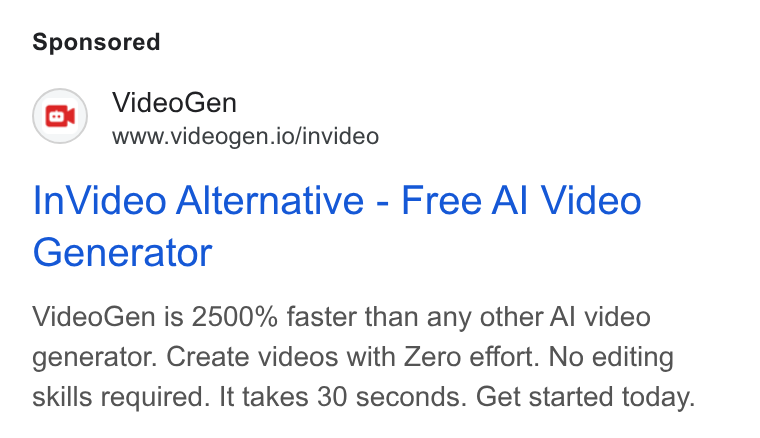
- Running
- 497 days (longevity = it's converting)
- Hook
- Sponsored" followed by a red camera icon and the text "VideoGen www.videogen.io/invideo". Below this is the blue headline "InVideo Alternative - Free AI Video Generator".
- CTA / offer
- Get started today.
- Audience
- Individuals or businesses looking for a faster, easier, and free alternative to InVideo for AI video generation, especially those without editing skills.
Why it works. Targets InVideo's own searchers mid-comparison and offers a free option, for buyers weighing which paid tool to pick.
Directly names a competitor and positions itself as an alternative: "InVideo Alternative - Free AI Video Generator". Bid on your top competitor's name and headline your ad as '[Competitor] Alternative - [your free or key benefit]'.
Show 3 more ads

- Running
- 410 days (longevity = it's converting)
- Hook
- Sponsored videogen.io www.videogen.io/ Boost Ads with Videogen AI
- CTA / offer
- Sign for Videogen nOW!
- Audience
- Businesses and marketers looking to improve their advertising performance, indicated by the phrases 'Boost Ads' and 'helps businesses grow'.
Why it works. Narrows targeting to performance marketers by tying the tool to ad results instead of general video making.
Headline with direct benefit: 'Boost Ads with Videogen AI' Write one ad variant that targets a specific use case of your product, like ads or social, instead of the generic pitch.

- Running
- 379 days (longevity = it's converting)
- Hook
- Sponsored VideoGen www.videogen.io/ Free AI Video Generator - Try it now for free
- CTA / offer
- Get started today.
- Audience
- Individuals or businesses looking for AI-powered video creation tools, specifically those interested in YouTube Shorts, indicated by the listed categories.
Why it works. Doubles down on zero cost as the objection-killer for price-sensitive searchers comparing AI video tools.
Headline: "Free AI Video Generator - Try it now for free" If your product has a free tier, say 'free' in both the description and the call-to-action of your headline.
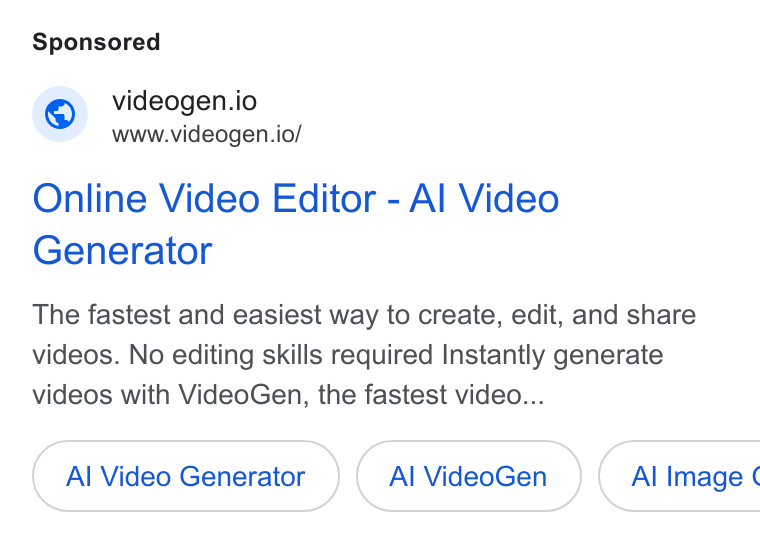
- Running
- 573 days (longevity = it's converting)
- Hook
- Sponsored videogen.io www.videogen.io/ Online Video Editor - Al Video Generator
- Audience
- Individuals who create, edit, or share videos, particularly those without prior editing skills, indicated by the text 'No editing skills required'.
Why it works. Covers two adjacent keyword intents, editing and generating, in a single ad to widen the search-term net for one campaign.
Headline clearly states product and key benefit: 'Online Video Editor - Al Video Generator'. Combine two related keyword phrases your buyers search separately into one headline to capture both intents at once.
08 The playbook
The channels are not separate. They are one system where each stage feeds the next. Here is the read, then the plays to run tomorrow.
The inferred playbook
VideoGen's loop starts with a demo video or a competitor-comparison ad, converts on a metered free tier, and compounds through a single-language SEO wedge and an affiliate network, but has no visible personal-founder amplifier.
Attention starts on a YouTube demo or a Google ad rather than a founder's personal feed, given the founder's 80-follower X account.
The free plan plus a $16/month Pro tier (5,000 monthly credits, 50GB storage, billed yearly) lets users produce real output before committing to an annual card, rather than gating on a countdown trial.
Dig deeper+3▾
The Vietnamese /vi page and the affiliate program keep generating traffic without new content, unlike the YouTube channel, which needs constant uploads for shrinking per-video returns.
A personal founder narrative and an English-language content engine to match the Vietnamese one, leaving growth reliant on paid search and one language's organic wedge.
free-to-paid conversion off the credit-metered plan, the affiliate program's actual payout or commission terms, and channel-level acquisition cost split between founder-run paid search and the affiliate-run ad fleet.
Localize into one underserved language before expanding further
The proofVideoGen's Vietnamese /vi page pulls the large majority of its organic-search traffic and ranks top 10 for generic queries like "tạo video ai," while its English homepage barely registers by comparison.
The adaptationPick one language where your core English term is competitive but a literal-translation equivalent is not (mirror the "tạo video ai" pattern: translate the category term itself, not marketing copy), translate just your homepage and two or three core landing pages into it, and target that exact translated query pattern in your on-page titles and headers.
Cost: under $500 · Time to signal: months · Works pre-PMF: conditional, provided the core English product already converts and the target language market has real search demand with weak local competition.
Turn a referral program into a paid-traffic reseller network
The proofA large share of VideoGen's longest-running Google ads, one active for over 700 days as of 2026-07-14, are attributed to advertiser Anton Koenig, the same name tied to VideoGen's founder, effectively buying paid search under a separate advertiser account.
The adaptationSet up a simple revenue-share affiliate link through a referral-tracking tool, then recruit a handful of small performance marketers or niche comparison-site owners directly, not just existing users, offering them a cut of subscription revenue in exchange for running their own search or content campaigns pointed at your product.
Cost: $0 · Time to signal: weeks to months · Works pre-PMF: no, this needs a proven paid-conversion rate before outside advertisers will risk their own spend on it.
Bid a direct comparison ad against your biggest competitor's term
The proofVideoGen's longest-running ad creative directly names a competitor ("InVideo Alternative - VideoGen vs InVideo"), capturing demand from a term with roughly 374,000 monthly searches that VideoGen doesn't own outright.
The adaptationIdentify your single largest competitor's branded or generic term, write one ad that literally names both products ("X vs Y" or "X Alternative"), and run it on a small daily budget against just that keyword rather than broad category terms, to catch people already comparing options instead of paying to educate cold searchers.
Cost: under $500 · Time to signal: days · Works pre-PMF: yes, this is one of the fastest paid-signal tests since it targets already-qualified switch-intent searchers.
Post the surprising output as a short standalone hook, not a tutorial
The proofVideoGen's highest-view YouTube videos are all short bold-claim demo clips (one, a 34-second video titled "This Video Was Generated By AI," reached 1.1M views), while its later multi-minute tutorial uploads land in the dozens to low thousands.
The adaptationRecord a single video under 60 seconds that shows your product's single most surprising output with almost no explanation, title it as a bold claim rather than a how-to, and post it natively where your prospective audience already watches, saving longer tutorial content for people who already signed up.
Cost: $0 · Time to signal: days · Works pre-PMF: yes, provided the output itself is genuinely surprising; a bold-claim hook wrapped around a mediocre result burns credibility fast.
Meter the free tier by usage, not by a countdown clock
The proofVideoGen pairs a free plan with a $16/month Pro tier carrying 5,000 monthly credits, letting users produce a complete real output before hitting a volume-based paywall rather than a time-based one.
The adaptationReplace a 14-day trial with a small permanent free allotment sized to produce one full real output, then price your first paid tier around a usage cap you can state in a single sentence, so the upgrade trigger is proven usage rather than a ticking clock.
Cost: $0 · Time to signal: weeks · Works pre-PMF: yes. Not transferable at an earlier stage: the affiliate-run paid-search network and the localization payoff both assume an already-proven conversion rate and product-market fit in the home market, so a pre-revenue founder should validate conversion on owned channels first before recruiting outside advertisers or investing in a second language.
You just read how VideoGen does it. Tomorrow it is someone else.
Every morning we take one company that is actually growing and break down where its customers come from: the ads still running after a year, the channel doing the real work, and the play you can run this week.
Systemaic · directional intelligence. Traffic, spend, and reach figures are SimilarWeb-style estimates and qualitative reads of public data, not audited numbers. Built on real public receipts.
// teardowns with a similar GTM motion
sources & receipts (6)
Live ad libraries: google ad library
Launch archives: Hacker News: Locally Uncensored – Local AI desktop app(chat,codeagent,ima · Hacker News: VideoGen company sent me a copyright violation · Hacker News: Videogenr.com · Hacker News: AI VideoGen Open Beta Access · Hacker News: Capture your all fans' passion with VideoGenie
Traffic, spend, and revenue figures are estimates as noted in the report; the links above are the primary public artifacts.