- 01Go creator-first in an underserved language market
- 02Lead with zero tool-switching as your hook
- 03Hook with your buyer's most forbidden question
- 04Target the high-stakes milestone, not the category
01 Snapshot
The one-glance read on who they are and how they grow. Each point is verifiable from the receipts above.
An AI writing assistant embedded directly in Microsoft Word, built for university students who write term papers (Hausarbeiten) and bachelor theses (Bachelorarbeiten), with publicly reported MRR of ~$15,880 across 736 active subscriptions at ~$22 blended ARPU/mo.
Creator-led, concentrated in the German-language university market, with paid TikTok creator partnerships as the primary awareness engine.
Approximately 1,224 estimated monthly site visits; a June 2025 Product Hunt launch drew 11 upvotes from the three makers, Timothy Williams, Moritz, and Andre.
A structured paid creator campaign in the German student TikTok ecosystem seeded the subscriber base, and the business now runs on retention from that base rather than a repeatable acquisition motion.
02 How it unfolded
The order the channels came online. Sequence is strategy: what they did first, and what they layered on once demand existed.
03 Traffic & channel mix
Estimated demand, the channel split behind it, and the keywords and referrers doing the work. Directional modeling, not audited analytics.
Top search keywords
| Keyword | Volume | Weight | CPC |
|---|---|---|---|
| academic writing on ms word adds-on | 0 | - | |
| imrad structure | 2.3k | - | |
| what is the recommended ai percentage in scientific writing | 560 | - | |
| write io | 370 | - | |
| imrad-struktur | 150 | - |
Estimated total monthly visits are approximately 1,224, representing a severe -77.5% decline over the trailing three months. Of those visits, approximately 266 (roughly 22%) arrive via organic search, with the remainder driven by direct navigation and referral sources including link-in-bio clicks from TikTok creators. Organic search is almost entirely brand-driven: "fastwrite" is the top-ranking term and the homepage captures the large majority of those organic visits. Informational academic terms they rank for, such as "imrad structure" (2,290 total monthly web searches across the whole web) and "what is the recommended AI percentage in scientific writing" (560 total monthly web searches across the whole web), deliver negligible traffic to this company specifically. Two active Google text ads (as of 2026-06-29) cover some thesis-writing search intent, but at that scale they represent a token paid search presence. The core acquisition channel, paid TikTok creator content, drives awareness that does not register as organic search traffic, meaning the site visit count understates total brand reach while confirming that organic discovery is not compounding.
04 Organic content
The specific pages earning their organic search traffic, and the pattern behind why they rank. Adapt the format, not the topic.
The SEO surface is almost entirely brand-driven: the homepage captures 88.8% of the estimated 266 monthly organic visits, with "fastwrite" as the sole top-ranking term. The one non-branded asset is a German-language how-to post on creating automatic bibliographies in Microsoft Word, a practical workflow tutorial precisely aligned with the thesis-writing use case that earns a small but relevant slice of academic search. With only five pages generating any organic traffic and the blog barely indexed, the content engine is too thin to drive meaningful unbranded discovery.
Top pages by organic traffic
05 Channel map
Not traffic share. How much weight the growth system actually puts on each channel, with a one-line read on the role it plays.
What drove growth
06 The motions doing the work
For founder-led SaaS the breakdown shifts from ads to traction: where the first users came from, how the founder grows it in the open, and the compounding organic surface.
The product's entry to market was quiet, with a soft Product Hunt launch that generated no meaningful inbound, while the real traction came from a structured creator campaign that followed shortly after.
The June 2025 Product Hunt listing, "Write faster and more accurate with AI - directly in MS Word," drew 11 upvotes and 3 comments across the three makers (Timothy Williams, Moritz, and Andre), well below the threshold for front-page placement; no coordinated Hacker News or Reddit launch posts from the team are visible in public data.
Paid TikTok creator posts began appearing in July 2025, one month after the Product Hunt launch, suggesting the team shifted acquisition to the German student creator channel quickly after a weak launch moment; more than 20 paid posts are visible through mid-2026.
Dig deeper+1▾
The publicly reported 736 subscriptions at ~$22 ARPU represents the cumulative result of that creator seeding period rather than an active growth phase; the acquisition rate has dropped significantly from the period when the creator campaign was most active. ---
The company's public-facing growth runs entirely through paid creator partnerships, with no visible founder-led build-in-public presence on any tracked channel.
No X, LinkedIn, or Reddit presence tied to the fastwrite.io team (Timothy Williams, Moritz, or Andre) is visible in the public evidence; the brand's growth narrative lives entirely in creator posts, not in any maker's own account.
More than 20 paid TikTok creators have posted about fastwrite.io since mid-2025, providing the only substantive public presence the brand has; the brand TikTok account (@realfastwrite) is linked from the homepage but no data on its own content output or engagement is publicly available.
Dig deeper+1▾
The brand Instagram account (@fastwrite.io) has 7 followers and 5 posts and is not a functional distribution channel; all Instagram presence is through paid creator partnerships, not the brand's own publishing. ---
Organic search contributes roughly 22% of total monthly visits, nearly all of it brand-name navigation, meaning there is effectively no compounding SEO surface.
A blog is live on the site with one indexed post (a German-language how-to on automatic bibliography creation in Word), earning approximately 6 organic visits per month; the surface is nascent and not yet contributing to unbranded discovery at any meaningful scale.
The site embeds Rewardful, an affiliate and referral tracking platform, indicating a referral or affiliate program is active; the program is not prominently mentioned in any of the creator UGC reviewed, making it unclear whether creators operate as affiliates or on a flat-fee basis, and whether the referral loop is generating meaningful distribution or sitting dormant.
Dig deeper+1▾
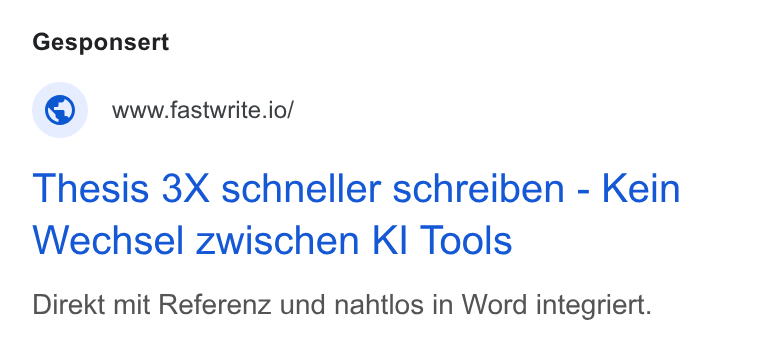
The 2 active Google text ads (as of 2026-06-29) use the hook "Thesis 3X schneller schreiben - Kein Wechsel zwischen KI Tools," targeting high-intent thesis-writing queries with a no-tool-switching angle that mirrors the TikTok creator messaging; the longest-running active ad at approximately 17 days suggests a recent test rather than a proven long-running investment. Free-to-paid conversion rate and CAC are not visible in public data. ---
07 Paid ads
This founder-led SaaS also runs paid acquisition. Here are the live ads doing the work, each with the X-ray and a play you can adapt.
- Running
- 17 days (longevity = it's converting)
- Hook
- Gesponsert www.fastwrite.io/ Thesis 3X schneller schreiben - Kein Wechsel zwischen KI Tools
- Audience
- Students or academics writing a thesis, indicated by the phrase "Thesis 3X schneller schreiben" (Write thesis 3X faster).
Why it works. A Google search ad catching students already searching for thesis help, leading with a 3x speed claim plus a differentiator against juggling multiple AI tools.
Headline with a quantifiable benefit: "Thesis 3X schneller schreiben - Kein Wechsel zwischen KI Tools" Rewrite your top search ad headline around one measurable speed benefit paired with the specific friction point your tool removes versus switching between apps.
08 The playbook
The channels are not separate. They are one system where each stage feeds the next. Here is the read, then the plays to run tomorrow.
The inferred playbook
Fastwrite.io ran a targeted paid creator campaign in an underserved language niche to seed a paying subscriber base, then let retention carry the MRR while the acquisition engine faded.
Paid German-language TikTok creators reached university students at peak thesis-writing stress moments, using problem-agitation hooks ("how do you always write such easy Hausarbeiten?"), bold-claim formats (a creator stating she passed her Bachelorarbeit with a 1.1 grade using the tool, an advertised claim in paid creator content rather than a verified outcome), and lifestyle-embed formats (uni day vlogs with natural product mentions).
The core product proposition removes tool-switching friction by embedding directly in Microsoft Word, the software German university students already use; a Rewardful-powered referral program exists as a potential self-reinforcing loop but its active contribution to growth is not visible in public data.
Dig deeper+2▾
With no visible compounding channel (no SEO surface, no maker-led community, no active inbound loop), the current ~$15,880 MRR is sustained by the existing subscriber base rather than ongoing acquisition; subscriber renewal rates and churn are not visible in public data.
The creator campaign generated awareness and first subscriptions but did not build a compounding growth surface; without a flywheel (organic content rankings, a referral loop with visible uptake, a community), the business carries churn risk with no mechanism to replace departing subscribers at equivalent pace. ---
Go creator-first in an underserved language market
The proofFastwrite.io ran paid German-language creator posts on TikTok when the English AI writing tool market was crowded, generating individual posts with 250 to 6,500 engagements with minimal competition for that specific audience. More than 20 posts, all disclosed as "Anzeige," targeted German university student hashtags across a campaign spanning mid-2025 through mid-2026.
The adaptationIdentify the non-English language market where your category is underserved and find 5 to 10 micro-creators (5,000 to 50,000 followers) already posting content for your target audience in that language. Map the native TikTok or Instagram hashtag ecosystem for your use case in that market, recruit creators on a flat-fee basis, and brief them to demonstrate the tool in their natural content format rather than as a formal product review. Start by running one creator post in one language market to prove CPM and engagement before expanding. The mechanism: non-English creator CPMs are lower and category competition is thinner, so a given creator budget reaches a higher share of the relevant audience than the equivalent English-language spend. ---
Lead with zero tool-switching as your hook
The proofEvery fastwrite.io creator post and both active Google ads lead with the same positioning: no need to switch between AI tools because the product lives inside Microsoft Word. The Google ad headline states this directly ("Kein Wechsel zwischen KI Tools"), and TikTok creators reinforce it by demonstrating the product inside Word without ever leaving the document.
The adaptationIf your product can be delivered as a plugin, extension, or add-on inside a tool your target customer uses every day (Google Docs, Notion, VS Code, Figma, Slack), make that integration the primary hook in all content and ad copy rather than the standalone product capabilities. Build your first creator brief or landing page around "you stay in [their existing tool], not ours." Start by identifying the one daily-use tool your customer lives in and build the integration-first positioning before investing in any standalone surface. The mechanism: tool-switching is the primary friction in software adoption, and removing it at the positioning layer reduces the perceived cost of trying the product before a user ever reaches the checkout. ---
Hook with your buyer's most forbidden question
The proofOne of fastwrite.io's visible TikTok creative angles opens with the question "Sind es Plagiate, wenn man KI Tools für die Bachelorarbeit benutzt?" (Is it plagiarism to use AI tools for your thesis?), exploiting a genuine ethical fear students carry about AI use, then routes the viewer into a demonstration of how the product works within academic integrity norms. This curiosity format appears alongside the bold-claim and lifestyle-embed formats in the creator mix, offering a distinct hook for a different viewer state.
The adaptationFind the one unspoken fear or objection your target buyer carries about using your category of product ("is this cheating?", "will my team know I used AI?", "is this GDPR compliant?") and build a creator brief or content piece around answering it honestly before introducing the product. Start by asking five current customers what they were nervous about before they signed up, and write the first creator brief around the most common fear. The mechanism: anxiety-driven hooks address a real objection the buyer was already carrying, converting resistance into curiosity at the top of the funnel rather than at the point of purchase. ---
Target the high-stakes milestone, not the category
The proofFastwrite.io does not market to "students who write" generally. Every creator post, every Google ad, and every hashtag targets the specific milestones of the Bachelorarbeit and Hausarbeit, the two highest-stakes writing events in a German university student's academic career, when willingness to pay is highest and the outcome feels most consequential.
The adaptationIdentify the single highest-stakes moment in your target customer's workflow where your product's value is most undeniable, and build creator briefs and landing page copy exclusively around that moment rather than the general category. If your product has seasonal or calendar-driven demand spikes (annual tax filing, quarterly board deck season, end-of-semester deadlines), schedule creator campaigns to coincide with those windows rather than running year-round generic content. Start by mapping when your buyer's pain is most acute and concentrate your first paid creator test in that window. The mechanism: milestone-triggered buying intent is more concentrated and time-bound than general category interest, meaning the same message converts at higher rates when delivered at the right moment in the buyer's calendar.
You just read how fastwrite.io does it. Tomorrow it is someone else.
Every morning we take one company that is actually growing and break down where its customers come from: the ads still running after a year, the channel doing the real work, and the play you can run this week.
Systemaic · directional intelligence. Traffic, spend, and reach figures are SimilarWeb-style estimates and qualitative reads of public data, not audited numbers. Built on real public receipts.
// teardowns with a similar GTM motion
sources & receipts (1)
Live ad libraries: google ad library
Traffic, spend, and revenue figures are estimates as noted in the report; the links above are the primary public artifacts.