- 01Relaunch until it sticks
- 02Trade product access for public reviews
- 03Name your competitor in the ad
- 04Write for the moment around your product, not just the product
01 Snapshot
The one-glance read on who they are and how they grow. Each point is verifiable from the receipts above.
An AI resume builder for individual job seekers plus a growing Rezi Enterprise arm serving 300+ organizations, with the company reporting roughly 1M new users a year.
Organic-led (SEO), with a founder-driven build-in-public layer now paired with an escalating paid-search defense.
Publicly reported MRR of $262,849 across 10,913 active paying subscriptions (≈$24 blended ARPU), on top of ~767.8K estimated visits over the last 3 months and 32 active Google ads as of 2026-07-06.
The founder mapped exact dollar bids to search rank, "Position 1: $100,000 budget, Positions 2-5: $50,000 budget, Positions 6-10: $20,000 budget," to hold the term "resume."
As of 2026-07-06 the newest live Google ad is 11 days old from a secondary advertiser entity, running alongside comparison-hook tests like "Teal Alternative, Ranked #1 by Forbes."
Rezi's edge isn't creative quality, it's persistence: the same founder has been resubmitting launches and re-bidding the same handful of keywords for a decade, converting SEO equity into an increasingly expensive paid-search moat around its own brand terms.
02 How it unfolded
The order the channels came online. Sequence is strategy: what they did first, and what they layered on once demand existed.
03 Traffic & channel mix
Estimated demand, the channel split behind it, and the keywords and referrers doing the work. Directional modeling, not audited analytics.
Traffic sources
Top search keywords
| Keyword | Volume | Weight | CPC |
|---|---|---|---|
| rezi | 51k | $0.85 | |
| rezi ai | 11k | $0.39 | |
| rezi resume | 3.8k | $0.51 | |
| ai resume builder | 48k | $4.96 | |
| rezi.ai | 870 | - |
Top referring sites
Closest competitors by audience
Rezi pulls an estimated ~767.8K visits over the last 3 months (down 8.08% month-over-month). Direct traffic leads at 47.1%, search organic follows at 28.4%, and referrals add 10.6%, a mix consistent with a decade of SEO-first growth plus a habitual, bookmark-driven user base. Social organic contributes a further 7.2%; the rest, Gen AI referrals, email, paid search, paid social, and display, together total 6.6%. The founder has publicly claimed Rezi now outranks "legacy resume softwares" including Kickresume and Enhancv for the term "resume builder," which tracks with the organic share here. They rank and bid into real demand: "ai resume builder" pulls ≈47,500 searches/mo, "rezi" itself ≈51,400/mo, and "rezi ai" ≈10,900/mo, the latter two showing brand-term searches are now a demand pool in their own right. Referral traffic includes resume.io, which is also a listed head-to-head competitor, meaning cross-linking or comparison content likely drives some of that traffic; resumai.com and samrush.site round out the top referrers as likely SEO-tool or aggregator sites. Beyond resume.io, the closest competitors are Enhancv and Kickresume, both named directly by the founder as the software Rezi now beats in search.
04 Organic content
The specific pages earning their organic search traffic, and the pattern behind why they rank. Adapt the format, not the topic.
Rezi's organic footprint is anchored by the homepage itself, which the tool's per-page model credits with the large majority of the site's organic search visits. The next tier is workplace-adjacent long-tail content rather than more "resume builder" pages: resignation letter and resignation email guides, a motivational-quotes roundup, and a Canva-templates comparison page. The pattern is a deliberate hedge against how crowded the core "resume builder" query is: instead of competing only on the head term, Rezi built practical, single-intent pages for the life moments that surround a job search (quitting, writing farewell emails, finding a template), which face far less competition and still funnel into the same product.
Top pages by organic traffic
05 Channel map
Not traffic share. How much weight the growth system actually puts on each channel, with a one-line read on the role it plays.
What drove growth
06 The motions doing the work
For founder-led SaaS the breakdown shifts from ads to traction: where the first users came from, how the founder grows it in the open, and the compounding organic surface.
Rezi's traction came from relaunching the same product under new framing for a decade, not from one breakout moment.
The founder submitted Show HN posts under two different usernames (jacob_kr in 2017, then jacob_rezi from 2019 onward) at least nine times between 2017 and 2026, spanning a resume editor, layoff support tools, hiring tools, and an "ATS Hack Mode," with the strongest result, "Rezi, Resumes for Large Companies," hitting 21 points and 7 comments in 2019.
Rezi's only Product Hunt launch, "Free resume software for serious job seekers," landed 115 upvotes and 29 comments on 2019-11-14.
Dig deeper+2▾
the founder ran a recurring "Rezi Lifetime" account giveaway, at one point handing out roughly 600 lifetime accounts (worth $149 each) a month to seed reviews, and the megathread relaunch of that campaign drew a 252 score and 1,149 comments.
across founder interviews, early growth from 54,000 users at 30% month-over-month up to 120,000 users is attributed entirely to organic channels, SEO, Korean accelerator funding, and in-person Seoul resume seminars, with no paid marketing spend in that period (source, source). A separate investor analysis credits an early $3.69 price test with unlocking 100% month-over-month growth to about 9,000 users a month, well below today's $29/mo Pro tier (source).
The founder, Jacob Jacquet, runs Rezi's build-in-public presence personally on X, posting concrete numbers rather than general updates, distinct from the brand's own @reziHQ account.
to 2,303 followers, he posted an exact "$9.57K avg. in March" ad-spend figure after starting paid campaigns on brand terms, "AI Resume Builder," and "ATS Resume Templates."
in one post he broke down the exact bid tiers for ranking on "resume": $100,000 for position 1, $50,000 for positions 2-5, $20,000 for positions 6-10 (covered above).
Dig deeper+2▾
he described a deliberate motion of giving away product access in exchange for reviews and later claimed a "no AI" content push drove renewed Reddit exposure; the only subreddit visible in evidence is the brand's own r/Rezi, where the 2023 giveaway thread (covered above) is the clearest engagement proof.
Jacob Jacquet's 14,241 LinkedIn followers represent scale, but no posting activity is in evidence, so it reads as an audience asset rather than an active channel.
Search organic and paid search now run as two deliberately separate levers rather than one blended strategy.
the long-tail workplace pages covered above extend Rezi's organic footprint past the crowded "resume builder" query into lower-competition, adjacent search moments.
the site runs its referral program through Rewardful, giving outside partners a commission incentive to link into the signup funnel, a lever none of the three named competitors visibly run.
Dig deeper+1▾
Google Ads shows 32 active ads as of 2026-07-06, with creative leaning on bold-claim hooks like "Almost Too Good to Be True" and "Bypass ATS Systems With Ease," plus direct competitor conquesting: one ad headlined "Teal Alternative, Ranked #1 by Forbes" to intercept searches for a rival resume tool. "Ranked #1 by Forbes" and "Trusted by 4 million job seekers" are the ad's own claims, not independently confirmed. The founder's willingness to bid up to $100,000/month for the top slot on "resume" (covered above) shows the same aggression funding both the organic defense and the paid one.
07 Paid ads
This founder-led SaaS also runs paid acquisition. Here are the live ads doing the work, each with the X-ray and a play you can adapt.
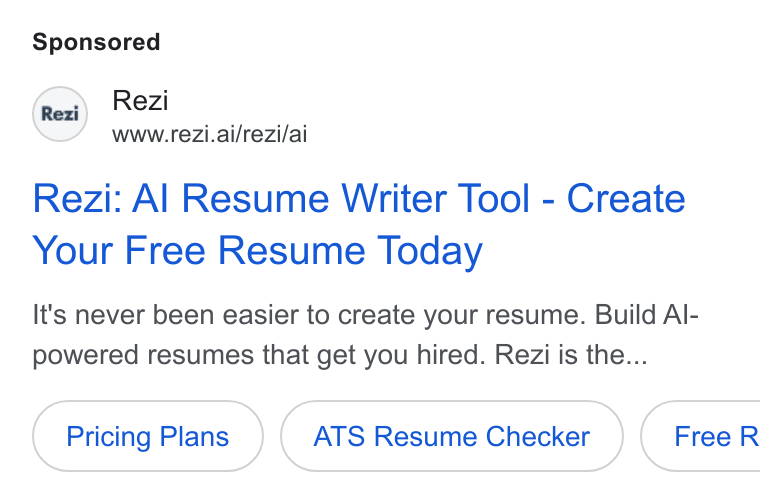
- Running
- 622 days (longevity = it's converting)
- Hook
- Sponsored Rezi www.rezi.ai/rezi/ai Rezi: AI Resume Writer Tool - Create Your Free Resume Today
- CTA / offer
- Create Your Free Resume Today
- Audience
- Individuals seeking employment or career advancement, indicated by the focus on 'Resume Writer Tool' and 'get you hired'.
Why it works. Combines category clarity with a same-day free offer, which lowers the decision cost for a job seeker who wants a resume built right now.
Headline clearly states the product and its primary benefit: "Rezi: AI Resume Writer Tool - Create Your Free Resume Today" Put your product category and a time-bound free offer in the same headline instead of splitting them across two lines.
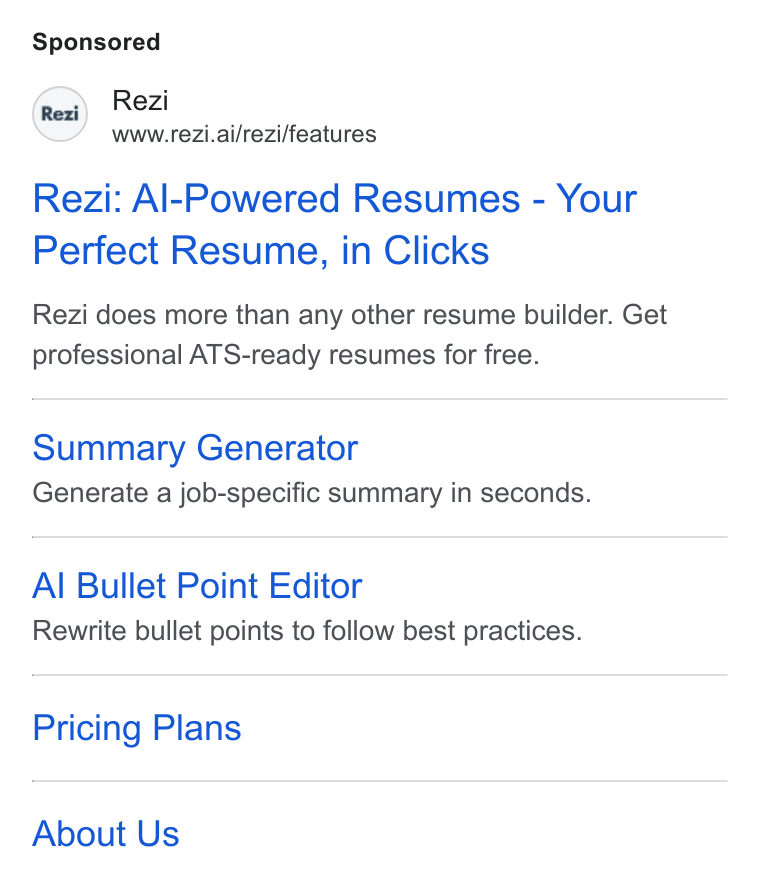
- Running
- 620 days (longevity = it's converting)
- Hook
- Visual: The word "Sponsored" at the top, followed by a circular logo with "Rezi" inside, and the text "Rezi" and "www.rezi.ai/rezi/features". Below this is the blue headline "Rezi: AI-Powered Resumes - Your Perfect Resume, in Clicks".
- CTA / offer
- Get professional ATS-ready resumes for free.
- Audience
- Individuals seeking to create or improve their resumes, indicated by the focus on "Resumes", "ATS-ready", and tools like "Summary Generator" and "AI Bullet Point Editor".
Why it works. Sells effort reduction specifically, promising a finished result in a few clicks rather than just claiming quality, which speaks to time-pressed job seekers.
Headline with a bold claim and benefit: "Rezi: AI-Powered Resumes - Your Perfect Resume, in Clicks" State the exact unit of effort your product removes, such as clicks or minutes, instead of a vague speed claim like fast or easy.
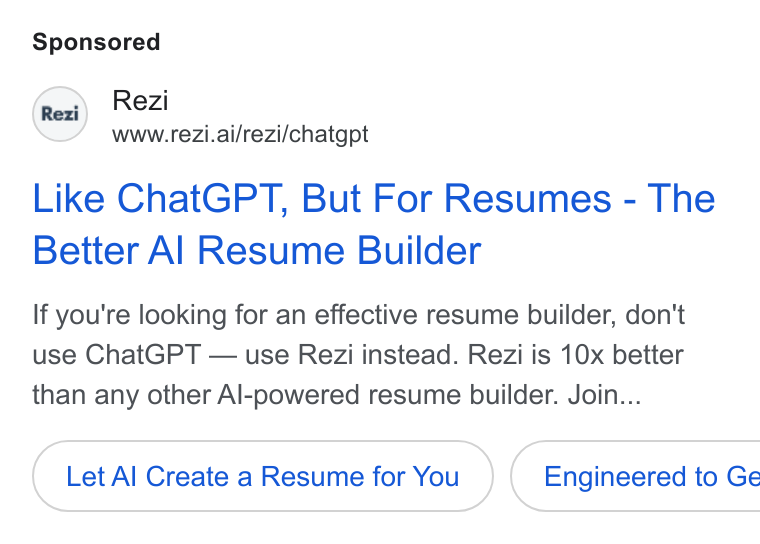
- Running
- 580 days (longevity = it's converting)
- Hook
- Visual: A sponsored ad with a small circular logo containing the word "Rezi". Text: "Sponsored" and "Rezi" and "www.rezi.ai/rezi/chatgpt". Headline: "Like ChatGPT, But For Resumes - The Better AI Resume Builder".
- CTA / offer
- Let AI Create a Resume for You
- Audience
- Individuals seeking to build or improve their resumes, specifically those familiar with or interested in AI tools like ChatGPT, indicated by "Like ChatGPT, But For Resumes" and "AI-powered resume builder".
Why it works. Uses ChatGPT as a reference point everyone already understands, then narrows the pitch to the one job it claims to do better, resume writing.
Direct comparative headline: "Like ChatGPT, But For Resumes - The Better AI Resume Builder" Compare your product to the single most recognized name in your category, then name the specific task you claim to do better than it.
Show 3 more ads
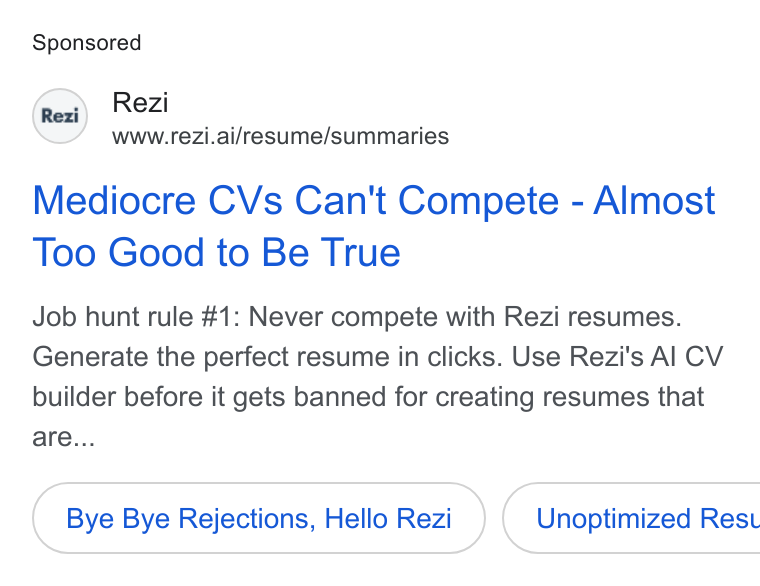
- Running
- 544 days (longevity = it's converting)
- Hook
- Mediocre CVs Can't Compete - Almost Too Good to Be True
- CTA / offer
- Bye Bye Rejections, Hello Rezi
- Audience
- Job hunt rule #1: Never compete with Rezi resumes.
Why it works. Reframes not using the product as a competitive disadvantage in a job market, which pushes urgency harder than a plain feature claim.
Headline: 'Mediocre CVs Can't Compete - Almost Too Good to Be True' Name the specific cost of inaction, such as 'X can't compete', before introducing your product as the fix.
- Running
- 546 days (longevity = it's converting)
- Hook
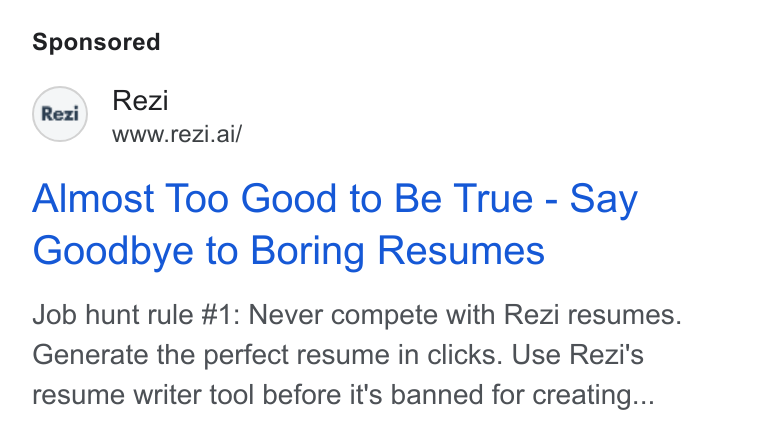
- Sponsored Rezi www.rezi.ai/ Almost Too Good to Be True - Say Goodbye to Boring Resumes
- CTA / offer
- Use Rezi's resume writer tool
- Audience
- Individuals actively engaged in a 'Job hunt' and seeking to improve their 'resumes'.
Why it works. Targets a concrete emotional pain, a boring resume, with the same disarm-then-claim structure, testing which pain point converts best in the RSA rotation.
Headline: "Almost Too Good to Be True - Say Goodbye to Boring Resumes" Run several headline variants that pair one proven opener with different specific pain points to see which resonates most.
- Running
- 544 days (longevity = it's converting)
- Hook
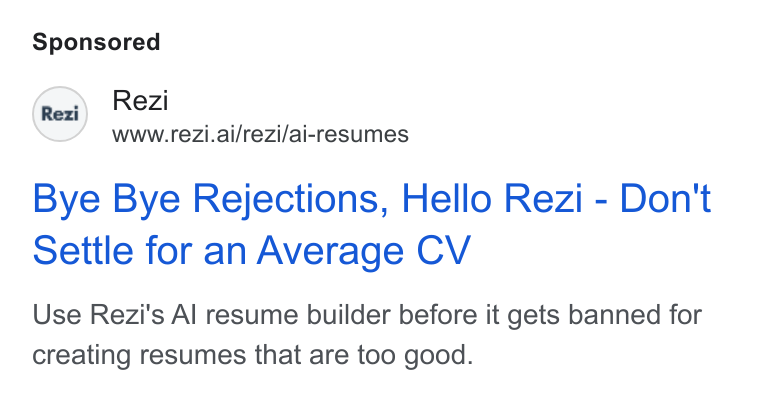
- Sponsored Rezi www.rezi.ai/rezi/ai-resumes Bye Bye Rejections, Hello Rezi - Don't Settle for an Average CV
- CTA / offer
- Use Rezi's AI resume builder
- Audience
- Individuals seeking employment or career advancement, indicated by the focus on 'Rejections' and 'CV'.
Why it works. Leads with the exact outcome the reader is trying to avoid, application rejection, instead of a generic quality claim about the resume.
Headline directly addresses a pain point and offers a solution: 'Bye Bye Rejections, Hello Rezi - Don't Settle for an Average CV'. Open your headline with the specific bad outcome your customer fears most, then introduce your brand as what ends it.
08 In their own words
Pulled from interviews and community sessions. The quotes are the angle; the takeaway is what to do with it.
[ON aIR] 다국적 기업 채용 지원자들의 플랫폼!📄 글로벌 기업 합격을 향한 구직을 준비한다면 필수!시청! ㅣ레지REZI (제이콥 자케 대표) ↗한화생명 DREAMPLUS · 1.7k views · 21 min▶ View source“our marketing budget is zero dollars”
Expand
Jacob Jacquet built Rezi to 90,000 users on a zero-dollar marketing budget, crediting SEO as the primary and most scalable channel — ranking #1 for AI-powered resume builder keywords. He layered on B2B resale partnerships with universities and news outlets, plus in-person resume seminars in Seoul to build a direct, personal user relationship, and pursued global expansion as a third lever.
“the most important channel that we've identified is seo... we're ranking number one for all ai powered resume builder keywords and this is a very scalable and profitable growth channel for resi”
“we also have resale partnerships where other companies and news outlets resell resi to their user base”
“before the pandemic we had a lot of resume seminars where we were able to host a presentation and i would just lecture our users on how to make a resume so it was really cool to interact with our customers in person”
“we're growing 30 percent month over month organically”
Own a specific, high-intent keyword cluster through SEO before spending on paid — Rezi ranked #1 for 'AI-powered resume builder' with zero ad spend.
Layer B2B resale partnerships (universities, job boards, news outlets) on top of a free B2C product to get institutional distribution without a sales team.
Run in-person user education events (seminars, workshops) in a dense metro to build personal trust and feedback loops early, especially if your product solves an anxiety-laden problem.
Treat a specific country or city as a secondary 'home market' to concentrate word-of-mouth — Rezi made South Korea its second-largest market and leveraged government startup programs there.
Anchor the free B2C product on a universal job-search artifact (the resume) so adoption is driven by necessity, not discretionary interest — this gives natural virality as every job seeker needs one.
“we now have 45 or 54,000 job seekers who trust resi we're growing at 30 percent per month and our marketing spend is zero dollars so all of this is happening organically”
Expand
Rezi grew to 54,000 users at 30% month-over-month with zero marketing spend, entirely through organic channels. The founder built a freemium B2C product and layered in B2B university contracts (Seoul National University, University of Wisconsin) as institutional distribution. He positioned Korea specifically because government spending on youth unemployment ($43B) created a large, motivated user base with an acute pain point.
“our business model is freemium so it's free and the prices go up to 98 for the job seeker”
“our two clients right now are the university of wisconsin in seoul national university and here is our first paying client in south korea so we power the career center for all global job seekers at seoul national university”
“we see youth unemployment as the largest social issue in south korea today the government is spending 43 billion dollars to fight this it's the highest youth unemployment rate in the past 20 years and there's millions of unemployed young job seekers”
“the marketplace companies like resi are extremely competitive and as a result they're frequently acquired by the full service staffing companies”
Use institutional B2B contracts (universities, career centers) as a distribution channel to seed users at scale before spending on paid acquisition.
Freemium with a clear paid ceiling ($98) lets you accumulate a large user base organically while capturing willingness-to-pay from serious job seekers.
Pick a geography where government is already spending heavily on your problem — it signals demand, funds institutional buyers, and reduces the need to educate the market.
Build product features (real-time ATS keyword analysis, content scoring) that make the core job-seeker outcome measurably better, so word-of-mouth and organic growth replace paid channels.
Frame the exit narrative to investors early: position in a market where larger incumbents (full-service recruiters) have historically acquired marketplace players, making M&A a credible path.
“make it so good that other people market it for you — if you build like an industry leading product other people will kind of push it for you”
Expand
Jacob grew Rezi to 120,000 users with no marketing budget by winning Korean government accelerator programs for runway, hosting in-person resume seminars in Seoul to build word-of-mouth, and leaning on SEO and a distribution partnership with AppSumo. His core scaling thesis was product-led: make the product good enough that others market it for you, then layer on B2B-to-C deals (universities) and content to make growth self-sustaining.
“over the past 13 months we've had around 120,000 users use it and this is organically with no marketing budget”
“appsumo they marketed it for us and we had about 25,000 users for that — this is a marketing partnership where a partner writes a ton of different press for really high profile media partners and then it's a revenue split on that”
“we really focused on using content just so google can rank resi higher and higher and it's been working pretty well but it's a really slow process”
“we always had these resume seminars where we would invite people job seekers to our co-working space and i would just lecture them on how to make a resume — we went from like 30 people to 300 people and what's really cool about this is the network effect”
Run free in-person seminars tied to your ICP's pain point (job seekers needing resumes) — they compound via word-of-mouth and scale from 30 to 300 attendees without ad spend.
Use revenue-split distribution deals (AppSumo-style) to spike new users: a partner handles press and promotion, you share the upside, no upfront budget required.
Win government accelerator programs early to fund operations when VC is inaccessible — each win builds reputation that gets you invited into the next program without applying.
Pursue B2B-to-C by placing software inside one institution (university, job platform) to unlock thousands of end users at once, then use that logo for credibility in the next deal.
Invest in SEO and content as the only self-sustaining, profitable channel for a free product — accept it is slow but treat it as the long-term foundation while relationship-based channels seed early growth.
“We dropped the price and regrew 100% the next month — so we found that $3.69 is the sweet spot for the templates.”
Expand
Rezi grew early by targeting underemployed college students with ATS-optimized resume templates, validating a price point of $3.69 that unlocked 100% month-over-month growth, and using content marketing plus campus events to drive traffic to ~9,000 users/month within a year. The investor's core critique was that Rezi had no defensible technology or unique distribution moat, making it a viable lifestyle business but not a fundable startup.
“We have 841 total customers; that's been growing very fast — we're up over 400%, 2016 over 2015.”
“Content marketing is the best way to get this resume out there because when people are writing a resume they need education — and for that we have a fantastic blog with lead generation, automated email, so that stuff is kind of on autopilot.”
“We've had events at University of Wisconsin Madison where we have somebody dress up as a Power Ranger with Rezi collateral and goes out to the university libraries and just tells everybody about Rezi.”
“You can either continue to do what you're doing and make money for yourself and eventually make enough to pay your bills, or pivot and try to invent some technology which doesn't exist on the market.”
Run a price-sensitivity test early: Rezi found $3.69 (vs. $9.69) triggered 100% MoM growth — a single price change was the clearest growth lever they had.
Pair SEO content with automated email capture: Rezi put blog + lead-gen email on 'autopilot' so organic search traffic converted into a nurture list without ongoing manual effort.
Do physical campus activations to seed a student product: costumed reps in university libraries created memorable brand impressions where the exact target customer already congregated.
Use Facebook retargeting + custom audiences rather than chasing organic social followers — Rezi found transactional lift there, not on Instagram (50 followers, brand awareness only).
Acquire complementary micro-products cheaply to fill feature gaps: Rezi bought an existing Resume Builder app for $1,300 to add interactivity rather than building from scratch.
09 The playbook
The channels are not separate. They are one system where each stage feeds the next. Here is the read, then the plays to run tomorrow.
The inferred playbook
Rezi's loop starts with a decade-deep SEO base, converts through a freemium wall, and now layers an increasingly expensive paid-search defense on top of terms it already owns organically.
search organic and a free tier capped at one resume feed a $29/mo Pro plan (unlimited resumes, full AI features) and a $149 one-time Lifetime tier, with the ~$24 blended ARPU sitting below the $29 sticker price, implying a real mix of free, Pro, and discounted Lifetime users.
the long-tail blog content and the Rewardful affiliate program both keep adding surface area without incremental ad spend, while the founder's build-in-public X posts double as low-cost credibility content.
Dig deeper+3▾
Instagram and TikTok activity is almost entirely third-party creator UGC rather than an owned content operation, so Rezi doesn't control the volume or cadence of its most visually native channel.
paid search has grown from a defensive brand-term bid into 32 concurrent active ads as of 2026-07-06, a signal that the organic moat alone no longer holds the category terms it used to win for free.
free-to-paid conversion rate, churn, and CAC on the newly active paid-search spend.
Relaunch until it sticks
The proofnine Show HN submissions since 2017 under different framings, peaking at 21 points in 2019 (covered above).
The adaptationpick one launch venue that fits your category (a niche subreddit, Show HN, a directory) and treat every real feature ship as a new, honestly-framed launch attempt instead of a single make-or-break event. Write a fresh one-paragraph pitch each time, post it, and move on regardless of the score; the mechanism is that repeated honest attempts cost nothing and only need one to land.
Cost: $0 · Time to signal: days · Works pre-PMF: yes
Trade product access for public reviews
The proofrecurring "Lifetime" giveaways, at one point ~600 accounts a month, seeding a megathread that drew 1,149 comments (covered above).
The adaptationgive away your top paid tier to a capped number of users in exchange for a public review or case study, tracked so it never exceeds a fixed percentage of new signups. Post the offer in your own community first, not a public one, since the goal is a page of reviews you can point new prospects to, not indefinite free access.
Cost: $0 (foregone revenue) · Time to signal: weeks · Works pre-PMF: conditional, only if total demand is large enough that the giveaway doesn't just replace paying customers
Name your competitor in the ad
The proofa live Google ad headlined "Teal Alternative, Ranked #1 by Forbes" intercepting searches for a named rival.
The adaptationidentify the one competitor your prospects search right before they buy, and write a single "[Competitor] alternative" ad or landing page pointed at that brand-term search. Check the ad platform's trademark and competitor-name policy before bidding, since this tactic carries real account-level risk if run carelessly.
Cost: under $500 · Time to signal: days to weeks · Works pre-PMF: conditional, needs an established competitor with real search volume to intercept
Write for the moment around your product, not just the product
The proofRezi's top non-homepage organic pages target resignation letters, resignation emails, and templates, not "resume builder" itself (covered above).
The adaptationlist the 5-10 adjacent moments your buyer searches before or after using your product, and write one practical, single-intent page per moment. This works because those queries carry far less competition than your head term while still funneling searchers into the same product.
Cost: $0 to under $500 if outsourcing the writing · Time to signal: months · Works pre-PMF: yes, best started early since it compounds
Post the real number, not the update
The proofthe founder's exact "$9.57K avg. in March" ad-spend post and his tiered bid budget for ranking on "resume" (covered above).
The adaptationeach time you hit a milestone, post one real number from your own operation, spend, conversion rate, MRR delta, and the specific tactic behind it, instead of a vague "excited to share" update. Specificity is what earns replies and trust from an audience of other operators, not the milestone itself.
Cost: $0 · Time to signal: days for engagement, months for audience-build · Works pre-PMF: yes Not transferable at an earlier stage: the $100,000-a-month bidding war for a single keyword assumes real revenue already funding it. A pre-revenue founder should adapt the relaunch cadence and the build-in-public number-posting, not the bid-war spend.
You just read how Rezi does it. Tomorrow it is someone else.
Every morning we take one company that is actually growing and break down where its customers come from: the ads still running after a year, the channel doing the real work, and the play you can run this week.
Systemaic · directional intelligence. Traffic, spend, and reach figures are SimilarWeb-style estimates and qualitative reads of public data, not audited numbers. Built on real public receipts.
// teardowns with a similar GTM motion
sources & receipts (12)
Live ad libraries: google ad library
Launch archives: Hacker News: Show HN: Rezi – Resumes for Large Companies · Hacker News: Show HN: Resume Editor · Hacker News: Show HN: Rezible – Open-Source Mission Control for Oncall · Hacker News: Show HN: Rezible – Open-Source Mission Control for Oncall Te · Hacker News: Show HN: Layoff Support · Hacker News: Rezilion Uncovers New Details of Google Chrome 0-Day Vuln (C
Founder interviews: Rezi How-To on AppSumo · [ON aIR] 다국적 기업 채용 지원자들의 플랫폼!📄 글로벌 기업 합격을 향한 구직을 준비한다면 필수!시청! ㅣ레지REZI · L-CAMP 6기 데모데이 피칭 - 레지 Jacob A. Jacquet 대표 · Rezi.io · Jacob Jacquet - Founder and CEO of Rezi
Traffic, spend, and revenue figures are estimates as noted in the report; the links above are the primary public artifacts.