- 01Recruit a creator swarm, not a single brand account
- 02Save the founder's account for launch threads, not daily posting
- 03Seed a discount code where word of mouth already happens
- 04Defend your own name in paid search before chasing broad keywords
01 Snapshot
The one-glance read on who they are and how they grow. Each point is verifiable from the receipts above.
An AI tutor and study-tool suite (flashcards, quizzes, notes) built from uploaded course materials, aimed at college and med-school students, backed by a reported Series A.
Creator-led, powered by a swarm of individually branded student TikTok and Instagram creators rather than a brand-run social account or heavy paid spend.
~1.15M monthly visits (as of 2026-07-12), 7M+ self-reported registered users (independent estimates put it nearer 6M), and a Series A reported at $11.5M in June 2025 (up from an initially reported $10M that April).
A swarm of individually branded creators (studyfetchgia, studyfetchangela) drives viral spikes, but 83% of organic search traffic funnels to one homepage: the compounding asset is brand awareness, not scaled SEO.
02 How it unfolded
The order the channels came online. Sequence is strategy: what they did first, and what they layered on once demand existed.
03 Traffic & channel mix
Estimated demand, the channel split behind it, and the keywords and referrers doing the work. Directional modeling, not audited analytics.
Traffic sources
Top search keywords
| Keyword | Volume | Weight | CPC |
|---|---|---|---|
| studyfetch | 55k | $0.54 | |
| study fetch | 44k | $0.56 | |
| study ai | 43k | $1.32 | |
| studyfetch ai | 2.0k | $1.32 | |
| focus flight | 25k | $1.43 |
Top referring sites
Closest competitors by audience
StudyFetch draws an estimated ~1.15M monthly visits, down 38.3% over the last 3 months as of 2026-07-12, a decline worth watching alongside the churn/pricing friction visible in its Reddit threads below. Direct traffic leads the mix at 56.6%, plausibly inflated by viewers who see a creator's TikTok or Instagram clip and then type the brand name in directly rather than clicking a link, a pattern consistent with the UGC-heavy footprint documented in the channel map below. Search Organic is second at 28.5%, Referrals a distant third at 5.1%, and the rest, Social Organic, Search Paid, Email, AI-referral traffic and Display, together total under 10%. The keywords they rank and bid for are dominated by their own name (studyfetch, ≈55,000 searches/mo; study fetch, ≈44,000/mo) but "study ai" also pulls ≈43,000 searches/mo, real non-branded category demand they're competing into. Their top referrers are thin: stripe.com (almost certainly checkout-flow traffic rather than editorial referral), uv.es (a Universidad de Valencia domain, suggesting an institutional page or resource list linking to the tool in Spain), and flikover.com (an unfamiliar site with no further detail in the evidence). Named competitors span legacy note-sharing (studocu.com, a much larger existing student-document platform they're now competing against) and near-identical AI clones (mindgrasp.ai, studdyai.com), underscoring how replicable the "upload notes, get an AI tutor" category has become.
04 Organic content
The specific pages earning their organic search traffic, and the pattern behind why they rank. Adapt the format, not the topic.
Their organic footprint is concentrated: the homepage alone pulls ≈192,000 organic visits/mo across their top five pages, with the homepage taking 83% of that total and the rest split across login, signup, a features/mini-apps page, and an enterprise/teacher page. None of the top five are blog posts, comparison pages, or "best X" roundups, and the keywords ranking #1 are almost entirely branded (studyfetch, study fetch, even the typo "study sketch") plus two category terms (ai study tools, study websites). The pattern reads as a branded-search capture funnel rather than a built content moat: people search the name because they already heard about it elsewhere (most likely the creator videos below), and Google rewards that demand, rather than StudyFetch winning organic discovery through owned content.
Top pages by organic traffic
05 Channel map
Not traffic share. How much weight the growth system actually puts on each channel, with a one-line read on the role it plays.
What drove growth
06 The motions doing the work
For founder-led SaaS the breakdown shifts from ads to traction: where the first users came from, how the founder grows it in the open, and the compounding organic surface.
StudyFetch's earliest public trail is a pair of founder threads from December 2023, not a coordinated launch-day push across multiple platforms.
On December 16, 2023, Esan Durrani posted two threads from his personal X account, one claiming "hundreds of thousands of students" were already using the platform to augment their learning, the other unveiling Live Lecture, a feature that auto-transcribes lectures into notes, framing early growth as already underway rather than a single launch spike.
The company has described running a formal campus-ambassador program that offers a budget and free Premium access to students in exchange for content, the reported mechanism behind the wide roster of individually branded TikTok creators in the channel map above. The specific view and download totals tied to this program trace to a single marketing blog rather than an independently verified source, so treat them as directional, not confirmed.
Dig deeper+1▾
A dedicated r/StudyFetchPromoCodes subreddit thread offering 50%-off codes pulled 61 comments (covered above), showing that once a student hears about the tool, an actual discount is what pushes them to sign up rather than organic curiosity alone.
StudyFetch's growth-in-the-open is thin on personal audience-building and heavy on episodic, high-reach product threads from co-founder and CEO Esan Durrani.
Durrani's X account sits at 1,361 followers with 79 total posts, yet his Honen launch thread's outsized reach (covered above) shows the account's pull comes from occasional viral hits, not a compounding subscriber base.
His December 2023 threads (covered above) read as product-launch copy rather than the milestone, MRR, or lessons-learned cadence typical of founder build-in-public, the account exists to unveil things, not to narrate the day-to-day.
Dig deeper+2▾
Every X post in evidence is tagged to Durrani personally, so his feed is effectively StudyFetch's only owned-voice channel on the platform, there is no separate brand account posting in parallel.
The actual distributed, in-public energy is the creator swarm and the community-run r/studyfetch and r/StudyFetchPromoCodes threads (both covered above), meaning "build in public" here is a recruited creator army's voice, not the founder's own audience.
Organic search is StudyFetch's second-largest channel at 28.5% of traffic (covered above), but the content side of that funnel is nearly empty, paid channels are doing more of the categorical-demand work than owned content is.
The five pages earning organic traffic are all product, account, and enterprise surfaces (covered above), with no blog, no comparison or "alternative to" pages, and no templates or integrations directory in evidence, so the SEO motion is capturing brand awareness rather than manufacturing new discovery.
Unlike the grassroots promo-code sharing in r/StudyFetchPromoCodes (covered above), no formal affiliate or partner program surfaces in the evidence, which reads as a community-run discount culture rather than a company-operated distribution lever.
Dig deeper+2▾
Google's active campaigns (covered above) run generic bold-claim copy, "Create Interactive Study Tools" and "Study Smarter with AI," pointing straight to the signup flow, consistent with brand-term capture and category-keyword bidding rather than a creative-led acquisition push.
The full active LinkedIn set (covered above) promotes Honen and B2B features like "Active AI Literacy" and "Learning Connections," including a founder-to-camera clip arguing "General-purpose AI doesn't actually care whether you learn or don't," making LinkedIn the venue for the B2B narrative, not student acquisition.
07 Paid ads
This founder-led SaaS also runs paid acquisition. Here are the live ads doing the work, each with the X-ray and a play you can adapt.
- Running
- 139 days (longevity = it's converting)
- Hook
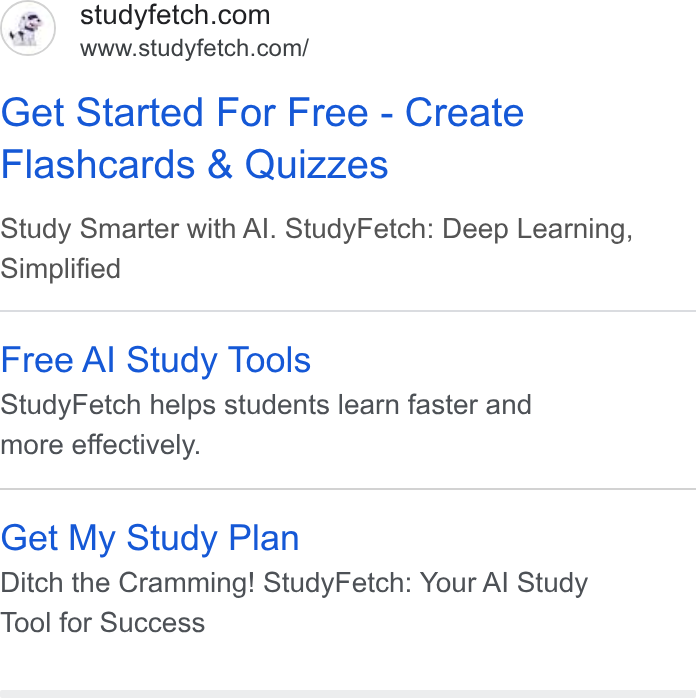
- studyfetch.com www.studyfetch.com/ Get Started For Free - Create Flashcards & Quizzes Study Smarter with Al. StudyFetch: Deep Learning, Simplified
- CTA / offer
- Get Started For Free
- Audience
- Students or anyone seeking to learn faster and more effectively, indicated by phrases like "Flashcards & Quizzes," "Study Smarter," and "Ditch the Cramming!".
Why it works. Stacks a free-tier offer with a concrete output, flashcards and quizzes, so students see both price and product in one line.
Headline: "Get Started For Free - Create Flashcards & Quizzes" Pair your free-tier CTA directly with the specific artifact users get, not a vague benefit, in the same headline.
- Running
- 169 days (longevity = it's converting)
- Hook
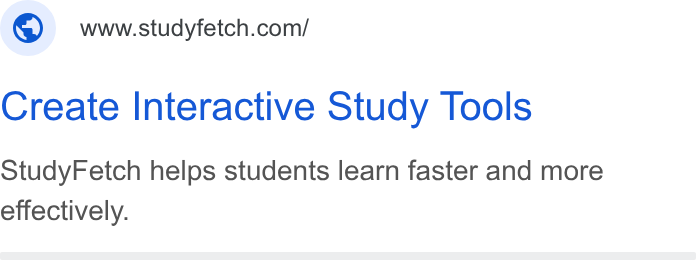
- Visual: A blue globe icon next to the text "www.studyfetch.com/". Text: "Create Interactive Study Tools".
- Audience
- Students or educators, indicated by the text "StudyFetch helps students learn faster and more effectively" and "Create Interactive Study Tools".
Why it works. A minimal search-ad headline that mirrors likely search intent so the ad matches the query with no wasted words.
Headline stating core function: "Create Interactive Study Tools" Write a search ad headline that repeats the exact phrase your buyer types into Google, nothing else.
08 The playbook
The channels are not separate. They are one system where each stage feeds the next. Here is the read, then the plays to run tomorrow.
The inferred playbook
Attention starts with recruited creators and occasional founder virality, converts through a single branded homepage, and compounds through the creator roster itself, while the owned-content layer that would catch demand once that cohort's mindshare fades is largely absent.
Recruited student creators and Durrani's occasional high-reach threads (both covered above) generate top-of-funnel awareness, not a paid-media budget.
That awareness converts almost entirely through direct visits and branded search into a single homepage (covered above), with Google ads recapturing category searches like "study ai" at the same signup page.
Dig deeper+3▾
The creator roster and the Reddit promo-code culture are the assets that keep paying off, each new creator or code thread reaches a fresh cohort without additional media spend.
Even as the creator swarm keeps posting, there is no owned-content or SEO layer beyond the homepage to catch demand once this creator cohort's reach cools, and ad spend is now split between consumer signup ads and the Honen enterprise pitch, a bifurcation that could dilute both motions.
free-to-paid conversion rate, churn, CAC, and confirmed consumer pricing (only third-party estimates exist).
Recruit a creator swarm, not a single brand account
The proofDozens of individually branded creator accounts, studyfetchgia, studyfetchangela, tyesen, and others (covered above), post relatable study-hack and exam-season content under their own names rather than one house handle.
The adaptationPick five to ten people who already talk to your target audience in their own voice, whether that's small-business owners, new parents, or hobbyist coders, and offer them free product access plus a modest content budget in exchange for a fixed monthly posting cadence, letting each keep their own name and style. The mechanism: individually branded but recognizably affiliated handles let each creator feel authentic to their own audience while still functioning as one distribution network you can track and pay.
Cost: under $5k · Time to signal: weeks · Works pre-PMF: conditional, only if the product creates a genuinely dramatizable moment (a before/after, a "why did I not know this" reveal); a mediocre product gives creators nothing to show.
Save the founder's account for launch threads, not daily posting
The proofDurrani's sparse but high-variance X account (covered above) shows reach coming from concentrated moments, not follower count.
The adaptationInstead of posting daily filler, write one structured thread per real milestone (a new feature, a metric worth sharing, a hard lesson) with a specific claim in the first line and concrete proof in the body, and hold it until there's something worth the format. The mechanism: threads get algorithmic distribution based on engagement and reshares, not on how many followers the account already has, so a well-timed thread can outrun a small account.
Cost: $0 · Time to signal: days · Works pre-PMF: yes, provided there is an actual new capability or number to announce, not just a status update.
Seed a discount code where word of mouth already happens
The proofA Reddit thread trading 50%-off codes for the product (covered above) pulled real engagement despite not being run by the company.
The adaptationSet up a standing referral or promo code, then find the two or three online communities where your target buyer already discusses your category and either post the code directly (where allowed) or reply with it when someone asks "does anyone have a discount." The mechanism: a discount removes the last-mile friction that stalls word of mouth, someone who hears about a tool from a friend needs a reason to act right then, not just interest.
Cost: $0 to under $500 · Time to signal: weeks · Works pre-PMF: yes.
Defend your own name in paid search before chasing broad keywords
The proofActive paid search campaigns (covered above) bid on both the brand name and adjacent category terms, pointing to a single signup page.
The adaptationOnce your product name starts generating any search volume of its own, even a few hundred searches a month, set up a cheap, always-on text ad on your own name and close variants before spending on expensive, broad category keywords. The mechanism: branded search is the cheapest, highest-intent traffic available, and losing it to a competitor bidding on your name costs more in lost signups than defending it costs in ad spend.
Cost: under $500 · Time to signal: days · Works pre-PMF: conditional, only useful once some outside awareness (creators, press, word of mouth) is already generating branded search to defend.
Separate the pitch when you launch a second product line
The proofLinkedIn ads carry the entire B2B Honen narrative, including a founder-to-camera clip, while Google ads stay focused on the original consumer signup (both covered above).
The adaptationWhen you add a second product or a new buyer segment, pick a distinct channel and message for each, enterprise or B2B pitches on LinkedIn or direct outreach, consumer pitches on the channels that already work for you, rather than blending both pitches on one page or feed. The mechanism: different buyers evaluate on different criteria, a procurement-minded enterprise buyer and an individual end user aren't persuaded by the same claims, and mixing the pitch weakens both.
Cost: $0 to under $500 · Time to signal: weeks · Works pre-PMF: conditional, only relevant once there's an actual second product or buyer segment to separate. Not transferable at an earlier stage: the funded, multi-creator ambassador program with paid budgets and dedicated marketing management assumes headcount and cash that two friends starting out don't have, and the enterprise LinkedIn pivot only makes sense once a consumer base and a second product genuinely exist, so an earlier-stage founder should borrow the seeding and discount mechanics above, not the current scale of either motion.
You just read how StudyFetch does it. Tomorrow it is someone else.
Every morning we take one company that is actually growing and break down where its customers come from: the ads still running after a year, the channel doing the real work, and the play you can run this week.
Systemaic · directional intelligence. Traffic, spend, and reach figures are SimilarWeb-style estimates and qualitative reads of public data, not audited numbers. Built on real public receipts.
// teardowns with a similar GTM motion
sources & receipts (2)
Live ad libraries: linkedin ad library · google ad library
Traffic, spend, and revenue figures are estimates as noted in the report; the links above are the primary public artifacts.