- 01Free-utility hack framing for an adjacent audience
- 02One landing page per search intent, not one homepage
- 03One message, pushed identically everywhere at once
- 04Cap the free tier on usage, not features
01 Snapshot
The one-glance read on who they are and how they grow. Each point is verifiable from the receipts above.
An AI audio/video creation platform (recording, editing, transcription, voice cloning) for podcasters and creators, freemium-priced, rebranded from Podcastle to Async on January 28, 2026 while podcastle.ai kept the same product and pricing.
A hybrid of early creator-led virality and long-running paid search rather than a founder-audience motion; CEO Arto Yeritsyan announces company milestones on X (@ArtoYeritsyan) and LinkedIn, but the acquisition engine was the viral free tool plus paid search, not founder narration.
~10,500 monthly visits (down 18% over the recent traffic window) as of 2026-07-11; 54 total Google ads tracked with 0 active as of the same date; a $13.5M Series A closed February 2024 led by Mosaic Ventures, on top of a 2020 pre-seed and a 2021 $7M round, for roughly $22-23.5M raised in total; ~45 employees.
Podcastle's growth engine paired a free tool that went viral organically with students on TikTok against always-on Google search ads that captured the resulting demand, and both halves of that loop show signs of stalling around the moment the company relaunched itself as Async.
02 How it unfolded
The order the channels came online. Sequence is strategy: what they did first, and what they layered on once demand existed.
03 Traffic & channel mix
Estimated demand, the channel split behind it, and the keywords and referrers doing the work. Directional modeling, not audited analytics.
Top search keywords
| Keyword | Volume | Weight | CPC |
|---|---|---|---|
| podcastle ai | 3.4k | $3.25 | |
| podcastle.ai | 660 | - | |
| podcastle | 8.2k | $3.34 | |
| beware of chicken | 4.1k | $0.69 | |
| best podcast recording software | 720 | $8.96 |
Closest competitors by audience
Podcastle draws an estimated ~10,500 monthly visits, down 18% over the recent traffic window, a small and shrinking footprint for a company three funding rounds and roughly 45 employees in. No channel-mix breakdown by source is available in this pull, so the split between search, direct, and social traffic can't be stated here. The keyword surface is mostly branded: "podcastle" pulls roughly 8,200 searches/mo and "podcastle ai" roughly 3,400/mo, both people already looking for the product by name (combined branded demand of ~11,600/mo runs higher than the ~10,500 monthly visits because search volume counts total query demand, not all of which clicks through to the site), while "best podcast recording software" (720/mo) is the one non-branded category term they show up for. Among the listed competitors, descript.com is the closest direct rival on all-in-one recording and editing, and elevenlabs.io competes specifically on the AI voice-cloning feature Podcastle sells as "Revoice." One listed competitor, async.com, is not actually a rival, it is the company's own new domain from the January 2026 rebrand, meaning the tool that generated this competitor list picked up their own brand transition as if it were outside competition.
04 Organic content
The specific pages earning their organic search traffic, and the pattern behind why they rank. Adapt the format, not the topic.
Podcastle's organic footprint runs through essentially one asset: an episode of their own in-house "show" series titled "Trustworthy AI: De-risk Business Adoption of AI," which accounts for the large majority of their tracked organic visits, with the homepage picking up the rest. That pattern, a single AI-topic interview episode outperforming the marketing site itself, suggests the company is publishing its own podcast as content marketing and one episode that happened to land on a trending AI-adoption topic is carrying nearly all of the organic weight. There's no visible library behind it: no comparison pages, no "alternative to" pages, no template or glossary pages, just this one episode and the homepage, meaning organic search functions as a lucky single hit rather than a scaled content system.
Top pages by organic traffic
05 Channel map
Not traffic share. How much weight the growth system actually puts on each channel, with a one-line read on the role it plays.
What drove growth
06 The motions doing the work
For founder-led SaaS the breakdown shifts from ads to traction: where the first users came from, how the founder grows it in the open, and the compounding organic surface.
Podcastle's earliest traction came from a free browser tool going viral inside TikTok's student "study hack" wave, not a coordinated launch event.
the product started in 2020 as a browser extension that converted articles into podcasts, and TikTok creators picked it up immediately: tymzyje's 2020-08-28 post framing it as a way to "consume hours of info in less than 1 min" pulled 29,928 engagements with zero paid spend behind it.
the real spike came in 2021 when student-audience creators adopted it as a productivity tool rather than a podcasting one, gisela's 2021-02-13 "It's so useful!!" post hit 79,814 engagements and dojacat's 2021-05-20 "goto school hack" post hit 51,121, both aimed squarely at students, not creators.
Dig deeper+1▾
users had already spotted the transition about a week earlier (a "Podcastle to ASYNC....changing name??" Reddit thread on 2026-01-20), and on 2026-01-28 the company made it official, pushing near-identical "no acquisition, just getting smarter" copy to its Instagram account and to a dedicated post on the r/PodcastleAI subreddit the same messaging window, a coordinated cross-surface announcement rather than a product launch.
The founders (CEO Arto Yeritsyan, CPO Vardan Dabaghyan, CCO Allan Rechtman, who started the company in 2020) don't run a metrics-sharing build-in-public motion, so the open channel runs through community reaction and executive milestone posts, not a founder growth narrative.
Arto Yeritsyan does keep an active X (@ArtoYeritsyan) and LinkedIn presence where he announces company news (the Series A raise and the Magic Dust AI launch both went out on LinkedIn), but that is executive announcement posting to a professional network, not the daily metrics-and-journey narration some founder-led SaaS peers use as an acquisition channel.
the owned Instagram account posts product-feature explainers at light engagement, functioning as a documentation feed rather than an audience-building one (covered above).
Dig deeper+1▾
the company pushed its coordinated announcement to the r/PodcastleAI subreddit it owns, but over in the general r/podcasting community a user surfaced it cold, posting "I am (unfortunately) a user of Podcastle, this morning I found there has been a name/branding change to Async??" before most people there had context, so the change also spread through user-to-user discovery in communities the brand did not own.
Organic search is a minor, single-asset channel for Podcastle; the real owned-content investment historically ran through paid search instead.
only two pages register measurable organic traffic (the show episode and the homepage, covered above), with no comparison, "alternative to," or templated pages behind them, so there's no programmatic layer compounding over time.
the strongest Google creatives each pointed to their own dedicated URL, /filler-words/tool, /voice/editor, /ai/voices, rather than the homepage, several previously running from 700 days up to roughly 1,200+ days (first shown as early as August 2022, last shown as late as December 2025) before stopping, a paid-search program built around one URL per pain point rather than one general landing page.
Dig deeper+2▾
all 54 tracked ads show zero active as of 2026-07-11, and even the newest test batch (image and text creatives for AI dubbing and an AI clip maker) had stopped by January 19, 2026, roughly nine days before the official January 28 relaunch as Async, so the paid-search pullback began before the rename went public rather than being carried into the new brand.
no partner or referral program surfaced in the evidence, so the creator presence above reads as organic and earned, not an incentivized seller network.
07 Paid ads
This founder-led SaaS also runs paid acquisition. Here are the live ads doing the work, each with the X-ray and a play you can adapt.
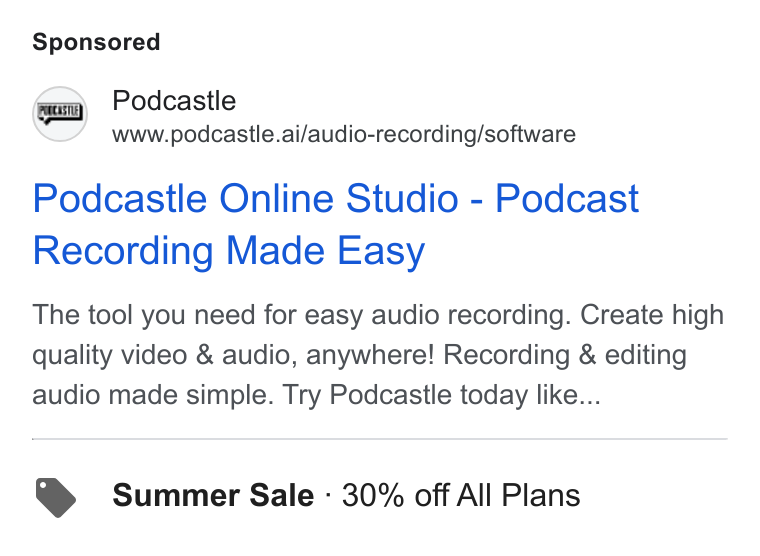
- Running
- 1210 days (longevity = it's converting)
- Hook
- Sponsored Podcastle www.podcastle.ai/audio-recording/software Podcastle Online Studio - Podcast Recording Made Easy
- CTA / offer
- Summer Sale 30% off All Plans
- Audience
- Individuals interested in creating podcasts or recording audio/video, indicated by the text "Podcastle Online Studio - Podcast Recording Made Easy" and "easy audio recording".
Why it works. Matches a high-intent search for podcast recording software with a headline that mirrors the exact category language shoppers use.
Headline clearly states the core benefit: "Podcastle Online Studio - Podcast Recording Made Easy". Mirror your target keyword phrase directly in the headline so search intent and ad copy match word for word.
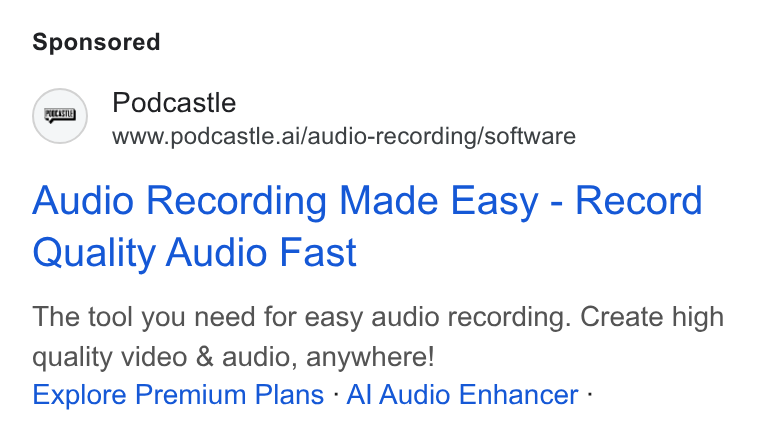
- Running
- 952 days (longevity = it's converting)
- Hook
- Sponsored Podcastle www.podcastle.ai/audio-recording/software Audio Recording Made Easy - Record Quality Audio Fast
- CTA / offer
- Explore Premium Plans
- Audience
- Individuals or businesses involved in content creation (podcasters, video creators) who need simple, high-quality audio and video recording solutions, indicated by the text "Audio Recording Made Easy" and "Create high quality video & audio, anywhere!".
Why it works. Speaks to creators who want quality without a learning curve, stacking ease and speed to justify a click over free recorders.
Headline directly addresses a pain point and offers a solution: "Audio Recording Made Easy - Record Quality Audio Fast" Stack two of your strongest benefits in one headline, such as easy plus fast, instead of picking just one.
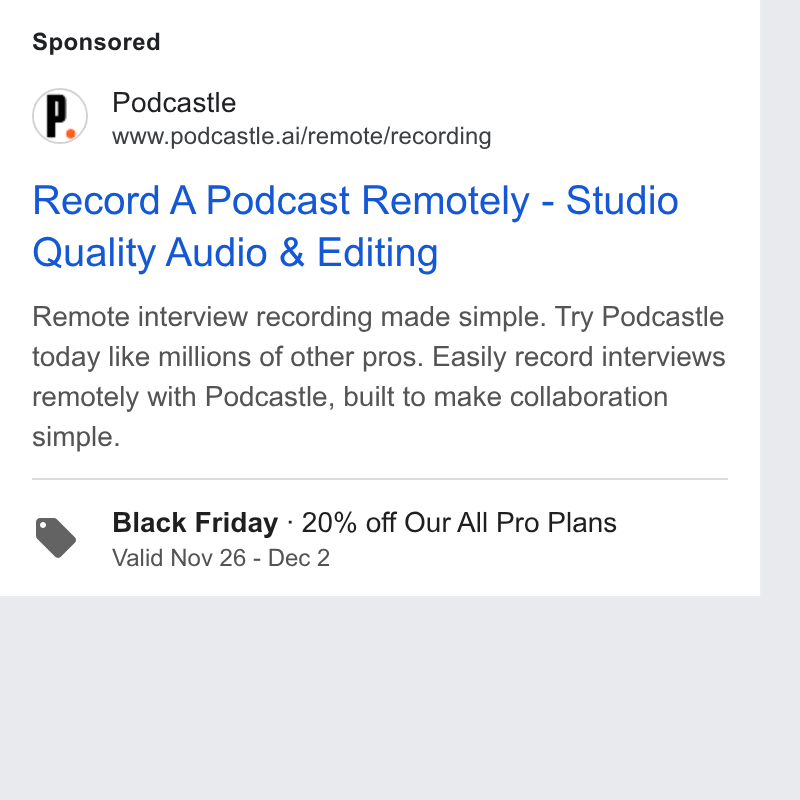
- Running
- 952 days (longevity = it's converting)
- Hook
- Sponsored P Podcastle www.podcastle.ai/remote/recording Record A Podcast Remotely - Studio Quality Audio & Editing
- CTA / offer
- 20% off Our All Pro Plans
- Audience
- Podcasters and professionals who conduct remote interviews, indicated by phrases like "Record A Podcast Remotely" and "millions of other pros."
Why it works. Speaks directly to podcast teams recording across locations, a segment underserved by single-room recording tools.
Headline directly addresses a core problem and solution: "Record A Podcast Remotely - Studio Quality Audio & Editing" If your product solves a location-specific limitation of the category, name that limitation directly in the headline.
Show 3 more ads
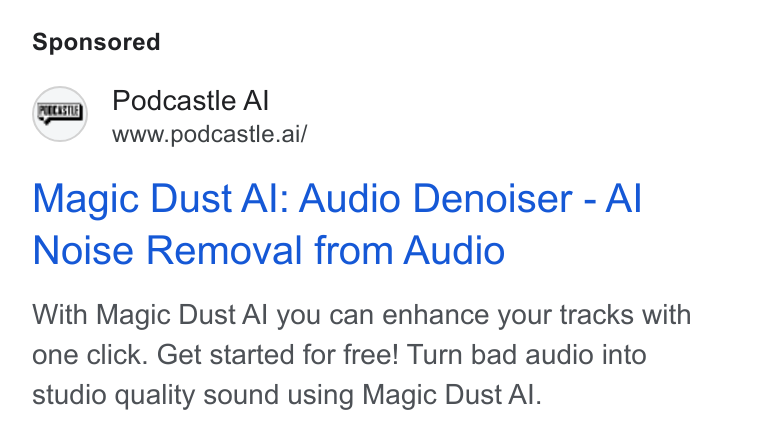
- Running
- 797 days (longevity = it's converting)
- Hook
- Visual: The word "Sponsored" at the top, followed by a small circular logo with "PODCASTLE" written inside, and the text "Podcastle AI" and "www.podcastle.ai/". Text: "Magic Dust AI: Audio Denoiser - AI Noise Removal from Audio"
- CTA / offer
- Get started for free!
- Audience
- Individuals or businesses involved in audio production, podcasting, or content creation who struggle with poor audio quality, indicated by the terms "tracks", "bad audio", and "studio quality sound".
Why it works. Converts a narrow, high-intent search for background noise removal using a branded feature name to build recall for the free tool.
Headline directly addresses a pain point and offers a solution: "Magic Dust AI: Audio Denoiser - AI Noise Removal from Audio" Give your niche feature a memorable name and pair it with a plain description of the problem it solves.
- Running
- 1214 days (longevity = it's converting)
- Hook
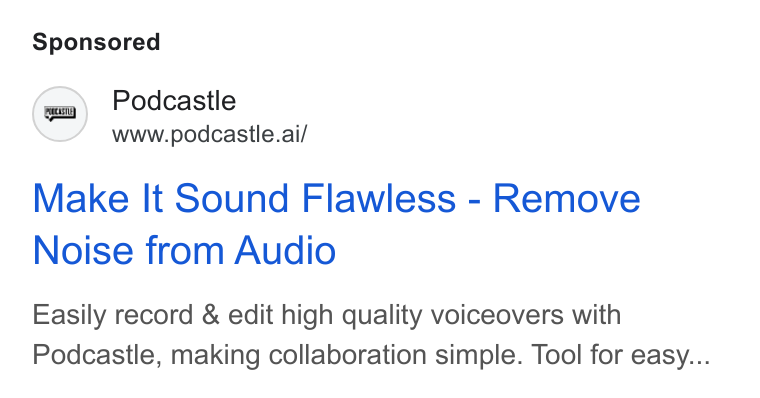
- Sponsored Podcastle www.podcastle.ai/ Make It Sound Flawless - Remove Noise from Audio
- CTA / offer
- Easily record & edit high quality voiceovers with Podcastle, making collaboration simple. Tool for easy...
- Audience
- Individuals or teams involved in audio content creation, indicated by 'voiceovers' and 'collaboration simple'.
Why it works. Matches the literal search intent of someone typing 'remove background noise,' then promises a flawless result to close the click.
Headline directly addresses a pain point and offers a solution: "Make It Sound Flawless - Remove Noise from Audio" Write your search ad headline to mirror the exact phrase your buyer would type when frustrated, then add the outcome they want.
- Running
- 1208 days (longevity = it's converting)
- Hook
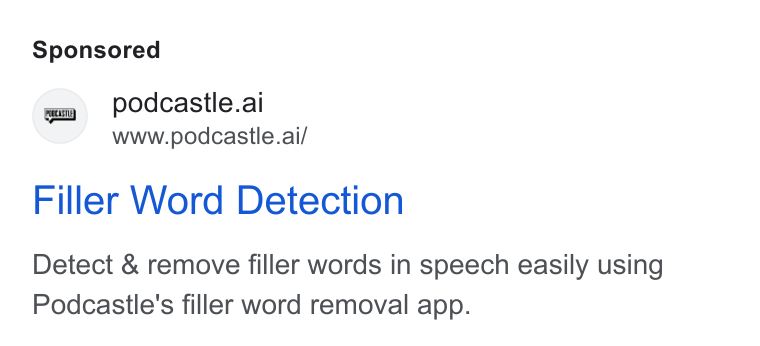
- Sponsored podcastle.ai www.podcastle.ai/ Filler Word Detection
- CTA / offer
- Detect & remove filler words in speech easily using Podcastle's filler word removal app.
- Audience
- Individuals involved in speech-based content creation (podcasters, voice-over artists, presenters) who are concerned about the quality and professionalism of their audio, indicated by the focus on "filler words" and "speech".
Why it works. Calls out a hyper-specific editing pain that generic audio tools don't name, appealing to podcasters who edit their own shows.
Headline directly names the problem: "Filler Word Detection". Headline with the name of one narrow feature that solves an annoying, specific task, rather than a broad benefit claim.
08 The playbook
The channels are not separate. They are one system where each stage feeds the next. Here is the read, then the plays to run tomorrow.
The inferred playbook
The acquisition loop paired a free viral utility with always-on paid search to capture the demand that virality created, and both halves show signs of breaking at the same time.
the free Chrome extension generated organic top-of-funnel awareness among students at zero CAC (the TikTok wave above).
long-running, single-feature Google ads then captured anyone who searched for the specific pain point (noise, filler words, dubbing) the free tool had made them aware of.
Dig deeper+3▾
Free ($0, capped at 2GB storage, 3 hours of video, 1 hour of transcription) steps up to Storyteller (~$12-15/mo), Pro (~$20-25/mo, adds voice cloning and filler-word removal), Teams (~$40/mo), and custom Business pricing, a freemium funnel with the free tier deliberately capped tight rather than feature-gated. Revenue is not publicly disclosed; given ~45 employees, $22-23.5M raised, and this pricing ladder, an order-of-magnitude estimate would put Podcastle in the low-to-mid seven figures of annual recurring revenue, though this is an estimate, not a reported figure.
with both the ad program dark and Reddit showing users leaving over reduced storage and higher prices at the same moment, the two engines that used to reinforce each other (viral awareness, paid capture) look simultaneously quiet on podcastle.ai. One caveat sharpens this: every signal here is measured on the legacy podcastle.ai domain, so traffic or ads now running on async.com are not captured in this pull, and part of the drop reflects the brand moving to a new address rather than demand vanishing. The more durable read is the post-rebrand churn, users publicly leaving over storage caps and price, rather than the domain-level traffic dip alone, and nothing in the evidence yet shows a replacement engine (active ads or a scaled content library) rebuilt under the new brand.
free-to-paid conversion, churn rate, CAC, and current MRR.
Free-utility hack framing for an adjacent audience
The proofPodcastle's Chrome extension pulled 79,814 and 51,121-engagement TikTok posts in 2021 by getting framed as a student "study hack," not a podcasting tool (see Launch & Traction).
The adaptationBuild a free, single-purpose slice of your product and pitch it to creators in an adjacent, overworked audience (students, freelancers, small-business owners) as a shortcut for their problem, not a tool for your category. First step: clip a 20-second before/after screen recording of your product's single most impressive moment, no voiceover, and send it to 5-10 micro-creators in that adjacent niche framed as "here's a shortcut," not "here's my product." The mechanism: an audience outside your obvious category has no competing tool to compare it against, so a genuinely striking demo reads as a discovery worth reposting rather than an ad.
Cost: $0 · Time to signal: days · Works pre-PMF: yes, provided the before/after moment is genuinely striking, a mediocre demo will not get reposted.
One landing page per search intent, not one homepage
The proofPodcastle's strongest ad creatives each pointed to a dedicated URL for one feature (noise removal, filler words, voice cloning) and previously ran for 700 to 1,200+ days each before stopping (covered above).
The adaptationFor any search ad you run, build one narrow page per specific pain point instead of routing all clicks to your general homepage, and match the ad headline to the page headline word for word. First step: pick your 3 most-searched features or pain points and build one page per term, each answering only that search intent. This lifts relevance and conversion because a visitor lands on a page that answers the exact question their search asked, instead of having to hunt for it on a general homepage.
Cost: under $500 · Time to signal: weeks · Works pre-PMF: conditional, only useful once you have at least one feature specific enough to own a distinct search intent.
One message, pushed identically everywhere at once
The proofWhen Podcastle renamed itself Async, near-identical "no acquisition, just getting smarter" copy ran on Instagram and on a dedicated Reddit post the same window (see Launch & Traction), yet a separate community thread shows a user finding out cold anyway.
The adaptationFor your own next major change (a pricing shift, a pivot, a rename), write one tight 3-sentence explanation and post it yourself, in your own voice, to every channel your users already gather in on the same day, so people hear it from you before they hear it from each other. First step: draft that 3-sentence version now and post it to your top 2 existing channels simultaneously the day you make the change.
Cost: $0 · Time to signal: days · Works pre-PMF: yes.
Cap the free tier on usage, not features
The proofPodcastle's free tier isn't feature-gated, it's usage-capped on storage (2GB) and hours (3 hours video, 1 hour transcription), letting a user experience the full product before hitting a wall.
The adaptationGive your free tier every feature you have, but cap it on a usage dimension tied to habitual use (storage, minutes, exports) so the user hits the wall right when they're hooked, not before they've seen the value. First step: replace any feature-gate in your current free plan with a numeric usage cap instead, and run it for two weeks. The mechanism: a usage cap teaches the full product before it asks for money, so the upgrade moment arrives as "I need more of this," not "I need the better version."
Cost: $0 · Time to signal: weeks · Works pre-PMF: conditional, only works once a paid tier already exists to catch the upgrade. Not transferable at an earlier stage: the multi-year, always-on Google search ad program (creatives that previously ran 700 to 1,200+ days) needs the ad budget and search volume this company's paid-search maturity affords. A reader with no budget should start with the free-tool TikTok mechanic and the announcement-copy move, and treat single-feature landing pages as the version to build once there's ad spend to point at them.
You just read how Podcastle does it. Tomorrow it is someone else.
Every morning we take one company that is actually growing and break down where its customers come from: the ads still running after a year, the channel doing the real work, and the play you can run this week.
Systemaic · directional intelligence. Traffic, spend, and reach figures are SimilarWeb-style estimates and qualitative reads of public data, not audited numbers. Built on real public receipts.
// teardowns with a similar GTM motion
sources & receipts (3)
Live ad libraries: google ad library
Launch archives: Hacker News: Show HN: PodCastle - Reddit for podcasts · Hacker News: Podcastle has won and is declining the Parsec Award
Traffic, spend, and revenue figures are estimates as noted in the report; the links above are the primary public artifacts.