- 01Give every new capability its own indexable page
- 02Turn a customer number into a reusable ad template
- 03Put your best feature behind zero friction
- 04Bid on "vs [competitor]" before you bid on your own name
01 Snapshot
The one-glance read on who they are and how they grow. Each point is verifiable from the receipts above.
A developer-facing "one API for all AI" inference platform (image, video, audio, 3D, and LLM generation) selling on price and speed against per-compute-second rivals.
Organic-led (direct plus organic search is 71.7% of traffic) with a heavy paid-ad layer bolted on for brand and comparison-term defense.
~284,000 monthly visits (+43.6% over the trailing 3 months) as of 2026-07-08, a $50M Series A in December 2025, and 10B+ generations across 200,000+ developers disclosed at that same announcement.
As of 2026-07-08, the newest paid tests are Google cost-claim headlines ("Save Up to 10x on AI APIs") and LinkedIn posts announcing just-shipped models like Gemini 3.5 Flash and Kling v3's native 4K support.
Every new model integration ships as three assets at once, a LinkedIn post, a paid ad, and a new indexable page, so the model catalog's growth rate is literally the content and SEO growth rate.
02 How it unfolded
The order the channels came online. Sequence is strategy: what they did first, and what they layered on once demand existed.
03 Traffic & channel mix
Estimated demand, the channel split behind it, and the keywords and referrers doing the work. Directional modeling, not audited analytics.
Traffic sources
Top search keywords
| Keyword | Volume | Weight | CPC |
|---|---|---|---|
| runware | 7.4k | $2.56 | |
| runware ai | 2.3k | $7.76 | |
| runware api | 630 | $0.40 | |
| runway | 997k | $0.68 | |
| sdxl controlnet depth | 0 | - |
Top referring sites
Closest competitors by audience
Runware pulls an estimated ~284,000 monthly visits, up 43.6% over the trailing 3 months as of 2026-07-08. The mix is dominated by two channels: direct at 48.7%, consistent with developers who already know the brand navigating straight to docs or the console, and organic search at 23%, fed by the page-per-model SEO pattern detailed below. Paid search adds 9.3% and referrals 8.5%; the remaining five channels, display ads, generative-AI referrals, organic social, email, and paid social, combine for roughly 10%.
Their own branded terms rank modestly: "runware" (~7,400 searches/month), "runware ai" (~2,300/month), and "runware api" (630/month), all reflecting people who already know the name rather than category-generic demand. Note that "runway" (~997,000 searches/month) in the same keyword list is an unrelated namesake, the well-known video-AI company Runway, not demand for this business. Top referrers tell a coherent story: techcrunch.com (funding-round press coverage converting into direct traffic), aiengineerpack.com (a developer-tooling directory listing them as an option), and github.com (SDK or repo links pulling in technical evaluators). Their closest competitors are fal.ai and replicate.com, the two other pay-per-generation inference APIs it's positioned against, plus pollinations.ai, a free/open-source image API competing at the low end.
04 Organic content
The specific pages earning their organic search traffic, and the pattern behind why they rank. Adapt the format, not the topic.
Outside the homepage (46.8% of organic visits), every other top-ranking page is a template applied to a specific model or partner: a dedicated page for one hosted model, a partner/creator index page, a curated "state of the art" model collection, and a use-case product page. This is a programmatic, one-page-per-integration pattern rather than a blog or guide-driven content strategy, and it works because each page is created and keyword-matched the moment a new model or partner is announced, giving Runware a constantly expanding long-tail surface without needing fresh editorial content.
Top pages by organic traffic
05 Channel map
Not traffic share. How much weight the growth system actually puts on each channel, with a one-line read on the role it plays.
What drove growth
06 The motions doing the work
For founder-led SaaS the breakdown shifts from ads to traction: where the first users came from, how the founder grows it in the open, and the compounding organic surface.
Runware's earliest traction ran through an ungated speed demo and an accelerator credibility boost, not a launch-platform spike, well before the funding announcements became the public traction story.
Co-founder and CEO Flaviu Radulescu built PicFinder, a real-time image generator, in November 2022; the team's acceptance into the a16z Speedrun accelerator in May 2023 relocated them to San Francisco and became the credibility signal that preceded the Runware platform itself.
Runware's own July 2025 video frames fastflux.ai, a no-signup FLUX trial microsite, as proof of raw speed, and it's the exact link an r/StableDiffusion user posted in August 2024 when asking whether a UI client existed, unprompted praise for the service's speed and cost.
Dig deeper+1▾
The publicly disclosed numbers, 10 billion-plus generations, 200,000-plus developers, and 300 million-plus end users, all surfaced alongside the $50M Series A announcement in December 2025 rather than a standalone growth update; unconfirmed third-party estimates put 2025 annual revenue near $2.5M, a small fraction of the roughly $66M raised to date.
Runware's "in public" motion runs through the company account's product changelog, not a personal founder audience, with a new "[Model] is now on Runware" post nearly every time an integration ships.
at least 15 recurring "[Model] is now on Runware" LinkedIn posts in the sampled library (Recraft V4.1, HeyGen Avatar V, Luma Uni-1, Inworld TTS-2, and others) read as public shipping updates first and paid creative second.
the same library carries named testimonials, HeyGen ("cut cost per image by over 50%"), OpenArt ("$20M+ in annual revenue on a team of 15"), and NightCafe ("10M+ generations per day"), functioning as third-party proof rather than founder narrative.
Dig deeper+1▾
co-founder Ioana Hreninciuc appears in a podcast clip on enterprise pricing sensitivity ("with the largest clients especially... they kind of understand the unit economics"), repurposed by outside growth-marketing accounts, but no evidence shows either founder running a personal build-in-public account.
The SEO engine is structurally tied to the model catalog: every new integration mints its own indexable URL, so search surface area grows in lockstep with the product line rather than a separate content calendar.
the model and partner pages covered above are instances of one template stamped out for every new integration, so organic search (23% of total visits) compounds automatically as the catalog does.
a curated "state of the art" model collection page aggregates top models under one durable URL that keeps absorbing new entries as the catalog grows.
Dig deeper+2▾
across Google (~200 ads, 93 active as of 2026-07-08) and LinkedIn (~142 ads), Google skews toward comparison and cost-claim bidding, "Save Up to 10x on AI APIs," "2x Throughput, 10x Cheaper," pointed at a dedicated comparison landing page; the strongest LinkedIn video creative is pure output demo, a white sneaker splashed in iridescent liquid captioned only "Luma Uni-1," selling model quality through the visual rather than a pitch.
the owned-site evidence shows only social links and a blog, with no partner or referral program surfaced, so distribution runs on owned pages and paid bidding rather than a seeded affiliate network.
07 Paid ads
This founder-led SaaS also runs paid acquisition. Here are the live ads doing the work, each with the X-ray and a play you can adapt.

- Running
- 95 days (longevity = it's converting)
- Hook
- Runware www.runware.ai/ AI Image Generation From Text
- Audience
- Individuals or businesses interested in AI-powered content creation, indicated by the explicit mention of 'AI Image Generation From Text' and 'AI-powered image, video, and audio generation'.
Why it works. Matches search intent word for word so the click-through decision is already made before the user reads the description line.
Prominent display of core service as a headline: 'AI Image Generation From Text' For a single-function product, make the headline the function itself in plain words and let search intent close the click.
- Running
- 94 days (longevity = it's converting)
- Hook
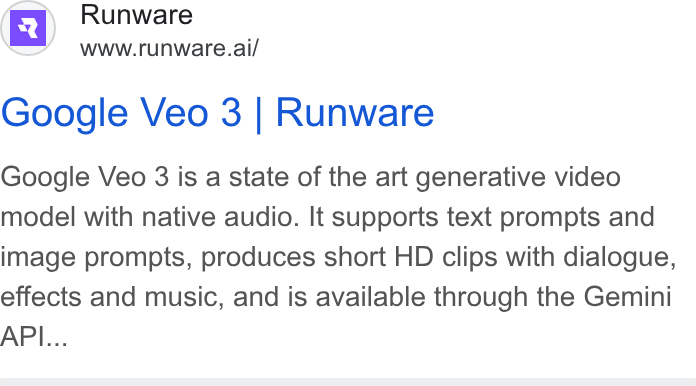
- Runware www.runware.ai/ Google Veo 3 | Runware Google Veo 3 is a state of the art generative video model with native audio. It supports text prompts and image prompts, produces short HD clips with dialogue, effects and music, and is available through the Gemini API...
- Audience
- Developers, AI enthusiasts, and video creators interested in advanced generative AI models, indicated by the mention of "generative video model," "text prompts," "image prompts," and "Gemini API."
Why it works. An announcement-style ad piggybacking on a household AI brand's new release, capturing search traffic from people looking for Veo 3 access anywhere they can get it.
Headline stating the product name and company: "Google Veo 3 | Runware" When you gain access to a well-known third-party model, run a dedicated ad naming it directly to capture people searching for that name.
- Running
- 76 days (longevity = it's converting)
- Hook
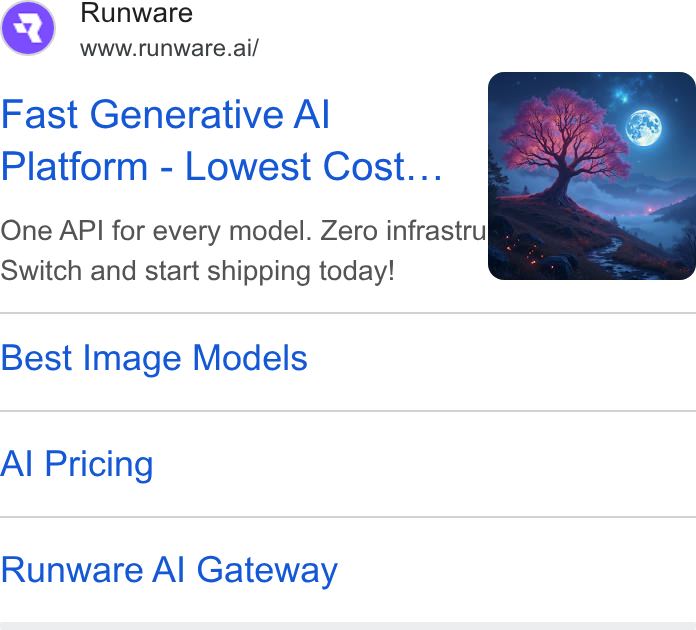
- Runware logo and text "Runware www.runware.ai/ Fast Generative AI Platform - Lowest Cost..."
- Audience
- Businesses or developers looking for AI solutions, evidenced by terms like "Generative AI Platform," "API," and "shipping today!"
Why it works. A search ad anchored on price alone, the single variable technical buyers price-compare across API providers before ever evaluating quality.
Headline with a bold claim: "Fast Generative AI Platform - Lowest Cost..." If price is your best differentiator, put it in the headline word for word rather than burying it in the description line.
Show 3 more ads
- Running
- 76 days (longevity = it's converting)
- Hook
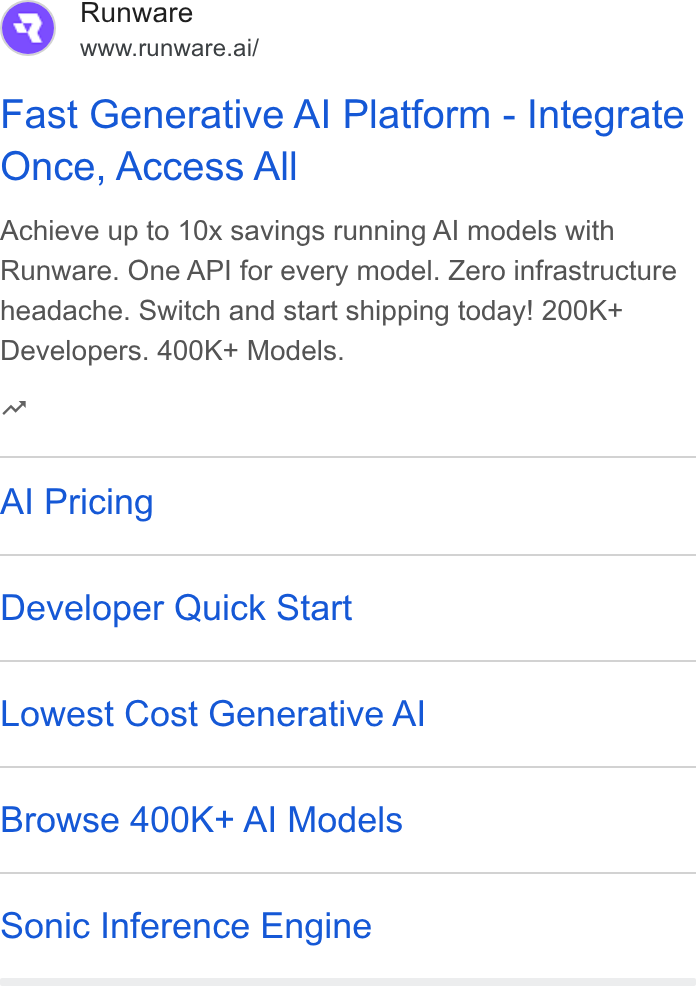
- Runware www.runware.ai/ Fast Generative Al Platform - Integrate Once, Access All
- Audience
- The mention of 'Developers' and 'API' clearly targets software developers and tech-savvy individuals or businesses looking for AI integration solutions.
Why it works. Targets developers' fear of re-integrating for every new model release by promising one integration covers the whole catalog going forward.
Bold headline stating a core benefit: 'Fast Generative Al Platform - Integrate Once, Access All' If your product removes ongoing integration work, say so as plainly as 'integrate once, access all' rather than listing features.
- Running
- 76 days (longevity = it's converting)
- Hook
- www.runware.ai/ Runware, One API for All AI
- Audience
- Businesses or developers using AI, indicated by the phrases 'overpaying for AI' and 'One API for All AI'.
Why it works. Positions Runware as the single abstraction layer over every AI model, the exact pain point of developers juggling multiple vendor APIs and keys.
Headline with a broad, aspirational claim: 'Runware, One API for All AI' If you unify multiple fragmented tools into one interface, say so in exactly those terms: one X for all Y.
- Running
- 76 days (longevity = it's converting)
- Hook
- www.runware.ai/ with a blue globe icon to its left. Below this, in large blue text, is "Runware AI".
- Audience
- The text 'Run AI models faster and cheaper' targets individuals or businesses involved in AI development and deployment, seeking performance and cost optimization.
Why it works. A bare brand-and-URL display ad running purely on name recognition, useful only once search demand for the brand itself already exists.
Direct benefit statement: The text "Run AI models faster and cheaper on the Runware platform." is prominently displayed. Reserve plain brand-name-only ads for after you've built search demand, lead with a value-prop headline until then.
08 The playbook
The channels are not separate. They are one system where each stage feeds the next. Here is the read, then the plays to run tomorrow.
The inferred playbook
The loop starts at a model-catalog announcement, converts through self-serve docs and free credits, compounds through the page-per-model SEO surface, and has no visible community layer to catch developers in between.
a new model integration triggers a LinkedIn post and ad simultaneously with a new page (covered above), functioning as top of funnel more than any single campaign.
direct traffic at 48.7% of all visits suggests developers who already know the brand, likely from funding press, navigate straight to the product, meaning conversion leans on recall over landing-page persuasion.
Dig deeper+2▾
there's no visible developer community hub despite a technical audience that already volunteers unprompted praise on Reddit, leaving word of mouth to happen where the company can't shape it.
free-to-paid conversion, churn, CAC, and a confirmed ARPU behind the per-generation pricing.
Give every new capability its own indexable page
The proofa single model-specific page (covered above) pulls a meaningful share of Runware's total organic visits on its own, part of a page-per-integration pattern applied across the catalog.
The adaptationthe first time you ship a new feature, integration, or partner, publish it as its own dedicated URL with a keyword-matched title, not a line item in a changelog feed. Start with your last three shipped features, build one page each, and keep doing it for every future release. The mechanism: search engines reward a permanent, specific page far more than a paragraph buried in a blog post that gets pushed down the archive.
Cost: $0 · Time to signal: months · Works pre-PMF: yes
Turn a customer number into a reusable ad template
The proofRunware runs one branded case-study template across at least five customers (quotes covered above), reused as a repeatable format across its ad library.
The adaptationbuild one reusable slide layout, same colors, same logo placement, one blank for a customer logo and one for a single quantified result, the first time a customer gives you a number worth bragging about. Reuse that exact template for every future win instead of designing a new asset each time, post it organically first, then push a small budget behind whichever version gets the most engagement.
Cost: under $500 · Time to signal: weeks · Works pre-PMF: no, this requires at least one paying customer willing to share a real number.
Put your best feature behind zero friction
The proofthe ungated fastflux.ai trial microsite (covered above) let people test the fastest model with no signup, and it's the exact link that seeded organic word of mouth in a developer community.
The adaptationcarve out the single most impressive thing your product does and put a stripped-down version on its own page with no login wall, then point every ad, post, and reply at that page instead of the paywalled homepage. A frictionless first taste is what turns a lurker into an unprompted recommender.
Cost: under $5k · Time to signal: weeks · Works pre-PMF: yes, conditional: only if that one feature is genuinely impressive in a single interaction, a mediocre demo will backfire.
Bid on "vs [competitor]" before you bid on your own name
The proofRunware's comparison landing page (covered above) is the destination for its cost-claim Google ads, part of its roughly 200-ad library.
The adaptationbuild one page naming your two closest competitors and stating your specific advantage in plain numbers, then run a small daily budget on searches that already include a competitor's name. Switching-intent searchers convert cheaper than generic category terms because they're already shopping.
Cost: under $500 · Time to signal: days · Works pre-PMF: conditional, only once you have one honest, specific edge (price, speed, a feature) to put on the page.
Show up where your buyer already asks for a tool like yours
The proofan unprompted r/StableDiffusion post asking about a UI client for Runware (covered above) is the clearest organic discovery signal in the evidence, born from one user's own experience.
The adaptationfind the one or two communities where your exact buyer already asks "does anyone have a tool for X," and answer as a genuine user with a working link when it's actually relevant, not as a drive-by promoter. Community-native answers travel further than anything posted from a brand account.
Cost: $0 · Time to signal: days · Works pre-PMF: yes Not transferable at an earlier stage: the funding-driven press traction (the Series A coverage that doubles as Runware's traction disclosure) and the two-platform paid ad footprint depend on capital this company has already raised. A pre-seed reader should adapt the page-per-feature and community-seeding mechanics first, and add comparison-term bidding only once there's a specific, provable edge to defend.
You just read how Runware does it. Tomorrow it is someone else.
Every morning we take one company that is actually growing and break down where its customers come from: the ads still running after a year, the channel doing the real work, and the play you can run this week.
Systemaic · directional intelligence. Traffic, spend, and reach figures are SimilarWeb-style estimates and qualitative reads of public data, not audited numbers. Built on real public receipts.
// teardowns with a similar GTM motion
sources & receipts (7)
Live ad libraries: linkedin ad library · google ad library
Launch archives: Hacker News: New Juggernaut Flux Models · Hacker News: Show HN: Edit any image with plain language – full guide and · Hacker News: The closed-source LLM premium has collapsed · Hacker News: The Quest for Runware [pdf] · Hacker News: The quest for runware: on compositional, executable and intu
Traffic, spend, and revenue figures are estimates as noted in the report; the links above are the primary public artifacts.