- 01Build programmatic pages from your own users' queries to compound organic reach
- 02Build a dedicated landing page for each core feature, targeting capability searches before brand preference forms
- 03Launch an affiliate program while your paid acquisition is still running, not after it ends
- 04Write one Google ad per specific use case rather than one ad for the whole product
01 Snapshot
The one-glance read on who they are and how they grow. Each point is verifiable from the receipts above.
An AI study assistant at atlas.org that ingests class materials to generate flashcards, solve homework questions, and surface step-by-step explanations for students, competing with Brainly, Quizlet, and Chegg in the homework-help category.
Paid-search-led acquisition (June 2024 through early 2026), transitioning to organic search and affiliate distribution with the primary paid budget now dark.
Publicly reported ~$28,054 MRR across 3,008 active paying subscriptions at roughly $9 blended ARPU per month; estimated ~405,644 monthly visits; approximately 200 historical Google ads with all primary advertiser campaigns inactive as of 2026-07-02.
Atlas built its paying subscriber base on a sustained Google paid search campaign that ran for roughly two years, pulled that budget with no obvious scaled replacement in place, and is now holding 3,000+ subscribers on organic search, brand direct traffic, and a nascent affiliate program.
02 How it unfolded
The order the channels came online. Sequence is strategy: what they did first, and what they layered on once demand existed.
03 Traffic & channel mix
Estimated demand, the channel split behind it, and the keywords and referrers doing the work. Directional modeling, not audited analytics.
Traffic sources
Top search keywords
| Keyword | Volume | Weight | CPC |
|---|---|---|---|
| atlas ai | 39k | $5.30 | |
| atlas | 462k | $1.13 | |
| atlas.org | 650 | - | |
| atlas ia | 2.4k | $0.52 | |
| unblocked ai for school free | 320 | - |
Top referring sites
Closest competitors by audience
Estimated ~405,644 monthly visits trend down -21.8% over the trailing 3-month measurement window. For a student-facing product, summer academic calendars likely account for part of this; the more durable signal is that paid search now drives less than half a percent of visits despite a history of heavy Google spend.
The channel split, cited exactly: Direct 48.9%, Search Organic 38.5%, Social Organic 5.7%, Gen AI 2.8%, Referrals 2.2%, Email 1.1%, Search Paid 0.4%, Display Ads 0.4%. Direct and organic search together account for 87.4% of all visits, meaning the paid-to-organic transition is already structurally locked in. The 48.9% direct share suggests meaningful brand recall and return-user behavior built during the paid acquisition phase.
Organic search runs on brand volume and long-tail educational queries. "Atlas" draws an estimated 462,370 total monthly searches across the web; "atlas ai" draws 38,770, giving the brand strong name-term capture. Long-tail bets include "unblocked ai for school free" (320 total web searches per month), where low-competition student intent points directly to individual solution pages.
Top referring domains are seogroup.club and url-opener.com, pointing to SEO tool directories rather than editorial coverage. Closest organic competitors by keyword overlap include brainly.com (a student Q&A platform), quizlet.com (a flashcard and study tool), chegg.com (a tutoring and homework-help service), helloatlas.io, atlasai.co, and schoolhub.ai.
04 Organic content
The specific pages earning their organic search traffic, and the pattern behind why they rank. Adapt the format, not the topic.
Atlas earns its organic traffic through two distinct page types that mirror the Brainly and Chegg playbook applied to an AI-answer product: feature and tool landing pages that catch mid-funnel category searches, and programmatic individual solution pages that rank for verbatim student homework questions.
The programmatic surface is the deeper bet. Each student question gets its own URL at /solution/{uuid}/{question-slug} and ranks directly for the verbatim query. Ranking #1 for a specific research data lifecycle question and #4 for "which sentence uses the underlined word correctly?" shows this model is functioning. Every new student question indexed becomes a potential organic entry point, compounding the surface over time without additional content investment.
The feature and tool pages catch buyers who search for a capability before they know which product to use. Ranking #5 for "study guide maker" at /features/ai-study-guide-maker and targeting "AI homework solver" at /tools/ai-homework-solver places Atlas at the decision moment, when commercial intent is high and brand preference is still open.
Top pages by organic traffic
05 Channel map
Not traffic share. How much weight the growth system actually puts on each channel, with a one-line read on the role it plays.
What drove growth
06 The motions doing the work
For founder-led SaaS the breakdown shifts from ads to traction: where the first users came from, how the founder grows it in the open, and the compounding organic surface.
Atlas built its first subscribers through Google paid search rather than a community launch moment, with the ad campaign itself functioning as the go-to-market event.
Triangle Labs began running Google ads to atlas.org in June 2024, which appears to be the effective market launch. The campaign scaled from text ads to video and image formats and ran 15+ creatives for 140 to 400+ days, a duration that points to positive return on ad spend sustaining the investment.
Reaching 3,008 paying subscribers at roughly $9 blended ARPU with no visible Product Hunt, Hacker News, or Reddit launch is a noteworthy signal. The 48.9% direct traffic share suggests word-of-mouth and return-user behavior developed alongside the paid campaign rather than from any single launch event.
Dig deeper+2▾
All Triangle Labs campaigns to atlas.org are inactive. The channel that drove initial acquisition has ended, and the company holds its subscriber base through organic search and brand direct traffic. Whether the programmatic solution pages and affiliate program can replace that acquisition volume is the central open question.
The dip in traffic over the trailing 3-month window measured through summer is consistent with academic calendar seasonality for a student-facing product and does not on its own indicate structural subscriber loss.
Atlas has no visible founder-led distribution; growth runs through the product surface, paid search history, and the affiliate program rather than through any named individual's personal audience.
No founder name, personal social account, or public interview surfaced in the evidence. All social accounts operate under the @atlasinterfaces brand handle with no individual voice distinguishable from the company account.
The @atlasinterfaces Instagram account at 105 followers and roughly 9 average engagements per post is not a material acquisition channel. No engagement data surfaced for X or TikTok, and no Reddit presence is visible in public data.
Dig deeper+1▾
The Rewardful-powered affiliate program at atlas.org/affiliate-program functions as a structural substitute for founder-led distribution: the company outsources word-of-mouth to external promoters rather than building an owned audience. One active Google ad from a separate advertiser (as of 2026-07-02) pointing to atlas.org suggests at least one affiliate may be running paid traffic independently on the brand's behalf.
Organic search at 38.5% of traffic is the most durable asset Atlas has built, running on a programmatic question-indexing surface that compounds as the student user base generates more indexed queries.
Individual homework question pages at /solution/{uuid}/{slug} create a long-tail SEO moat that scales with user activity rather than editorial effort. Ranking #1 and #4 for specific verbatim student queries shows the model works; the total addressable surface grows every time a new student question gets answered and indexed.
Pages like /features/ai-study-guide-maker and /tools/ai-homework-solver target the decision stage, where a student searches for a capability type before choosing a brand. Ranking #5 for "study guide maker" places Atlas at a moment of high commercial intent before brand preference is set.
Dig deeper+2▾
The Rewardful affiliate program at atlas.org/affiliate-program is the most visible new acquisition bet with the paid budget off. The active Google ad from a third-party advertiser pointing to atlas.org suggests at least one affiliate is independently generating paid traffic. Commission structure, affiliate count, and contribution to subscriber acquisition are not visible in public data.
As of 2026-07-02, roughly 1 of approximately 200 historical Google ads in the library is active (67 days, from a separate advertiser). The Triangle Labs ads that ran for the longest periods rotated around two proven creative angles: extreme efficiency claims ("Study 10 Times Faster," "Make Studying 10 Times Easier") and specific feature hooks ("Transform PowerPoint Slides into Flashcards Instantly," "Generate In Seconds - Free Flashcard Creator," "Scan to solve - Get step-by-step solutions"). No Meta ads evidence surfaced, suggesting paid social was not part of the mix. Specific pricing tiers are not visible in public data; the ~$9 blended ARPU points to an entry-level subscription model. Free-to-paid conversion rate and CAC during the paid period are also not visible in public data.
07 Paid ads
This founder-led SaaS also runs paid acquisition. Here are the live ads doing the work, each with the X-ray and a play you can adapt.
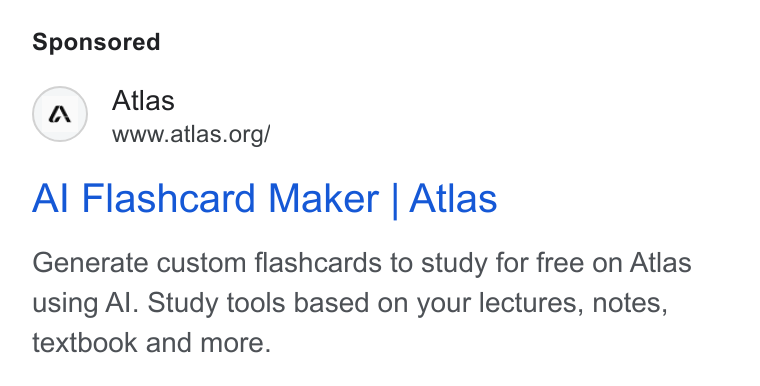
- Running
- 258 days (longevity = it's converting)
- Hook
- Sponsored Atlas www.atlas.org/ AI Flashcard Maker | Atlas
- CTA / offer
- Generate custom flashcards to study for free on Atlas
- Audience
- Students or anyone needing to study, indicated by the mention of 'flashcards', 'lectures', 'notes', and 'textbook'.
Why it works. Targets a single feature search instead of the whole platform, picking off narrower and more decisive queries.
Headline clearly states the product and its core benefit: 'AI Flashcard Maker | Atlas'. Run a dedicated ad for your single most-searched feature instead of only promoting the full product.
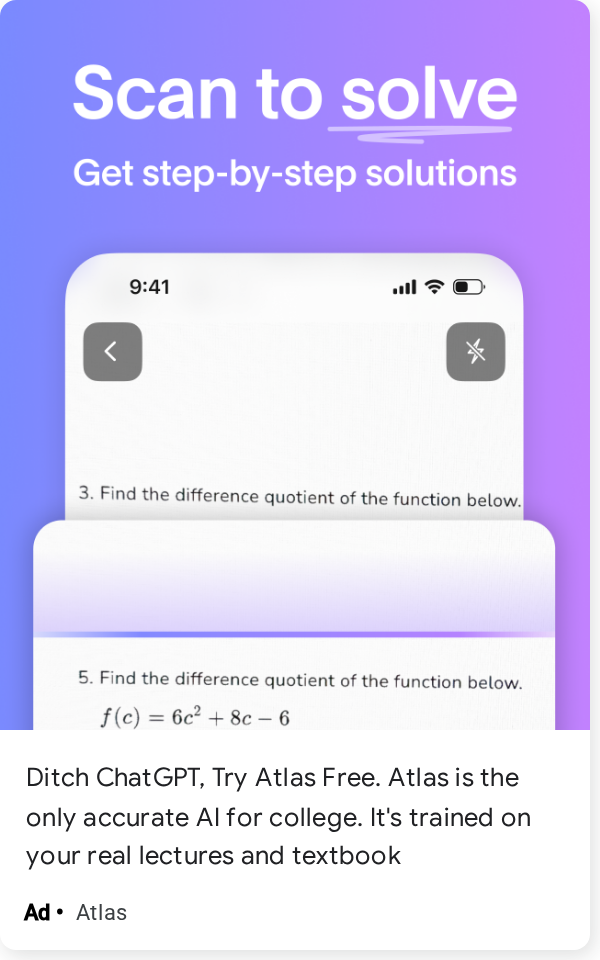
- Running
- 257 days (longevity = it's converting)
- Hook
- "Scan to solve" with the word "solve" underlined, and below it "Get step-by-step solutions". A partial view of a smartphone screen is visible below this text.
- CTA / offer
- Try Atlas Free
- Audience
- College students struggling with math problems and seeking accurate AI assistance, indicated by the math problem shown and the text 'Atlas is the only accurate AI for college'.
Why it works. Shows the actual scan-a-problem workflow on screen, letting students picture the exact motion instead of reading a claim.
Directly challenges a competitor and offers a free alternative, as seen in the text "Ditch ChatGPT, Try Atlas Free." Show your product's core action verb-first (scan, upload, ask) paired with the specific output a user gets from it.
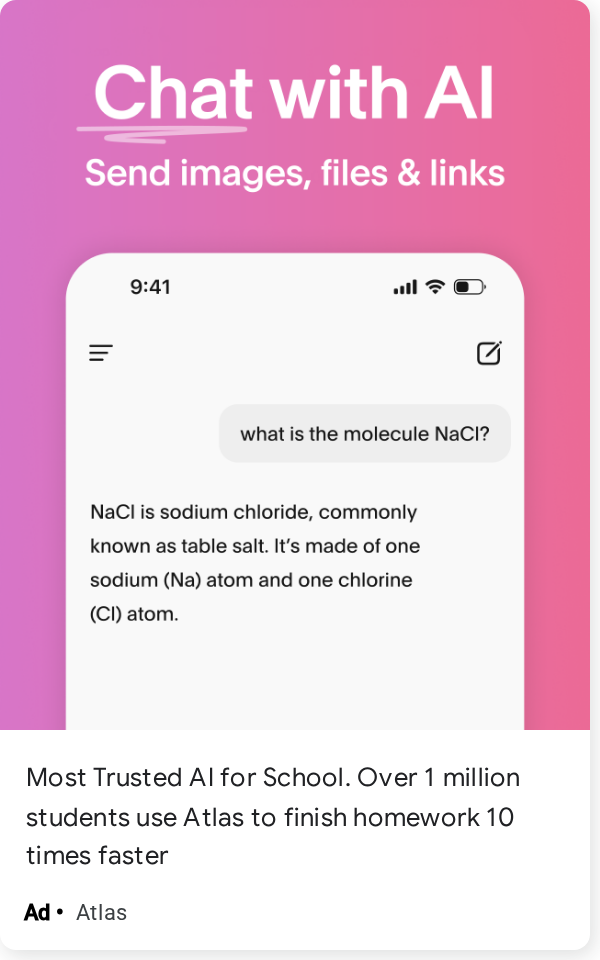
- Running
- 406 days (longevity = it's converting)
- Hook
- "Chat with AI" with an underline beneath "Chat", on a pink and purple gradient background. Below that, "Send images, files & links".
- Audience
- Students and parents, evidenced by "Most Trusted AI for School" and "students use Atlas to finish homework 10 times faster".
Why it works. Demonstrates the chat interface accepting multiple file types, reassuring students that messy homework formats are supported.
Product demonstration within a simulated phone interface, showing a question and answer: "what is the molecule NaCl?" and "NaCl is sodium chloride, commonly known as table salt. It's made of one sodium (Na) atom and one chlorine (Cl) atom." List the specific input formats your tool accepts directly in the ad copy so users know their exact use case is covered.
Show 3 more ads
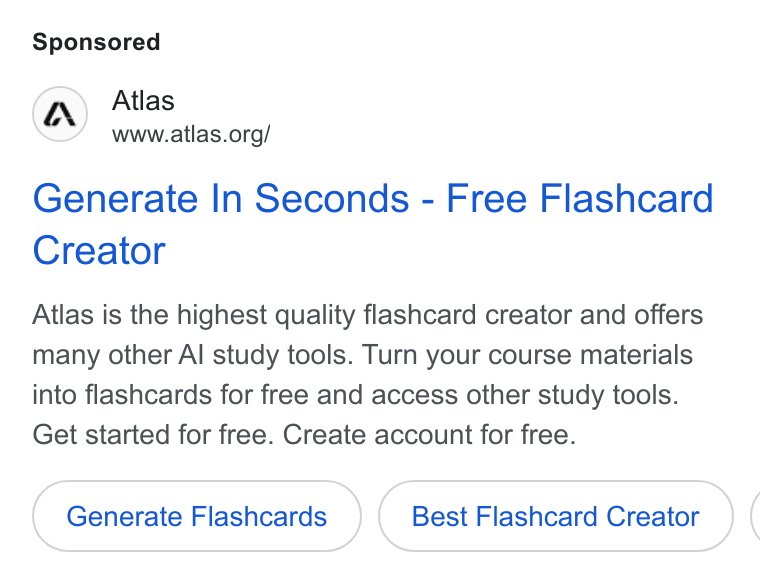
- Running
- 142 days (longevity = it's converting)
- Hook
- Sponsored ad for Atlas with the headline "Generate In Seconds - Free Flashcard Creator"
- CTA / offer
- Get started for free. Create account for free.
- Audience
- Students or anyone needing to create flashcards and utilize AI study tools, indicated by the direct mention of "flashcard creator" and "AI study tools."
Why it works. Removes both the time cost and money cost of making flashcards, appealing to students who want study aids without setup work.
Headline with strong benefit and cost (or lack thereof): "Generate In Seconds - Free Flashcard Creator" State your output's speed and price together in the headline when both are strong, e.g. generate X in seconds, free.
- Running
- 142 days (longevity = it's converting)
- Hook
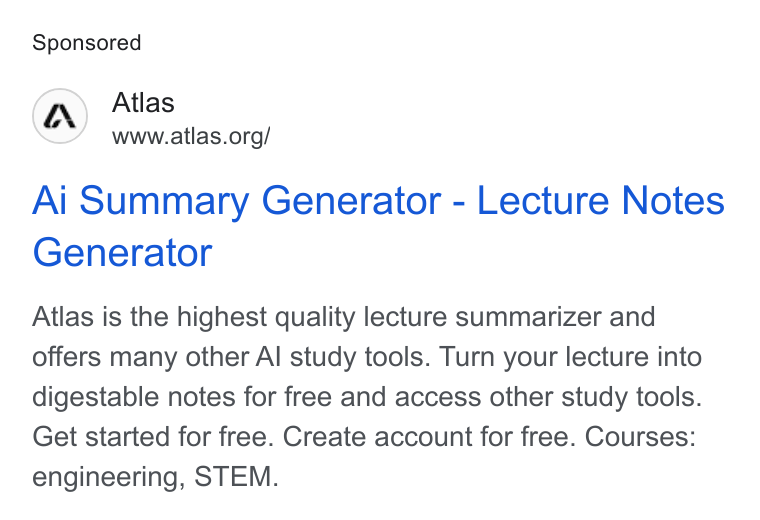
- Sponsored Atlas www.atlas.org/ Ai Summary Generator - Lecture Notes Generator
- CTA / offer
- Get started for free. Create account for free.
- Audience
- Students, specifically those in 'engineering, STEM' fields, who need help with lecture summarization and study tools.
Why it works. Headline echoes the probable search term verbatim, so it lands as the answer to that query rather than an interruption to it.
Headline directly names the solution: 'Ai Summary Generator - Lecture Notes Generator' Write one exact-match headline per top search phrase your customers type, using their own wording, not your internal product name.
- Running
- 381 days (longevity = it's converting)
- Hook
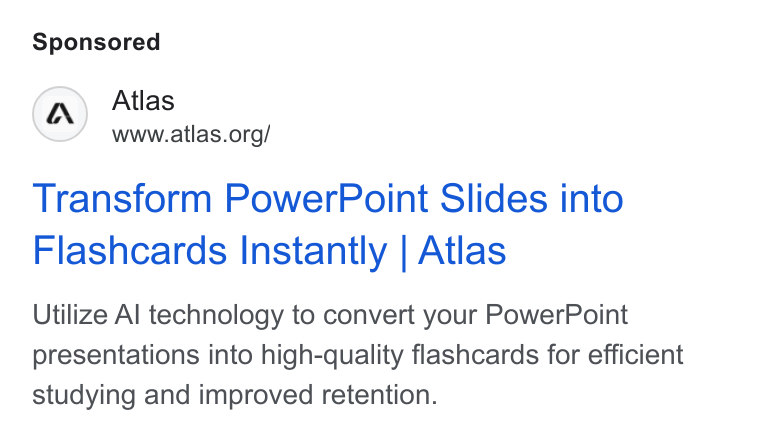
- Sponsored Atlas www.atlas.org/ Transform PowerPoint Slides into Flashcards Instantly | Atlas
- Audience
- Students or professionals who use PowerPoint for presentations and need to study or retain information, indicated by the phrases "PowerPoint Slides," "Flashcards," "studying," and "improved retention."
Why it works. Targets students who already have lecture slides and skips the manual flashcard-making step, a narrow high-intent search query.
Headline: "Transform PowerPoint Slides into Flashcards Instantly | Atlas" Name the exact file format your users already have and the exact study output you generate, e.g. slides into flashcards, in seconds.
08 The playbook
The channels are not separate. They are one system where each stage feeds the next. Here is the read, then the plays to run tomorrow.
The inferred playbook
Atlas acquired subscribers through sustained Google paid search, is defending them with programmatic SEO and brand equity, and has not yet demonstrated a scaled replacement for the paid channel it turned off.
Triangle Labs ran Google ads from June 2024 through early 2026 using extreme-efficiency creative and specific feature hooks to convert students searching for study tools. This phase built the 3,008-subscriber base and the brand's 48.9% direct traffic share.
The programmatic solution pages accumulate long-tail query coverage as more student questions are indexed, producing a surface that grows with usage rather than headcount. Feature and tool pages catch category-level demand at the decision stage. Together these hold 38.5% organic search share, which is material but not yet dominant enough to replace paid volume on its own.
Dig deeper+2▾
A 48.9% direct traffic share and 3,008 active paying subscribers at ~$9 ARPU suggest the product retains users well enough to build return-visit behavior. At this price point, churn needs to stay low for MRR to hold without fresh paid acquisition.
No named founder audience, no active paid budget, and no visible community surface leave the affiliate program as the only new acquisition lever in motion. Its economics, scale, and ability to replace the paid channel are the unknowns that will determine whether the subscriber base grows, holds, or erodes.
Build programmatic pages from your own users' queries to compound organic reach
The proofAtlas creates an individually indexed URL for each student homework question at /solution/{uuid}/{question-slug}, ranking #1 for a specific research lifecycle question and #4 for a common grammar question, without any editorial team producing content.
The adaptationIf your product captures user questions, searches, or report outputs, create public, indexable pages for each (with any sensitive data removed or paraphrased). A contract tool could index "how to add a limitation of liability clause" queries; an analytics tool could index each report template as a standalone page. Start by identifying the 50-100 most frequent user queries, build a templated URL structure with clean slugs, publish them as static pages, and submit the sitemap to Google Search Console. The mechanism: users generate the content inventory at scale, long-tail verbatim queries have low competition but high intent, and each page compounds organic reach without additional effort per page.
Build a dedicated landing page for each core feature, targeting capability searches before brand preference forms
The proofAtlas's /features/ai-study-guide-maker page ranks #5 for "study guide maker" and /tools/ai-homework-solver targets "AI homework solver" searches, catching students who are searching for a capability rather than a named product.
The adaptationAudit your product's top 10-20 capabilities and build a dedicated landing page for each, optimized for the search term a potential buyer would use before knowing your brand exists. For a project management tool, that means /tools/meeting-notes-to-tasks rather than just /features; for a finance tool, /tools/expense-categorizer. Start by running your top competitors' domains through a keyword gap tool to find which capability searches they rank for, then build pages that demonstrate your specific approach to each feature. The mechanism: category searches catch buyers of intent before they have a brand preference, and a feature-specific URL signals direct relevance to both the searcher and the search engine.
Launch an affiliate program while your paid acquisition is still running, not after it ends
The proofAtlas embedded Rewardful and built out atlas.org/affiliate-program as a recruitment surface. The pattern in the Google ad library suggests affiliate relationships emerged alongside or after the Triangle Labs paid campaign, meaning when that campaign went dark, the affiliate program was not yet mature enough to replace it at scale.
The adaptationSet up an affiliate tracking layer (Rewardful or equivalent) while your paid channel is actively converting users, not as a contingency once the budget is gone. Use the paid campaign's conversion data to define the offer your affiliates will promote, and recruit your first affiliates from the users who have already referred at least one other customer. Reach out to them directly, name what they did, and offer a formal commission. Starting while paid is still on lets you train affiliates on what messaging converts and gives them a running start before you need them. The mechanism: affiliates distribute acquisition cost and let third parties run their own experiments, but they need a proven conversion signal to act on, which your paid campaign provides.
Write one Google ad per specific use case rather than one ad for the whole product
The proofThe Triangle Labs ads that ran for the longest periods (140 to 400+ days on atlas.org) used specific input-output hooks: "Transform PowerPoint Slides into Flashcards Instantly," "Scan to solve - Get step-by-step solutions," and "Generate In Seconds - Free Flashcard Creator," not generic "AI study tool" positioning. Generic claims like "Smart AI for Students" appear in the shorter-running tests.
The adaptationWhen writing search ad copy for a feature-rich tool, write a distinct ad for each primary use case naming the specific input, the output, and the transformation. For a document tool: "Turn Meeting Recordings into Action Items in One Click," not "AI Productivity Assistant." Start by listing your five most-used features and writing one ad headline per feature that names what the user brings in and what they get out. The mechanism: specificity pre-qualifies the searcher (only users who need that specific task click), which improves conversion rate relative to broad brand claims and reduces wasted spend on exploratory clicks.
You just read how Atlas does it. Tomorrow it is someone else.
Every morning we take one company that is actually growing and break down where its customers come from: the ads still running after a year, the channel doing the real work, and the play you can run this week.
Systemaic · directional intelligence. Traffic, spend, and reach figures are SimilarWeb-style estimates and qualitative reads of public data, not audited numbers. Built on real public receipts.
// teardowns with a similar GTM motion
sources & receipts (7)
Live ad libraries: google ad library
Launch archives: Hacker News: The Mathematical Atlas · Hacker News: The Mathematical Atlas · Hacker News: Atlassian fired me while I was taking care of my wife who is · Hacker News: Inside the longest Atlassian outage · Hacker News: Slack Is Buying HipChat from Atlassian · Hacker News: I’m Joining Stripe to Work on Atlas
Traffic, spend, and revenue figures are estimates as noted in the report; the links above are the primary public artifacts.