- 01Segment one claim across audience bands
- 02Localize instead of reinventing
- 03Stand up a low-lift affiliate layer
- 04Borrow credibility from an adjacent voice
01 Snapshot
The one-glance read on who they are and how they grow. Each point is verifiable from the receipts above.
An AI-driven intermittent fasting, nutrition, and weight-loss coaching app (built around the in-app AI coach "Avo"), reporting roughly $160M ARR as of October 2025.
Paid-UGC-led, not founder-led or organic-led: the growth engine is a mass-scale, segmented display and video ad machine, not a founder audience or a content flywheel.
~17.1M estimated monthly visits (+33.8% over the last 3 months) as of 2026-07-11, a Google ad library of roughly 70,000 ads with the longest active line running 441 days, ~1.1M Instagram followers, and a $35M Series B led by Kevin Hart's HartBeat Ventures in October 2025 (total raised to date ~$45M across all rounds).
As of ads first shown 2026-07-09 and 2026-07-10, the newest tests localize a "how much to walk to drop cortisol and lose weight" angle into French, Portuguese, and English variants in parallel.
Their organic search footprint is dominated by their own brand terms, meaning it functions as a downstream recapture layer for paid-generated demand, not an independent discovery engine, while the real edge is a segmentation-and-localization machine that turns one core claim into hundreds of age, weight, and language variants at a ~70,000-ad scale.
02 How it unfolded
The order the channels came online. Sequence is strategy: what they did first, and what they layered on once demand existed.
03 Traffic & channel mix
Estimated demand, the channel split behind it, and the keywords and referrers doing the work. Directional modeling, not audited analytics.
Traffic sources
Top search keywords
| Keyword | Volume | Weight | CPC |
|---|---|---|---|
| simple | 129k | $0.91 | |
| simple life | 5.9k | $2.11 | |
| jejum intermitente | 6.5k | $0.08 | |
| tai chi walking | 38k | $1.45 | |
| simple app | 2.8k | $2.65 |
Top referring sites
Closest competitors by audience
Simple pulls an estimated ~17.1M monthly visits, up 33.8% over the last 3 months. The mix is paid-dominated: Display Ads lead at 53.4%, consistent with the huge Google image-ad library; Social Paid follows at 15.3%, matching the Meta creative running across Facebook, Instagram, Messenger, and Threads; and Email sits at a notable 10.7%, pointing to a real lifecycle/retention layer working alongside acquisition. Affiliate traffic (4.4%) ties directly to the partner program on their site, and Direct (8.9%) and Search Paid (4.1%) round out meaningful share; the rest, Search Organic, Referrals, Social Organic, and Gen AI traffic, totals under 3.5%.
On keywords, "simple" carries ~129,000 monthly searches but is mostly generic-term volume rather than company-specific demand; "tai chi walking" at ~38,500 searches/month lines up directly with their own walking-challenge ad angle, meaning they're chasing a keyword they're also manufacturing demand for via ads; "jejum intermitente" (Portuguese for intermittent fasting) at ~6,500 searches/month reflects real Brazilian-market pull that matches their Portuguese-language ad variants.
Referrers and competitors each tell a different story. Medicalnewstoday.com sends traffic with a health-authority credibility halo, dailymail.com reflects tabloid diet-culture press pickup, and olx.com.br (a Brazilian classifieds site) is an unusual referrer that looks more like ad-network noise than editorial endorsement. Among "competitors," simple-life-app.com is actually Simple's own onboarding and checkout funnel domain (same branding as simple.life), not an independent rival, walk-fit.io runs the same quiz-funnel, age/weight-personalized playbook, and calm.com signals SimilarWeb's competitive set extends into broad wellness, not just fasting apps.
04 Organic content
The specific pages earning their organic search traffic, and the pattern behind why they rank. Adapt the format, not the topic.
Their organic footprint is thin and almost entirely branded: the homepage alone accounts for ~85.6% of their roughly 91,000 monthly organic visits across their top five pages, while blog posts (MCT foods for weight loss, chewing gum during a fast, keto meal plans) each pull under 1,200 visits/month. The pages that DO rank are branded and navigational: "simple premium," "simple life app," "simple life," and even their own support email all rank #1, which reads less like a content strategy and more like people searching the brand name after seeing an ad. The strategic takeaway: organic search here isn't generating new demand, it's capturing demand that paid media already created.
Top pages by organic traffic
05 Channel map
Not traffic share. How much weight the growth system actually puts on each channel, with a one-line read on the role it plays.
What drove growth
06 The motions doing the work
For founder-led SaaS the breakdown shifts from ads to traction: where the first users came from, how the founder grows it in the open, and the compounding organic surface.
The visible traction story here is a funding and revenue curve, not a single coordinated launch moment.
Simple closed a Series A of €4.1M in December 2020 (Target Global and Palta co-leading), then a $35M Series B in October 2025 led by Kevin Hart's HartBeat Ventures, each round itself a public traction signal rather than a product launch event.
The company reported 2024 revenue of $100M, up 64% year over year (third-party trackers put 2023 ARR near $51.6M, on a different measurement basis), reaching roughly $160M ARR with about 700,000 active subscribers at the time of the Series B in October 2025.
Dig deeper+1▾
No Product Hunt or coordinated multi-surface launch data is visible in the evidence; the only organic pull-through on record is the single Reddit friend-recommendation thread from 2025-03-14, a small but genuine signal that word-of-mouth exists alongside the paid engine.
There's no founder-personal build-in-public motion visible here, the public-facing presence is entirely brand-owned, not founder-owned.
The homepage links to a company LinkedIn and Instagram (handle "simpleappofficial"), not a personal account for either co-founder, Mikhail Prytkov (CEO) or Alexander Ilinskiy.
The 1.1M-follower brand Instagram account averages just ~144 engagements per post, an engagement rate consistent with a following acquired through ad spend rather than content people actively engage with.
Dig deeper+1▾
The real "public" distribution lever is the affiliate/partner program, recruiting outside partners to refer traffic rather than compounding a founder's personal reach.
Organic content is a minor, branded-capture layer here (covered above); the real system is the paid-creative machine and, secondarily, the affiliate program.
Their proven-winner ad set repeatedly personalizes one core claim, walking, fasting windows, sugar challenges, by age band or weight bracket ("28-Day Walking Challenge based on your age," "Reto Sin Azúcares según tu edad"), plus a numerology-style curiosity hook tying fasting windows to finger length, expanded as Play 1 below.
Talking-head creators drive some of the longest-running Meta ads with lines like "Never recommend Intermittent Fasting to your wife!" and "The MOST COMMON intermittent fasting mistake," expanded as Play 4 below.
Dig deeper+2▾
All the analyzed Google creative is Display Network image/video content (not branded search text ads), meaning the ~70,000-ad Google library and the Meta creative are both acquisition-focused demand generation, not brand-term defense.
The dedicated affiliate-program page is their one lever that can compound independent of ad spend, since it recruits outside partners whose links keep working after the campaign that recruited them ends.
07 Paid ads
This founder-led SaaS also runs paid acquisition. Here are the live ads doing the work, each with the X-ray and a play you can adapt.
- Running
- 147 days (longevity = it's converting)
- Hook
- "The MOST COMMON intermittent fasting mistake" spoken by a bearded man in a plaid shirt outdoors in the snow.
- CTA / offer
- "personalized plan" via a "free quiz"
- Audience
- People interested in intermittent fasting who are struggling to see results or find the process confusing (evidenced by the 'mistake' hook and 'scared I'll get confused' dialogue).
Why it works. Opens with a warning about a common error rather than a benefit, which works on viewers already doing intermittent fasting and worried they're doing it wrong.
Curiosity-Gap Expert Hook (0:00) Open by naming a common mistake people make in your category instead of a benefit, so people already active in that space self-select in to find out if it's them.
- Running
- 147 days (longevity = it's converting)
- Hook
- "I only eat from 12pm to 6pm" + A woman in a white t-shirt takes a large, aggressive bite of a chicken drumstick while holding a plate of food.
- CTA / offer
- Take the free quick quiz to get a personal fasting window.
- Audience
- Women interested in weight loss, specifically those aged 40+ (indicated by the 'Age 45' input in the app demo).
Why it works. Shows a woman eating a large meal while stating her fasting window, directly undercutting the assumption that fasting means being hungry or restricted.
0:00-0:03 High-energy eating visual + bold text overlay Show your product's constraint (a schedule, a limit) right next to visual proof it doesn't feel restrictive, so the two images argue against each other.
- Running
- 147 days (longevity = it's converting)
- Hook
- "Fasting ends at 12pm" / "me at 11:59am" on-screen text with a woman in glasses and a beige cardigan staring intensely at her Apple Watch in front of a plate of pancakes.
- CTA / offer
- "Take the free quick quiz" / "TAKE FREE TEST"
- Audience
- People interested in intermittent fasting who are frustrated by restrictive eating or calorie tracking ("so you don't have to count calories").
Why it works. Turns UGC-style meme humor into an objection-handling hook about the hardest minute of fasting, then routes viewers into a personalized quiz.
Meme-Format Relatability (0:00): "Fasting ends at 12pm / me at 11:59am" Turn your product's most frustrating moment into a me-at-a-specific-time meme using a relatable facial expression.
Show 3 more ads
- Running
- 147 days (longevity = it's converting)
- Hook
- "Never recommend Intermittent Fasting to your wife!" spoken by a shirtless bearded man wearing a tan cap and gold chain standing next to a dark grey truck.
- CTA / offer
- "try a free test now"
- Audience
- Women looking for significant weight loss for a specific event ("drop 40 lbs for a wedding") or concerned about age-related weight loss ("at my age").
Why it works. Pairs a jarring visual (shirtless man, gold chain, truck) with a domestic warning, a contrast that reads as authentic rather than scripted.
Bait-and-Switch Hook (0:00-0:03): "Never recommend Intermittent Fasting to your wife!" Cast an unexpected messenger who looks nothing like a category expert delivering advice in a deadpan warning tone, so the claim feels like an insider tip.

- Running
- 440 days (longevity = it's converting)
- Hook
- "DIGIUNO INTERMITTENTE SECONDO LA LUNGHEZZA DELLE DITA" with a yellow background and black text, showing a grid layout.
- CTA / offer
- FAI IL TEST
- Audience
- Individuals interested in intermittent fasting and self-assessment tests, indicated by the Italian text and the nature of the content.
Why it works. Links intermittent fasting to finger length, an arbitrary trait unrelated to fasting science, to build an unusual self-assessment test to take.
Presenting a novel, slightly unusual correlation: 'DIGIUNO INTERMITTENTE SECONDO LA LUNGHEZZA DELLE DITA' (Intermittent Fasting According to Finger Length). Pair your core topic with an unrelated, easy-to-check physical trait (a body measurement, a personality quirk) to build a quick self-test format.
- Running
- 365 days (longevity = it's converting)
- Hook
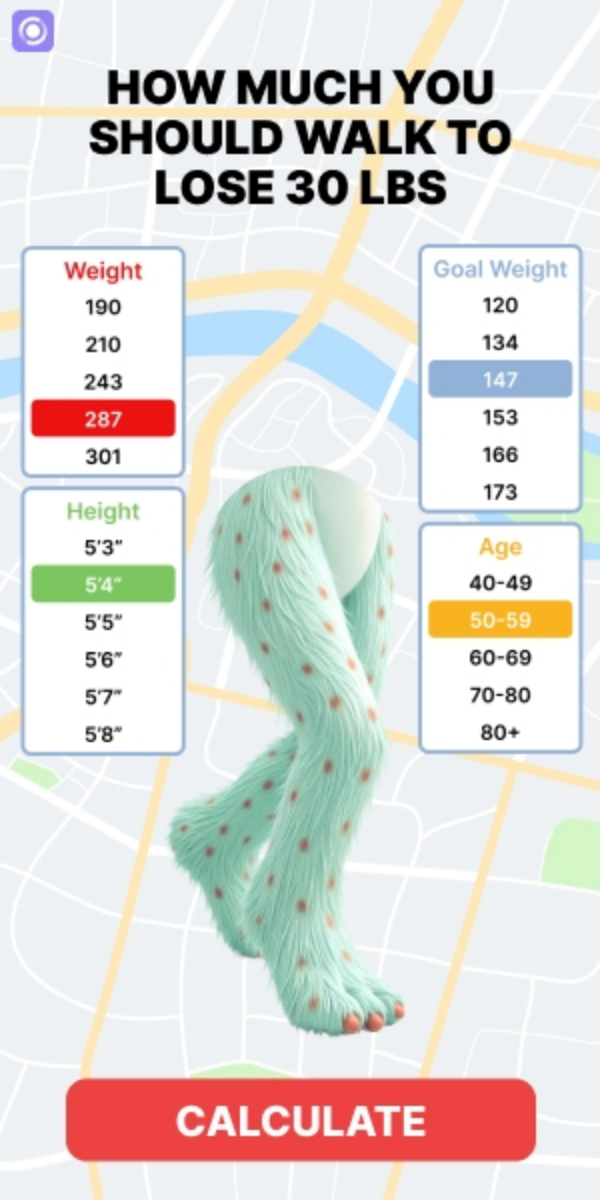
- "HOW MUCH YOU SHOULD WALK TO LOSE 30 LBS" as black text on a light grey map background, with a purple circular logo in the top left corner.
- CTA / offer
- CALCULATE
- Audience
- Individuals interested in weight loss, specifically losing 30 lbs, and those who are between 40-80+ years old, with current weights ranging from 190-301 lbs and goal weights from 120-173 lbs, and heights from 5'3"-5'8". This is indicated by the selectable options for 'Weight', 'Goal Weight', 'Height', and 'Age'.
Why it works. Presents the ad as a personal calculator rather than a sales pitch, using a map background to suggest a route-planning tool.
The creative presents a clear, actionable question as the main headline: "HOW MUCH YOU SHOULD WALK TO LOSE 30 LBS". Reframe your product as answering a how-much or how-many question tied to an activity your audience already does daily.
08 The playbook
The channels are not separate. They are one system where each stage feeds the next. Here is the read, then the plays to run tomorrow.
The inferred playbook
The loop starts with a segmented, localized paid-creative machine, converts through a quiz-based signup, and has almost no owned organic layer underneath it to fall back on.
Attention starts with age/weight/language-segmented curiosity and bold-claim creative running at Google-library scale, not with search or content discovery.
Per third-party reviews, pricing is revealed only after an onboarding quiz (roughly $10-15/month on short plans, dropping toward $5-10/month, ~$50-60/year, on annual plans), meaning the funnel itself is a conversion and personalization tool, not just an information page. That quiz pricing sits below the ~$230/year implied by $160M ARR across roughly 700,000 subscribers, so blended revenue per user is likely lifted by higher-priced or legacy cohorts and multi-month plans rather than the entry annual rate.
Dig deeper+3▾
Email carries 10.7% of total traffic, an unusually large share that points to an active lifecycle/re-engagement system working the existing user base rather than only chasing new visits.
With organic search contributing under 1.5% of the channel mix and no founder-audience or content flywheel in evidence, almost the entire engine is rented (paid) rather than owned, so any pullback in ad spend has little compounding organic base to fall back on.
free-to-paid conversion rate, churn, CAC, and precise blended ARPU (pricing is quiz-dependent and not published as a fixed list).
Segment one claim across audience bands
The proofSimple runs the same core claims (walking, sugar-free challenges, fasting windows) as separate creative simply resliced by age bracket or weight bracket across its proven-winner set.
The adaptationTake your single best-performing ad or landing-page headline and produce 3-4 variants that swap only the audience marker (age band, experience level, use case) while keeping the claim and structure identical. Start by cutting one existing creative into these variants and running them as separate ad sets or landing pages to see which segment converts best, no new creative concept required.
Cost: under $500 · Time to signal: days · Works pre-PMF: conditional, provided you already have one claim that tests well enough to be worth resegmenting.
Localize instead of reinventing
The proofTheir newest tests as of 2026-07-09/2026-07-10 are the identical "walking drops cortisol" concept translated into French, Portuguese, and English rather than three distinct creative ideas.
The adaptationWhen a piece of creative or copy works in your home market, translate and lightly re-localize it for one or two adjacent-language markets before building new concepts. First step: pick your best-converting ad or page, get it professionally translated (not machine-translated) for one nearby market, and run it as a duplicate campaign to multiply your testing surface without multiplying creative production.
Cost: under $500 · Time to signal: weeks · Works pre-PMF: yes.
Stand up a low-lift affiliate layer
The proofSimple's own affiliate/partner program page converts to a measurable 4.4% of total traffic, a real channel sitting alongside paid.
The adaptationBuild a one-page affiliate offer with a flat commission or free-month structure and pitch it directly to 10-20 creators, bloggers, or adjacent-tool operators in your niche rather than waiting for inbound interest. The mechanism: unlike a paid ad, an affiliate link keeps earning after the outreach conversation ends, so it compounds instead of resetting every budget cycle.
Cost: under $500 · Time to signal: weeks · Works pre-PMF: conditional, you need paying customers willing to vouch for the product before partners will bother promoting it.
Borrow credibility from an adjacent voice
The proofOne of Simple's longest-running ads has a man addressing other men with "Never recommend Intermittent Fasting to your wife," using a bystander's voice instead of the core user's voice as the hook.
The adaptationIdentify who else is affected by your product besides the direct user (a partner, a coworker, a manager) and script a UGC ad or post from that adjacent perspective instead of only from the buyer's. First step: find one creator willing to talk about your product from that outside vantage point, since it's a pattern-interrupt in a category where every ad speaks in the user's own voice.
Cost: under $500 · Time to signal: days · Works pre-PMF: yes.
Own every branded search variant
The proofSimple ranks #1 for "simple premium," "simple life app," "simple life," and even its own support email, meaning it has claimed the full branded SERP even though the actual blog content underneath barely registers.
The adaptationMake sure your own homepage and a few dedicated pages explicitly target every branded search variant a curious prospect might type after seeing your ad (your product name plus "pricing," "premium," "reviews," "login"). First step: search your own brand name plus five common modifiers and fix any page where a competitor or directory outranks you, since this is a near-zero-cost way to capture the traffic your paid spend already creates.
Cost: $0 · Time to signal: weeks · Works pre-PMF: yes. Not transferable at an earlier stage: the sheer paid-ad volume (a ~70,000-ad Google library run in parallel with active Meta buys across four placements) depends on a $45M-plus funded budget and a mature performance-marketing team; a pre-seed or bootstrapped founder should adapt the segmentation and localization mechanics above, not attempt to match the spend that makes them work at this scale.
You just read how Simple does it. Tomorrow it is someone else.
Every morning we take one company that is actually growing and break down where its customers come from: the ads still running after a year, the channel doing the real work, and the play you can run this week.
Systemaic · directional intelligence. Traffic, spend, and reach figures are SimilarWeb-style estimates and qualitative reads of public data, not audited numbers. Built on real public receipts.
// teardowns with a similar GTM motion
sources & receipts (8)
Live ad libraries: meta ad library · google ad library
Launch archives: Hacker News: Netlify just sent me a $104k bill for a simple static site · Hacker News: Stoop Coffee: A simple idea transformed my neighborhood · Hacker News: Amazon LightSail: Simple Virtual Private Servers on AWS · Hacker News: Do the simplest thing that could possibly work · Hacker News: The unreasonable effectiveness of simple HTML · Hacker News: Llm.c – LLM training in simple, pure C/CUDA
Traffic, spend, and revenue figures are estimates as noted in the report; the links above are the primary public artifacts.