- 01Run a numbered "Day N of" ARR tracking series to make your traction legible to buyers and press.
- 02Recruit one niche-credible collaborator as a named presence in your product.
- 03Frame your launch title around the end-user transformation, not the software category.
- 04Treat geographic expansion milestones as distribution events, not just operational updates.
01 Snapshot
The one-glance read on who they are and how they grow. Each point is verifiable from the receipts above.
Vertical SaaS platform combining EHR, AI-assisted documentation, compliance tools, and 550+ on-demand staff training classes built exclusively for IDD (intellectual and developmental disability) service providers, with publicly reported MRR of ~$234,319 across 375 active paying subscriptions.
Mission-led, demo-gated B2B with earned media as the awareness engine and relationship selling as the conversion mechanism.
~78,178 estimated monthly visits (+487.9% over the last 3 months); 375 paying organizations at ~$625 blended ARPU; over 250 provider organizations across nearly all 50 states as of December 2025; 10 active Google ads as of 2026-06-29; a GTM Engineer and Government Relations Manager among 4 open roles.
Founder and CEO Daniel Caridi described converting a volunteer Zoom fitness class from five participants to 80-100 per session during COVID and treating it as "a proof-of-concept that validated demand before formally launching" (source).
Kibu's 80.2% direct-traffic share is the visible footprint of a word-of-mouth business: in a compliance-paranoid, relationship-driven niche, earned media credibility (Good Morning America, People magazine, Forbes 30 Under 30) and a genuine mission origin story do more conversion work than ads or SEO ever could.
02 How it unfolded
The order the channels came online. Sequence is strategy: what they did first, and what they layered on once demand existed.
03 Traffic & channel mix
Estimated demand, the channel split behind it, and the keywords and referrers doing the work. Directional modeling, not audited analytics.
Traffic sources
Top search keywords
| Keyword | Volume | Weight | CPC |
|---|---|---|---|
| kibu | 5.7k | $1.17 | |
| kibu login | 480 | - | |
| kibu ai | 50 | - | |
| kibu, a washington, dc-based human network and app-based platform | 30 | - | |
| jabs | 4.2k | $1.09 |
Closest competitors by audience
Kibu draws an estimated 78,178 monthly visits (up +487.9% over the last 3 months), with a channel mix that reads as a word-of-mouth-driven B2B business rather than an inbound content machine. Direct traffic accounts for 80.2% of all visits, a signature of bookmarks, customer logins, and sales-follow-up visits from an existing base that already knows the brand. Referrals at 9.2% point to press placements, sector directory links, and partnership sources. Organic search at 8.5% is almost entirely branded: the homepage and help-center onboarding pages are the top organic destinations, ranking for "kibu," "kibu login," and "kibu ai" rather than any category-level IDD or EHR terms. Paid search at 1.4% represents a modest Google Ads investment capturing intent from buyers already aware of the product or category. Email at 0.7% suggests an early lifecycle presence with no mature nurture sequence yet.
Top keyword terms the site ranks or bids for include "kibu" (5,700 searches/mo across the web), "kibu login" (480 searches/mo), and "kibu ai" (50 searches/mo), all branded. The non-branded term "jabs" (4,200 searches/mo across the web) surfaces from the fitness and boxing training classes in Kibu's content library, not from IDD software buyers seeking a solution.
Closest competitors in the search landscape include storiicare.com, clinii.com, givhealthcare.com, and episource.com, all operating in the IDD or home-care management software category. The channel read: Kibu wins through relationships and credibility within a tightly networked provider community, not through organic discovery.
04 Organic content
The specific pages earning their organic search traffic, and the pattern behind why they rank. Adapt the format, not the topic.
Kibu's organic content surface is almost entirely branded and support-focused, serving customers who already know the name rather than strangers discovering a solution. Every top organic page is either the homepage, an onboarding help-center doc, or an about or content library page, a pattern that reflects a product people search for by name, not one they find by researching the category. There are no comparison pages, compliance guides, or "best EHR for disability providers" style resources capturing category-level search intent, which means the entire organic footprint tells the story of an existing customer base, not a compounding content engine.
Top pages by organic traffic
05 Channel map
Not traffic share. How much weight the growth system actually puts on each channel, with a one-line read on the role it plays.
What drove growth
06 Who they’re hiring
Open roles read like a roadmap: the functions they’re staffing show where the company is investing next and what stage it’s at.
4 open roles
07 The motions doing the work
For founder-led SaaS the breakdown shifts from ads to traction: where the first users came from, how the founder grows it in the open, and the compounding organic surface.
Kibu's earliest traction came from a community validation loop that predated the product, not a coordinated platform launch event.
Caridi ran free volunteer Zoom fitness classes for people with IDD during COVID, growing them organically from five participants to 80-100 per session, treating the demand signal as proof-of-concept before building a formal product (source).
Caridi recruited Billy Blanks Jr. via a cold approach at a disability-charity event, and connected with Mike Tyson through a family relationship, deploying both as coaches and brand validators in a sector where trust is the primary purchase barrier (source).
Dig deeper+2▾
The August 2023 Product Hunt launch used the title "MasterClass for people with special needs" rather than "EHR for IDD providers," leading with the mission and beneficiary rather than the software category, and earned 86 upvotes and 9 comments.
A People magazine mention in January 2024, followed by a Good Morning America segment, was the most visible earned-media moment. Caridi reported $580k ARR at end of 2024; by July 2025 a public tracking series showed progress toward a $1M-to-$2M ARR goal; the current publicly reported MRR of ~$234,319 implies ~$2.8M ARR. The specific drivers of the jump from $580k to the current figure are not detailed in public sources, though the $2M seed round closed in May 2025 and the Forbes 30 Under 30 announcement in December 2025 are the two largest accelerant signals visible externally. ---
Caridi runs a consistent build-in-public practice on his personal X account Daniel Caridi (1,103 followers), mixing ARR milestones with product and geographic expansion updates.
His highest-engagement posts are quantified traction summaries: the 2024 year-end recap combining $580k ARR, a $93k best-month, a GMA appearance, and a "CT's most innovative company" recognition earned 30 likes and 4,867 views, functioning as compressed proof-of-momentum for investors, prospects, and press simultaneously.
The "Day 108 of $1M to $2M ARR" format (posting +$33,968 ARR in a single July 2025 update, with 28.29% progress toward goal) turns the growth journey into a public accountability series that gives the account a weekly posting reason without manufacturing content.
Dig deeper+2▾
At 1,103 X followers, Caridi's build-in-public reach is too limited to be a meaningful direct-acquisition channel. Its primary function appears to be investor signaling and press attention rather than driving demo requests at volume.
No meaningful founder-led or brand Reddit posts are visible in public data for this company. ---
Kibu's organic search presence is minimal and almost entirely branded, making paid search and relationship-driven referrals the functional new-customer acquisition channels.
The top organic pages are the homepage, help-center onboarding docs, and the about and content library pages, all serving customers who already know the brand. No comparison pages, alternative-to pages, or compliance guides targeting IDD provider search queries are visible, leaving a category-level content surface that a well-resourced competitor could occupy first.
Ten active Google ads as of 2026-06-29 (longest-running ~122 days) run across text, image, and video formats. Proven hooks include "Focus on People, Not Paper," "Focus on Excellent Service. We'll Handle the Rest," and "Kibu Makes it Simple - Our Software Works for You." The motion is demand capture, not demand generation: intercepting buyers who already have intent, not creating awareness among providers who haven't heard of the category.
Dig deeper+2▾
Two active LinkedIn ads lead with direct customer quotes, deploying social proof as the primary conversion lever for a B2B audience conducting active vendor evaluation.
The open Government Relations Manager and Content Platform engineer roles together point toward the next likely content motion: Medicaid-waiver, state-compliance, and policy-adjacent content that would generate category-level organic traffic from administrators searching for regulatory answers rather than vendor names. No affiliate or referral program is visible in the public site evidence. Free-to-paid conversion rate, CAC, and churn are not visible in public data. ---
08 Paid ads
This founder-led SaaS also runs paid acquisition. Here are the live ads doing the work, each with the X-ray and a play you can adapt.
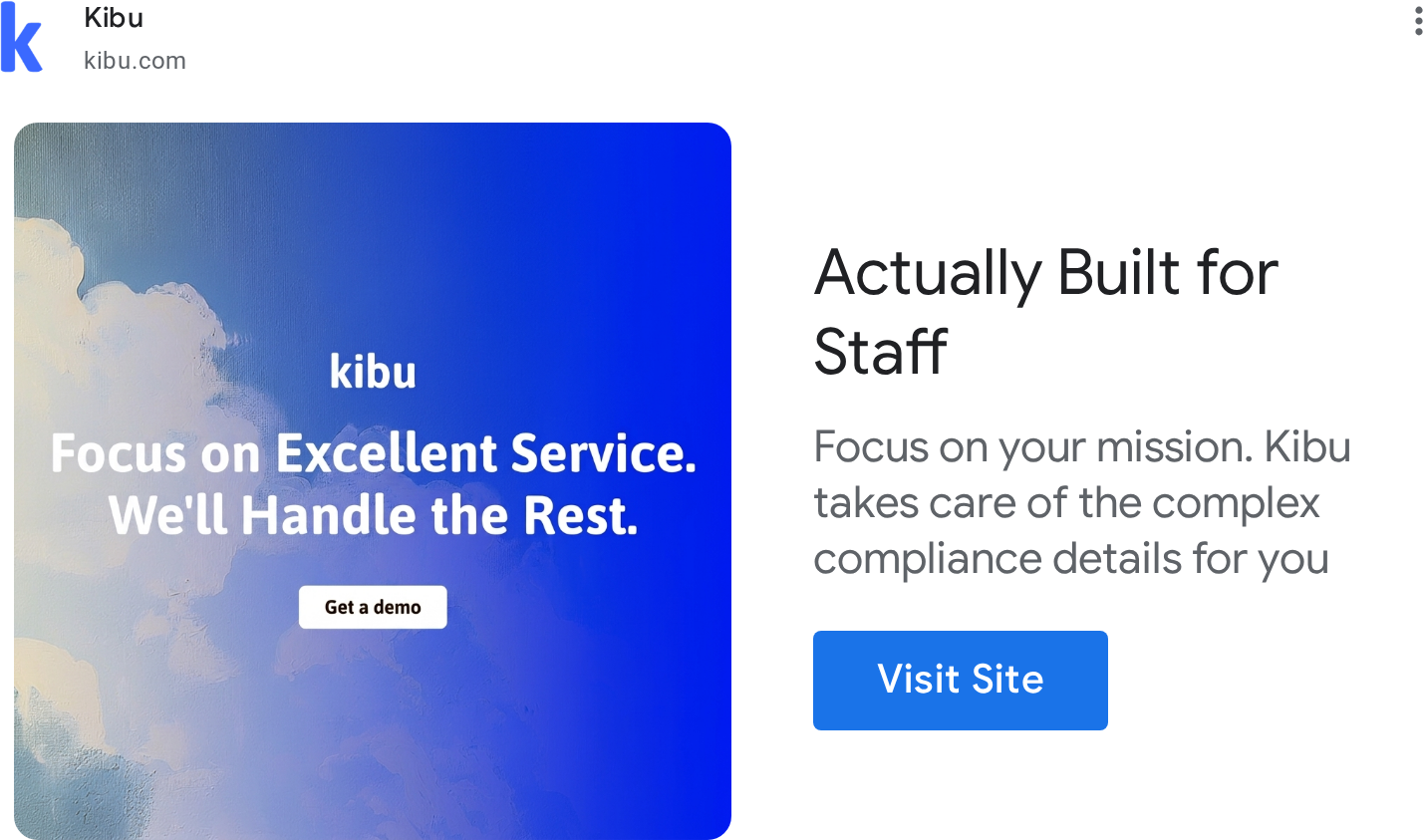
- Running
- 6 days (new — still being tested)
- Hook
- Visual: A blue and white gradient background with clouds, featuring the word "kibu" in white. On-screen text: "kibu Focus on Excellent Service. We'll Handle the Rest."
- CTA / offer
- Get a demo / Visit Site
- Audience
- The phrase "Actually Built for Staff" and "Focus on your mission. Kibu takes care of the complex compliance details for you" signals that the target audience is businesses or organizations with staff who deal with compliance.
Why it works. Draws a direct line between the one thing operators want to spend time on and everything else Kibu absorbs for them.
On-screen text: "Focus on Excellent Service. We'll Handle the Rest." prominently displayed on a large blue graphic. Split your value prop into 'you focus on X, we handle Y' so the trade-off is concrete, not a vague promise of ease.
- Running
- 5 days (new — still being tested)
- Hook
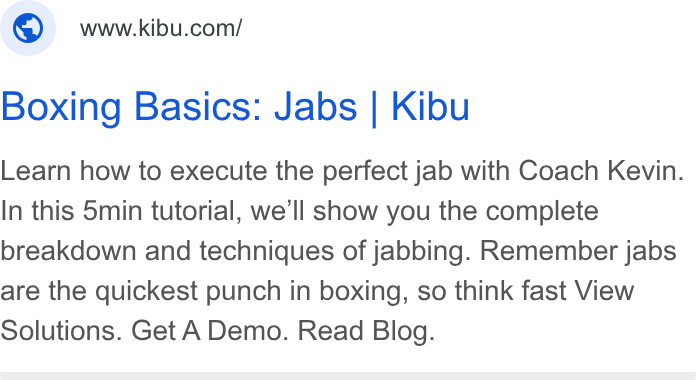
- www.kibu.com/ and "Boxing Basics: Jabs | Kibu" as the main headline.
- CTA / offer
- View Solutions. Get A Demo. Read Blog.
- Audience
- Individuals interested in boxing or fitness, indicated by the title "Boxing Basics: Jabs" and the mention of a "5min tutorial" and "Coach Kevin."
Why it works. Uses a single named activity title from Kibu's content library so program staff can see exactly what a session covers before clicking.
Clear, benefit-oriented headline: "Boxing Basics: Jabs | Kibu" Title content previews with the exact skill taught, not a generic category, so the right buyer self-selects.
- Running
- 122 days (longevity = it's converting)
- Hook
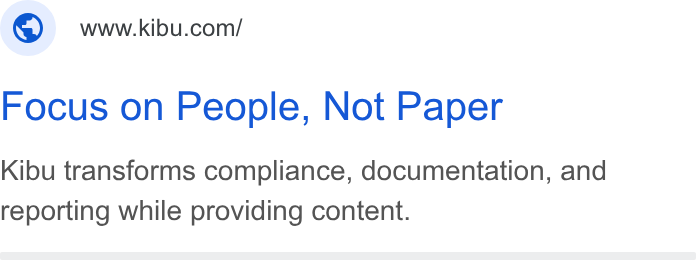
- Visual: A blue globe icon next to the text "www.kibu.com/". Below that, in large blue text, "Focus on People, Not Paper".
- Audience
- Organizations or individuals dealing with compliance, documentation, and reporting, indicated by the text "Kibu transforms compliance, documentation, and reporting while providing content."
Why it works. Turns a shared IDD-staff frustration, paperwork over people, into a two-sided phrase that doubles as a mission statement.
Headline: "Focus on People, Not Paper" Write your headline as a direct contrast: what your buyer wants to spend time on versus the specific thing blocking them.
Show 3 more ads
- Running
- 122 days (longevity = it's converting)
- Hook
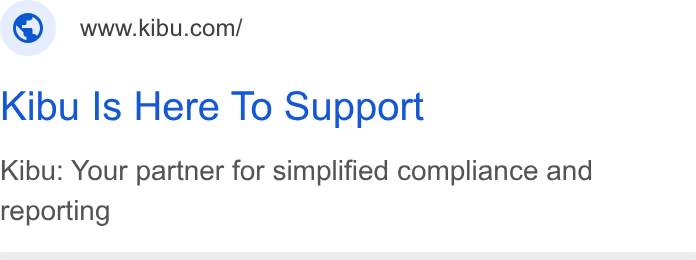
- www.kibu.com/ Kibu Is Here To Support
- Audience
- Businesses or individuals dealing with 'compliance and reporting' are targeted, indicated by the specific problem mentioned.
Why it works. Uses a short, confident support statement as a low-commitment search ad test, leaning on brand recognition rather than a specific proof point.
Headline stating purpose: 'Kibu Is Here To Support' If testing a broad reassurance line like this, pair it with one concrete proof point (a stat, a guarantee) so it doesn't read as filler.
- Running
- 64 days (longevity = it's converting)
- Hook
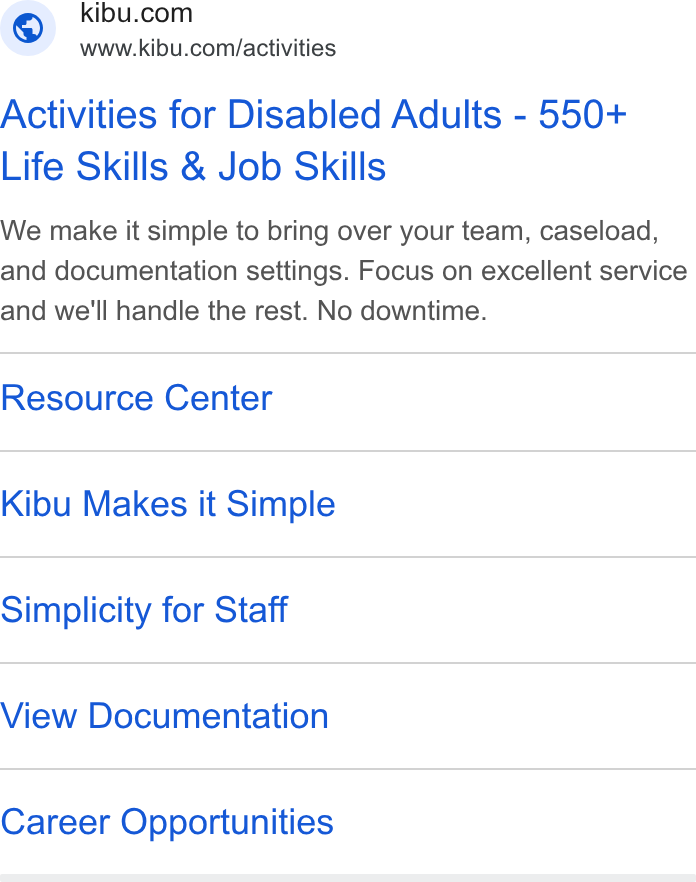
- Activities for Disabled Adults - 550+ Life Skills & Job Skills
- Audience
- Organizations or individuals supporting 'Disabled Adults' looking for 'Life Skills & Job Skills' programs, indicated by the prominent headline.
Why it works. Pairs a named audience with a hard content count to prove breadth to activity coordinators comparing curriculum vendors.
Headline directly states the target audience and a large, specific number of offerings: "Activities for Disabled Adults - 550+ Life Skills & Job Skills". Put a specific inventory number (550+, 12, 40) in your headline to prove depth instead of claiming 'comprehensive.'
- Running
- 56 days (longevity = it's converting)
- Hook
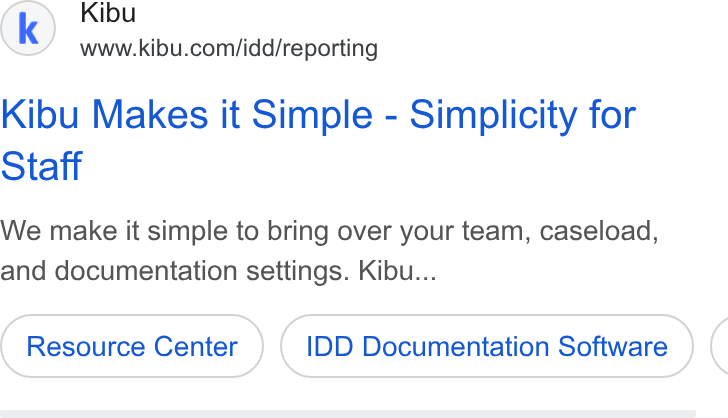
- Kibu Makes it Simple - Simplicity for Staff
- Audience
- The phrase "Simplicity for Staff" and the mention of "team, caseload, and documentation settings" signals that this targets professionals or organizations dealing with administrative tasks, likely in a healthcare or social services context given "IDD Documentation Software."
Why it works. Ties the brand name directly to the one role most burdened by documentation, making the benefit feel personal rather than corporate.
Headline with a clear benefit: The main headline states, "Kibu Makes it Simple - Simplicity for Staff." Attach your core benefit word to the specific job title it helps, not to the company as a whole.
09 In their own words
Pulled from interviews and community sessions. The quotes are the angle; the takeaway is what to do with it.
32. Interview of Daniel Caridi & Billy Blanks Jr from Homefield.Fit ↗NEW YORKS FINEST: RETIRED & UNFILTERED PODCAST · 194 views · 60 min▶ Listen“after we were running the zoom classes for a couple weeks we were having 80 90 100 people every single class and everyone's engaged and working out and smiling and it blew my mind I was like there's no way that there's this many people with disabilities in my local area and there's no way that there's no resources for them to do these types of activities already”
Expand
Daniel grew Homefield by converting a volunteer Zoom fitness class (5 participants) into a proof-of-concept that organically scaled to 80-100 attendees per session during COVID, validating demand before formally launching. He then recruited celebrity validators through personal relationships (Tyson via a family connection, Billy Blanks Jr. via a cold approach at a disability-charity event) and used their credibility to open B2B doors with school districts, day programs, and the Special Olympics. The core GTM motion is institutional sales to schools and providers at a group-account price, layered with a $20/month individual subscription funnel starting with a free trial.
“he's actually a family friend of my dad's... I reached out to him and said what I'm working on he's like tell me exactly how I can help because I love this Mission I want to help in every way I can so he actually flew to New York filmed videos with us he's done it a couple times he's posted on his Instagram several times”
“we were working with a day program in Greenwich Connecticut and he was doing one of the charity events he was emceeing it so I saw him up on the stage he's dancing he has the entire crowd engaged... after his set I walk up to him and I explain what I wanted to do and wanted to put together and similar to Tyson he was just like absolutely I'm in let's meet next week”
“he joined the team and since then we've been growing like crazy we're in schools across the country we're in day programs across the country you mentioned we're partners with the Special Olympics partners with best buddies it's been pretty wild and it's only been around since February”
“we take all feedback requests so the anti-bullying series was actually asked for us by a school system... a parent called me and said my son just got invited to a party for the first time... she asked Can you do videos on all these popular dances... those are some of our most popular videos now”
Validate demand by running the product free before building: 80-100 organic Zoom attendees proved market need before any formal launch or spend.
Recruit celebrity validators through warm personal networks, not PR: Tyson came via a family friendship; the ask was mission-first ('he loves this Mission'), making participation feel like a cause, not a sponsorship deal.
Cold-approach high-credibility people immediately after a live performance — Billy Blanks Jr. was signed after Daniel walked up right after his stage set at a disability charity event.
Prioritize B2B institutional sales (schools, day programs, nonprofits like Special Olympics) over consumer acquisition: a single school district unlocks hundreds of users and provides social proof that accelerates the next deal.
Let institutional customers co-create content: the anti-bullying video series and the popular dance videos both came from school and parent requests, driving product-market fit and making buyers feel ownership over the platform.
The Green Internet Episode #4: Adam Nielson ↗Kibu · 49 views · 19 min3rd-party breakdown▶ View source
10 The playbook
The channels are not separate. They are one system where each stage feeds the next. Here is the read, then the plays to run tomorrow.
The inferred playbook
Kibu grows through trust-first credibility building in a compliance-sensitive niche where relationships, earned media, and mission alignment carry more weight than any content or paid channel.
Mission-driven earned media (GMA, People, Forbes 30 Under 30) creates awareness among IDD provider organizations that are deeply skeptical of new software vendors. The founder's origin story, starting with volunteer fitness classes for five people, is the primary trust-building narrative deployed at every stage of the funnel.
A demo-required, no-public-pricing sales motion filters for serious buyers. At ~$625 blended ARPU across 375 paying subscriptions, the ICP is a provider organization with a real compliance and documentation burden willing to pay for a complete vertical solution, not a self-serve trial user.
Dig deeper+2▾
Geographic expansion from 17 states (May 2024) to nearly all 50 states (December 2025) in a tightly networked sector means each new customer reference accelerates the next sale. The 80.2% direct-traffic share is the visible footprint of that referral network compounding over time.
With no category-level organic content and organic search at 8.5% nearly all branded, Kibu is entirely dependent on outbound sales, earned media, and referrals for new-customer discovery. A competitor who builds the compliance-content surface first could intercept category-level demand that Kibu wins only through relationships. ---
Run a numbered "Day N of" ARR tracking series to make your traction legible to buyers and press.
The proofCaridi's "Day 108 of $1M to $2M ARR" posts showed incremental ARR added each update (+$33,968 ARR in a single July 2025 post with a 28.29% progress marker), functioning as investor signal, prospect social proof, and organic press bait simultaneously.
The adaptationStart a numbered series tracking your own milestone ($50k to $100k ARR, or 10 to 25 customers) with a weekly post on X or LinkedIn showing the delta added since the last update. The specific number and the day count together make progress legible to prospects evaluating whether you'll still be around in a year. Start by publishing your current ARR baseline and the goal you're measuring toward, then post each week with the new delta. The mechanism: consistent public accountability reduces buying risk in a long-consideration B2B sale by showing momentum without requiring a press release.
Recruit one niche-credible collaborator as a named presence in your product.
The proofCaridi cold-approached Billy Blanks Jr. at a disability-charity event and recruited him as a Kibu coach and brand face. A single resulting TikTok post tagging Good Morning America earned 1,899 engagements, outperforming every brand-owned post, and the GMA segment that followed was the company's most visible earned-media moment.
The adaptationIdentify one person your buyers already trust (a respected practitioner, a sector-specific podcast host, a nonprofit champion with standing in your vertical) and recruit them into a content collaboration: a co-authored guide, a named curriculum module, or a product demo they record in their own voice. Approach them at sector events or through a warm introduction tied to shared mission. The mechanism: in trust-gated professional communities, credibility is borrowed faster than it is built, and one recognized face earns more buying confidence than a year of brand-owned posts. Caveat: this only works when the collaborator has genuine affinity for the product; a transactional placement without authentic use is detectable to a skeptical B2B audience.
Frame your launch title around the end-user transformation, not the software category.
The proofKibu's Product Hunt launch used "MasterClass for people with special needs" rather than "EHR for IDD providers," leading with the outcome for the person served rather than the product category. The mission framing pulled engagement and press attention from a wider audience than a category headline would have reached.
The adaptationWhen you launch on Product Hunt, Hacker News, or LinkedIn, write two versions of your headline: one category-led ("documentation software for disability providers") and one transformation-led ("compliance-free audit prep for day programs"). Lead with the transformation version. The mechanism: mission or outcome framing hooks engagement from people who care about the end user, not just buyers evaluating features, and that broader engagement is what drives upvote velocity and earns press pickup beyond your direct buyer base.
Treat geographic expansion milestones as distribution events, not just operational updates.
The proofCaridi posted each new state as a named milestone on X ("Alabama brings us to 17 states"), and the Forbes 30 Under 30 feature cited over 250 disability providers in nearly all 50 states as the proof-of-scale number. In a sector where IDD provider networks are organized by state Medicaid programs and regional Arc chapters, proof of presence in a buyer's state reduces a primary objection before a demo is ever booked.
The adaptationIf you sell to a geographically distributed buyer base in a regulated or community-organized sector, publish a running "we serve providers in X states/regions" count on your homepage and post each new market entry on LinkedIn with a tag to the relevant state association or regional organization. The mechanism: in regulated sectors with peer-referral buying patterns, buyers verify whether anyone in their network already uses a product before signing; a public geographic count makes that social proof searchable and legible before a prospect contacts sales.
Build category-level compliance content before a direct competitor does.
The proofKibu's organic search is nearly all branded with no pages capturing queries like "IDD documentation software," "EHR for disability providers," or "how to prepare for a Medicaid audit." A Content Platform engineer hire signals awareness of this gap. The competitor set (storiicare.com, clinii.com, givhealthcare.com) shows the same void in public search data, meaning the category content surface is unclaimed.
The adaptationIf you are a vertical SaaS founder in a compliance-heavy regulated niche, publish 10-15 pages targeting the questions your buyers ask before they know your name: regulatory guides, audit preparation checklists, "what to look for in X software" frameworks, and state-specific compliance breakdowns. First step: run a keyword gap analysis against your closest competitor's domain to surface the 20 terms neither of you ranks for yet, then write the first three pages targeting the ones with the clearest buyer intent. The mechanism: in regulated niches, category-level search converts at higher rates than branded search because the buyer is earlier in the decision process and more open to being educated by a vendor they haven't encountered before.
You just read how Kibu does it. Tomorrow it is someone else.
Every morning we take one company that is actually growing and break down where its customers come from: the ads still running after a year, the channel doing the real work, and the play you can run this week.
Systemaic · directional intelligence. Traffic, spend, and reach figures are SimilarWeb-style estimates and qualitative reads of public data, not audited numbers. Built on real public receipts.
// teardowns with a similar GTM motion
sources & receipts (10)
Live ad libraries: linkedin ad library · google ad library
Launch archives: Hacker News: Show HN: Kibun (気分) – a decentralized status.cafe alternativ · Hacker News: Kibuye Spreads Hope
Founder interviews: AUTISM And Sir Anthony Hopkins! · 32. Interview of Daniel Caridi & Billy Blanks Jr from Homefield.Fit · The Green Internet Episode #6: Anna Lerner · Defying Down syndrome! Sarah Gordy!!! · The Green Internet Episode #5: Ahmed Baba · The Green Internet Episode #4: Adam Nielson
Traffic, spend, and revenue figures are estimates as noted in the report; the links above are the primary public artifacts.