- 01Turn one customer number into your ad copy
- 02Peg your launch to your next newsworthy moment
- 03Mine real objections for your ad hooks
- 04Split founder roles across press and practitioner content
01 Snapshot
The one-glance read on who they are and how they grow. Each point is verifiable from the receipts above.
Enterprise GTM AI agents, one per target account, sold to revenue teams at Ramp, Ironclad, Verkada, and Samsara, no self-serve signup or published pricing.
Paid-led enterprise ABM (account-based marketing), amplified by founder press moments rather than a community or content flywheel.
$45M Series B at a $250M valuation as of April 28, 2026 (total raised ~$67.5M); ~36,000 monthly visits, +26.7% over the last 3 months; 43 paid ads active (40 LinkedIn, 3 Google) as of 2026-07-11.
Co-founder and CEO Mihir Garimella framed the category problem plainly: "Sales is the most expensive function in most companies, and one of the hardest."
Nine of the 24 sampled LinkedIn ads are recent-launch tests (flagged by the platform's transparency data as newly launched), including a gated "GTM AI maturity" report offer and a partner tie-in built around Anthropic's Claude Managed Agents.
The named-customer results (Ramp's 23% win-rate lift, Verkada's $14M quarterly pipeline) aren't just case-study copy, they're reused directly as the paid ad creative, so the proof point and the ad are the same asset.
02 How it unfolded
The order the channels came online. Sequence is strategy: what they did first, and what they layered on once demand existed.
03 Traffic & channel mix
Estimated demand, the channel split behind it, and the keywords and referrers doing the work. Directional modeling, not audited analytics.
Traffic sources
Top search keywords
| Keyword | Volume | Weight | CPC |
|---|---|---|---|
| actively ai | 7.9k | $6.33 | |
| actively | 15k | $5.37 | |
| actively ai login | 360 | - | |
| active ai | 880 | $6.07 | |
| hockeystack | 11k | $13.43 |
Closest competitors by audience
Actively draws an estimated ~36,000 monthly visits, up 26.7% over the last 3 months. Direct traffic dominates at 57.9%, consistent with a company whose growth runs through named-account outreach and press pickups rather than search discovery; Search Organic follows at 20.5% and Social Organic at 7.4%. The remaining four channels, email, paid search, AI-assistant referrals, and other referrals, together account for roughly 14% of traffic. The keywords they rank and bid for are almost entirely their own brand: "actively ai" (7,930 searches/month) and "actively" (14,750 searches/month) dwarf category terms, meaning most of that search volume is people who already know the name rather than prospects discovering the category. Notably, "hockeystack" (10,590 searches/month), a competitor analytics tool's own brand name, also appears in their keyword set, suggesting some competitor-conquesting search activity. Among the listed competitors, people.ai is the established, well-funded incumbent in sales intelligence, signaling this is a maturing category rather than a greenfield one; twain.ai and salesape.ai are smaller AI-SDR entrants, the kind of crowded field the Reddit thread below describes as "noise."
04 Organic content
The specific pages earning their organic search traffic, and the pattern behind why they rank. Adapt the format, not the topic.
Organic search traffic is concentrated almost entirely on the homepage, which pulls ~918 of an estimated ~1,150 monthly organic visits across their top five tracked pages, roughly 80% of the total. The other four pages (the app login, a CRO solutions page, the customers page, and careers) each draw a handful of visits. The top-ranking keywords aren't category terms either: "actively ai," "actively," and three common misspellings ("activley," "activily," "activiely") all rank in the top two positions, meaning the organic engine is capturing brand-name lookups and typo traffic, not building topical authority through blog posts, comparison pages, or glossary content that would pull in prospects who don't already know the company.
Top pages by organic traffic
05 Channel map
Not traffic share. How much weight the growth system actually puts on each channel, with a one-line read on the role it plays.
What drove growth
06 The motions doing the work
For founder-led SaaS the breakdown shifts from ads to traction: where the first users came from, how the founder grows it in the open, and the compounding organic surface.
Actively's traction story isn't a viral spike, it's a coordinated funding-plus-launch moment that used enterprise proof points, not virality, as the credibility engine.
Founded in 2022, the company stayed quiet on a $5M seed until April 2, 2025, when both co-founders announced the product's public launch and a $17.5M Series A on X the same day, framing the product as "GTM superintelligence."
Rather than a single launch-day spike, traction shows up as named-customer results stacked over successive funding rounds and reused directly as paid creative: Ramp's 23% higher win rate, Verkada's $14M in quarterly pipeline from under 10 outbound reps, and Samsara's 2x conversion rate across a 1,000-plus-person GTM team.
Dig deeper+1▾
The April 28, 2026 Series B announcement ($45M at a $250M valuation) is the single highest-reach organic post in the evidence at 127,762 views, roughly 8x the next-best post (a 16,808-view OpenAI keynote mention), showing that funding news, not product news, is what breaks through.
Build in public here is press amplification for a two-person founding team with a modest personal following, not an audience-driven growth engine.
Co-founder and CEO Mihir Garimella owns the broad-reach moments, funding announcements, an OpenAI keynote thank-you, and hosting a Techweek panel on enterprise AI agents with DecagonAI, OpenAI, and LangChain, while co-founder Anshul Gupta shows up in narrower practitioner venues like a sales-AI podcast appearance.
Mihir Garimella has posted 97 times to 1,560 followers and Anshul Gupta 370 times to 1,167 followers, both accounts posting sparingly and mostly around discrete milestones (launch, funding, partner features) rather than frequent build-in-public updates.
Dig deeper+1▾
With followings in the low thousands for a Series B company, the founders' X activity functions as a credibility signal that press and paid creative can point to rather than as a primary acquisition channel in its own right.
Search organic sits at 20.5% of the traffic mix, but as covered above, nearly all of it is brand-name and typo traffic, meaning the SEO motion is a defensive brand-capture layer rather than a demand-generation one.
The site carries an active blog, but the organic top-content data shows no comparison pages, "alternative to" pages, or integrations directory pulling in category search, the structural pieces that usually compound after a launch simply aren't built yet.
The 43 active paid ads (40 LinkedIn, 3 Google) lean on two creative angles: problem-agitation hooks like "Your AI adoption metrics look great. Your pipeline doesn't." that target GTM leaders skeptical of AI-tool sprawl, and named-customer case-study ads that double as the proof point and the media buy. This is demand generation aimed at buyers already evaluating AI GTM tools, not defensive brand-term bidding.
Dig deeper+1▾
Nothing in the owned-site evidence shows a referral or affiliate program, so distribution runs entirely on paid spend and press rather than an incentivized network.
07 Paid ads
This founder-led SaaS also runs paid acquisition. Here are the live ads doing the work, each with the X-ray and a play you can adapt.
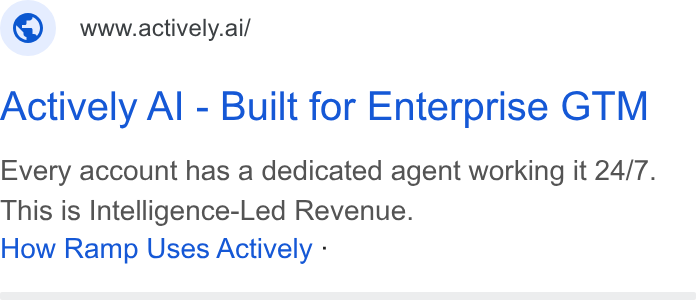
- Running
- 90 days (longevity = it's converting)
- Hook
- "Actively AI - Built for Enterprise GTM" with a blue globe icon and the URL "www.actively.ai/" above it.
- Audience
- The phrase "Enterprise GTM" and the mention of a "dedicated agent working it 24/7" targets businesses and professionals in Go-To-Market strategies who require robust, always-on support and advanced AI solutions.
Why it works. Pairs the product name directly with its buyer segment, enterprise GTM, so the ad pre-qualifies searchers before they click.
Lead with a clear, benefit-driven headline: "Actively AI - Built for Enterprise GTM" Put your product name and your single target buyer segment in the same headline line so unqualified clicks self select out.
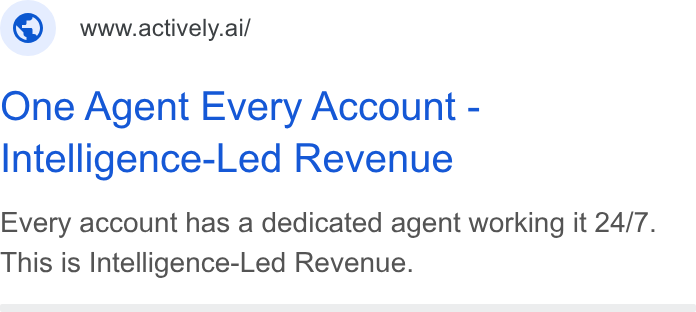
- Running
- 74 days (longevity = it's converting)
- Hook
- www.actively.ai/ One Agent Every Account - Intelligence-Led Revenue
- Audience
- Businesses or individuals seeking dedicated account management and revenue growth, indicated by the phrases 'Every Account' and 'Intelligence-Led Revenue'.
Why it works. Turns a headline into a specific staffing promise, one agent per account, which reads as more concrete than generic AI powered claims in search results.
Headline stating a unique service model: 'One Agent Every Account - Intelligence-Led Revenue' State your product's core commitment as a specific one to one ratio or staffing promise rather than a generic capability claim.
08 The playbook
The channels are not separate. They are one system where each stage feeds the next. Here is the read, then the plays to run tomorrow.
The inferred playbook
The loop runs on funding-news reach feeding paid ABM targeting, closed by customer proof, with organic search still an underbuilt layer.
Funding announcements and partner features (OpenAI, Anthropic) generate the reach spikes covered above, then LinkedIn ABM ads carry that awareness to specific GTM buyer titles.
Case-study ads quoting Ramp, Verkada, and Samsara numbers do the credibility work a cold pitch can't, letting the sales-led motion open with proof instead of a claim.
Dig deeper+3▾
No comparison or programmatic content layer exists to compound organic discovery, and no visible community, docs hub, or self-serve signal shows up in public data, expected for an enterprise sales-led motion, but it means growth depends on continued press and paid spend rather than a self-sustaining asset.
No public MRR or ARR figure is confirmed. Grounded in the Series B valuation, enterprise contracts reported by third parties in the five-to-six-figure annual range (not company-confirmed), and roughly 30-50 employees per third-party headcount trackers, ARR is plausibly in the high-single-digit to low-double-digit millions, an estimate, not a confirmed number.
free-to-paid conversion (not applicable, no self-serve tier), churn, CAC, and confirmed contract pricing.
Turn one customer number into your ad copy
The proofActively's top LinkedIn ads quote a single hard metric per customer (Ramp's 23% win-rate lift, Verkada's $14M pipeline) instead of a generic value prop.
The adaptationEven with one happy customer, pull one specific, quotable number from a call or survey and build a text-only ad or post headline around it instead of waiting for a formal case-study process. First step: message your three best customers this week asking permission to quote one specific metric publicly. The mechanism: a real number from a named account carries more weight than any adjective a founder can write about their own product.
Cost: $0 · Time to signal: weeks · Works pre-PMF: no, you need at least one live customer with a measurable result to quote.
Peg your launch to your next newsworthy moment
The proofActively's highest-reach organic post by a wide margin was the tweet announcing its Series B, roughly 8x the next-best post.
The adaptationHold product announcements until they can ship alongside any newsworthy peg, a raise, a milestone, a notable client win, since audiences amplify news far more than routine updates. First step: identify your next milestone, however small (first paying customer, a revenue threshold), and draft the announcement post now so it's ready to publish the day it happens.
Cost: $0 · Time to signal: days · Works pre-PMF: yes, provided you have a genuine milestone to peg to, a manufactured one won't land.
Mine real objections for your ad hooks
The proofActively's sharpest-performing creative agitates a specific, current skepticism ("Your AI adoption metrics look great. Your pipeline doesn't.") rather than a generic pitch.
The adaptationPull the exact skeptical objection prospects voice on sales calls or in support tickets, then write your next headline as that objection turned back on your buyer. First step: pull five real objections from call notes this week and test the sharpest one as a plain-text post on LinkedIn or X, no design needed.
Cost: $0 · Time to signal: days · Works pre-PMF: yes, this only needs objections you've already heard, not a finished product.
Split founder roles across press and practitioner content
The proofone Actively co-founder handles funding and press moments while the other shows up in narrower practitioner venues like a niche podcast, covered above.
The adaptationwith two or more founders, assign one to broad-reach announcements and one to in-the-weeds practitioner content (niche podcasts, small communities) so the combined output covers both a wide audience and a narrower expert one instead of duplicating the same post. First step: before your next announcement, agree in writing which founder owns which register.
Cost: $0 · Time to signal: weeks · Works pre-PMF: yes.
Bid on the competitor name your prospects already search
The proofamong Actively's tracked keywords is a direct competitor's brand name pulling meaningful monthly search volume, alongside their own brand terms.
The adaptationidentify the one or two adjacent tools your prospects already search by name, check the volume with a free keyword tool, and run a small test ad or comparison page against that exact term to reach buyers already in-market. First step: list three competitor or adjacent brand names and check their search volume before committing any budget.
Cost: under $500 · Time to signal: weeks · Works pre-PMF: conditional, only works once you can state a clear point of differentiation on the landing page these searchers hit. Not transferable at an earlier stage: the funding-news amplification and the enterprise case-study ads assume a founder has already closed a round or landed marquee logos, a reader who is pre-seed or pre-customer should start with the objection-mining and role-division plays instead.
You just read how Actively does it. Tomorrow it is someone else.
Every morning we take one company that is actually growing and break down where its customers come from: the ads still running after a year, the channel doing the real work, and the play you can run this week.
Systemaic · directional intelligence. Traffic, spend, and reach figures are SimilarWeb-style estimates and qualitative reads of public data, not audited numbers. Built on real public receipts.
// teardowns with a similar GTM motion
sources & receipts (8)
Live ad libraries: linkedin ad library · google ad library
Launch archives: Hacker News: Multiple Russia-aligned threat actors actively targeting Sig · Hacker News: Leaving Google has actively improved my life · Hacker News: Internet Freedom Is Actively Dissolving in America · Hacker News: Ask HN: Do you still play with VR actively? · Hacker News: The brain may actively forget during REM sleep · Hacker News: iOS 16.6.1 fixes two vulnerabilities known to be actively ex
Traffic, spend, and revenue figures are estimates as noted in the report; the links above are the primary public artifacts.