- 01Turn every real user query into a permanent public page
- 02Seed unpaid creator demos instead of buying ad creative
- 03Pair a founder launch post with a second post that uses the product to answer a real question
- 04Ship a lightweight integration into the AI tools your users already have open
01 Snapshot
The one-glance read on who they are and how they grow. Each point is verifiable from the receipts above.
An AI academic search engine that synthesizes answers from 220M+ peer-reviewed papers, reaching 2.5M+ monthly active users as of May 2026.
Organic-led, powered by founder build-in-public moments and a compounding programmatic-content engine.
~5 million monthly visits as of 2026-07-12; $45.75M raised across four rounds, including a $30M Series B in May 2026; roughly 300 active Google ads as of 2026-07-12.
Co-founder Christian Salem framed the whole strategy as product over marketing: "When you are a product-led startup, velocity of shipping is the most important thing."
Newest Google tests as of 2026-07-12 include a video-format ad running since 2026-06-22 alongside several fresh text variants launched within the prior week.
The core engine is students and researchers demonstrating the product to each other across TikTok and Instagram in five-plus languages, a self-perpetuating study-hack UGC loop that the company's own paid-search spend mostly defends underneath rather than drives.
02 How it unfolded
The order the channels came online. Sequence is strategy: what they did first, and what they layered on once demand existed.
03 Traffic & channel mix
Estimated demand, the channel split behind it, and the keywords and referrers doing the work. Directional modeling, not audited analytics.
Traffic sources
Top search keywords
| Keyword | Volume | Weight | CPC |
|---|---|---|---|
| consensus | 413k | $0.36 | |
| consensus ai | 173k | $0.34 | |
| google scholar | 10.6M | $1.43 | |
| concensus | 35k | $0.46 | |
| elicit | 201k | $0.79 |
Top referring sites
Closest competitors by audience
Consensus pulls an estimated ~5 million monthly visits, down 14.5% over the last 3 months as of 2026-07-12. The mix is dominated by direct traffic at 51.6%, consistent with a product students bookmark and return to repeatedly, followed by organic search at 25.7%, the clearest sign their content and SEO engine is doing real work. Referrals add 7.2% and a "Gen AI" referral bucket (traffic arriving via ChatGPT, Claude, and similar assistants) contributes 6.1%, notable for a company whose own MCP integration reportedly gets used millions of times inside Claude. Paid search sits at 4.9%; the rest, social organic, email, display, paid social, and affiliate, totals under 5% combined.
Worth flagging the tension head-on: web visits are softening even as Consensus just raised a $30M Series B and reports 2.5M+ monthly active users. Public data cannot fully resolve the gap, but the likeliest reads are a seasonal academic-summer lull (students and researchers off through July) and usage shifting into the app and the MCP/API surface a web-visit estimate never captures, rather than genuine demand erosion.
Their branded terms carry real volume: "consensus" pulls ~413,000 searches/mo and "consensus ai" ~172,700/mo, while the misspelling "concensus" still nets ~35,000/mo, evidence of a recognizable brand people search for by name. They're also chasing incumbent demand: "google scholar" carries a massive ~10.6M searches/mo, a term Consensus likely bids into as demand-capture against the free default researchers already know, and "elicit" at ~200,600/mo shows up as a direct competitor name in their keyword set.
Referrers point to where usage clusters: canva.com suggests students citing or embedding Consensus output inside presentation work, groupy.id (an Indonesian student community site) lines up with the Indonesian-language TikTok UGC in the evidence, and smu.edu.sg (Singapore Management University) reads as course pages linking students to the tool. On competitors, elicit.com is the closest direct rival in the AI-research-search category, scholar.google.com is the free incumbent Consensus is positioned against, and scispace.com rounds out the set as another literature-synthesis tool competing for the same workflow.
04 Organic content
The specific pages earning their organic search traffic, and the pattern behind why they rank. Adapt the format, not the topic.
Their top organic pages split into two distinct plays: a branded /search/ hub catching generic search-engine intent, and a long tail of /questions/ pages built from real user queries turned into public, indexable answer pages. The dominant pattern is programmatic long-tail SEO: templated question pages on health and pharmacology topics (fasting duration, Adderall naming, ear infection symptoms) each pull a slice of the roughly 306,500 monthly organic visits their top pages generate, ranking well because they answer one specific natural-language question with a citation-backed synthesis, the exact query shape search engines now reward.
Top pages by organic traffic
05 Channel map
Not traffic share. How much weight the growth system actually puts on each channel, with a one-line read on the role it plays.
What drove growth
06 The motions doing the work
For founder-led SaaS the breakdown shifts from ads to traction: where the first users came from, how the founder grows it in the open, and the compounding organic surface.
Consensus's traction was founder-driven from day one: a solo Show HN post did the initial pitching, and the growth that followed compounded through word of mouth among graduate students rather than any single launch spike.
Co-founder Christian Salem posted the company's Show HN on 2022-09-08, titled "Search Engine that uses AI to find answers in Scientific Research," pitching an ad-free way to see the underlying science and asking readers to also back the company's Product Hunt launch the same day, but it drew only 9 points and no comments on Hacker News itself.
A second Show HN, "Find out what science says about your question with LLMs," landed on 2023-02-01 from a different account and pulled 6 points, the same day Salem's personal account announced the new Consensus Meter feature to 41,754 views on X, a coordinated relaunch-and-feature-drop rather than a single breakout moment.
Dig deeper+2▾
By the company's April 2023 seed round the product had reached roughly 200,000 registered users, growth the company attributed entirely to organic word of mouth among graduate students and PhD candidates spreading the tool across labs and campuses with no paid marketing (source).
Five more Hacker News submissions about Consensus through 2025 never topped single-digit points, so credibility instead built through press pickups Salem shared himself: a Wall Street Journal feature in February 2024 and a Nature front-page mention in October 2024.
Christian Salem, Co-Founder & CPO alongside CEO Eric Olson, is the one consistent public voice for Consensus, posting product milestones and press wins from his personal X account rather than running a high-frequency brand-building cadence.
Salem's account (@c_salem2) carries 1,060 followers across 1,259 posts, verified as the company's founder account by a bio that ties directly to Consensus's mission, a modest but authentic build-in-public channel rather than a large personal platform.
His most-engaged posts are feature-velocity updates, the product-over-marketing framing covered above, not personal narrative or revenue milestones. No MRR or subscriber figures appear anywhere in his public posts.
Dig deeper+1▾
On 2025-09-04 Salem announced a partnership with Project Biomni, a biomedical AI-agent research initiative, framing the next phase of growth through technical integrations rather than follower-building content.
The organic engine is less about any single page and more about a self-feeding system: real user queries become permanent public pages, and an AI-ecosystem channel now feeds back into that same content.
Every question a user asks through consensus.app/search can graduate into one of the templated /questions/ pages covered above, so usage itself manufactures new indexable inventory without a separate editorial team.
Their MCP (Anthropic's Model Context Protocol) integration, referenced above via its Claude usage volume, now shows up as its own 6.1% "Gen AI" slice of total traffic, a distribution channel that search-only competitors don't have.
Dig deeper+2▾
Affiliate referrals sit at just 0.1% of the traffic mix, so unlike creator-commission-driven DTC brands, growth here compounds through the product's own surface area rather than a recruited partner network.
The active Google ad library noted above bids mostly into generic and competitor terms such as "ChatGPT for Research" and "AI Search Engine For Research" rather than defending the branded term, positioning Consensus against both AI chat incumbents and the free default Google Scholar noted above. The newest video-format test flagged above suggests a shift from static text into video creative.
07 Paid ads
This founder-led SaaS also runs paid acquisition. Here are the live ads doing the work, each with the X-ray and a play you can adapt.
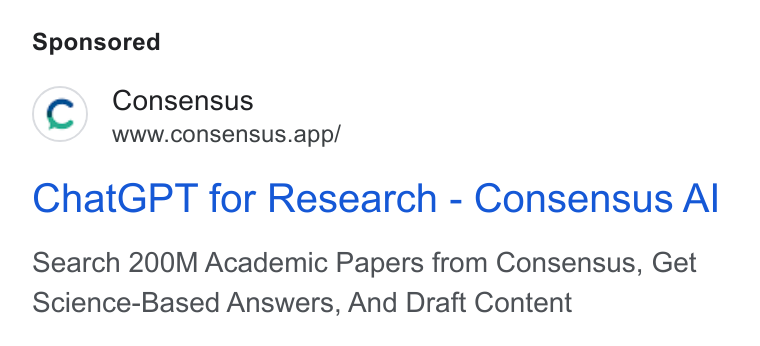
- Running
- 690 days (longevity = it's converting)
- Hook
- Sponsored Consensus www.consensus.app/ ChatGPT for Research - Consensus AI
- CTA / offer
- Search 200M Academic Papers from Consensus, Get Science-Based Answers, And Draft Content
- Audience
- Academics, researchers, and students are targeted, evidenced by phrases like "Academic Papers," "Science-Based Answers," and "Research."
Why it works. Anchors the unfamiliar product to ChatGPT, a name searchers already trust, then narrows it to the research use case.
Headline directly names a popular technology and its application: "ChatGPT for Research - Consensus AI" Name the best-known tool in your category in your headline, then narrow it to your specific use case right after.
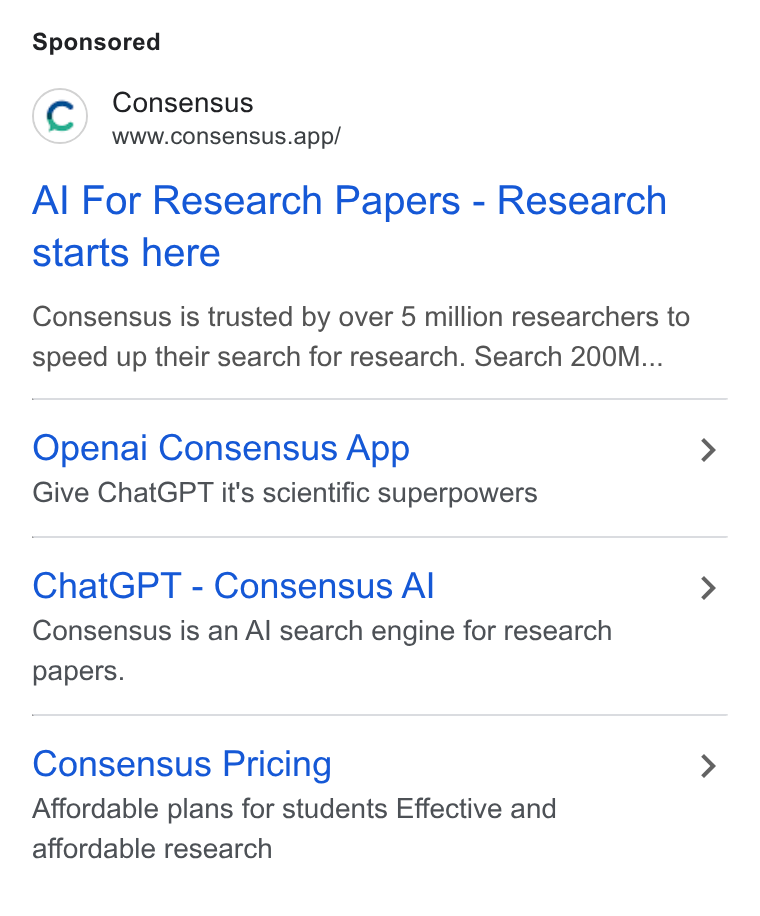
- Running
- 779 days (longevity = it's converting)
- Hook
- Sponsored Consensus www.consensus.app/ AI For Research Papers - Research starts here
- Audience
- Researchers and students are targeted, evidenced by phrases like "research papers," "5 million researchers," "scientific superpowers," and "students."
Why it works. Stacks a use-case label with a workflow-first claim so both literal searchers and casual browsers get a reason to click.
Headline stating core value proposition: "AI For Research Papers - Research starts here" Combine a plain use-case label with a short workflow claim in one headline to cover two different reader mindsets.
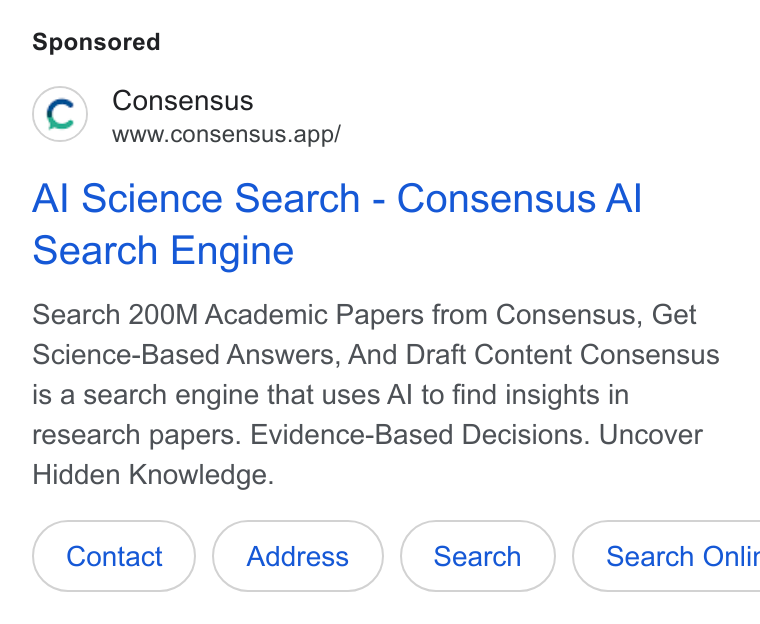
- Running
- 885 days (longevity = it's converting)
- Hook
- Sponsored Consensus www.consensus.app/ AI Science Search - Consensus AI Search Engine
- CTA / offer
- Search 200M Academic Papers from Consensus, Get Science-Based Answers, And Draft Content Consensus is a search engine that uses AI to find insights in research papers. Evidence-Based Decisions. Uncover Hidden Knowledge.
- Audience
- Academics, researchers, students, or professionals who need to analyze large volumes of research papers, indicated by '200M Academic Papers' and 'research papers'.
Why it works. Qualifies the category down to science specifically, pre-filtering clicks to the exact academic niche the product serves.
Headline clearly states the product and its core function: 'AI Science Search - Consensus AI Search Engine'. Add one qualifying word to your category name, like 'science' or 'legal', to pre-filter who clicks your ad.
Show 3 more ads

- Running
- 861 days (longevity = it's converting)
- Hook
- Sponsored Consensus www.consensus.app/ AI For Research Papers - ChatGPT for Research
- CTA / offer
- Consensus Pricing, Affordable Plans
- Audience
- Researchers and academics, indicated by terms like 'academic search engine', 'lit reviews', 'researchers', and 'research papers'.
Why it works. Layers a direct use-case claim with a ChatGPT comparison, doubling the odds one of the two framings lands with the reader.
Headline directly addresses a common task with a modern solution: "AI For Research Papers - ChatGPT for Research". Test a headline pairing your product's direct use case with a comparison to the most familiar tool in your space.
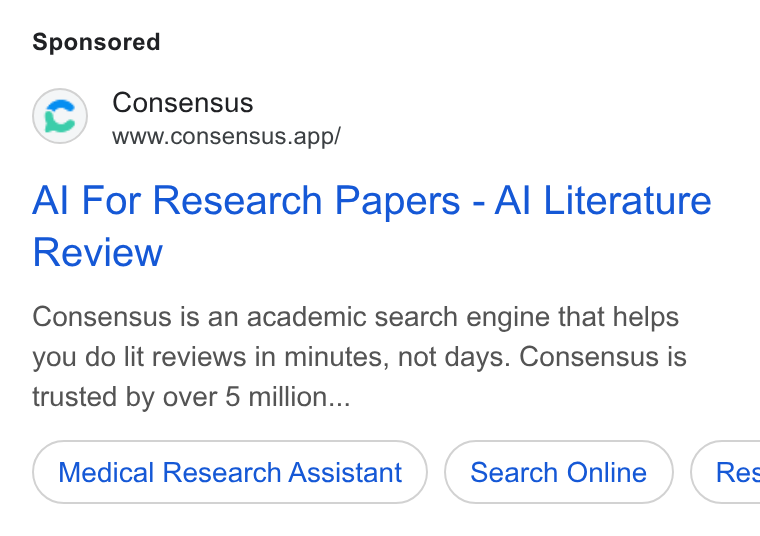
- Running
- 651 days (longevity = it's converting)
- Hook
- Sponsored Consensus www.consensus.app/ AI For Research Papers - AI Literature Review
- Audience
- Academics, researchers, and students who conduct literature reviews, indicated by phrases like 'academic search engine', 'lit reviews', and 'research papers'.
Why it works. Pairs two high-intent academic search terms in one line, catching both paper-writing and lit-review searchers with a single ad.
Headline directly addresses a pain point and offers a solution: "AI For Research Papers - AI Literature Review" Pair two closely related buyer search terms in one headline, like 'X for Y - X for Z', to cover more query intents.
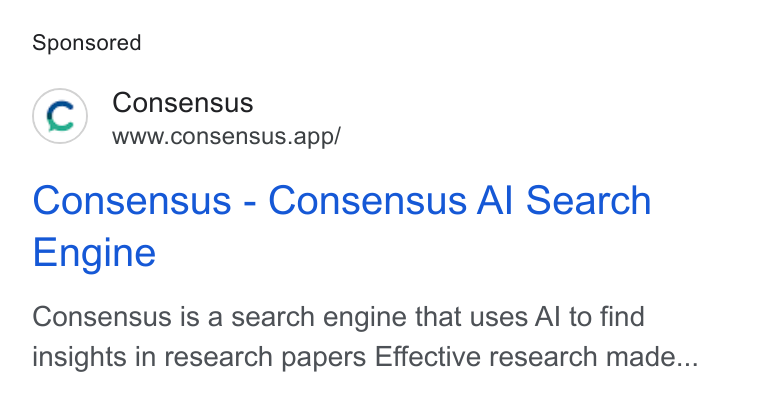
- Running
- 652 days (longevity = it's converting)
- Hook
- Sponsored Consensus C www.consensus.app/ Consensus - Consensus Al Search Engine
- Audience
- Individuals engaged in research or academic work, indicated by the text "find insights in research papers Effective research made...".
Why it works. Mimics the format of an organic search result, brand plus category label, so the paid ad blends into results the reader trusts.
Clear branding and domain display: "Consensus www.consensus.app/" Format your headline like a search result: brand name followed by a plain category descriptor, skip the superlatives.
08 The playbook
The channels are not separate. They are one system where each stage feeds the next. Here is the read, then the plays to run tomorrow.
The inferred playbook
Consensus's growth loop starts with someone else's content, a creator's demo video or an AI-assistant session, and pulls users into a free tier that only leaks into paid at a rate the public data doesn't show.
Unpaid creator UGC across five-plus languages and AI-ecosystem placements originate discovery, while the paid search and branded-term SEO covered above catch the demand those touchpoints create.
The free tier (20 AI credits per month) lets a user run the exact workflow shown in creator videos before hitting a paywall, with Pro priced at $15/month or $120/year (a 40% student discount applies) and custom sitewide licensing for universities, so the demo videos function as the funnel, not just awareness content.
Dig deeper+3▾
Every real question asked in the product can become a public /questions/ page, and every institution that signs a sitewide license, over 100 universities per public reporting, embeds the tool into a captive, recurring user base beyond what individual signups alone would produce.
Direct traffic is over half of all visits, but nothing in the public data shows how that base of free users actually converts to Pro, so the loop's weakest visible link is the free-to-paid step itself.
free-to-paid conversion rate, churn, and CAC across the free, Pro, and institutional tiers.
Turn every real user query into a permanent public page
The proofConsensus's /questions/ pages, each built from an actual searched question, pull the bulk of their organic traffic without a content team writing them one by one.
The adaptationPull your own product's top 20-50 recurring user searches or support questions from your analytics or help desk, and publish each as its own indexed page with a direct, cited answer. Start by exporting a recent month of search logs, picking the queries with the highest repeat volume, and building one templated page per query. The mechanism: real demand writes your content calendar for you, so the pages match exactly what people already type into search boxes.
Cost: $0 · Time to signal: weeks · Works pre-PMF: yes, provided the product already generates real user queries to mine
Seed unpaid creator demos instead of buying ad creative
The proofTwo dozen organic TikTok and Instagram videos across five-plus languages demo Consensus, including the Indonesian creator video referenced above, with no sign of paid sponsorship.
The adaptationIdentify 10-15 small creators already active in your product's niche, student-life, productivity, or professional-workflow accounts, and offer free premium access in exchange for an honest, unscripted demo rather than a scripted ad read. Start by DMing creators who already post about adjacent free tools in your category, no agency or ad spend required.
Cost: under $500 · Time to signal: weeks · Works pre-PMF: conditional, only if the product has a genuinely visible "aha" moment on screen
Pair a founder launch post with a second post that uses the product to answer a real question
The proofConsensus's own Show HN launch ran alongside a second post asking what predicts a successful startup founder, answered using the product itself instead of pitching it.
The adaptationOn launch day, post the founder's own account of why you built it on one forum, then publish a second, separate post where your product answers a genuinely interesting question in your niche, cross-posted to a community your users already read. This is a one-time launch-moment move, not a recurring content format, and repeated self-promotion on the same forum risks moderator pushback.
Cost: $0 · Time to signal: days · Works pre-PMF: yes
Ship a lightweight integration into the AI tools your users already have open
The proofConsensus's integration into Claude and ChatGPT now accounts for a distinct slice of total traffic, referenced above, layering AI-ecosystem distribution on top of search.
The adaptationBuild a minimal plugin, skill, or API connector into whichever AI assistant or workflow tool your users already run daily, even before it's a polished product, and list it in that platform's directory. Start by scoping the smallest useful version, one function your core workflow performs, and shipping it as a connector rather than a full app.
Cost: $0 · Time to signal: months · Works pre-PMF: conditional, requires an API-shaped product and a directory that will list early-stage tools
Let the founder, not a press office, amplify every media hit
The proofSalem shared the company's Wall Street Journal and Nature features from his own account rather than routing them through brand PR, noted above.
The adaptationWhen you land any press mention, however small, share it yourself with one specific reflection instead of generic thanks, and do it from a named founder account, not the company handle. Start by setting a reminder to screenshot and comment on every trade-press or newsletter mention within a day of it running.
Cost: $0 · Time to signal: months · Works pre-PMF: yes Not transferable at an earlier stage: the funding and multi-year paid-search program noted above depend on later-stage capital most readers won't have yet; the query-to-page and creator-seeding mechanics scale down to zero budget.
You just read how Consensus does it. Tomorrow it is someone else.
Every morning we take one company that is actually growing and break down where its customers come from: the ads still running after a year, the channel doing the real work, and the play you can run this week.
Systemaic · directional intelligence. Traffic, spend, and reach figures are SimilarWeb-style estimates and qualitative reads of public data, not audited numbers. Built on real public receipts.
// teardowns with a similar GTM motion
sources & receipts (7)
Live ad libraries: google ad library
Launch archives: Hacker News: A Dark Consensus About Screens and Kids Begins to Emerge in · Hacker News: Senior Engineers Build Consensus (2019) · Hacker News: W3C abandons consensus, standardizes DRM, EFF resigns · Hacker News: Proof of stake is incapable of producing a consensus · Hacker News: A generalised solution to distributed consensus · Hacker News: Raft Consensus Animated (2014)
Traffic, spend, and revenue figures are estimates as noted in the report; the links above are the primary public artifacts.