- 01Name pages after the problem, not the product
- 02Repurpose real customer answers as ad footage
- 03Test multiple spokesperson personas in one ad account
- 04Gate the routine quiz before the price
01 Snapshot
The one-glance read on who they are and how they grow. Each point is verifiable from the receipts above.
Dermatologist-formulated, concern-specific skincare (dark spots, keratosis pilaris, dry lips, eye cream, aging) from founder-dermatologist Dr. Muneeb Shah, now sold via remedyskin.com, Amazon, TikTok Shop, and Target shelves (a ~1,600-store launch on December 28, 2025 that expanded to all Target locations by January 9, 2026).
Founder-led, with a creator and TikTok Shop commerce layer riding on top.
~224,684 estimated monthly visits as of 2026-07-26; at least 80 active Meta ads (of a roughly 106-ad library) as of the same date; a $20M Series A closed June 2026 led by L Catterton; an owned Instagram at 81,962 followers as of 2026-07-26.
As of 2026-07-26 their newest Meta creative shifts from bold-claim doctor testimonials toward blunt problem-agitation hooks like "If you have hands like this," and problem/solution infographics.
Remedy's paid creative pairs Dr. Shah with outside credentialed-physician voices and the brand's own page, a pattern that reads as testing which spokesperson credential sells best rather than leaning on one face. (The ad-creative sample isn't bound to a verified advertiser ID, so treat the specific physician attributions as directional.)
02 How it unfolded
The order the channels came online. Sequence is strategy: what they did first, and what they layered on once demand existed.
03 Traffic & channel mix
Estimated demand, the channel split behind it, and the keywords and referrers doing the work. Directional modeling, not audited analytics.
Traffic sources
Top search keywords
| Keyword | Volume | Weight | CPC |
|---|---|---|---|
| remedy skincare | 5.3k | $1.00 | |
| remedy | 56k | $2.35 | |
| remedy for dark spots | 4.2k | $1.36 | |
| remedy science | 2.1k | $0.95 | |
| remedy skin | 820 | $1.06 |
Top referring sites
Closest competitors by audience
Remedy pulls an estimated 224,684 monthly visits, down 6.3% over the last 3 months. Three channels dominate: Direct at 23% (a sizeable habitual/branded base, likely fed by the founder's own audience typing the URL or brand name directly), Organic Search at 20.3%, and Paid Search at 17.1%. Display Ads add another notable 13.6%, pointing to a heavier programmatic-display spend than most DTC skincare brands run. The rest, paid and organic social, email, affiliate, referrals, and a sliver of AI-chat traffic, combine for under a quarter of total visits.
Their top search demand centers on their own name: "remedy" pulls 55,960 monthly searches across the web (a term they benefit from but don't own outright), while "remedy for dark spots" (4,210/mo) and "remedy skincare" (5,340/mo) show demand specific to the brand and its flagship concern. The two listed referring domains, force.com and nooks.in, don't read as genuine consumer referral sources, more likely tooling or tracking artifacts than earned media, so no real referral-partner story sits there. Among the closest competitors, theordinary.com and drdennisgross.com are direct positioning rivals (an affordable-actives brand and another dermatologist-founder DTC line, respectively), while sephora.com's presence likely reflects retail-marketplace overlap rather than a true head-to-head competitor.
04 Organic content
The specific pages earning their organic search traffic, and the pattern behind why they rank. Adapt the format, not the topic.
Remedy's organic traffic is dominated by its homepage at 39.2% of organic visits, well ahead of any individual product page, a branded-demand pattern consistent with a founder who drives search behavior before people ever land on a specific product. Below that, the top organic pages are individual concern-named product pages (dark spots, dry lips, body bumps), each pulling roughly 9% of organic traffic and ranking #1 or #3 for their own condition-name keywords (remedy for dark spots at #1, keratosis pilaris lotion at #3). The pattern: naming a product after the exact skin problem, rather than an abstract product name, lets that single page absorb both branded search and informational "how do I treat X" intent at once, which is why the site's organic footprint concentrates on a handful of pages instead of spreading across a wide content library.
Top pages by organic traffic
05 Channel map
Not traffic share. How much weight the growth system actually puts on each channel, with a one-line read on the role it plays.
What drove growth
06 The creative doing the work
Each exhibit shows the actual asset, an X-ray of why it works, a status, and a play you can adapt. This is the heart of the teardown.
Remedy runs roughly 80 active Meta ads (of a ~106-ad library) as of 2026-07-26. Several genuinely qualify as proven winners, the library's oldest active creative has run 286 days, with others at 277, 149, 135, and 129 days, real longevity that marks positive-ROI bets they keep paying for.
The quiz-driving dark spots ad lands on its dedicated product page, where a persistent "UNLOCK EARLY ACCESS: COPPER PEPTIDE SERUM" banner and a "Build my Routine" quiz CTA appear regardless of which product the visitor actually clicked through for. The retinal serum stick ad ($28) and the eye cream ad ($18) both land on their own product pages running the same pattern: a 20% off sitewide discount plus a Skio-powered "subscribe and save" option baked into the buy box. The body bumps ad lands on a KP lotion page showing tiered pricing ($20, $25, $28, likely by size), the same subscription and discount mechanics repeated. Free shipping above $50 rounds out the offer. The effect is a single funnel template, quiz or product page, subscribe-to-save, 20% off, and a next-launch teaser, reused across every paid entry point rather than a bespoke lander per ad.
- Running
- 286 days (longevity = it's converting)
- Hook
- 0:00-0:03, a man in blue scrubs holds up a yellow bottle with 'REMEDY for dark spots' written on it. On-screen text reads: "Dermatologist explains how to treat dark spots in one step". The man says: "I think they need to rename this liquid gold for dark spots because it works so well."
- Audience
- Individuals with dark spots or pigment issues who are looking for an effective and simplified skincare routine. The presence of a dermatologist suggests a target audience that values expert opinion and scientific formulations.
Why it works. A scrub-clad presenter's off-the-cuff nickname reads as a spontaneous reaction rather than a scripted claim, building trust for dark-spot buyers.
Expert endorsement and bold claim at 0:00-0:05, "Dermatologist explains how to treat dark spots in one step" and "I think they need to rename this liquid gold for dark spots because it works so well." Have your presenter jokingly suggest renaming your product based on how well it performs, framed as a spontaneous aside, not a slogan.
- Running
- 277 days (longevity = it's converting)
- Hook
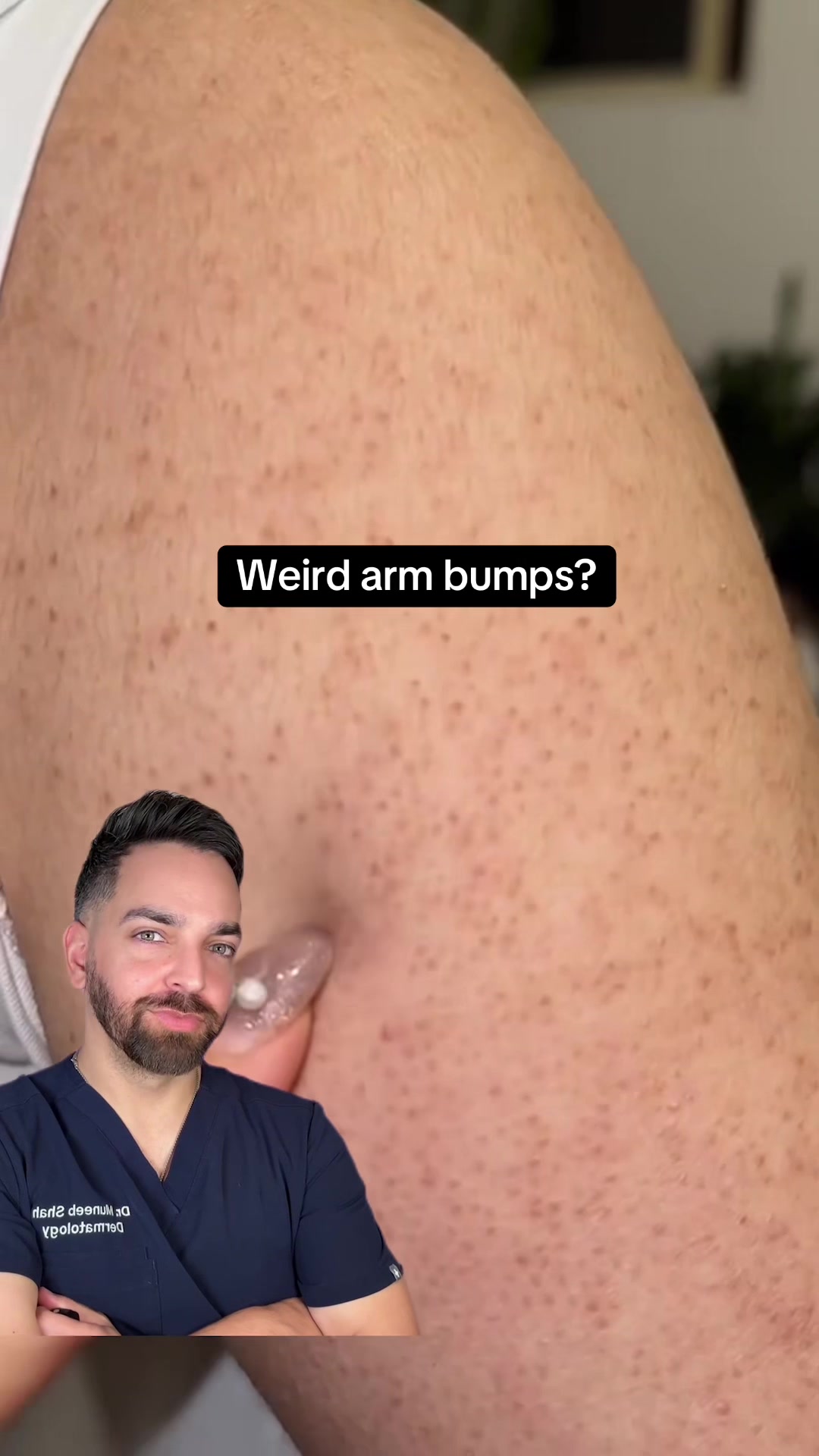
- "I used to just think I had bad skin on my arms." A man in a blue scrub top is speaking directly to the camera.
- Audience
- Individuals experiencing 'body bumps' or 'keratosis pilaris' who have tried multiple products without success. The speaker's personal experience and medical background (MD Dermatology) signal credibility.
Why it works. A personal, low-stakes confession about arm skin invites viewers with the same overlooked issue to keep watching for the reframe.
Relatable problem introduction and personal experience (0:00-0:09): "I used to just think I had bad skin on my arms... It's something called keratosis pilaris and I've personally dealt with it for years." Open with a personal admission of misunderstanding your own skin issue, stated in past tense, before revealing what you learned.
- Running
- 2 days (new — still being tested)
- Hook
- "If you have wrinkles" + Close-up of skin with wrinkles, with white lines highlighting them.
- Audience
- People concerned about visible signs of aging like wrinkles, sagging skin, and fine lines, as directly addressed by the speaker and visuals at 0:00-0:07.
Why it works. Filters for the wrinkle-concerned segment in the first three seconds, then backs the claim with ingredient transparency for skeptical premium buyers.
Problem identification with visual emphasis at 0:00-0:07: "If you have wrinkles, sagging skin, or fine lines, these are the signs of aging skin." Open your script by naming the viewer's exact skin concern as an unfinished conditional, then cut straight to a close-up showing it.
Show 7 more exhibits
- Running
- 2 days (new — still being tested)
- Hook
- 0:00-0:03: A woman in a light green scrub top is speaking to the camera. Behind her, a blurred image of hands with red, irritated skin is visible. She says, "If you have hands like this,"
- Audience
- Individuals concerned about dry, aging hands, dark spots, crepey skin, and damaged cuticles, as shown by the visuals and spoken problem statements.
Why it works. Targets people with visibly irritated or aging hands specifically, using an expert-presenting speaker to make the diagnosis feel credible.
Problem identification and agitation (0:00-0:05): The video opens with a dermatologist stating, "If you have hands like this, this or this, these are dry aging hands." Have your presenter start with an unfinished 'if you have X like this' line timed to a cut showing the exact problem on screen.
- Running
- 2 days (new — still being tested)
- Hook
- "IF YOU HAVE" - A close-up of a person's eye with a white dashed line outlining the under-eye area.
- Audience
- Individuals concerned about the appearance of dark circles, puffiness, and fine lines under their eyes, as directly addressed by the problem statement and visual examples.
Why it works. Uses a close-up eye shot with the affected under-eye area outlined to make dark circles impossible to miss before the product is shown.
Problem identification and visual agitation at 0:00-0:03, "IF YOU HAVE dark circles under your eyes LIKE THIS". Outline the exact problem area on a close-up photo with a simple dashed line so viewers instantly locate their own version of the issue.
- Running
- 2 days (new — still being tested)
- Hook
- “If you have these dark circles under your eyes and no eye cream seems to work, here’s why.” Visual: Close-up of a person's eye with a dark circle under it, then a woman in blue scrubs holding a microphone.
- Audience
- Individuals experiencing dark circles, puffiness, and fine lines under their eyes, who have tried other eye creams without success. The doctor in scrubs suggests a medical/scientific approach.
Why it works. Targets people who already tried and failed with eye cream by explaining the underlying cause first, then positioning the product as the fix.
Problem identification and re-framing (0:00-0:10): 'If you have these dark circles under your eyes and no eye cream seems to work, here’s why. Because most people think dark circles are just extra pigment under the eyes.' Call out the product category your audience already tried and found ineffective, then explain the root cause it missed before naming yours.
- Reach
- 38 upvotes · 13 comments · r/30PlusSkinCare
A community is already discussing this in r/30PlusSkinCare. Show up there authentically and answer the thread before a competitor does.
Who amplifies them
The brand runs its own voice through @remedyskin on Instagram and Remedy Science / @remedy.skin on TikTok, distinct from Dr. Shah's personal channels, Doctorly on YouTube (his long-running education brand) and DermDoctor | Dr. Shah on TikTok, where his Shop posts do the heaviest lifting. A genuine bench of third-party creators features the brand organically: Loretta Lynne, skincarewithshelbs, Olivia Farisai, bonoy_hr, Fashionably Divorced, nanaacom070, and Styled Beauty (who posted twice about the copper peptide serum), plus TikTok Shop seller @shop.shiesty. On Instagram, dannyguo.md ran a sponsored post citing the brand's own clinical claim (an 81% reduction in tyrosinase activity, per their own trial data, not independently verified). Reddit amplification is real but organic and unprompted, spread across r/30PlusSkinCare, r/Melasmaskincare, and r/SkincareAddiction, none of it brand-seeded.
07 Organic & video
The organic content engine: the videos, creator posts, and community presence earning attention without paid spend.
Cadence splits cleanly by channel: Doctorly on YouTube runs long-form education (10-20 minute videos, some past 10M views) that cross-links Remedy products contextually, while the Remedy/DermDoctor TikTok presence is shorter and commerce-tied. The clearest standouts are TikTok Shop posts, not plain organic clips: DermDoctor's hand and cuticle butter cream post logged roughly 5.3M engagement (2025-12-13), his KP exfoliating body scrub post roughly 4.9M (2026-05-06), and creator @shop.shiesty's Vitamin C serum post roughly 420K (2026-03-05), with a long tail of smaller creator clips in the low-thousands range. The format that performs is the TikTok Shop product demo, posted directly to the shop tab rather than the plain feed, where the multi-million engagement counts dwarf ordinary hashtag posts.
08 Affiliate & partners
How the brand turns creators and partners into a tracked, variable-cost acquisition channel, and how the program is structured.
TikTok Shop is the de facto affiliate engine, both DermDoctor's own Shop posts and third-party sellers like @shop.shiesty function as a creator-commission sales channel. No dedicated on-site affiliate or ambassador program (a Rewardful/PartnerStack-style signup page) appears in the owned-site evidence, so the small affiliate slice of traffic (3.4%) is most likely riding on TikTok Shop's built-in commission structure rather than a formal outbound program, room to formalize an ambassador motion beyond what TikTok Shop already provides by default.
09 The playbook
The channels are not separate. They are one system where each stage feeds the next. Here is the read, then the plays to run tomorrow.
The inferred playbook
The loop starts with Dr. Shah's own multi-million-view dermatology education content, converts through concern-named product pages and a routine quiz funnel, and compounds through TikTok Shop creator commissions, with the Meta ad account testing which "MD" spokesperson persona sells best.
Doctorly YouTube videos and DermDoctor TikTok/Shop posts double as top-of-funnel education and direct commerce, and that same footage style shows up recycled as Meta ad testimonials.
The Meta library credits creative to multiple physician-sounding names alongside Dr. Shah and the brand's own page, though the exact mechanics behind the shared advertiser ID aren't fully verifiable from the ad library alone.
Dig deeper+3▾
Naming products after the exact problem lets one page absorb both branded and informational intent, and those pages make up the bulk of organic traffic beyond the homepage.
The Target rollout and TikTok Shop sales are new legs meant to widen the funnel, but no channel-level read on how much retail lifts DTC traffic is visible in this data.
the revenue split across remedyskin.com, Amazon, Target, and TikTok Shop; the blended paid-media return behind the 56-ad Meta library; and the subscribe-and-save attach rate on the Skio-powered checkout.
Name pages after the problem, not the product
The proofRemedy's concern-named product pages (dark spots, dry lips, body bumps) pull the bulk of the site's non-homepage organic traffic and rank #1 or #3 for their own condition terms, the pattern covered in Organic Content above.
The adaptationBuild one dedicated page per specific customer problem, titled in the customer's own search phrasing rather than an abstract feature name. Pull three phrases straight from support tickets or sales calls this cycle (the same source Remedy effectively drew "dark spots" and "body bumps" from) and turn each into its own titled page rather than a blog aside, so it can rank for the problem term and the brand term at once.
Cost: $0 · Time to signal: months · Works pre-PMF: yes
Repurpose real customer answers as ad footage
The proofRemedy's longest-running dark spots ad reads like organic explainer content reused as paid creative, a doctor-voice testimonial delivering a punchy, memorable line rather than scripted ad copy.
The adaptationFilm your next real customer-facing explanation, a support call, a demo answer, a how-to response, on a phone, and cut it to 15-30 seconds using the same "I think they need to rename this X" structure: state the problem, deliver one quotable reframe, show the fix. No audience or ad account required to start, just a genuine answer worth repeating.
Cost: $0 · Time to signal: weeks · Works pre-PMF: yes, provided whoever is on camera is comfortable and credible on the topic.
Test multiple spokesperson personas in one ad account
The proofRemedy's Meta library runs identical-style ad copy under multiple credentialed-physician voices alongside Dr. Shah and the brand page, covered in Paid Ads above.
The adaptationPick two or three plausible messenger types for your category, a customer, an outside expert, the founder, and run the same underlying script under each as a distinct named voice in your ad account. Tag each variant clearly so you can isolate whether authority framing or relatability framing converts before committing real budget to one face.
Cost: under $500 · Time to signal: weeks · Works pre-PMF: conditional, needs at least a small paid budget to run two variants side by side.
Gate the routine quiz before the price
The proofRemedy's "Build Your Routine" quiz ad has run 129+ days across several image variants, the report's longest-standing funnel mechanic besides the dark spots testimonial.
The adaptationBuild a 3-5 question quiz as the primary cold-traffic CTA instead of a direct product-page click, routing every answer combination to an existing product or plan so no personalization engine is needed. Reveal price and any discount only after the quiz completes, mirroring Remedy's "20% off inside" reveal, so a stranger commits attention before ever seeing a number.
Cost: under $500 · Time to signal: weeks · Works pre-PMF: yes
Turn a real shortage into the ad hook
The proofRemedy's body bumps "finally back in stock" ad has run 277 days, pairing a relatable-problem opener with genuine restock scarcity.
The adaptationThe next time you genuinely sell out of a SKU or reopen a waitlist, write the ad hook around the shortage itself rather than the product's features, pairing it with a real number when you have one (a waitlist count, days out of stock). The scarcity narrative gives cold traffic a timely reason to act that a features list doesn't.
Cost: $0 · Time to signal: days · Works pre-PMF: yes, provided the shortage is real, a fabricated scarcity claim damages trust fast. Not transferable at an earlier stage: Dr. Shah's pre-existing 20M+ education following and the L Catterton-backed budget behind 56 concurrent Meta creatives aren't available to a founder starting from zero. What transfers is the mechanics, problem-named pages, persona testing, quiz-gating, and honest scarcity hooks, not the audience size or ad spend behind them.
You just read how Remedy Science does it. Tomorrow it is someone else.
Every morning we take one company that is actually growing and break down where its customers come from: the ads still running after a year, the channel doing the real work, and the play you can run this week.
Systemaic · directional intelligence. Traffic, spend, and reach figures are SimilarWeb-style estimates and qualitative reads of public data, not audited numbers. Built on real public receipts.
// teardowns with a similar GTM motion
sources & receipts (17)
Live ad libraries: meta ad library
Researched facts: Founding and launch: REMEDY (Remedy Science) was founded by board-certified dermatologist · Seed investor: Norwest Venture Partners led REMEDY's seed round prior to the Series A · Norwest investor quote: Norwest Partner Lisa Wu on the investment thesis for Remedy · 2026 revenue trajectory: Remedy is reported to be on track to generate $50M in sales in 20 · National retail launch at Target: REMEDY launched nationwide at Target on December 28, 202 · Direct-to-consumer subscription pricing model: remedyskin.com offers a 'Subscribe To Save · Bundle pricing: remedyskin.com offers product bundles with an additional discount for comb · Brand logo/name origin: REMEDY's logotype was designed to reference founder Dr. Muneeb Sha · Product line scope: REMEDY's line targets specific dermatologic concerns: dark spots, pore
Milestone sources: 2024-03-19: Dr. Muneeb Shah (@DermDoctor) publicly launches Remedy (Remedy Science), his d · 2026-01-09: Remedy's Target rollout reaches full nationwide coverage, available in all Tar
Community threads: Trustpilot: UK customer on Trustpilot names Remedy her favorite skincare brand, with poten · Brand-site product reviews (remedyskin.com, Dark Spots serum): Customer review on the Dark · Brand-site product reviews (remedyskin.com, Daily Defense Vitamin C serum): Customer revie · TikTok: A dermatology-adjacent TikTok creator publicly co-signs the Dark Spots serum, tagg · Independent review blog (SkincareManyc): Independent skincare review blog praises the Dark
Traffic, spend, and revenue figures are estimates as noted in the report; the links above are the primary public artifacts.