- 01Turn your earliest superfans into stakeholders
- 02Claim the exact-match phrase inside a crowded generic word
- 03Hold ad winners for a full quarter before judging them
- 04Let a founder's old job pick the first landing page
01 Snapshot
The one-glance read on who they are and how they grow. Each point is verifiable from the receipts above.
AI computer-vision software that reads commercial HVAC (heating, ventilation, and air conditioning) blueprints to auto-generate bills of materials and quotes for equipment distributors and rep firms, having doubled annual recurring revenue (ARR) in the first six weeks of 2026.
Founder-led, insider-network motion inside a narrow B2B vertical, propped up by always-on paid search that generates demand in an unbranded, low-search category rather than any public-facing content or social engine.
A $14M Series A closed March 2026, ~40 enterprise clients as of that announcement (seven of whom are also investors), an estimated low-to-mid seven-figure ARR run rate (not publicly disclosed, inferred from the raise and client count), and 4 Google ads still active as of 2026-07-16, the oldest running 111 days.
Rebar's real distribution asset is not content or social, it is turning its own earliest customers into its cap table, a mechanic that only works because commercial HVAC distribution is a small, relationship-dense buyer universe where a happy customer's opinion travels fast.
02 How it unfolded
The order the channels came online. Sequence is strategy: what they did first, and what they layered on once demand existed.
03 Traffic & channel mix
Estimated demand, the channel split behind it, and the keywords and referrers doing the work. Directional modeling, not audited analytics.
Traffic sources
Top search keywords
| Keyword | Volume | Weight | CPC |
|---|---|---|---|
| rebar hvac ai | 200 | - | |
| rebar ai | 290 | $11.85 | |
| rebarai | 110 | - | |
| rebar michigan login | 0 | - | |
| rebar | 59k | $0.51 |
Closest competitors by audience
Rebar draws an estimated ~15,500 monthly visits, up 51.7% over the last 3 months. Three channels dominate: Direct at 59.5% (buyers typing the URL directly, consistent with a sales-led enterprise motion rather than discovery traffic), Referrals at 21.5% (likely the customer/investor network sending traffic rather than open-web link building), and Search Organic at 11.4%. The rest, email and organic social, together total under 8%.
The keywords that matter are narrow: "rebar hvac ai" (200 searches/month) and "rebar ai" (290 searches/month) show a small but real pocket of category-specific demand forming around the product. By contrast, the bare word "rebar" pulls 59,240 monthly searches, a volume that is almost entirely noise from the construction material and an unrelated open-source Erlang build tool that happens to share the name, not demand for this company. Rebar's closest traffic-similar competitors include autorebar.com and mateenbar.com, both apparent rivals in construction estimating software, and webstructural.com, a structural-engineering software player adjacent to the same buyer.
04 Organic content
The specific pages earning their organic search traffic, and the pattern behind why they rank. Adapt the format, not the topic.
Rebar's entire measured organic footprint runs through a single page: the homepage, pulling an estimated 220 organic visits per month and holding the #1 ranking for "rebar takeoff software," "rebar estimating software," "rebar software," and "rebar takeoff," plus a #3 for "rebar company." The pattern here is not a content strategy at all, it is brand-term capture: because "rebar" as a software category term has almost no competing vendors, the homepage's own title and product copy are enough to own the phrase outright without a single supporting blog post or comparison page.
Top pages by organic traffic
05 Channel map
Not traffic share. How much weight the growth system actually puts on each channel, with a one-line read on the role it plays.
What drove growth
06 The motions doing the work
For founder-led SaaS the breakdown shifts from ads to traction: where the first users came from, how the founder grows it in the open, and the compounding organic surface.
Rebar's public traction moment was not a launch stunt, it was the funding announcement itself, timed to a revenue inflection.
Founded in October 2024, Rebar shows no public-facing launch artifacts (no forum thread, no upvote-driven debut) anywhere in the evidence; the company appears to have built and sold quietly to a specific enterprise buyer before going public with anything.
The March 10, 2026 Series A announcement, $14M led by Prudence with Zero Infinity Partners, Founder Collective, Villain Capital, and Optimist Ventures participating, doubled as the company's first real public traction story, bundling the doubled-ARR figure and the 40-client count into one press moment.
Dig deeper+1▾
The most unusual detail in that announcement is structural, not narrative: seven of Rebar's 40 clients had also become investors by the time the round closed, meaning the earliest sales pipeline and the cap table were the same list of people.
Rebar shows no visible founder build-in-public channel, no personal X, LinkedIn posting cadence, or Reddit presence surfaced in the evidence, so its openness plays out structurally rather than socially.
CEO Evan Brown previously worked as an HVAC estimator and sales engineer before founding the company, and that background is the narrative the press coverage of the raise leans on rather than any personal audience-building. Co-founder Andrew Schwartz holds the COO and CPO roles alongside him.
With seven of 40 clients also holding equity, the "build in public" analog here is closer to build-in-private-with-your-buyers: the people validating the product publicly (via the funding round) are the same people who bought it.
Dig deeper+1▾
Unlike founder-led SaaS companies that grow through a personal X or LinkedIn following, nothing in the evidence shows Rebar's founders posting product updates or milestones in the open, so this is not a channel a reader can study tactically here.
Organic search accounts for a modest 11.4% of Rebar's total traffic mix, and the company's content investment matches that scale: thin and concentrated on a single page rather than a compounding library.
The site has a blog, but with zero blog pages among the top organic earners, there is no visible library of comparison pages, guides, or templates building a growing organic footprint the way a true content engine would.
With only 200-290 monthly searches on category terms that actually name the product ("rebar hvac ai," "rebar ai"), Google search ads are doing the work organic search cannot yet do at this stage, running 4 always-on text ads for 81 to 111 days each as of 2026-07-16 against buyer-specific headlines: "Built for HVAC Estimators," "Built for HVAC Distributors," and "Built for HVAC Rep Firms." That is demand generation into an unbranded, low-search category, not defensive brand-term protection.
Dig deeper+1▾
Nothing in the evidence points to a referral or affiliate program, consistent with a sales-led motion where the 21.5% referral traffic share more likely comes from the customer-investor network than a formal program.
07 Paid ads
This founder-led SaaS also runs paid acquisition. Here are the live ads doing the work, each with the X-ray and a play you can adapt.
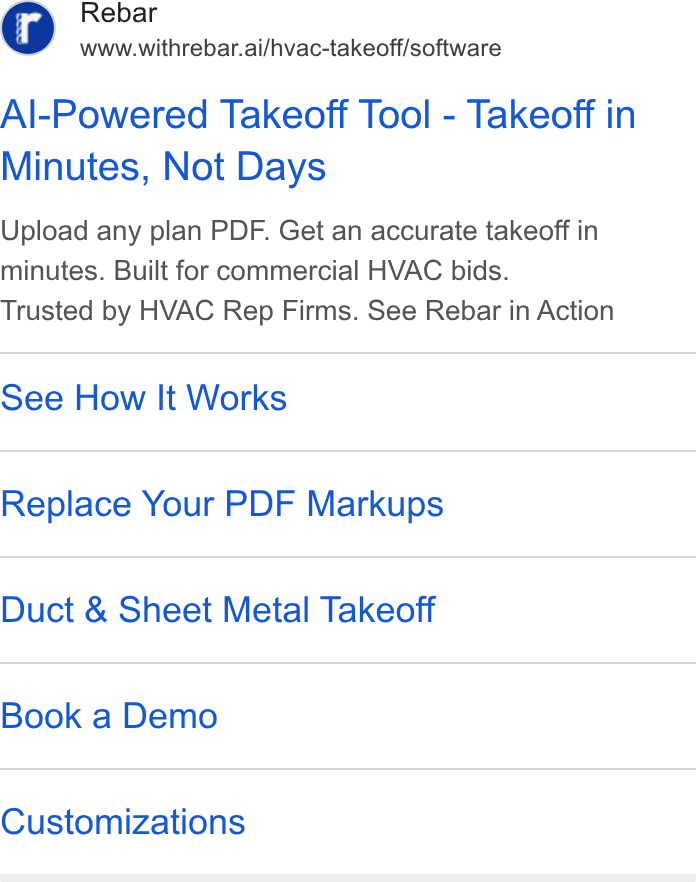
- Running
- 82 days (longevity = it's converting)
- Hook
- Rebar www.withrebar.ai/hvac-takeoff/software Al-Powered Takeoff Tool - Takeoff in Minutes, Not Days
- CTA / offer
- Book a Demo
- Audience
- HVAC professionals and firms, indicated by 'Built for commercial HVAC bids' and 'Trusted by HVAC Rep Firms'.
Why it works. Turns Rebar's speed benefit into a measurable before and after, days shrink to minutes, giving estimators a concrete reason to click.
Headline with a bold, quantifiable benefit: 'AI-Powered Takeoff Tool - Takeoff in Minutes, Not Days' Replace a vague speed claim with a specific before and after unit, like days to minutes, that your buyer can picture in their own workflow.
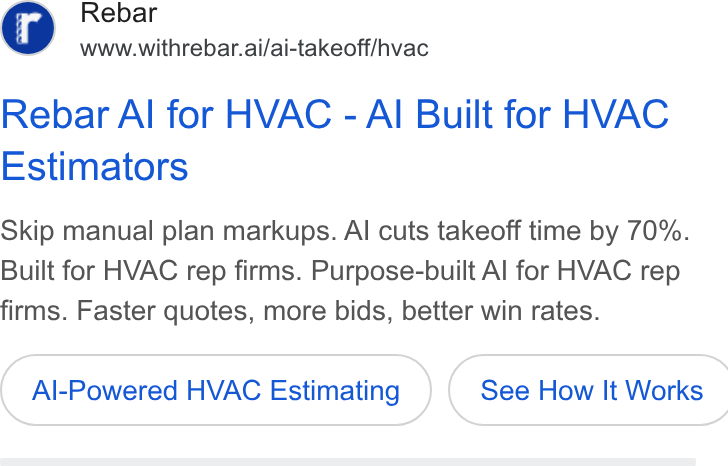
- Running
- 81 days (longevity = it's converting)
- Hook
- Rebar AI for HVAC - AI Built for HVAC Estimators
- CTA / offer
- AI-Powered HVAC Estimating
- Audience
- HVAC Estimators, HVAC rep firms (explicitly stated in text)
Why it works. Speaks directly to HVAC estimators by job title rather than the broader industry, so the buyer who actually runs takeoffs recognizes themselves in the headline.
Headline targeting and value proposition: "Rebar AI for HVAC - AI Built for HVAC Estimators" Name your buyer's actual job title in the headline instead of their industry, so the right person self-selects before they click.
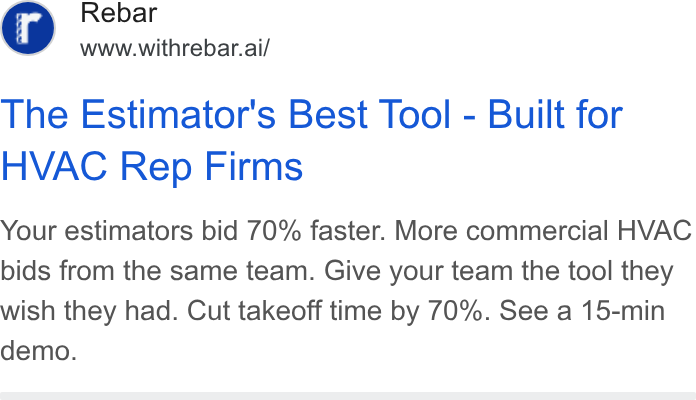
- Running
- 81 days (longevity = it's converting)
- Hook
- Rebar www.withrebar.ai/ The Estimator's Best Tool - Built for HVAC Rep Firms
- CTA / offer
- See a 15-min demo.
- Audience
- HVAC Rep Firms, estimators, commercial HVAC bids
Why it works. Targets HVAC rep firms as a distinct segment from Rebar's other ads aimed at distributors and contractors, showing account based targeting by business type.
Headline directly addresses the target user and their need: 'The Estimator's Best Tool - Built for HVAC Rep Firms'. Run separate ad variants for each distinct business type in your market, distributor, rep firm, contractor, each with its own headline.
Show 1 more ad
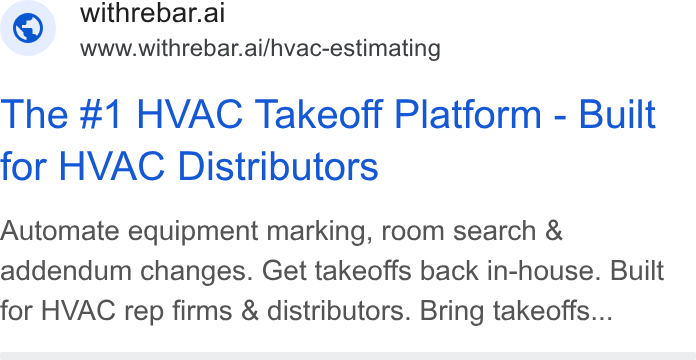
- Running
- 111 days (longevity = it's converting)
- Hook
- "The #1 HVAC Takeoff Platform - Built for HVAC Distributors" is the main headline, with a small globe icon and "withrebar.ai" above it.
- Audience
- The ad explicitly targets "HVAC Distributors" and "HVAC rep firms & distributors" in the headline and body text.
Why it works. Claims the top spot in a narrow category, HVAC takeoff, while calling out distributors specifically, so it reads as built for them rather than generic software.
Lead with a strong, specific claim in the headline: "The #1 HVAC Takeoff Platform - Built for HVAC Distributors". Pick the narrowest category you can plausibly lead in, then pair the leadership claim with the specific buyer role it serves.
08 The playbook
The channels are not separate. They are one system where each stage feeds the next. Here is the read, then the plays to run tomorrow.
The inferred playbook
The loop, as the evidence shows it, starts with a handful of narrow paid search ads targeting named HVAC buyer roles, converts on a homepage that already owns the branded search terms, and compounds through a tight distributor network where early customers become investors and advocates.
Four Google ads, each aimed at a distinct buyer sub-role (distributor, rep firm, estimator), do the top-of-funnel work that a near-zero branded search volume cannot.
The homepage itself, already ranking #1 for the product's own category terms, functions as both the SEO asset and the landing page, with no secondary content layer built out yet.
Dig deeper+2▾
The customer-to-investor conversion turns the buyer network itself into the referral engine, a mechanic that scales trust inside a small industry faster than open content ever could, but that has no visible second gear (no case studies, community, or public advocacy) once a prospect isn't already inside that network.
per-client contract value or usage-based pricing tiers, the conversion rate from client to investor beyond the seven-of-40 figure disclosed at the raise, and how the doubled ARR splits between new logos and expansion inside the existing 40 accounts.
Turn your earliest superfans into stakeholders
The proofSeven of Rebar's 40 clients also invested in its Series A, converting its most enthusiastic buyers into its own cap table.
The adaptationWhen a customer in your own product shows outsized enthusiasm (fast expansion, unprompted referrals, showing up to every call), offer them a small allocation in your next raise or an advisor slot instead of only chasing the renewal, formalizing the relationship the same way Rebar did with its distributor customers. Start by listing the 2-3 accounts in your existing base who already act like advocates and have one direct conversation with each about a small SAFE note.
Cost: under $500 (legal paperwork for a SAFE) · Time to signal: months · Works pre-PMF: conditional, only once you have a few genuinely happy paying customers to draw from, not as a substitute for product traction.
Claim the exact-match phrase inside a crowded generic word
The proofRebar's homepage ranks #1 for "rebar takeoff software" and similar phrases even though the bare word "rebar" carries 59,240 unrelated monthly searches from construction material and an unrelated software tool sharing the name.
The adaptationIf your own brand name overlaps with an unrelated common word, check what your exact "[brand] + [category]" phrase ranks for and rewrite your homepage title tag and H1 to match that phrase verbatim rather than competing for the crowded generic term. Start by pulling your current homepage title tag and testing whether it contains your product category word at all.
Cost: $0 · Time to signal: weeks · Works pre-PMF: yes.
Hold ad winners for a full quarter before judging them
The proofRebar runs exactly 4 Google ads, all running 81 to 111 days as of 2026-07-16 with zero in active testing, which is what marks them as proven winners rather than live experiments.
The adaptationInstead of rotating ad creative weekly, write one ad variant per named buyer sub-role in your market (not one generic ad for "everyone") and commit to holding each variant live for 60-90 days before calling a winner, mirroring the hold time Rebar's own ads have already proven out. Start by drafting 3-4 headline variants, each naming a specific job title your buyer holds, and let them run unedited for that window.
Cost: under $500 to start · Time to signal: weeks to a couple months · Works pre-PMF: conditional, requires a defined buyer persona list, not a single broad audience.
Let a founder's old job pick the first landing page
The proofCEO Evan Brown's own background as an HVAC estimator shaped both the product and the specific buyer language in Rebar's ad headlines ("Built for HVAC Rep Firms," "Built for HVAC Distributors").
The adaptationScope your first landing page and outbound message to the exact sub-niche a founder or early hire has personally worked inside, using the job titles and tools that buyer actually uses rather than an industry-wide pitch. Start by rewriting your homepage headline to name the specific role your founder used to hold, the same way Rebar names "estimators" and "rep firms" instead of "HVAC" broadly.
Cost: $0 · Time to signal: days · Works pre-PMF: yes. Not transferable at an earlier stage: the customer-to-investor conversion and the 81-to-111-day held ad campaigns both assume a funded company with legal infrastructure for a SAFE and enough paid budget to let an ad run untouched for three months, so treat those two as motions to graduate into once you have paying customers and a live raise, not as day-one moves.
You just read how Rebar does it. Tomorrow it is someone else.
Every morning we take one company that is actually growing and break down where its customers come from: the ads still running after a year, the channel doing the real work, and the play you can run this week.
Systemaic · directional intelligence. Traffic, spend, and reach figures are SimilarWeb-style estimates and qualitative reads of public data, not audited numbers. Built on real public receipts.
// teardowns with a similar GTM motion
sources & receipts (11)
Live ad libraries: google ad library
Launch archives: Hacker News: ReBarUEFI: Resizable BAR for almost any UEFI system · Hacker News: Rebar and the Alvord Lake Bridge (2013) · Hacker News: Show HN: The new code formatter for Erlang: rebar3 format · Hacker News: Rebar and Reinforced Concrete · Hacker News: Major Vulnerability Fix for Rebar3 · Hacker News: Rebar3 shell (Erlang)
Researched facts: Company founding date: October 2024 · Series A funding amount and lead investor: $14 million Series A led by Prudence · Co-founder and CEO: Evan Brown · Legal/registered headquarters: Principal place of business at 2009 32nd Ave S, Seattle, Wa
Traffic, spend, and revenue figures are estimates as noted in the report; the links above are the primary public artifacts.