- 01Boost your own milestone post as an ad
- 02Build one comparison page and match it with a search ad
- 03Seed a "which tool should I use" thread where your buyers already argue about tools
- 04Turn an accelerator or credential badge into evergreen ad creative
01 Snapshot
The one-glance read on who they are and how they grow. Each point is verifiable from the receipts above.
AI-native ATS/CRM for recruiting and staffing agencies migrating off Bullhorn, Vincere, Loxo, and JobAdder, fresh off a Y Combinator Winter 2025 batch.
Paid-led and sales-assisted: Google and LinkedIn ad spend feeds an AE-staffed demo funnel rather than a self-serve signup flow.
~64,700 monthly visits (+10.6% over the last 3 months) as of 2026-07-25, a combined 198-ad Google and LinkedIn footprint, and a $3.2M Base10-led seed closed May 2025.
As of 2026-07-25, Spott's newest LinkedIn creative (first shown July 16, 2026) pushes its native MCP integration with Claude and ChatGPT.
Spott boosts founder milestones, new-hire posts, and its YC photo as paid LinkedIn ads instead of relying on organic reach, making this a funded sales operation more than a bootstrapped build-in-public story.
02 How it unfolded
The order the channels came online. Sequence is strategy: what they did first, and what they layered on once demand existed.
03 Traffic & channel mix
Estimated demand, the channel split behind it, and the keywords and referrers doing the work. Directional modeling, not audited analytics.
Traffic sources
Top search keywords
| Keyword | Volume | Weight | CPC |
|---|---|---|---|
| spott | 3.4k | $2.66 | |
| bullhorn | 25k | $4.74 | |
| loxo | 6.6k | $14.95 | |
| spott ats | 280 | - | |
| spott ai | 370 | - |
Closest competitors by audience
Spott pulls an estimated ~64,700 monthly visits, up 10.6% over the last 3 months. Three channels do almost all the work: Direct at 57.1% (the largest single share, consistent with a company whose buyers arrive already knowing the name), Social Organic at 16.4%, and Search Organic at 12.8%. Search Paid adds another 7.9%, a meaningful slice for a company this size and the clearest signal that paid demand capture, not SEO, is the deliberate acquisition lever. The rest, referrals, email, and display, totals under 6%.
The keyword picture reinforces the paid-capture read: two of the three most telling search terms are competitor brand names rather than category terms, "bullhorn" (~24,900 searches/month) and "loxo" (~6,600/month), against "spott" itself at roughly 3,400/month. Spott is positioned to intercept people already searching for the incumbents it replaces, not to win a generic "ATS software" category search. On competitors, SimilarWeb's model surfaces seekout.com (a genuine AI-sourcing rival), spot.ai (almost certainly a domain-name collision with an unrelated video-security company, not a real competitor), and laborsoft.com (workforce-relations software, adjacent rather than head-to-head), suggesting the automated competitor set is broader and less precise than Spott's actual field of ATS/CRM incumbents.
04 Organic content
The specific pages earning their organic search traffic, and the pattern behind why they rank. Adapt the format, not the topic.
Beyond the homepage, the pages earning organic traffic split into two buckets. One is an evergreen category-anxiety piece asking whether AI will replace recruiters, which ranks in the top position for that exact query. The other is a set of competitor-comparison and pricing-intent pages, a TrackerRMS-vs-Spott comparison and a JobAdder pricing page that also ranks first, built to intercept buyers already shopping a named incumbent. That pairing, one industry-anxiety topic plus bottom-of-funnel comparison content, is a low-volume, high-intent play: it won't carry broad category traffic, but it puts Spott in front of recruiters actively evaluating a switch, the same audience its paid compare-page ads target.
Top pages by organic traffic
05 Channel map
Not traffic share. How much weight the growth system actually puts on each channel, with a one-line read on the role it plays.
What drove growth
06 Who they’re hiring
Open roles read like a roadmap: the functions they’re staffing show where the company is investing next and what stage it’s at.
8 open roles
07 The motions doing the work
For founder-led SaaS the breakdown shifts from ads to traction: where the first users came from, how the founder grows it in the open, and the compounding organic surface.
Spott's traction runs through two acts: a YC-anchored seed that funded early customer migrations, then roughly a year later a self-reported revenue inflection amplified almost entirely through paid LinkedIn posts rather than a single launch spike.
Founded in November 2024, Spott went through Y Combinator's Winter 2025 batch, then closed a $3.2M seed in May 2025 led by Base10 Partners with YC, Fortino Capital, True Equity, and angels participating. By the raise, the company had generated 1,000+ candidate reports and was running a paid trial with executive-search firm Stanton Chase.
One of the longest-running LinkedIn ads reuses a photo of the three co-founders, CEO Lander Degrève, COO Manu Vanderveeren, and CTO Samuel Smeys, standing in front of a Y Combinator step-and-repeat wall, turning the accelerator badge into ongoing social-proof creative rather than a one-time launch beat.
Dig deeper+1▾
A June 2026 LinkedIn milestone post claims the company added $1M in new ARR and 75 customers in a single month, crediting "most of it" to inbound referrals from existing agencies rather than outbound sales. A July 2026 follow-up claims the customer base grew 447% in the first six months of 2026 and ARR grew 8x over the same window. Both figures are the company's own ad copy, not independently verified.
Spott's personal-voice content doesn't come from grassroots organic posting, it comes from company-funded LinkedIn ad spend that boosts founder- and employee-voice narrative into feeds.
Manu Vanderveeren's 13,407-follower LinkedIn presence is the natural home for build-in-public content, but the evidence available here only sizes the audience, it doesn't show individual post engagement.
Rather than leaning on organic reach alone, Spott takes first-person milestone posts, the $1M-ARR-in-a-month and 447%-growth claims described above, and runs them as boosted LinkedIn ads under "Promoted by Spott," blending build-in-public tone with paid amplification.
Dig deeper+2▾
Posts from a newly hired Head of US ("I've spent my first quarter at Spott talking to 250+ of them") and a sales leader citing prior Salesforce experience are boosted the same way, turning onboarding narratives into always-on recruiting and social proof.
The founder-linked Reddit thread covered in Where They Show Up functions as a low-key way to surface product discussion in a niche subreddit rather than posting brand content directly.
Search plays a supporting role behind paid and direct traffic, and the SEO investment that exists targets competitor and pricing intent rather than top-of-funnel education.
The same angle behind the compare-and-pricing pages shows up in Google ad creative, headlines like "Vincere Alternative - Spott" and "#1 Loxo Alternative" all point to /compare/ats, pairing organic and paid capture on identical competitor terms.
Search Organic is only 12.8% of total traffic, small enough that the compare-page motion reads as brand-defense against competitor-name searches like "bullhorn" rather than a demand-generation engine.
Dig deeper+2▾
60 of 64 Google ads and every sampled LinkedIn ad are active as of 2026-07-25, with the longest-running Google ad live for roughly 154 days, sized like a primary acquisition budget rather than a side test. Creative leans on a recurring "One ATS. Every AI." tagline and a repeated talking-head testimonial opener ("Hi, my name is Melanie"), both tagged as proven-winner formats.
No affiliate or referral program shows up in the site evidence, so distribution runs through paid capture and the word-of-mouth loop described in Launch & Traction, not a formal partner incentive.
08 Paid ads
This founder-led SaaS also runs paid acquisition. Here are the live ads doing the work, each with the X-ray and a play you can adapt.
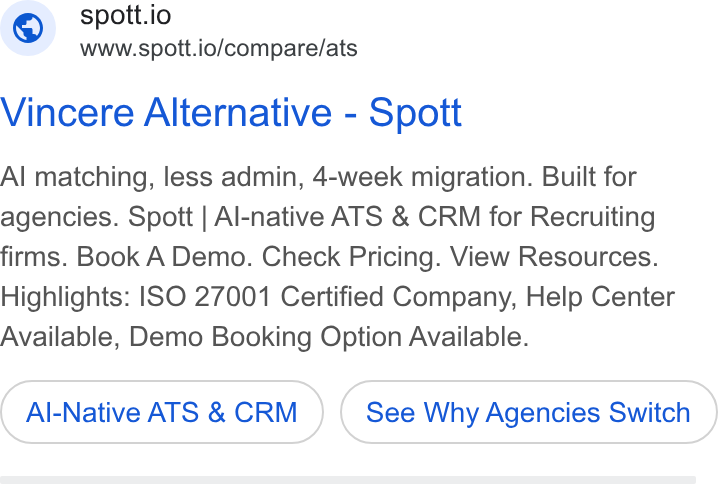
- Running
- 153 days (longevity = it's converting)
- Hook
- Vincere Alternative - Spott" as the main headline, with "spott.io" and "www.spott.io/compare/ats" above it. The visual is a blue globe icon next to "spott.io".
- CTA / offer
- Book A Demo. Check Pricing. View Resources.
- Audience
- Recruiting firms and agencies, evidenced by phrases like "Built for agencies", "Recruiting firms", and the call to action "See Why Agencies Switch".
Why it works. Targets bottom-funnel searchers already evaluating Vincere by naming it outright, capturing high-intent competitor traffic.
Direct competitor call-out in headline: "Vincere Alternative - Spott" Run a search ad titled [Competitor] Alternative, Your Brand to capture prospects who are already comparing tools by name.
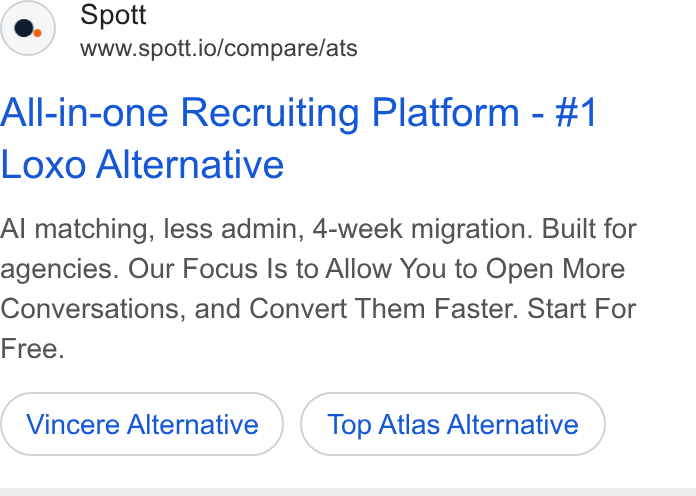
- Running
- 143 days (longevity = it's converting)
- Hook
- Visual: A circular logo with an orange dot and a dark grey dot on a white background, next to the text "Spott" and "www.spott.io/compare/ats". Text: "All-in-one Recruiting Platform - #1 Loxo Alternative"
- CTA / offer
- Start For Free.
- Audience
- Recruiting agencies and professionals seeking ATS/CRM solutions, indicated by "Built for agencies" and the mention of "Recruiting Platform" and specific alternatives like "Loxo", "Vincere", and "Atlas".
Why it works. Positions Spott as the leading switch option for Loxo users, aimed at recruiters already shopping for an ATS alternative with high intent.
Direct competitor comparison in headline: "All-in-one Recruiting Platform - #1 Loxo Alternative" If you can support it, claim the number one alternative to [Competitor] position in a headline aimed at competitor-branded searches.
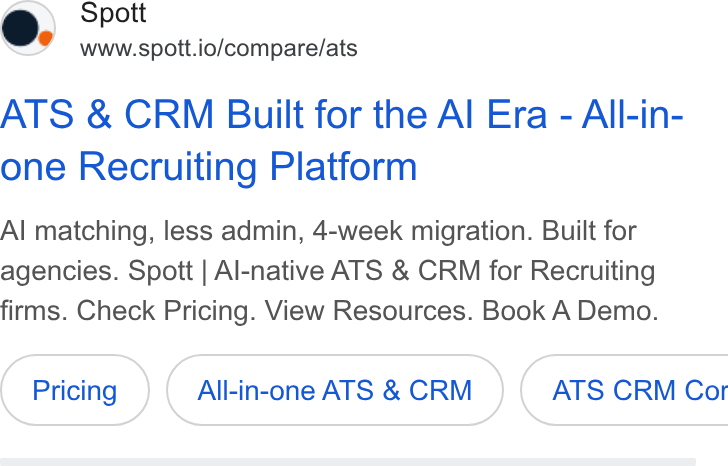
- Running
- 81 days (longevity = it's converting)
- Hook
- Spott logo (dark blue circle with orange abstract shape) and text "Spott www.spott.io/compare/ats" followed by "ATS & CRM Built for the AI Era - All-in-one Recruiting Platform"
- CTA / offer
- Check Pricing. View Resources. Book A Demo.
- Audience
- Recruiting firms and agencies, indicated by phrases like "Built for agencies" and "AI-native ATS & CRM for Recruiting firms."
Why it works. Search ad ties the category, ATS/CRM, to a named moment, the AI era, so firms worried about falling behind self-select in.
Headline with a bold claim: "ATS & CRM Built for the AI Era - All-in-one Recruiting Platform" Name the industry shift your product rides, like 'the AI era', directly in your headline instead of just listing features.
Show 3 more ads
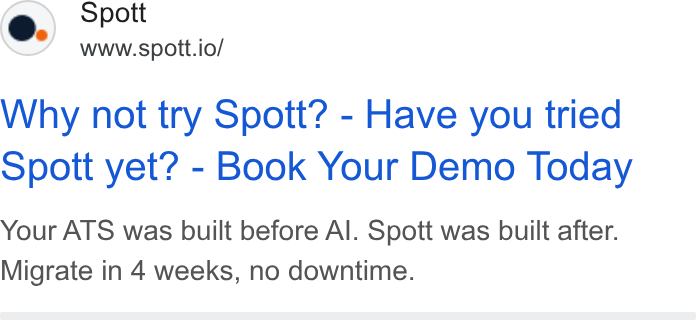
- Running
- 77 days (longevity = it's converting)
- Hook
- Visual: A circular logo with a dark blue shape and a small orange dot, next to the text "Spott" and "www.spott.io/". Text: "Why not try Spott? - Have you tried Spott yet? - Book Your Demo Today"
- CTA / offer
- Book Your Demo Today
- Audience
- Recruiting firms using an Applicant Tracking System (ATS) that is not AI-native, indicated by "Your ATS was built before AI."
Why it works. Uses a soft rhetorical question paired with a same-line demo CTA to lower the perceived risk of switching ATS providers.
Direct question headline: "Why not try Spott? - Have you tried Spott yet? - Book Your Demo Today" Test a headline phrased as a casual question (Why not try X?) paired with an immediate low-friction CTA like Book a demo.
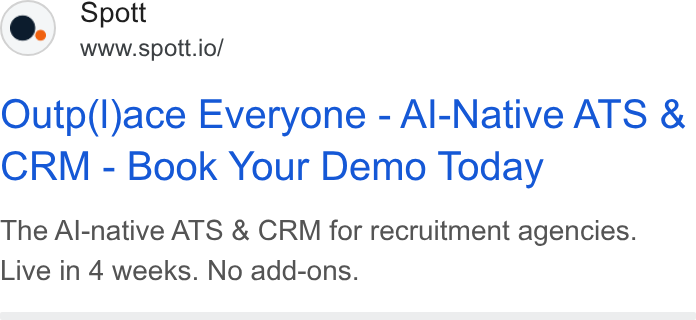
- Running
- 76 days (longevity = it's converting)
- Hook
- Spott www.spott.io/ Outp(I)ace Everyone - Al-Native ATS & CRM - Book Your Demo Today
- CTA / offer
- Book Your Demo Today
- Audience
- Recruitment agencies, evidenced by the line "The Al-native ATS & CRM for recruitment agencies."
Why it works. Turns a generic speed claim into a memorable wordplay that visually fuses AI into the promise, aimed at agencies wanting a competitive edge.
Headline with a bold, competitive claim: "Outp(I)ace Everyone - Al-Native ATS & CRM - Book Your Demo Today" Look for a common power word where your category acronym (like AI) can be spelled out inside it for a headline pun.
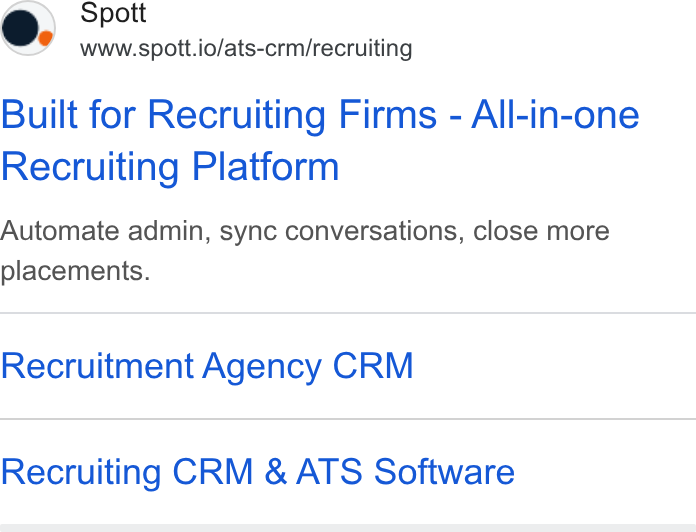
- Running
- 141 days (longevity = it's converting)
- Hook
- "Built for Recruiting Firms - All-in-one Recruiting Platform" is the headline, with a dark blue circle with an orange dot logo and the text "Spott www.spott.io/ats-crm/recruiting" above it.
- Audience
- The phrases "Recruiting Firms", "Recruitment Agency CRM", and "Recruiting CRM & ATS Software" directly signal the target audience of professionals in the recruiting industry.
Why it works. Search ad headline states the buyer and category outright, filtering clicks to recruiting firms already searching for an ATS/CRM.
Headline targeting: "Built for Recruiting Firms - All-in-one Recruiting Platform" Put your buyer's job title or industry into your search ad headline instead of just naming your product category.
09 The playbook
The channels are not separate. They are one system where each stage feeds the next. Here is the read, then the plays to run tomorrow.
The inferred playbook
The 8 open roles listed as of 2026-07-25 split between backend engineering in Leuven and a revenue layer spanning sales, customer success, and talent acquisition across Leuven and New York, reading as a company still building core product while laying an enterprise sales floor on top of it. The loop starts with paid demand capture, funnels into a sales team running demos, and compounds through a referral effect the company credits with most of its growth.
Google and LinkedIn ads carry the top of funnel with competitor-alternative and milestone creative, since Search Organic is just 12.8% of total traffic.
A human sales team runs the deal, evidenced by a "Book Your Demo Today" funnel and an AE hiring push spanning Leuven and New York, meaning conversion depends on sellers rather than a self-serve signup.
Dig deeper+3▾
The company's own framing, "most of it came to us, not from us," points to a referral loop among recruiting agencies, reinforced by case studies naming firms migrated off Bullhorn, Vincere, JobAdder, and Loxo.
Spott charges $119-149/user/month for Core and $179-219/user/month for Pro depending on annual versus monthly billing, plus an Enterprise tier around €149/user/month. Against that pricing and a team of roughly 21 people, an estimated MRR in the low-to-mid six figures (a rough estimate, not independently verified) is more plausible as an ongoing run rate than the "$1M added in a single month" claimed in the company's own June 2026 LinkedIn post.
demo-to-paid conversion rate, seat-expansion or net revenue retention once an agency is onboard, and any independent launch-day reception (Product Hunt or press) beyond the company's own milestone posts.
Boost your own milestone post as an ad
The proofSpott's "+$1M in new ARR in a single month" and "447% customer growth" posts run as boosted LinkedIn ads under "Promoted by Spott," among its longest-active creative.
The adaptationWrite one plain-language, numbers-first update about your own business, a revenue figure, a customer count, or a hard lesson, framed the same direct way ("we added X in a month"), and put a small budget behind it as a LinkedIn boosted post targeted at your exact buyer job titles instead of posting it organically and hoping. Run it for a week and compare it against your last three organic posts.
Cost: under $500. Time to signal: days. Works pre-PMF: conditional, only if the number is small but real; don't manufacture a milestone you don't have.
Build one comparison page and match it with a search ad
The proofSpott's TrackerRMS-vs-Spott page and its "Vincere Alternative" and "#1 Loxo Alternative" Google ads both target the same competitor-switcher intent, and Search Paid still carries 7.9% of its total traffic.
The adaptationWrite a specific "[Competitor] alternative" comparison page naming real feature differences for the one competitor your prospects mention most, then bid a small daily budget on that competitor's brand name in search. Publish the page first at no cost, then add paid bidding once you see any organic pickup.
Cost: $0 to start, under $500 with paid search added. Time to signal: weeks. Works pre-PMF: yes.
Seed a "which tool should I use" thread where your buyers already argue about tools
The proofA thread in r/RecruitmentAgencies asking whether to move to Spott drew a real, if modest, score and comment count from an account tagged as founder-linked in the underlying data.
The adaptationPost a genuine, specific question about your category (not your own product by name) in the subreddit or forum where your buyers already compare vendors, then participate honestly in the replies to surface organic discussion. Start with one subreddit and one question tied to a real decision you or a peer is facing.
Cost: $0. Time to signal: days. Works pre-PMF: yes, but treat it carefully: posting from a company-linked account without disclosure risks being flagged as astroturfing and can get a Reddit account banned, so disclose the affiliation if asked and never do this at volume.
Turn an accelerator or credential badge into evergreen ad creative
The proofSpott's photo of its three co-founders in front of the Y Combinator wall is one of its longest-running "proven winner" LinkedIn ads, expanded on above.
The adaptationIf you've gone through any recognizable credential (an accelerator, a notable customer logo, a press mention), get one real photo or screenshot of it and run it as a simple, low-production ad rather than treating it as a one-time announcement post. The mechanism: credibility signals compound as ongoing creative far longer than they do as a single day's post.
Cost: under $500. Time to signal: weeks. Works pre-PMF: conditional, only if the credential is genuinely recognizable to your buyer; an obscure badge won't move anyone.
Turn a new hire's onboarding story into recruiting and proof content
The proofSpott boosts posts from a newly hired Head of US and a sales lead describing why they joined, run the same way as its milestone ads.
The adaptationWhen you make your next hire, ask them to write two or three sentences on why they joined and what surprised them in their first weeks, post it under their name, and share it the same places you'd share a product update. Use the same specific, first-person framing Spott's hires use ("I've talked to 250+ of them") rather than generic praise for the company.
Cost: $0. Time to signal: days. Works pre-PMF: yes. Not transferable at an earlier stage: the human-seller conversion funnel, an AE team spanning two continents, depends on the $3.2M in funding Spott raised to staff it. A reader without that capital should adapt the content and paid-capture mechanics above, not the sales headcount that closes the deals they generate.
You just read how Spott does it. Tomorrow it is someone else.
Every morning we take one company that is actually growing and break down where its customers come from: the ads still running after a year, the channel doing the real work, and the play you can run this week.
Systemaic · directional intelligence. Traffic, spend, and reach figures are SimilarWeb-style estimates and qualitative reads of public data, not audited numbers. Built on real public receipts.
// teardowns with a similar GTM motion
sources & receipts (21)
Live ad libraries: linkedin ad library · google ad library
Launch archives: Hacker News: Bop Spotter · Hacker News: AI tools are spotting errors in research papers · Hacker News: Spotting base64 encoded JSON, certificates, and private keys · Hacker News: Dark web agent spotted bedroom wall clue to rescue girl from · Hacker News: Data sleuths who spotted research misconduct cleared of defa · Hacker News: Monster gravitational waves spotted for first time
Researched facts: Seed funding raised: $3.2M seed round, led by Base10 Partners · Participating investors in seed round: Y Combinator, Fortino Capital, True Equity, and ang · Y Combinator batch: Winter 2025 (W25) · Founding date: November 2024 · Founders and roles: Manu Vanderveeren (Co-Founder & CEO), Samuel Smeys (Co-Founder & CTO), · Founders' shared background: The three co-founders met studying business engineering at KU · Headquarters location: Leuven, Belgium, with an additional office in New York City (Ventur · Core product description: AI-native ATS & CRM for recruiting/staffing firms, built on a ve · Daily active user count: 1,000+ daily active users across five continents (Argentina, US, · Customer migration sources: Spott has migrated recruiting-agency customers off Bullhorn, V · Named executive-search customer: Stanton Chase (global executive search firm) has run paid · Customer case study — Rainy Day Recruitment: Australian agency Rainy Day Recruitment rebui
Community threads: G2: G2 reviewer who evaluated multiple ATS platforms before choosing Spott, citing no clos
Traffic, spend, and revenue figures are estimates as noted in the report; the links above are the primary public artifacts.