- 01Engineer share loops into every output
- 02Localize one high-intent tool page into a lower-competition language market
- 03Disclose one retention or burn metric alongside every revenue milestone post
- 04Build at AI-assisted speed to outship larger teams on feature surface
01 Snapshot
The one-glance read on who they are and how they grow. Each point is verifiable from the receipts above.
Genspark (genspark.ai) is an AI workspace platform that uses orchestrated multi-agent systems to automate multi-step knowledge work -- research, presentations, spreadsheets, and docs -- for business teams; it pivoted from search to agentic AI in April 2025 and reached a reported $250M ARR twelve months later.
Funded and scaling via product-embedded virality, a creator affiliate network, and an aggressive paid search machine.
Approximately 15.3M monthly visits; $250M ARR reported in April 2026; $635M raised across four rounds to a $2.6B post-money valuation; approximately 6,000 Google ads active as of July 4, 2026; freemium with a Team plan at $30/user/month.
Co-founder and CEO Eric Jing, posting on X in September 2025: "for startups, speed is the moat" -- backed by a ~20-person core team, Q2 net burn under $1M, and 88-92% month-1 paid retention.
As of July 4, 2026, Genspark launched Google video ads for the first time, a format shift from a previously text-only search campaign running for up to ~302 days.
Genspark's acquisition machine runs on three compounding layers: product outputs that carry a built-in "Remix with Genspark" share button, a creator affiliate army posting under #WorkWithGenspark in four languages, and a paid Google search blanket -- all feeding a 67.4% direct-traffic base that signals the retained paying user cohort is real and sticky.
02 How it unfolded
The order the channels came online. Sequence is strategy: what they did first, and what they layered on once demand existed.
03 Traffic & channel mix
Estimated demand, the channel split behind it, and the keywords and referrers doing the work. Directional modeling, not audited analytics.
Traffic sources
Top search keywords
| Keyword | Volume | Weight | CPC |
|---|---|---|---|
| genspark | 656k | $1.74 | |
| genspark ai | 372k | $1.49 | |
| 젠스파크 | 160k | $1.47 | |
| gemini | 137.9M | $0.26 | |
| canva | 71.1M | $0.84 |
Top referring sites
Closest competitors by audience
Genspark draws an estimated 15.3M monthly visits, though the trend is down 25.7% over the last ~3 months -- a divergence from a revenue trajectory that was still pointing up as of April 2026 (the implications are in The Inferred Playbook).
Direct traffic at 67.4% is the defining number in the channel mix: it reflects habitual, return-visit behavior from users who have integrated the product into their daily work. The 88-92% month-1 paid retention Eric Jing disclosed in September 2025 is consistent with a base that comes back without prompting.
Paid search carries 14.6% of visits, and the presence of "gemini" (roughly 137.9M total monthly searches across the web) and "canva" (roughly 71.1M) in their keyword footprint shows the scope of competitor-term bidding: they are intercepting users already searching for adjacent tools. Organic search contributes 9.3%, concentrated almost entirely in Japanese-language pages covered in the next section.
Display ads add 3.4%, referrals 1.3%, and paid social 1.2%. The rest -- social organic 1%, generative AI referral 1%, email 0.6%, affiliate 0.2% -- totals under 5% combined.
Top referring sites: impact.com (an affiliate tracking platform, confirming a formal affiliate program is in place), number10blues.com, and damoa.ai, a Korean AI aggregator whose presence alongside Korean-language Google ads signals deliberate East Asian market expansion. Traffic overlaps most with manus.im (a direct agentic-AI rival), gamma.app (presentation-focused), and perplexity.ai (research-focused) -- each pointing to a different angle in the "replace your AI stack" positioning Genspark runs.
04 Organic content
The specific pages earning their organic search traffic, and the pattern behind why they rank. Adapt the format, not the topic.
Genspark's organic search surface is almost entirely a Japanese-language localization play: the /ja homepage alone accounts for 83.3% of approximately 750K organic visits per month, and the next three pages (/ja/tools/ai-presentation-maker, /ja/business, /ja/tools) contribute another 13.7%. The pattern is product-page localization rather than editorial content. Genspark localized the core workspace and tool pages into Japanese and captured top rankings for terms like "スライド作成 ai" (AI slide creation, ranked #2) in a market where English-first AI tools have historically been slower to localize. Japan is one of Genspark's top-five reported markets, so the intent behind these pages aligns with converting traffic, not passive discovery.
- https://www.genspark.ai/ja (~185,878 organic visits/mo)
- https://www.genspark.ai/ja/tools/ai-presentation-maker (~11,393 organic visits/mo)
- https://www.genspark.ai/ja/business (~10,341 organic visits/mo)
- https://www.genspark.ai/ja/tools (~8,962 organic visits/mo)
- https://www.genspark.ai/ja/tools/ai-photo-editor (~1,842 organic visits/mo)
Top pages by organic traffic
05 Channel map
Not traffic share. How much weight the growth system actually puts on each channel, with a one-line read on the role it plays.
What drove growth
06 The motions doing the work
For founder-led SaaS the breakdown shifts from ads to traction: where the first users came from, how the founder grows it in the open, and the compounding organic surface.
Genspark's entire revenue ramp traces to a single hard pivot: abandoning its prior search-product identity and launching Super Agent on April 3, 2025.
Super Agent launched April 3, 2025 as a full directional reset from search to agentic AI. Nine days in, Eric Jing announced $10M ARR on X with 91,544 views and 307 likes. The founder framed it as "the fastest AI product in history" -- the evidence doesn't independently verify that ranking, but the velocity is concrete: approximately $36M ARR by approximately May 18, 2025 (45 days post-launch) and $50M ARR by approximately September 2025 (five months).
The founding team built over 80% of the product code using AI-assisted generation (described as "vibe working"), which let a ~20-person core team ship weekly updates. Zero paid marketing ran in the first phase. Shipping velocity substituted for headcount, and the output was a feature-complete workspace at a pace large incumbents couldn't match.
Dig deeper+2▾
"Remix with Genspark" buttons embedded in every generated output -- slides, research reports, spreadsheets -- turned each shared file into a distribution touchpoint. Every recipient of a Genspark-generated asset was one click from the product.
Hacker News traction was minimal across the company's public history -- eight total submissions, all with low point counts, no front-page Show HN breakout. The Super Bowl placement in February 2026 was the catalyst for the most-discussed HN thread (6 points), but the discussion was skeptical. Community-led developer channels were not where Genspark found its audience. ---
Eric Jing runs a build-in-public practice on X that treats ARR milestones as earned media events, not just internal celebrations.
Jing's post announcing $10M ARR nine days after launch (April 2025, 91,544 views) established the pattern: milestone + specific metric + competitive framing, published the moment a threshold is crossed. The September 2025 $50M ARR post added retention data (88-92% month-1 paid retention) and burn figures (Q2 net burn under $1M), turning a revenue announcement into a credibility artifact for the operator and investor audience that follows SaaS benchmarks.
Jing uses plainspoken competitive positioning in his posts: "Genspark is the AI Costco where we select the best models for you, one subscription is enough to access them all." That framing communicates the product's commercial logic -- a bundled all-you-can-eat workspace priced below running five separate AI subscriptions -- in a phrase that gets shared without explanation.
Dig deeper+1▾
At 18,094 followers, Jing's X audience is modest relative to the $250M ARR scale. No LinkedIn or Reddit presence from the founding team appears in the evidence. The build-in-public surface is concentrated on one founder, one platform -- which means the milestone posts depend on earned reshares to reach beyond Jing's direct audience. ---
Organic search accounts for 9.3% of Genspark's approximately 15.3M monthly visits -- a small share for a company at this revenue scale, and one the Japanese localization play (detailed in Organic Content above) largely explains. The paid search machine is the real investment. Google creative leans on two angles: the brand hook ("Genspark Super Agent") and a specific tool offer ("Free AI PowerPoint Generator"). Ads run in English, Japanese, and Korean. The text ads with the longest active run (~302 days) signal a campaign that has found its return and is running without creative rotation. The July 3, 2026 video ad batch is the first format test on Google -- worth watching as a signal of where they take the next creative cycle.
impact.com appearing as a top referrer confirms a formal affiliate program is live. The #WorkWithGenspark creator network on TikTok and Instagram functions as a hybrid affiliate-plus-UGC surface: creators receive affiliate economics, the brand gets product-review content in English, Italian, French, and Korean, and the hashtag acts as a searchable content library that compounds with each new post.
Genspark does not appear to invest in editorial blog posts, comparison pages, or programmatic templates at any detectable scale. The organic footprint is full product-page localization into Japanese, capturing high-intent search in a market where English-first AI tools have lagged. Korea is the next visible expansion vector (Korean Google ads, a Korean AI aggregator as a referral source), suggesting a replication of the Japan playbook. ---
07 Paid ads
This founder-led SaaS also runs paid acquisition. Here are the live ads doing the work, each with the X-ray and a play you can adapt.
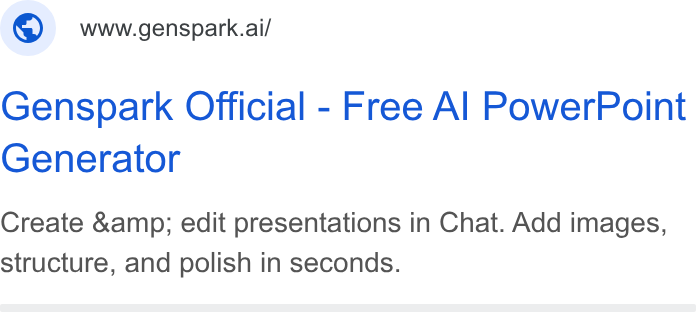
- Running
- 181 days (longevity = it's converting)
- Hook
- www.genspark.ai/ Genspark Official - Free AI PowerPoint Generator
- CTA / offer
- Free AI PowerPoint Generator
- Audience
- Individuals or professionals who create presentations and seek tools to streamline the process, indicated by the direct mention of 'PowerPoint Generator' and 'presentations in Chat'.
Why it works. Leads with a specific free tool for a common task instead of a generic brand name, giving searchers an immediate reason to click.
Headline clearly states the core offering and its cost: 'Genspark Official - Free AI PowerPoint Generator'. Replace a generic product name headline with your single most concrete free deliverable, naming the exact task it replaces.
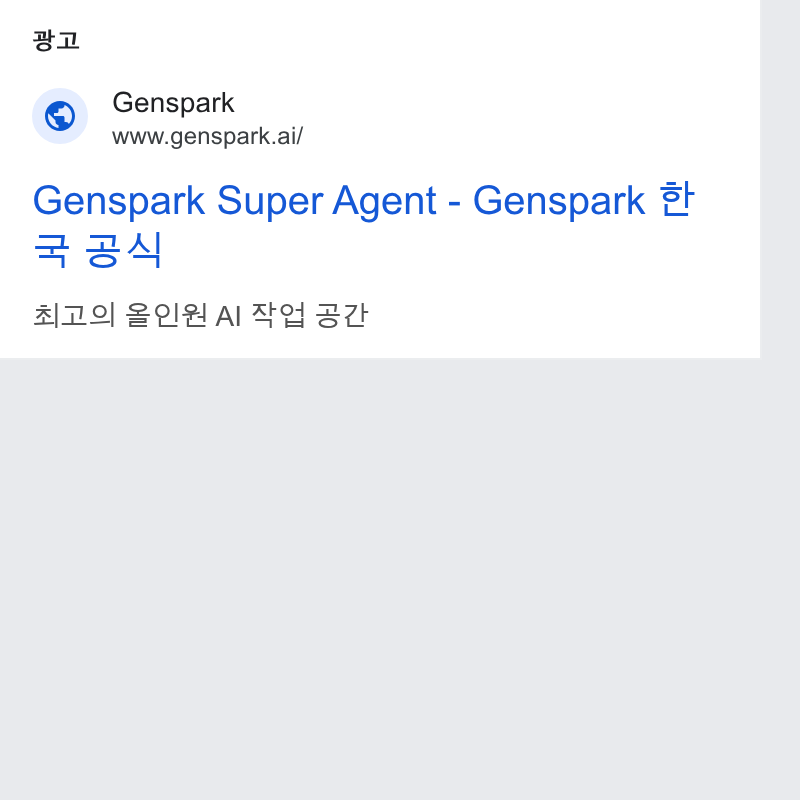
- Running
- 218 days (longevity = it's converting)
- Hook
- 광고 Genspark www.genspark.ai/ Genspark Super Agent - Genspark 한 국 공식 최고의 올인원 AI 작업 공간
- Audience
- Professionals and businesses interested in AI tools and workspace solutions, indicated by the terms "AI 작업 공간" (AI workspace) and "Super Agent".
Why it works. Localizes the pitch for Korea with a specific value line, best all-in-one AI workspace, rather than just translating the brand name.
Prominent display of brand name and URL: "Genspark www.genspark.ai/" When localizing an ad for a new market, translate the value proposition line itself, not just the brand name and URL.
08 The playbook
The channels are not separate. They are one system where each stage feeds the next. Here is the read, then the plays to run tomorrow.
The inferred playbook
Genspark's acquisition loop starts with a product engineered to share itself, converts on a freemium model (100 credits/day free, no card required), and retains at high rates on a $30/user/month Team plan -- with paid search and a creator affiliate network filling the cold-discovery gap the product's virality alone can't reach.
Every generated asset carries a "Remix with Genspark" share button. The recipient of any forwarded slide deck or research report is the next potential user of maximum relevance. In B2B knowledge work, outputs get shared constantly -- this mechanic lets the product grow at the speed of sharing.
By the time a user searches "genspark" (656K monthly searches across the web) or "genspark ai" (371K), the brand-term bid ensures Genspark appears first. The ad library covering competitor terms ("gemini," "canva") intercepts users mid-comparison -- that is a demand-capture layer, not demand generation.
Dig deeper+3▾
#WorkWithGenspark posts reach audiences who have never encountered a Genspark output. The top creators function as conversion-context videos, showing the product handling real workflows before a user ever signs up. The cross-language posts (Italian, French, Korean) suggest the creator program is actively recruited across markets, not just organically assembling.
The most recent ARR figure ($250M, April 2026) was still growing. The evidence doesn't establish the mechanism, but one plausible read is that the April 2025 Super Agent launch generated a spike from social and organic discovery that isn't being replaced by a compounding content layer, while the paying cohort -- the 67.4% direct-traffic base with 88-92% month-1 retention -- stays put. If the top of the funnel is thinning, paid search and creator UGC become load-bearing for replacing that organic intake.
Free-to-paid conversion rate, churn beyond month-1, CAC by channel, blended ARPU across free and Team tiers. ---
Engineer share loops into every output
The proofEvery Genspark-generated slide, doc, or research report carries a "Remix with Genspark" button. The recipient of any shared output is one click from the product. This mechanic was live at the April 2025 launch and is a structural reason a 20-person team reached $10M ARR in nine days with zero paid marketing.
The adaptationAudit every artifact your product already produces that users forward to others -- a formatted report, a generated doc, a dashboard snapshot -- and add a tracked "open in [Your Product]" or "made with [Your Product]" link directly to it. Referral embedded in the moment of consumption outperforms referral at signup because the recipient has already seen the output's value. The first step is identifying the file type or export that leaves your product most often, then adding the link before any other referral mechanic.
Cost: $0 · Time to signal: weeks · Works pre-PMF: yes, provided the product produces a shareable artifact someone else would actually open
Localize one high-intent tool page into a lower-competition language market
The proofThe Japanese /ja pages drive approximately 625K of Genspark's ~750K monthly organic visits. The /ja/tools/ai-presentation-maker page earns roughly 11K organic visits by ranking #2 for "スライド作成 ai" (AI slide creation), a term with real commercial intent that English-first AI tools had not saturated.
The adaptationPick one market where your product category is growing but English-first tools dominate -- Japan, Korea, France, Brazil, and Germany are common candidates. Fully localize your product landing page and one high-intent tool or use-case page into that language (native translation, not auto-translate), then submit it to Google Search Console. The investment is two to four days of translation work. The return is organic rankings in a market where the competition for those terms is materially lower than in English. Start with the page that describes your most-searched feature.
Cost: under $500 · Time to signal: months · Works pre-PMF: conditional -- a localized page for a half-finished product earns traffic that churns immediately; this works once you have one feature that genuinely solves a job-to-be-done
Disclose one retention or burn metric alongside every revenue milestone post
The proofEric Jing's September 2025 X post attached 88-92% month-1 paid retention and Q2 net burn under $1M to the $50M ARR figure, reaching 88,762 views. The retention number converted a vanity ARR announcement into a credibility artifact, shared by operators who track SaaS benchmarks.
The adaptationWhen your month-1 retention crosses a genuinely strong threshold (80%+ is a reasonable bar) or your burn-to-revenue ratio is unusually efficient, publish the specific figure alongside the milestone. One metric that signals product quality (retention) and one that signals capital efficiency (burn) gives the post two distinct audiences: operators who will share it to their networks, and founders who will reference it. Start by writing the post the moment the metric clears a threshold you would be proud to defend in due diligence.
Cost: $0 · Time to signal: days · Works pre-PMF: conditional -- this mechanic generates credibility only when the metrics are genuinely strong; posting mediocre retention publicly invites the skepticism that the Genspark Super Bowl placement received on Hacker News
Build at AI-assisted speed to outship larger teams on feature surface
The proofGenspark's 20-person core team shipped Super Agent by generating over 80% of the product code via AI-assisted generation, then shipped weekly product updates for the following year. That pace justified a "replace multiple AI subscriptions" positioning that required feature breadth a typical small team would have taken 18 months to build manually.
The adaptationBefore scoping your next sprint as a manual build, define the feature as a detailed plain-language spec and run it through an agentic coding workflow. The goal is a higher output-per-engineer ratio, not zero engineers. For a solo or two-person team, this means a full feature that would have taken two weeks can become a three-day task, which compresses the time between "user asks for X" and "X ships." First step: scope one complete feature as a written prompt and test the quality gap before committing to a manual build.
Cost: $0 · Time to signal: weeks · Works pre-PMF: yes
Run a creator affiliate program anchored to one ownable hashtag
The proof#WorkWithGenspark creator posts have generated 232,404 engagements on a single TikTok video (Maddie, August 2025), 9,882 (Moddy, April 2026), plus a long tail of dozens of posts in the 1,000-6,000 range. Creators post in English, Italian, French, and Korean, giving the brand organic reach into four language markets without a dedicated marketing team in each. The impact.com referrer in the traffic mix confirms the program runs through a formal affiliate platform.
The adaptationChoose one use-case hashtag your product owns -- specific to a workflow or outcome, not a generic category term -- and set a CPA or flat-rate payout through an affiliate platform (impact.com or PartnerStack are both common starting points). Recruit 10-20 mid-tier creators (10K-200K followers) in your target niche with a brief that gives them a single product angle ("replace your 5 AI tools with one") and a specific call-to-action format (the dominant pattern in Genspark's creator posts: "comment [keyword] and I'll DM you the link"). The hashtag is the compounding surface: a user who watches one creator video and searches the hashtag finds all the others, which builds social proof from the second touchpoint onward.
Cost: dedicated budget or hire · Time to signal: weeks · Works pre-PMF: conditional -- requires a product that is visually demonstrable in a short video and a creator audience that overlaps with your ICP; a B2B tool with no visual output does not translate to this format Not transferable at an earlier stage: the Super Bowl commercial, the Caltrain station takeover, and the approximately 6,000-ad Google library covering competitor terms all require both the budget ($635M raised across four rounds) and the brand surface area to sustain. The Microsoft Agent 365 integration is a distribution partnership that depends on enterprise revenue credibility a pre-PMF team cannot yet offer. The plays above are drawn from Genspark's earliest mechanics, the ones that got them to $10M ARR before any of the above was possible.
You just read how Genspark does it. Tomorrow it is someone else.
Every morning we take one company that is actually growing and break down where its customers come from: the ads still running after a year, the channel doing the real work, and the play you can run this week.
Systemaic · directional intelligence. Traffic, spend, and reach figures are SimilarWeb-style estimates and qualitative reads of public data, not audited numbers. Built on real public receipts.
// teardowns with a similar GTM motion
sources & receipts (7)
Live ad libraries: google ad library
Launch archives: Hacker News: What Is Genspark? · Hacker News: AI Startup Genspark in Talks to Raise over $200M at More Tha · Hacker News: ChatGPT Angent vs. Genspark Super Agent Side by Side · Hacker News: Genspark AI Browser · Hacker News: Show HN: Suparagent AI- Alternative to Manus and Genspark · Hacker News: All AI Unicorns (Including New Additions Suno and Genspark A
Traffic, spend, and revenue figures are estimates as noted in the report; the links above are the primary public artifacts.