- 01Kill the losing bet on a numeric deadline
- 02Post the boring usage counter instead of the milestone
- 03Recruit a named champion for your launch
- 04Build a free tool that ranks on the job, not the brand
01 Snapshot
The one-glance read on who they are and how they grow. Each point is verifiable from the receipts above.
An AI video-repurposing SaaS that turns long-form video into short vertical clips for creators and media teams.
Creator-UGC-led and paid-search-led, with a founder-documented launch story underneath both.
~5.64M estimated monthly visits (+3.9% over the last 3 months) as of 2026-07-11, 138,386 owned Instagram followers, a ~400-ad Google library (233 active in the sampled set) and a live Meta ad set, and a $215M valuation after a $20M SoftBank Vision Fund 2 round in March 2025.
Google evidence shows a fresh wave of new advertiser identities (Zhen Li, Roberto Leamon) running text ads into opus.pro, each active for just 4-8 days as of 2026-07-11.
The product manufactures its own distribution: creators use OpusClip to clip their own content, then post those clips (and reviews of the tool itself) back onto TikTok and Instagram, so the paid-search and Meta budgets are largely defending brand-term demand that the creator layer already generated.
02 How it unfolded
The order the channels came online. Sequence is strategy: what they did first, and what they layered on once demand existed.
03 Traffic & channel mix
Estimated demand, the channel split behind it, and the keywords and referrers doing the work. Directional modeling, not audited analytics.
Traffic sources
Top search keywords
| Keyword | Volume | Weight | CPC |
|---|---|---|---|
| opus clip | 371k | $0.39 | |
| opusclip | 152k | $0.62 | |
| opus | 275k | $0.71 | |
| opus clips | 38k | $0.45 | |
| agent opus | 29k | $1.61 |
Top referring sites
Closest competitors by audience
OpusClip pulls ~5.64M estimated monthly visits, up 3.9% over the last 3 months. Direct traffic dominates at 42.5%, consistent with a tool people bookmark and return to for repeat uploads rather than rediscover per session; Search Organic follows at 27.5%, and Search Paid adds another 9%, meaning close to a third of the mix is bought or defended on keywords rather than earned through content alone. Social Organic contributes a further 8.7%, the direct traffic-side echo of the creator-UGC wave documented below, while Display Ads add 4.2% and the rest, referrals, AI-assistant referrals, paid social, and email, together total under 8%. On keywords, "opus clip" (371,300 searches/month) and "opusclip" (152,400 searches/month) are almost entirely brand-term defense, while "agent opus" (28,860 searches/month) shows real demand forming around their newer AI video-agent product. Referrers skew toward tool ecosystems rather than press: feishu.cn (a Chinese workspace/collaboration tool, likely internal document links rather than marketing), hotmart.com (a course and digital-product marketplace, suggesting creator-course instructors are linking to or teaching with OpusClip), and posteverywhere.ai (an adjacent social-scheduling tool, more likely a cross-promotional or integration relationship than a competitor). The closest competitors are veed.io (a broader all-purpose video editor competing on adjacent workflows), vizard.ai (the most direct AI-clipping rival), and descript.com (a higher-end podcast/video suite pulling from the same creator base).
04 Organic content
The specific pages earning their organic search traffic, and the pattern behind why they rank. Adapt the format, not the topic.
Their top organic pages are not blog posts, they are free single-purpose utility tools: a YouTube transcript extractor pulls an estimated 16.4% share of the sampled organic pages, and a YouTube Shorts resize tool and a "best hashtags for YouTube" research page round out the top five alongside the homepage and the in-product editor page. The pattern is a programmatic top-of-funnel play: narrow, single-task pages built around adjacent search intent (get a transcript, resize a video, find hashtags) rather than the core "clip my podcast" pitch, each cheap to rank because the competing intent is a utility need, not a purchase decision. That mix, plus first-place rankings on "opus clip" and "opusclip" and top-10 placement on "youtube transcript" and "youtube to transcript," suggests the tool pages exist mainly to catch searchers before they know they need a clipping product, then convert them once they're already inside the editor.
Top pages by organic traffic
05 Channel map
Not traffic share. How much weight the growth system actually puts on each channel, with a one-line read on the role it plays.
What drove growth
06 The motions doing the work
For founder-led SaaS the breakdown shifts from ads to traction: where the first users came from, how the founder grows it in the open, and the compounding organic surface.
OpusClip's early traction came from abandoning a failing product on a deadline, then documenting the replacement's raw usage numbers in public before it had a name anyone trusted.
According to public reporting on the company's founding, the team shut down an AI livestreaming product that had drawn only around 200 users in its first three months and rebuilt the company around the clipping feature those same users had been organically requesting.
The private beta opened March 21, 2023, and twenty days in, the founder posted the exact processing tally, 2,934 hours of user-uploaded video and 51,238 generated clips, as proof the tool worked at real volume before any public launch.
Dig deeper+2▾
OpusClip went live on Product Hunt on 2023-07-11 with the tagline "a GenAI video tool that turns a long video into viral shorts in one click," hunted by a named third party (Michael Mignano) rather than self-submitted, giving the launch post outside credibility on the feed.
The $1M-ARR milestone and the 400K-user count noted above both land within the first four months of that beta, so the growth curve tracks the beta-to-launch sequence itself rather than any single viral spike visible in the evidence.
Build-in-public here runs through one founder's personal feed rather than a large following, so the transferable habit is the transparency cadence, not audience size.
Young Zhao's personal account, not the @opusclip brand handle, carries every traceable milestone post, the beta processing numbers, the Product Hunt debut, and the funding announcement, while the brand account is only linked from the homepage with no posts in evidence.
Each post leads with a specific count (hours processed, creators onboarded, clips generated) instead of a lesson or reflection, a receipts-first style suited to an audience that hasn't yet decided to trust the founder.
Dig deeper+2▾
At 821 followers, the account is too small to function as a primary demand channel at OpusClip's current scale, so the founder's posts read as a documentation trail that press and the case-study content below can point back to, rather than a standalone growth engine.
The subreddit activity visible here is unprompted user complaints that the founder neither posts to nor replies in, so unlike founder-led companies that seed their own subreddit threads, this growth motion runs on product-market pull rather than founder community management.
The organic system is a free-utility funnel feeding a paid-search layer that splits cleanly into brand defense and demand generation.
The transcript-extractor and resize pages covered above sit inside a Search Organic channel that already carries 27.5% of total visits, and the replicable system is building free single-task tools next to the paid editor, rather than any single page winning on its own.
LinkedIn case-study posts framed as "Audacy just generated 1B+ views" and a Grant Cardone Enterprises repurposing story, run as promoted posts, substitute named customer wins for keyword capture, a different content mechanic from the SEO pages above.
Dig deeper+2▾
The site embeds Rewardful (an affiliate-tracking platform) and links to a dedicated opus.pro/affiliate page, the infrastructure behind the "comment CLIP for the link" mechanic creators use across TikTok and Instagram noted above, turning satisfied users into paid referral nodes rather than relying on organic mentions alone.
Google's creative alternates brand-defense text ads ("OpusClip - Opus Clip," "opus.pro") with demand-generation ones targeting adjacent jobs ("Auto-Caption Your Videos," "1-Click, 10 Viral Clips," a blog-post ad for "The Ultimate Guide to Video Podcast Software"), while Meta's English creative leads with a feature checklist (Virality Score, AI B-Roll, Speaker Detection) and a parallel Portuguese-language set citing Mark Rober and Dhar Mann as tool users tests expansion into Brazil.
07 Paid ads
This founder-led SaaS also runs paid acquisition. Here are the live ads doing the work, each with the X-ray and a play you can adapt.
- Running
- 32 days (longevity = it's converting)
- Hook
- "Você provavelmente conhece essas pessoas que estão aparecendo aqui em cima." + Split screen showing a man in a blue suit on top and the narrator on bottom.
- CTA / offer
- "1 Semana Grátis" and "50% de desconto nos primeiros três meses"
- Audience
- Content creators and video editors; evidenced by mentions of YouTube, viral shorts, and automating video cutting.
Why it works. A niche creator-economy voice links recognizable top creators to one shared tool, borrowing their credibility to sell the software.
Authority Association (0:00-0:05) "Você provavelmente conhece essas pessoas..." Show 3 to 4 recognizable leaders in your niche and ask what they have in common before revealing your product as the shared answer.
- Running
- 5 days (new — still being tested)
- Hook
- "REGGAETON" text on a necklace worn by an AI-generated woman in a black leather jacket holding a glowing, circuit-patterned cube.
- CTA / offer
- "Get clips in 1 click"
- Audience
- Content creators and podcasters, evidenced by the UI showing long-form podcast footage being converted into vertical clips for social media platforms like TikTok and X.
Why it works. Opens on a high-fidelity AI-generated visual to signal advanced technology before cutting to the actual product interface converting long videos into shorts.
Visual pattern interrupt with high-fidelity AI art (0:00-0:03) Open your ad with a 3-second AI-generated visual that metaphorically represents your product's core benefit before showing the real interface.
- Running
- 4 days (new — still being tested)
- Hook
- "I FOUND A CHEAT CODE" + Pixar-style 3D animation of a girl with curly black hair looking surprised at a glowing computer screen.
- Audience
- Content creators looking to repurpose long-form video for social media (YouTube, TikTok, Instagram, LinkedIn icons shown).
Why it works. Cinema-grade animation stands out against typical creator UGC ads, then sells the tool as a growth shortcut for people tired of manual editing.
Gaming-inspired 'Cheat Code' framing (0:00 - 'I FOUND A CHEAT CODE') Use words like cheat code, hack, or glitch in the first 3 seconds to describe your tool's core benefit instead of listing features.
Show 3 more ads
- Running
- 1027 days (longevity = it's converting)
- Hook
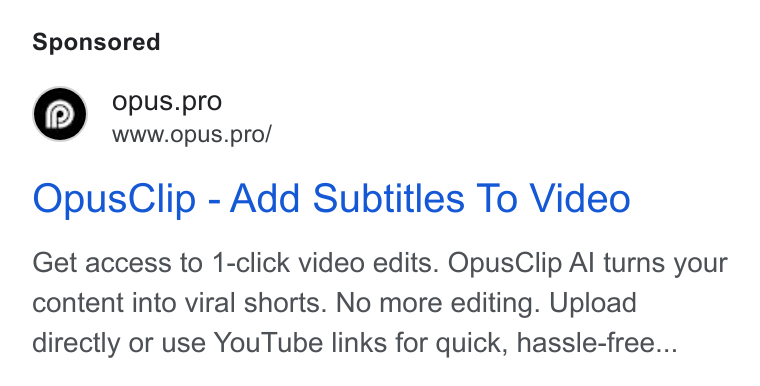
- Sponsored opus.pro www.opus.pro/ OpusClip - Add Subtitles To Video Get access to 1-click video edits. OpusClip AI turns your content into viral shorts. No more editing. Upload directly or use YouTube links for quick, hassle-free...
- CTA / offer
- OpusClip - Add Subtitles To Video
- Audience
- Content creators and video editors, indicated by phrases like "video edits," "viral shorts," and "YouTube links."
Why it works. Matches subtitle-focused search intent then upsells the full AI clipping suite in the description for searchers who came for one feature.
Headline directly addresses a common task: "OpusClip - Add Subtitles To Video" Write a search headline that repeats the exact task phrase your buyer would type, then expand to your full product in the description line.
- Running
- 1026 days (longevity = it's converting)
- Hook
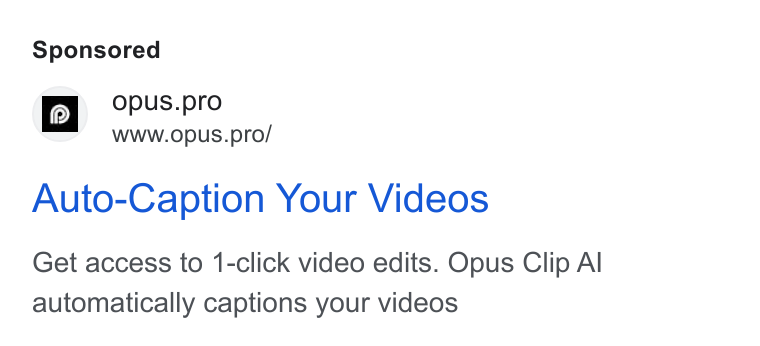
- Sponsored opus.pro www.opus.pro/ Auto-Caption Your Videos
- CTA / offer
- Get access to 1-click video edits. Opus Clip Al automatically captions your videos
- Audience
- Individuals or businesses who create videos and need to add captions, indicated by the direct offer to "Auto-Caption Your Videos" and mention of "1-click video edits."
Why it works. Captures narrow-intent searchers hunting specifically for captioning rather than general video editing, a cheaper and higher-converting query.
Clear problem/solution headline: The ad uses the headline "Auto-Caption Your Videos" to immediately state the problem it solves. Split one broad feature-set ad into several single-feature search ads, each headlined with just that one task.
- Running
- 1026 days (longevity = it's converting)
- Hook
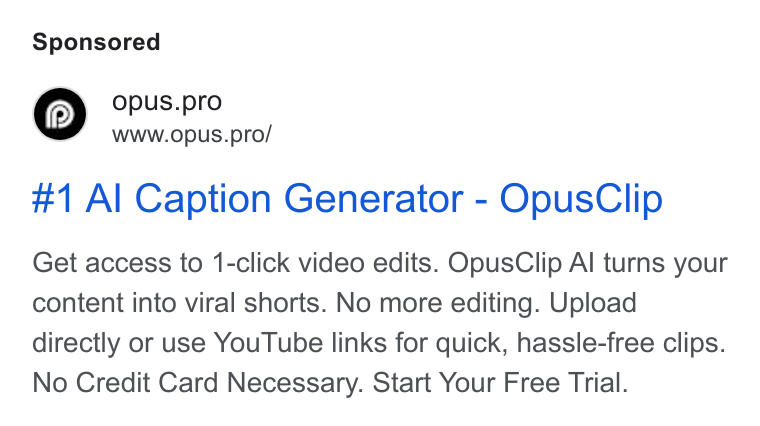
- #1 Al Caption Generator - OpusClip
- CTA / offer
- Start Your Free Trial.
- Audience
- Content creators and marketers who produce video content and seek efficiency, signaled by phrases like 'viral shorts', 'no more editing', and 'hassle-free clips'.
Why it works. Gives comparison shoppers a ranking shortcut in a crowded caption-tool category instead of asking them to evaluate features.
Lead with a bold, quantifiable claim: '#1 Al Caption Generator - OpusClip' If you can defend a category ranking claim, lead your headline with it instead of a feature list.
08 The playbook
The channels are not separate. They are one system where each stage feeds the next. Here is the read, then the plays to run tomorrow.
The inferred playbook
The loop starts on creator platforms, converts through a free tier and free tools, and compounds through customer references and an affiliate program, while a support-quality complaint sits right next to the growth engine.
TikTok and Instagram creators, not brand posting, are the top-of-funnel noted above, and that UGC volume plausibly explains why "opus clip" and "opusclip" alone pull the hundreds of thousands of monthly searches captured in the Traffic section.
A $0 Free tier (60 credits a month, watermarked exports) and the free utility tool pages let a prospect finish a clip before ever seeing the $15 Starter, $29 Pro, or custom-priced Business tier, so the paywall sits after the "aha moment" rather than before it.
Dig deeper+3▾
Company and press materials tied to the SoftBank raise name enterprise customers including Univision, Billboard, and iHeartMedia, unverified customer claims rather than confirmed case studies, while the Rewardful affiliate program noted above turns individual creators into standing referral partners, so both the enterprise layer and the creator layer regenerate demand without new ad spend.
The Reddit threads about unusable clips and unresponsive support sit directly beside a fast-growing paid-acquisition motion, a retention risk the traffic numbers do not surface; the founder's own personal account is also too small to be a scale lever, unusual for a company still leaning on a founder narrative in press at this size.
free-to-paid conversion rate, churn, CAC, and blended ARPU across the four pricing tiers.
Kill the losing bet on a numeric deadline
The proofOpusClip's founders shut down an AI livestreaming product that had drawn only around 200 users in three months and rebuilt the company around the clipping feature those same users kept requesting, the pivot covered in Launch & Traction above.
The adaptationSet a specific user-count threshold before you start building anything, for example 200 signups by week twelve or you redirect, and track which small feature or workaround users ask for unprompted while the main product stalls. When the deadline passes without hitting the number, rebuild around that requested feature instead of iterating on the original pitch, since users pulling toward one narrow feature on their own is a stronger signal than founder conviction in an untested roadmap.
Cost: $0 · Time to signal: weeks · Works pre-PMF: yes
Post the boring usage counter instead of the milestone
The proofDuring its 20-day private beta, OpusClip's founder posted the exact processing tally, 2,934 hours of video and 51,238 clips generated, rather than waiting for a press-worthy milestone.
The adaptationIf you're running a beta with no customers yet, post a specific usage number every few days on your own X or LinkedIn: units processed, error rate improved, signups by day. A specific, slightly unglamorous number reads as verifiable even from a stranger with a small following, which is what makes it work before you have testimonials to lean on.
Cost: $0 · Time to signal: days · Works pre-PMF: yes
Recruit a named champion for your launch
The proofOpusClip's Product Hunt debut was hunted by a named third party rather than posted from the company account, lending outside credibility to the launch feed.
The adaptationBefore your own launch on any feed-based platform, spend a week finding one person with even a modest following in your category and offer them early access in exchange for being the visible submitter or nominator. Their name attached to the post substitutes for the reputation you don't have yet.
Cost: $0 · Time to signal: days · Works pre-PMF: yes
Build a free tool that ranks on the job, not the brand
The proofOpusClip's highest-traffic organic pages are free single-task tools, a transcript extractor and a resize tool, that rank on generic utility searches rather than the branded product name, covered in Organic Content above.
The adaptationPick one narrow, free, embeddable step in your paid product's workflow, a converter, a checker, a calculator, and publish it as its own page targeting a plain-language "how do I" search instead of a "best X tool" comparison search. It competes for far less contested intent, and one person with basic web skills can ship it.
Cost: under $500 · Time to signal: months · Works pre-PMF: conditional, yes if you can build the tool yourself; skip it until after launch if it requires hiring a developer.
Gate the referral link behind a comment, and back it with a real payout
The proofOpusClip runs a self-serve affiliate program and its creator UGC consistently tells viewers to comment a keyword for the link rather than posting a bio link, both covered above.
The adaptationSet up low-cost affiliate software with a clear commission, then recruit three to five small creators or existing customers in your niche and give them the same script: ask viewers to comment a word and follow up by direct message with the tracked link. The mechanism: platforms suppress reach on posts with outbound links, so gating the link behind a comment keeps the post's distribution intact while still capturing the lead.
Cost: under $500 · Time to signal: weeks · Works pre-PMF: conditional, yes once you have a paying product to fund the commission; it doesn't work before that. Not transferable at an earlier stage: OpusClip's large Google ad library and multi-language Meta creative testing assume ad budget and a data team no pre-PMF founder has. Adapt the seeding mechanics above, not the media-buying scale.
You just read how Opus Clip does it. Tomorrow it is someone else.
Every morning we take one company that is actually growing and break down where its customers come from: the ads still running after a year, the channel doing the real work, and the play you can run this week.
Systemaic · directional intelligence. Traffic, spend, and reach figures are SimilarWeb-style estimates and qualitative reads of public data, not audited numbers. Built on real public receipts.
// teardowns with a similar GTM motion
sources & receipts (3)
Live ad libraries: meta ad library · linkedin ad library · google ad library
Traffic, spend, and revenue figures are estimates as noted in the report; the links above are the primary public artifacts.