- 01Run Your Own Product on Your Own Marketing First
- 02Build a Practitioner Glossary Before a Blog
- 03Write the Ad That Admits It Is an Ad
- 04Turn Customer-Facing Hires Into Distribution From Day One
01 Snapshot
The one-glance read on who they are and how they grow. Each point is verifiable from the receipts above.
B2B attribution and activation SaaS that maps the full account-level buying journey for mid-market and enterprise marketing teams, with a freemium entry at $0 for up to 5 seats and a custom enterprise plan, backed by $67M total raised including a $55M Series B in October 2025.
Content-led demand generation built on proprietary benchmark research distributed as LinkedIn thought leadership and amplified by organic employee advocacy rather than paid account-targeted ads.
~84,150 estimated monthly visits as of July 6, 2026, 35 active Google ads as of July 6, 2026 with the oldest running since October 2021, and 100%+ year-over-year ARR growth at flat headcount reported at the October 2025 Series B.
As of July 6, 2026, new Meta video ads lead with "B2B's ROAS winner has been decided" and fresh Google text ads reframe the product as "B2B Revenue Analytics" and "Engagement Data Tool," both shifting away from the original "marketing attribution" label.
Dreamdata's structural advantage is the product-as-proof loop: it attributes its own LinkedIn spend using its own platform, publishes those benchmark findings (a 272-day average buyer journey and 121% ROAS for LinkedIn, per the 2026 LinkedIn Ads Benchmarks Report) as category education, and converts the B2B marketers who engage with those findings into demo requests.
02 How it unfolded
The order the channels came online. Sequence is strategy: what they did first, and what they layered on once demand existed.
03 Traffic & channel mix
Estimated demand, the channel split behind it, and the keywords and referrers doing the work. Directional modeling, not audited analytics.
Traffic sources
Top search keywords
| Keyword | Volume | Weight | CPC |
|---|---|---|---|
| dreamdata | 9.8k | $11.01 | |
| dream data | 820 | $37.65 | |
| hockeystack | 18k | $12.32 | |
| dreamdata documentation | 240 | - | |
| dream adata benchamark report | 190 | - |
Closest competitors by audience
~84,150 estimated monthly visits as of July 6, 2026, down 20.8% over the prior three months. For a company that raised $55M in October 2025 on 100%+ ARR growth, this web-traffic retreat likely reflects a shift toward outbound, email, and LinkedIn pipeline generation rather than inbound web visits.
The three dominant channels account for 56.4% of visits. Direct (22.3%) reflects a product in daily operational use: an attribution platform that both existing customers and free-tier teams log into for reporting creates habitual return traffic before enterprise conversion. Search Organic (18.2%) runs on branded queries (they rank #1 for "dreamdata," a term drawing 9,790 total monthly searches across the web) alongside /library/ glossary pages covering B2B marketing concepts. Social Organic (15.9%) is concentrated on LinkedIn, matching Dreamdata's publicly stated primary distribution surface.
The remaining 43.6% distributes across Referrals (15%), Search Paid (14.8%), Email (10.7%), and Social Paid (3.2%). Search Paid nearly mirrors Search Organic because 35 active Google text ads have run without interruption since October 2021. Email at 10.7% is unusually high for a B2B SaaS at this stage, pointing to an active benchmark-report subscriber base. Social Paid accounts for the Meta campaigns running from April 2026 onward.
Two keyword signals define the acquisition logic. "Hockeystack" (17,930 total monthly searches across the web) is Dreamdata's highest-volume non-branded target, a direct attribution competitor's brand they bid on to intercept evaluators mid-comparison. "What are impressions on LinkedIn" is an educational ICP query where they rank #11, pulling B2B marketers before purchase intent has formed.
Three companies in the competitive set are interpretively rich. Hockeystack.com is a direct attribution rival whose brand is also Dreamdata's top non-branded keyword bid, confirming active competitor-keyword conquest. Attributionapp.com, another attribution tool, shows the same evaluation-traffic dynamic. Anteriad.com, a B2B demand-generation platform, signals Dreamdata competes at the intersection of attribution and activation, where buyers evaluate full-stack measurement vendors alongside point attribution tools.
04 Organic content
The specific pages earning their organic search traffic, and the pattern behind why they rank. Adapt the format, not the topic.
Dreamdata's organic footprint follows a B2B marketing glossary model: the /library/ section targets definitional, practitioner-level queries (LinkedIn impressions, target audience, paid marketing) that their ICP searches on the job, with the bet that a marketer looking up "what are impressions on LinkedIn" is the same person who will eventually need attribution software. The approach favors category-vocabulary ownership over comparison or "alternative to X" content, pulling informational intent from the right persona without triggering a hard-sell context.
The /intent-data page adds a category-level feature term, bridging the glossary surface to conversion intent. These five pages carry the organic load within a concentrated footprint, and the homepage alone accounts for roughly one in five tracked organic visits on branded queries.
Top pages by organic traffic
05 Channel map
Not traffic share. How much weight the growth system actually puts on each channel, with a one-line read on the role it plays.
What drove growth
06 The motions doing the work
For founder-led SaaS the breakdown shifts from ads to traction: where the first users came from, how the founder grows it in the open, and the compounding organic surface.
Dreamdata's early customer base came from direct founder-network outreach and a LinkedIn content motion started at founding, with the $4.4M seed closing in December 2020 well before any traditional launch moment: no Product Hunt listing or Hacker News Show HN is visible in the public record.
Lars Grønnegaard Hansen and Ole Lerche Dallerup brought Trustpilot seniority; Steffen Hedebrandt, who publicly announced joining as co-founder in June 2019, brought Airtame and Upwork relationships, together giving the team direct access to B2B SaaS marketing decision-makers before the product existed at any meaningful scale.
Early sales hire Laura Erdem describes joining when there was no inbound at all and building pipeline entirely through personal LinkedIn presence, framing her approach as showing up on LinkedIn and building demand from scratch when no one has heard of the company and there is no brand or inbound to rely on, a documented employee-led demand motion that predated any marketing infrastructure.
Dig deeper+2▾
Publishing B2B buyer journey benchmarks (the 272-day average, 88 touchpoints, and 10-stakeholder findings from its published benchmark research) positioned Dreamdata as a research publisher in the attribution category, attracting B2B marketers looking for numbers to justify internal budget requests rather than buyers actively evaluating a new tool.
The $4.4M seed (December 2020), ~$8M Series A (December 2022), and $55M Series B (October 2025, on 100%+ ARR growth at flat headcount) mark three distinct phases; Dave Kellogg, the veteran SaaS operator and Kellblog author, joining the board (announced June 2026, and picked up on Hacker News) signals the company is formalizing its enterprise GTM motion on top of the content-led base.
The build-in-public surface is LinkedIn-first and runs across three parallel layers: the CMO's personal editorial voice, an employee amplification track, and a data loop that converts product output directly into distributable content.
Hedebrandt operates as the company's main distribution voice on LinkedIn, keeping his personal posting separate from the @dreamdataio brand account; his @SHedebrandt account on X carries 5,014 followers and 4,005 posts as of the evidence snapshot, with X playing a secondary role to LinkedIn in this motion. The research brief describes his LinkedIn output as a deliberate mix of benchmark data, product commentary, memes, and raw attribution screenshots, prioritizing authenticity over polish.
Laura Erdem, an early sales hire, built personal LinkedIn distribution in parallel with the founders' content, generating pipeline from her own network when the company brand had no recognition. A podcast episode documents her approach as building demand from scratch via personal posts, extending the company's content surface without requiring the founders to post at higher frequency.
Dig deeper+1▾
Dreamdata attributes its own LinkedIn spend through its own platform, then publishes those attribution findings as benchmark content; the benchmark figures from the Snapshot recirculate as organic posts and as the creative inventory across the current Meta and YouTube ad campaigns. The marketing motion and the product demonstration are structurally the same exercise.
The content strategy bets on ICP persona accuracy over keyword volume, with Search Organic at 18.2% of the traffic mix running primarily on branded queries and a small library of practitioner-level definitions.
The /library/ pages covered above pull B2B marketers on job-level queries before any software evaluation intent has formed, with /intent-data/ bridging from educational vocabulary to a direct product feature.
Each annual LinkedIn Ads Benchmarks Report functions simultaneously as an email-list builder, a source of infographic ad creative, a LinkedIn organic seed, and a search asset. The 2026 edition, analyzing 66+ million sessions, generated the full creative inventory running across Meta, YouTube, and Google from a single production cycle, distributing content across four channels without a separate creative brief per channel.
Dig deeper+2▾
The 35 active Google text ads as of July 6, 2026 have run in continuous rotation since October 2021, with creatives spanning branded terms ("Marketing Attribution Software"), category-claim angles ("B2B Attribution," "Track B2B Buyer Journeys"), and free-tier calls to action ("Sign Up For Free"). The highest-volume non-branded keyword target, "hockeystack," is a competitor brand bid capturing buyers already in vendor-evaluation mode for a direct rival.
Google ads launched in January 2026 introduce framings the prior five years never used: "B2B Revenue Analytics," "Engagement Data Tool," and a new video format (first active March 2026). Meta video ads testing "B2B's ROAS winner has been decided" follow the same shift, collectively suggesting a deliberate pivot toward broader platform positioning away from the original "attribution" label.
07 Paid ads
This founder-led SaaS also runs paid acquisition. Here are the live ads doing the work, each with the X-ray and a play you can adapt.
- Running
- 49 days (longevity = it's converting)
- Hook
- "B2B deals are getting more complex" headline over a static infographic showing 2024 metrics for channels, stakeholders, and touchpoints.
- CTA / offer
- LinkedIn® Ads Benchmarks Report 2026
- Audience
- B2B marketing and sales professionals, indicated by terms like 'B2B deals', 'stakeholders', and 'touchpoints'.
Why it works. Uses a year-over-year checkbox and channel-count visual to make a trend claim feel tracked rather than asserted, aimed at B2B marketers watching deal complexity rise.
Comparative bar chart animation (0:01-0:04) Show a claim as a year-over-year checkbox comparison plus one supporting stat, instead of a plain text claim.
- Running
- 49 days (longevity = it's converting)
- Hook
- "Benchmarking benches in San Francisco" shown over a woman sitting on a wooden bench overlooking the Golden Gate Bridge.
- CTA / offer
- "Check out our real benchmarks at dreamdata.io"
- Audience
- B2B marketers (mentions of 'buying committee', 'pipeline in the dark', 'B2B sales cycle', and 'ROAS').
Why it works. Truncates 'Benchmark' mid-word over a relaxed vacation-style shot, using the visual gag to earn a beat before revealing the real product benchmarks.
Literal Visual Pun (0:00): "Benchmarking benches" Cut off a category word mid-syllable over an unrelated, relatable visual, then pay off the joke by revealing your product's real data.
- Running
- 49 days (longevity = it's converting)
- Hook
- "B2B's ROAS winner has been decided" headline appears above a table comparing Facebook, Google, and LinkedIn metrics.
- CTA / offer
- LinkedIn® Ads Benchmarks Report 2026
- Audience
- B2B marketers and growth leads, evidenced by the use of 'B2B', 'ROAS', and 'Influenced New Business Deals' metrics.
Why it works. Frames a channel comparison as an already-decided contest, giving LinkedIn ad buyers a data table that justifies moving Facebook and Google budget to LinkedIn.
Progressive disclosure of data rows (0:00-0:06) Open with a flat verdict about your category, then back it with a CPC/CPM style table against the two next-most-obvious alternatives.
Show 3 more ads
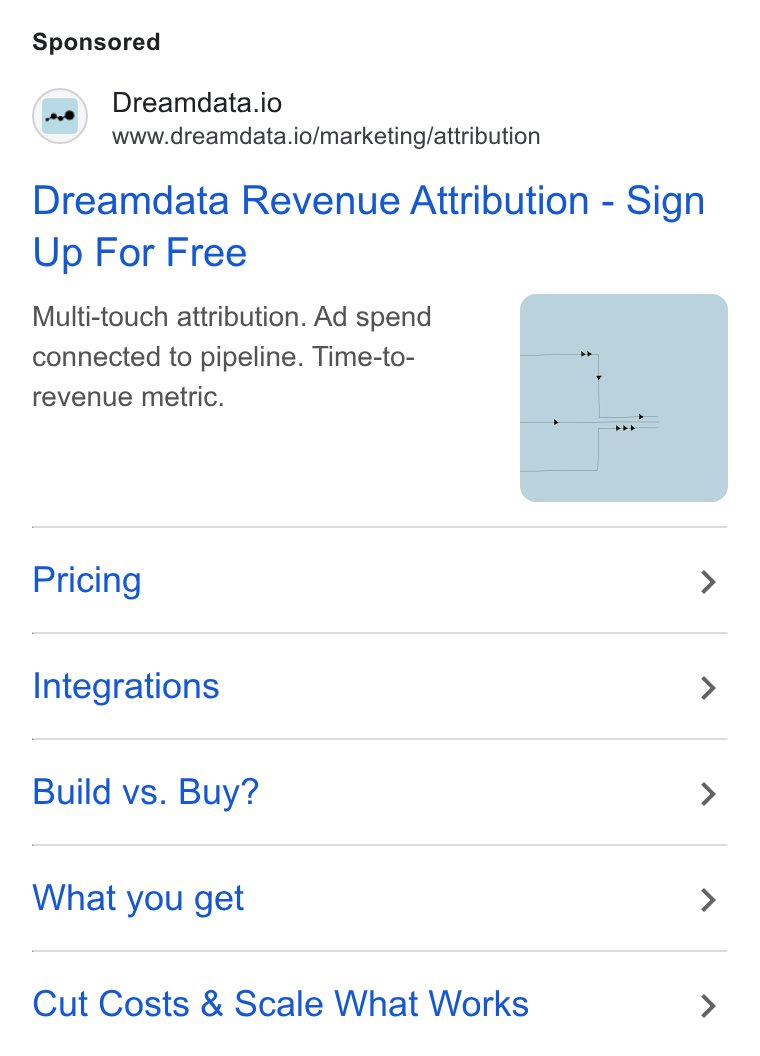
- Running
- 663 days (longevity = it's converting)
- Hook
- Sponsored" and a small circular logo with three dots, next to "Dreamdata.io" and "www.dreamdata.io/marketing/attribution". Below that, "Dreamdata Revenue Attribution - Sign Up For Free".
- CTA / offer
- Sign Up For Free
- Audience
- Businesses or marketers interested in 'Multi-touch attribution', 'Ad spend connected to pipeline', and 'Time-to-revenue metric'. The questions 'Pricing', 'Integrations', 'Build vs. Buy?', 'What you get', and 'Cut Costs & Scale What Works' suggest a B2B audience evaluating software solutions.
Why it works. Names the product category and pairs it with a free-signup offer in a single headline, filtering for high-intent B2B searchers.
Headline with clear value proposition: "Dreamdata Revenue Attribution - Sign Up For Free" Put your product category name and a free-trial CTA in the same headline so intent and offer land in one glance.
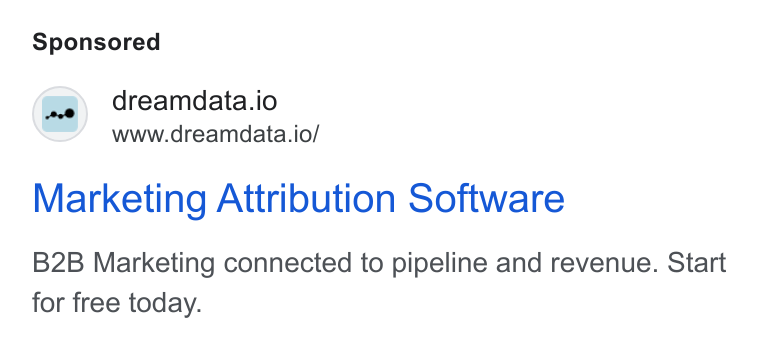
- Running
- 713 days (longevity = it's converting)
- Hook
- Sponsored dreamdata.io www.dreamdata.io/ Marketing Attribution Software B2B Marketing connected to pipeline and revenue. Start for free today.
- CTA / offer
- Start for free today.
- Audience
- B2B Marketing professionals, indicated by "B2B Marketing connected to pipeline and revenue."
Why it works. States the category, the revenue outcome, and a free-start CTA in one compact block for searchers who already know the term attribution.
Clear product identification and benefit-driven headline: "Marketing Attribution Software" Sequence your headline as category, then the revenue outcome it drives, then a free-start CTA, all in one short block.
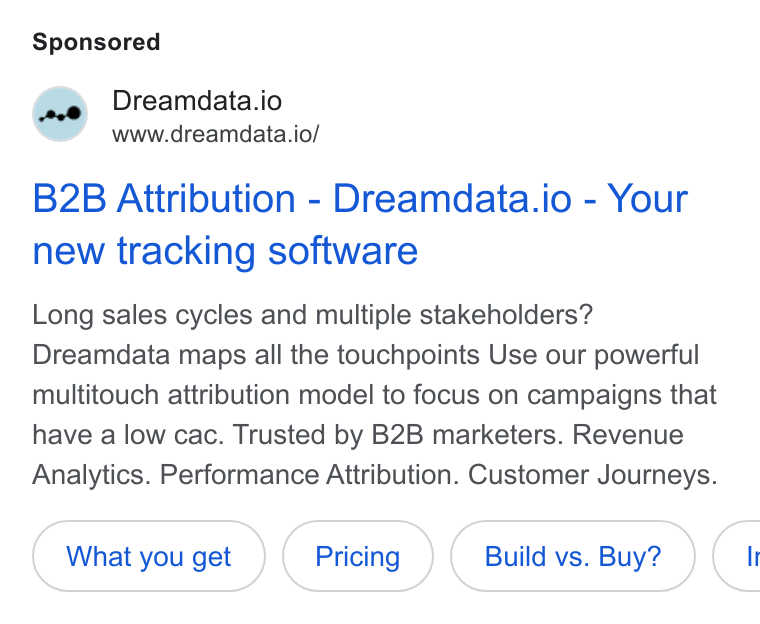
- Running
- 1713 days (longevity = it's converting)
- Hook
- Sponsored Dreamdata.io www.dreamdata.io/ B2B Attribution - Dreamdata.io - Your new tracking software
- CTA / offer
- What you get
- Audience
- The text 'Long sales cycles and multiple stakeholders?' and 'Trusted by B2B marketers' directly addresses B2B professionals facing complex sales and marketing challenges.
Why it works. Assumes the reader already tracks attribution somehow and reframes the ad as an upgrade decision instead of a category-education pitch.
Headline directly addresses a core business need: 'B2B Attribution - Dreamdata.io - Your new tracking software'. Write your headline as a replacement pitch, your new X, aimed at people who already own a worse version of your category.
08 The playbook
The channels are not separate. They are one system where each stage feeds the next. Here is the read, then the plays to run tomorrow.
The inferred playbook
The near-doubling of headcount from approximately 50 to 103 employees between October 2025 and May 2026 signals a post-Series B push concentrated in GTM and customer success, with board-level enterprise advisory added in mid-2026 to formalize the sales motion on top of the content-led demand base. The acquisition loop runs: LinkedIn content earns attention at the CMO and marketing-director persona level; benchmark reports convert that attention into email subscribers and demo requests; the free tier ($0, 5 seats, 2 months of history) delivers a first attribution insight as a self-serve trial; closed customers generate more proprietary journey data; that data feeds the next annual benchmark report, closing the cycle and making each cohort of customers a production input for the next cohort's acquisition.
Hedebrandt's personal LinkedIn content, amplified by organic employee advocacy rather than paid account-targeted ads, generates pipeline that Dreamdata's own attribution platform validates, proving the channel works via the product itself, which then produces the next benchmark report. The tool and the marketing motion run on the same data.
At $0 for up to 5 seats with 2 months of user history, the free plan is a proof-of-insight gateway: a marketing team gets one real attribution view before any commercial conversation begins. Conversion to the paid custom tier requires that first free insight to deliver a genuine aha moment without sales assistance.
Dig deeper+2▾
The channel mix likely shifted toward outbound ABM and LinkedIn direct rather than a demand contraction; those motions do not generate tracked web visits the way inbound content does, and a post-raise company adding 50+ headcount in GTM is expanding its pipeline motion, not contracting it. The launch-driven spikes are, however, not yet being replaced by a compounding content-led inbound flywheel at the domain level.
Free-to-paid conversion rate, churn, CAC by channel, and blended ARPU across the free and paid tiers.
Run Your Own Product on Your Own Marketing First
The proofDreamdata attributes its own LinkedIn ad spend through its own platform and publishes the resulting data as a benchmark report; those stats became the creative hook across the current Meta ad set, generating reach by demonstrating the product rather than describing it.
The adaptationWhatever your product measures, measure it on your own business first and document one concrete finding worth sharing. A scheduling tool measures booking rates, publish your own data. A CRM tool tracks follow-up sequences, share what yours actually produces. The format does not need to be a polished report: a single LinkedIn post framed as "we ran this on ourselves, here is what happened" earns more credibility than a customer case study because readers know you cannot fabricate your own numbers. Start by running your product on your own workflow for 30 days, identifying the one finding that would genuinely surprise your ICP, and posting it without a pitch attached.
Cost: $0 · Time to signal: Weeks · Works pre-PMF: Yes, provided the product generates a measurable output you can document
Build a Practitioner Glossary Before a Blog
The proofDreamdata's top non-branded organic pages are /library/ definitions targeting queries like "what are impressions on LinkedIn" (ranking #11) and "target audience", low-competition terms their ICP types on the job, pulling the right persona before any evaluation intent has formed.
The adaptationList 8 to 10 terms your ICP searches for while doing their job (not while evaluating software) and publish one clean, accurate page per term under a /library/ or /glossary/ path, each linking to the product feature that addresses the underlying need. These terms often carry low total search volumes, making ranking achievable at modest domain authority, and they pull exactly the right persona at the earliest point in their research. Start by typing what your ICP would type into Google when stuck on a day-to-day work task and treating the autocomplete results as your initial keyword list.
Cost: $0 · Time to signal: Months · Works pre-PMF: Yes
Write the Ad That Admits It Is an Ad
The proofDreamdata's Meta creative "We paid for you to see this because we are marketers, you're a marketer, and this is what we do to each other" first ran in April 2026 and was refreshed in June 2026, making it one of the brand's most sustained Meta creative lines and a clear signal that self-aware copy outperformed conventional product-claim hooks against a B2B marketing audience.
The adaptationWhen your seller and buyer share a professional identity (marketers to marketers, developers to developers, designers to designers), write one ad that acknowledges the transaction openly. The hook becomes honesty: you know this is an ad, the reader knows, and here is why you believe it is worth their attention anyway. This disarms the professional cynicism B2B buyers bring to every sponsored post and replaces it with a moment of recognition. Start by drafting a headline that describes the relationship accurately rather than leading with the product's value proposition, and A/B test it against your current best-performing hook.
Cost: $0 · Time to signal: Days · Works pre-PMF: Yes
Turn Customer-Facing Hires Into Distribution From Day One
The proofLaura Erdem, Dreamdata's early sales hire, joined when there was no inbound pipeline and built demand entirely through personal LinkedIn content, extending the company's distribution surface beyond the founding team without requiring the founders to post more frequently, a documented pattern the company then scaled across additional employees.
The adaptationWhen you hire your first two or three sales, customer success, or growth people, build personal LinkedIn (or X) posting explicitly into the role from the start rather than treating it as optional initiative. Give them access to your product data so they have genuine things to say, amplify their strongest posts from the company account, and treat their individual networks as a sales channel in their own right. The mechanism: buyers at ICP companies trust practitioners over brand pages, and each hire reaches a network the founder has never touched. Start by listing the customer-facing people already on your team, identifying which one has the most natural voice, and scheduling a working session to write and publish their first post together.
Cost: $0 · Time to signal: Months · Works pre-PMF: Conditional, requires at least one customer-facing hire willing to post consistently under their own name
Intercept Buyers Already Evaluating Your Closest Competitor
The proof"Hockeystack," a direct attribution rival, is Dreamdata's highest-volume non-branded search keyword target (17,930 total monthly searches across the web for that term), capturing traffic from buyers already in vendor-evaluation mode for a competing product.
The adaptationScan your recent sales conversations for the most common "we are also looking at X" mentions, identify the one or two competitors that appear most frequently, and run a focused comparison page ("/vs/[competitor-name]") backed by a small keyword bid on that competitor's brand term. Buyers typing a competitor's name are already convinced they have the problem you solve; conversion intent is pre-qualified, which typically makes cost per acquisition lower than on category or generic keywords. Start with a $200 to $500 test on a single competitor brand term pointed at a simple comparison page covering three concrete differentiators.
Cost: Under $500 to test · Time to signal: Days to weeks · Works pre-PMF: No, requires enough live differentiation to make a credible comparison and a functioning conversion step (demo booking or trial signup) to capture the intent
Not transferable at an earlier stage: Dreamdata's LinkedIn employee advocacy motion, amplifying the CMO's organic posts through team-wide organic sharing rather than paid spend, requires a founder LinkedIn audience with meaningful organic reach already in place and a team willing to post consistently under their own names. Running it without those inputs produces posts with no earned credibility behind them, and B2B buyers notice. The annual benchmark report at Dreamdata's current production scale, drawing on 66+ million sessions of customer data, is similarly a later-stage lever that only becomes credible with hundreds of active customers generating the underlying data. Plays 1 through 4 above transfer at any stage; Play 5 requires post-PMF differentiation clarity before the comparison can be made credibly.
You just read how Dreamdata does it. Tomorrow it is someone else.
Every morning we take one company that is actually growing and break down where its customers come from: the ads still running after a year, the channel doing the real work, and the play you can run this week.
Systemaic · directional intelligence. Traffic, spend, and reach figures are SimilarWeb-style estimates and qualitative reads of public data, not audited numbers. Built on real public receipts.
// teardowns with a similar GTM motion
sources & receipts (5)
Live ad libraries: meta ad library · google ad library
Launch archives: Hacker News: The (technical) recipe for measuring the lifetime value of B · Hacker News: Why I'm Joining the Board of Dreamdata · Hacker News: Product led growth CRMs for revenue leaders
Traffic, spend, and revenue figures are estimates as noted in the report; the links above are the primary public artifacts.