- 01Turn the product itself into the launch hook
- 02Post shipped features with real numbers, from your own name
- 03Run your own branded subreddit as a shipping log
- 04Change the launch hook every time, don't recycle the format
01 Snapshot
The one-glance read on who they are and how they grow. Each point is verifiable from the receipts above.
Developer infrastructure for building AI voice agents that handle phone calls, now anchored by a headline enterprise win at Amazon Ring.
Founder-led and launch-driven at the outset, now layering a heavy enterprise paid-ads push on LinkedIn and Google.
~873,000 monthly visits as of 2026-07-09, against 1M+ developers and 1B+ calls processed as of the May 2026 Series B.
As of 2026-07-09, LinkedIn tests lean on vertical-specific proof points, citing UnityAI's Medicare outreach results and Spring Venture Group's stack-compatible rollout.
Vapi turns each enterprise deployment into ad creative almost immediately, running named-customer case studies (Spring Venture Group, UnityAI, Amazon Ring) as LinkedIn cold-outreach copy rather than broad brand messaging.
02 How it unfolded
The order the channels came online. Sequence is strategy: what they did first, and what they layered on once demand existed.
03 Traffic & channel mix
Estimated demand, the channel split behind it, and the keywords and referrers doing the work. Directional modeling, not audited analytics.
Traffic sources
Top search keywords
| Keyword | Volume | Weight | CPC |
|---|---|---|---|
| vapi | 152k | $0.34 | |
| vapi ai | 34k | $1.74 | |
| wapi | 9.9k | $1.47 | |
| vapi mcp | 920 | - | |
| vapi pricing | 1.5k | $1.34 |
Top referring sites
Closest competitors by audience
Vapi draws an estimated ~873,000 monthly visits, down 27.2% over the last 3 months. Direct traffic dominates at 56.9%, a plausible signal that existing developers are re-visiting bookmarked docs and dashboard URLs rather than discovering the product fresh each time. Search Organic follows at 22.5% and Referrals at 8.6%; Search Paid adds 3.6%, while the rest, Social Organic, Gen AI referrals, Email, Affiliate, Display, and Social Paid, together total roughly 8%.
The keyword picture reinforces the direct-traffic read: the terms they rank and bid for are almost entirely their own name, "vapi" (152,320 searches/mo), "vapi ai" (33,730 searches/mo), and "vapi pricing" (1,530 searches/mo), meaning the organic-search share is largely navigational rather than earned through competitive discovery. Top referrers include supabase.com and github.com, both consistent with a developer audience finding Vapi through adjacent dev-tool ecosystems, plus voicerr.ai, a smaller voice-AI-adjacent site. Named competitors in the traffic data include retellai.com, a direct voice-agent-platform rival; elevenlabs.io, a voice-model provider increasingly building its own agent layer; and twilio.com, the telephony incumbent whose call infrastructure Vapi effectively unbundles and re-packages for developers.
04 Organic content
The specific pages earning their organic search traffic, and the pattern behind why they rank. Adapt the format, not the topic.
Vapi's organic footprint is concentrated almost entirely on the product itself rather than a content marketing surface: the homepage alone earns 88.1% of tracked organic visits, with the next four pages, a voice-provider integration doc (playht), the quickstart guide, the live dashboard, and the pricing page, each pulling roughly 1.3-1.4%. There is no blog post, comparison page, or how-to guide in the top-five list, and every top-ranking keyword is a variant of the brand name itself ("vapi ai," "vapi," "vapi.ai," even the misspellings "wapi" and "vaip"). That pattern reads as branded, navigational search rather than a compounding SEO content engine: people who already know Vapi are finding the docs and dashboard through search, not discovering the product through a funnel of ranked educational content.
Top pages by organic traffic
05 Channel map
Not traffic share. How much weight the growth system actually puts on each channel, with a one-line read on the role it plays.
What drove growth
06 Who they’re hiring
Open roles read like a roadmap: the functions they’re staffing show where the company is investing next and what stage it’s at.
5 open roles
07 The motions doing the work
For founder-led SaaS the breakdown shifts from ads to traction: where the first users came from, how the founder grows it in the open, and the compounding organic surface.
Vapi's early traction ran through repeated Hacker News launch attempts, with only the most playful framing breaking through, and a scatter of third-party builders shipping tools on top of the API becoming the clearest sign real developers had adopted it.
the game-format Show HN, "convince our voice AI to give you the secret code" (covered above), remains the single post that broke through; a second solo attempt nearly a year later pitching the platform directly as "1-844-HEY-VAPI, voice AI platform for developers" (2025-04-02) drew just 12 points and 5 comments, a fraction of the original's reach.
later technical write-ups aimed at the same audience, "We Solved Latency at Vapi" (2025-07-19) and "How We Took Vapi from 99.9% to 99.99% Reliability" (2025-08-12), scored 3 and 2 points respectively, suggesting the front-page win was the format, not the founder's continued presence on the site.
Dig deeper+2▾
independent developers launched their own Show HN posts for tools built on top of Vapi, including a whitelabel dashboard for agencies (Mahmoud_Marey, 2025-03-03) and an AI-powered support center (danielampassos, 2024-05-23), showing organic ecosystem activity forming around the API rather than around Vapi's own marketing.
Vapi's co-founder Jordan Dearsley kept returning to Hacker News with new angles even after weaker showings, treating the platform as a recurring distribution surface rather than a one-time launch event.
Vapi's build-in-public engine runs almost entirely through co-founder Jordan Dearsley's personal accounts, with LinkedIn as the flagship surface (covered above) and X as the faster-cadence changelog.
a March 2025 X post from Dearsley detailed 5 features shipped in 5 days, claiming the update reached roughly 125,000 people across channels and drove 250+ applications to Vapi's startup program, turning an internal changelog into an acquisition post.
Dearsley posts far more frequently under his own name (232 posts versus co-founder Nikhil Gupta's 144), while Gupta's account is reserved for milestone moments like the Series B thread (covered above), splitting day-to-day cadence from headline announcements.
Dig deeper+1▾
the brand posts under its own account directly into its self-titled subreddit, r/vapiai, where the Series B announcement is the top post by engagement (covered above) and a later product update on new voice-model integrations drew only 3 points and no comments, making Reddit a distant third channel behind LinkedIn and X.
Vapi invests almost nothing in a compounding content or SEO surface, and paid search and social are filling the gap that a content engine would otherwise cover.
the site's blog is active per the crawl, but no comparison, "alternative to," or how-to page cracks the organic top-content list beyond the homepage and product docs (covered above), meaning there is no growing library of ranked pages behind the brand-name search traffic.
Vapi runs a referral program through Tolt, an affiliate-tracking tool embedded on the homepage, though affiliate referrals are a sliver of total traffic, making it an early-stage lever rather than a proven distribution engine.
Dig deeper+2▾
with organic content thin, the ad libraries (sizes covered above) carry bold-claim hooks built for direct response, a LinkedIn creative reading "4 engineers shipped voice AI in a week. No stack changes." and a Google search ad headlined "Boost Engagement by 30% Now," both substituting a quantified outcome for the category education a content library would normally provide.
the newest LinkedIn tests replace generic platform messaging with named-vertical proof points in healthcare and insurance (covered above), indicating paid is being used to open specific enterprise verticals rather than build broad brand awareness.
08 Paid ads
This founder-led SaaS also runs paid acquisition. Here are the live ads doing the work, each with the X-ray and a play you can adapt.

- Running
- 438 days (longevity = it's converting)
- Hook
- Boost Engagement by 30% Now
- CTA / offer
- Build AI Voice Agents in Minutes. Automate Calls & Improve Customer Experience Today!
- Audience
- Businesses or individuals looking to improve customer experience and automate calls, indicated by the text "Build AI Voice Agents" and "Automate Calls & Improve Customer Experience Today!".
Why it works. Swaps a vague benefit word for a hard percentage, giving marketing and CX buyers a number they can defend to their own boss.
Headline with a specific, high-impact number: "Boost Engagement by 30% Now" Replace a generic benefit word like better or faster with an actual percentage from your own case data, even a conservative one.
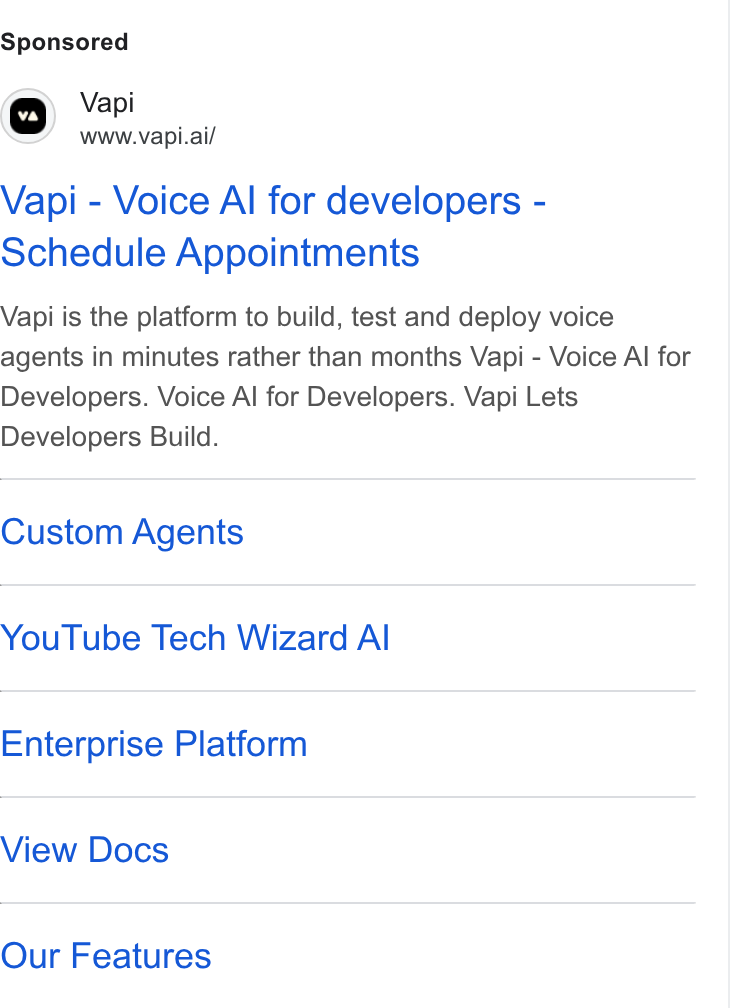
- Running
- 351 days (longevity = it's converting)
- Hook
- "Sponsored" text at the top, followed by a black circle with a white 'VA' logo, then "Vapi" and "www.vapi.ai/" text. Below this, the blue text "Vapi - Voice AI for developers - Schedule Appointments" is visible.
- Audience
- The text "Vapi - Voice AI for developers" and "Vapi Lets Developers Build" clearly targets software developers or companies looking to integrate voice AI.
Why it works. Moves past the generic voice AI pitch to name one concrete workflow, appointment scheduling, that a healthcare or services buyer immediately recognizes as their own pain.
Headline with clear benefit: The main headline states "Vapi - Voice AI for developers - Schedule Appointments". Pick your single most common customer use case and put it in the headline instead of your general product category.

- Running
- 262 days (longevity = it's converting)
- Hook
- Sponsored www.vapi.ai/ Vapi - Mistral AI Vapi Lets Developers Build, Test and Deploy Voice Agents in Minutes Rather than Months
- Audience
- The text 'Vapi Lets Developers Build, Test and Deploy Voice Agents' directly targets 'Developers' interested in 'Voice Agents' and AI.
Why it works. Anchors credibility by naming a known AI partner, Mistral AI, then quantifies the payoff as months of dev work collapsed into minutes, aimed at engineering leads evaluating build vs buy.
Headline with product and key technology: 'Vapi - Mistral AI' If you integrate with a recognizable AI provider, name it in your headline and pair it with a concrete before and after time comparison.
Show 3 more ads
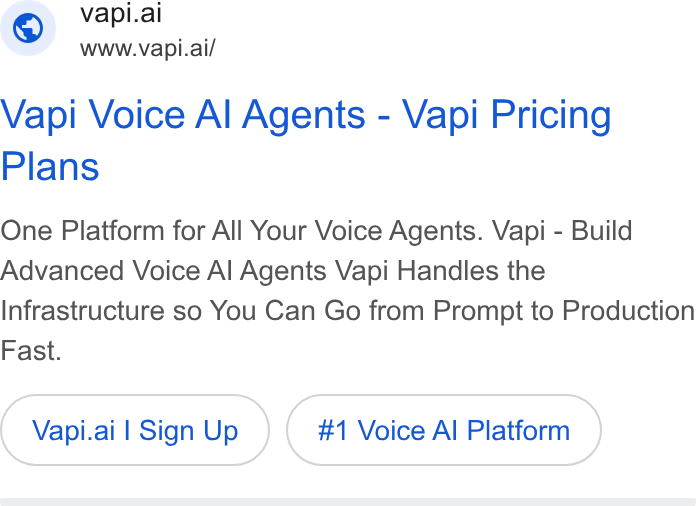
- Running
- 5 days (new — still being tested)
- Hook
- Visual: A small blue globe icon next to "vapi.ai" and "www.vapi.ai/". Text: "Vapi Voice AI Agents - Vapi Pricing Plans"
- CTA / offer
- Vapi.ai I Sign Up
- Audience
- Individuals or businesses looking for AI voice agent solutions, indicated by the text "Vapi Voice AI Agents" and "One Platform for All Your Voice Agents."
Why it works. Targets bottom-funnel searchers by combining the product name with pricing intent, catching buyers already comparing costs.
Headline clearly states the product and purpose: "Vapi Voice AI Agents - Vapi Pricing Plans" Run a search variant that appends 'Pricing Plans' to your product name to catch buyers in the comparison stage.
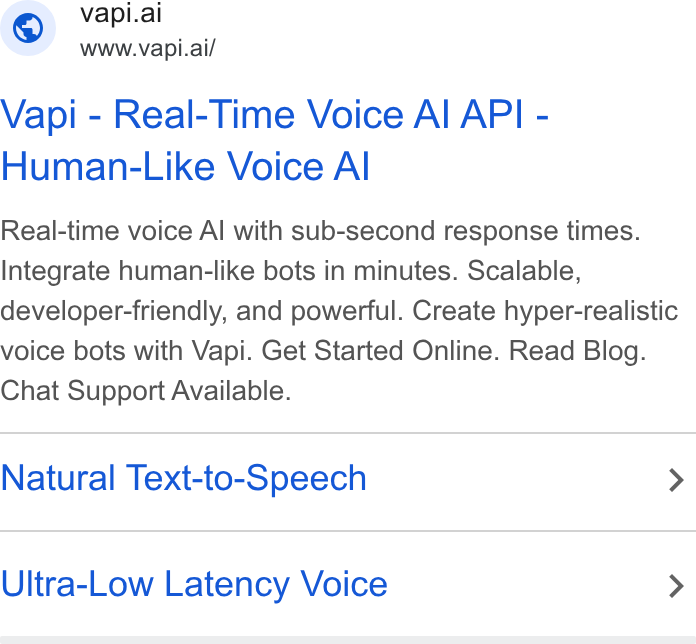
- Running
- 2 days (new — still being tested)
- Hook
- vapi.ai www.vapi.ai/ Vapi - Real-Time Voice AI API - Human-Like Voice AI
- CTA / offer
- Get Started Online. Read Blog. Chat Support Available.
- Audience
- Developers and businesses looking for AI voice solutions, indicated by 'developer-friendly', 'API', and 'Integrate human-like bots'.
Why it works. Targets developers comparing voice APIs by naming both a technical spec, real-time, and the qualitative output, human-like, in a single headline.
Headline stating core value proposition: "Vapi - Real-Time Voice AI API - Human-Like Voice AI" List your product category plus one technical spec and one outcome quality side by side in the headline.

- Running
- 3 days (new — still being tested)
- Hook
- vapi.ai www.vapi.ai/ Voice AI - Build Voice Agents - VP Of Software Development
- Audience
- The title "VP Of Software Development" and the focus on "advanced voice AI agents" signals that this is for high-level technical professionals involved in software development and AI.
Why it works. Calls out the exact decision-maker title in the ad itself, so a VP scrolling search results sees language written for their role, not a generic developer.
Headline with a bold claim and target role: "Voice AI - Build Voice Agents - VP Of Software Development" Add your actual target job title as a headline component so senior buyers self-select instead of guessing if the tool is for them.
09 The playbook
The channels are not separate. They are one system where each stage feeds the next. Here is the read, then the plays to run tomorrow.
The inferred playbook
Vapi's loop starts with frictionless developer signup, compounds through founder-driven trust, and converts into enterprise contracts that paid ads and a growing sales team now chase directly. Of the 5 open roles, 3 are enterprise or mid-market sales positions against 2 engineering roles, signaling Vapi is actively building an outbound sales layer on top of its self-serve developer base as of 2026-07-09.
pricing starts at a pure pay-as-you-go tier, $0.05/min for calls and $0.005/message for SMS and chat, with 10 concurrent lines included and additional lines at $10/month, removing any sales gate for a developer to start building.
HIPAA (+$2,000/month) and Zero Data Retention (+$1,000/month) are sold as line-item add-ons rather than gated behind a sales call, letting regulated buyers self-serve most of the way toward compliance before ever talking to a rep.
Dig deeper+4▾
the largest wins appear to close on named case studies pushed through founder channels and LinkedIn outreach rather than a self-serve enterprise checkout. Co-founder Nikhil Gupta's Series B thread (2026-05-12) put the flagship reference on record: Amazon's Ring runs 100% of its inbound calls on Vapi, live in production within two weeks with CSAT up, joined by ServiceTitan, NY Life, Intuit, and Kavak. UnityAI and Spring Venture Group (covered above) anchor the vertical LinkedIn outreach, and the custom "Scale" tier is reserved for committed-volume contracts.
no independent MRR or ARR figure is present in the public evidence gathered here; given roughly $72M raised through a Series B at a reported ~$500M valuation, a usage-based pricing model, and over 1 million developers building on the platform, a reasonable estimate places current revenue in the high seven to low eight figures, a directional read only.
with organic content not compounding (covered above), the paid-ad spend and the founder's personal reach are effectively the entire middle-of-funnel; if either slows, there is no owned content asset backing up discovery.
free-to-paid conversion rate, churn, CAC, and blended ARPU across the usage-based and enterprise tiers.
Turn the product itself into the launch hook
The proofVapi's highest-performing Hacker News post wasn't a feature list, it was a game, "convince our voice AI to give you the secret code" (covered above), while a plain platform pitch a year later drew a fraction of the engagement.
The adaptationbuild a tiny interactive challenge around your product's core mechanic and launch that, not a description of the product, wherever your buyers already gather, whether that's Hacker News, a niche subreddit, or a Discord server. If you sell a chat or voice tool, invite people to try to break it; if you sell a data tool, invite them to find a hidden insight in a sample dataset. The mechanism: trying the challenge becomes the demo, so the post markets itself instead of asking for attention.
Cost: $0. Time to signal: days. Works pre-PMF: yes, provided the interactive mechanic actually showcases the product rather than being a gimmick bolted on for launch day.
Post shipped features with real numbers, from your own name
The proofco-founder Jordan Dearsley's personal account, not the company page, posted a five-features-in-five-days update claiming roughly 125,000 people reached and 250+ applications to Vapi's startup program.
The adaptationwrite up your next shipped feature as a short, numbers-driven post from your own personal account rather than a brand account, and include a real number, whether that's users reached, signups, or applications to a program you run. Post it on whichever platform your specific buyer already reads, then repeat on a cadence tied to actual releases, not a content calendar.
Cost: $0. Time to signal: weeks. Works pre-PMF: yes.
Run your own branded subreddit as a shipping log
The proofVapi's founder account posts funding and product updates directly into its self-titled subreddit, r/vapiai (covered above), rather than relying solely on outside communities to carry the news.
The adaptationcreate or claim a subreddit named after your product and post there yourself, under a real name, every time you ship something. Use it as a searchable release log that also surfaces complaints early, since an unanswered public complaint anywhere online is worse than one answered in your own space. Start by posting your next release note there directly.
Cost: $0. Time to signal: days. Works pre-PMF: yes.
Change the launch hook every time, don't recycle the format
The proofVapi's second Hacker News attempt reused a plain platform pitch a year after its game-format launch worked, and it landed at 12 points versus the original's much larger showing (covered above), a controlled before-and-after inside the same company's own launch history.
The adaptationtreat every relaunch or major update as a new creative problem rather than reusing the framing that worked once. Before your next launch post, write down what made the first one specific and interactive, then invent a different mechanic for this one instead of restating the pitch in plainer language. Works best as a discipline you apply consciously, not a growth hack you install once.
Cost: $0. Time to signal: weeks to months, since you need at least two launch attempts to see the pattern. Works pre-PMF: yes.
Turn a fresh customer result into outreach copy immediately
The proofVapi's newest LinkedIn tests are built from live customer numbers within weeks of the result landing, Spring Venture Group's revenue and savings figures and UnityAI's Medicare outreach metrics (covered above), rather than waiting to build a polished case study page.
The adaptationthe next time a customer reports a concrete, quantifiable result, turn that single number into a one-line outreach message and run it as paid or direct outreach to lookalike buyers in the same vertical within days, before the story goes stale. Skip the case-study webpage until after the outreach has validated which number actually gets replies.
Cost: under $5k in ad spend and creative time. Time to signal: weeks. Works pre-PMF: no, this requires an existing paying customer with a quantifiable result, so it only becomes available once you have at least one strong reference account. Not transferable at an earlier stage: Play 5's paid case-study repurposing needs an existing enterprise reference customer and real ad budget, and the dedicated enterprise sales hiring described in the Inferred Playbook only becomes viable once the self-serve motion is already proving out, so a pre-revenue reader should focus on Plays 1 through 4 first.
You just read how Vapi does it. Tomorrow it is someone else.
Every morning we take one company that is actually growing and break down where its customers come from: the ads still running after a year, the channel doing the real work, and the play you can run this week.
Systemaic · directional intelligence. Traffic, spend, and reach figures are SimilarWeb-style estimates and qualitative reads of public data, not audited numbers. Built on real public receipts.
// teardowns with a similar GTM motion
sources & receipts (8)
Live ad libraries: linkedin ad library · google ad library
Launch archives: Hacker News: We Solved Latency at Vapi · Hacker News: Vapi AI · Hacker News: CDC says stop vaping as mystery lung condition spreads · Hacker News: Vapid: an intentionally simple CMS · Hacker News: NYU professors who defended vaping didn't disclose ties to J · Hacker News: CDC Confirms a THC Additive, Vitamin E Acetate, Is Culprit i
Traffic, spend, and revenue figures are estimates as noted in the report; the links above are the primary public artifacts.