- 01Post specific numbers, not follower counts
- 02Build a relatable-pain content series, not a demo series
- 03Seed micro-creators with a trackable code, not a flat fee
- 04Write the pre-category question pages, not the comparison pages
01 Snapshot
The one-glance read on who they are and how they grow. Each point is verifiable from the receipts above.
A per-seat AI executive assistant that sorts Gmail/Outlook inboxes and drafts replies in the user's tone, sold to individual professionals and 50+ seat enterprise accounts like eXp Realty.
Paid-search and creator-UGC-led, with founder-driven enterprise deal-closing layered on top.
≈428,600 monthly visits, 36,707 Instagram followers, and a Series B of $30M announced September 2025.
"In the final 10 weeks of 2024 we changed the trajectory of Fyxer, by 10x ing our revenue," founder Richard Hollingsworth posted on X in October 2025.
Fyxer is running a fresh batch of Google search text ads first shown 2026-07-06, five days into their run as of 2026-07-12.
Fyxer buys distribution on three separate fronts at once, competitor-name search ads, a paid creator army with trackable discount codes, and in-person enterprise closing, rather than compounding off a large owned audience.
02 How it unfolded
The order the channels came online. Sequence is strategy: what they did first, and what they layered on once demand existed.
03 Traffic & channel mix
Estimated demand, the channel split behind it, and the keywords and referrers doing the work. Directional modeling, not audited analytics.
Traffic sources
Top search keywords
| Keyword | Volume | Weight | CPC |
|---|---|---|---|
| outlook | 18.3M | $0.47 | |
| fyxer | 23k | $11.55 | |
| fyxer ai | 14k | $12.31 | |
| clean email | 20k | $4.01 | |
| superhuman | 102k | $3.92 |
Top referring sites
Closest competitors by audience
Fyxer draws an estimated ≈428,600 monthly visits across all channels, down 23.8% over the trailing three months as of 2026-07-12, a decline worth flagging against the company's own growing-revenue narrative. Direct traffic leads the mix at 38.8%, typically a sign of an existing paid-seat base logging straight back into the app rather than discovering it fresh. Organic search follows at 21.1%, split between branded queries and the templated task pages covered below, while paid search adds another 14.5%, the direct output of the competitor-conquest ad program deconstructed later in this report. The rest, email, referrals, paid social, display, organic social, and affiliate, together total roughly a quarter of the mix, none individually large enough to be a primary channel.
Their most telling non-brand keyword play is bidding on "outlook" (≈18.3M monthly searches worldwide) to intercept users already hunting for their existing inbox tool, alongside "superhuman" (≈101,900 monthly searches), a direct-competitor term matching the "Superhuman? Fyxer's Better" headline in their ad library, and "fyxer ai" (≈13,600 monthly searches), which shows meaningful branded demand has already formed. Referrer sourcescrub.com, a B2B prospecting database, likely sends traffic from being indexed as a listed vendor rather than an active partnership. exprealty.international ties directly to eXp Realty, the enterprise customer featured in Fyxer's testimonial ads, suggesting that account's own agent portal links out to the product. The competitor set centers on Superhuman, the incumbent AI email client Fyxer's ads attack by name, Jace.ai, another AI inbox assistant also named directly in ad headlines, and Front, a shared-inbox tool for support teams that signals adjacent-category overlap more than a head-to-head rival.
04 Organic content
The specific pages earning their organic search traffic, and the pattern behind why they rank. Adapt the format, not the topic.
Fyxer's top-ranking pages beyond the homepage are not product pages but templated workplace-task guides: a two-weeks-notice letter template, a time-off request email template, a "confirm receipt of email" template, and a guide to recovering archived Gmail emails, each pulling roughly 950 to 1,200 organic visits a month. The pattern is generic professional-life utility content rather than category or comparison content, questions any working professional googles long before they know an AI inbox tool exists. That makes the pages low-competition, high-intent traffic magnets that sit adjacent to the product's core pain (email overwhelm) without needing to rank against dedicated SaaS-comparison content.
Top pages by organic traffic
05 Channel map
Not traffic share. How much weight the growth system actually puts on each channel, with a one-line read on the role it plays.
What drove growth
06 The motions doing the work
For founder-led SaaS the breakdown shifts from ads to traction: where the first users came from, how the founder grows it in the open, and the compounding organic surface.
Fyxer's traction story is not a single launch event but a compounding revenue narrative the founders tell in public, from a bootstrapped staffing-agency pivot to reported hypergrowth inside about a year.
Richard and Archie Hollingsworth previously ran a UK executive-assistant staffing business, reportedly bootstrapped to about $5M in revenue, before building Fyxer on that operational insight into what executive assistants actually do.
the founder's own account of the trajectory, rather than a launch platform, is the record: a 10x revenue jump claimed in the final ten weeks of 2024, followed by a Series B announcement in September 2025 framed as "$1-$17M in 7 months."
Dig deeper+1▾
the official r/FyxerAI subreddit, opened in November 2025, has hosted a Forbes feature recap citing "25x growth" over ten months per co-founder Archie Hollingsworth, but post scores in the single digits suggest it functions as a support and retention touchpoint rather than a traffic driver.
Richard Hollingsworth (co-founder and CEO), his brother Archie Hollingsworth (co-founder, GTM), and Matt Ffrench (co-founder and CTO) built Fyxer, but only Richard maintains a public build-in-public account, and it stays small.
Richard posts from @rich_fyxer_ai to just 218 followers, using the account for specific, dated numbers rather than volume, the 10x-revenue post covered above plus the Series B reveal itself ("This morning we announced our $30M Series B, led by Madrona Ventures. $1-$17M in 7 months").
every founder-tagged Reddit post traces back to r/FyxerAI alone, covering a London HQ meetup with outside engineers, the Drafts 2.0 feature launch (top score of 6), and press recaps, rather than posting into unrelated subreddits to find new users.
Dig deeper+1▾
the owned Instagram (roughly 37K followers, ≈10,000 avg engagement/post) and TikTok humor content do the audience-building work that a 218-follower personal account cannot, making Fyxer's build-in-public motion closer to brand-led than founder-led in practice.
Organic search's 21.1% share of the channel mix rests on a narrow but deliberate content bet: evergreen workplace-task templates rather than the docs, integrations directories, or "alternative to X" comparison pages typical of the SaaS content playbook.
by targeting universal professional queries (resignation letters, time-off requests) instead of product-adjacent comparison terms, Fyxer trades product-qualified traffic for volume, betting the inbox-overwhelm pain surfaces naturally once a reader is on-site.
the site links to a referral/partner program at fyxer.com/referral-program-terms, reportedly offering a $50 credit per teammate invited, but Affiliate traffic registers at just 0.1% of the channel mix, infrastructure that exists without yet moving the needle.
Dig deeper+2▾
an estimated 2,000-ad Google library (214 of a 240-ad sample still active, the longest-running active ad ~291 days as of 2026-07-12) plus a ~421-ad LinkedIn library split into two jobs, defensive capture on "fyxer"/"fyxer ai" brand terms and offensive competitor-conquest bidding, headlines naming Superhuman, Jace.ai, Perplexity, Boomerang, Saner, and Planable directly to intercept switching intent rather than create fresh demand.
the top LinkedIn video ad features Seth Siegler, Chief Innovation Officer at eXp Realty, speaking to camera, pairing the paid-search conquest layer with third-party enterprise credibility. LinkedIn is also testing a thought-leadership ad around a conversation with OpenAI's chief economist, a push toward enterprise-audience content beyond direct-response headlines.
07 Paid ads
This founder-led SaaS also runs paid acquisition. Here are the live ads doing the work, each with the X-ray and a play you can adapt.
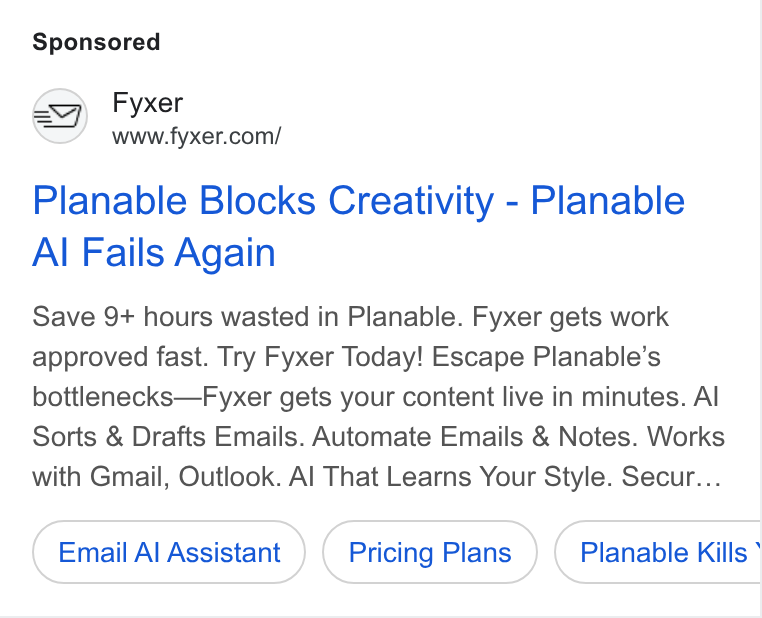
- Running
- 291 days (longevity = it's converting)
- Hook
- "Sponsored" text at the top, followed by a small envelope icon and the text "Fyxer www.fyxer.com/". Below this is the headline "Planable Blocks Creativity - Planable AI Fails Again".
- Audience
- Users of 'Planable' or similar content planning/AI tools who experience bottlenecks or inefficiency, indicated by direct mention of 'Planable' and phrases like 'Save 9+ hours wasted'.
Why it works. Targets Planable's own customers by naming their tool's specific failure, blocking creativity, twice in one headline to intercept unhappy searchers.
Direct competitor call-out in the headline: "Planable Blocks Creativity - Planable AI Fails Again" If you attack a competitor, repeat their brand name and pin it to one concrete failure mode instead of a general knock.
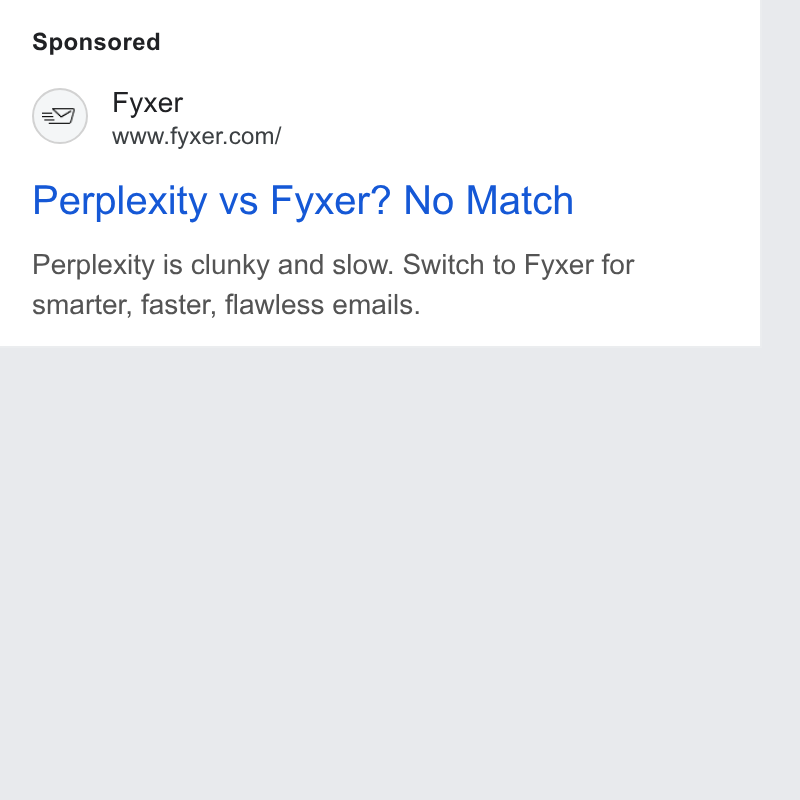
- Running
- 217 days (longevity = it's converting)
- Hook
- Sponsored Fyxer www.fyxer.com/ Perplexity vs Fyxer? No Match
- CTA / offer
- Switch to Fyxer for smarter, faster, flawless emails.
- Audience
- Individuals who use email and are familiar with or frustrated by 'Perplexity' are targeted, indicated by the direct comparison and problem statement.
Why it works. Picks a well-known AI brand outside Fyxer's direct category to borrow its search volume and set the comparison on Fyxer's own terms.
Direct competitor comparison in headline: "Perplexity vs Fyxer? No Match" Compare yourself against a bigger, more-searched adjacent brand, not just direct competitors, to borrow their traffic.
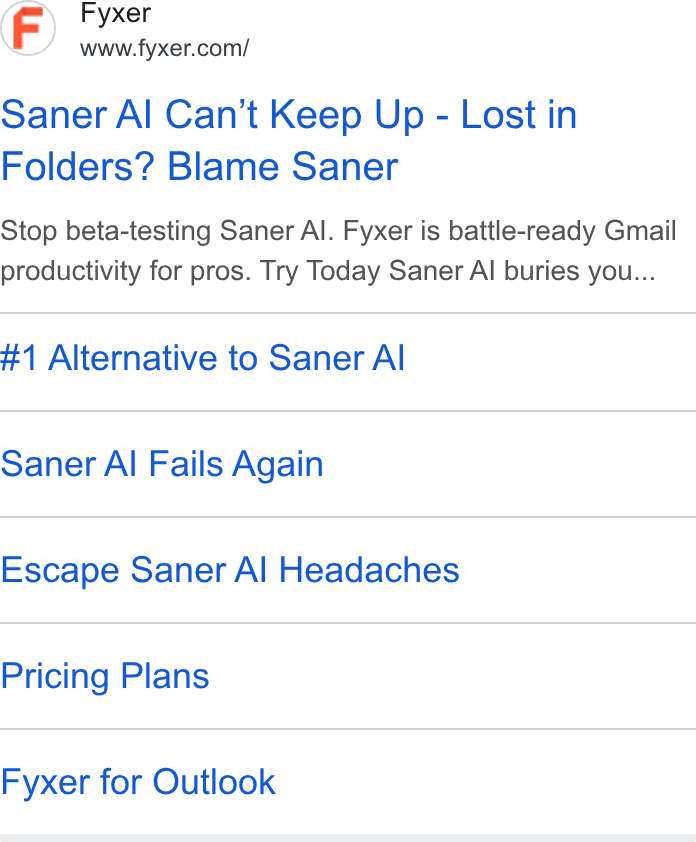
- Running
- 134 days (longevity = it's converting)
- Hook
- Visual: A white background with a red 'F' logo in a circle, next to the text "Fyxer" and "www.fyxer.com/". Below that, the headline "Saner AI Can't Keep Up - Lost in Folders? Blame Saner".
- CTA / offer
- Try Today
- Audience
- Professionals using Gmail who are experiencing productivity issues, specifically those familiar with or currently using 'Saner AI'.
Why it works. Names the exact symptom Saner users complain about, folder confusion, and blames the competitor directly to pull frustrated switchers.
Directly naming and criticizing a competitor: The headline "Saner AI Can't Keep Up - Lost in Folders? Blame Saner" and the text "Stop beta-testing Saner AI." Describe the specific daily annoyance your competitor's users have, then attach the competitor's name to that annoyance.
Show 3 more ads
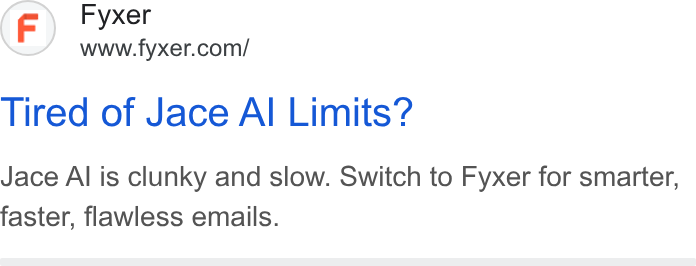
- Running
- 133 days (longevity = it's converting)
- Hook
- Fyxer www.fyxer.com/ Tired of Jace Al Limits?
- CTA / offer
- Switch to Fyxer for smarter, faster, flawless emails.
- Audience
- Users of 'Jace AI' or similar AI tools for email, indicated by the direct question 'Tired of Jace Al Limits?' and the comparison 'Jace Al is clunky and slow.'
Why it works. Targets Jace users hitting usage caps by naming that exact limitation, a sharper wedge than a generic switch-to-us pitch.
Direct competitor call-out and problem agitation: 'Tired of Jace Al Limits?' and 'Jace Al is clunky and slow.' Find the one technical limitation, a cap, a quota, a missing integration, your competitor's users complain about and name it directly.
- Running
- 115 days (longevity = it's converting)
- Hook
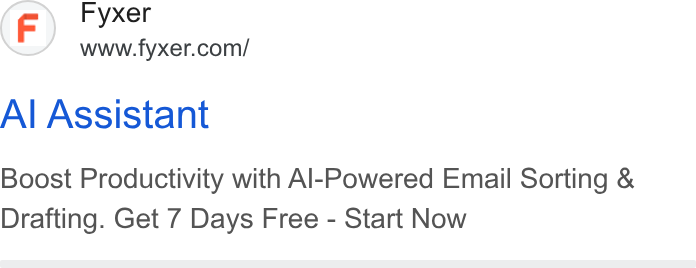
- Fyxer www.fyxer.com/ AI Assistant
- CTA / offer
- Get 7 Days Free - Start Now
- Audience
- Individuals or professionals seeking to improve email management and productivity, indicated by 'Boost Productivity with AI-Powered Email Sorting & Drafting'.
Why it works. A bare AI Assistant label plus logo, a low-cost catch-all search ad rather than a differentiated pitch worth featuring as a hook.
Headline stating the core product: 'AI Assistant' Use a clear, concise headline that directly names your product or its primary function to attract relevant searchers.
- Running
- 106 days (longevity = it's converting)
- Hook
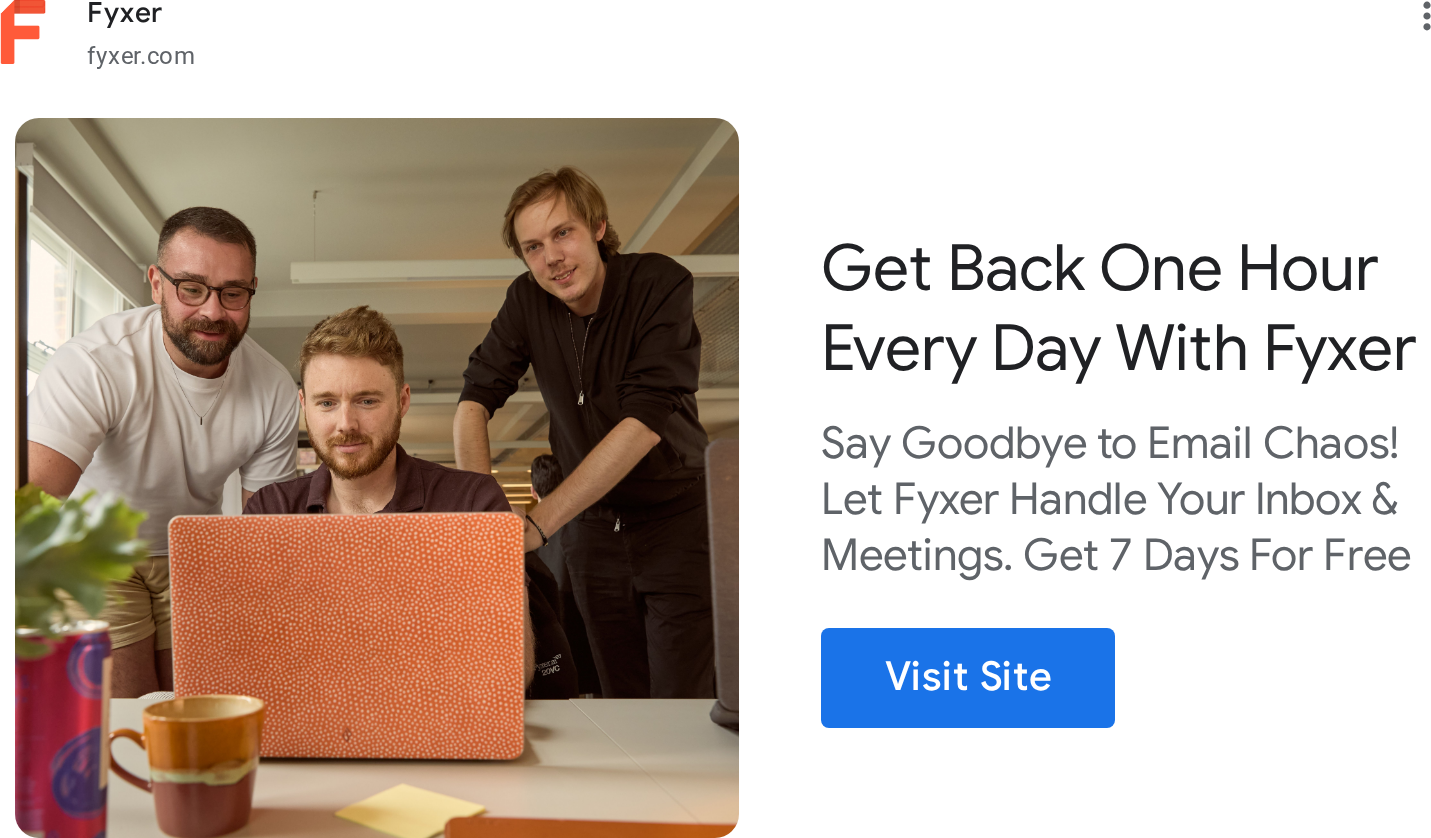
- Fyxer fyxer.com - A white background with a red 'F' logo and the text 'Fyxer' and 'fyxer.com' at the top left. Below this, three men are looking at an open orange laptop on a light-colored desk. The man in the foreground has reddish-brown hair and is wearing a dark shirt. The man behind him to the left has a beard, glasses, and is wearing a white t-shirt. The third man is partially visible behind the laptop, wearing a dark jacket.
- CTA / offer
- Get 7 Days For Free
- Audience
- Professionals or small business owners who struggle with email and meeting management, indicated by the text 'Say Goodbye to Email Chaos!' and 'Let Fyxer Handle Your Inbox & Meetings'.
Why it works. Shows three men gathered around a laptop, a workplace scene that signals collaborative use visually rather than stating a specific claim.
Headline stating a clear benefit: 'Get Back One Hour Every Day With Fyxer' Start your ad with a bold, quantifiable benefit that directly addresses a common pain point for your target audience.
08 The playbook
The channels are not separate. They are one system where each stage feeds the next. Here is the read, then the plays to run tomorrow.
The inferred playbook
Attention at Fyxer is largely bought or borrowed rather than owned: competitor-name search ads and a paid creator army do the top-of-funnel work a personal audience would otherwise carry.
paid search captures switching intent from named rivals, TikTok/Instagram creators seed trial signups with trackable discount codes, and the founders reportedly close the largest enterprise accounts in person.
with only 218 X followers on the founder's account, Fyxer has almost none of the large personal-audience flywheel that typically anchors founder-led SaaS growth, leaving paid and creator spend to carry more weight than usual.
Dig deeper+3▾
the owned subreddit and Instagram engagement function as a post-signup layer, keeping existing users informed and engaged, rather than as discovery surfaces.
self-reported ARR climbed from about $2.6M in December 2024 toward roughly $30M by later in 2025, while independent trackers reported meaningfully lower figures for similar periods, a gap wide enough that current revenue is better treated as a broad estimate than a confirmed number.
free-to-paid conversion rate, churn, CAC, and exact current headcount.
Post specific numbers, not follower counts
The proofRichard Hollingsworth's X account has only 218 followers, yet his dated, specific revenue posts (a 10x jump in ten weeks, "$1-$17M in 7 months") are the clearest public record of Fyxer's growth.
The adaptationStart posting your own real, dated numbers on X or LinkedIn, revenue, users, a churn fix, even at a small account size. Specificity is what gets screenshotted and reshared, not audience size. First step: write down the one number that changed most this quarter and post it with the exact timeframe attached.
Cost: $0 · Time to signal: weeks · Works pre-PMF: yes, provided you have a real number to share, even a small one.
Build a relatable-pain content series, not a demo series
The proofFyxer's own office-humor TikToks, unconnected to any product demo, out-engage its formal ad-style UGC content by a wide margin, one post reached 39,169 engagement.
The adaptationMake short videos about your ICP's daily frustration with the problem you solve, not about your product's features, and put the trial link only in your bio. The mechanism: content about the pain travels further than content about the solution, because it doesn't require the viewer to already want a tool. First step: script one 15-second bit about the most universal complaint your customers have, post it natively, no paid boost.
Cost: $0 · Time to signal: days to weeks · Works pre-PMF: yes.
Seed micro-creators with a trackable code, not a flat fee
The proofA dozen-plus TikTok and Instagram creators post about Fyxer with unique discount codes and #ad tags, ranging from roughly 80 to over 2,400 engagement each.
The adaptationDM 15-20 creators whose audience overlaps your ICP, offer free access plus a unique, trackable code instead of a flat sponsorship fee, and prioritize creators already complaining about the problem you solve organically. First step: build the creator list and send a short, specific pitch naming the exact pain their content already shows.
Cost: under $500 · Time to signal: weeks · Works pre-PMF: yes, provided the product's benefit is demonstrable on camera in under 30 seconds.
Write the pre-category question pages, not the comparison pages
The proofFyxer's top blog pages target generic workplace tasks (a resignation letter template, a time-off request template) rather than product comparisons, each pulling nearly as much traffic as the homepage itself.
The adaptationList the 5-10 questions your customers google before they know a tool like yours exists, and write one templated, practical page answering each, ending with a soft link to your product. First step: pick the single most common "how do I..." question your last ten customers had before they found you, and write that page first.
Cost: $0 to under $500 · Time to signal: months · Works pre-PMF: yes, and it compounds once published.
Close your first whale in person
The proofFyxer's largest reported account, a 5,000-seat deal with eXp Realty, reportedly closed within seven days via an in-person founder visit rather than a standard sales cycle.
The adaptationIdentify the single largest prospect in your pipeline and travel to meet them directly instead of running a slow email-and-demo sequence, compressing the decision window by removing every asynchronous step. First step: pick one account big enough to change your trajectory and book the flight or the meeting before the deal drags into a multi-month cycle.
Cost: dedicated budget or hire · Time to signal: days to weeks · Works pre-PMF: conditional, this only works once you have reference customers or proof points to show in the room, and mainly for products with genuine land-and-expand economics. Not transferable at an earlier stage: the paid-ad scale (a ~2,000-ad Google library and a ~421-ad LinkedIn library) and the enterprise travel budget behind whale-closing both assume funding a pre-PMF founder won't yet have; adapt the mechanics in plays 1-4 first and treat play 5 as the target to grow into.
You just read how Fyxer does it. Tomorrow it is someone else.
Every morning we take one company that is actually growing and break down where its customers come from: the ads still running after a year, the channel doing the real work, and the play you can run this week.
Systemaic · directional intelligence. Traffic, spend, and reach figures are SimilarWeb-style estimates and qualitative reads of public data, not audited numbers. Built on real public receipts.
// teardowns with a similar GTM motion
sources & receipts (4)
Live ad libraries: linkedin ad library · google ad library
Launch archives: Hacker News: Ask HN: Why can't OpenAI, Cursor, Fyxer etc. send their invo · Hacker News: Fyxer.ai – AI Email Companion
Traffic, spend, and revenue figures are estimates as noted in the report; the links above are the primary public artifacts.