- 01Subsidize the wedge feature deliberately
- 02Get co-invested by the platform you integrate with
- 03Open a crowdfund tranche to your own users
- 04Seed unsponsored head-to-head content
01 Snapshot
The one-glance read on who they are and how they grow. Each point is verifiable from the receipts above.
A bot-free AI meeting notetaker for Zoom, Google Meet, and Microsoft Teams with a free-forever tier, pulling an estimated 5.18M monthly visits as of 2026-07-15.
Organic-led, built on a multi-year free giveaway and Zoom/HubSpot marketplace placement rather than a founder-audience or paid-creative motion.
97 total Google ads on file with 30 still active as of 2026-07-15, a longest-running active ad at 468 days, and direct visits alone accounting for 72.2% of total traffic.
As of 2026-07-15, ten Google ad variants launched since mid-April 2026 remain active, including two new video-format creatives alongside continued "Switch to Fathom" competitive copy.
Fathom didn't need a launch moment because Zoom's own venture arm co-funded it as a native Zoom App from the seed round, so its growth loop runs through two platforms' marketplaces rather than through content or a personal following.
02 How it unfolded
The order the channels came online. Sequence is strategy: what they did first, and what they layered on once demand existed.
03 Traffic & channel mix
Estimated demand, the channel split behind it, and the keywords and referrers doing the work. Directional modeling, not audited analytics.
Traffic sources
Top search keywords
| Keyword | Volume | Weight | CPC |
|---|---|---|---|
| fathom | 271k | $1.54 | |
| fathom download | 2.8k | $1.82 | |
| fathom mcp | 2.3k | $4.29 | |
| fathom login | 4.2k | $1.05 | |
| download fathom | 1.3k | $5.17 |
Top referring sites
Closest competitors by audience
Fathom pulls an estimated 5.18M monthly visits, up 3.4% over the last 3 months. The mix is dominated by Direct at 72.2%, Referrals at 12%, and Email at 7%, three channels that together account for over 90% of traffic, a pattern consistent with a product people already know by name and return to rather than discover fresh. The rest, social organic, search organic, generative-AI referrals, display, and paid search and social, together totals just under 9%.
The brand term "fathom" alone draws 271,430 monthly searches across the web, dwarfing feature-specific terms like "fathom mcp" (2,300/mo, tied to its Claude integration) and "fathom login" (4,180/mo, a signal of habitual repeat use rather than new discovery). Among referrers, asana.com and planhat.com are complementary productivity and customer-success tools whose traffic likely comes through integration or app-directory listings rather than editorial mentions, while epreneurs.link reads as a niche tool-discovery site referral. On the competitive side, fireflies.ai and tldv.io show up repeatedly in the same head-to-head comparison content consumers are producing about Fathom, and otter.ai represents the older, more established incumbent Fathom is positioned against.
04 Organic content
The specific pages earning their organic search traffic, and the pattern behind why they rank. Adapt the format, not the topic.
Fathom's ranking pages are almost entirely support documentation rather than top-of-funnel content: help-center articles on downloading and logging in account for the majority of its top five organic pages, with the homepage itself pulling only the fourth-largest share. This is a servicing pattern, not a demand-generation one: people already using or actively evaluating the product search for functional terms like "fathom download" (where it ranks #1) and land on instructional pages, rather than arriving through comparison or educational content built to win searchers who've never heard of Fathom. It's the organic footprint of a product that's already won brand recognition through its free tier, not one manufacturing new demand through content.
Top pages by organic traffic
05 Channel map
Not traffic share. How much weight the growth system actually puts on each channel, with a one-line read on the role it plays.
What drove growth
06 The motions doing the work
For founder-led SaaS the breakdown shifts from ads to traction: where the first users came from, how the founder grows it in the open, and the compounding organic surface.
Fathom's early traction came from a platform bet, not a launch spike.
Founder Richard White, previously the founder of UserVoice, built Fathom as one of the first deeply-integrated Zoom Apps, and Zoom itself invested through its Zoom Apps Fund as part of a $4.7M seed round that closed in September 2021. That put platform placement inside the cap table before the product had to compete for marketplace attention on its own.
Revenue climbed from roughly $100K ARR in 2022 to about $1M in 2023 to around $10M by the time of a $17M Series A in September 2024, all while the core product stayed free, a deliberate bet that per-user transcription costs would fall faster than the giveaway cost.
Dig deeper+2▾
Roughly $2M of that $17M Series A came directly from Fathom's own users through Wefunder crowdfunding, turning the existing customer base into a funding event rather than relying on a splashy public unveiling.
Press accounts describe Fathom as HubSpot's 2025 "Most Used App of the Year" and as G2's top-rated AI notetaker, both outcomes of sustained integration depth rather than a single traction spike.
There's no visible founder-audience engine here, the compounding motion is the product embedding itself inside platforms other people already use.
Instead of a personal X or LinkedIn following driving awareness, the growth loop runs through being a Zoom Apps Fund-backed integration and HubSpot's top-used app, placing Fathom inside workflows salespeople and managers already open daily rather than inside a founder's feed.
The Wefunder tranche of the Series A functioned as Fathom's most public "in the open" moment, a cap-table event visible to its own user base rather than a founder-narrated build log.
Dig deeper+1▾
The comparison and review content that would normally come from a founder's own posts instead comes from third-party creators and Reddit threads weighing Fathom against Fireflies, tl;dv, and Granola, including the high-engagement Instagram reel noted above.
Organic search is a minor channel, a small slice of that sub-9% remainder, and what little ranks is support documentation rather than a built content system, so the real compounding engine is paid search layered on top of an already-known brand name.
Unlike competitors that build "alternative to X" or template libraries, Fathom's organic surface is limited to help articles and the homepage, meaning there's no programmatic content asset extending its keyword footprint beyond people who already know the name.
The 271,430 monthly searches for "fathom" show how much of the company's discoverability is people looking for it directly, a byproduct of the free-tier word of mouth rather than an SEO campaign.
Dig deeper+1▾
The 97-ad Google account splits between "Free Forever" brand-defense creative protecting high-volume branded queries and "Switch to Fathom, Save Big" conquest copy aimed at competitors' customers (expanded as Play 5 below), with two new video-format tests active as of 2026-07-15 signaling a shift beyond static text ads.
07 Paid ads
This founder-led SaaS also runs paid acquisition. Here are the live ads doing the work, each with the X-ray and a play you can adapt.
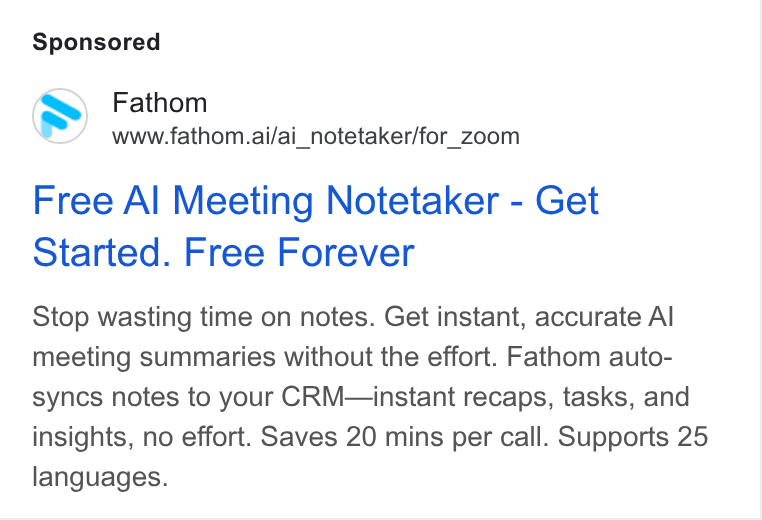
- Running
- 358 days (longevity = it's converting)
- Hook
- "Sponsored" text at the top, followed by the Fathom logo and company name, then the URL "www.fathom.ai/ai_notetaker/for_zoom". Below this is the headline "Free AI Meeting Notetaker - Get Started. Free Forever".
- CTA / offer
- Free AI Meeting Notetaker - Get Started. Free Forever
- Audience
- Professionals who attend meetings and use CRMs, indicated by the mention of "meeting summaries" and "CRM".
Why it works. Targets Zoom users specifically in the URL while leading with a permanent, not trial, free offer, cutting signup friction for a well-defined audience.
Prominent display of a free, high-value offer: "Free AI Meeting Notetaker - Get Started. Free Forever". Build a landing page and ad URL for your single most common integration, like Zoom, and lead with a permanent, not trial, free offer.
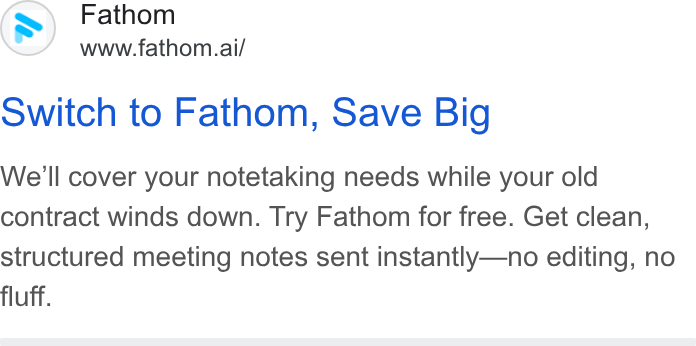
- Running
- 300 days (longevity = it's converting)
- Hook
- Fathom logo and text "Fathom www.fathom.ai/" followed by "Switch to Fathom, Save Big"
- CTA / offer
- Try Fathom for free.
- Audience
- Individuals or businesses with 'notetaking needs' and existing 'old contract' for a similar service, indicated by the text 'We'll cover your notetaking needs while your old contract winds down.'
Why it works. Offers to cover the switching cost from an existing contract, removing the single biggest reason locked-in teams hesitate to change tools.
Headline with a clear benefit and call to action: "Switch to Fathom, Save Big" If prospects are locked into a competitor's contract, explicitly offer to cover that cost in your ad copy to remove their biggest excuse not to switch.
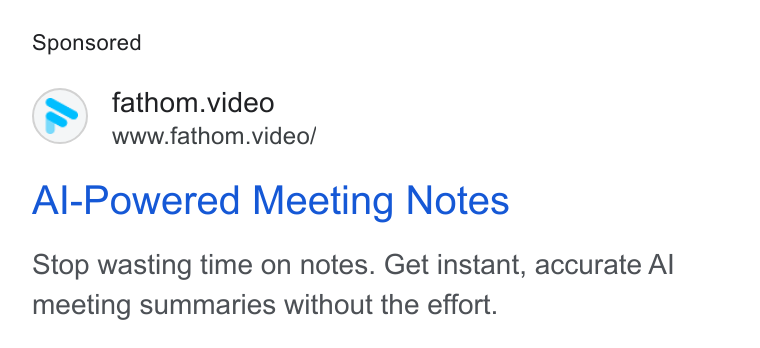
- Running
- 257 days (longevity = it's converting)
- Hook
- Sponsored, fathom.video, www.fathom.video/, AI-Powered Meeting Notes
- Audience
- Professionals and teams who attend meetings and are looking for efficiency, indicated by the phrases 'Stop wasting time on notes' and 'meeting summaries'.
Why it works. Leads with the literal deliverable, AI-generated meeting notes, appealing to professionals who specifically search for that phrase.
Headline directly addresses a common pain point with a solution: 'AI-Powered Meeting Notes'. Lead your headline with the literal deliverable your product produces, not a benefit phrase, to match how people actually search.
Show 3 more ads
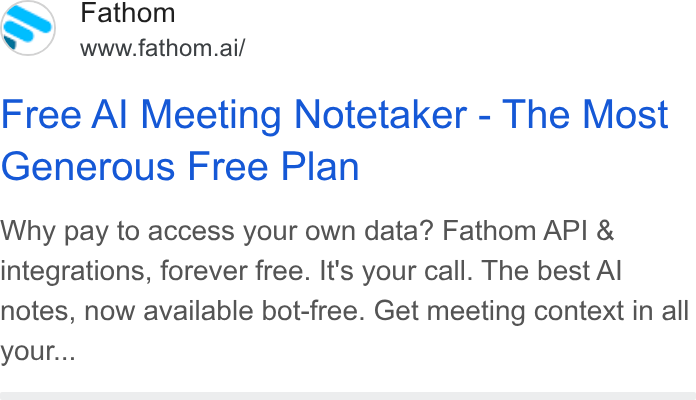
- Running
- 90 days (longevity = it's converting)
- Hook
- Fathom www.fathom.ai/ Free AI Meeting Notetaker - The Most Generous Free Plan
- CTA / offer
- Fathom API & integrations, forever free.
- Audience
- Professionals who attend meetings and need assistance with note-taking, indicated by 'AI Meeting Notetaker' and 'meeting context'.
Why it works. Pairs free with a superlative to reassure price sensitive searchers who are comparing free tiers across several AI notetakers at once.
Bold, benefit-driven headline: 'Free AI Meeting Notetaker - The Most Generous Free Plan' Test a superlative free tier headline against a plain free headline to see if the comparison framing lifts click through.
- Running
- 90 days (longevity = it's converting)
- Hook
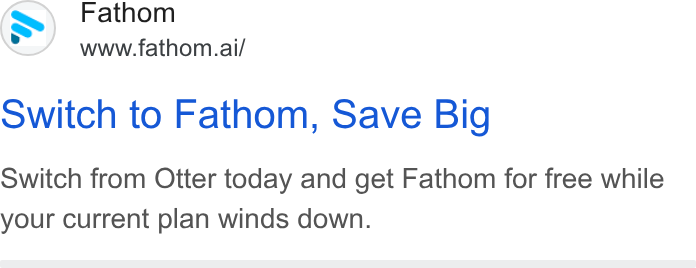
- "Fathom" and "www.fathom.ai/" with a light blue and white logo of three curved, parallel lines, followed by "Switch to Fathom, Save Big".
- CTA / offer
- Switch from Otter today and get Fathom for free while your current plan winds down.
- Audience
- Users of Otter.ai, indicated by the text "Switch from Otter today".
Why it works. Uses explicit competitor switch framing plus a savings promise to pull users already paying for a rival notetaker toward Fathom.
Direct competitor call-out: The ad explicitly states "Switch from Otter today". Name your top competitor directly in one search line paired with a savings or time claim, and send clicks to a comparison page.
- Running
- 86 days (longevity = it's converting)
- Hook
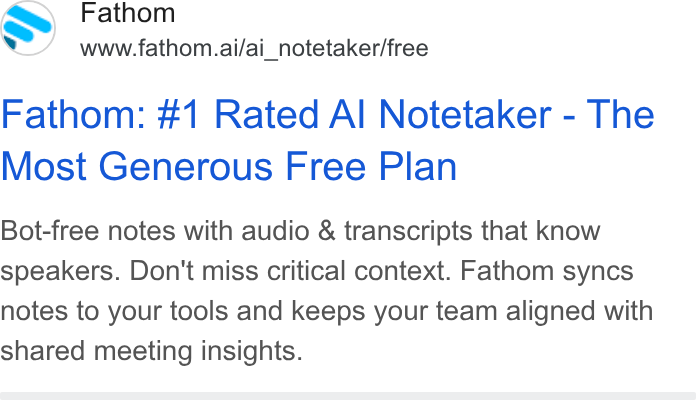
- Fathom: #1 Rated AI Notetaker - The Most Generous Free Plan" + a blue and white Fathom logo on a white background.
- CTA / offer
- Most Generous Free Plan
- Audience
- Professionals and teams who have meetings and need to take notes, indicated by phrases like 'Bot-free notes with audio & transcripts that know speakers', 'Don't miss critical context', 'Fathom syncs notes to your tools', and 'keeps your team aligned with shared meeting insights'.
Why it works. Combines a ranking claim and a free tier claim to preempt both the quality doubt and the cost objection in a single search headline.
Lead with a strong, quantifiable claim and a free offer: "Fathom: #1 Rated AI Notetaker - The Most Generous Free Plan" A/B test a headline that stacks a ranking claim with your free tier offer against each claim run on its own.
08 The playbook
The channels are not separate. They are one system where each stage feeds the next. Here is the read, then the plays to run tomorrow.
The inferred playbook
The loop starts inside a platform, converts on a usage cap, and compounds through other people's content rather than Fathom's own.
Placement inside Zoom's own app ecosystem and HubSpot's marketplace puts Fathom in front of users already mid-workflow, skipping the discovery step most SaaS companies have to manufacture.
The free-forever tier removes adoption friction entirely, unlimited recording and transcription, and the paid funnel is usage-triggered: AI summaries cap at 5 calls a month before a user needs Premium, Team, or Business.
Dig deeper+3▾
Creator reviews and Reddit comparison threads function as an ongoing earned-content layer that a company without a visible founder-audience or content-marketing engine would otherwise have to build itself.
There's no comparison-page content strategy or personal founder channel visible in the evidence, so if the creator-review and marketplace flywheel slows, there's no second organic engine already built to replace it.
the free-tier-to-paid conversion rate at the 5-summary cap, per-seat expansion once a workspace crosses the Team or Business 2-user minimum, and what share of the Google ad spend defends the 271,430-monthly-search brand term versus winning switches from named competitors.
Subsidize the wedge feature deliberately
The proofFathom stayed fully free for roughly two years, taking ARR from $100K to $10M before introducing paid tiers, betting that per-user transcription costs would drop.
The adaptationPick the one feature your category normally paywalls first (unlimited history, unlimited exports, unlimited seats) and give it away free for a defined runway while tracking your real per-user cost, then introduce a usage cap modeled on Fathom's 5-summaries-a-month line once a natural ceiling in usage emerges. Start by calculating what one year of free usage actually costs per user before committing to the giveaway window.
Cost: dedicated budget or hire · Time to signal: months · Works pre-PMF: conditional, only if the free experience is strong enough to generate word of mouth on its own, not just burn cash.
Get co-invested by the platform you integrate with
The proofFathom built as a native Zoom App from day one and secured Zoom's own Apps Fund as a seed investor, baking platform placement into its cap table rather than treating the integration as a checkbox.
The adaptationIf your product sits on top of a platform (Shopify, Notion, HubSpot, Slack), find that platform's developer or venture fund page and apply with a working integration and real usage data, not a mockup. First step: build the minimum integration this week and submit it to the platform's partner program before you have significant traction, since platforms often want early co-investment signal, not proof of scale.
Cost: $0 to under $500 · Time to signal: months · Works pre-PMF: yes, and often easier pre-PMF since platforms want to co-invest in signal, not scale.
Open a crowdfund tranche to your own users
The proofAbout $2M of Fathom's $17M Series A came directly from its own customers through Wefunder rather than solely from venture investors.
The adaptationWhen raising a round, set aside a small allocation on a platform like Wefunder for your most active paying users, sourced from usage data rather than a mass email blast. First step: pull your top 100-200 most active accounts and send a private, personal note offering early access to the crowdfund tranche before the round closes.
Cost: under $500 · Time to signal: weeks · Works pre-PMF: no, this requires an existing base of paying, engaged users.
Seed unsponsored head-to-head content
The proofFathom shows up organically in Reddit threads and Instagram/TikTok posts where creators compare it directly against Fireflies, tl;dv, and Granola, none of it produced by Fathom itself.
The adaptationIdentify 5-10 small creators in your niche who've already reviewed a competitor's product, send them free access with no script, and explicitly ask for an honest head-to-head against that named competitor rather than a sponsored feature. First step: search your own competitor's name plus "review" on TikTok and Instagram this week to find creators already primed to make the comparison.
Cost: $0 to under $500 · Time to signal: weeks · Works pre-PMF: yes.
Run conquest ads once your brand has search volume
The proofFathom runs "Switch to Fathom, Save Big" ads against competitor demand alongside brand-defense ads on its own name, out of a 97-ad Google account with 30 active as of 2026-07-15.
The adaptationOnce your own product name starts generating meaningful search volume, split a small budget between defending that branded term and bidding on your top 2-3 competitors' names with a direct comparison headline. First step: check your branded search volume in a free keyword tool, and only launch the conquest half once that number is non-trivial, since conquest ads need a searcher who's already comparing options to land on.
Cost: under $500 to start · Time to signal: days to weeks · Works pre-PMF: conditional, only once your own name gets meaningful search volume; without it there's nothing to defend and no receptive audience to conquest. Not transferable at an earlier stage: the Zoom Apps Fund investment and the free-for-two-years subsidy both depended on Fathom already having a credible product and a platform relationship worth co-investing in, a pre-PMF founder can apply the underlying motions (seek platform partnership, subsidize a wedge feature) but shouldn't expect the same capital backing or runway to fund a multi-year giveaway.
You just read how Fathom does it. Tomorrow it is someone else.
Every morning we take one company that is actually growing and break down where its customers come from: the ads still running after a year, the channel doing the real work, and the play you can run this week.
Systemaic · directional intelligence. Traffic, spend, and reach figures are SimilarWeb-style estimates and qualitative reads of public data, not audited numbers. Built on real public receipts.
// teardowns with a similar GTM motion
sources & receipts (7)
Live ad libraries: google ad library
Launch archives: Hacker News: Fathom – Simple, trustworthy website analytics · Hacker News: Mozilla Fathom: Find meaning in the web · Hacker News: From Google Analytics to Fathom · Hacker News: Fathom: a framework for understanding web pages · Hacker News: It Took Me a Decade to Find the Perfect Personal Website Sta · Hacker News: Y Combinator’s FathomDB Takes The Hassle Out Of Managing You
Traffic, spend, and revenue figures are estimates as noted in the report; the links above are the primary public artifacts.