- 01Prove the offer with your own content first
- 02Recruit affiliates with proof of sales, not a bigger cut
- 03Shoot a $15 phone-rig video of the unglamorous part of your business
- 04Turn your product lineup into a ranking video
01 Snapshot
The one-glance read on who they are and how they grow. Each point is verifiable from the receipts above.
Flavored pretzels, popcorn, kettle chips and baked cheese puffs sold direct and through major retail, with the pretzel line pushed as TikTok Shop's top-selling food item in the brand's own claims.
Creator-led, built around a TikTok Shop affiliate flywheel that co-owner JT Sarafa actively documents in public.
~25,829 estimated monthly site visits, 29,733 Instagram followers, and 19 active Meta ads as of 2026-07-14, the brand's full library, with the longest running 166 days.
Four Meta ads under 56 days old as of 2026-07-14 recut the brand's proven ranking-video and Dutch Apple Pie scripts with new footage rather than new concepts.
Growth compounds through a two-step sequence, brand-page content proves an offer converts, then that visible sales volume, not commission rate, is what pulls affiliates in to scale it.
02 How it unfolded
The order the channels came online. Sequence is strategy: what they did first, and what they layered on once demand existed.
03 Traffic & channel mix
Estimated demand, the channel split behind it, and the keywords and referrers doing the work. Directional modeling, not audited analytics.
Traffic sources
Top search keywords
| Keyword | Volume | Weight | CPC |
|---|---|---|---|
| pop daddy pretzels | 1.0k | $0.58 | |
| popdaddy | 940 | $0.61 | |
| pop daddy | 470 | $0.54 | |
| pop daddy snacks | 250 | $0.69 | |
| elote pretzels | 180 | - |
Closest competitors by audience
Pop Daddy Snacks draws an estimated 25,829 monthly visits, down 15.5% over the last 3 months. Search Organic dominates the mix at 62.3%, with Display Ads at 13.9% and Social Organic at 9.3% behind it; the rest, referrals, direct, and paid search, together make up about 14%. The keyword profile is almost entirely branded: "pop daddy pretzels" pulls 1,040 monthly searches, "popdaddy" 940, and "pop daddy" 470, meaning the demand they're ranking into is people who already know the name, not category shoppers discovering it cold. Their closest competitive set includes kettlebrand.com, an established national kettle-chip brand overlapping their chip line, snydersofhanover.com, the category-leading national pretzel brand their pretzel SKU is chasing shelf and search share from, and bettermade.com, a fellow Michigan-based regional snack maker that's more a local shelf rival than a national threat.
04 Organic content
The specific pages earning their organic search traffic, and the pattern behind why they rank. Adapt the format, not the topic.
Their organic footprint is concentrated in commerce pages, not content. The /collections/pretzels page alone pulls an estimated 7,508 organic visits/mo (42.2% of the organic total), with the homepage (19.3%) and /collections/shop (10.4%) close behind, and a single flavor product page and a store-locator page rounding out the top five. Top-ranking terms are almost all branded ("pop daddy pretzels," "pop daddy," both #1) plus a couple of generic flavor queries ("garlic parmesan pretzels," "dill pickle pretzels," both #2). The pattern reads as demand capture rather than a content-marketing engine: TikTok virality creates branded search volume, and their Shopify collection pages, titled with flavor and category names, simply absorb it, occasionally picking off a generic flavor query along the way.
Top pages by organic traffic
05 Channel map
Not traffic share. How much weight the growth system actually puts on each channel, with a one-line read on the role it plays.
What drove growth
06 The creative doing the work
Each exhibit shows the actual asset, an X-ray of why it works, a status, and a play you can adapt. This is the heart of the teardown.
Pop Daddy Snacks runs 19 active Meta ads as of 2026-07-14, its entire visible library, with the longest-running creative active for 166 days, genuinely long enough to call proven.
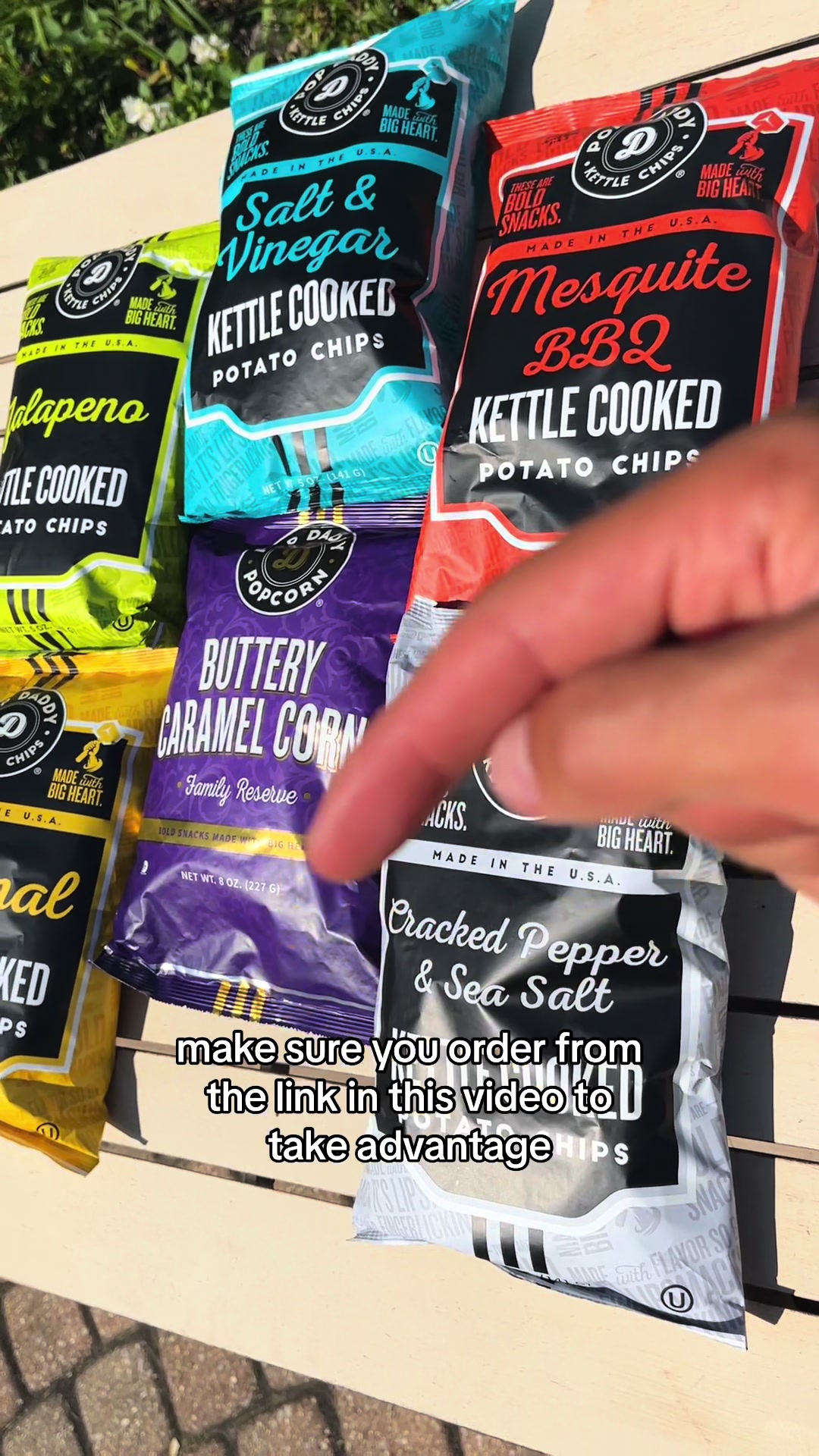
Hook: "Tier Ranking Pop Daddy Kettle Chips," a countdown-style ranking video, first shown 2026-01-29 and still active 166 days later. Why it works: framing the ad as a ranking video rather than a pitch lowers ad-blindness on Meta feeds and creates curiosity about which flavor wins; running it as a DCO unit also lets Meta auto-test creative and copy combinations against that single format. Run this play: expanded as Play 4 below.
Hook: "Pretzel Heads! You need to try Dutch Apple Pie Pretzels," delivered straight to camera by a UGC talking head, active roughly 67 days as of the observation date. Why it works: opening with an in-group nickname for regulars ("Pretzel Heads") builds identity before the pitch even starts, then narrows to one specific flavor claim instead of the whole product line, giving the viewer a single reason to act. Run this play: give your regulars a name in the first line so the hook doubles as identity, then call out one flavor or SKU by name, not the whole catalog.
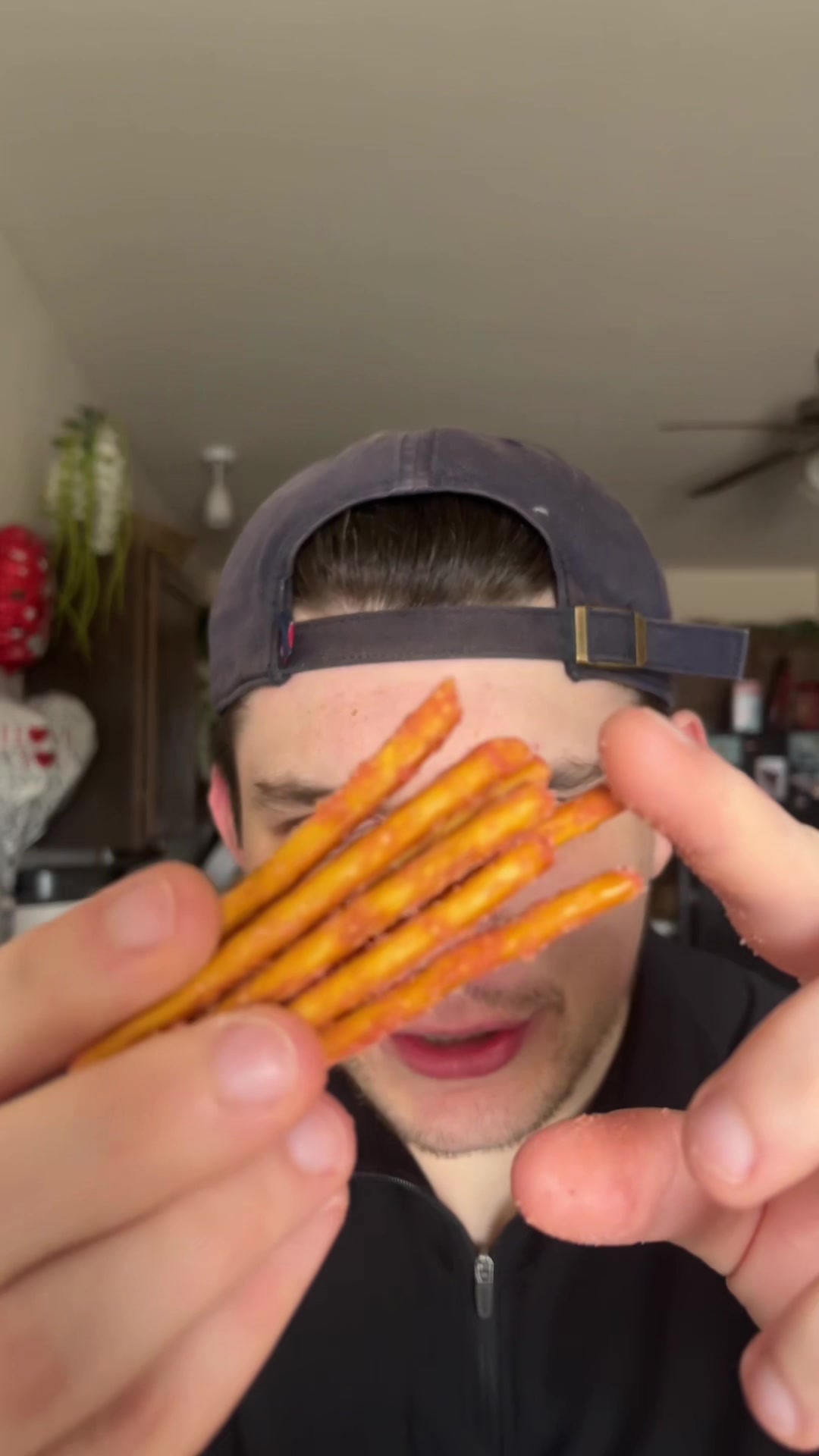
Hook: "Do these pretzels," an unfinished sentence paired with a creator pointing directly at a bag of Mexican Street Corn pretzels, also active roughly 67 days as of the observation date. Why it works: the incomplete sentence is an open loop, the viewer has to keep watching to find out what's actually being asked, a classic pattern interrupt for a feed scroll. Run this play: cut your headline mid-sentence and resolve it on-screen a beat later so the product, not the copy, finishes the thought.
Every winning ad sends traffic to a category or bundle collection page on the Shopify storefront, not a standalone lander. The pretzel-flavor ads land on the Pretzels collection, the ranking-format kettle chip ad lands on Kettle Chips, and the bundle-focused creative lands on a dedicated "Build Your Own 12 Bag Bundle, 11 bags get one free" page. Pricing on these pages runs from single bags around $5-$7 up to bundles at $27, $50, and $60, with free shipping over $50 acting as the built-in upsell threshold, and a Recharge-powered subscription option available at checkout. This offer structure lines up directly with JT Sarafa's own account of the strategy: individual-flavor listings underperformed, and a custom variety pack now drives roughly 95% of sales, which is exactly what the Build Your Own Bundle page is built to sell.
- Running
- 60 days (longevity = it's converting)
- Hook
- "If you're a real pretzel head like me..." + Man in a grey and white hat talking to camera with red text overlay "Pretzel Heads! 🥨 You need to try Dutch Apple Pie Pretzels 🥧"
- CTA / offer
- "You get nine mini bags in this sampler pack" / "BUILD A BUNDLE 12-PACK"
- Audience
- Snack enthusiasts ('Pretzel Heads') interested in unique flavor profiles and 'guilt-free' snacking.
Why it works. A pretzel-head identity tag paired with an unlikely apple pie flavor turns a routine review into a niche endorsement for snack enthusiasts on TikTok Shop.
ASMR Crunching (0:04, 0:16, 0:21) Open your next UGC ad by naming the niche audience with an insider label before naming the product, then reveal an unexpected flavor twist.
- Running
- 67 days (longevity = it's converting)
- Hook
- "Okay, this brand claims they've made a pretzel that tastes like Mexican Street Corn" + Bald man in a black t-shirt holding a white and green bag of Pop Daddy Pretzels.
- Audience
- Snack enthusiasts and fans of 'Mexican Street Corn' (explicitly mentioned) looking for 'Bold Snacks' (text on bag).
Why it works. Opening as a skeptical taste test of the brand's own flavor claim gives the review built-in tension that a plain product shot can't match.
The 'Claim' Framing (0:00-0:02 "this brand claims they've made...") Introduce your product's flavor claim as something you're personally testing and doubting, then resolve the doubt on camera.
- Running
- 66 days (longevity = it's converting)
- Hook
- "Do these pretzels actually taste like Mexican Street Corn? Let's find out." + Man in a grey t-shirt holding a bag of Pop Daddy Mexican Street Corn Pretzels.
- Audience
- Snackers looking for authentic, bold flavors (specifically fans of Mexican Street Corn).
Why it works. A direct taste-test question about flavor accuracy gives skeptical shoppers a reason to watch the verification instead of scrolling past another product shot.
Side-by-side comparison at 0:03 ("I got some Mexican Street Corn right here") Ask your product's key claim as a literal on-camera question, then answer it by tasting or demonstrating live.
Show 3 more exhibits
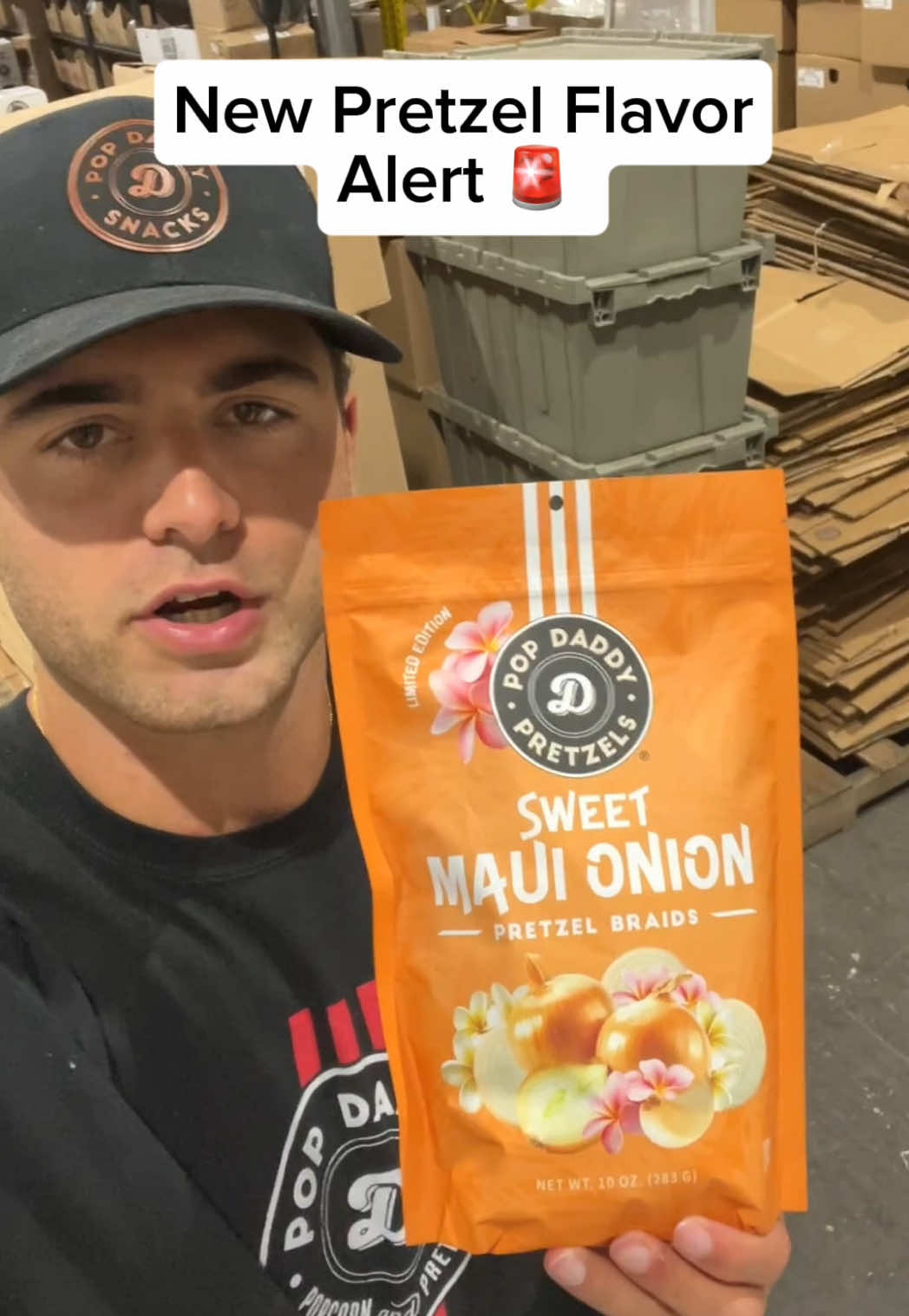
- Hook
- "New Pretzel Flavor Alert 🚨" is on-screen text, a man in a black baseball cap and black t-shirt holds a bright orange bag of Pop Daddy Pretzels Sweet Maui Onion flavor, with a warehouse background.
- CTA / offer
- Buy all 13 flavors of pretzels and get a free bag of Sweet Maui Onion.
- Audience
- People interested in snack foods, particularly pretzels, and those who enjoy trying new and limited-edition flavors. The casual, direct address suggests a younger, social media-savvy audience.
Why it works. Framing a new flavor as breaking news gives existing pretzel customers a reason to re-engage instead of scrolling past a familiar product.
Direct announcement of a new product with an exclusivity claim at 0:00-0:05, "New Pretzel Flavor Alert 🚨" and "Sweet Maui Onion. It's brand new. You guys are the first ones to see it." For your next SKU drop, open with '[Product] Alert' plus a siren emoji before showing the item, borrowing the urgency of breaking news.
Who amplifies them
The affiliate layer is the biggest lever here, and JT Sarafa quantified it directly: in the 30 days before his post, affiliates generated 1,000+ posts, 7M views, and more than 50% of total sales, a flywheel he describes as brand-page sales attracting affiliates, who post and drive more sales, which attracts more affiliates. Named creators driving that volume include luketastic (193,583 engagement on a variety-pack TikTok Shop post), JH (149,851 on a sampler review), and Jaiden (38,450 on an early Buttery Caramel Corn TikTok Shop listing), with a longer tail of smaller creators like Kenzzz, Morgan Chomps, and zaralarsson posting in the 1,000-20,000 engagement range. JT Sarafa himself, posting from @jtsarafa, is the one figure amplifying the company's own strategy publicly rather than the product itself, distinct from both the brand's TikTok Shop account and the creator roster above.
07 Organic & video
The organic content engine: the videos, creator posts, and community presence earning attention without paid spend.
The clearest organic mechanic in the evidence is the founder-shot, near-zero-cost clip. JT Sarafa's own account describes filming himself packing an order with a $15 iPhone head mount, editing the footage at 3x-10x speed on TikTok, and generating 3.8M views and 2,800 orders from a video that took about 30 minutes to make. On the creator side, the standout format is the UGC talking-head review: 3rd And Pearl's sampler post ("13 flavors and they're all delicious") drew 35,255 engagements, and MOE DA GOAT's flavor-tasting clip and kimberlymichbeauty's Dollar Tree cross-shop hunt round out a steady stream of similar reviews, plus a long tail of smaller posts in the 900-5,000 engagement range. The pattern across both brand and creator content is the same: hold the product in frame, react on camera, and let the flavor variety carry the video.
08 Affiliate & partners
How the brand turns creators and partners into a tracked, variable-cost acquisition channel, and how the program is structured.
The affiliate program runs natively through TikTok Shop's creator marketplace rather than a separate referral system on the owned site. JT Sarafa's posts describe testing commission rates at 15%, 30%, and 35% and finding almost no difference in affiliate quality or volume, concluding that visible sales performance, not payout rate, is what attracts creators; by his account, TikTok Shop's roughly 30,000 high-GMV (gross merchandise value, the total dollar value of goods sold) affiliates are courted by an estimated 500,000 brands. No separate affiliate/referral link, Rewardful- or PartnerStack-style program, or ambassador page was found on the owned site itself.
09 The playbook
The channels are not separate. They are one system where each stage feeds the next. Here is the read, then the plays to run tomorrow.
The inferred playbook
Pop Daddy Snacks' loop starts with founder-shot proof, scales through an affiliate army recruited on visible results, and lets Meta and branded search backfill the demand that TikTok Shop creates.
JT Sarafa is explicit that 90% of brands, including his own, take off from brand-page content first, using early sales as the credibility signal that then recruits outside affiliates rather than trying to recruit them cold.
once individual-flavor listings underperformed, the team collapsed the catalog around a single variety-pack SKU that now drives about 95% of sales, a decision operationalized directly in the Build Your Own Bundle page covered above.
Dig deeper+3▾
the branded-keyword dominance and collection-page traffic pattern show search catching demand TikTok already created, rather than generating new demand on its own.
a 19-ad Meta library that mostly recuts two proven scripts suggests paid spend is reinforcing an already-working creator motion rather than carrying discovery on its own. No independently verified revenue figure exists for Pop Daddy Snacks. The company's own reporting to press describes $700K in monthly TikTok Shop GMV, which measures gross transaction value, not net revenue, and doesn't include wholesale sales through Walmart, Target, Kroger, Meijer, and Whole Foods. A rough, clearly-labeled estimate blending that self-reported TikTok Shop figure with modest DTC site volume implied by ~25,829 monthly visits puts total monthly revenue in the high six to low seven figures, but this is an estimate, not a verified number.
the net revenue behind the self-reported TikTok Shop GMV figure, the blended affiliate commission cost as a share of sales, and the wholesale-versus-DTC revenue split behind the brand's retail-distribution claims.
Prove the offer with your own content first
The proofJT Sarafa's own account states that 90% of brands, Pop Daddy included, take off from brand-page content before affiliates ever pay attention, because affiliates only promote what's already selling.
The adaptationBefore reaching out to a single creator or affiliate, post five to ten pieces of content from your own brand account showing the product being used, unboxed, or sold, and track which one gets real engagement or a sale. That post becomes the brief you hand every affiliate later, the same sequence Pop Daddy used to go from zero to an affiliate-ready product.
Cost: $0 · Time to signal: days · Works pre-PMF: yes
Recruit affiliates with proof of sales, not a bigger cut
The proofJT Sarafa tested affiliate commissions at 15%, 30%, and 35% and found almost no difference in who reached out, concluding that visible sales volume is what actually moves creators to post.
The adaptationOnce you have even a small trickle of real sales, screenshot the order count or a simple sales graph and lead your affiliate outreach message with it instead of your commission rate. Send it to a handful of small creators in your category with a low, standard commission, and let the proof of demand do the persuading rather than an inflated payout.
Cost: under $500 · Time to signal: weeks · Works pre-PMF: conditional, needs at least a small run of real sales to point to first
Shoot a $15 phone-rig video of the unglamorous part of your business
The proofA packing-orders video shot with a $15 iPhone head mount and edited at 3x-10x speed took Pop Daddy about 30 minutes to make and generated 3.8M views and 2,800 orders.
The adaptationBuy a cheap phone mount, film yourself doing the most mundane real task in your business (packing, prepping, building, fulfilling), and cut it fast-paced with the speed-up edit trick rather than polished b-roll. Post it natively on TikTok the same day; the mechanism is the boring-task-made-satisfying angle, not production value.
Cost: $0 · Time to signal: days · Works pre-PMF: yes, provided the underlying task actually looks satisfying sped up
Turn your product lineup into a ranking video
The proofA "Tier Ranking" DCO video became Pop Daddy's single longest-running Meta ad at 166 days active as of 2026-07-14, and they're testing a fresh cut of the same format on kettle chips.
The adaptationIf you sell more than two or three variants of anything, film yourself ranking them worst to best with honest reactions, then run it as an ad rather than an organic-only post. The format works because it reads as content, not a pitch, so open with the ranking premise, not the brand name, and save the CTA for the final ranked slot.
Cost: under $500 · Time to signal: weeks · Works pre-PMF: conditional, only works once you have enough variants to make ranking them interesting
Consolidate around the SKU that actually sells, then bundle around it
The proofAfter individual-flavor listings underperformed, Pop Daddy's variety pack now drives about 95% of sales, and the Build Your Own Bundle page on their site is built specifically to sell it.
The adaptationOnce you have a few weeks of sales data, identify whichever single product or combination is outselling everything else and build your primary landing page or offer around that, not your full catalog. Structure it the way Pop Daddy did: a build-your-own or fixed bundle with a small giveaway unit (their "11 bags, get one free" mechanic) rather than a flat discount.
Cost: $0 · Time to signal: weeks to months · Works pre-PMF: conditional, requires enough sales history to know which SKU is actually the winner Not transferable at an earlier stage: the affiliate-army scale JT Sarafa describes, tens of thousands of TikTok Shop creators competing to promote a brand, depends on Pop Daddy already having enough visible sales volume and retail distribution to look like a safe bet to affiliates; a reader with no sales history yet should expect the recruiting motion in Play 2 to take longer and convert fewer creators until that proof exists.
You just read how Pop Daddy Snacks does it. Tomorrow it is someone else.
Every morning we take one company that is actually growing and break down where its customers come from: the ads still running after a year, the channel doing the real work, and the play you can run this week.
Systemaic · directional intelligence. Traffic, spend, and reach figures are SimilarWeb-style estimates and qualitative reads of public data, not audited numbers. Built on real public receipts.
// teardowns with a similar GTM motion
sources & receipts (1)
Live ad libraries: meta ad library
Traffic, spend, and revenue figures are estimates as noted in the report; the links above are the primary public artifacts.