- 01Publish your usage data as a standalone public asset
- 02Turn founder milestones into competitive content
- 03Build one page per catalog item instead of a blog
- 04Hunt your own referrer logs for an accidental niche
01 Snapshot
The one-glance read on who they are and how they grow. Each point is verifiable from the receipts above.
A unified API/marketplace giving developers one key to 400+ LLMs across providers, now used by 8M+ developers as of the May 2026 Series B announcement.
Founder-led, Hacker News-native organic growth, with no meaningful paid-acquisition engine behind it.
~17.26M monthly visits (-3.7% over the last 3 months) as of 2026-07-11; a $113M Series B closed 2026-05-26, separate from an earlier $120M raise reported at roughly a $1.3B valuation; third-party analysis (Sacra) estimates ~$50M in annualized revenue as of March 2026, up from about $19M at the end of 2025.
OpenRouter's own public model-usage rankings, first floated in a 2023 Show HN post, function as a self-perpetuating press engine: strangers keep writing Hacker News posts using OpenRouter's own leaderboard data as their source material, generating recurring earned coverage no ad budget produces on its own.
02 How it unfolded
The order the channels came online. Sequence is strategy: what they did first, and what they layered on once demand existed.
03 Traffic & channel mix
Estimated demand, the channel split behind it, and the keywords and referrers doing the work. Directional modeling, not audited analytics.
Traffic sources
Top search keywords
| Keyword | Volume | Weight | CPC |
|---|---|---|---|
| openrouter | 1.4M | $1.63 | |
| open router | 303k | $1.66 | |
| janitor ai | 1.4M | $1.20 | |
| openrouter ai | 49k | $2.09 | |
| openrouter api | 57k | $1.77 |
Top referring sites
Closest competitors by audience
Total estimated traffic sits at ~17.26M monthly visits, down 3.7% over the last 3 months. Direct traffic dominates the mix at 59.5%, with organic search a distant second at 24.6% and referrals at 6.8%; the remaining four channels, social, AI-assistant referrals, email, and display, together total about 9%. That heavy direct share reads specifically for this business: the top organic-search page is the sign-in screen itself (detailed below), meaning much of both the "direct" and "organic" buckets are existing developers logging back into a dashboard, not new discovery. The brand terms "openrouter" (1.4M searches/month) and "open router" (303K/month) dominate keyword demand, but a third top keyword is unusual: "janitor ai" (1.42M searches/month) is a consumer roleplay-chat app, not OpenRouter's own brand, and it ranks alongside two of the top three referring domains, janitorai.com and a similar app godmod3.ai, both of which run on OpenRouter as backend infrastructure and feed it a niche consumer-adjacent referral stream distinct from typical developer discovery. The third notable referrer, nvidia.com, reflects Nvidia's role as both a model/technology partner and a Series B investor. Among named competitors, Hugging Face is the closest model-hub adjacent alternative, Ollama represents the local-inference build-vs-buy comparison, and Together AI is the most direct managed-inference competitor.
04 Organic content
The specific pages earning their organic search traffic, and the pattern behind why they rank. Adapt the format, not the topic.
The pages earning organic traffic are overwhelmingly branded and navigational: the sign-in page alone accounts for 70.3% of all organic-search visits to the site, meaning most "organic" traffic is existing users searching their own product name to get back into their account rather than net-new discovery. Beneath that, the pattern is programmatic rather than editorial: individual per-model pages (like the GPT-4o-mini page) and per-integrated-app pages (like the Chub AI listing) each rank independently, with the Chub AI page landing at #7 for "chub ai" search volume. This works because the page catalog grows automatically as the model roster and app ecosystem expand, no blog output required to keep adding indexable, individually-ranking surface area.
Top pages by organic traffic
05 Channel map
Not traffic share. How much weight the growth system actually puts on each channel, with a one-line read on the role it plays.
What drove growth
06 The motions doing the work
For founder-led SaaS the breakdown shifts from ads to traction: where the first users came from, how the founder grows it in the open, and the compounding organic surface.
OpenRouter's traction didn't come from one coordinated launch, it came from a 2023 side-project mechanic that Hacker News kept independently rediscovering and re-amplifying for years afterward.
the founder's November 2023 Show HN post, "Ranking LLMs by Usage over Time," describes OpenRouter growing out of the earlier "Window AI" browser extension and frames it not as a product launch but as "a router on top of a public, explorable dataset." It drew only 3 points at the time, but it set the durable mechanic that pays off years later.
that same public rankings data keeps generating unprompted Hacker News coverage with no relaunch effort behind it, "Grok is now the most popular model on OpenRouter" (58 points), "OSS models decisively overtook Proprietary models in openrouter market share," and a third-party "State of AI: An Empirical 100T Token Study with OpenRouter" (207 points, 95 comments), all citing OpenRouter's own data rather than an OpenRouter announcement.
Dig deeper+2▾
the Series B announcement thread, "OpenRouter raises $113M Series B," is the single largest Hacker News moment in the evidence at 460 points and 253 comments, landing four days after the CapitalG-led round closed on 2026-05-26, evidence that funding news alone now functions as a launch-scale distribution event.
the product shows up repeatedly as the reference point inside other people's posts rather than its own, a European-alternative comparison ("Eden AI," 133 points), dueling cost-comparison threads ("Apple Silicon costs more/less than OpenRouter," 355 and 64 points), and a workflow-migration post ("Reallocating $100/Month Claude Code Spend to Zed and OpenRouter," 349 points, 234 comments), meaning the community treats it as settled infrastructure worth arguing about rather than something that needs re-launching.
Growth is carried by CEO Alex Atallah's personal X account rather than a distinct brand voice, with funding and usage milestones doing the heavy lifting.
Atallah's X account (59,346 followers, 4,922 posts) is the evidenced founder channel, distinct from any separate brand handle, and it produced the largest single reach moment in the dataset: the seed-and-Series-A announcement post pulled 2,307 likes and 457,091 views.
recurring posts turn raw infrastructure numbers into shareable proof points, "processed over 1 trillion tokens every day last week" compared directly against OpenAI's own published API volume drew 572 likes and 98,526 views, a format that works by turning a usage stat into a competitive claim against the biggest labs.
Dig deeper+2▾
Atallah publicly called out Anthropic and OpenAI for buying Google search ads against OpenRouter's own brand terms, a scrappy-versus-giants frame that reinforces the neutral-platform, founder-led positioning.
Atallah's LinkedIn profile (16,749 followers) is a verified channel but shows no evidence of post-level engagement comparable to X, leaving X as the clear primary build-in-public surface.
Organic search is a real but secondary channel at 24.6% of total traffic, and the pages doing the work are structurally programmatic rather than hand-written.
every model and every third-party integrated app gets its own indexable URL automatically (the model and app pages covered above), so content surface area grows with the catalog rather than with editorial headcount.
the public leaderboard first floated in the 2023 Show HN post stays current by construction, since the underlying usage data updates itself as new models launch, which is why it keeps resurfacing in fresh Hacker News threads years later.
Dig deeper+2▾
the owned-site evidence shows social links and an active blog but no referral or affiliate program page, so distribution here runs on product surface area and earned coverage rather than a paid referral network.
of the 4 total Google ads found, none remain active as of 2026-07-11, and the advertisers behind them, Io.net and Alibaba Cloud, are infrastructure partners referencing openrouter.ai rather than OpenRouter's own campaigns.
07 Paid ads
This founder-led SaaS also runs paid acquisition. Here are the live ads doing the work, each with the X-ray and a play you can adapt.
- Running
- 20 days (longevity = it's converting)
- Hook
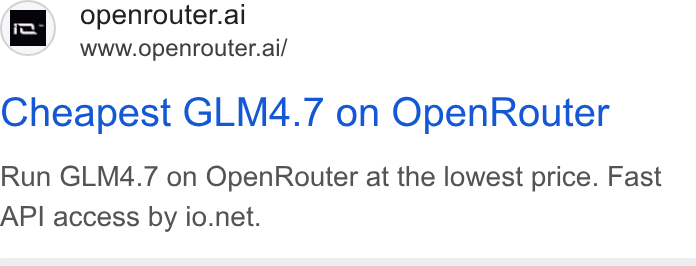
- openrouter.ai www.openrouter.ai/ Cheapest GLM4.7 on OpenRouter
- CTA / offer
- Run GLM4.7 on OpenRouter at the lowest price. Fast API access by io.net.
- Audience
- Individuals or businesses seeking cost-effective access to GLM4.7 and fast API access, indicated by the phrases "Cheapest GLM4.7" and "Fast API access by io.net."
Why it works. Targets developers price-shopping a specific model by name, using a superlative price claim to win the click from comparison search queries.
Headline with a bold price claim: "Cheapest GLM4.7 on OpenRouter" Put your cheapest specific model or SKU name plus a superlative like cheapest in your search ad headline so it matches exact-match price comparison queries.
08 The playbook
The channels are not separate. They are one system where each stage feeds the next. Here is the read, then the plays to run tomorrow.
The inferred playbook
The loop starts with a public data asset that earns unprompted coverage, converts through a low-friction sign-in, and compounds through an auto-expanding page catalog.
unprompted third-party posts about OpenRouter's own rankings and usage data supply steady top-of-funnel attention without a media budget.
the funnel lands on the sign-in page itself, the site's top organic-attributed page at 109,357 monthly visits, consistent with a low-friction, self-serve signup that needs no sales conversation.
Dig deeper+3▾
the per-model and per-app pages plus the rankings dataset both grow automatically as the model catalog expands, so content surface scales with product usage rather than headcount.
there is no visible creator-affiliate program, paid-ads engine, or brand social account carrying weight independent of the founder, so if Atallah's personal reach or the rankings dataset's novelty fades, no second acquisition engine is visible in the public evidence.
free-to-paid conversion, churn, CAC, blended ARPU by tier.
Publish your usage data as a standalone public asset
The proofThe model-rankings dataset first floated in a 2023 Show HN post still generates unprompted Hacker News coverage years later, from "Grok is now the most popular model" to a third-party 100-trillion-token study built entirely on that data.
The adaptationIdentify what usage or performance data your own product already collects internally, publish it as a standalone, auto-updating public page, and submit it to the communities native to your category rather than pitching your product directly. People cite an authoritative number far more readily than they share a product pitch, so the data becomes other people's content.
Cost: under $500 · Time to signal: weeks · Works pre-PMF: conditional, only if your product already generates a number worth comparing (rankings, benchmarks, usage volume).
Turn founder milestones into competitive content
The proofAtallah's tweet comparing OpenRouter's daily token volume against OpenAI's published API volume drew 98,526 views by framing a usage stat as a claim against a household name.
The adaptationPick one usage or growth metric from your own product each month, frame it explicitly against a recognizable industry benchmark or bigger competitor, and post it from your personal founder account rather than the brand account, since personal accounts carry more perceived candor than corporate ones.
Cost: $0 · Time to signal: days · Works pre-PMF: yes, provided there is any real number worth comparing, even a small one.
Build one page per catalog item instead of a blog
The proofIndividual per-model and per-app pages (covered in Content & SEO Engine above) rank independently with no manual content work.
The adaptationIf you have a multi-item catalog of any kind, integrations, templates, plugins, models, generate one templated page per item with its own specs and pricing, and submit the resulting sitemap. This scales your SEO surface area in step with product growth instead of requiring ongoing content production.
Cost: under $500 · Time to signal: weeks · Works pre-PMF: conditional, only useful once you have 10+ distinct catalog items worth individual pages.
Hunt your own referrer logs for an accidental niche
The proofTwo consumer roleplay-chat apps, janitorai.com and godmod3.ai, appear among OpenRouter's top referring domains, an unplanned downstream use case feeding real traffic distinct from its core developer audience.
The adaptationCheck your own analytics for surprise referring domains or use cases you didn't design for, then actively support that niche with tailored docs or examples once you spot it. An accidental downstream adopter can become a real acquisition channel if you lean into it rather than ignore it.
Cost: $0 · Time to signal: weeks · Works pre-PMF: conditional, only once you already have some organic downstream adoption to detect.
Answer comparison threads with specifics, not marketing
The proofThird-party threads like "Apple Silicon costs more/less than OpenRouter" and "Eden AI, European Alternative to OpenRouter" (covered in Launch & Traction above) drove real discussion without OpenRouter initiating any of them.
The adaptationMonitor "alternative to X" and cost-comparison discussions in your own category's forums, and reply with concrete technical specifics, pricing, limits, benchmarks, rather than promotional language, since technical communities reward a straight factual answer over a pitch.
Cost: $0 · Time to signal: days · Works pre-PMF: yes. Not transferable at an earlier stage: picking public fights with category giants over ad spend only reads as confidence once you already have enough scale and credibility behind you; a very early founder should hold off on that particular move until the underlying numbers are undeniable.
You just read how OpenRouter does it. Tomorrow it is someone else.
Every morning we take one company that is actually growing and break down where its customers come from: the ads still running after a year, the channel doing the real work, and the play you can run this week.
Systemaic · directional intelligence. Traffic, spend, and reach figures are SimilarWeb-style estimates and qualitative reads of public data, not audited numbers. Built on real public receipts.
// teardowns with a similar GTM motion
sources & receipts (7)
Live ad libraries: google ad library
Launch archives: Hacker News: OpenRouter raises $113M Series B · Hacker News: Apple Silicon costs more than OpenRouter · Hacker News: Reallocating $100/Month Claude Code Spend to Zed and OpenRou · Hacker News: A robot is sprinting towards you. Do you want it running on · Hacker News: Openrouter Fusion API · Hacker News: GPT-5.5 Price Increase: What It Costs
Traffic, spend, and revenue figures are estimates as noted in the report; the links above are the primary public artifacts.