- 01Gate signups with a manual waitlist
- 02Trade private support for a public community
- 03Amplify the users already publicizing you
- 04Run a recurring "how we use our own product" show
01 Snapshot
The one-glance read on who they are and how they grow. Each point is verifiable from the receipts above.
A spreadsheet-style GTM data enrichment and AI outbound-agent platform for sales/RevOps teams that crossed $100M ARR in December 2025, per its own blog.
Community-led and content-led, with paid search and boosted LinkedIn posts layered on top rather than driving acquisition themselves.
~1.55M monthly visits (+3.9% over the last 3 months), ~14,000 customers as of January 2026, and a combined ~630-ad Google and LinkedIn library as of 2026-07-09.
As of 2026-07-09, Clay's newest Google tests are video creative launched in late June 2026, replacing the text-only ad format that has run for years.
Clay's growth engine, agencies who publicly build and resell Clay workflows as their own expertise, is now also its exposure point: a 2026 pricing overhaul is visibly pushing some of those same users toward alternatives on Reddit.
02 How it unfolded
The order the channels came online. Sequence is strategy: what they did first, and what they layered on once demand existed.
03 Traffic & channel mix
Estimated demand, the channel split behind it, and the keywords and referrers doing the work. Directional modeling, not audited analytics.
Traffic sources
Top search keywords
| Keyword | Volume | Weight | CPC |
|---|---|---|---|
| clay | 360k | $1.10 | |
| clay ai | 41k | $2.97 | |
| clay pricing | 15k | $1.50 | |
| clay careers | 9.7k | $6.01 | |
| clay university | 5.3k | $3.94 |
Top referring sites
Closest competitors by audience
Clay pulls an estimated ~1,552,411 monthly visits, up 3.9% over the last 3 months. Direct traffic dominates at 60.7% of the mix, which for a browser-based workspace tool reads less as brand-recall marketing and more as existing customers logging back into open enrichment jobs. Search Organic is the clear second channel at 24.8%, consistent with a deliberate programmatic SEO program (detail below), and Social Organic sits at 4.7%, concentrated on LinkedIn rather than X. The rest, referrals, generative-AI referrals, email, paid search, paid social, and display, totals under 12% combined and none of them individually clears 3%.
On keyword demand, "clay" pulls 360,460 monthly searches as the branded head term, "clay ai" pulls 41,430 as the product-category variant, and "clay pricing" pulls 15,040, a high-intent, bottom-funnel signal that lines up with the pricing backlash visible in the Reddit evidence below. Referring sites include thesignal.club, which reads as a GTM/marketing community or newsletter sending community-driven referrals rather than paid placement, and gumloop.com, a workflow-automation tool adjacent to Clay's own category whose referral traffic likely comes from audience overlap or an integration mention rather than competition. Among the competitor set, apollo.io is the closest head-to-head substitute in prospecting and data enrichment, while gong.io and hubspot.com sit adjacent in the same GTM stack and are more likely co-purchased than swapped out for Clay.
04 Organic content
The specific pages earning their organic search traffic, and the pattern behind why they rank. Adapt the format, not the topic.
Clay's highest-traffic organic pages beyond the homepage are "dossier" pages, templated company-lookup pages like company headquarters addresses and executive names, one of which (an OpenAI CEO lookup, another for Amazon's headquarters address) individually pulls over a thousand monthly organic visits. The pattern is classic programmatic SEO: one page template applied across thousands of companies, each page an exact-match landing spot for a specific long-tail query ("amazon headquarters address," where Clay ranks #1). It likely ranks easily because these are low-competition, high-specificity queries that generic content sites don't bother templating, and each page doubles as a live demo of the exact company-data lookup Clay's product performs, so the traffic and the product pitch are the same page.
Top pages by organic traffic
05 Channel map
Not traffic share. How much weight the growth system actually puts on each channel, with a one-line read on the role it plays.
What drove growth
06 The motions doing the work
For founder-led SaaS the breakdown shifts from ads to traction: where the first users came from, how the founder grows it in the open, and the compounding organic surface.
Clay's early growth ran on manufactured scarcity and a support pivot, not a single launch spike.
After a Product Hunt debut in February 2022 (named Product of the Month), Clay reimposed an invite waitlist roughly two months later and kept it active for about 15 months, hand-qualifying signups against its ideal customer profile before granting access.
Clay shut down its paid Intercom support plan and routed all customer support into a public Slack community that grew from around 200 members at launch to a reported 10,000-20,000+, turning support tickets into peer advocacy.
Dig deeper+1▾
Growth spread on LinkedIn rather than X, as lead-gen agency users publicly posted their own Clay-built workflows as a skill signal and lead magnet for their own services, a loop Clay later formalized into its Clay Creator, Playbooks, and Expert partner programs. The evidence gathered here does not include Product Hunt upvote counts or a first-week traffic curve, so the exact inflection point is not independently verifiable beyond the sequence above.
Clay's public-building voice comes less from a single founder's feed and more from an institutionalized program that turns internal team members into the company's own case studies, then pays to amplify whichever posts land.
Co-founder and head of operations Varun Anand runs a LinkedIn account with 55,134 followers focused on the company and product (co-founder/CEO Kareem Amin is the company's other named founder), but no specific posts from him appear in the evidence, so his reach is measurable while his cadence is not.
The flagship format is "How Clay Uses Clay," internal builders such as Bruno Estrella, Davide Grieco, and Luca Prando posting how they use Clay's own AI agents on Clay's own GTM problems, which the company then boosts as LinkedIn ads under both "Clay" and "Promoted by Clay" bylines.
Dig deeper+2▾
One boosted post states that 40% of "How Clay Uses Clay" registrants returned for another episode without paid re-acquisition, at under $20 average cost per lead across 15,000+ registrants, the clearest evidence the format compounds instead of resetting with every new episode.
Clay runs no Reddit presence of its own, but its product and pricing show up unprompted across at least six subreddits (gtmengineering, SaaS, LeadGenMarketplace, b2bmarketing, GrowthHacking, ExperiencedFounders), real evidence of category mindshare even where the threads turn critical.
Search is Clay's second-largest channel at 24.8% of total traffic, built on a programmatic page network rather than classic blog SEO.
Beyond the dossier pages covered above, that same company-lookup format scales the way most B2B programmatic SEO plays do: one template, thousands of company records, each page a landing spot for a specific high-intent query.
The Rewardful-powered partner program at clay.com/partners formalizes the agency workflow-sharing loop into trackable referral economics, converting unpaid advocacy into a structured, incentivized channel.
Dig deeper+2▾
Paid Search is only 1.6% of the traffic mix against organic search's 24.8%, and the Google ad angles ("still using one data provider?", "flexible, risk-free pricing") read as brand and near-brand capture rather than cold demand generation.
The boosted "How Clay Uses Clay" program covered above supplies the bulk of Clay's LinkedIn ad library rather than the company running separate ad-only creative.
07 Paid ads
This founder-led SaaS also runs paid acquisition. Here are the live ads doing the work, each with the X-ray and a play you can adapt.
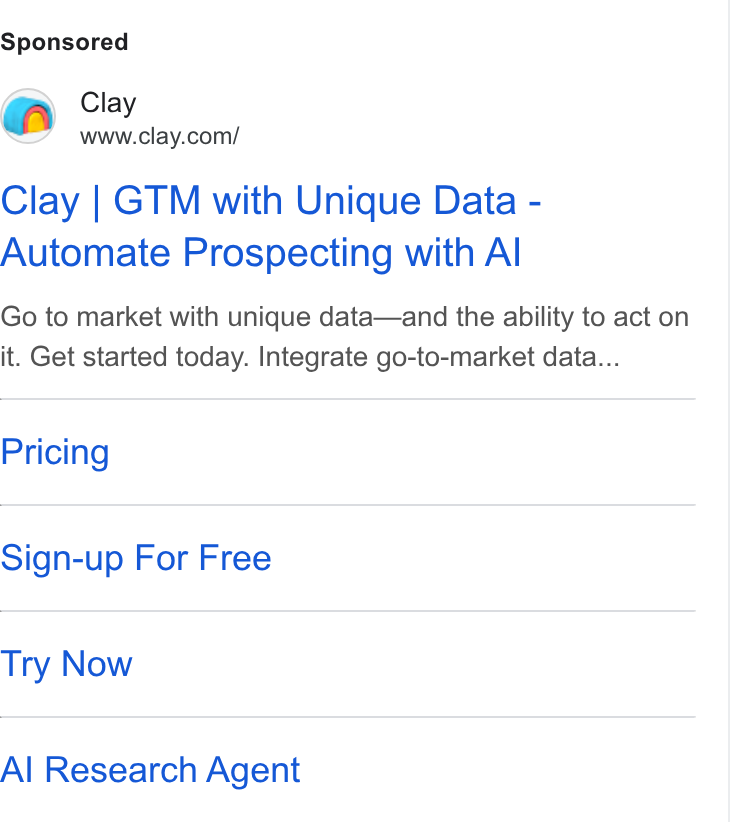
- Running
- 628 days (longevity = it's converting)
- Hook
- Sponsored Clay www.clay.com/ Clay | GTM with Unique Data - Automate Prospecting with AI
- CTA / offer
- Sign-up For Free
- Audience
- Businesses or individuals involved in sales, marketing, or business development, indicated by terms like 'GTM', 'Prospecting', and 'AI Research Agent'.
Why it works. Signals a data-differentiation angle to GTM buyers already comparing several prospecting tools side by side.
Headline clearly states the core benefit: "Clay | GTM with Unique Data - Automate Prospecting with AI" Add a one-word differentiator right after your category name in the headline instead of the category alone.
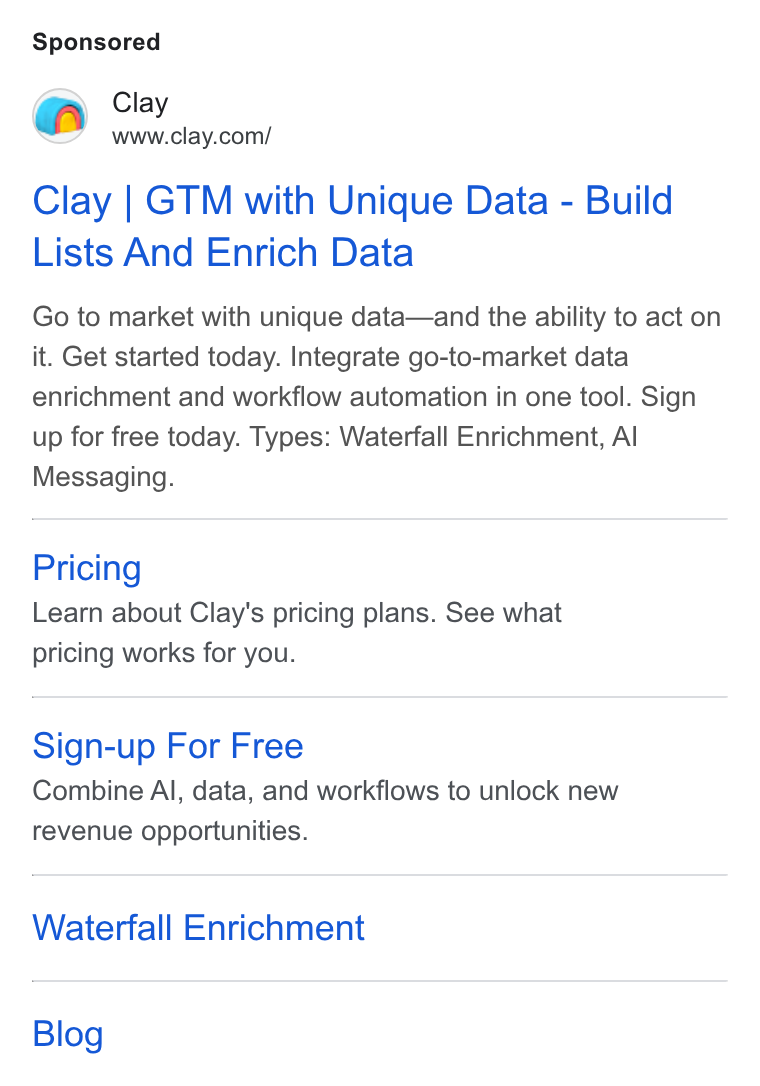
- Running
- 567 days (longevity = it's converting)
- Hook
- Sponsored Clay www.clay.com/ Clay | GTM with Unique Data - Build Lists And Enrich Data
- CTA / offer
- Sign up for free today.
- Audience
- The ad targets businesses or individuals involved in 'Go to market' strategies, 'data enrichment', and 'workflow automation', indicated by the specific terminology used in the main ad copy.
Why it works. Speaks to the two-step manual workflow GTM teams already run, positioning Clay as the replacement for both at once.
Headline directly addresses a business need: 'Clay | GTM with Unique Data - Build Lists And Enrich Data' List the two or three manual steps your product replaces directly in the headline, not one vague benefit.
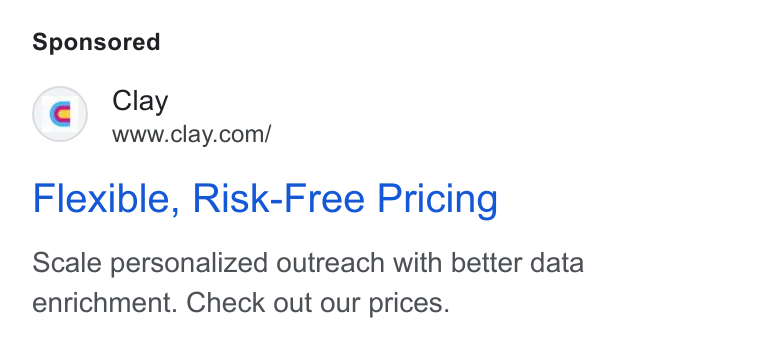
- Running
- 567 days (longevity = it's converting)
- Hook
- Sponsored Clay www.clay.com/ Flexible, Risk-Free Pricing
- CTA / offer
- Check out our prices.
- Audience
- The text 'Scale personalized outreach with better data enrichment' targets businesses or individuals involved in sales, marketing, or customer relations who are looking to improve their outreach strategies.
Why it works. Targets prospects stalled on the pricing objection late in evaluation, using 'risk-free' to counter contract-lock fears.
Headline: 'Flexible, Risk-Free Pricing' If price or contract length is a common sales objection, put the objection-defusing phrase directly in the headline.
Show 3 more ads
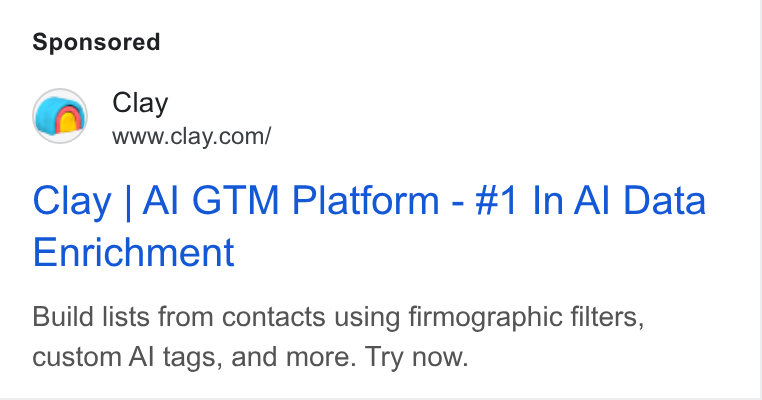
- Running
- 567 days (longevity = it's converting)
- Hook
- Visual: The word "Sponsored" at the top left, followed by a small circular icon with blue, orange, and yellow colors, and the text "Clay" and "www.clay.com/". Text: "Sponsored" and "Clay | AI GTM Platform - #1 In AI Data Enrichment"
- CTA / offer
- Try now.
- Audience
- Businesses or individuals involved in Go-To-Market (GTM) strategies, sales, or marketing, indicated by "AI GTM Platform" and "Build lists from contacts using firmographic filters, custom AI tags."
Why it works. Uses a category-specific ranking claim to reassure comparison-stage buyers evaluating several AI enrichment vendors.
Headline with a bold claim: "Clay | AI GTM Platform - #1 In AI Data Enrichment" If you can claim a #1 spot in a narrow, defensible category, name that exact category rather than the broad market.
- Running
- 424 days (longevity = it's converting)
- Hook
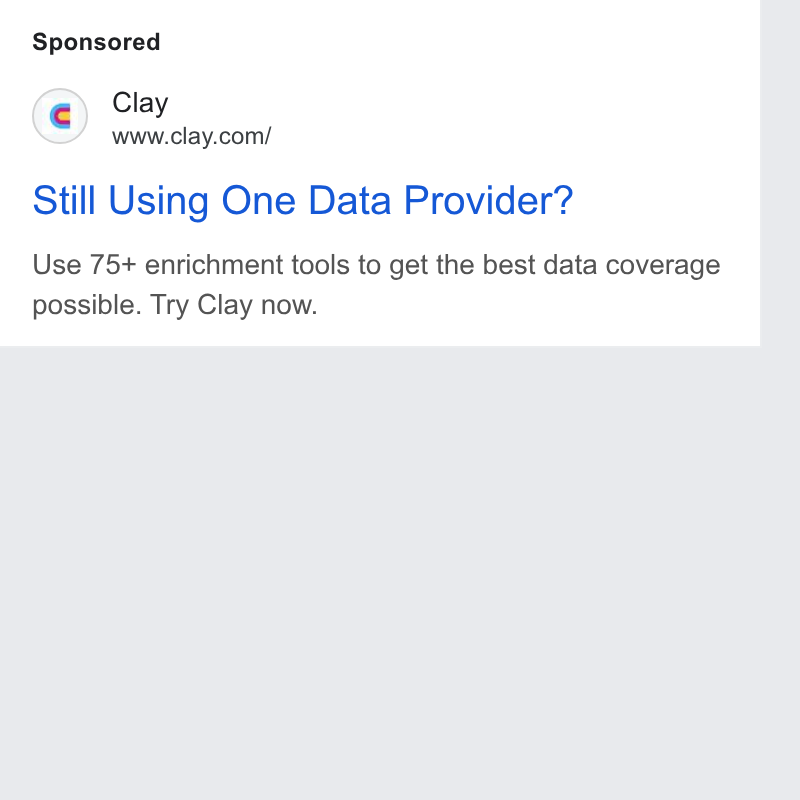
- Sponsored Clay www.clay.com/ Still Using One Data Provider?
- CTA / offer
- Try Clay now.
- Audience
- Businesses or individuals who currently use a single data provider, indicated by the question "Still Using One Data Provider?".
Why it works. Targets teams already paying for one enrichment vendor by implying they're missing coverage, a wedge into existing budget.
Directly questioning the viewer's current behavior with a leading question: "Still Using One Data Provider?" Ask a yes/no question implying your prospect's current single-vendor setup is a compromise, then offer the fix.
- Running
- 424 days (longevity = it's converting)
- Hook
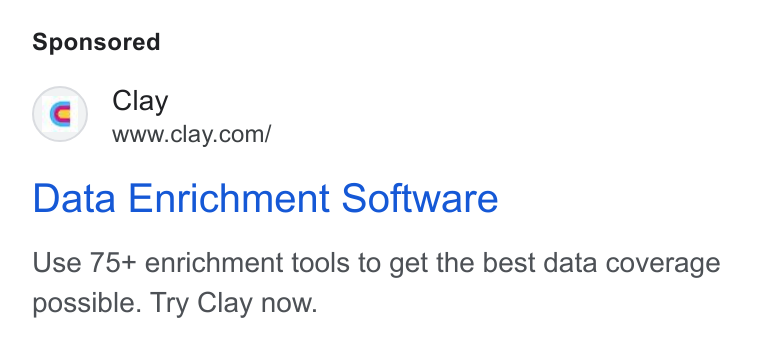
- Sponsored Clay www.clay.com/ Data Enrichment Software
- CTA / offer
- Try Clay now.
- Audience
- Businesses or individuals seeking to improve data quality and coverage, indicated by the terms 'Data Enrichment Software' and 'enrichment tools'.
Why it works. A plain category-name search ad built to catch bottom-funnel searchers who already know the term and are comparing vendors.
Headline: 'Data Enrichment Software' Use a headline that explicitly names your product category or primary benefit to instantly qualify your audience.
08 The playbook
The channels are not separate. They are one system where each stage feeds the next. Here is the read, then the plays to run tomorrow.
The inferred playbook
The loop starts with free organic discovery, converts through a self-serve free tier with a real usage floor, and is now straining at the pricing layer that used to be its differentiator.
Programmatic dossier pages capturing high-intent company-research search traffic, and agencies publicly rebroadcasting their own Clay workflows on LinkedIn, both compounding without incremental ad spend.
A free tier (100 data credits / 500 actions) feeds into $185/mo Launch or $495/mo Growth tiers, with Enterprise custom-quoted from roughly $30,000/year. Dividing the company-stated $100M ARR by ~14,000 customers works out to a blended ARPU near $7,100/year (~$590/month), well above the Launch tier price, implying the mix skews toward Growth and Enterprise accounts rather than the entry plan.
Dig deeper+3▾
The community-plus-partner-program flywheel (public Slack support, Clay Creator/Playbooks/Expert tiers) turns support and services into more free marketing, since each qualified user is also a potential publisher.
The 2026 shift to dual-meter (credits plus actions) pricing is the subject of at least six separate Reddit threads asking for alternatives, with agencies citing 30-50% month-to-month bill swings that break their client pricing, and no visible Clay response appears in the threads sampled.
free-to-paid conversion rate, churn, and CAC (enterprise net revenue retention is company-stated above 200% with no reported enterprise churn, but that figure is unaudited).
Gate signups with a manual waitlist
The proofClay's waitlist (covered above) was reimposed on purpose after launch, not left open, and ran for roughly 15 months of hand-qualification.
The adaptationReplace an open signup button with a short qualifying form and approve entries by hand against your ideal customer profile, even after you've technically "launched." First step: write three qualifying questions, put them behind your signup CTA, and review submissions once a day, messaging rejected applicants with why so it still builds goodwill. Manufactured scarcity paired with manual qualification means every early user is a proven fit, so word of mouth spreads inside the right circles instead of diluting into generic traffic.
Cost: $0 · Time to signal: weeks · Works pre-PMF: yes, provided there's enough inbound interest to make a waitlist credible rather than an empty gate.
Trade private support for a public community
The proofClay's support-to-Slack swap (covered above) replaced paid support with a public channel rather than adding community as an extra option.
The adaptationMove support out of private tickets and into a public Slack or Discord channel, and answer every question there instead of by DM. First step: post your next ten support answers in a public channel instead of a closed ticket. Making support publicly visible turns every resolved question into searchable proof the product works and free onboarding content for the next user with the same problem.
Cost: $0 · Time to signal: weeks · Works pre-PMF: yes.
Amplify the users already publicizing you
The proofClay's early LinkedIn virality (covered above) ran on lead-gen agencies posting their own Clay-built workflows as their own skill signal, unprompted.
The adaptationSearch your product name for unprompted mentions on LinkedIn and X, then reach out to the three most active posters and offer to co-promote or feature their content. First step: run that search, shortlist the top three, and send a specific offer (a feature, a case study, early access to something new) rather than a generic "thanks for the shoutout." A peer publicly using your product as their own expertise is a stronger trust signal than anything brand-authored, because the audience believes a user over an ad.
Cost: $0 · Time to signal: weeks to months · Works pre-PMF: conditional, only works once a handful of users are already talking about you; it does nothing at zero customers.
Run a recurring "how we use our own product" show
The proofClay's "How Clay Uses Clay" series (covered above) is its highest-retention content format.
The adaptationHost a recurring internal-facing walkthrough of how your own team uses your own product to solve a real problem, and post it natively with zero production budget. First step: pick one real internal workflow, record a 15-minute screen share solving it, and post it with a one-line hook naming the problem it solved. Audiences trust a company using its own tool under real pressure more than a polished demo, and a recurring cadence turns each episode into a reason to come back instead of a one-off spike.
Cost: $0 to start (paid boosting of the strongest episodes later runs under $500/mo) · Time to signal: weeks · Works pre-PMF: yes.
Template a data pattern only your product already touches
The proofClay's dossier pages (covered above) rank #1 for exact-match queries like "amazon headquarters address" by templating data the product already collects.
The adaptationFind one data pattern your product already generates or touches, a directory, a comparison set, a calculator, and template it into one page per entity or query variant. First step: list 20 high-intent long-tail queries adjacent to your product's data, build a single page template, and publish all 20 at once to test indexing speed. Templated pages targeting exact-match, low-competition queries rank faster than fighting for a handful of generic head terms, and each page doubles as a live product demo.
Cost: under $500 (or $0 built in-house) · Time to signal: months · Works pre-PMF: yes. Not transferable at an earlier stage: Clay's current paid-ad scale (a combined ~630 active and historical ads across Google and LinkedIn), its 300-person team as of January 2026, and its $30,000+/year enterprise tier assume a budget and headcount the reader almost certainly doesn't have yet; adapt the early seeding and community mechanics above, not the current spend level.
You just read how Clay does it. Tomorrow it is someone else.
Every morning we take one company that is actually growing and break down where its customers come from: the ads still running after a year, the channel doing the real work, and the play you can run this week.
Systemaic · directional intelligence. Traffic, spend, and reach figures are SimilarWeb-style estimates and qualitative reads of public data, not audited numbers. Built on real public receipts.
// teardowns with a similar GTM motion
sources & receipts (8)
Live ad libraries: linkedin ad library · google ad library
Launch archives: Hacker News: Pythagorean Theorem found on clay tablet 1k years older than · Hacker News: Clayton Christensen has died · Hacker News: Clay – UI Layout Library · Hacker News: Scammers Game Amazon A-Z Policy By Replacing iPhones With Cl · Hacker News: Clay PCB Tutorial · Hacker News: Clay (short for C Layout) is a high performance 2D UI layout
Traffic, spend, and revenue figures are estimates as noted in the report; the links above are the primary public artifacts.