- 01Turn your credentials into the ad hook
- 02Bid on your own category name before someone else does
- 03Name your core mechanism
- 04Recruit creators with a personal code instead of a public affiliate link
01 Snapshot
The one-glance read on who they are and how they grow. Each point is verifiable from the receipts above.
DTC "skin longevity" skincare built around a proprietary OS-01 peptide, sold to a premium/biohacker-adjacent skincare audience, backed by roughly $42M in total funding to date, including a fresh $20M investment from Prelude Growth Partners in August 2025.
Creator-led, with a long-running paid-search anchor doing the category-ownership work in the background.
~343,000 estimated monthly visits (+7.5% over the last 3 months) as of 2026-07-13, an owned Instagram of 170,674 followers, a Google ad still active after ~965 days as of 2026-07-13, and press-reported 2025 revenue projection of $40-50M announced alongside the August 2025 raise.
As of 2026-07-13, the entire visible Meta ad set launched together on July 2, 2026, testing myth-busting peptide claims and hydration-stat social proof, while Google's newest tests probe educational search intent (retinol tapering, hyaluronic acid, microneedling alternatives).
OneSkin's acquisition splits cleanly by platform: Google search ads have anchored the "skin longevity" category for nearly three years while its own social accounts barely move the needle (X dormant since 2021, Instagram running roughly 0.1% engagement per post), so discovery is bought and borrowed from hired creators, not generated by the brand's own feed.
02 How it unfolded
The order the channels came online. Sequence is strategy: what they did first, and what they layered on once demand existed.
03 Traffic & channel mix
Estimated demand, the channel split behind it, and the keywords and referrers doing the work. Directional modeling, not audited analytics.
Traffic sources
Top search keywords
| Keyword | Volume | Weight | CPC |
|---|---|---|---|
| oneskin | 7.9k | $0.62 | |
| one skin | 7.5k | $0.63 | |
| one skin eye cream | 50 | $1.63 | |
| one skin os-01 | 340 | - | |
| www. oneskin.co | 420 | - |
Top referring sites
Closest competitors by audience
OneSkin draws an estimated ~343,000 monthly visits, up 7.5% over the last 3 months. Search Organic is the single largest channel at 34.8%, consistent with the brand ranking #1 for "oneskin," "one skin," and "combination skin." Direct traffic follows at 18.6%, a sizable chunk of habitual or bookmark-driven visits for a six-year-old brand with real repeat-purchase subscribers. Display Ads sit at 12.4%, the third leg, reflecting the always-on programmatic push visible in the Google ad library. Social Paid (11%), Search Paid (8.7%), and Email (8.4%) form a secondary tier that keeps the funnel warm without dominating the mix; the rest, Affiliate, Referrals, Social Organic, and Gen AI, totals under 6% combined. The brand ranks or bids into real demand: "oneskin" pulls 7,920 searches/month and "one skin" 7,490/month (both are brand-name search volume that reflects name demand rather than site traffic), while "one skin os-01" at 340 searches/month shows the ingredient name itself has started generating direct-navigation demand. The one referring site in the data, selvaventures.com, belongs to Selva Ventures, which led OneSkin's 2024 Series A, so it is an investor's site rather than an organic partner, a reminder that "referrer" data can reflect capital relationships as much as marketing ones. Among competitors, medik8.com and perriconemd.com are established, science-positioned skincare brands competing for the same credibility-seeking buyer, while murad.com represents the more mainstream dermatologist-branded tier OneSkin is pricing and positioning above.
04 Organic content
The specific pages earning their organic search traffic, and the pattern behind why they rank. Adapt the format, not the topic.
The top organic pages split between the homepage (~39.8% of tracked organic traffic on its own) and two distinct content types: product pages (OS-01 Body, OS-01 Face) and educational "reference lab" blog posts comparing ingredients (niacinamide vs. retinol) and skin types (combination skin). This pairing is deliberate: the ingredient-education angle feeds people searching for skincare science questions, then routes them straight to the product that answers the question, rather than parking them on a generic blog. It likely ranks well because it matches genuine informational search intent (comparison and "vs." queries) with a brand that has built its entire identity around being the scientifically rigorous option, giving Google's algorithm and readers alike a reason to trust the answer coming from a product page's neighboring content hub.
Top pages by organic traffic
05 Channel map
Not traffic share. How much weight the growth system actually puts on each channel, with a one-line read on the role it plays.
What drove growth
06 The creative doing the work
Each exhibit shows the actual asset, an X-ray of why it works, a status, and a play you can adapt. This is the heart of the teardown.
The two ad platforms tell different stories about maturity. On Google, the sampled library runs to roughly 200 ads (directional, sample-capped), with 54 still active as of 2026-07-13, and the oldest active ad has been running ~965 days since November 2023, a genuine proven winner by any longevity standard. On Meta, every dated active ad in the sample shares the same first-shown date of July 2, 2026, just 11 days old as of the observation date, meaning nothing on Meta has cleared the longevity bar yet; call this a synchronized creative refresh, the current push, rather than a proven library.
The Google winners:
-
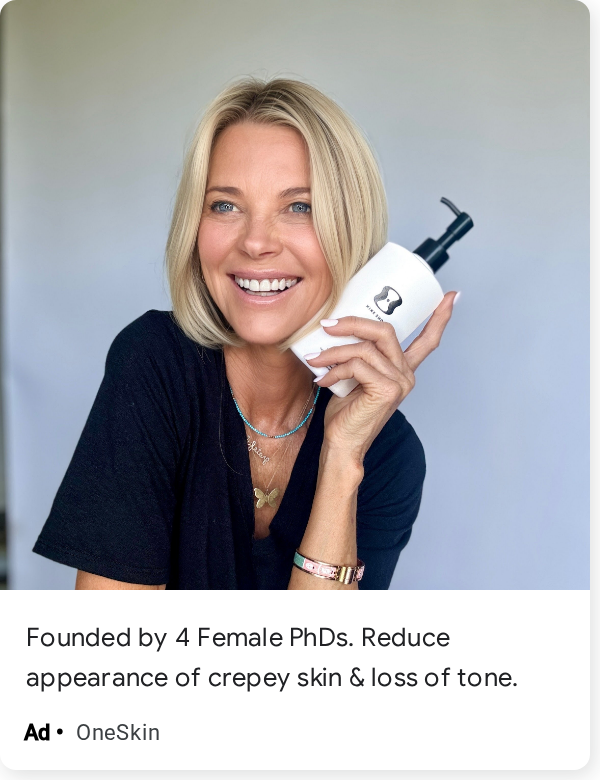
Hook: "Founded by 4 Female PhDs. Reduce appearance of crepey skin & loss of tone." over a smiling woman holding the product.
-
Why it works: it pairs a founder-credibility signal (four female scientists) with the exact anxiety search term ("crepey skin"), preempting the "is this real science or marketing" skepticism that dogs peptide skincare claims before the reader can raise it.
-
Run this play: expanded as Play 1 below.
-
Hook: a text-based Google search ad reading "Sponsored / OneSkin / Your Skin Longevity Company - Skin Longevity Supplements," part of the set active since November 2023.
-
Why it works: it bids directly on branded and category search queries to keep the brand's own coined category, "skin longevity," locked to its name in the results a searcher already trusts.
-
Run this play: expanded as Play 2 below.
-
Hook: "Powered by the OS-01 peptide. OS-01 is a one of a kind peptide that actually targets the root cause of aging," over a close-up product shot.
-
Why it works: naming the mechanism (OS-01) gives searchers a specific, ownable term to remember and re-search later, which shows up directly in the monthly search volume for "one skin os-01."
-
Run this play: expanded as Play 3 below.
The ads land on Shopify product and bundle pages rather than a single generic storefront. The crepey-skin BODY ad lands on "Revitalize Crepey Skin: Save 15% on OS-01 BODY + Free Shipping," where single items sit at $109-$117 and bundle sets show a sale price against a struck-through full price ($203.40 down from $229, $389.70 down from $429), plus a subscribe-and-save 15% and free shipping. The limited-edition trio and duo ads (hair, body SPF, face SPF) all land on near-identical $79 bundle pages using the same mechanic: subscribe and save 15% via the Skio subscription platform, with free shipping kicking in over $79. The consistency across landers, same discount rate, same shipping threshold, same subscription vendor, suggests a templated bundle-building system rather than one-off promo pages, which lowers the cost of spinning up a new seasonal set (Body Longevity Essentials Duo, Head-to-Toe Skin Health Trio) whenever a new ad wave needs a matching offer.
- Running
- 11 days (new — still being tested)
- Hook
- "I'm packing for the beach..." shown with the text overlay "2 PRODUCT BEACH MAKEUP & SPF ALL IN ONE" and a woman in a navy halter top holding two white tubes.
- Audience
- Women interested in simplified skincare and makeup routines for summer/beach activities.
Why it works. Anchoring the pitch to the exact moment of packing for a trip turns a routine product feature into a solution for a specific near-term task.
Efficiency Claim (0:00 - "2 PRODUCT BEACH MAKEUP & SPF ALL IN ONE") Set your opening line at the exact moment your buyer is deciding what to pack or buy for a specific trip or event.
- Running
- 3 days (new — still being tested)
- Hook
- "Myth: 'Peptides are just a marketing word.'" shown as text over a close-up of a white bottle with a black logo being pumped to dispense white cream onto a hand.
- Audience
- Women concerned with skin aging, specifically those who are skeptical of standard beauty marketing and value scientific validation.
Why it works. Voices the exact skepticism peptide buyers already hold, then uses the demo to answer it, which suits a product with a real objection to overcome.
Myth/Fact Framework (0:00-0:03) Write down the top objection people leave in comments, then open your next ad with Myth: plus that exact objection.
- Running
- 3 days (new — still being tested)
- Hook
- "Irritation from retinol?" + close-up of dry, peeling skin on a chin and around the mouth.
- Audience
- Skincare users who use retinol and suffer from "retinol burn" or skin barrier damage.
Why it works. Calling out retinol by name catches people mid-use of a competitor's ingredient and offers this product as the fix for that exact side effect.
Macro-visual problem agitation (0:00-0:03 "Irritation from retinol?") Name the specific ingredient or product your audience currently uses that's causing their problem, not the problem in general terms.
Show 7 more exhibits
- Running
- 3 days (new — still being tested)
- Hook
- "Hyaluronic acid hydrates. OS-01 does something different." Spoken and on-screen text while a woman in a black tank top holds a small black microphone.
- Audience
- Skincare users familiar with Hyaluronic Acid who are seeking advanced, science-backed anti-aging solutions.
Why it works. Contrasting OS-01 against the industry's default ingredient by name shifts the decision from 'which moisturizer' to 'which category'.
Category Redefinition (0:05 - "OS-01 FACE isn't just a moisturizer") Name the default ingredient your buyers already trust, state its one job, then say your product does a different job entirely.
- Running
- 964 days (longevity = it's converting)
- Hook
- A smiling woman with blonde hair holds a white bottle with a black pump dispenser. On-screen text reads: "Founded by 4 Female PhDs. Reduce appearance of crepey skin & loss of tone."
- Audience
- Women concerned about aging skin, specifically 'crepey skin & loss of tone', who value scientific backing and professional endorsement.
Why it works. Leads with founder PhDs before the benefit, so skeptical buyers of crepey-skin products get credentialed backup before the claim lands.
On-screen text states: "Founded by 4 Female PhDs." in the ad copy. If your team has relevant degrees or titles, put the credential in the headline itself, not the About page.
- Running
- 953 days (longevity = it's converting)
- Hook
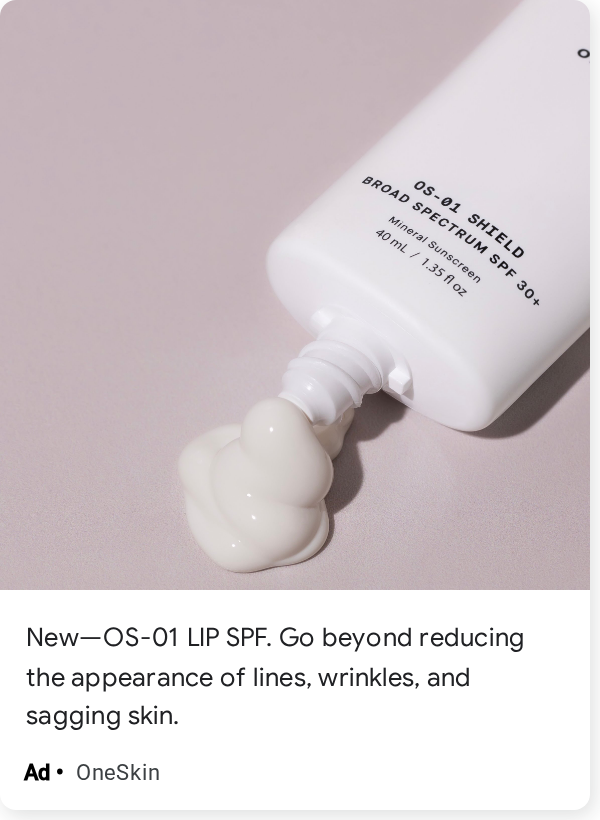
- A white tube of 'OS-01 SHIELD BROAD SPECTRUM SPF 30+ Mineral Sunscreen 40 mL / 1.35 fl oz' is shown on a light purple surface, with a dollop of white cream squeezed out of its nozzle.
- Audience
- Individuals concerned with aging skin, specifically lines, wrinkles, and sagging skin, and those seeking sun protection for their lips.
Why it works. A tight, glossy product texture shot works as a sensory teaser for a new sunscreen launch where buyers haven't felt the formula yet.
Visual product demonstration: The image shows a white cream being squeezed from a white tube labeled 'OS-01 SHIELD BROAD SPECTRUM SPF 30+ Mineral Sunscreen 40 mL / 1.35 fl oz'. For a new SKU, shoot one close-up of the product's texture on a plain background before shooting lifestyle scenes.
Skin first, outfit second. @oneskin.co #oneskin #skinlongevity #parisfashionweek #oneskinpartner
My ultimate love language…skincare @oneskin.co. ad| products used: @augustinusbader face sheet @augustinusbader body cream @clarinsofficial double serum concentrate @oneskin.co OS-01 FACE @oneskin.co OS-01 EYE @oneskin.co Lip SPF @refybeauty brow @bumbleandbumble styling foam
mornings like this on repeat - @oneskin.co face moisturizer made with senescence blocking peptides to promote youthful complexion @oneskin.co concentrated eye cream to strengthen delicate skin around the eyes @oneskin.co lip spf made with antioxidants to prevent sun damage - @modelistemagazine @calademarixtapa @visitiz #modearoundtheglobe
- Reach
- 3 upvotes · 20 comments · r/SkincareAddictionLux
A community is already discussing this in r/SkincareAddictionLux. Show up there authentically and answer the thread before a competitor does.
Who amplifies them
The amplification engine is almost entirely third-party creators tagged #OneSkinPartner, not the brand's own accounts. Bella Dane (TikTok) and rahi_chadda (Instagram) are the two highest-reach names in the data, with rahi_chadda's posts disclosed as paid partnerships ("ad|") on at least one occasion. Smaller creators run personal discount codes as their calling card: Karen on TikTok offers "karen15" for 15% off, and theskincarediarist offers "SKINCAREDIARIST" for the same. The Lipstick Lesbians' sponsored TikTok explaining senescent cells ("skin age 'longevity' robbers") pulled 11,991 engagements, the top single organic post in the dataset. Reddit amplification is thin but real: a single organic thread in r/SkincareAddictionLux shows the brand being discussed unprompted. The brand account (@OneSkinTech) and founder Carolina Reis Oliveira's personal X account are both effectively inactive, so none of this amplification runs through owned brand channels.
07 Organic & video
The organic content engine: the videos, creator posts, and community presence earning attention without paid spend.
The brand's own X account produced its highest-signal moment years ago: an October 2020 tweet announcing a live product launch conversation between co-founder and CEO Carolina Reis Oliveira and longevity expert Peter Diamandis, and a March 2021 restock post noting the prior batch "sold out in ONLY FOUR DAYS," an early scarcity signal rather than an ongoing tactic. The real posting cadence now lives with creators, not the brand. Bella Dane's TikTok review ("Skincare that actually does what it says it's going to do!") pulled 7,608 engagements, and a follow-up post four months later pulled 6,257. On Instagram, fashion creator rahi_chadda's Paris Fashion Week post ("Skin first, outfit second. @oneskin.co") pulled 32,387 engagements, the highest single number in the dataset, while cierra.ortega's morning-routine reel pulled 12,424; a dozen smaller creator posts sit in the 100-1,900 engagement range. The format that consistently performs is the UGC talking-head or routine reel, a real person narrating their own use of the product in a lifestyle setting, over anything brand-produced or overtly polished.
08 Affiliate & partners
How the brand turns creators and partners into a tracked, variable-cost acquisition channel, and how the program is structured.
There is no public affiliate portal link visible on the owned site, but the creator evidence points to a working ambassador program run through personal codes rather than a self-serve link: karen15 and SKINCAREDIARIST both function as trackable, creator-specific discount codes, and the recurring #OneSkinPartner tag marks a defined roster rather than organic mentions. The traffic mix backs this up with a small but real 2.5% Affiliate channel share. This is a manually recruited creator/ambassador model rather than an open TikTok Shop-style seller network.
09 The playbook
The channels are not separate. They are one system where each stage feeds the next. Here is the read, then the plays to run tomorrow.
The inferred playbook
OneSkin's loop starts on Google, converts through templated 15%-off subscription bundles, and depends on creators to supply the discovery that its own dormant social accounts don't generate.
Google search ads that have run for nearly three years combine with a 34.8% organic-search channel share and #1 rankings on brand and category terms to make Google the load-bearing channel, not Meta, which is still on its first 11-day creative wave.
with the brand's own X dormant since 2021 and Instagram running roughly 0.1% engagement per post, actual top-of-funnel awareness runs through paid creators like Bella Dane and rahi_chadda under the #OneSkinPartner program and their personal discount codes.
Dig deeper+2▾
every landing page funnels into the same mechanic, a 15% subscribe discount, a $79 free-shipping threshold, and a matching bundle, which press coverage ties to roughly two-thirds of sales coming from subscribers rather than one-time buyers.
free-to-paid conversion rate, churn, CAC, and exact blended ARPU behind the bundle pricing.
Turn your credentials into the ad hook
The proofOneSkin's longest-running Google winner leads with "Founded by 4 Female PhDs" before it mentions a single product benefit.
The adaptationList the actual, verifiable credential behind your product (a founder's PhD, a decade in the field, a patent, a specific past job) as the first line of your next ad or landing page headline, not the third paragraph of an About page. Write three versions, each leading with a different credential, and run them as the cheapest possible test (a boosted post or a $5/day search ad) to see which credibility angle a skeptical buyer responds to first.
Cost: $0 · Time to signal: days · Works pre-PMF: yes, and it is often more powerful pre-PMF, when you have credentials but no customer reviews yet to substitute for them.
Bid on your own category name before someone else does
The proofexpanded from the Google winner above, OneSkin has kept a plain-text "Your Skin Longevity Company" search ad live since November 2023, locking its own coined category term to its name in the results.
The adaptationIf you've coined or adopted a specific descriptor for what you do (a category name, not just your brand name), buy a small Google search campaign against that exact phrase plus your brand name together, so anyone searching either term lands on you first. Start with a $10-20/day cap and watch which query actually converts before scaling it.
Cost: under $500 · Time to signal: weeks · Works pre-PMF: conditional, yes once you have a landing page and something to sell, but testing category-ownership keywords before you have inventory just burns spend on curiosity clicks.
Name your core mechanism
The proof"OS-01" functions as a proprietary, memorable name for OneSkin's ingredient, and it now shows up as its own 340-searches-per-month keyword independent of the brand name.
The adaptationGive the specific mechanism behind your product, an algorithm, a process, a formula, a methodology, its own short, ownable name instead of describing it generically. Use that name consistently in every piece of copy from day one so it becomes something customers search for on its own, which is a compounding asset a generic description never becomes.
Cost: $0 · Time to signal: weeks to months, since branded-term search volume builds slowly · Works pre-PMF: yes, and it is easiest to do before your generic description is already locked into existing marketing.
Recruit creators with a personal code instead of a public affiliate link
The proofcreators like Karen (karen15) and theskincarediarist (SKINCAREDIARIST) each carry their own named discount code rather than a shared public affiliate URL, tying sales directly to the individual creator relationship.
The adaptationPick 5-10 small creators in your category, send them your product for free, and give each one a unique code with their own name or handle in it rather than a generic "affiliate10" code. Track redemptions per code so you learn which creator's audience actually buys, then double down on whichever two or three convert best.
Cost: under $500, mostly product cost · Time to signal: weeks · Works pre-PMF: conditional, yes if you have a finished, shippable product to send; not workable on a prototype.
Use a beta waitlist and a public sellout as your first scarcity signal
The proofOneSkin's earliest tweets show a "limited number of participants for our beta test group" recruitment post, followed months later by a "sold out in ONLY FOUR DAYS" restock announcement, both years before its current paid-ad scale.
The adaptationBefore or right after launch, cap your first batch on purpose (a real number, even a small one) and say so publicly. When it sells out, announce that fact rather than quietly restocking, because a visible sellout is free social proof that a waitlist alone can't manufacture. Post the waitlist signup on your own account and any community you're already part of, and post the sellout update the moment it happens.
Cost: $0 · Time to signal: days · Works pre-PMF: yes, this is close to the purest possible pre-launch move, provided the product is genuinely capacity-constrained and not an artificial scarcity claim that a first batch of reviews would contradict. Not transferable at an earlier stage: sustaining a years-long evergreen search ad and running a synchronized, multi-format Meta wave both assume the ad budget and creative production pipeline that OneSkin's roughly $42M in funding buys. A founder without that budget should borrow the mechanics, the credibility hook, the category bid, the ingredient name, at a few dollars a day, not as months of always-on spend.
You just read how OneSkin does it. Tomorrow it is someone else.
Every morning we take one company that is actually growing and break down where its customers come from: the ads still running after a year, the channel doing the real work, and the play you can run this week.
Systemaic · directional intelligence. Traffic, spend, and reach figures are SimilarWeb-style estimates and qualitative reads of public data, not audited numbers. Built on real public receipts.
// teardowns with a similar GTM motion
sources & receipts (2)
Live ad libraries: meta ad library · google ad library
Traffic, spend, and revenue figures are estimates as noted in the report; the links above are the primary public artifacts.