- 01Seed a branded hashtag with real customers
- 02Turn your own team into the highest-performing creator
- 03Bid to defend your own brand name in search
- 04Ship a persistent, trackable referral link
01 Snapshot
The one-glance read on who they are and how they grow. Each point is verifiable from the receipts above.
Premium athleisure apparel (leggings roughly $89-$128) built by bootstrapped co-founders Danny Harris (CEO) and Marco DeGeorge (President), sold direct at aloyoga.com, through 130+ retail stores, and via wholesale partners like Nordstrom and Saks.
Creator-driven brand pull, defended by an always-on Google search-ads moat on the brand's own name.
~9.03 million estimated monthly visits as of 2026-07-13, ~3.81 million Instagram followers, and a Google ad library of roughly 7,000 ads with a text ad active continuously since May 2022; the brand passed $1 billion in annual sales in 2022, and its founders explored a roughly $10 billion outside-investment valuation in late 2023 before choosing to retain full ownership.
As of 2026-07-13, Alo's newest Meta creative pushes into a wellness-mist product line and Cannes and Saint-Tropez lifestyle-event tie-ins, alongside 10 fresh Google text and image ads first shown July 6-10, 2026.
Alo skips top-of-funnel content marketing almost entirely because celebrity and creator visibility already manufactures branded search demand on its own, and a multi-year, never-switched-off Google campaign then locks that demand in before a reseller or competitor can bid it away.
02 How it unfolded
The order the channels came online. Sequence is strategy: what they did first, and what they layered on once demand existed.
03 Traffic & channel mix
Estimated demand, the channel split behind it, and the keywords and referrers doing the work. Directional modeling, not audited analytics.
Traffic sources
Top search keywords
| Keyword | Volume | Weight | CPC |
|---|---|---|---|
| alo | 660k | $0.54 | |
| alo yoga | 132k | $0.72 | |
| aloyoga | 20k | $0.76 | |
| alo set | 7.4k | $0.71 | |
| alo careers | 11k | $1.64 |
Top referring sites
Closest competitors by audience
Alo draws an estimated 9.03 million monthly visits, down 6.5% in the most recent measured month. Three channels dominate: search organic at 31.6%, direct at 28.7%, and search paid at 17.7%, together nearly 78% of all traffic. That mix reads as a brand people already know and go looking for by name, not one built primarily through paid discovery. The remaining channels, paid social, organic social, referrals, display, email, and affiliate, combine for about 22% of visits, each in the low single digits.
The keywords behind that organic share are almost entirely navigational: "alo" pulls roughly 660,000 monthly searches, "alo yoga" another ~132,000, and even "alo careers" carries ~11,000 searches a month, a real, telling volume for a jobs-adjacent query. That careers demand lines up with the top referring domains: greenhouse.io, the applicant-tracking platform behind Alo's job listings, is a leading referrer, meaning a meaningful slice of "traffic" is candidates hunting for openings rather than shoppers. contestgirl.com, a giveaway-listing aggregator, points to sweepstakes or influencer-giveaway placements feeding referral traffic, and bbc.co.uk suggests earned press coverage rather than a paid placement. The tracked competitor set, lululemon.com, vuoriclothing.com, and gymshark.com, spans the category leader Alo is positioned against on price and prestige, the closest premium athleisure peer chasing the same "studio to street" customer, and a community/influencer-led rival running a similar creator-seeding motion.
04 Organic content
The specific pages earning their organic search traffic, and the pattern behind why they rank. Adapt the format, not the topic.
Alo's top organic pages are not blog posts or guides, they're the homepage and a handful of commerce collection pages: best-selling sets, the sale collection, new arrivals, and a dedicated sale landing page. The homepage alone captures the large majority of that organic traffic. Every top-ranking keyword in the evidence, "alo," "alo yoga," "alo set," "alo quarter zip," "aloyoga," is a branded, navigational term, not a generic category search. The strategic read: Alo isn't ranking through content-marketing SEO, it's ranking because so much demand is already searching for the brand by name, and its "SEO" job is simply to make sure the right category and sale pages are what that already-convinced traffic lands on.
Top pages by organic traffic
05 Channel map
Not traffic share. How much weight the growth system actually puts on each channel, with a one-line read on the role it plays.
What drove growth
06 The creative doing the work
Each exhibit shows the actual asset, an X-ray of why it works, a status, and a play you can adapt. This is the heart of the teardown.
Google is the backbone of Alo's paid motion: a library of roughly 7,000 active ads, sampled at 240, every single one still live, with the longest-running ad active continuously since May 30, 2022, about 1,504 days as of 2026-07-13. Meta shows at least 56 active ads across Facebook, Instagram, Threads, Messenger, WhatsApp, and Audience Network in the pulled sample (no larger library estimate is available for Meta the way it is for Google), and none of them predates late February 2026, most likely a routine creative refresh rather than a rebrand, since the Google side shows no such reset. LinkedIn carries a much smaller footprint, roughly 6 ads with the longest active for about 846 days, no creative text was captured for it.
Deep-dive on the strongest proven winners:
Hook: "Studio To Street Yoga Clothes. The hottest styles of the latest collection." Why it works: the tagline collapses the buying decision into one claim, that the product works equally as gym gear and everyday wear, which justifies premium pricing by removing the "I'll only wear it once a week" objection. Run this play: expanded as Play 3 below.
Hook: "Studio To Street Yoga Clothes. Want your order ASAP? Choose Same-Day Delivery." Why it works: it pairs the same brand tagline with a logistics guarantee at the exact moment of branded search intent, neutralizing the #1 objection to buying DTC instead of walking into a Nordstrom that stocks the same product. Run this play: put your single strongest fulfillment or service advantage directly in the ad copy that runs against your own brand-name searches, since that's the moment a buyer is comparing you to the retailer selling you next to a rack of competitors.
Hook: "Closet refresh, incoming." (dynamic product ad, active ~125 days as of 2026-07-13) Why it works: the vague, low-pressure headline is deliberately generic so the same ad can auto-populate with whatever product a specific viewer already browsed, letting one piece of copy carry an unlimited number of retargeting combinations. Run this play: write retargeting headlines that describe a feeling ("upgrade incoming") rather than a specific product, so the same creative keeps working as your catalog and audience segments change underneath it.
The winning ads land almost entirely on individual product pages rather than a campaign microsite. The "Closet refresh, incoming." ad drops shoppers on specific SKUs like the 7/8 High-Waist Airbrush Legging in white or the Muse Hoodie in black, and the "Sold out once, definitely will sell out again." scarcity ad lands the same way, on the Suit Up Trouser product page. Every one of these pages carries a persistent "Enjoy complimentary shipping & returns" banner, the closest thing to a visible standing offer, with no discount code or spend threshold showing up anywhere in the pulled evidence. The site nav on every landing page also carries an "As Seen on Kendall & Kylie" module, folding celebrity association directly into the shopping experience rather than confining it to marketing.
The one ad that breaks the product-page pattern is "Join us in Saint-Tropez," which routes to a dedicated Alo Events page listing Studios, Stores, and Events rather than a purchase flow, tying the brand's lifestyle-event creative to real-world programming instead of a transaction.
- Running
- 122 days (longevity = it's converting)
- Hook
- "A clean slate." + A woman in a black sports bra and black leggings stretches her arms above her head on a wooden pier overlooking a foggy lake.
- CTA / offer
- aloyoga.com.br
- Audience
- High-income women interested in wellness and fashion, signaled by the presence of Rosie Huntington-Whiteley and the European architectural setting.
Why it works. Pairs a slow, ambient-scored stretch shot at a misty dock with just the brand wordmark, selling Alo as a wellness lifestyle over a specific product.
Celebrity-led lifestyle b-roll (0:00-0:19) Shoot one unbranded, ambient lifestyle scene with only your logo on screen to build brand feeling separate from a product pitch.
- Running
- 6 days (new — still being tested)
- Hook
- "POV: you made last minute plans and same-day delivery saved the day" + woman walking with shopping bags.
- CTA / offer
- same-day delivery
- Audience
- Fashion-conscious urban women (NYC-style street setting, trendy athleisure, 'last minute plans' social lifestyle).
Why it works. Turns a logistics feature, same-day delivery, into the emotional payoff of a last-minute panic, useful wherever fast fulfillment is a real edge.
Relatable 'POV' text overlay at 0:00: 'POV: you made last minute plans and same-day delivery saved the day' Write a POV line about a last-minute scenario your customer has lived, then reveal your fastest fulfillment option as the fix.
- Running
- 6 days (new — still being tested)
- Hook
- A woman in a black and white ribbed set pouring water from a glass pitcher against a Mediterranean backdrop.
- Audience
- Women seeking luxury athleisure, signaled by the high-end Mediterranean setting and 'Goddess' branding.
Why it works. A slow, quiet water-pouring moment borrows spa and wellness cues to associate the apparel with calm rather than performance.
Vertical split-screen with motion on top and static detail on bottom. Shoot your product during a quiet, ritual-like moment instead of an action shot to signal a calmer brand mood.
Show 7 more exhibits
- Running
- 6 days (new — still being tested)
- Hook
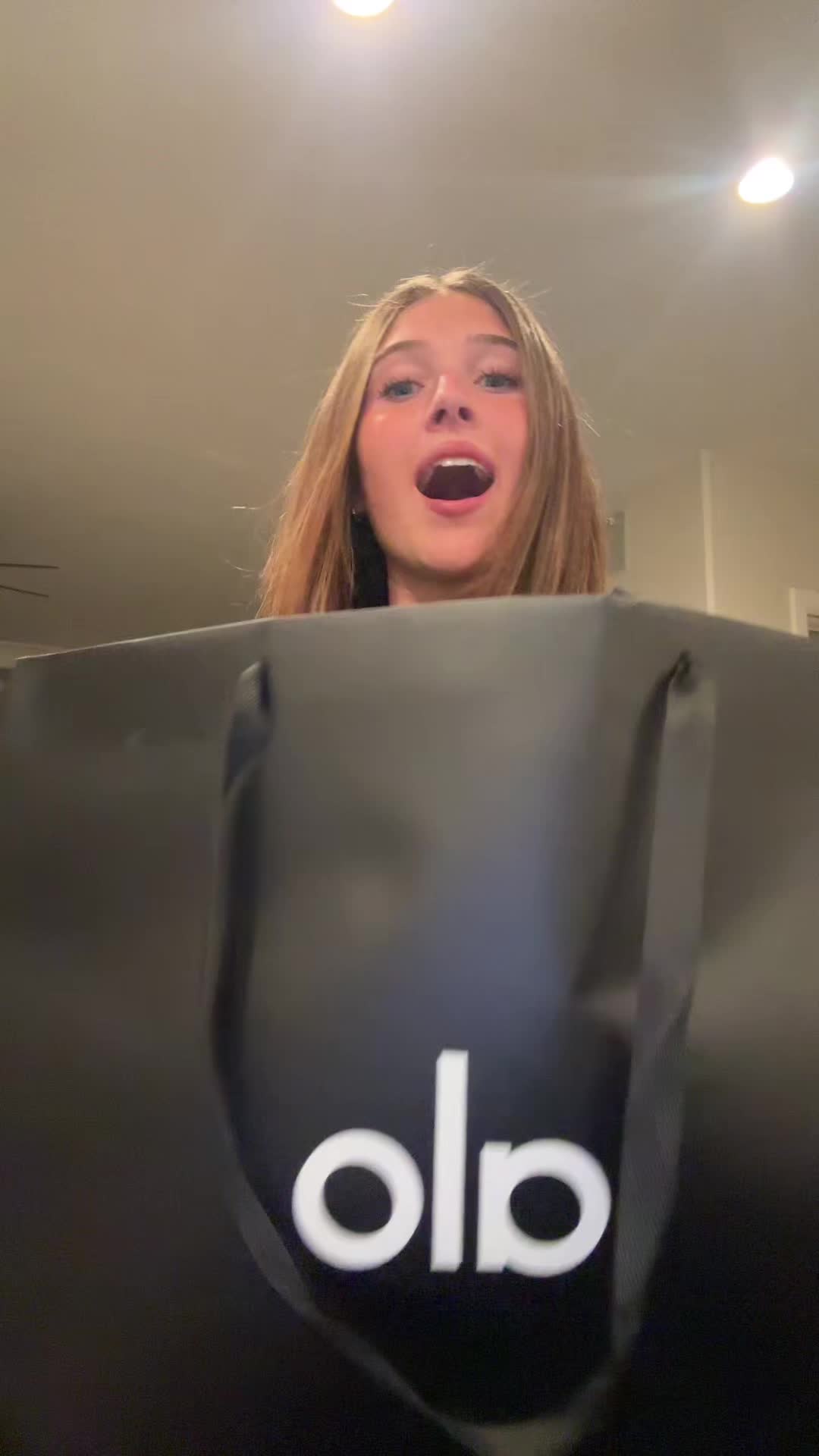
- A hand pulls a black half-zip sweatshirt out of a large black "alo" shopping bag against a white background.
- Audience
- Consumers who value the 'clean girl' fitness aesthetic, indicated by the minimalist white background and the prominent "alo" branding.
Why it works. An unboxing-style reveal from a branded bag builds anticipation shot by shot, letting pacing and music do the persuading instead of copy.
Rapid-fire product reveal from a branded bag (0:00-0:19). Film your products being pulled one by one from your own branded packaging with upbeat music and no voiceover.
- Running
- 5 days (new — still being tested)
- Hook
- Close-up of a hand spraying a white bottle labeled 'alo wellness system' and 'HYPOCHLOROUS CLARITY MIST' against a coastal background.
- Audience
- Women interested in wellness and yoga, signaled by the 'alo' branding, the black activewear, and the 'Refresh Ritual' text.
Why it works. A close-up spray demo plus a clinical ingredient name in the product title makes a new skincare SKU feel formulated, not just scented.
Macro close-up of the mist spray at 0:00. Put your product's most technical-sounding ingredient or spec directly in the on-screen product name, then show it being used up close.
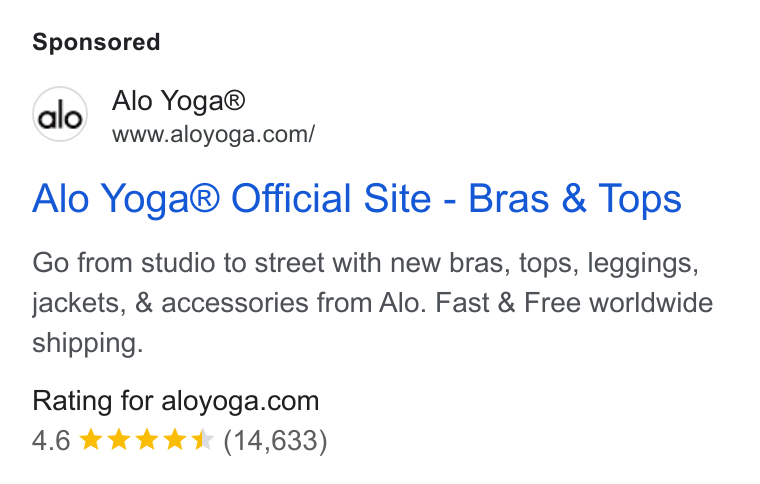
- Running
- 1504 days (longevity = it's converting)
- Hook
- Sponsored Alo Yoga® www.aloyoga.com/ Alo Yoga® Official Site - Bras & Tops
- CTA / offer
- Fast & Free worldwide shipping.
- Audience
- Individuals interested in activewear and athleisure, indicated by the brand 'Alo Yoga' and product categories 'bras, tops, leggings, jackets, & accessories'.
Why it works. Matches the headline to one specific subcategory so shoppers searching that exact term see instant relevance.
Headline clearly states product categories: 'Alo Yoga® Official Site - Bras & Tops' Split search ads by specific subcategory, not just brand name, so each headline mirrors the exact term a shopper typed.
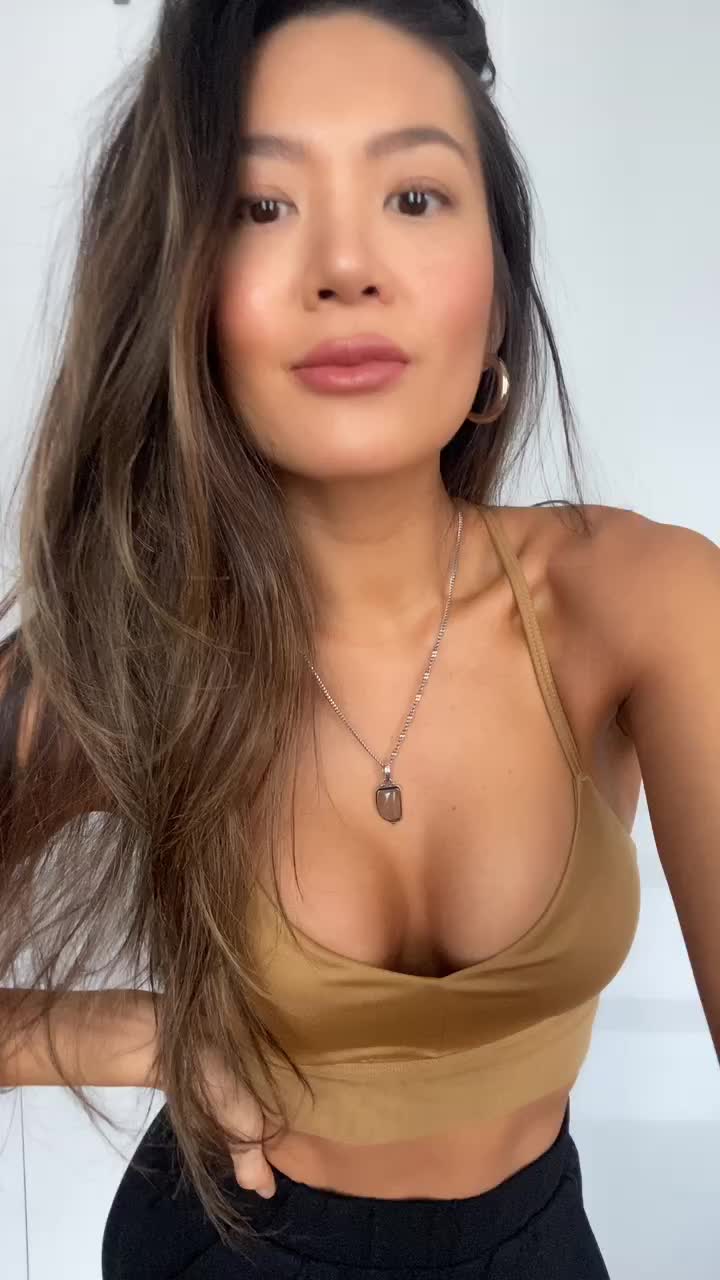
- Hook
- A woman with long brown hair, wearing a gold crop top and black pants, smiles and looks directly at the camera. She has one hand on her hip. Music plays.
- Audience
- The woman's casual attire and playful demeanor suggest a target audience interested in fashion, dance, or lighthearted content, likely young adults or those interested in current trends.
Why it works. Lets a relatable creator's natural expression carry the ad, borrowing her established rapport with viewers instead of a hard product pitch.
Playful facial expressions and gestures (0:02-0:03, 0:07-0:09) Cast a creator who already has audience trust and let a few seconds of unscripted personality open the video before any product mention.
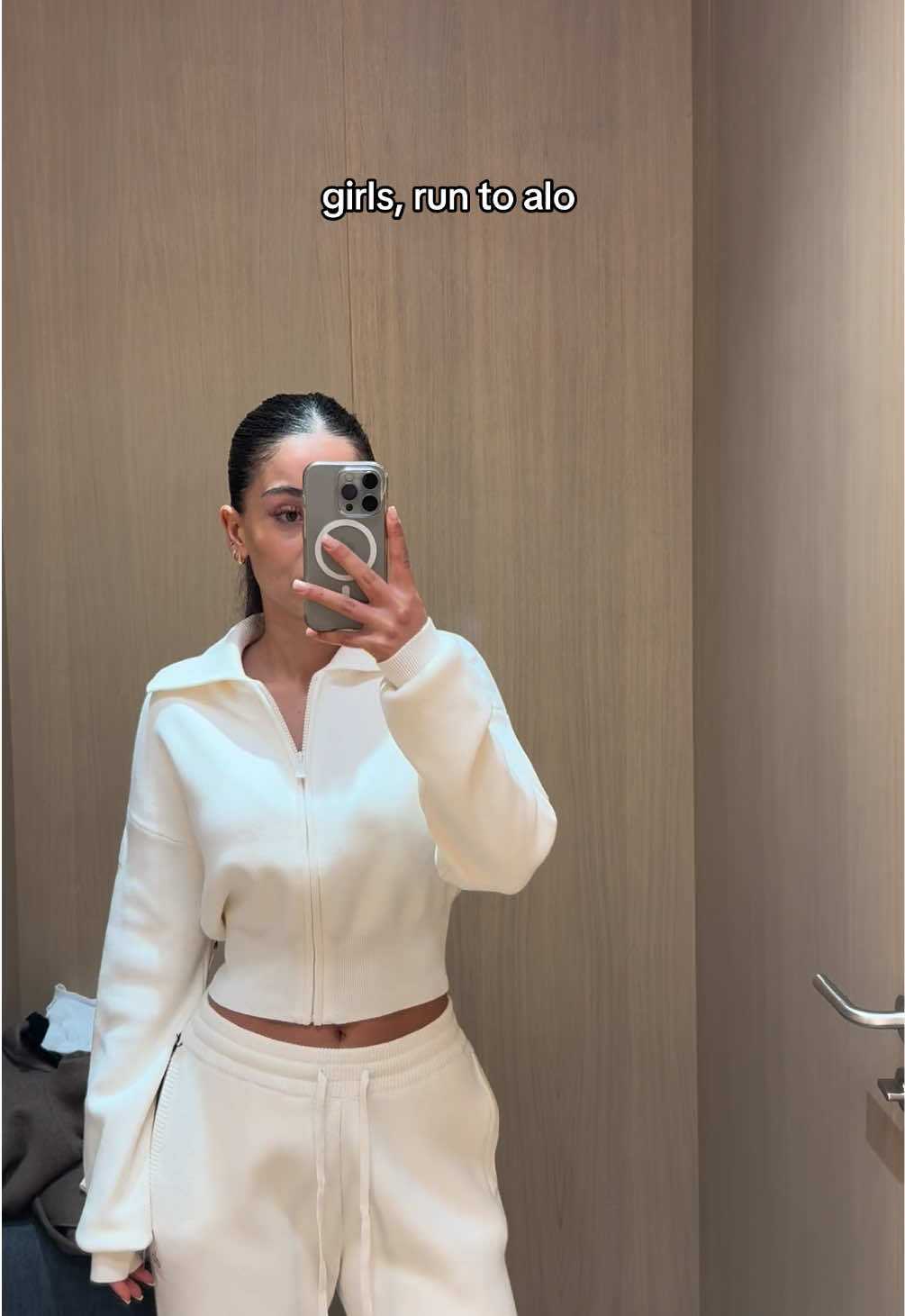
- Hook
- On-screen text: "girls, run to alo". Visual: A woman in a white two-piece loungewear set, holding a phone to record herself in a mirror.
- Audience
- The on-screen text "girls, run to alo" directly addresses and targets a female audience interested in fashion, loungewear, or activewear brands like Alo Yoga.
Why it works. Uses UGC try-on format with a peer-to-peer imperative that reads as a friend's tip rather than an ad, driving impulse visits.
Direct call to action in on-screen text at 0:00: "girls, run to alo". Open your UGC video with a short, urgent command aimed at your target group's social circle (e.g. 'girls, run to [brand]').
- Reach
- 317 upvotes · 56 comments · r/NYCinfluencersnark
A community is already discussing this in r/NYCinfluencersnark. Show up there authentically and answer the thread before a competitor does.
Who amplifies them
The creator base doing the real work is unpaid or lightly incentivized TikTok talent: @leahhagley, @abellebae, belly frost (an apparent employee account) all post organic haul or try-on content tagged #aloyoga and #aloyogahaul. On Instagram, @dudafournier posted a personal styling reel featuring the brand, and reviewer account stylehard published a more skeptical "Is ALO really worth your money??" reel. Reddit's r/aloyoga functions as an informal deals-and-support community, where users like rackandroll_ and Yaaasitsme trade promo emails and referral links, while unrelated subreddits (r/NYCinfluencersnark, r/malefashionadvice) surface more critical, unprompted commentary. No brand-versus-founder distinction is visible on X, since no post activity was captured there beyond the homepage link.
07 Organic & video
The organic content engine: the videos, creator posts, and community presence earning attention without paid spend.
Alo's own Instagram reels post in the low thousands of engagement against a much larger follower base, consistent with the thin per-post engagement noted above. The format that actually performs is creator try-on and haul content on TikTok: leahhagley's trouser try-on ("can confirm these trousers are everything") pulled 26,690 engagements, abellebae's outfit-idea tutorial pulled 28,633, and by far the standout was an employee "day one" wardrobe post from belly frost at 893,411 engagements, roughly 15 times the typical haul post, because it read as an unscripted glimpse rather than sponsored content. On the owned-content side, YouTube's Alo Moves library favored long-form, instructor-led class videos with a "free 14-day trial" CTA baked into every description, a format that has since given way to shorter, higher-production campaign films like the Jisoo collaboration.
08 Affiliate & partners
How the brand turns creators and partners into a tracked, variable-cost acquisition channel, and how the program is structured.
A Reddit poster shared a live share.aloyoga.com referral link to unlock a discount, evidence of a standing, trackable referral system rather than a one-off promo code, and the traffic mix confirms affiliate as a real, ongoing channel at 3.6% of total visits. The TikTok haul culture functions as an informal extension of that same motion, unpaid creators driving discovery the way a formal affiliate army would, though no TikTok Shop seller tagging showed up in the pulled evidence to confirm a structured commission program there.
09 The playbook
The channels are not separate. They are one system where each stage feeds the next. Here is the read, then the plays to run tomorrow.
The inferred playbook
Alo's loop starts with celebrity and creator visibility that manufactures branded search demand, then locks that demand in with a Google ad campaign that has run, largely unchanged, for years.
with "alo" and "alo yoga" combining for roughly 792,000 monthly searches, Alo runs a ~7,000-ad Google library, including a single ad active for 1,504 days, purely to make sure no reseller or competitor can outrank the brand on its own name.
organic and direct together account for over 60% of traffic while paid social sits at just 2%, consistent with a brand whose top-of-funnel demand is generated by celebrity visibility and unpaid creator hauls rather than social ad spend.
Dig deeper+3▾
the Wicker Park store thread on r/chicago and the dedicated Alo Events landing page show a physical retail and in-person event program running in parallel to the digital funnel, reinforcing local brand presence outside the ad account entirely.
despite ~3.81 million Instagram followers, the brand's own social posts and its paid-social spend both underperform relative to that scale, suggesting owned social functions more as a brand signal than as a primary acquisition engine. On revenue: no verified current metrics were provided for this teardown. Third-party e-commerce tracking put a five-week 2025-2026 holiday window at roughly $479.5 million, and separate online-revenue trackers for 2024-2025 range anywhere from $323 million to over $800 million, an inconsistency across methodologies rather than a real swing. Combined with the brand passing $1 billion in total annual sales in 2022, a reasonable estimate is that Alo's current annualized revenue sits in the high hundreds of millions to low billions, not an audited figure.
Alo Moves free-to-paid conversion, customer acquisition cost, the wholesale-versus-DTC revenue split, and return or exchange rates.
Seed a branded hashtag with real customers
The proofAlo's TikTok haul ecosystem runs almost entirely on unpaid creators tagging #aloyogahaul, with engagement ranging from low thousands up to the 893,411-engagement employee post referenced above.
The adaptationpick one simple, ownable hashtag for your product category, then send free or discounted product to 10-20 real customers or your own staff with no contract attached, just a request for one honest try-on or unboxing post tagged with it. First step: message your 10 best existing customers offering a free item in exchange for one unscripted post. Unscripted creator content reads as more trustworthy than brand ads, and it compounds into a searchable hashtag archive that keeps surfacing long after any single post's feed life ends.
Cost: $0-under $500 · Time to signal: days · Works pre-PMF: yes, provided you already have a handful of real users willing to post.
Turn your own team into the highest-performing creator
The proofAlo's single best-performing piece of UGC in this evidence wasn't a paid ad or influencer deal, it was an employee's casual "first day" wardrobe video, far outperforming any outside creator's haul post.
The adaptationask a teammate, or yourself if solo, to film a casual "day in the life" or "what I actually use" clip showing the product in ordinary use, no script, no hashtag requirement, and post it from a personal account rather than the brand account so it doesn't read as an ad. First step: film one 30-second clip on a personal phone and post it from a personal profile.
Cost: $0 · Time to signal: days · Works pre-PMF: yes.
Bid to defend your own brand name in search
The proofAlo has run the same "Studio To Street" Google search ad continuously for about 1,504 days as of 2026-07-13, specifically to own the search results for its own name.
The adaptationclaim a small budget on Google Ads bidding on your exact brand name and its common misspellings, so no reseller, marketplace, or competitor can outrank you when someone searches for your own product. First step: launch a $5-10/day exact-match campaign on your brand name plus your top two or three product names.
Cost: under $500 · Time to signal: days · Works pre-PMF: conditional, useful once you have any brand-name search volume at all; before that, there's nothing yet to defend.
Ship a persistent, trackable referral link
The proofa Reddit user shared a live share.aloyoga.com referral link to unlock a discount, evidence of a standing referral system woven into ordinary word-of-mouth rather than a one-time promo.
The adaptationset up a simple referral link, most e-commerce and SaaS platforms offer this free or cheap, that rewards both the referrer and the new customer, then hand it directly to your most recent 20-50 buyers to share wherever they already talk about your product. First step: generate one working referral link and send it to your 10 most recent customers.
Cost: $0-under $500 · Time to signal: weeks · Works pre-PMF: yes.
Show up transparently in the community that already talks about you
The proofr/aloyoga functions as an organic deal-sharing and support hub alongside more critical, unprompted mentions in unrelated subreddits like r/NYCinfluencersnark.
The adaptationrather than creating a branded community from scratch, find the existing forum, subreddit, or group where your category is already being discussed and engage there transparently, answering questions and sharing real discount codes from a clearly labeled account rather than a disguised one. First step: search Reddit for your product category plus "worth it" or "discount" and reply helpfully to three to five threads from an account that discloses who you are.
Cost: $0 · Time to signal: weeks · Works pre-PMF: yes, provided you engage transparently; a disguised brand account in a community risks getting called out or removed. Not transferable at an earlier stage: Alo's Google branded-search fortress, a 7,000-ad library with a single ad running 1,504 days, and its physical retail and events footprint both depend on years of accumulated brand-name search volume and real-estate budget that an early-stage founder won't have. Adapt the seeding, employee-content, and referral mechanics here, not the ad scale or the store footprint.
You just read how Alo Yoga does it. Tomorrow it is someone else.
Every morning we take one company that is actually growing and break down where its customers come from: the ads still running after a year, the channel doing the real work, and the play you can run this week.
Systemaic · directional intelligence. Traffic, spend, and reach figures are SimilarWeb-style estimates and qualitative reads of public data, not audited numbers. Built on real public receipts.
// teardowns with a similar GTM motion
sources & receipts (3)
Live ad libraries: meta ad library · linkedin ad library · google ad library
Traffic, spend, and revenue figures are estimates as noted in the report; the links above are the primary public artifacts.