- 01Bid on the social-behavior name your category is generating
- 02Write the comparison page your buyer searches before choosing a brand
- 03Lead creative with the identity your buyer already inhabits
- 04Seed your product in a named consumable ritual and let creators adopt the vocabulary
01 Snapshot
The one-glance read on who they are and how they grow. Each point is verifiable from the receipts above.
Adaptogen-based supplement powders and skincare (adaptogens are botanicals used to support stress response and hormonal balance) for health-conscious consumers, anchored by Magnesi-Om magnesium powder, which became embedded in the viral TikTok sleepy girl mocktail trend; the brand is in a reset after DTC revenue fell more than 50% in 2025 following the closure of its LA juice shops and an exit from Sephora, with a reported 42% quarter-over-quarter DTC recovery in early 2026.
Creator-led organic with a paid search and Meta amplification layer concentrated on the top SKU.
~194,000 estimated monthly visits as of July 2026 (-5% over the prior three months); 468,354 Instagram followers as of July 2026; approximately 300 Google ads in library with 45 active and the longest-running active ad approximately 696 days as of July 2026; DTC revenue reported at $10.1M for 2024 before the 2025 decline.
As of June-July 2026, Moon Juice is running a Solstice Savings flash-discount wave on Meta (35% off subscriptions, 15% off everything else) via DCO (Dynamic Creative Optimization, simultaneous multi-variant ad testing) formats, and piloting educational-entry-point queries on Google including "12 Hormone Balancing Foods for Women."
The brand's original traction came from earned cultural moments, a 2015 viral controversy (an Elle feature detailing founder Amanda Chantal Bacon's reported $710-a-day wellness routine, which set off national backlash) that drove mass awareness and a Gwyneth Paltrow Goop newsletter feature that delivered the brand to exactly its target audience, both with zero paid outlay; the 2025 revenue collapse shows that cultural cachet did not survive the simultaneous loss of Sephora placement and physical retail, and the current recovery depends on whether the TikTok creator organic flywheel converts to retained DTC subscribers.
02 How it unfolded
The order the channels came online. Sequence is strategy: what they did first, and what they layered on once demand existed.
03 Traffic & channel mix
Estimated demand, the channel split behind it, and the keywords and referrers doing the work. Directional modeling, not audited analytics.
Traffic sources
Top search keywords
| Keyword | Volume | Weight | CPC |
|---|---|---|---|
| moon juice | 16k | $1.02 | |
| moonjuice | 2.4k | $1.00 | |
| moon juice magnesium | 930 | $1.03 | |
| moon juice magnesi-om | 540 | - | |
| superyou | 37k | $0.23 |
Top referring sites
Closest competitors by audience
~194,000 estimated monthly visits as of July 2026, down 5% over the prior three months. Search (organic and paid combined) drives 57.1% of all traffic, the single dominant acquisition lever: organic search accounts for 34.2% and paid search for 22.9%. The near-even split signals that Moon Juice is spending to defend and amplify keyword positions it already holds organically, consistent with bidding on trend-hijack terms like "sleepy girl magnesium powder" where earned creator awareness created demand and paid ads close the transactional loop. Direct at 21.2% reflects a habitual buyer base navigating straight to the site for a daily-ritual repurchase.
The remaining channels account for the balance: referrals 7.9%, display ads 5.3%, email 3.5%, affiliate 2%, Gen AI 1.8%, social organic and social paid together under 1.3%. Social's combined share under 1.3% is the starkest number, given the heavy TikTok creator presence described below. The gap indicates that TikTok-driven awareness converts through search: a viewer sees a creator post, Googles "moon juice magnesium" later, and arrives via organic or paid search. The creator flywheel feeds the search channel, not the social referral line.
The most revealing keyword is "superyou" at approximately 37,000 total monthly web searches, their most-searched product term by volume, exceeding the branded "moon juice" (~16,000/mo). Both are exact-phrase keyword-tool estimates, and the generic "superyou" phrase likely captures searches unrelated to the SKU, so read the gap as directional. The brand bids against "sleepy girl magnesium powder," converting earned trend awareness into paid search capture.
Top referrers: force.com, Salesforce's platform domain, most likely a Salesforce-hosted wholesale or partner portal linking back to the site; tryatria.com, a supplement brand whose outbound link suggests a cross-promotional arrangement; and similarweb.com, an analytics research tool that routes competitor analysts and journalists to the site.
04 Organic content
The specific pages earning their organic search traffic, and the pattern behind why they rank. Adapt the format, not the topic.
The top organic pages cluster around educational ingredient explainers and comparison posts that intercept wellness queries at the research stage: a cortisol-reduction supplement guide, a best electrolyte drinks roundup, and a magnesium glycinate-versus-oxide breakdown (approximately 1,400 organic visits per month via third-party estimates) each answer a specific question a supplement buyer asks before committing to a brand. The content earns rankings because it delivers genuine ingredient-science depth, not promotional copy with a product pitch embedded, and each piece maps naturally to a Moon Juice product within the same session. The Magnesi-Om product page earns direct organic traffic on its own (approximately 2,000 visits per month via third-party keyword estimates), ranking first for queries like "moon juice magnesi-om" and "moon juice magnesium." The blog operates as a parallel soft funnel addressing the credibility question, while the product page captures the buyer who already knows what they want.
Top pages by organic traffic
05 Channel map
Not traffic share. How much weight the growth system actually puts on each channel, with a one-line read on the role it plays.
What drove growth
06 The creative doing the work
Each exhibit shows the actual asset, an X-ray of why it works, a status, and a play you can adapt. This is the heart of the teardown.
Google: approximately 300 total ads, 45 active as of July 2026. The longest-running active placement has been in market approximately 696 days (launched July 2024). Three creative angles define the proven library: capturing viral-trend search demand the brand helped generate, removing first-order transaction friction with a threshold-calibrated offer, and establishing ingredient credibility for informed buyers before the click.
- Running
- 28 days (longevity = it's converting)
- Hook
- "If I could go back and gift myself one thing" spoken by a woman in a tan sweater holding a brown jar in a kitchen setting.
- Audience
- Pregnant or nursing mothers ("for my first pregnancy and nursing").
Why it works. Uses a founder's personal regret about pregnancy and nursing to build trust with mothers making the same decision now, not a stranger pitching features.
Regret-Based Hook (0:00-0:08): "If I could go back and gift myself one thing..." Have your founder open with an unfinished regret sentence about your product category, then reveal the specific fix a beat later.
- Running
- 11 days (new — still being tested)
- Hook
- "I actually made Mini Dew very much" + woman with long brown hair in a tan sweater holding a brown glass jar of Mini Dew.
- Audience
- nursing and pregnant women, parents of children
Why it works. A founder personally explaining why she made the product builds trust for a new pregnancy-specific supplement buyers haven't heard of yet.
Founder-to-camera origin story (0:00) "I actually made Mini Dew very much with nursing and pregnant women in mind" Let your founder explain the product's origin in their own words, even imperfect phrasing, rather than smoothing it into ad copy.
- Running
- 4 days (new — still being tested)
- Hook
- "I'm a girl with no vices left who still wants to calm down" + A woman in a white robe leaning on a wooden table next to a jar of Magnesi-Om.
- Audience
- Health-conscious women seeking wellness rituals (signaled by the white robe, 'no vices' comment, and 'Sleepy Girl' trend terminology).
Why it works. Turns a calming supplement into a permitted vice for people who've already cut out alcohol and other crutches, then shows it mixed as a mocktail recipe to make the use case concrete.
Trend Hijacking (0:06 - 'Sleepy Girl Mocktail™') Frame your product as the one remaining allowed indulgence for people who've already given up other habits, then show exactly how it's used.
Show 7 more exhibits
- Running
- 684 days (longevity = it's converting)
- Hook
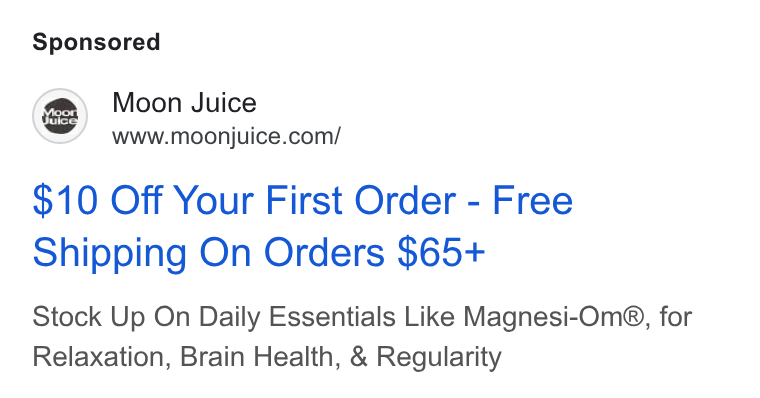
- Sponsored text at the top, followed by a circular logo with "Moon Juice" inside, and the text "Moon Juice" and "www.moonjuice.com/". Below that, in large blue font, "$10 Off Your First Order - Free Shipping On Orders $65+".
- CTA / offer
- $10 Off Your First Order - Free Shipping On Orders $65+
- Audience
- Individuals interested in health supplements, particularly for relaxation, brain health, and regularity, indicated by the mention of "Magnesi-Om®" and the benefits listed.
Why it works. Combines a first-order dollar discount with a free-shipping threshold to convert both price-sensitive and cart-building shoppers in one ad.
Clear financial incentive: "$10 Off Your First Order - Free Shipping On Orders $65+" Pair a flat first-order discount with a free-shipping minimum in the same headline to cover two buyer motivations at once.
- Running
- 610 days (longevity = it's converting)
- Hook
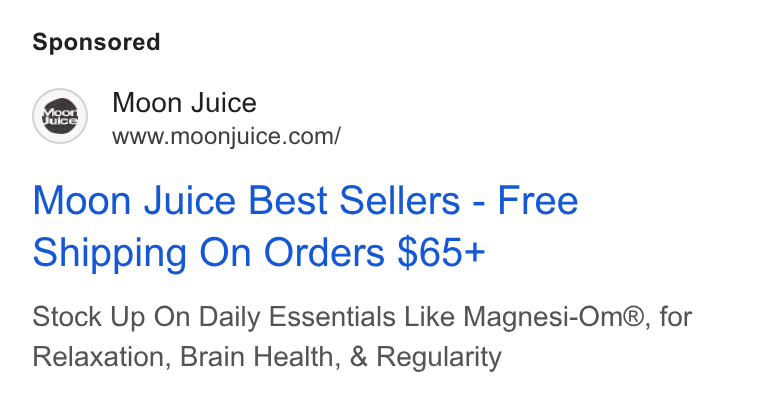
- Moon Juice Best Sellers - Free Shipping On Orders $65+
- CTA / offer
- Free Shipping On Orders $65+
- Audience
- Individuals interested in health supplements for 'Relaxation, Brain Health, & Regularity', indicated by the product description.
Why it works. Uses a best-sellers frame to cut product-choice friction while the shipping threshold nudges cart size up before checkout.
Prominent display of a monetary incentive: 'Free Shipping On Orders $65+' For undecided shoppers, route search traffic to a best-sellers collection page instead of one SKU, then add a free-shipping minimum.
- Running
- 586 days (longevity = it's converting)
- Hook
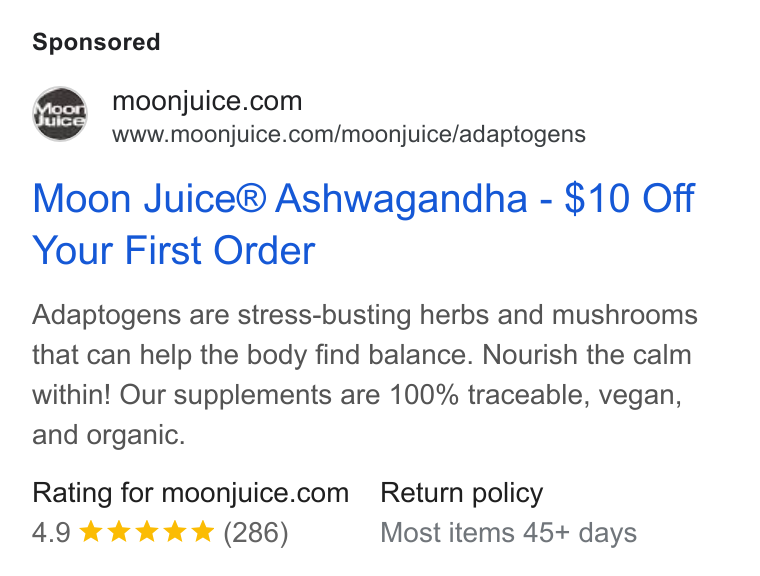
- Sponsored moonjuice.com www.moonjuice.com/moonjuice/adaptogens Moon Juice® Ashwagandha - $10 Off Your First Order
- CTA / offer
- $10 Off Your First Order
- Audience
- Individuals interested in natural health supplements, stress reduction, and organic/vegan products, indicated by the mention of "Adaptogens," "stress-busting herbs," "vegan," and "organic."
Why it works. Matches a high-intent ingredient search term directly to a named product plus a first-order discount, shortening query to offer.
Headline offer: "Moon Juice® Ashwagandha - $10 Off Your First Order" Build a dedicated search ad per key ingredient your buyers search for, and pair each one with your standard first-order discount.

- Hook
- Visual: A woman with dark skin, wearing a light green spaghetti strap top, is sitting on a white couch, covered with a fluffy white blanket. She is looking at the camera with her mouth slightly open and her eyes appearing heavy. Her right hand is raised, palm facing the camera, fingers spread. The background shows a city skyline at night through a large window. On-screen text: "pov: you made a sleepy cocktail not knowing the saxophones would be getting louder so quickly". Audio: "I'm literally sitting here trying to watch a show, y'all. My eyes keep dropping."
- Audience
- Individuals seeking sleep aids or relaxation, likely those who enjoy cocktails and a bit of humor. The mention of 'GNO outfit' in a comment suggests a younger, social audience.
Why it works. Opens on a woman visibly drowsy under a blanket, dramatizing the exact state of the target customer before any product appears.
Relatable 'POV' opening with on-screen text and audio at 0:00-0:06: "pov: you made a sleepy cocktail not knowing the saxophones would be getting louder so quickly" and "I'm literally sitting here trying to watch a show, y'all. My eyes keep dropping." Cast someone visibly living the pain point, like exhausted or wired, as your video's opening shot before you introduce the product.

- Hook
- Visual: A bedroom with a made bed, a wooden table with various items, and a record player. Audio: Upbeat jazz music begins.
- Audience
- Individuals interested in wellness routines, self-care, and a relaxed lifestyle, indicated by the focus on a morning routine, matcha preparation, and journaling.
Why it works. Aspirational calm morning routine lets the supplement ride along as part of a lifestyle viewers already want, not a hard sell.
Visual storytelling of a morning routine (0:00-0:15) Film your own morning or routine sequence with clean cuts between 3-4 small rituals and let your product sit in frame as one of them.

- Reach
- 19 upvotes · r/CPGIndustry
A community is already discussing this in r/CPGIndustry. Show up there authentically and answer the thread before a competitor does.
Who amplifies them
The three largest amplifiers by single-post engagement as of the evidence snapshot are @CRYSTAL NICOLE (approximately 354,000 engagements, TikTok, sleepy girl cocktail post), @bloodorange (approximately 233,000 engagements, TikTok, matcha-magnesium-plus-lion's-mane morning routine), and @lulu price (approximately 10,500 engagements, TikTok, a garden-routine post tagging Moon Juice alongside Liquid I.V.). All three appear organic: no affiliate code or paid-partnership tag is visible in the scraped captions. Their combined engagement on these posts alone exceeds two months of Moon Juice's estimated total site traffic.
The paid-creator tier tracks attribution through discount codes: Scout Willis collaborated using code "Scout" for 15% off (463 engagements on a Magnesi-Om mocktail recipe post), and Elly | Corporate Millennial ran a sponsored Ting feature using code "Millennial15" for 15% off (2,460 engagements, positioned as a work-from-home productivity supplement). The identical 15% rate across both codes points to a standardized commission structure rather than individually negotiated deals. A further set of creators including @roa_music and @slayyyter generated engagements in the 4,000 to 6,000 range per post on the sleep-supplement topic, with a larger pool of organic posts in the 200 to 500 range.
Mecca Beauty, an Australian beauty retailer, produced two branded Instagram posts about the brand (672 and 493 engagements), functioning as retail-partner content rather than independent creator UGC. No active Reddit community appears as an amplifier; the one relevant Reddit post in the evidence is an industry-observer discussion of the store closures, not a consumer recommendation thread.
07 Organic & video
The organic content engine: the videos, creator posts, and community presence earning attention without paid spend.
The brand's Instagram output runs on two alternating modes: ingredient-science posts that name mechanisms with clinical specificity, and ritual-aesthetic content that positions the supplement as a visual daily anchor. The highest-performing brand post in the evidence is "SMOOTH MOVES // Magnesium Citrate is an osmotic laxative, meaning it draws water into the bowels to support regular 💩s" (2,868 engagements), which earns engagement by pairing precise clinical language with the brand's irreverent copy voice. The "QUANTUM FIELD // This is your brain on Neuro Magnesi-Om" Reel (732 engagements) is the aesthetic counterpart: minimal copy, striking visual metaphor, no explanation required.
Read the full breakdown+2▾
The format that compounds on TikTok is the ritual reveal: a creator shows a real bedtime or morning moment, the product is one named ingredient, and the hook is the routine rather than a review. The format includes no formal review structure, no before-and-after comparison, and no product performance claim. @slayyyter's "sleepy girl drink or whatever..." (5,573 engagements) demonstrates the saturation-signal version: the winking dismissal signals that the product has reached cultural recognition wide enough that ironic distancing still reads as endorsement.
@genpadalecki's Instagram post (7,212 engagements) and @emonthebrain (4,718 engagements) are the strongest third-party performers on that platform, both ritual-reveal posts without a visible paid-partnership label. @genpadalecki frames the product as "a new kind of nightcap...a delicious way to unwind without the hangover"; @emonthebrain describes a nightly habit and flavor combinations in first-person detail. The unifying thread across every high-performing third-party post is first-person specificity: the creator describes their actual habit, not the product's attribute list.
08 Affiliate & partners
How the brand turns creators and partners into a tracked, variable-cost acquisition channel, and how the program is structured.
The affiliate program is live at moonjuice.com/pages/affiliates, with creator discount codes confirming active operation. Both the "Scout" and "Millennial15" codes carry 15% off for referred buyers, consistent with a standard revenue-share structure tracked through unique codes on the DTC site. The program runs through the brand's own site; no TikTok Shop native seller network appears in the creator evidence.
Read the full breakdown+2▾
Subscribe-and-save (10 to 30% off) functions as the retention layer downstream of affiliate acquisition: an affiliate drives a first purchase; the subscription discount converts that buyer into a recurring order without a second affiliate-attributed touch. Whether affiliate-first buyers subscribe at a rate sufficient to sustain commission economics is not in the public record.
Target's 755-store wholesale placement operates on retailer economics rather than affiliate commission structures and represents a separate buyer-acquisition path. A consumer who encounters the brand on a Target shelf and later searches for a subscription represents a retail-to-DTC conversion that bypasses affiliate attribution entirely, which is both the opportunity and the measurement blind spot in the current recovery.
09 The playbook
The channels are not separate. They are one system where each stage feeds the next. Here is the read, then the plays to run tomorrow.
The inferred playbook
Moon Juice's acquisition loop starts with earned cultural resonance, routes through organic creator embedding, and closes through search capture, but the loop is operating in a rebuilding phase after the 2025 DTC contraction.
The brand's first awareness came from two earned moments, covered in the Snapshot, that required no paid outlay. What those events seeded was a slightly polarizing brand voice legible enough to generate earned media throughput at scale, which became the platform every subsequent channel ran on.
Organic creator posts embed products in named rituals, producing awareness that converts through Google rather than through direct social referrals, as the Traffic section's sub-1.3% combined social channel share shows. The search-capture layer closes the intent that the creator layer creates upstream, with trend-phrase paid search ads handling the final transactional step.
Dig deeper+2▾
The DTC recovery concentrates spend on converting first-time buyers into subscribers at 10 to 30% off. Meta paid creative targets the two highest-intent segments in the current push: pregnant women for Mini Dew, and post-vice women seeking a calming ritual for Magnesi-Om. Target's retail footprint adds a parallel discovery path that does not build a DTC subscription relationship on its own.
The 2025 revenue decline shows the brand lacked a retention base strong enough to survive the simultaneous loss of Sephora and physical retail. Creator organic reach drove awareness and first purchase, but nothing in the public record shows a loyalty layer or email-nurture depth that retained DTC buyers when the retail shelf disappeared. The current paid push is the live test of whether subscription economics can fill that gap. Not visible in public data: subscription retention rate, affiliate-to-subscriber conversion, CAC per channel, affiliate commission rates.
Bid on the social-behavior name your category is generating
The proofMoon Juice's Google search strategy targets "Sleepy Girl Magnesium Powder - Sleepy Girl Trend" as a primary headline, capturing queries that TikTok organic creator content generated upstream. The ad mirrors the name of the social behavior rather than describing the product. Ads on this hook ran approximately 614 days, from January 2024 through September 2025, among the longest runs in the Google library before rotating out.
The adaptationMonitor TikTok and Instagram for named behaviors, rituals, or formats that reference your product category: a named drink recipe, a "routine" format, a challenge name. When a phrase generates social volume and Google search queries simultaneously, bid on that exact phrase in paid search before competitors identify the demand signal. A buyer searching the phrase by name has already been sold on the category by a creator; your ad closes the conversion rather than creating awareness. First step: identify the most-shared ritual or format name in your category, check whether it generates Google search volume with a free keyword tool, and write a search headline that mirrors the social phrase exactly. The intelligence phase costs nothing; add a small paid budget once the search volume confirms the signal is real.
Cost: Under $500 once the social signal is confirmed · Time to signal: days · Works pre-PMF: conditional (requires a named creator behavior in your category with measurable search volume; if the behavior exists but no one Googles the name yet, wait for the search signal before spending).
Write the comparison page your buyer searches before choosing a brand
The proofMoon Juice's "magnesium glycinate vs oxide" blog page earns approximately 1,400 organic visits per month via third-party keyword estimates, ranking for a pre-purchase query a supplement buyer types when researching what to put in their body before committing to a purchase.
The adaptationIdentify the two or three "X vs Y" or "best X for Z" queries your category generates. Write one honest comparison post that gives the buyer a genuine framework to decide, naming both options fairly. Your product can be one option or can emerge as the answer for the use case where it wins, but the post has to earn the ranking by being genuinely useful to a buyer who has never heard of your brand. A visitor arriving through a comparison query has pre-answered the objection your product page would otherwise need to handle, and arrives closer to a purchase decision than a branded-search visitor. First step: open a free search tool, type three candidate comparison queries in your category, and write the post targeting the one with at least a few hundred monthly searches.
Cost: $0 · Time to signal: months (organic search indexing) · Works pre-PMF: yes.
Lead creative with the identity your buyer already inhabits
The proofMoon Juice's sharpest Meta creative is "I'm a girl with no vices left who still wants to calm down," a talking-head UGC format that names a specific person, what she has already given up, and the frustration that remains. Full deconstruction is in the Paid Ads section above.
The adaptationFor your product, identify the most common prior identity shift your buyer has already made before finding you: a diet they dropped, a tool they abandoned, a habit they quit. Lead your creative with "I'm a [person who stopped X] who still needs [outcome]." Someone who identifies as that person recognizes themselves immediately and stops scrolling; someone who does not scrolls past, which is the correct filter. A hook that repels the wrong buyer as clearly as it attracts the right one is more valuable than a hook that feels safe to everyone. First step: write five variations of this sentence for your product, pick the most specific one that makes you slightly nervous about how narrow it is, record a 30-second talking-head video with your own face, and post it as a Reel or TikTok before spending any budget.
Cost: $0 · Time to signal: days · Works pre-PMF: yes.
Seed your product in a named consumable ritual and let creators adopt the vocabulary
The proofMagnesi-Om became a recurring named ingredient in the sleepy girl mocktail format (tart cherry juice, magnesium powder, sparkling water), generating hundreds of thousands of engagements across organic creator posts without Moon Juice creating or owning the format. The product's form factor, a flavored powder that dissolves into a drink, made it a natural ritual ingredient; the naming convention spread because it was specific enough to be searchable and short enough to be quoted.
The adaptationAsk whether your product fits naturally as a named component in something people already film: a morning stack, a desk setup, a pre-bed routine. If it does, create the simplest possible version of the recipe or routine on your own channel first, give it a two-to-four word name, and show the product label clearly on screen. A creator who adopts your named ritual and films their own version will cite the product by name because that is how they credit the format. The name is more important than the content: a format name that is searchable and quotable spreads the vocabulary even when the product is cropped out of frame. First step: post your own version of the ritual as a Reel or TikTok, pin it to your profile, and use the format name consistently in captions so visiting creators encounter the template before they encounter your product description.
Cost: $0 · Time to signal: weeks to months · Works pre-PMF: yes, provided the product can plausibly be part of a filmed routine and its form factor makes it a natural ingredient rather than an awkward addition.
Target the highest-stakes version of your product's use case first
The proofMini Dew, an electrolyte powder that could be positioned as a general hydration product, is being advertised on Meta specifically to pregnant women: "Summer pregnancy? Mini Dew provides essential minerals and electrolytes that hydrate deeper than water alone." The pregnancy context raises the stakes from "stay hydrated" to a concrete health need with an obvious emotional charge.
The adaptationMap every audience that might use your product and rank them by the consequence of not solving the problem. Lead your creative around the context where the stakes are highest. Leading with your most motivated buyer produces specific-enough creative to convert that segment at lower cost, while also stopping the scroll of adjacent audiences who recognize themselves in a high-stakes moment you did not write for them. First step: write one hook per context in under 15 words for your top three use cases ranked by stakes, post all three as TikTok or Instagram Reels, and measure which generates the most saves or shares before spending a dollar on paid amplification. The organic signal tells you which creative to fund.
Cost: $0 to validate organically · Time to signal: days · Works pre-PMF: yes, provided the product addresses a problem with a clearly articulable consequence; less effective for purely discretionary products where the stakes of not using it are low. Not transferable at an earlier stage: Moon Juice's largest early distribution levers, the Goop newsletter placement and the 2015 cultural controversy, depended on founder proximity to the celebrity wellness circuit and a brand voice polarizing enough to generate national press backlash, neither of which can be engineered from a standing start. The Target retail expansion at 755 stores requires an existing DTC revenue base and brand name recognition that a pre-PMF brand has not yet built, and the LinkedIn B2B channel is stage-locked for the same reason.
You just read how Moon Juice does it. Tomorrow it is someone else.
Every morning we take one company that is actually growing and break down where its customers come from: the ads still running after a year, the channel doing the real work, and the play you can run this week.
Systemaic · directional intelligence. Traffic, spend, and reach figures are SimilarWeb-style estimates and qualitative reads of public data, not audited numbers. Built on real public receipts.
// teardowns with a similar GTM motion
sources & receipts (3)
Live ad libraries: meta ad library · linkedin ad library · google ad library
Traffic, spend, and revenue figures are estimates as noted in the report; the links above are the primary public artifacts.