- 01Make the demo the ad
- 02Post your own growth numbers where builders hang out
- 03Let every free-tier output carry your mark
- 04Seed creators already making your category's content
01 Snapshot
The one-glance read on who they are and how they grow. Each point is verifiable from the receipts above.
An AI video-generation platform, avatars, voice cloning, and 175+ language lip-sync translation, for creators, SMBs, and enterprise marketing/L&D teams, reportedly at $200M ARR by June 2026.
Launch-led: growth was ignited by unpaid demo virality, not a paid-acquisition funnel or a content-marketing buildup.
~10.5M monthly visits (down 0.7% over the trailing 3 months), a ~2,000-ad Google library whose 551-day-active top ad is run by a third-party advertiser rather than HeyGen (HeyGen's own longest-tracked winners run 143 to 191 days) as of 2026-07-04, and a founder X account at 27,278 followers.
As of 2026-07-04, ten fresh Google image ads went live in the prior two days, and Meta's newest creative tests a "1 recording of me now = 9 videos" UGC-grid hook in English and Spanish.
HeyGen's core asset isn't a funnel, it's a demo that doubles as proof: every lip-synced clip a user makes is simultaneously the ad, the case study, and the product demonstration in one shareable artifact, which is why strangers keep re-posting it for them.
02 How it unfolded
The order the channels came online. Sequence is strategy: what they did first, and what they layered on once demand existed.
03 Traffic & channel mix
Estimated demand, the channel split behind it, and the keywords and referrers doing the work. Directional modeling, not audited analytics.
Traffic sources
Top search keywords
| Keyword | Volume | Weight | CPC |
|---|---|---|---|
| heygen | 2.0M | $0.45 | |
| heygen ai | 119k | $0.30 | |
| hey gen | 158k | $0.52 | |
| hygen | 57k | $1.96 | |
| hyperframes | 185k | - |
Top referring sites
Closest competitors by audience
HeyGen pulls roughly 10.5 million estimated monthly visits, down 0.7% over the trailing 3 months, essentially flat rather than compounding. Three channels dominate the mix: Direct traffic leads at 56%, Search Organic follows at 24.5%, and Search Paid adds 8.4%. That direct-heavy split is notable for a company whose growth story is virality-driven rather than habitual daily use: it suggests a large share of visits are people typing "heygen" straight into the address bar after seeing a shared clip, not returning users navigating from a bookmark. The rest, social organic, referrals, a nascent Gen-AI answer-engine slice, email, display ads, social paid, and affiliate, together total under 12%, though that Gen-AI sliver (2.2%) is an early signal that AI answer engines are starting to send people directly to the product.
Search demand is overwhelmingly branded: "heygen" pulls 2,018,300 searches a month and "hey gen," a common misspelling, still pulls 157,860, evidence the name itself has become the entry point rather than generic category terms. More telling: "hyperframes," their newer open-source video-composition tool, already draws 184,760 searches a month on its own name, meaning a sub-product is starting to generate independent demand rather than riding the parent brand.
Referral traffic comes from liveavatar.com (an adjacent avatar-video product, likely comparison-shopping traffic), toolify.ai (an AI-tool directory that indexes HeyGen among competing generators), and adobe.com (plausibly editorial or integration mentions inside Adobe's ecosystem, though no partnership is confirmed in the data). Among named competitors, synthesia.io is the most direct rival, it's the enterprise avatar-video product HeyGen gets compared against by name in organic Reddit discussion, while kling.ai and elevenlabs.io compete for adjacent budget in prompt-to-video generation and voice cloning respectively.
04 Organic content
The specific pages earning their organic search traffic, and the pattern behind why they rank. Adapt the format, not the topic.
Their organic-search footprint is anchored by a single page: heygen.com/en-in, a India-localized version of the homepage, which alone earns an estimated 162,897 organic visits a month, 58.8% of all their tracked organic-page traffic. That dwarfs the generic homepage's 28,432 (10.3%). The next tier down is a cluster of free-standing utility pages, image-to-video, AI face swap, face-swap video, each pulling several thousand visits on their own. The pattern is clear: rather than blog posts or comparison content, HeyGen's organic engine runs on country-localized landing pages and single-purpose free tools that rank on their own generic-intent keywords ("free ai video generator" at #4, "ai video generator free" at #5) while the brand terms ("heygen," "heygen ai," "hey gen") lock the #1 spot outright. The tool pages function as always-on lead magnets: a visitor searching for a narrow utility lands on a working feature, not a sales page, and converts into the broader product from there.
Top pages by organic traffic
05 Channel map
Not traffic share. How much weight the growth system actually puts on each channel, with a one-line read on the role it plays.
What drove growth
06 The motions doing the work
For founder-led SaaS the breakdown shifts from ads to traction: where the first users came from, how the founder grows it in the open, and the compounding organic surface.
HeyGen's traction didn't come from a single coordinated launch, it came from a product capability so visually startling that strangers kept re-submitting it themselves.
the Hacker News handle "buffxzz," which lines up with co-founder Wayne Liang's identity rather than Joshua Xu's, posted "How we hit $1M ARR in 7 months" to Hacker News on 2023-04-26, an early build-in-public artifact rather than a press-driven launch.
through September 2023, multiple unrelated Hacker News users independently submitted the same capability, lip-synced video translation with voice cloning, under titles like "Video translation with deep fake lips and voice cloning" and "Translate your video with natural voice clone, lip-sync and talking style," organic word-of-mouth rather than a single post breaking through.
Dig deeper+2▾
on 2024-01-18, two separate Hacker News users independently submitted a video of Argentine President Milei's Davos speech translated and lip-synced via HeyGen ("The Milei speech in English, rendered using HeyGen," "Javier Milei speech at Davos... translated, dubbed, lipsynced via AI model heygen"), a genuine multi-submitter viral spread rather than a coordinated push.
the $60M Series A and $500M valuation announcements in June 2024 each drew only a single Hacker News submission with 1 point, confirming that the audience responds to the product doing something visibly impressive far more than to financing headlines.
Growth milestones, not lifestyle content, are what co-founder and CEO Joshua Xu's X account runs on, and the numbers get more specific with scale, not vaguer.
Joshua Xu posts from @joshua_xu_ (27,278 followers, 1,203 posts), and his highest-reach posts are always tied to a concrete threshold: the avatar 2.0 launch plus a funding announcement pulled 64,929 views, the $60M Series A announcement pulled 134,141 views, and hitting $100M ARR 29 months after first reaching $1M (announced October 2025) pulled 258,448 views and 630 likes.
a January 2026 post reported 24 million users, 58 million videos processed in 2025, and 2.7 million paid videos created in the prior month alone, precise operational numbers rather than a generic "great year" recap.
Dig deeper+2▾
posting from @wayne_liang_ (1,413 followers), he shared the same $1M-ARR-in-7-months write-up on LinkedIn in April 2023, reposting Joshua Xu's milestone rather than posting a distinct story, and announced the HeyGen 5.0 launch in March 2024, a secondary voice to Joshua Xu's, not a duplicate one.
a March 2026 post noting HeyGen's inclusion on Fast Company's Most Innovative Companies list also disclosed "31 million people signed up so far," using third-party recognition as a vehicle for a fresh usage number rather than standalone bragging.
Organic search is a real, second-largest channel at 24.5% of total traffic, but the pages earning it are localized landing pages and free tools rather than a blog-driven library, and two structural surfaces compound that reach further.
beyond the core app, HeyGen ships a public TypeScript SDK, an MCP server, and Hyperframes, an open-source "agent-native" framework for composing video with HTML/CSS/JS, which drew its own Hacker News submission and now pulls 184,760 monthly searches independent of the parent brand.
the site embeds Rewardful and links to a dedicated heygen.com/affiliate-program page, a self-serve recruitment channel for partners and creators that requires no direct outreach from the company.
Dig deeper+2▾
with a ~2,000-ad Google library (240 sampled, all active) whose longest-running HeyGen-owned winners are active 143 to 191 days (a third-party advertiser's ad has run 551 days), the bulk of the deconstructed ad copy is defensive brand-term capture, headlines like "Free AI Video Generator - HeyGen" and "Best AI Video Translation - Get Started For Free" rather than demand generation into new audiences.
one recurring proven-winner format presents a fake "INVOICE: One year of weekly videos, 52 editor invoices, 52 voiceover sessions, studio fees, re-shoots and lost time," quantifying the exact production overhead the product replaces rather than describing the product itself.
07 Paid ads
This founder-led SaaS also runs paid acquisition. Here are the live ads doing the work, each with the X-ray and a play you can adapt.
- Running
- 51 days (longevity = it's converting)
- Hook
- "ChatGPT can now create entire videos with your AI clone or a hyper-realistic avatar." + Woman in a black blazer holding a black Rode microphone with a green ChatGPT logo overlay.
- CTA / offer
- "comment 'VIDEO' and I'll send it you."
- Audience
- Content creators and marketers who use ChatGPT; evidenced by the screen recording of the ChatGPT interface and the mention of 'AI clones' for social media posts.
Why it works. Rides ChatGPT's search and trend volume to smuggle in HeyGen's own avatar-video feature, aimed at people already following AI news for a fast credibility borrow.
0:00-0:03 - Anchoring to ChatGPT with logo and name. If your feature works alongside or resembles a widely known AI tool, name that tool's capability in your opening line before pivoting to your own product demo.
- Running
- 36 days (longevity = it's converting)
- Hook
- "Queridos creadores, su forma de hacer vídeos está a punto de cambiar para siempre." Visual: A person in a dark room with a mannequin, followed by a woman filming a man behind a counter.
- CTA / offer
- "Pruébalo y vas a entender a qué me refiero."
- Audience
- Content creators (addressed as "creadores" with visuals of video editing and professional camera setups).
Why it works. Addresses creators directly as a group and promises their entire video workflow is about to change, setting up an AI-production reveal instead of leading with the product.
Visual contrast of manual editing (0:04) vs. passive automation while drinking mate (0:07). Open by naming your specific audience and promising a workflow-level change is coming, then deliver the specific mechanism right after.
- Running
- 36 days (longevity = it's converting)
- Hook
- "'You've been cooking on content lately'" + woman resting chin on hand looking at camera.
- Audience
- Content creators and social media managers, identified by the slang 'cooking on content' and the 'Social ready' validation.
Why it works. Leads with a compliment about the viewer's own content volume before the demo, letting anyone who's been posting a lot see themselves in the ad before the pitch starts.
Comment-response hook at 0:00: "'You've been cooking on content lately'" Open with a specific, casual compliment about a result your audience already suspects they're achieving, before naming your tool.
Show 3 more ads
- Running
- 9 days (new — still being tested)
- Hook
- “Haces 50 vídeos al día??” with a blonde woman resting her chin on her hand in a bedroom-like setting.
- Audience
- Content creators and social media managers (implied by '50 videos a day' and 'ready for social media' text).
Why it works. Opens with a jaw dropping production number then proves it live, aimed at creators stuck making one video a day.
Impossible-feat hook at 0:00 ('“Haces 50 vídeos al día??”') Open with a specific number that sounds implausible for your category, then spend the next few seconds proving it on screen.
- Running
- 551 days (longevity = it's converting)
- Hook
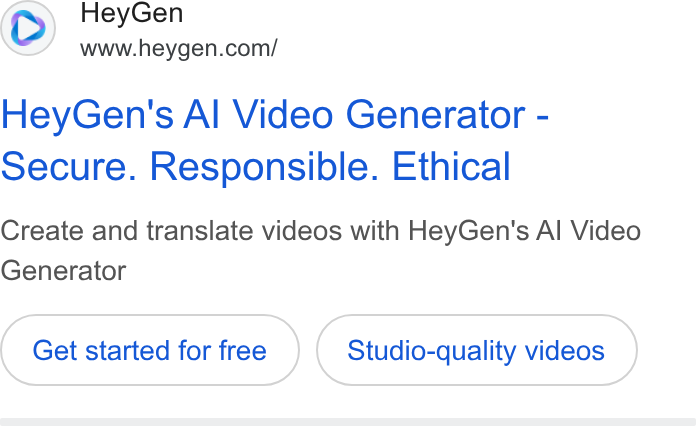
- HeyGen's Al Video Generator - Secure. Responsible. Ethical
- CTA / offer
- Get started for free
- Audience
- Individuals or businesses looking for AI video generation tools, indicated by 'HeyGen's Al Video Generator' and the benefits listed.
Why it works. Answers the safety objection AI video buyers silently hold, letting HeyGen own the trust angle before competitors do in search.
Headline with strong, benefit-driven adjectives: 'HeyGen's Al Video Generator - Secure. Responsible. Ethical' List the top 3 anxieties your category triggers and state them as blunt adjectives in your own headline, ahead of any feature claim.
- Running
- 414 days (longevity = it's converting)
- Hook
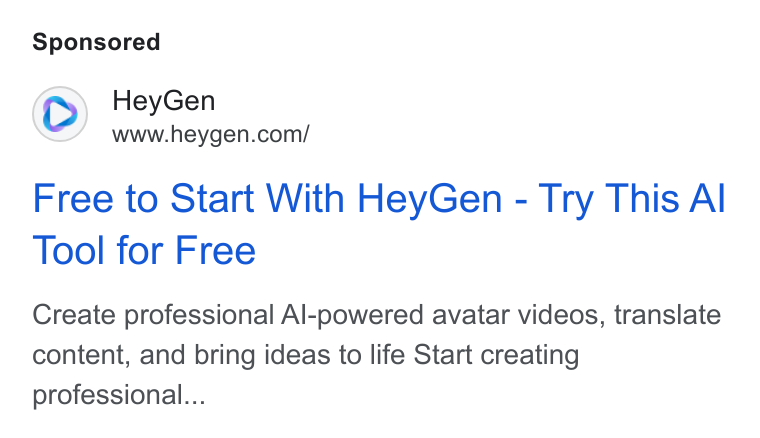
- Sponsored HeyGen www.heygen.com/ Free to Start With HeyGen - Try This Al Tool for Free Create professional Al-powered avatar videos, translate content, and bring ideas to life Start creating professional...
- CTA / offer
- Free to Start With HeyGen - Try This Al Tool for Free
- Audience
- Individuals or businesses looking to create 'professional AI-powered avatar videos' and 'translate content' are targeted, indicated by the detailed description of the tool's capabilities.
Why it works. Doubles down on 'free' language for price-sensitive first-time triallists comparing several AI video tools at once.
Headline emphasizes cost-free entry: 'Free to Start With HeyGen - Try This Al Tool for Free' If cost is your buyers' main hesitation, use the word 'free' more than once in your headline rather than just once.
08 The playbook
The channels are not separate. They are one system where each stage feeds the next. Here is the read, then the plays to run tomorrow.
The inferred playbook
The loop starts with a demo that is also the ad, gets amplified by unpaid organic resharing, and locks in the resulting demand with brand-term paid search, with the open gap being a competitive brand HeyGen doesn't control.
because the product's entire value proposition is "watch a real person's face and voice become someone else's language convincingly," every output a user makes is simultaneously a demonstration, unlike most SaaS demos, there's nothing to explain, only something to watch.
Hacker News and TikTok users have repeatedly resurfaced HeyGen outputs (the Milei speech, creator clone videos), not all of it unpaid, converting single demo moments into multi-week discovery windows the company didn't have to buy.
Dig deeper+3▾
the ~2,000-ad Google library is overwhelmingly built around capturing people who already know the "heygen" name, not generating category awareness from scratch.
a competing project, "Heygem," launched on Hacker News in May 2025 explicitly positioned as a free, local, open-source "alternative to Heygen" and drew 24 points, more engagement than most of HeyGen's own submissions, a structural gap where the brand's recognition is being used against it by category clones.
free-to-paid conversion rate, churn, CAC, and what share of the reported ARR runs through the affiliate program.
Make the demo the ad
The proofTwo separate Hacker News users independently submitted Milei-speech translation clips in the same week, pure organic reach off a single visually startling output, not a coordinated PR push.
The adaptationIdentify the single most visually or emotionally surprising thing your product can produce, then build a demo around a real, timely, or recognizable moment (a trending topic, a well-known voice, a before/after) instead of a generic feature walkthrough. Post it yourself first on the community where your users already argue about tools (a subreddit, Hacker News, a niche Discord), and let the surprise do the sharing rather than asking anyone to share it. The mechanism: when the demo itself proves the capability, viewers become distributors because reposting it is more interesting than describing it.
Cost: $0 · Time to signal: days · Works pre-PMF: yes.
Post your own growth numbers where builders hang out
The proofthe Hacker News account behind "How we hit $1M ARR in 7 months" lines up with co-founder Wayne Liang's identical same-day X post, not Joshua Xu's, rather than the milestone coming from a press release.
The adaptationOnce you have any real number, users, revenue, retention, write a short, specific first-person post about how you got there and submit it yourself to Hacker News, Indie Hackers, or a relevant subreddit. Skip the framing of an announcement and write it as a builder sharing a result with peers.
Cost: $0 · Time to signal: days to weeks · Works pre-PMF: yes, even a small number works if it's specific and real.
Let every free-tier output carry your mark
The proofHeyGen's free tier is limited and appears to stamp outputs as free-tier content, turning every free use into a public impression rather than a private trial.
The adaptationAudit whatever your free tier or trial exports, if it leaves your product with no trace of where it came from, add a small, unobtrusive brand mark or link before shipping it anywhere else. First step: find the one export or share action your free users take most often and put your name on it.
Cost: $0 · Time to signal: weeks · Works pre-PMF: yes.
Seed creators already making your category's content
The proofDozens of independent TikTok creators, like Dejinova, post tutorials and reviews of HeyGen features, several clearing 20,000+ engagement, though some carry explicit "Ad |" paid-placement tags rather than running purely organic.
The adaptationFind 10 to 20 creators who already post content adjacent to your category (not influencers you'd have to brief from scratch), offer them free or extended product access with one clear feature to try, and let them post their own take rather than a script. Start by DMing creators who've already organically mentioned a competitor or adjacent tool.
Cost: under $500 to under $5k for access/gifting · Time to signal: weeks · Works pre-PMF: conditional, yes if your product is visually demonstrable enough that a creator's own audience finds it interesting unscripted.
Stand up a self-serve affiliate program
The proofHeyGen runs a public affiliate-program page and Rewardful integration as an always-on recruitment channel, distinct from its creator-gifting motion.
The adaptationSet up a lightweight affiliate tool (Rewardful, FirstPromoter, or similar) with a public program page, then recruit your first affiliates directly from your existing paying users and any creators who've already mentioned you unprompted.
Cost: under $500 · Time to signal: weeks · Works pre-PMF: conditional, yes once you have even a handful of paying customers to reward, it needs revenue to point commissions at. Not transferable at an earlier stage: the paid-search scale (a ~2,000-ad Google library capturing brand-term traffic) and the enterprise case-study content (Coursera, Workday) both depend on a brand recognition and customer roster that took years of the above plays compounding to build, don't start there.
You just read how HeyGen does it. Tomorrow it is someone else.
Every morning we take one company that is actually growing and break down where its customers come from: the ads still running after a year, the channel doing the real work, and the play you can run this week.
Systemaic · directional intelligence. Traffic, spend, and reach figures are SimilarWeb-style estimates and qualitative reads of public data, not audited numbers. Built on real public receipts.
// teardowns with a similar GTM motion
sources & receipts (8)
Live ad libraries: meta ad library · google ad library
Launch archives: Hacker News: Show HN: Heygem AI – An Open Source, Free Alternative to Hey · Hacker News: Heygem AI: China's Open Source Heygen and Synthesia Alternat · Hacker News: HyperFrames lets AI agents compose videos by writing HTML, C · Hacker News: HeyGen – AI Video Generator · Hacker News: How we hit $1M ARR in 7 months · Hacker News: Video translation with deep fake lips and voice cloning
Traffic, spend, and revenue figures are estimates as noted in the report; the links above are the primary public artifacts.