- 01Bid on generic category terms, not your own name
- 02Build category hub pages instead of blog posts for a transactional product
- 03Lead with an insider credential the buyer community already trusts
- 04Turn your first real customer win into a single reusable proof point
01 Snapshot
The one-glance read on who they are and how they grow. Each point is verifiable from the receipts above.
A marketplace connecting fire departments, EMS agencies and municipalities to buy and sell used fire trucks, ambulances and other emergency apparatus, born out of Y Combinator Winter 2024.
Paid-led, running on Google Search demand capture with a thin owned-SEO layer riding alongside it.
~62,300 estimated monthly visits as of July 14, 2026; 24 of 48 Google ads active; $18M raised through an August 2025 Series A.
Ten newer Google ad creatives, including video and product-shot formats, were live as of July 14, 2026, the newest first shown June 24, 2026.
Garage substitutes typical marketplace network-effect virality with sustained, category-term paid search, because fire departments are a narrow, infrequent-purchase buyer pool the company reaches by paying to intercept them mid-search rather than waiting to be discovered.
02 How it unfolded
The order the channels came online. Sequence is strategy: what they did first, and what they layered on once demand existed.
03 Traffic & channel mix
Estimated demand, the channel split behind it, and the keywords and referrers doing the work. Directional modeling, not audited analytics.
Traffic sources
Top search keywords
| Keyword | Volume | Weight | CPC |
|---|---|---|---|
| gov surplus trucks for sale | 0 | - | |
| garage fire apparatus | 250 | - | |
| fire truck for sale | 1.1k | $0.94 | |
| skeeter brush truck 2016 | 350 | - | |
| government trucks auctions near me | 0 | - |
Closest competitors by audience
Garage draws an estimated ~62,300 monthly visits, down 4.4% over the last 3 months. Direct traffic leads the mix at 37.8%, followed by Social Paid at 20.5% and Search Organic at 15.2%. Paid Search adds another 11.9%, and the rest, email, organic social, referrals, display and affiliate, together total under 15%.
The Direct-heavy mix fits a narrow professional buyer base: fire departments and municipal procurement offices that navigate straight to a known marketplace once a peer department has referred them, rather than rediscovering Garage through search each time. The keyword data backs the category-intent read: "fire truck for sale" draws 1,080 searches/month across the web, "garage fire apparatus" draws 250, and the oddly specific "skeeter brush truck 2016" (350/month) shows Garage also picks up long-tail, model-and-year searches tied to individual listings.
Among the named competitors, firetruckmall.com and bradfordfireapparatus.com are direct rivals for the same used-apparatus buyers, specialized dealers Garage's marketplace model is trying to disintermediate. garage.com, also listed as a competitor, is likely a domain-name-similarity artifact rather than a genuine rival in this category.
04 Organic content
The specific pages earning their organic search traffic, and the pattern behind why they rank. Adapt the format, not the topic.
Garage's organic footprint is concentrated on marketplace structure, not editorial content: the homepage and the /fire-trucks and /auctions category hubs carry nearly all of the traffic, and every top-ranking keyword ("garage fire trucks," "garage fire apparatus," "shop garage," "garage auction," "garage auctions") sits at #1. That ranking pattern is a near-branded search signature, terms that pair the Garage name with a product category, rather than competitive non-branded terms like "used fire truck dealer."
That points to a specific mechanism for a tight professional buyer community: fire departments likely first hear about Garage through a peer referral or press mention, then search a "garage + category" phrase to find it, converting word-of-mouth into branded-search traffic rather than building an independent content-driven discovery funnel.
Top pages by organic traffic
05 Channel map
Not traffic share. How much weight the growth system actually puts on each channel, with a one-line read on the role it plays.
What drove growth
06 Who they’re hiring
Open roles read like a roadmap: the functions they’re staffing show where the company is investing next and what stage it’s at.
14 open roles
07 The motions doing the work
For founder-led SaaS the breakdown shifts from ads to traction: where the first users came from, how the founder grows it in the open, and the compounding organic surface.
Garage's traction story runs through funding and press rather than a single launch-platform spike, anchored by co-founder and CEO Martin Hunt's personal firefighter background and a fast run to nationwide coverage.
YC W24 origin: Garage came out of Y Combinator's Winter 2024 batch, the company's earliest public launch moment on record. Funding-marked growth: A $4.5M seed led by Initialized Capital followed in 2024, and a $13.5M Series A led by Infinity Ventures, with Initialized Capital, Wayfinder Ventures, FJ Labs and Y Combinator's fund participating, closed in August 2025, bringing total funding to $18M. Nationwide reach: By the Series A announcement in August 2025, Garage had customers in all 50 states, roughly a year and a half after starting operations, per the company's own account. First reference customer: South Farmingdale Fire Department in New York sold one engine through Garage for $170,000, the concrete proof point Garage cites in its outreach and press narrative.
Garage's public narrative runs through press and funding coverage rather than a founder's day-to-day posting cadence, since no personal social activity from either co-founder shows up in the channels pulled.
Founder-story as PR hook: Hunt's background as a volunteer firefighter and EMT in New Castle County, Delaware, is the consistent framing across the YC launch and the funding announcements, standing in for a personal audience the founders haven't otherwise built. Brand account, light footprint: The company's own Instagram presence, detailed in the channel map above, is modest and functions as a supporting channel rather than a growth engine. Community referral over personal audience: Direct traffic's 37.8% share of total visits, paired with the South Farmingdale case's word-of-mouth framing, points to peer referral inside the tight-knit fire-service community as the real amplification loop, not founder-driven social content.
Organic search sits third in Garage's channel mix at 15.2%, behind Direct and Social Paid, a supporting role rather than the primary engine.
Structural pages over content: The pages earning organic traffic are category and auction hub pages, not blog posts, meaning the SEO surface leans on marketplace inventory structure rather than an editorial flywheel. Paid search carries the demand generation: Garage's Google Search program targets generic category terms like "Used Fire Trucks For Sale" and "Used Ambulances for Sale" rather than its own brand name, meaning it is generating new demand, not defending branded searches, a distinction that matters given how long the winning creatives have stayed active. Newest tests: Ten newer creatives, including video and product-shot formats showing an actual fire truck rather than text-only layouts, were still active as of July 14, 2026, the newest first shown June 24, 2026, testing whether visual formats outperform the text-heavy winners. No affiliate or partner program was found on the owned site, and Affiliate traffic sits at just 0.3% of the mix, so this is not a distribution lever Garage is investing in.
08 Paid ads
This founder-led SaaS also runs paid acquisition. Here are the live ads doing the work, each with the X-ray and a play you can adapt.
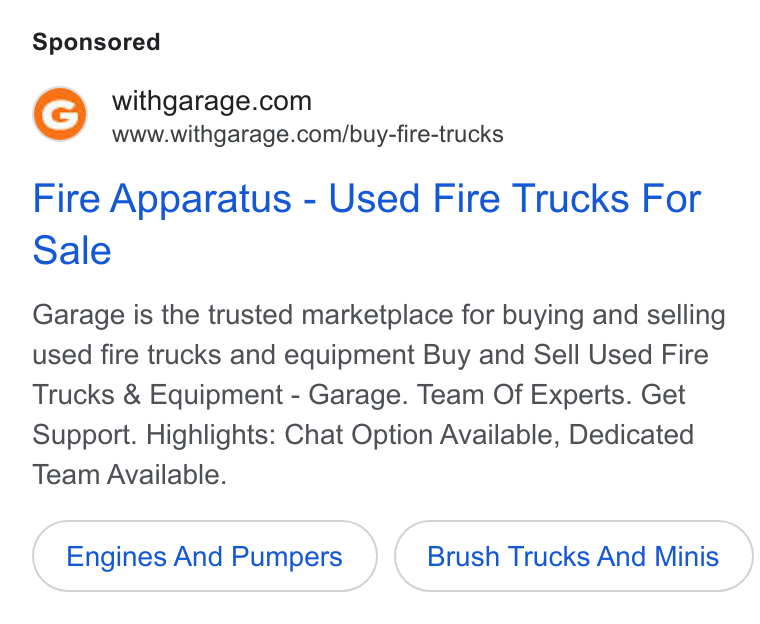
- Running
- 672 days (longevity = it's converting)
- Hook
- Sponsored withgarage.com www.withgarage.com/buy-fire-trucks Fire Apparatus - Used Fire Trucks For Sale
- CTA / offer
- Buy and Sell Used Fire Trucks & Equipment - Garage.
- Audience
- Individuals or organizations looking to buy or sell 'Used Fire Trucks & Equipment', indicated by the direct headline and description.
Why it works. Runs on a second domain, withgarage.com, letting Garage test a distinct brand name against the same fire truck buyer intent.
Headline clearly states the product and intent: "Fire Apparatus - Used Fire Trucks For Sale" If you own two domains, run parallel search campaigns on each with the same offer to see which brand name converts better.
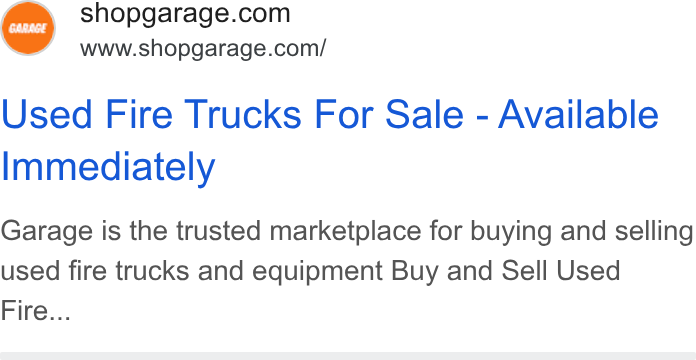
- Running
- 427 days (longevity = it's converting)
- Hook
- shopgarage.com www.shopgarage.com/ Used Fire Trucks For Sale - Available Immediately
- CTA / offer
- Buy and Sell Used Fire...
- Audience
- Individuals or organizations in need of specialized vehicles and equipment, specifically 'used fire trucks and equipment'.
Why it works. Pairs the niche product with a stock-in-hand claim, which matters to fire departments that often need a replacement vehicle fast.
Headline with immediate availability: 'Used Fire Trucks For Sale - Available Immediately' If your inventory is in stock now, add that fact to the headline itself instead of leaving it for the landing page.
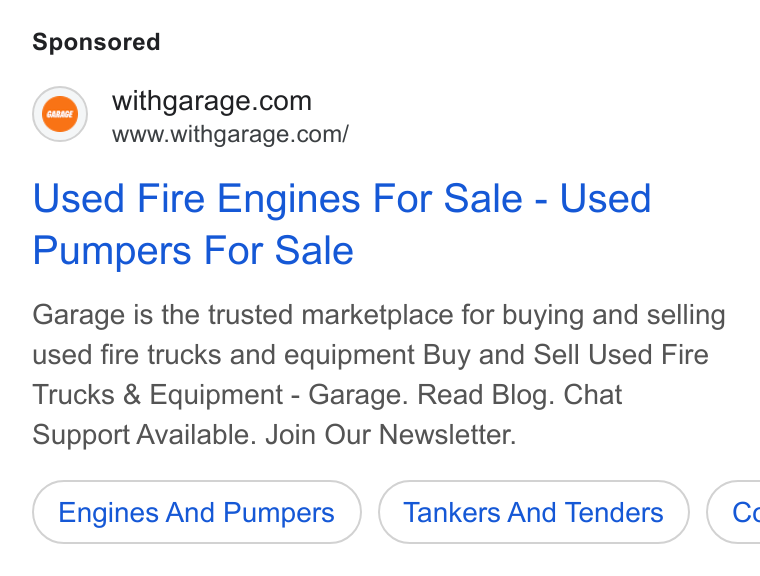
- Running
- 410 days (longevity = it's converting)
- Hook
- "Sponsored" text at the top, followed by a circular orange logo with "GARAGE" written in white, and then "withgarage.com" and "www.withgarage.com/" below it. The main headline "Used Fire Engines For Sale - Used Pumpers For Sale" is partially visible.
- Audience
- Individuals or organizations looking to buy or sell used fire trucks and equipment, indicated by the explicit mention of "Used Fire Engines For Sale" and "Used Pumpers For Sale" in the headline.
Why it works. Covers multiple industry search terms for the same equipment class so Garage does not lose buyers who search a different synonym.
Clear, direct headline: "Used Fire Engines For Sale - Used Pumpers For Sale" List the two or three different names your customers use for the same product and stack them in one headline, separated by a dash.
Show 3 more ads
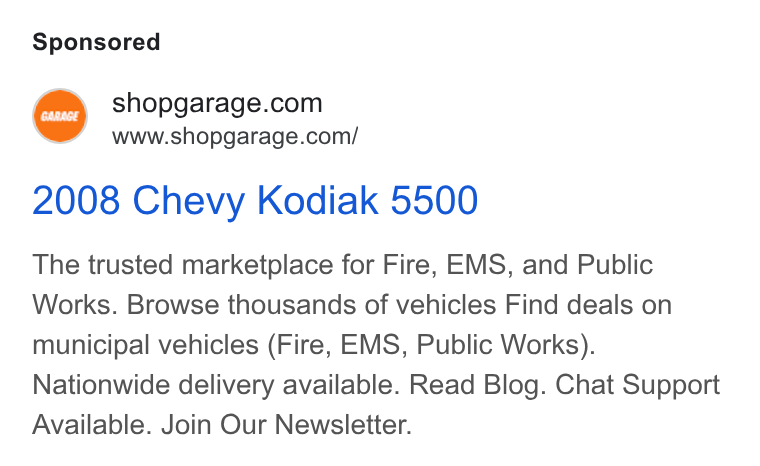
- Running
- 342 days (longevity = it's converting)
- Hook
- Sponsored GARAGE shopgarage.com www.shopgarage.com/ 2008 Chevy Kodiak 5500
- CTA / offer
- Join Our Newsletter.
- Audience
- Individuals or organizations involved in 'Fire, EMS, and Public Works' looking for 'municipal vehicles'.
Why it works. Mirrors the buyer's own search query for a specific medium-duty truck, which is the strongest relevance signal a search ad can send.
Direct product identification: '2008 Chevy Kodiak 5500' For high-intent product searches, let the exact search term be the headline rather than rewriting it into marketing language.
- Running
- 220 days (longevity = it's converting)
- Hook
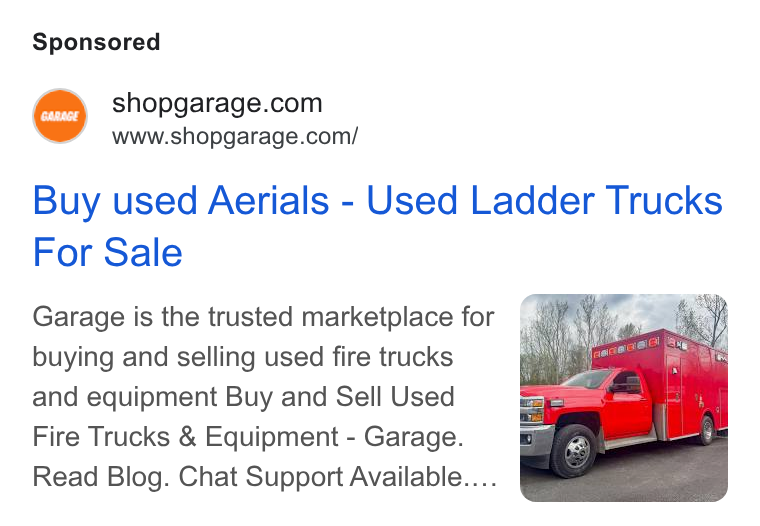
- Visual: A small orange circular logo with the word "GARAGE" in white, next to the text "shopgarage.com". Text: "Sponsored" above the logo and website. Text: "Buy used Aerials - Used Ladder Trucks For Sale" below the website.
- CTA / offer
- Buy used Aerials - Used Ladder Trucks For Sale
- Audience
- Individuals or organizations looking to purchase used fire trucks and equipment, indicated by the explicit mention of 'used Aerials', 'Used Ladder Trucks', and 'used fire trucks and equipment'.
Why it works. Targets a sub-category of fire apparatus, ladder trucks, letting Garage capture buyers whose need is narrower than a generic fire truck search.
Clear and direct headline stating the product category: "Buy used Aerials - Used Ladder Trucks For Sale" Break your generic category into its named sub-types and write one ad per sub-type instead of a single catch-all ad.
- Running
- 126 days (longevity = it's converting)
- Hook
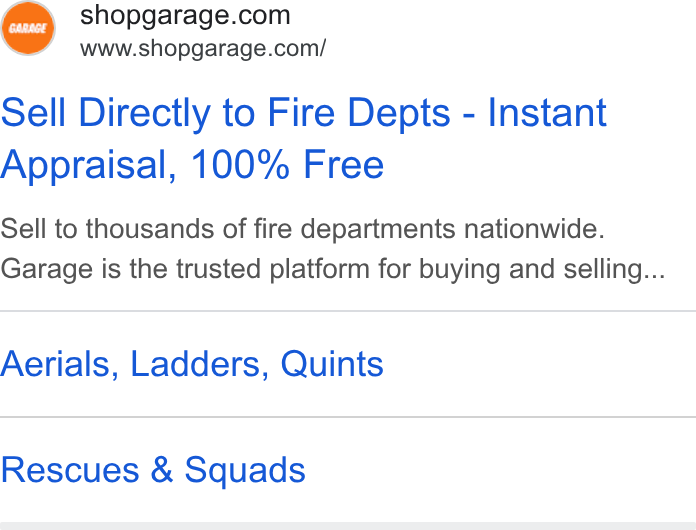
- "Sell Directly to Fire Depts - Instant Appraisal, 100% Free" with a small orange circular logo with the word "GARAGE" in white.
- CTA / offer
- Sell Directly to Fire Depts - Instant Appraisal, 100% Free
- Audience
- Individuals or organizations looking to sell fire department equipment, indicated by phrases like "Sell Directly to Fire Depts" and specific equipment types like "Aerials, Ladders, Quints" and "Rescues & Squads."
Why it works. Targets the supply side of the marketplace, departments looking to offload old apparatus, with a free instant-appraisal offer to build seller inventory.
Direct, benefit-driven headline: "Sell Directly to Fire Depts - Instant Appraisal, 100% Free" Write a separate ad aimed at people who want to sell to you, not just buy from you, and lead with speed and zero cost.
09 The playbook
The channels are not separate. They are one system where each stage feeds the next. Here is the read, then the plays to run tomorrow.
The inferred playbook
The 14 open roles as of July 14, 2026 skew heavily toward growth marketing and sales (eight of fourteen), with a dedicated finance layer forming alongside it, the hiring mix of a funded marketplace shifting from founder-led demand generation to a built-out, quota-carrying growth and sales engine. Garage's loop starts with paid Google Search intercepting fire departments and municipalities actively shopping for apparatus, converts on structural inventory pages, and compounds through direct return visits from a repeat, professionally networked buyer base.
Google Search ads on terms like "fire truck for sale" capture in-market buyers of intent, the best-supported acquisition mechanism in the evidence given how many ads stay active for well over a year. Conversion: inventory pages, not content: Traffic lands on the /fire-trucks and /auctions hubs, built around live listings, converting browsing intent directly rather than nurturing through blog content. Compounding: direct and repeat share: A 37.8% Direct share suggests a buyer base that returns straight to the marketplace once it knows Garage exists, consistent with a professional community referring peers. Gap: no evidenced amplification layer: Neither a founder personal following nor creator or community UGC appears in the channels pulled, so the loop depends on paid search and direct return traffic without a visible low-cost amplification layer to offset acquisition cost as ad spend scales. Revenue, estimated not verified: No verified current revenue figure is public; a third-party tracker cited about $2.1M in revenue for 2024, and a 2025 job listing claimed year-over-year growth of more than 10x, an unverified company claim with no stated driver behind the jump, which would put current revenue meaningfully higher if accurate but should be read as a rough, unconfirmed signal rather than fact.
Garage's marketplace take rate or commission percentage, its blended paid-search cost per completed transaction, and the repeat-listing rate among fire departments and dealers are not shown in public sources.
Bid on generic category terms, not your own name
The proofGarage's Google Search ads target phrases like "Used Fire Trucks For Sale" rather than its own brand, with 24 of 48 ads still active as of July 14, 2026 and its oldest winner running roughly 672 days.
The adaptationIdentify the two or three highest-intent generic phrases buyers in your category actually type, in the "[used/category item] for sale" or "[category] near me" pattern, and run a small exact- or phrase-match Google Search campaign against only those terms. Track cost per lead for the first 30 days before adding image or video formats, mirroring how Garage layers new creative formats onto proven text ads rather than replacing them outright.
Cost: under $500 · Time to signal: weeks · Works pre-PMF: conditional, only if buyers in your category already search with clear purchase intent rather than browse casually.
Build category hub pages instead of blog posts for a transactional product
The proofGarage's organic traffic concentrates on structural marketplace pages, the /fire-trucks and /auctions hubs, not blog content, and both rank #1 for near-branded category terms.
The adaptationFor each major product or service category you sell, build one dedicated hub page with a URL that names the category directly and populate it with real, current inventory or listings rather than a generic explainer post. Update it as inventory changes so it stays a living page search engines revisit, the same structural-page approach that lets Garage's hub pages double as both SEO surface and conversion page in one.
Cost: $0 · Time to signal: months · Works pre-PMF: yes.
Lead with an insider credential the buyer community already trusts
The proofCo-founder and CEO Martin Hunt's own history as a volunteer firefighter and EMT is the consistent framing across Garage's launch and funding coverage, standing in for a personal social following neither founder has built.
The adaptationIf you're entering a vertical where you have any direct personal tie, worked the job, volunteered, apprenticed, find that one concrete credential and lead with it in every cold outreach email, landing page bio and press pitch, instead of a generic founder biography. A niche B2B or B2G buyer trusts someone who has stood where they stand over a marketer explaining the product to them.
Cost: $0 · Time to signal: weeks · Works pre-PMF: yes.
Turn your first real customer win into a single reusable proof point
The proofThe South Farmingdale Fire Department case, which Garage cites as selling one engine through the marketplace for $170,000, anchors the company's outreach and funding narrative.
The adaptationOnce you close your first handful of customers, document one of them with a specific before-and-after number: dollars saved, time saved, or deals closed. Lead your next 20 cold outreach emails and your landing page's opening line with that one number until a stronger case study replaces it, rather than describing your product in the abstract.
Cost: $0 · Time to signal: weeks · Works pre-PMF: yes.
Hire into growth only after the paid-plus-referral loop proves itself
The proofEight of Garage's 14 open roles as of July 14, 2026 sit in growth marketing and sales, a hiring buildout that followed its funding rounds rather than preceded them.
The adaptationTreat a dedicated growth or sales hire as a scaling decision, not a starting one. Run the category-term search test from Play 1 yourself first, and only budget for a growth hire once you can show a positive return on that small spend, so the hire is amplifying a proven loop instead of searching for one from scratch.
Cost: dedicated budget or hire · Time to signal: months · Works pre-PMF: no. Not transferable at an earlier stage: Garage's nearly two-year-old, $18M-funding-backed Google Search program assumes a spend and runway most pre-seed founders don't have. Run the category-term testing in Play 1 at a fraction of that budget and validate cost per lead before scaling it, rather than trying to match Garage's ad footprint directly.
You just read how Garage does it. Tomorrow it is someone else.
Every morning we take one company that is actually growing and break down where its customers come from: the ads still running after a year, the channel doing the real work, and the play you can run this week.
Systemaic · directional intelligence. Traffic, spend, and reach figures are SimilarWeb-style estimates and qualitative reads of public data, not audited numbers. Built on real public receipts.
// teardowns with a similar GTM motion
sources & receipts (7)
Live ad libraries: google ad library
Launch archives: Hacker News: Home Assistant blocked from integrating with Garage Door ope · Hacker News: Garage – An S3 object store so reliable you can run it outsi · Hacker News: Z2 – Lithographically fabricated IC in a garage fab · Hacker News: 22-year-old builds chips in his parents’ garage · Hacker News: Chamberlain blocks smart garage door opener from working wit · Hacker News: Garage, our self-hosted distributed object storage solution
Traffic, spend, and revenue figures are estimates as noted in the report; the links above are the primary public artifacts.