- 01Launch inside someone else's hackathon first
- 02Run your own subreddit as a home base, but post the big news where the bigger crowd already lives
- 03Build one landing page per named alternative and bid on that exact term
- 04Give the paid tier away until you have proof, then charge
01 Snapshot
The one-glance read on who they are and how they grow. Each point is verifiable from the receipts above.
An open-source AI coding agent for VS Code, JetBrains, and CLI that plans, edits, and runs code autonomously, now past 5M installs and a $32M raise.
Founder-led, community-led (open-source distribution).
5M+ installs and 57K GitHub stars as of January 30, 2026, built on a $32M Seed+Series A raise (Series A closed July 31, 2025, ~$110M valuation).
As of 2026-07-09, live LinkedIn tests push a model-agnostic infrastructure pitch alongside free-access promotion for the new Devstral 2 model inside Cline.
Cline's funnel runs on unpaid distribution, GitHub stars and Hacker News threads feed installs, while its paid ads target existing developers into Teams/Enterprise seats, not new awareness.
02 How it unfolded
The order the channels came online. Sequence is strategy: what they did first, and what they layered on once demand existed.
03 Traffic & channel mix
Estimated demand, the channel split behind it, and the keywords and referrers doing the work. Directional modeling, not audited analytics.
SimilarWeb does not publish a traffic estimate for this domain yet, which is normal for a newer or smaller site below its tracking threshold. The growth read here leans on the other public signals in this teardown rather than modeled traffic.
SimilarWeb does not publish a traffic estimate for this domain yet, which is normal for a site this size, so the growth read here leans on the other public signals below.
04 Organic content
The specific pages earning their organic search traffic, and the pattern behind why they rank. Adapt the format, not the topic.
Their organic footprint is heavily branded-search driven: the homepage captures the large majority of measured organic-search traffic, and their top ranking keyword is their own name, reflecting demand created elsewhere (Hacker News, GitHub, Reddit) rather than content marketing pulling in new searchers. The second-ranked keyword is a Japanese-language term for their "Memory Bank" feature, pointing to genuine pull from Japan's developer community into that one documentation page even though the docs subdomain otherwise contributes negligible measured organic volume. The pattern reads as a single hero page plus one sleeper documentation asset, not yet a broad content flywheel, leaving real headroom in turning docs and comparison pages into deliberate SEO surface instead of leaning on brand search alone.
Top pages by organic traffic
05 Channel map
Not traffic share. How much weight the growth system actually puts on each channel, with a one-line read on the role it plays.
What drove growth
06 The motions doing the work
For founder-led SaaS the breakdown shifts from ads to traction: where the first users came from, how the founder grows it in the open, and the compounding organic surface.
Cline's traction was never a single launch event, it was a hackathon entry that refused to die.
Built in June 2024 for Anthropic's Build with Claude hackathon under the name "Claude Dev," the project did not win, but the founder's own Reddit announcement (the 376-upvote post noted above) proved there was a receptive audience before the company had a real brand.
The product resurfaced as "Cline" in a public relaunch in October 2024, and from there growth accrued through a steady stream of independent Hacker News submissions and Reddit threads rather than a single coordinated Product Hunt or Show HN moment, the evidence shows no Cline-run Show HN post at all, only third parties writing about the tool over many months.
Dig deeper+1▾
Looking back in January 2026, the founder framed the arc explicitly as going from "losing at a hackathon" to the installs and stars milestones covered above, plus a 4,700% year-over-year contributor growth figure, casting the story as one of grinding community credibility rather than a single breakout moment.
The founder, Saoud Rizwan, builds in public almost entirely from his personal X account rather than the brand handle, using Reddit as the venue for direct product news to the community he seeded.
Rizwan's own posts (@sdrzn, followers and post count noted above) carry the funding and milestone news, while the brand account's own posting activity does not surface distinctly in the evidence, suggesting the personal voice, not @cline, is the primary public-facing channel.
Beyond the original hackathon post, Rizwan posts product news directly into r/CLine, the company's own subreddit, where "Introducing Cline SDK" scored 25 points with 8 comments and "Introducing ClinePass" scored 44 points with 37 comments, versus the broader r/ClaudeAI, where the original hackathon post (covered above) still outperforms both. The pattern for a reader: your own subreddit gets steady engagement on product news, but a large adjacent official community can outscore it by an order of magnitude on a single high-relevance post.
Dig deeper+1▾
The ClinePass post introduced a $9.99/month subscription for a 2-5x discount on GLM-5.2 and other open-weight models, with a $1.99 introductory promo, launched as a Reddit post rather than a press release, treating the community as the first customer touchpoint for a new monetization experiment.
Cline's content system is thin by design, one hero page and a growing set of purpose-built landing pages rather than a broad blog-driven funnel.
The site runs an active blog (funding and product announcements) noted in the owned-site data, but it isn't producing the kind of distinct keyword-ranking pages that would show up as a second or third organic entry point beyond the homepage and Memory Bank page covered above.
The Google ad destinations reveal a deliberate structure of dedicated pages built for named surfaces, including /cursor, /augment/code, /kilo/code, /qwen, /grok-code-fast, and /claude/code, each pairing a specific competitor or model name with paid search against that exact query. This is a demand-capture system built for intent that already exists (a developer typing "cursor" or "qwen" into Google), not a demand-generation content program.
Dig deeper+2▾
With the ad footprint already sized above, the split between developer-acquisition hooks and enterprise-governance messaging shows the budget is aimed at capturing developers already comparing tools and at enterprise buyers already evaluating governance, not at creating category awareness from scratch.
The owned-site evidence surfaces no partner or referral program, so unlike DTC-style creator-affiliate motions, Cline's distribution runs entirely on community discovery and paid search capture rather than a recruited seller network.
07 Paid ads
This founder-led SaaS also runs paid acquisition. Here are the live ads doing the work, each with the X-ray and a play you can adapt.
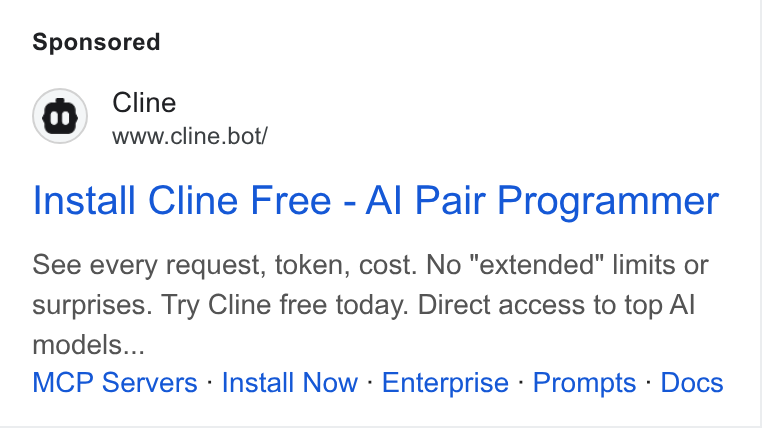
- Running
- 208 days (longevity = it's converting)
- Hook
- Visual: A black and white icon of a robot head. Text: "Sponsored", "Cline", "www.cline.bot/", "Install Cline Free - AI Pair Programmer".
- CTA / offer
- Install Cline Free
- Audience
- Developers, programmers, or businesses interested in AI tools, indicated by "AI Pair Programmer", "MCP Servers", "Prompts", and "Docs".
Why it works. Removes the two biggest hesitations for a first-time trial, cost and setup effort, in a four-word headline.
Headline: "Install Cline Free - AI Pair Programmer" Pair your install or signup verb directly with the word 'Free' in the same headline instead of separating the offer from the action.
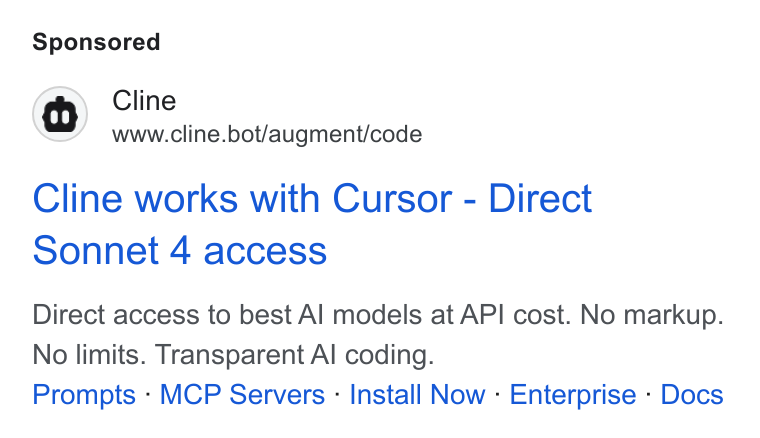
- Running
- 208 days (longevity = it's converting)
- Hook
- Sponsored Cline www.cline.bot/augment/code Cline works with Cursor - Direct Sonnet 4 access
- CTA / offer
- Install Now
- Audience
- Developers or businesses interested in AI models, specifically those familiar with 'Sonnet 4' and 'Cursor', indicated by the technical language and specific product names.
Why it works. Positions Cline as compatible with a competitor's users while dangling a named, current AI model as the incentive to switch.
Headline directly names a specific, high-value integration: 'Cline works with Cursor - Direct Sonnet 4 access'. If you integrate with or improve on a named competitor, put both the competitor's name and your specific technical edge in the headline.
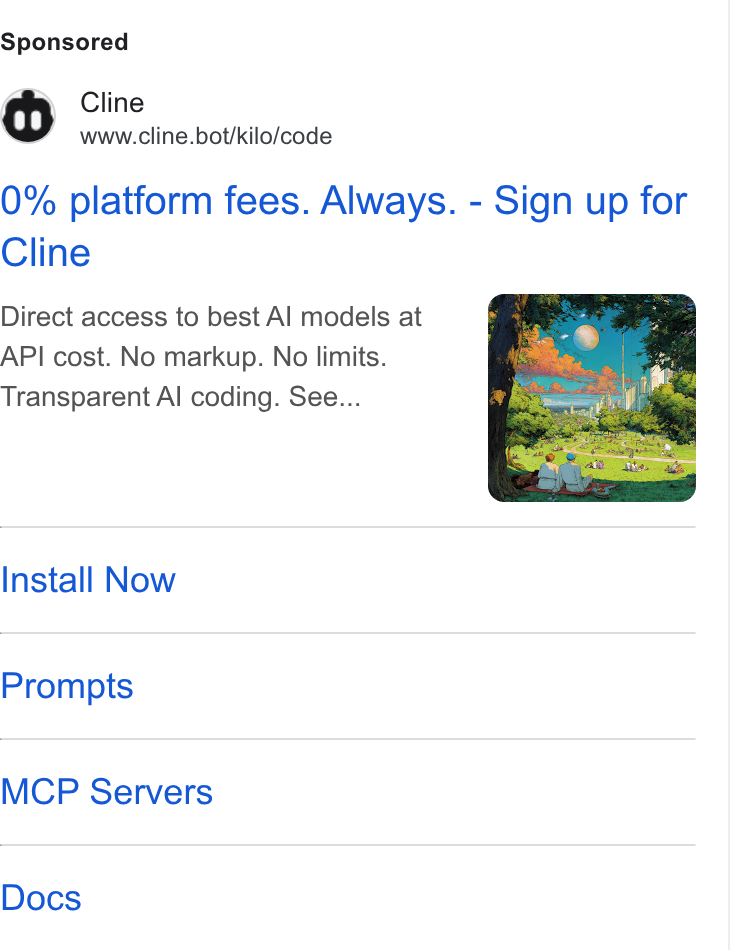
- Running
- 196 days (longevity = it's converting)
- Hook
- 0% platform fees. Always. - Sign up for Cline. Visual: A black and white logo with a stylized 'C' or similar shape, next to the text 'Cline' and 'www.cline.bot/kilo/code'.
- CTA / offer
- Sign up for Cline
- Audience
- Developers or businesses interested in AI models, indicated by 'API cost', 'Al coding', and 'MCP Servers'.
Why it works. Reuses a proven fee claim on a page conquesting a named competitor, Kilo Code, to win people already comparison-shopping.
Headline with a bold financial claim: '0% platform fees. Always. - Sign up for Cline' Reuse your strongest proven claim across competitor-conquesting pages instead of writing new copy for every comparison campaign.
Show 3 more ads
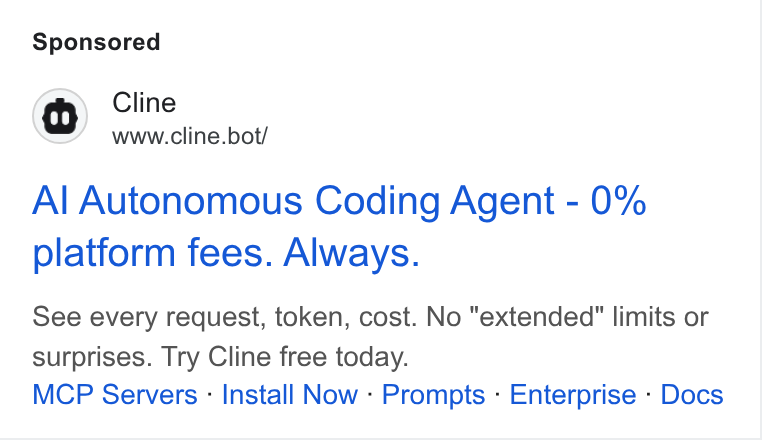
- Running
- 172 days (longevity = it's converting)
- Hook
- Sponsored Cline www.cline.bot/ AI Autonomous Coding Agent - 0% platform fees. Always.
- CTA / offer
- Try Cline free today.
- Audience
- Developers, businesses, or individuals interested in AI coding agents, indicated by terms like "Coding Agent," "platform fees," "request, token, cost," "MCP Servers," "Install Now," "Prompts," "Enterprise," and "Docs."
Why it works. Turns a common SaaS trust gap, whether a free tier stays free, into a headline guarantee for cost-conscious developer teams.
Headline with a bold financial claim: "AI Autonomous Coding Agent - 0% platform fees. Always." If your pricing is genuinely free or flat, add a durability word like 'Always' so readers don't discount it as a promo.
- Running
- 161 days (longevity = it's converting)
- Hook
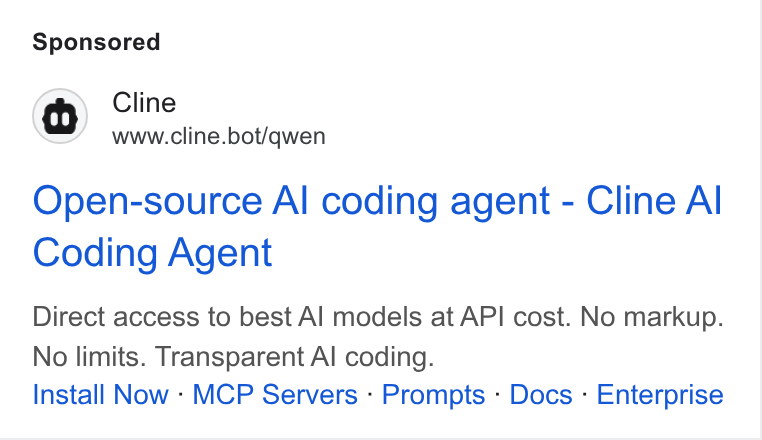
- Sponsored Cline www.cline.bot/qwen Open-source AI coding agent - Cline AI Coding Agent
- CTA / offer
- Install Now
- Audience
- The mention of 'AI coding agent', 'API cost', 'MCP Servers', 'Prompts', and 'Enterprise' signals a target audience of developers, tech professionals, and businesses interested in AI development and deployment.
Why it works. Uses the open-source label as the entire pitch to reach developers who search specifically for non-proprietary tooling.
Headline states a clear, benefit-driven product: 'Open-source AI coding agent - Cline AI Coding Agent'. If open-source or a specific technical category is your main differentiator, state it as a plain label, not a tagline, in the headline.
- Running
- 119 days (longevity = it's converting)
- Hook
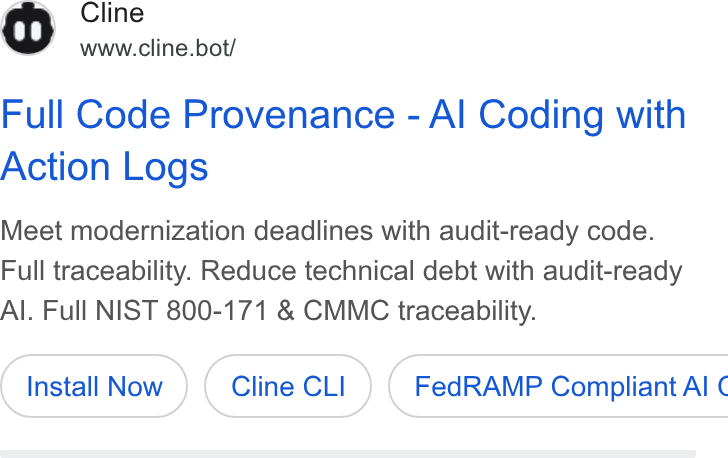
- "Full Code Provenance - AI Coding with Action Logs" with a small black icon of two white horizontal ovals, resembling eyes, above the text "Cline www.cline.bot/"
- CTA / offer
- Install Now
- Audience
- IT professionals, developers, or organizations concerned with code security, auditability, and compliance, indicated by terms like "Code Provenance," "Action Logs," "audit-ready code," "traceability," "technical debt," "NIST 800-171," "CMMC," and "FedRAMP Compliant AI C."
Why it works. Speaks to IT and compliance buyers who need an audit trail for AI-generated code, a distinct concern from cost or privacy.
Headline with specific technical terms: "Full Code Provenance - AI Coding with Action Logs" If your product logs every action for audit purposes, name the exact compliance term, like 'provenance' or 'audit trail', in the headline.
08 The playbook
The channels are not separate. They are one system where each stage feeds the next. Here is the read, then the plays to run tomorrow.
The inferred playbook
The loop runs on external community attention converting into free installs, with almost nothing yet built to compound organic discovery beyond the product itself.
Hacker News threads, Reddit posts in r/CLine and r/ClaudeAI, and the founder's personal X account (all detailed above) are the entry points, not owned content or paid awareness campaigns.
The open-source extension is free to install with no gate, so the "conversion" is a GitHub star, a marketplace install, or a Discord join, pushing monetization downstream into Teams and Enterprise seats and BYOK inference rather than at the point of first contact.
Dig deeper+3▾
GitHub stars and contributor growth (covered above) plus the competitor and model landing pages feed each other, developers searching a rival tool's name land on a comparison page, try the free extension, and some fraction becomes visible in the open-source metrics that then get cited in the founder's own recap posts.
There is no comparison or "alternative to" content beyond the ad-driven landing pages, no visible affiliate motion, and no case-study-style proof beyond the company's own named-customer claims, leaving the organic side almost entirely dependent on the community continuing to talk about Cline unprompted.
free-to-paid conversion rate from Teams seats, churn, CAC, and enterprise ARPU.
Launch inside someone else's hackathon first
The proofCline began as a non-winning entry in Anthropic's Build with Claude hackathon, and the founder's own community post announcing it is what proved demand before there was a company brand.
The adaptationSubmit your MVP to a sponsor-run hackathon or challenge tied to a platform you depend on, even if you don't expect to place. The goal isn't the prize, it's landing in front of a pre-qualified, technically engaged audience for free and getting a real reaction before you spend on marketing. First step: find the next hackathon run by the API or platform your product is built on, and enter with a working demo, not a slide deck.
Cost: $0 · Time to signal: days · Works pre-PMF: yes
Run your own subreddit as a home base, but post the big news where the bigger crowd already lives
The proofThe founder posts routine product updates in Cline's own subreddit, but his highest-scoring post ran in the larger, official r/ClaudeAI community instead (both referenced above).
The adaptationStand up a subreddit or forum for your own product for steady, lower-stakes updates, but reserve major announcements (funding, a big feature, a pricing change) for the largest official community adjacent to whatever platform or ecosystem you build on. Post as a real user sharing news, not as an ad. First step: identify the single largest subreddit or forum tied to your core dependency and post your next real milestone there directly, with the founder's name attached.
Cost: $0 · Time to signal: days · Works pre-PMF: yes
Build one landing page per named alternative and bid on that exact term
The proofCline runs individual pages for named competitors and models, expanded above as the core paid-search structure.
The adaptationFor every tool or model your own users compare you against, build one dedicated page addressing that specific comparison by name, then run a small search campaign bidding only on that exact competitor or product name. This works because someone searching a specific rival's name is already evaluating alternatives, a far higher-intent moment than generic category keywords. First step: list your three most-searched-for competitors, build one page each, and start a $5-10/day campaign against just those terms.
Cost: under $500 · Time to signal: weeks · Works pre-PMF: conditional, only once at least a couple of your competitors have enough name recognition to be searched directly.
Give the paid tier away until you have proof, then charge
The proofCline launched its Teams tier free for all team sizes alongside its 2025 raise and kept it free into 2026, only then introducing $20-per-seat pricing while keeping the first 10 seats permanently free, using the long free window to build adoption data first.
The adaptationLaunch your team or paid tier at $0 for a fixed window instead of pricing it from day one, using that window to collect usage data and logos you can point to when you do start charging. The mechanism: a time-boxed free period removes the buying decision as a barrier while you're still proving the product is worth paying for, then converts into pricing leverage once adoption exists. First step: set a public end date for your own free period (a quarter, not indefinite) and tell users now so the eventual price doesn't feel like a bait-and-switch.
Cost: $0 · Time to signal: months · Works pre-PMF: conditional, only if you already have users asking for team features, otherwise there's no one to seed. Not transferable at an earlier stage: the enterprise-governance ad campaigns and the model-agnostic infrastructure positioning depend on a $32M-funded sales motion and named enterprise customers that a pre-funding founder won't yet have, adapt the landing-page and community-seeding mechanics above, not the enterprise ad spend itself.
You just read how Cline does it. Tomorrow it is someone else.
Every morning we take one company that is actually growing and break down where its customers come from: the ads still running after a year, the channel doing the real work, and the play you can run this week.
Systemaic · directional intelligence. Traffic, spend, and reach figures are SimilarWeb-style estimates and qualitative reads of public data, not audited numbers. Built on real public receipts.
// teardowns with a similar GTM motion
sources & receipts (8)
Live ad libraries: linkedin ad library · google ad library
Launch archives: Hacker News: Using AI for Coding: My Journey with Cline and LLMs · Hacker News: Why Cline doesn't index your codebase · Hacker News: I Use Cline for AI Engineering · Hacker News: Cline and LM Studio: the local coding stack with Qwen3 Coder · Hacker News: Roo or Cline? We're building a superset · Hacker News: Cline founder stole my code
Traffic, spend, and revenue figures are estimates as noted in the report; the links above are the primary public artifacts.