- 01Open-source the utility, don't rely on your own launch post
- 02Make your product easy for someone else to write about
- 03Bid on your own brand name from a personal ad account
- 04Ask your integration question in the subreddit where your users already are
01 Snapshot
The one-glance read on who they are and how they grow. Each point is verifiable from the receipts above.
Open-source, privacy-focused web analytics (a self-hostable Google Analytics alternative) that is free to self-host forever, with a paid Umami Cloud tier.
Community- and launch-led, built on open-source distribution rather than paid acquisition or a creator army.
~410,097 monthly visits, ~37,900 GitHub stars and 7,647 forks as of late July 2026, and a $1.5M pre-seed round led by Race Capital announced July 2022.
Umami's growth doesn't hinge on one launch moment, it comes from being evergreen enough that strangers keep resubmitting it to Hacker News years apart, each resubmission hitting the front page again on its own.
02 How it unfolded
The order the channels came online. Sequence is strategy: what they did first, and what they layered on once demand existed.
03 Traffic & channel mix
Estimated demand, the channel split behind it, and the keywords and referrers doing the work. Directional modeling, not audited analytics.
Umami draws an estimated 410,097 monthly visits, down 5.8% over the trailing 3 months. No channel-by-channel breakdown, keyword data, or referrer list is available for this pull, so this figure reflects total volume only, not a source mix, and no further read on channel composition can be drawn from it.
04 Channel map
Not traffic share. How much weight the growth system actually puts on each channel, with a one-line read on the role it plays.
What drove growth
05 The motions doing the work
For founder-led SaaS the breakdown shifts from ads to traction: where the first users came from, how the founder grows it in the open, and the compounding organic surface.
Umami's breakthrough wasn't its own launch post, it was the community relaunching the product for it, repeatedly, over six years.
Mike Cao's own Show HN, "Umami, a self-hosted alternative to Google Analytics," posted August 17, 2020, landed just 10 points and 9 comments, a modest showing for what became the company's core narrative.
the very next day, a different user reposted the same pitch as "Umami: Self-hosted open-source alternative to Google Analytics" and it hit 820 points and 227 comments, the actual traction event, driven by someone else's curation rather than the founder's own submission.
Dig deeper+2▾
the identical framing resurfaced on HN's front page in May 2021 (204 points), May 2022 (89 points), and February 2025 (348 points, 168 comments) via unrelated submitters, plus smaller pickups tied to specific use cases like a December 2025 Matomo-migration writeup (62 points) and a July 2026 iOS-analytics post (66 points, 10 comments).
there's no Product Hunt evidence and the two Reddit threads are unrelated single-topic discussions, not launch-day cross-posts, so the traction pattern here is HN-native, not a synchronized campaign.
Umami's founder presence is real but small, this is closer to quiet community participation than a personal-audience growth engine.
Mike Cao posts from @caozilla, a personal X account with 666 followers and 330 posts whose bio explicitly ties back to @umami_software, distinct from the brand's own X handle that the homepage links to separately.
rather than posting MRR updates or build logs, the founder-tagged Reddit activity is a direct technical question in r/sveltejs asking the community how they're integrating Umami with SvelteKit, a low-key way to surface the product inside a relevant developer subreddit.
Dig deeper+1▾
with a 666-follower account and no interview or milestone-post evidence in this pull, Umami's growth is not running on a founder-audience motion, the evidence instead points to the open-source repo and Hacker News as the actual distribution layer, covered above.
Umami doesn't appear to run an owned blog or SEO content program in this evidence, its compounding surface is the open-source repo itself plus what third parties build and write about it.
at ~37,900 GitHub stars and 7,647 forks as of late July 2026, the repository is the thing that keeps generating fresh HN and community discovery events years after launch, functioning as Umami's de facto content engine.
community-written material does the SEO work Umami itself doesn't, including Docker Compose self-hosting guides, a Cloudflare/Fly/Supabase deployment walkthrough, and a provider-agnostic tracking SDK that lists Umami alongside Plausible and GA4 as a supported backend, each a piece of content Umami didn't have to produce.
Dig deeper+1▾
the single active Google ad running 22 days as of 2026-07-29 is bought under the founder's own advertiser name rather than a media-buying team account, reading as lightweight brand-term defense in search rather than demand generation, with no Meta ad activity visible in this pull.
06 Paid ads
This founder-led SaaS also runs paid acquisition. Here are the live ads doing the work, each with the X-ray and a play you can adapt.
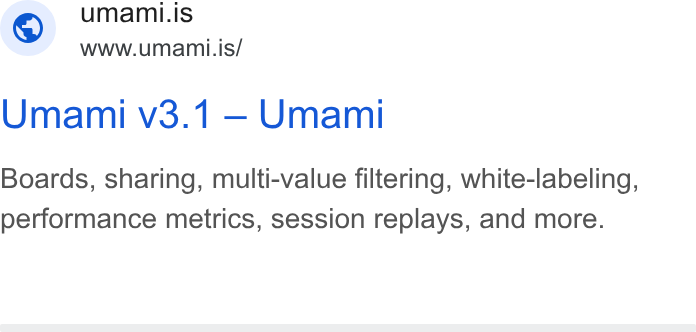
- Running
- 21 days (longevity = it's converting)
- Hook
- umami.is www.umami.is/ Umami v3.1 – Umami
- Audience
- The technical terms like 'multi-value filtering', 'performance metrics', and 'session replays' indicate a target audience of developers, product managers, or data analysts who use analytics tools.
Why it works. Announce a new product version with a concise list of new features to inform existing users and attract new ones interested in advanced analytics capabilities.
Displaying the product name and version prominently: "Umami v3.1 – Umami" When announcing a product update, clearly state the product name and version number at the top of your ad creative to immediately convey relevance to your audience.
07 The playbook
The channels are not separate. They are one system where each stage feeds the next. Here is the read, then the plays to run tomorrow.
The inferred playbook
The loop starts on Hacker News and the open-source repo, converts through free self-hosting, and monetizes only the fraction who'd rather not run their own infrastructure.
self-hosting is free forever, which removes the CAC from the top of the funnel entirely, GitHub stars and HN resubmissions do the awareness work instead of ads.
Umami Cloud runs a free Hobby tier (100k events/month, 3 sites) and a single $20/month Pro tier (1M events/month, unlimited sites), with custom Enterprise pricing above that, a simple two-step ladder rather than a multi-tier price list.
Dig deeper+3▾
each new HN resubmission and third-party integration guide adds to the repo's credibility, which makes the next resubmission more likely to land, a slow but self-reinforcing loop rather than a one-time spike.
there's no visible owned-content or SEO program, no personal-audience build-in-public engine given the founder's 666-follower account, and no funding beyond the 2022 pre-seed round in evidence, so paid and personal-brand acceleration levers both sit unused. Public revenue figures aren't available; given the $20/month Cloud price point and ~410K monthly visits, a rough order-of-magnitude estimate would put monthly revenue in the low tens of thousands of dollars, not a verified figure.
the self-host-to-Cloud conversion rate, the Hobby-to-Pro upgrade rate on Umami Cloud, and current MRR or subscriber counts.
Open-source the utility, don't rely on your own launch post
The proofMike Cao's own Show HN pulled 10 points, but a third party's repost the next day hit 820 points, and the same pitch resurfaced on Hacker News in 2021, 2022, and 2025 without any coordinated relaunch.
The adaptationif you're building a developer tool, put a plain "X, a self-hosted alternative to Y" framing in your README and make the repo genuinely useful to run, then let strangers find and resubmit it rather than treating your own launch post as the only shot. Start by writing that one-line positioning statement into your README so anyone who stumbles on the repo can resubmit it in your own words.
Cost: $0 · Time to signal: months · Works pre-PMF: yes, provided the tool solves a real, common problem well enough that a stranger wants to vouch for it.
Make your product easy for someone else to write about
The proofUmami's discovery keeps compounding through content it didn't produce, a Docker Compose guide, a Cloudflare/Fly/Supabase deployment walkthrough, and a third-party SDK that lists Umami as a supported provider alongside Plausible and GA4.
The adaptationship a copy-pasteable deploy snippet (a Docker Compose file, a one-command install script) and keep your API stable enough that a third party can build an adapter without asking permission, then when you spot someone's guide or integration post, reply in the thread to add credibility. First step: publish a minimal deploy snippet in your README this week that a stranger could paste directly into their own blog post.
Cost: $0 · Time to signal: weeks to months · Works pre-PMF: yes, conditional on the product actually being self-hostable or embeddable enough for outsiders to build on.
Bid on your own brand name from a personal ad account
The proofUmami's only active Google ad, running 22 days as of 2026-07-29, is bought under the founder's own name rather than a corporate media-buyer account, a lightweight brand-term defense, not a demand-gen campaign.
The adaptationonce your product has a name worth protecting in search, run a single low-budget text ad on your exact brand term plus close misspellings from your own ad account, mirroring the founder-run, single-ad approach here rather than building out a media team. Start with one $5-10/day exact-match brand campaign and expand only once you see it converting.
Cost: under $500 · Time to signal: days · Works pre-PMF: conditional, only useful once competitors or directories are already outranking you on your own name.
Ask your integration question in the subreddit where your users already are
The proofthe founder's Reddit activity is a direct technical question in r/sveltejs asking how the community integrates Umami with SvelteKit, framed as participation rather than promotion.
The adaptationfind the 2-3 subreddits where your specific use case gets discussed (a framework sub, a self-hosted sub) and post a genuine technical question about your own tool's integration rather than an announcement, since a question invites replies while a launch post invites scrolling past. First step: post one specific "how are people doing X with my tool" question in the single most relevant subreddit this week.
Cost: $0 · Time to signal: days · Works pre-PMF: yes. Not transferable at an earlier stage: the multi-year Hacker News rediscovery cadence took years of accumulated GitHub credibility to build and can't be manufactured on demand, a reader with a brand-new repo shouldn't expect the same repost-to-front-page odds until the tool has earned real word of mouth on its own.
You just read how umami does it. Tomorrow it is someone else.
Every morning we take one company that is actually growing and break down where its customers come from: the ads still running after a year, the channel doing the real work, and the play you can run this week.
Systemaic · directional intelligence. Traffic, spend, and reach figures are SimilarWeb-style estimates and qualitative reads of public data, not audited numbers. Built on real public receipts.
// teardowns with a similar GTM motion
sources & receipts (19)
Live ad libraries: google ad library
Launch archives: Hacker News: Umami: Self-hosted open-source alternative to Google Analyti · Hacker News: Umami is a simple, fast, privacy-focused alternative to Goog · Hacker News: Umami – An alternative to Google Analytics · Hacker News: It's the Umami – Why the Truth About MSG is So Easy to Swall · Hacker News: The man who discovered umami · Hacker News: An MSG Convert Visits the High Church of Umami
Researched facts: Umami raised a pre-seed funding round: $1.5 million, led by Race Capital, announced July 1 · Race Capital partner explained the investment thesis and named the founders: Alfred Chuang · Mike Cao built the first version of Umami in about a month: Documented by the founder hims · Umami Cloud simplified its pricing to a single plan: $20/month for 1 million events; self- · Umami's official pricing philosophy: Usage-based pricing for Umami Cloud, starting free an · Umami v3 major release: Launched November 6, 2025, with a redesigned interface, segments, · Umami Software, Inc. company profile: Tracked as a privately held web analytics company; U
Community threads: LowEndTalk forum: A self-hoster raves about switching to Umami for a personal analytics se · LowEndTalk forum: In a separate 2026 self-hosted-analytics thread, a user defends Umami as · Hacker News: On the original 2020 Show HN launch thread, an early tester reports the live · Hacker News: A 2022 HN thread debating Umami vs. Plausible lands on open-source competitiv · Personal tech blog (discussed on Hacker News): A developer who ran Matomo for a decade exp
Traffic, spend, and revenue figures are estimates as noted in the report; the links above are the primary public artifacts.