- 01Monetize inbound DMs before you have a product.
- 02Reinvest into one hyper-narrow first SKU.
- 03Seed creators with product and a partner tag, not a media budget.
- 04Sample in person where your exact buyer already gathers.
01 Snapshot
The one-glance read on who they are and how they grow. Each point is verifiable from the receipts above.
A women's-health supplement brand (greens powder, creatine gummies, collagen, and a newer Bloom Pop prebiotic soda) sold on bloomnu.com and through Target, Walmart, Sam's Club, GNC, Ulta, and Amazon.
Creator-led, powered by an in-house influencer network, with a founder-led origin story as the original spark.
An estimated 504,522 monthly visits (+44.6% over the last 3 months), 728,399 Instagram followers, and roughly 14 active Meta ads alongside a Google search ad active since 2021.
Mari Llewellyn sold a $5 workout PDF over Instagram DMs via PayPal before Bloom existed, then hand-packed the first resistance bands from her father's house (source).
As of 2026-07-03, Google search-ad tests are pushing new text copy for the Bloom Sparkling Energy soda line, leading with a 4.9-star rating callout rather than the brand's usual "Made by Women for Women" positioning.
The compounding asset is not paid media, it is an in-house creator network that manufactured category demand and then converted it into free, #1-ranked branded search for every core SKU page.
02 How it unfolded
The order the channels came online. Sequence is strategy: what they did first, and what they layered on once demand existed.
03 Traffic & channel mix
Estimated demand, the channel split behind it, and the keywords and referrers doing the work. Directional modeling, not audited analytics.
Traffic sources
Top search keywords
| Keyword | Volume | Weight | CPC |
|---|---|---|---|
| bloom | 264k | $0.62 | |
| bloom nutrition | 55k | $0.59 | |
| bloom drink | 12k | $0.43 | |
| bloom energy drink | 18k | $0.59 | |
| creatine gummies | 35k | $1.73 |
Bloom pulls an estimated 504,522 monthly visits, up 44.6% over the last 3 months. The mix is dominated by search organic (60.9%), direct (18%), and referrals (8.2%), with the remainder, paid search (6%), display (3.7%), email, organic social, and a sliver of Gen AI referral traffic, totaling under 11%. That 18% direct share lines up with interview claims of an omni-channel retail footprint of 50,000+ doors (source): shoppers who already know the brand from a Target or Walmart shelf go straight to the URL instead of searching. The company ranks or bids on its own name and category terms rather than generic fitness keywords: "bloom" pulls 263,600 monthly searches, "bloom nutrition" 54,940, and "creatine gummies" 35,230, demand it is capturing rather than creating from scratch. No individual referrer or competitor domains were captured at meaningful share in this pull.
04 Organic content
The specific pages earning their organic search traffic, and the pattern behind why they rank. Adapt the format, not the topic.
The top five organic pages are all product detail pages, not blog content: the Sparkling Energy soda page alone accounts for 34.4% of tracked organic traffic, ahead of the homepage (33.7%), Greens & Superfoods (12.7%), Creatine Gummies (5.3%), and Bloom Pop (4.3%). Each of those pages ranks #1 for its own category term ("bloom energy drink," "bloom greens," "creatine gummies"), which means the SEO strategy is category-keyword-targeted product pages standing in for what other brands would build as comparison or how-to content. That structure lets a single new SKU launch (the soda) become the single biggest organic earner within one page, rather than requiring a content library to build authority.
Top pages by organic traffic
05 Channel map
Not traffic share. How much weight the growth system actually puts on each channel, with a one-line read on the role it plays.
What drove growth
06 The creative doing the work
Each exhibit shows the actual asset, an X-ray of why it works, a status, and a play you can adapt. This is the heart of the teardown.
As of 2026-07-03, Bloom runs an estimated 14-ad Meta library and 19 total Google ads (5 active), a modest paid footprint that matches Greg LaVecchia's account that in-house influencer marketing consumes 85%+ of marketing spend, with under 5% going to Meta (source).
- Running
- 22 days (longevity = it's converting)
- Hook
- "exclusive welcome offer" text over a dark green background with a split-screen showing product tubs on the left and a frother/bottle on the right.
- CTA / offer
- Two free gifts (frother and water bottle) valued at $28.98 total with first-time orders over $40.
- Audience
- Women interested in fitness and supplementation, indicated by the product mix (collagen, greens, pre-workout) and the pastel/clean aesthetic.
Why it works. Build-your-own-bundle format anchored with a free gift to lower first-purchase friction for new customers assembling their own stack.
Visualizing the 'Choose' vs 'Receive' dynamic (0:00-0:08). Let first-time buyers pick from a fixed product menu and anchor a free gift next to their selection to raise perceived deal value.
- Running
- 1712 days (longevity = it's converting)
- Hook
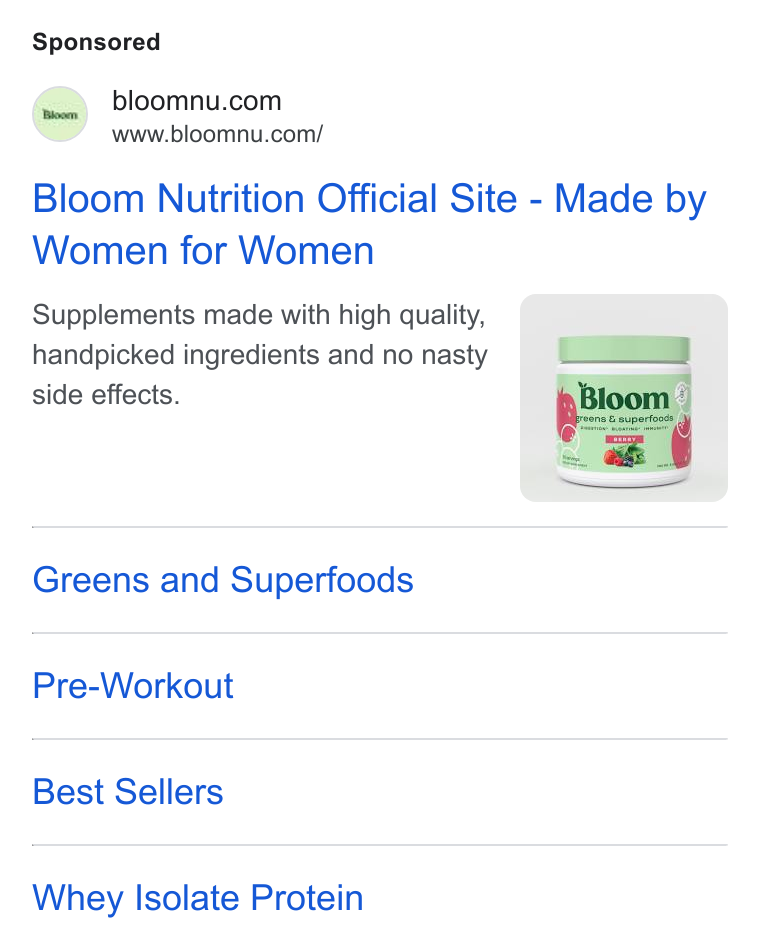
- Sponsored bloomnu.com www.bloomnu.com/ Bloom Nutrition Official Site - Made by Women for Women. Visual: A small circular logo with 'Bloom' in green text on a light green background, next to the text.
- Audience
- Women interested in health supplements, indicated by 'Made by Women for Women' and product categories like 'Greens and Superfoods', 'Pre-Workout', 'Best Sellers', and 'Whey Isolate Protein'.
Why it works. Uses a 'made by women for women' identity claim in the search headline to win clicks from women scanning generic supplement results.
Headline with identity-based claim: 'Bloom Nutrition Official Site - Made by Women for Women' If your founding team's identity matches your buyer's, state that match directly in your search ad headline.
- Running
- 197 days (longevity = it's converting)
- Hook
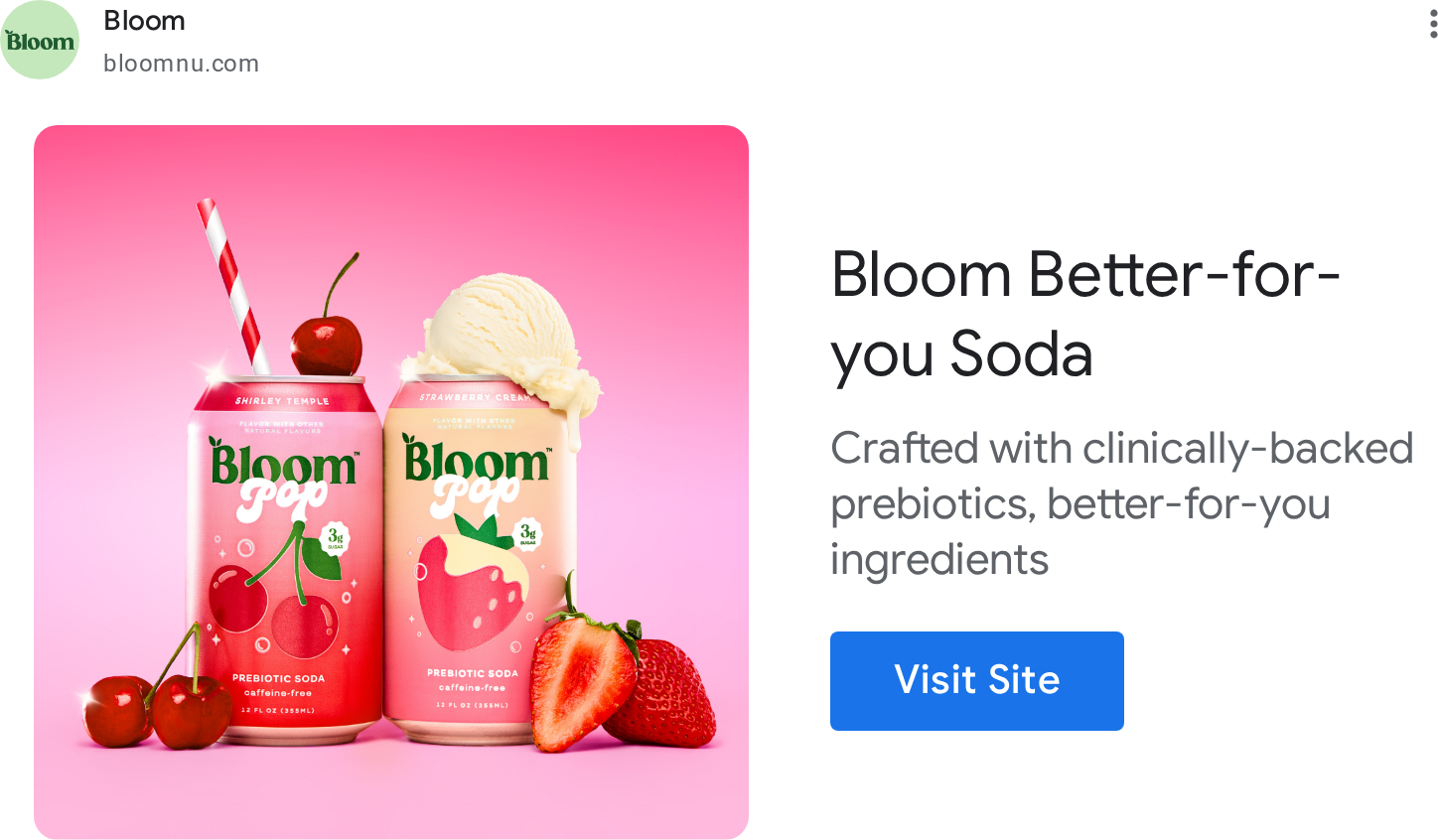
- Visual: Two cans of 'Bloom Pop' soda, one red (Shirley Temple) and one peach (Strawberry Cream), with cherries, strawberries, and a scoop of vanilla ice cream. Text: "Bloom Better-for-you Soda"
- CTA / offer
- Visit Site
- Audience
- Individuals interested in healthier beverage options, specifically those looking for prebiotics and lower sugar content, indicated by "Better-for-you Soda", "prebiotics", and "3g SUGAR" on the cans.
Why it works. Shows cans styled with real fruit and ice cream alongside a 'better-for-you' label, selling indulgence and health in the same shot.
Visual presentation of product and ingredients: The image shows two 'Bloom Pop' soda cans with fresh cherries, strawberries, and a scoop of vanilla ice cream on top of one can. Style your product like the indulgent version of its category, with a one-line reframe claim over the image.
Show 7 more exhibits
- Running
- 305 days (longevity = it's converting)
- Hook
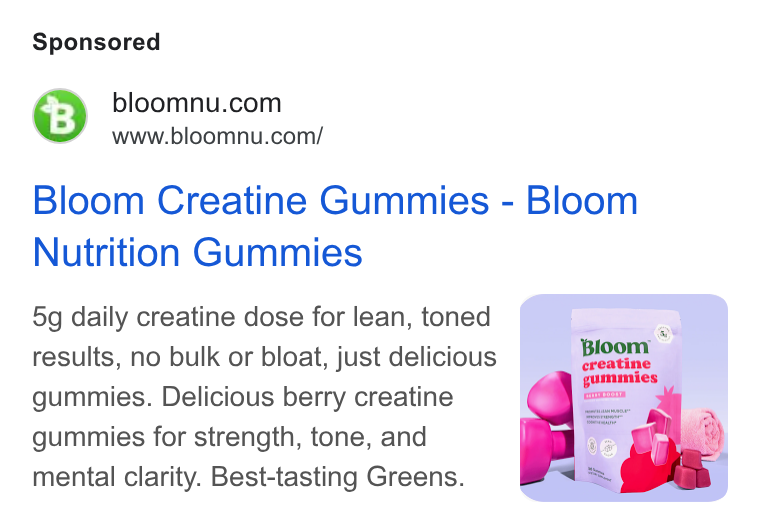
- Sponsored bloomnu.com www.bloomnu.com/ Bloom Creatine Gummies - Bloom Nutrition Gummies
- Audience
- Individuals interested in fitness, muscle development, and cognitive enhancement, specifically those who prefer supplements in gummy form or are looking for a 'no bulk or bloat' option. The mention of 'Best-tasting Greens' also suggests an audience interested in general wellness.
Why it works. Names the exact product format, creatine gummies, in the headline so only shoppers already searching that format click through.
Headline clearly states the product: "Bloom Creatine Gummies - Bloom Nutrition Gummies". Name your product format explicitly in the headline to pre-qualify clicks before they cost you anything.
- Running
- 221 days (longevity = it's converting)
- Hook
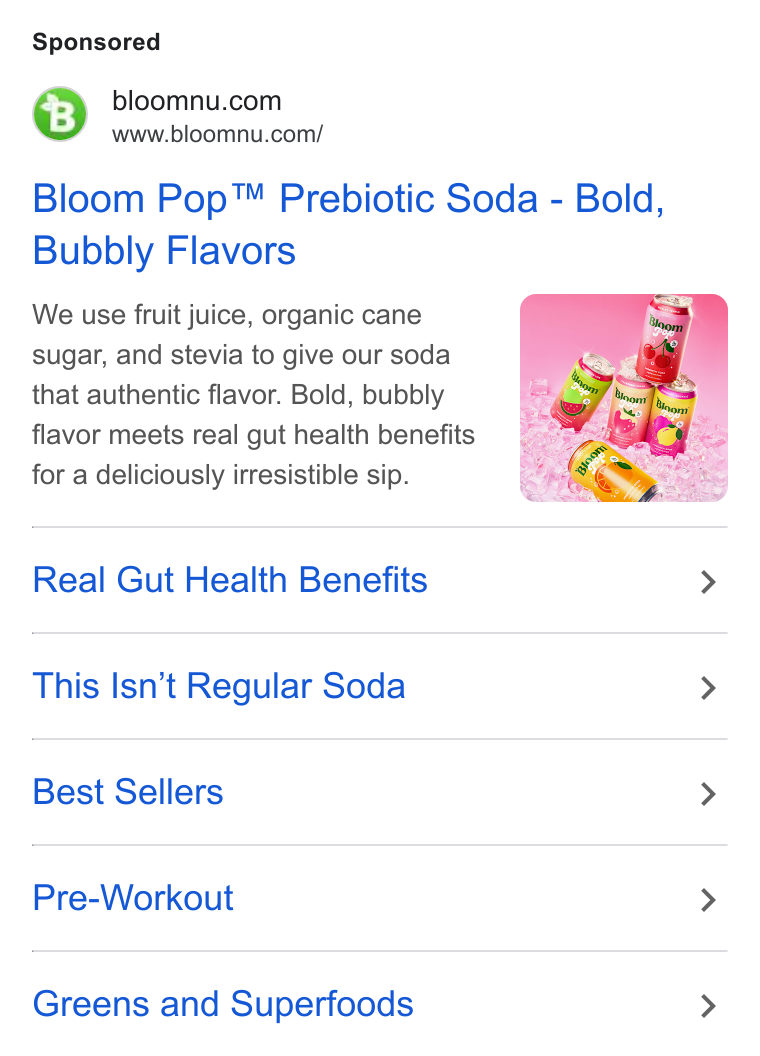
- Sponsored bloomnu.com www.bloomnu.com/ Bloom Pop™ Prebiotic Soda - Bold, Bubbly Flavors We use fruit juice, organic cane sugar, and stevia to give our soda that authentic flavor. Bold, bubbly flavor meets real gut health benefits for a deliciously irresistible sip.
- Audience
- Individuals interested in health and wellness, specifically gut health and alternative beverages, indicated by phrases like 'Prebiotic Soda', 'real gut health benefits', 'This Isn't Regular Soda', 'Pre-Workout', and 'Greens and Superfoods'.
Why it works. Introduces a new soda line by naming the trademark and flavor promise together, differentiating it from regular soda for gut-health searchers.
Headline with unique product claim: 'Bloom Pop™ Prebiotic Soda - Bold, Bubbly Flavors' When launching a new product line, put the trademarked name and its single best sensory claim in the same headline.
- Running
- 152 days (longevity = it's converting)
- Hook
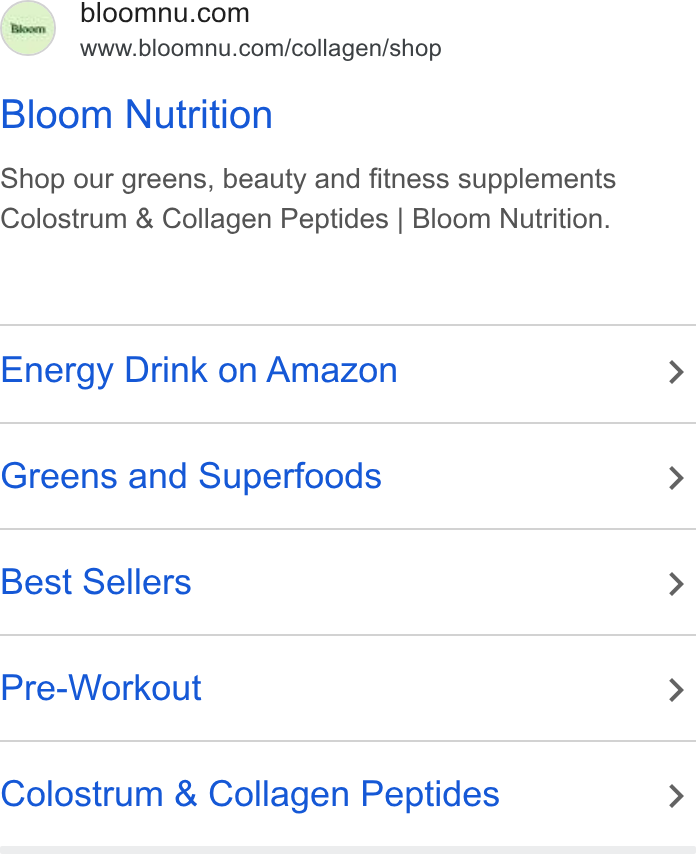
- bloomnu.com www.bloomnu.com/collagen/shop Bloom Nutrition Shop our greens, beauty and fitness supplements Colostrum & Collagen Peptides | Bloom Nutrition.
- Audience
- Individuals interested in health and fitness supplements, specifically those looking for 'greens', 'beauty', 'energy drinks', 'pre-workout', and 'colostrum & collagen peptides', as indicated by the listed categories.
Why it works. Uses a category-spanning headline to catch searchers before they've settled on a specific product, then routes them to the collagen page.
Displaying a clear brand name and website URL at the top, followed by a concise product description: "Bloom Nutrition Shop our greens, beauty and fitness supplements Colostrum & Collagen Peptides | Bloom Nutrition." If you sell across several categories, list them by name in one line before narrowing to the specific page you're driving to.
- Hook
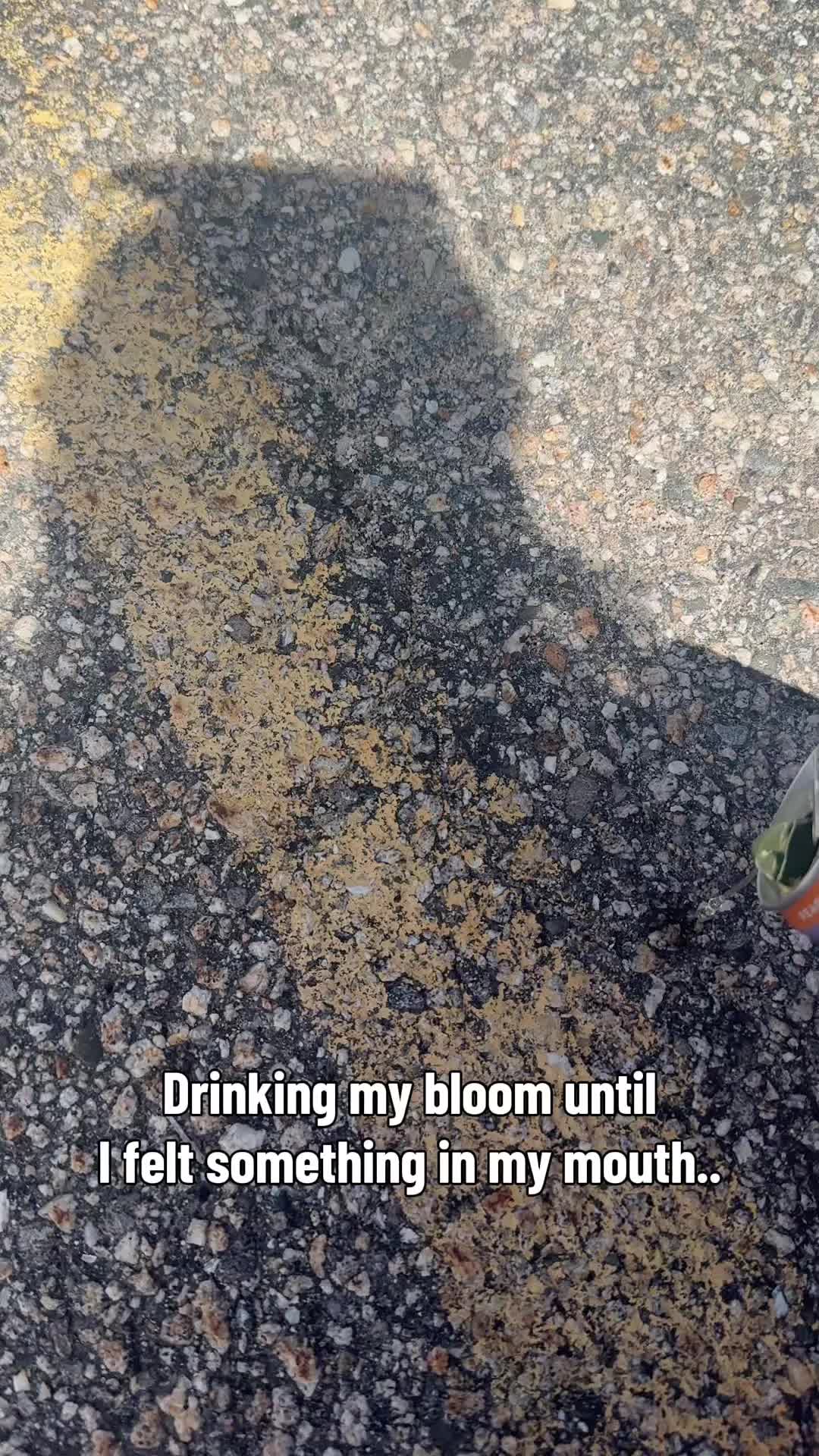
- "Drinking my bloom until I felt something in my mouth.." A hand holding a purple and orange can pours a green liquid onto a dark, pebbled surface. The liquid foams and spreads.
- Audience
- Individuals interested in health drinks or 'Bloom' brand products, indicated by the product name on the can and in the on-screen text.
Why it works. Uses a mid-drink shock beat to force a rewatch, betting the reveal is harmless enough to boost shares without hurting trust in the greens powder.
Opening with a personal anecdote and a visual reveal of a foreign object at 0:00-0:06, with the text "Drinking my bloom until I felt something in my mouth..". Interrupt a routine, everyday action with an unexplained physical sensation on screen, then hold the reveal for a few seconds before resolving it.
UGC product demo
- Hook
- Visual: A woman in a white sports bra and white pants with red and black stripes is looking up and moving her head to the music. Audio: Music starts playing.
- Audience
- Individuals interested in fitness and health supplements, indicated by the gym setting, workout attire, and product usage.
Why it works. Opens on movement and music with the product close-up rather than dialogue, betting on visual energy to signal the fitness fit before any claim is made.
Product reveal and close-up at 0:01-0:03 and 0:09-0:21, showing the 'Bloom' container and its contents. Try opening on physical movement with music alone, no dialogue, to establish tone before you introduce a claim.
- Reach
- 78 upvotes · 16 comments · r/gymsnark
A community is already discussing this in r/gymsnark. Show up there authentically and answer the thread before a competitor does.
Who amplifies them
The #bloompartner tag is the connective thread across dozens of creators, spanning wellness/lifestyle accounts (Katie Kat, Moore Money Moves, Alli Rezny, McKenzie Wren) and dedicated TikTok Shop sellers listing actual product bundles (introvertedforce, JessRKaz, nachoandthechip). A dietitian account (stephgrassodietitian) posted a third-party product review, adding a credibility layer beyond lifestyle creators. Founder Mari Llewellyn appeared as a guest on an outside podcast (karagoldin's show), distinct from the brand's own @bloomsupps account and from creator/affiliate posts. One post under the handle arianagrande also referenced the brand, though its modest 502 engagement here suggests it functioned more as a passing mention than a coordinated placement.
07 Organic & video
The organic content engine: the videos, creator posts, and community presence earning attention without paid spend.
Creator content dramatically outperforms the brand's own TikTok posting: JustKass's "First time ever doing one of these" post pulled 227,928 engagement under #bloompartner, Ky's "what is this in my drink?" clip pulled 115,496, and Katie Kat's hydration-sticks post pulled 85,650, plus a dozen smaller creator posts in the 500-36,000 engagement range. By contrast, the brand's own official TikTok posts (tagged #bloom #bloomnutrition directly from the house account) sit around 208 engagement each. The format that performs is creator talking-head and product-demo UGC tagged as a partner post, not brand-produced content; on Instagram, the owned account's 4,414 average engagement per post is respectable but is not where the outsized numbers live.
08 Affiliate & partners
How the brand turns creators and partners into a tracked, variable-cost acquisition channel, and how the program is structured.
No standalone affiliate-program link surfaced on the homepage (only social profile links to Instagram, LinkedIn, and TikTok). But the recurring #bloompartner tag across a dozen-plus creators and live TikTok Shop listings from named sellers show a real creator-affiliate motion running through TikTok's native commerce layer rather than a site-hosted referral program.
09 In their own words
Pulled from interviews and community sessions. The quotes are the angle; the takeaway is what to do with it.
How Mari Llewellyn Lost 90 Pounds & Transformed Her Life Through Dedication & Healthy Habits ↗The Bossticks · 269k views · 53 min▶ View source“I was not an active social media user during my journey... it was really just for me... at the end of the nine months I had this transformation photo that I thought was cool and I showed Greg and he was like oh you should for sure post that like everyone will freak out... and I ended up putting it up and it blew up... I was getting DMs, it was getting reposted on bigger pages, I was getting all these comments people asking me for my workout plan, my meal plan, and I think that's when something went off mostly in Greg's head, he's super entrepreneurial and business-minded”
Expand
Mari Llewellyn's growth started as an unplanned byproduct of posting one transformation photo, which went viral and generated inbound demand (DMs asking for her workout/meal plan) that she and her partner Greg then monetized step by step: a $5 PDF sold manually via DMs and PayPal, reinvested into a physical product (resistance bands) hand-packed and shipped from her dad's house, and finally reinvested again into formulating and launching Bloom Nutrition after identifying an underserved niche (supplements for women that weren't intimidating or 'masculine'). The PDF guide business was later relaunched as the Slay app.
“After this rush of interest we ended up creating a workout PDF, just me and Greg put together all the exercises I was doing on my journey, sold it for five dollars, we were manually emailing it to people, so in my DMs I'd be like do you want to check out my workout plan, they would PayPal me five dollars and I would email them the PDF”
“We saved all that money and put that into resistance bands, that was my first ever physical product, Mari Fitness resistance bands... we hand packed and shipped them out of my dad's house”
“I felt like there was this hole in the market for a supplement that was amazing for women, not intimidating, friendly, tasted good, and Greg is super passionate about supplements, so after saving all this money from selling these bands... we put all of that capital into Bloom Nutrition”
“All of 2018 we were sampling pre-workouts trying to find something that wasn't triggering my anxiety... we launched January 2019 with three pre-workout flavors, from there we added protein, greens, greens are our best seller now... and they came out right around the pandemic which worked out very well. Mari Fitness has now become the Slay app, so we took our PDF guides and turned it into an app”
Let a genuine personal transformation story (not a polished marketing asset) be the first piece of content, since authentic before/after proof generated organic virality and inbound demand without any paid push.
Monetize inbound demand immediately with the cheapest possible product (a $5 PDF sold manually via DM and PayPal) before building any infrastructure, to validate willingness to pay.
Reinvest early product revenue into a physical product step, rather than raising capital, funding resistance bands entirely from PDF sales.
Find the underserved niche within your own audience's pain point (women intimidated by masculine, caffeine-heavy supplement branding) and build the supplement to solve that specific unmet need.
Evolve the original low-cost content product (PDF guides) into a higher-value recurring product (the Slay app) once the audience and brand are established.
$500M of Brand Building Advice in 65 Minutes w/ Greg Lavecchia ↗Sweat Equity and Greg Lav · 70k views · 66 min3rd-party breakdown▶ View source“Within 24 hours, we did 1.36 million in sales... That's really what put us on the map. That's what really helped us bootstrap Bloom to 180 million with no investors whatsoever.”
Expand
The breakdown frames Bloom's growth as brand-building, not performance-marketing: it started as founder Mari's organic influencer content, converted that following into a scrappy DM-based guide business, then launched Bloom as a standalone brand (deliberately not named after Mari) that broke out via an unplanned viral hero SKU (the greens powder) and an in-house, comeup-influencer-focused marketing engine. From there Bloom used its existing DTC community to bootstrap dominance on Amazon and retail without paid-ad dependency, scaling to $180M with no outside investment.
“We used all of the direct to consumer marketing tactics, whether that was influencer, email, text message, our Instagram organic following, and we said, 'Now go buy us on Amazon.' And what ended up happening is we quickly became... the fastest growing brand on Amazon.”
“One of my favorite tactics... find someone on their comeup. Don't find someone when they're already at the peak of their fame and they're charging way too much.”
“We never deliver like an actual or at least a tight brief or script on exactly what we want you to say... we want you to represent Bloom if you're willing to.”
“Whenever I see a brand today launch on Amazon or launch at Target, they might have success out of the gate, but if the DNA of that brand success is performance marketing, they're not going to be able to bring that over to an omni channel operation.”
Build the founder's personal following first (organic content + a small paid boost to grow followers via lookalike audiences), then spin off a separate brand name early to avoid key-man risk.
Recruit influencers who are 'on the comeup' rather than already peaked and expensive, use one macro/authoritative influencer to set the trend, then let micro-influencers ride that wave organically.
Give influencers no script or brief; let them integrate the product into their own content style to preserve trust and authenticity.
Publicly broadcast concrete proof-of-demand numbers (sold out X times, ranked #5 at Walmart, units sold) as a core credibility/social-proof brand-building tactic, not just a vanity stat.
When launching on new channels (Amazon, retail), leverage the existing owned community (email, text, organic social) to drive initial sales velocity instead of relying on paid-ad/pixel-dependent acquisition, which doesn't transfer to omnichannel.
How to Build a Brand that Sells Out Before It Launches ft. Greg Lavecchia ↗THE 505 PODCAST and Greg Lav · 41k views · 110 min3rd-party breakdown▶ Listen“Restocked is the strongest word in all of marketing and I don't think it's used enough. It's way stronger than any type of discount.”
Expand
The breakdown frames Bloom's growth as a decade-long compounding of founder-led community building: it started by redirecting performance-marketing traffic to a personal Instagram following rather than a store, then converted that following into an outrageously niche first product, then used its own community and an in-house influencer network to force validity signals (become #1 on Amazon, then Target) before finally using a strategic partnership with Nutrabolt/Dr. Pepper to leap into retail distribution.
“The product is absolutely the number one priority... we always pinch ourselves and say the liquid is what matters most.”
“Going after a small dream or a small goal takes the same amount of resources and stress and effort as a massive goal, so you might as well go after the massive one.”
“I think that's how so many brands need to launch today is you need to go after such a small niche of a community that you can make sure you speak to directly.”
“We realized we needed to go enter a larger sales channel... start to try to bring all of our external traffic to Amazon and therefore kind of get like a total SEO advantage and kind of climb the ranks there.”
“We built quite a substantial network of being able to collaborate essentially buy ad space on these meme pages and just create a massive top of funnel of consumers.”
“There's an issue with your product, dog... if they're not coming back, that's an issue with your product.”
Launch into an outrageously narrow niche that's too small for incumbents to bother with, then expand outward once you own it.
Treat retention as the real signal of product quality: if performance marketing is acquiring customers who don't return, fix the product before optimizing acquisition further.
Build owned/organic community channels (personal brand, influencer relationships) before layering paid acquisition on top, using paid spend to amplify existing pull rather than manufacture it from scratch.
Redirect community and traffic toward high-authority sales channels (Amazon, then major retailers) deliberately to earn validity/ranking signals, not just direct-to-consumer revenue.
Avoid discounting price; instead reinvest that margin into over-delivering value (bonus content, useful branded accessories) to build loyalty without training customers to expect markdowns.
Bring in a strategic partner who has already solved a hard, adjacent problem (e.g., beverage manufacturing/distribution) rather than spending years learning it yourself.
Build influencer/creator relationship management in-house rather than relying on agencies, so it becomes a proprietary, scalable asset.
How Bloom Built the Playbook Every Founder Will Copy in 2026 ↗Open Residency and Greg Lav · 24k views · 128 min3rd-party breakdown▶ View source“Less than 5% of marketing spend is on meta, 85 plus% on influencer.”
Expand
Bloom's growth was built almost entirely on an in-house, agency-free influencer program (85%+ of marketing spend, less than 5% on Meta) that treats CPM efficiency and top-of-funnel reach as the goal rather than direct attribution, layered on top of aggressive omni-channel retail distribution (50,000+ doors) so consumers can convert wherever they encounter the brand. The breakdown frames Bloom's edge as operational discipline (never fixing what isn't broken, cutting the same wheel better) combined with deep community listening that drives product expansion into ever-larger TAMs.
“We've never done an affiliate code. We've never done a coupon code. And the reason for that is cuz we never optimized for Shopify. So, we're an omni channel operation.”
“The best way to start is just cut that CPM in half that you're getting on Meta. And that should be your goal for the influencer program... we've had CPMs that are below $2 for months at a time.”
“If you get 150 people at your event trying the blueberry lemonade and 135 of them love it, that is enough evidence... to press the button.”
“Every problem in your business is probably a product problem: if you're having an acquisition problem, your product isn't appealing to anybody; if you're having a retention problem, they bought it once and don't want to keep buying it.”
Build an in-house scouting-to-management influencer pipeline (scouts -> relationship managers -> director) rather than outsourcing to an agency, and use varied VPN locations/devices so scouts see different algorithmic feeds and find influencers outside their own bubble.
Set influencer CPM targets by halving your Meta CPM baseline, and adjust the price down further if an influencer's audience doesn't match your target demo (geography, gender, etc.) based on their trailing 10 videos' average views.
Give creators full creative freedom with just the product and light guidelines instead of scripted briefs, since algorithmically-favored content requires authentic delivery.
Skip attribution/coupon-code obsession for top-of-funnel brand campaigns when you're an omni-channel (retail + digital) business; use proxy signals like correlated Amazon search spikes instead.
Validate new products with small in-person sample tests (an N of 50-150 real ICP consumers) rather than large-scale syndicated data or trusting vocal online comment sections, which can mislead (e.g., the failed vegan protein launch driven by a loud but tiny online minority).
10 The playbook
The channels are not separate. They are one system where each stage feeds the next. Here is the read, then the plays to run tomorrow.
The inferred playbook
Bloom's loop starts with founder-story content, gets amplified by an in-house creator network operating largely outside paid media, and converts through omni-channel retail and branded search that the creator activity itself seeded.
Mari Llewellyn's viral transformation post generated inbound DMs that were monetized manually as a $5 PDF before any company existed, then reinvested step by step into a standalone brand deliberately not named after her (source, source).
per Greg LaVecchia, the majority of marketing effort runs through an owned, agency-free influencer program rather than Meta spend, which the modest ~14-ad live Meta library and TikTok Shop seller activity both corroborate (source).
Dig deeper+3▾
interviews describe forcing validity signals, #1 on Amazon, then Target, then Walmart (source), while on-site Subscribe & Save (10% off plus free shipping) and bundles like a Gut Health & Beauty Duo at $49.99 versus $69.99 list push average order value up without any free tier, a paid, subscription-discount model rather than freemium.
each core SKU page ranks #1 for its own category term, letting product pages themselves absorb category search demand instead of routing traffic through a content library.
creator-program commission structure, Subscribe & Save retention rate, blended CAC, and the DTC-versus-wholesale revenue split.
Monetize inbound DMs before you have a product.
Mari Llewellyn sold a $5 workout PDF over Instagram DMs via PayPal before Bloom existed as a company. If your own content is already drawing "how do I do this" questions, package the answer as a paid PDF or short guide and sell it manually through a payment link in your DMs, no storefront required, to prove people will pay before you build anything.
Cost: $0 · Time to signal: days · Works pre-PMF: yes
Reinvest into one hyper-narrow first SKU.
Bloom's earliest physical product was hand-packed resistance bands shipped from a home address, a deliberately narrow niche rather than a broad catalog. Pick the single narrowest problem your existing audience is already asking about, fulfill the first batch yourself, and let that margin fund the next step instead of raising money or building a full line up front.
Cost: $ · Time to signal: weeks · Works pre-PMF: yes
Seed creators with product and a partner tag, not a media budget.
Bloom's #bloompartner tag runs across dozens of creators and live TikTok Shop listings rather than paid ad placements. Send free product to 10-20 micro-creators in your niche with a unique trackable link or code and ask for one honest post; this only compounds with volume over time, one video will not move the needle, so treat it as an ongoing seeding motion, not a one-off.
Cost: $ · Time to signal: weeks · Works pre-PMF: yes
Sample in person where your exact buyer already gathers.
A Reddit mention shows Bloom staff handing out free samples on a college campus, an in-person, guerrilla tactic distinct from its current retail-scale distribution. Pick one physical venue where your ICP clusters (a gym, a meetup, a coworking space), hand out samples for a day, and drive people to a simple landing page or redemption code, cheap real-world signal before spending on ads.
Cost: $ · Time to signal: days · Works pre-PMF: yes
Build a dedicated landing page per category term instead of one homepage.
Bloom's Sparkling Energy product page alone earns more organic traffic than its homepage because it targets its own category keyword directly. Build one page per core offer, each written and titled around the exact category term your buyer searches, rather than routing all traffic to a generic homepage; ranking #1 takes time, but the one-page-per-term structure can be built immediately.
Cost: $0 · Time to signal: months · Works pre-PMF: yes What isn't transferable at an earlier stage: the omni-channel push into Target, Walmart, Sam's Club, GNC, and Ulta, the roughly $210M in outside investment from Nutrabolt, and a 728,399-follower brand account all assume distribution leverage a pre-revenue founder does not yet have.
You just read how Bloom Nutrition does it. Tomorrow it is someone else.
Every morning we take one company that is actually growing and break down where its customers come from: the ads still running after a year, the channel doing the real work, and the play you can run this week.
Systemaic · directional intelligence. Traffic, spend, and reach figures are SimilarWeb-style estimates and qualitative reads of public data, not audited numbers. Built on real public receipts.
// teardowns with a similar GTM motion
sources & receipts (9)
Live ad libraries: meta ad library · linkedin ad library · google ad library
Founder interviews: How Mari Llewellyn Lost 90 Pounds & Transformed Her Life Through Dedic · $500M of Brand Building Advice in 65 Minutes w/ Greg Lavecchia · How to Build a Brand that Sells Out Before It Launches ft. Greg Lavecc · Mari Llewellyn On Borderline Personality Disorder, Emotional Trauma an · How Bloom Built the Playbook Every Founder Will Copy in 2026 · Building a Billion Dollar Business (Co-Founder of Bloom) | Greg LaVecc
Traffic, spend, and revenue figures are estimates as noted in the report; the links above are the primary public artifacts.