- 01Sequence your product line so the fastest-proof SKU launches first
- 02Recruit category practitioners as content creators, not just lifestyle influencers
- 03Set up "running low" DPAs timed to your average reorder window
- 04Design a branded challenge with a named time horizon to turn single creator posts into serialized content
01 Snapshot
The one-glance read on who they are and how they grow. Each point is verifiable from the receipts above.
Plant-based hair wellness serums, supplements, shampoos, and conditioners targeting women experiencing hair thinning and shedding, sold DTC at $49–$160 per product (GRO Hair Serum at $49–$64, kits at $99–$160, subscriptions at a discount) and through 400+ Sephora US stores, drawing an estimated 677,718 monthly visits trending up 41.6% over the last 3 months.
Paid-led at scale, with display and paid search accounting for over half of all traffic, layered with a systematic creator-UGC program on TikTok and Instagram.
$80M raised from General Atlantic (2021), reported $90M+ in annual revenue that year with an estimated $100M+ by 2022-2023, a third-party 2025 DTC-site-only revenue estimate of approximately $22M (likely understating total by excluding Sephora retail), 420,956 Instagram followers, and approximately 600 Google ads in library with 139 active as of 2026-07-02.
Vegamour built a paid acquisition machine anchored on a single emotionally loaded problem (visible hair thinning), made the economics work through a subscription model and a reported 60% repeat-customer base, and extended reach cheaply by building a creator-challenge structure that turns one influencer relationship into multiple serialized posts.
02 How it unfolded
The order the channels came online. Sequence is strategy: what they did first, and what they layered on once demand existed.
03 Traffic & channel mix
Estimated demand, the channel split behind it, and the keywords and referrers doing the work. Directional modeling, not audited analytics.
Traffic sources
Top search keywords
| Keyword | Volume | Weight | CPC |
|---|---|---|---|
| vegamour | 13k | $1.76 | |
| vegamore | 950 | $1.82 | |
| vegamour gro hair serum | 2.3k | $1.79 | |
| vegamour lash serum | 770 | $1.96 | |
| hair growth serum | 20k | $1.13 |
Top referring sites
Closest competitors by audience
Vegamour draws an estimated 677,718 monthly visits, up 41.6% over the last 3 months. The channel breakdown: Display Ads 29.6%, Search Paid 22.5%, Direct 16.5%, Search Organic 14.9%, Email 6.8%, Social Paid 2.9%, Affiliate 2.7%, Referrals 2.1%, Social Organic 1.4%, Gen AI 0.7%.
Display and paid search together account for 52.1% of all traffic, a rate that makes this one of the more aggressively paid DTC brands in the beauty space. The 29.6% display share, roughly 200,000 visits per month from prospecting placements, is unusually large for a hair wellness brand and reflects the capital put to work after the 2021 raise. Direct at 16.5% and email at 6.8% are the retention signals underneath: they indicate genuine brand recognition and a functioning subscription layer that multiplies the value of paid acquisition.
Organic at 14.9% is almost entirely branded intent: every top-ranking keyword is a branded term, meaning organic captures demand already created by paid and creator channels rather than building an independent content moat. Top search terms include the brand name "vegamour" (12,670 total monthly web searches for that term), the product query "vegamour gro hair serum" (2,330 searches/mo across the web), and the competitive category term "hair growth serum" (20,240 searches/mo across the web), the high-intent non-branded bucket they are likely bidding into aggressively. Top referring domains are force.com, gethookd.ai, and railway.app. Closest audience-overlap competitors are nutrafol.com, prose.com, olaplex.com, livingproof.com, and keranique.com.
04 Organic content
The specific pages earning their organic search traffic, and the pattern behind why they rank. Adapt the format, not the topic.
Vegamour's top organic pages are branded product pages: the homepage, the GRO Hair Serum page, the GRO+ Advanced Hair Serum page, the GRO Revitalizing Shampoo page, and the GRO Lash Serum page. They rank #1 for every branded term they target (vegamour, vegamour gro hair serum, vegamour hair serum, vegamour shampoo, vegamour gro revitalizing shampoo). The site has a blog, but blog pages do not appear among the top organic traffic drivers. The pattern is pure brand-capture SEO: a direct product-page strategy that wins search share for buyers who already know the brand name, rather than editorial content that creates new demand from unbranded hair-loss queries.
The practical read is that organic traffic here grows as a downstream effect of paid and creator brand-building, not as an independent channel. Every organic visit to a product page represents a buyer whose first exposure almost certainly came through a paid display or search ad, or through a creator post, and who then searched the brand by name before clicking through.
Top pages by organic traffic
05 Channel map
Not traffic share. How much weight the growth system actually puts on each channel, with a one-line read on the role it plays.
What drove growth
06 The creative doing the work
Each exhibit shows the actual asset, an X-ray of why it works, a status, and a play you can adapt. This is the heart of the teardown.
Google runs approximately 600 total ads in its library, with 139 active as of 2026-07-02, anchored by text search ads running since October 2021. On Meta, a sampled library shows dozens of active ads across DPA, DCO, and video formats running simultaneously across six placements: Facebook, Instagram, Audience Network, Messenger, WhatsApp, and Threads.
- Running
- 45 days (longevity = it's converting)
- Hook
- "1 Hair Serum Sold Every 15 Seconds*" with a close-up of a clear glass dropper releasing a single drop of serum into a bottle.
- CTA / offer
- "Try It Today"
- Audience
- Women in their 30s or those who use hair extensions and are experiencing "thinning or shedding".
Why it works. Leads with a specific, footnoted sales-rate statistic as proof, letting purchase volume argue for the product before any ingredient claim appears.
Velocity-Based Social Proof (0:00 - "1 Hair Serum Sold Every 15 Seconds*") If you have a real sales-velocity stat, footnote it and lead your ad with that number instead of a generic bestseller claim.
- Running
- 45 days (longevity = it's converting)
- Hook
- "Stop Settling For Breakage" text overlay on a close-up of hands lathering shampoo into wet hair.
- CTA / offer
- "Start Your Hair Wellness® Journey"
- Audience
- Individuals with damaged or thinning hair, indicated by the text "Breakage", "Dryness", and "Weak Strands".
Why it works. Applies the brand's 'stop settling' framework to breakage specifically, timed over a hair-washing visual so problem and moment line up.
Problem-stacking hook (0:00-0:06) Reuse a 'Stop settling for X' headline across products in your line, swapping in each product's specific pain point.
- Running
- 45 days (longevity = it's converting)
- Hook
- "The secret to seeing less hair in your brush" + close-up of a heart-shaped, sugar-coated orange gummy held between fingers.
- Audience
- People experiencing hair shedding or thinning who are looking for an easy, supplement-based solution ("seeing less hair in your brush").
Why it works. Meta ad that opens on a common shedding anxiety, hair in the brush, before revealing a gummy as the unexpected fix, pulling in viewers who self-identify with the problem.
Curiosity-driven hook at 0:00: "The secret to seeing less hair in your brush" Open with the exact physical moment your customer dreads, a stat, a stain, a mess, before revealing your product as the fix.
Show 7 more exhibits
- Running
- 45 days (longevity = it's converting)
- Hook
- "Stop Settling For Surface-level Results" text over a macro close-up of a heart-shaped, sugar-coated orange gummy.
- Audience
- Individuals seeking 'hair wellness' and 'hair and nails' support who are dissatisfied with 'inconsistent results'.
Why it works. Opens by disqualifying the outcomes competitors deliver, positioning the supplement for people who already tried other products and were let down.
Macro sensory visuals (0:00, 0:17) showing the sugar-coated texture of the gummy. List the 2-3 specific ways your category typically disappoints customers as on-screen text before you mention your product.
- Running
- 22 days (longevity = it's converting)
- Hook
- "I didn't switch my shampoo for fun." + A woman in a black tank top running her hands through her long brown hair in a bathroom.
- Audience
- Women with thinning, frizzy, or damaged hair ("ends don't look desperate anymore", "so much fuller").
Why it works. UGC testimonial that opens on an unfinished, confessional sentence, borrowing the pattern of real personal storytelling to earn trust before the pitch for GRO shampoo and conditioner.
Emotional Agitation Hook (0:03 - "my hair was embarrassing me") Open your UGC script with a half-finished, confessional sentence about a personal decision, and let the product reveal complete the thought.
- Running
- 22 days (longevity = it's converting)
- Hook
- "I struggle with" spoken while the creator touches her hairline and holds a pink bottle.
- Audience
- Women with curly or wavy hair who are concerned about hairline density and styling unruly edges.
Why it works. A creator opens by naming her own hair concern before showing the dropper bottle, using first-person testimony to build trust before the pitch.
Problem-Agitation Hook (0:00 - 'I struggle with fullness around the hairline') Have your UGC talent name their specific hair concern out loud in the first line, before the product is ever shown.
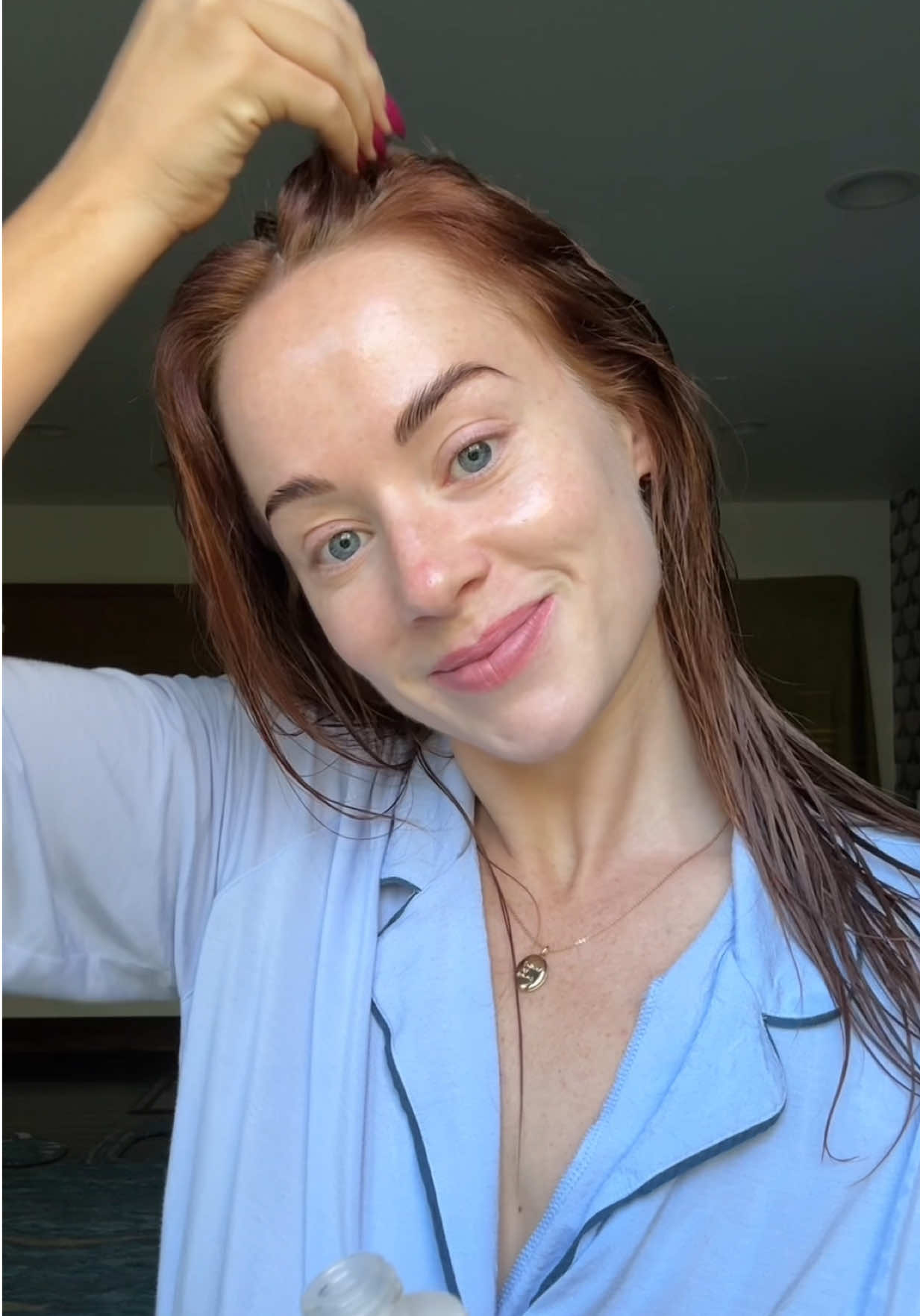
- Hook
- "There has been a lot of talk lately on the Whitney glow up." A woman with long, wet, reddish-brown hair and a light blue pajama top is speaking directly to the camera, gesturing with her right hand.
- Audience
- Women experiencing hair thinning or postpartum hair loss, as evidenced by the creator's personal story about "postpartum hair loss" and the product claims of tackling "thinning" and restoring "density."
Why it works. TikTok UGC that opens like insider gossip about a real person's transformation, letting the hair-growth reveal land as payoff to an established storyline rather than a cold pitch.
Personal before-and-after visual proof (0:06-0:08): "This is before and this is now." Open your UGC script by referencing your subject's transformation as if it's already being talked about, then use the video to explain what everyone's discussing.

- Hook
- "I very much like Vegamour and am thus very intrigued by their Derma Roller which was created for scalp stimulation." A woman with white hair wrapped in a white towel holds a white case with a gold derma roller inside.
- Audience
- The video targets older women experiencing hair thinning and shedding, as evidenced by the age of the woman in the video and her explicit mention of her hair thinning.
Why it works. UGC review from an older demographic that names the exact tool and its clinical purpose immediately, targeting viewers evaluating hair tools for age-related thinning.
Demonstration of product use and results (0:03-0:09, 0:13-0:19, 0:22-0:30) Have your reviewer name the specific product and its stated mechanism in the first line, so viewers know exactly what's being tested before the demo.

- Hook
- "Do you see the growth?" A woman's face is shown close-up, with her finger pointing to her hairline, revealing new hair growth.
- Audience
- Individuals experiencing hair thinning or hair loss along their hairline, especially those with conditions like seborrheic dermatitis, as indicated by the user's personal experience and product application.
Why it works. A UGC creator points to her own hairline on camera, turning the viewer into a judge of visible results rather than a passive listener.
Direct problem identification and solution introduction (0:02-0:05, "I have seborrheic dermatitis along my hairline, which is where my hair is the thinnest. Which is why I wanted to try this Vegamour growing serum just to see if it can help build the density there.") Have a real user point directly at the exact spot on their body where the change happened while asking viewers to confirm what they see.
- Reach
- 38 upvotes · 33 comments · r/FemaleHairLoss
A community is already discussing this in r/FemaleHairLoss. Show up there authentically and answer the thread before a competitor does.
Who amplifies them
Vegamour's creator layer operates under a structured partnership framework (#vegamourpartner, #vegamourchallenge) that is distinct from paid media. The challenge template commits creators to a multi-post narrative anchored to a hair goal and a time horizon, generating repeat audience touchpoints per relationship.
Named creators and their handles:
- Whitney Leavitt (@Whitney Leavitt on TikTok, @whitleavitt on Instagram): Hair-transformation content with 103,496 TikTok and 11,342 Instagram engagements on Vegamour-tagged posts, consistently co-tagging @sephora.
- Colleen Heidemann (@Colleen Heidemann on TikTok, @colleen_heidemann on Instagram): Lifestyle creator whose Vegamour posts hit 75,708 TikTok and 35,219 Instagram engagements, with timing coordinated to a Sephora savings event.
- @brianna_ruth_ (TikTok and Instagram): Beauty creator focused on hairline growth from a gifted post; 51,820 TikTok engagements.
- @oliviaolfactory (TikTok and Instagram): "Honest thoughts" format on the full Vegamour system; 8,025 TikTok and 6,144 Instagram engagements.
- @claire_elisabeth (TikTok): Vegamour partner challenge targeting hair thinning from multiple angles; 7,791 engagements.
- Hailey Polk (@Hailey Polk on TikTok): "My hair saviors" post co-tagging @sephora; 7,135 engagements.
- @hctmofficial (TikTok): Sephora-affiliated creator demonstrating GRO+ Advanced Hair Serum alongside a dermaroller as a scalp stimulation routine; 1,722 engagements.
- @destineewray (Instagram): 90-day hair reset series using the full GRO system (serum, biotin gummies, dermaroller, shampoo, conditioner); 3,018 engagements.
- Audrina Patridge (@audrinapatridge on Instagram): Television personality; "Obsessed with how @vegamour GRO Serum has transformed my hair, stronger, thicker, and healthier with every drop" - 2,431 engagements.
- @dermatologysurgeon (Instagram): A dermatology surgeon account featuring GRO+ Advanced Hair Serum in a clinical hair-shedding context, adding a practitioner credibility signal alongside the consumer UGC layer; 1,915 engagements.
The creator network consistently bridges DTC and Sephora retail by co-tagging both @VEGAMOUR and @sephora, reinforcing both purchase channels from the same post and generating in-store traffic signals that matter to the retail buyer.
07 Organic & video
The organic content engine: the videos, creator posts, and community presence earning attention without paid spend.
Vegamour's brand YouTube channel mixes educational explainers (causes of hair loss in women, CBD and hair growth, PRP treatment, scalp detox), ingredient demos, and customer before/afters. The GRO AGELESS Anti-Gray Hair Serum product video is the breakout performer at 2M+ views from a 31-second format. Most branded videos land in the 3,000-30,000 view range, and the channel functions as a credibility and evergreen-reference layer rather than a primary acquisition engine.
Read the full breakdown+4▾
The real organic video volume runs through creator-led TikTok and Instagram content. Posts tagged #vegamourpartner and #vegamourchallenge consistently outperform brand-owned output:
- Whitney Leavitt (@Whitney Leavitt on TikTok): "If you're looking for a hair glow up @VEGAMOUR is the move," co-tagged with @sephora - 103,496 engagements.
- Colleen Heidemann (@Colleen Heidemann on TikTok): "So much gratitude, @VEGAMOUR, for a hair wellness routine that I truly believe is going to make a difference," timed to a Sephora savings event - 75,708 TikTok engagements and 35,219 on the parallel Instagram post at @colleen_heidemann.
- @brianna_ruth_ (TikTok): "I can't wait to see how much more my hair fills in," a gifted post - 51,820 engagements.
The format that consistently performs is a progress-journey update: the creator declares a 90-day hair reset or challenge, shows the product entering their routine in an opening post, and returns with mid-point check-ins and a final result reveal. This creates a serialized content loop that re-engages the creator's audience across multiple posts from a single partnership, rather than yielding one impression from one placement.
08 Affiliate & partners
How the brand turns creators and partners into a tracked, variable-cost acquisition channel, and how the program is structured.
The traffic data shows an affiliate channel at 2.7% of monthly visits, a functioning third-party referral layer estimated at approximately 18,000 visits per month at current scale. No named affiliate platform is visible in the scraped evidence, and no self-serve affiliate signup page or referral parameter pattern is detectable from public site links alone.
Read the full breakdown+3▾
The creator partnerships (#vegamourpartner) appear to operate as a gifted and paid influencer program rather than a commission-on-attributed-sale affiliate structure. Creators receive product and likely paid placement fees; no public evidence of revenue-share codes or tracked referral links appears in the creator content. This means third-party distribution is curated and brand-controlled rather than an open self-serve recruitment flywheel, which keeps brand and quality signal high but caps scale at what the brand's outreach team can actively manage.
Creator payout terms, program commission rates, and free-to-paid conversion rates are not visible in public data.
09 The playbook
The channels are not separate. They are one system where each stage feeds the next. Here is the read, then the plays to run tomorrow.
The inferred playbook
Vegamour runs a paid-first acquisition machine where display and search buy attention, creator UGC builds the trust to convert it, and subscriptions compound the unit economics to justify sustained high-CPM investment.
Display at 29.6% of all traffic is the primary prospecting lever, serving category-aware audiences before they signal explicit purchase intent via search. This is a high-CPM bet that requires meaningful subscriber LTV to justify, and the 60% repeat-customer base (per the brand's own reported figure) is the number that makes it viable. The subscription pricing structure, discounting the one-time price of $49–$64 on the GRO Hair Serum for recurring orders, is the mechanism that extends LTV long enough to amortize prospecting spend.
The #vegamourchallenge structure turns a single creator relationship into at least 2-4 posts: an announcement, a mid-point update, and a result reveal. A creator like Whitney Leavitt hitting 103,496 TikTok engagements represents reach that paid social would have cost significantly more to buy, and the Sephora co-tag in those posts doubles as a retail-channel signal that reinforces in-store velocity for the retail buyer.
Dig deeper+2▾
The longest-running active text ad at approximately 1,711 days is the highest-signal creative in the stack. Surviving 4+ years of budget reviews and A/B tests in a competitive auction means the messaging is provably profitable; no brand keeps a search creative running at cost for nearly five years.
Organic is 14.9% and almost entirely branded, with no editorial content moat around non-branded queries like "postpartum hair shedding" or "hair thinning after stress." If paid spend pauses, organic does not sustain the business. CAC, churn, and the DTC-to-subscription conversion rate are not visible in public data, so the unit economics behind the display-heavy model can only be inferred from the sustained scale and duration of investment. ---
Sequence your product line so the fastest-proof SKU launches first
The proofVegamour's earliest YouTube content, dating to 2017, is entirely lash and brow serum content. The GRO Hair Serum, which requires 90+ days to show meaningful density change, came later. Lash and brow results are visible in weeks, which means the brand generated a before/after content library and social proof loop from a faster-feedback product before the flagship hair product had documented results to show.
The adaptationIf your main product has a long proof window (a supplement, a coaching program, an analytics tool that takes months to accumulate signal), identify whether you have a complementary product or feature that produces a visible result within days to a few weeks. Launch that entry product first, document its results publicly through creator or customer content, and then introduce the flagship to an audience that already trusts your brand's ability to deliver outcomes. Start by mapping your full product portfolio against time-to-visible-result and identifying the fastest honest proof you can show. This works because conversion trust is built on demonstrated proof: an entry product with a short feedback loop generates social proof assets that de-risk the longer-commitment flagship purchase for every subsequent buyer who encounters the brand.
Recruit category practitioners as content creators, not just lifestyle influencers
The proofA dermatology surgeon account (@dermatologysurgeon on Instagram) posted about Vegamour's GRO+ Advanced Hair Serum in the context of a clinical hair-shedding routine, earning 1,915 engagements on a niche credentialed account. Separately, Vegamour's Meta ad copy explicitly states the serum was "developed with dermatologists" and is "loved by hair experts, dermatologists and thousands of women," a practitioner credibility signal that appears in both organic UGC and paid copy, suggesting the brand actively recruits or at minimum receives organic validation from clinical voices.
The adaptationIdentify 5-10 credentialed practitioners in your product's category (dermatologists for skincare, registered dietitians for nutrition products, physiotherapists for recovery tools) and gift them the product for educationalcontent about the problem your product solves, not a scripted endorsement. Practitioner-led posts earn disproportionate trust because the audience treats a clinician's mention as a clinical recommendation rather than an ad. Start by searching your category's top practitioners on TikTok or Instagram for those already posting educational content about the problem you solve, and reach out with product and a brief on the educational angle. This works because practitioner credibility is borrowed institutional authority: it reframes the product from a brand's claim to something professionals use or recommend, which collapses skepticism that consumer UGC alone cannot.
Set up "running low" DPAs timed to your average reorder window
The proofOne of Vegamour's longest-running Meta formats is a Dynamic Product Ad with the copy "Running low? Time to stock up on the Hair Wellness essentials your strands already love," active as of 2026-07-02. The ad dynamically surfaces the specific products a past buyer interacted with they are statistically likely to be approaching depletion.
The adaptationFor any consumable product (supplements, skincare, coffee, a credit-based software product), pull your average days-between-reorders from order history and set a DPA retargeting segment to fire at roughly 70-80% of that window. Write the hook as "running low on [product]?" and surface the exact SKU the customer last ordered. Include a subscription or bundle upgrade offer as the conversion goal, since the replenishment moment is the highest-intent window for a recurring purchase conversation. Start with your highest-LTV product line, test the timing window against your reorder data, and measure lift against your baseline reorder rate. This works because it catches buyers they are consciously aware of needing more, converting existing customers at a fraction of new-customer acquisition cost and at a higher conversion rate than cold prospecting.
Design a branded challenge with a named time horizon to turn single creator posts into serialized content
The proofVegamour's #vegamourchallenge template generates at minimum an intro post, a mid-point check-in, and a result reveal per creator relationship, rather than one placement fee for one post. Colleen Heidemann produced parallel posts on TikTok and Instagram within the same campaign window (75,708 TikTok and 35,219 Instagram engagements). Whitney Leavitt's challenge post reached 103,496 TikTok engagements. The serialized structure commits the creator to a multi-month narrative, compounding reach without proportionally compounding spend.
The adaptationDefine a challenge name tied to a specific, honest outcome claim and a named time horizon your product can genuinely deliver within (a 30-day strength build, a 60-day complexion reset, a 90-day density challenge). Brief 5-10 micro-creators in your target audience with a three-post template: commitment announcement, honest mid-point update, and final result reveal. Require consistent hashtag usage across all posts. Start by identifying creators who already post about the problem your product solves and whose audiences actively engage on progress-format content. This works because serialized progress content earns repeat audience touchpoints from a single creator relationship, compounding reach without proportional increase in spend. Caveat: this format requires a product with a genuine, visible result within the stated window. If results are inconsistent, mid-point and result posts become authentically negative, which amplifies in the opposite direction just as effectively.
Brief creators to co-tag retail partners during promotional windows
The proofMultiple Vegamour creator posts co-tag @sephora alongside @VEGAMOUR, including Colleen Heidemann's post timed explicitly to a Sephora savings event ("Perfect timing for the @sephora savings event from 10/31-11/10... I know my local store is surely going to be seeing me") and Hailey Polk's "My hair saviors @VEGAMOUR #vegamourpartner @sephora." The co-tagging pattern bridges the DTC creator audience to a physical retail purchase moment and signals to the retailer's algorithm that the brand's creator content is generating in-store consideration.
The adaptationIf you have retail distribution in any chain, coordinate your creator content calendar with the retailer's promotional calendar (savings events, seasonal planograms, end-cap placements) and explicitly brief creators to mention in-store availability and tag the retailer account. This converts creator audiences into store traffic, which matters to retail buyers who measure velocity per shelf facing, and it demonstrates active promotional partnership when pitching expanded distribution or new doors. Start by identifying your retail partner's key promotional dates for the next two quarters and building a creator brief around each event. Caveat: this play requires existing retail placement to execute; it is a lever for amplifying distribution you already have, not a path to securing it. This works because a creator directing their audience to a physical retail location adds a legitimacy signal that DTC-only brands cannot replicate, and because co-tagging the retailer multiplies content reach through the retailer's own discovery surfaces.
You just read how Vegamour does it. Tomorrow it is someone else.
Every morning we take one company that is actually growing and break down where its customers come from: the ads still running after a year, the channel doing the real work, and the play you can run this week.
Systemaic · directional intelligence. Traffic, spend, and reach figures are SimilarWeb-style estimates and qualitative reads of public data, not audited numbers. Built on real public receipts.
// teardowns with a similar GTM motion
sources & receipts (2)
Live ad libraries: meta ad library · google ad library
Traffic, spend, and revenue figures are estimates as noted in the report; the links above are the primary public artifacts.